Shadwell Stair

Halloween is a chance for us to note our fears.

I first wrote “celebrate” in that sentence, but revised it to ”note,” with musical pun intended.* I don’t think we actually celebrate fear on Halloween, but rather we play with it: pretend we don’t have it, pretend we can sport with it — though perhaps some connoisseurs roll the sense of it around on their tongue to absorb fear’s full body and taste. But in any of those ways, however obliquely, we are acknowledging it.

How close are we to our fears the rest of the year? I suppose that varies. Can we name them? Do we bother? Do our friends, our intimates, know them? Do we even speak of them to ourselves?

Today’s piece is based on a hard to explain poem by one of the most loved British “War Poets” who wrote of their experience of WWI, Wilfred Owen. Certainly that war’s trench warfare, mixing squalid contemplation and carnage, would offer enough horror to write about, and Owen’s WWI poetry is loved while not flinching from that horror or buffering it in patriotic bunting.

But then there’s this poem. It is not set on the front lines. If it mentions the war at all, it must be implied from knowing his biography.

Shadwell Stair is on the banks of the Thames River in urban London. In Owen’s early 20th century it was apparently a noisy, smelly industrial area. This blog post has numerous pictures, some history of the Stair, and the delicious trivia that it’s next to “Labour in Vain Street.”

As treasured as Owen’s bleak poetry is, Shadwell Stair  isn’t one of his best-known “Greatest Hits.” Its effective condensed portrait of the locale isn’t the most-read poem of that time and place in metaphor, being eclipsed by “The Waste Land’s”  bankside sections written by an American, T. S. Eliot. Those portions of Eliot’s poem are alienated, partly by the recent Great War, and partly by his own sense of an educated visitor weighing England’s and Europe’s history and culture against the grimy realities of the London he had settled in. Eliot’s “The Waste Land”  doesn’t actually name the fears in the center of it, but it conveys them in vivid and varied silhouettes. Arguably, Owen’s poem is more coy — if only by being brief — but let me make a case for it. Here’s a link to the text of Owen’s poem.

The first stanza introduces lovely word-music that the poem carries on throughout. It claims to be in the voice of a ghost. We may (I did) anticipate a classic Halloween poem. If we know Owen’s biography, we might think the slaughter-house there is a reference to the war. It may be, but I think the second stanza gives us a different context.

It’s a fleshy context. I can almost feel the goosebumps on the skin, and the speaker’s eyes are lit up in what? Fear? Anticipation? Heightened vigilance? If this be a ghost, it’s an embodied one.

The third stanza is almost all scene-setting, lit by snapping arc lamps evoked between interrupting night noises — those streetlights had a sensual, buzzing, almost reptilian sound that younger readers now may not have had the experience to hear. Of our mysterious speaker, it only says of themselves here that they are watching. OK, watching for what?

Later readers have given an understanding to the mystery here: Owen’s sexuality had a homoerotic element. In this reading, the speaker (presumably Owen) is cruising for a hookup, and it’s said that the disreputable docks and titular Stair were known sites to London’s homosexual demimonde. As with the harsh arc-lights, this context illuminates the poem. I see vividness in this reading, and no reason not to give it credence. Let’s consider then the situation evoked: here is a man, likely on leave from the immense horror of a war that was grinding men up with ineffective tactics in the face of modern lethality. Many Halloween readers here with holiday ease to play with fears would likely have no gauge to measure that — but what has his flesh firming, his skin puckered with cold plucked-chicken skin, his pupils dilated out round as the gems of Rilke’s absorbing cat from last time? Answer: the anticipation of sensual, carnal, sexual contact — intensified by a fear of police trolling for arrests, complicated in the doubts of attraction or rejection with disgust that strangers meeting in the night would encounter.

If so, the enigma of this poem has a specific — if unspoken — core, and the last stanza is an aubade of something even more transitory than the average parting of lovers at dawn. We started being told this is a ghost poem, and the ghost here meets another ghost. The ghosts here are metaphor for spirits that could barely speak of the eros of their lives. A silencing louder than bombs.

shadwell stair MS1

Here’s Owen’s poem in work-in-progress form, He seems struggling most with the 3rd stanza yet at this point.

.

Today’s music had two challenges for me. The setting I devised might benefit from a “real singer,” someone who could carry a melody with confidence and a beautiful timbre. I’m not that. I decided I could do no better than I can do. And then too, while I was pleased at what I could come up with feeding parts into my orchestra instrument arranger, and particularly with the high trumpet part that comes in near the end, I was never satisfied that I could get the best trumpet Virtual Instrument I own to have the correct envelope I wanted. There I just surrendered. No one with a “no-revenue” independent musical enterprise could expect to be able to present the full richness of the actual instrument. Those who can, will know I fell short — but the rest will, I hope, accept my approximation. You can hear my musical setting of Wilfred Owen’s “Shadwell Stair” with the audio player gadget below. Not even a ghost of such a player visible?  This highlighted link is an alternate way which will open a new tab with its own audio player.

.

*”Note…fears?” See that final paragraph today.

Fall 2017 Parlando Project Top 10

It’s time to report the most popular audio pieces posted here over this increasingly busy summer. Before I get to this season’s Top 10 countdown, I want to thank everyone who has listened, followed, liked, or shared our posts and audio pieces on social media or on other blogs. I don’t have time (or perhaps the talents) to do all the promotion that some other blogs do, so it’s the kind words and enthusiastic work that you readers/listeners do that has spread the news about this combination of various words with various music.

Lots of changes from our last Top 10, so let’s get started. There should be a player gadget after each piece on the list, so you can easily hear the audio combining those words with music we create and perform as part of the Parlando Project.

10th place? Turns out it’s a three-way tie for 10, and since the three pieces demonstrate the variety I seek to present here, let’s just dispense with tie-breakers and list all three audio pieces that are tied at number 10..

“Sonnet 18”
  is, so far, our only Shakespeare selection. Shakespeare is, or course, inescapable, and setting Shakespeare’s sonnets to music isn’t a rare thing either, but one of the good things that comes from the Shakespeare phenomenon is that a listener can hear a lot of different takes on one text. I choose to bring out the brag in this one.

A Summer’s Night”  uses a poem by Paul Laurence Dunbar, the first widely published Afro-American poet who died tragically young in 1906. A lot of Dunbar’s success during his lifetime was with dialect pieces which he had ambiguous feelings about. He sometimes said that he wished to be known more for his poetic work in standard English, something that “A Summer’s Night”  demonstrates.


“On the Troop Ship To Gallipoli”  demonstrates a small bit of artistic courage on my part to pay tribute to the real-world courage of Rupert Brooke, who died in service to his country in WWI. The “Great War” redrew the world’s maps, overturned several empires, and it also drew a literary dividing line, as post-war poetry embraced Modernism which made the poetic stylings of Brooke seem decades old only a few years after he wrote them. Those who lived through that time often adapted to the new ideas of modern poetry, but Brooke never had that chance. So, in this piece I recast a late fragment of Brooke’s words as if it was an Imagist poem.

In 9th place, we have “Zalka Peetruza (who was christened Lucy Jane),”  which uses a poem by journalist and poet Roy Dandridge, who coincidently like Dunbar, was another Ohio Afro-American. By evidence of this poem, Dandridge deserves to be better known than he is, as it’s a tart observation of the art of getting over while Black, in this case by passing one’s self off as exotic.

8th place goes to a bit of a surprise, my slightly Beefheartian musical setting of two sections of Gertrude Stein’s “Tender Buttons.”  Don VanVliet (Capt. Beefheart) and Gertrude Stein were both uncompromising artists who hoed their own rows, so I viscerally made the connection in creating this piece.

7th is Sir Walter Raleigh’s damning litany “The Lie.”  It’s a poem I’ve loved since my youth and I don’t think one has to add much musical vengeance to amplify Raleigh’s words. 400 years old, and still pissed off.

6th slot goes to one of my translations, Rainer Maria Rilke’s “The Dark Interval.”  I did this translation a few years ago, and it was intended to be a somewhat freer variation. As I learn more, I think my assumptions on what the poem was getting at were wrong, but this looser version got 20 more listens that it’s more literal translation I also presented here this summer.

Halfway to number 1, at number 5, is Parlando Project alternative reader Dave Moore’s tale “I Was Not Yet Awake.”  Dave also plays many of the keyboard parts you hear here, including the organ part on this.  “I Was Not Yet Awake”  is short for a story, but longer than many pieces we present here. Dave’s story is so well told that it still managed to pick up a lot of listens this summer.

At number 4, dropping down from two straight appearance as number 1, is “Frances,”  a teenaged George Washington’s acrostic love poem. That’s still a marvel, as week after week I look at stats and see that it’s still getting listens, long after its appearance here last February.

Top 3 time! In position 3 is “The Death of Apollinaire,”  my translation of Dada principal Tristian Tzara’s surprisingly sincere eulogy for the multi-national poet and critic Guillaume Apollinaire, who invented the term “Surrealism” and helped weave together many of the strands of European Modernism before he died from complications of wounds he suffered in WWI.

And in position #2, up one place from 3rd in the last Top 10, is Dave Moore enigmatic song “Love and Money.”  It may offer an American answer to the question the Beatles once asked in “Can’t Buy Me Love.”

adlestrop Station

“The steam hissed. Someone cleared his throat. No one left and no one came…”

Position number 1 is another return, and an even higher rise in the chart due to the large number of listens over this summer: “Adlestrop,”  British poet Edward Thomas’ famous moment on train platform on a hot June 24th 1914, were nothing much happens, but everything palpably is.

The poem portrays the train’s stop as unscheduled, but research into train schedules (see them here in this blog post at The National Archives) says otherwise. Adding this element was a conscious choice by Thomas.

It’s a much-loved poem for many reasons. Some find extra resonance in the lines describing calmness in the tiny village train stop, the literal calm before the storm of WWI, and that’s a fine thought for those that hold it, but I believe the poem exists beyond those associations. “Adelstop’s”  closing lines are sublime even without that particular war, that particular trauma to that specific nation, and as it was, to the ending of the life of its author Thomas, who became another of the poets killed in that war.

Strange Meeting

Here is one more war poem from WWI, this one by another soldier poet, Wilfred Owen.

Beside living with the trauma of his war service, Owen was another poet caught in the revolution as English poetry moved from old modes to newer modernist verse. Like his friend Siegfried Sassoon, he was a decorated soldier who came to broadly distrust the case for war. Unlike Sassoon, Owen did not take the risky public stand against the war while it was being fought; but also unlike Sassoon, his fate was to die at the front of the war. Owen’s war poetry was largely published after his death, with Sassoon’s assistance and promotion.

wilfred-owen

Wilfred Owen: poet, soldier, witness to warfare

If WWI was billed as the war to end all wars, the anti-war poetry Owen and Sassoon wrote also spoke to universal themes. At least to what I’ve read, their poetry is not an argument against specific issues of their war, rather it’s an angry argument against war itself, and the associated patriotic justifications for sacrifice. Owen and Sassoon both wanted to rub their readers faces in the bloodied mud of the trenches.
 
It’s sometimes said that artists, if only they would happen to suffer the real struggles of non-artistic life, would see that art is only a trivial sideshow, inessential entertainment and decoration. Men like Owen are an example of how this is not necessarily so.

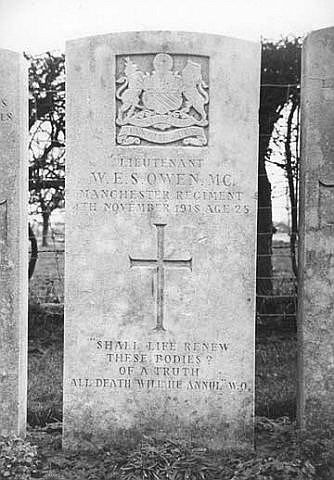
WilfredOwensGrave

Wilfred Owen’s gravestone

Today’s episode, “Strange Meeting,”  shows Owen’s anger, but because he’s a poet not yet fully in the 20th Century style, he expresses it sounding like a 19th Century poet, more like a Keats or early Yeats. As I came to grips with this piece, I felt the thought and subject matter was sometimes obscured by its march of rhymes and occasional poetic diction—and though a poem’s music is subjective, “Strange Meeting”  doesn’t consistently sing to me like Yeats does, but then Yeats is a very high standard to meet, and Yeats never lived the brutal fighting the war poets like Owen went through.

Speaking of music, I’m finding myself repeating ideas (or finding a style?) with the settings lately. “Strange Meeting”  starts with sustained piano chords, unsteady strings, and a plaintive wind instrument (in this case, an English horn). But I felt that carrying that all the way through would work against the grit and bitterness of the story here, just as Owen’s poetic diction does, so for much of the middle section I break it down to just drums and bass.

I hope I’m not overwhelming regular listeners with the war poetry from WWI this month. Perhaps I can find a change of pace soon, and some new variations in my musical arrangements too.

To hear my performance of Wilfred Owen’s WWI ghost story “Strange Meeting,”  use the player below.