I wanted to get another musical piece up this week as I was somewhat dissatisfied with my performance in my last one here for Armistice Day/Veterans Day. I looked a pieces I had near ready, and selected this one, by Anglo-Welsh poet Edward Thomas. Thomas is lesser-known in the United States, but is more recognized in Britain where he often gets grouped as a “War Poet.” The main reason for that: he volunteered and was killed in WWI, and some of his poetry speaks about his thoughts as he considered volunteering for overseas front-line service.
Sitting in America, which hasn’t regarded Thomas enough, I’d like to expand him a bit from behind that label. First off, like Wilfred Owen (another British poet filed under war poets, and another WWI casualty) Thomas was something of a beginning poet,* but like Owen his poetic voice is so strong it doesn’t need to apologize for being early days. As powerful as Owen’s poems about trench warfare are, I’m just as impressed by his home-front poem “Shadwell Stair.”And Thomas, this other “war poet,” seems not to have finished any poetry about his short front-lines experience before his death in that service. As we celebrate Veterans Day it would be good to remember that each person who served is not just their service.
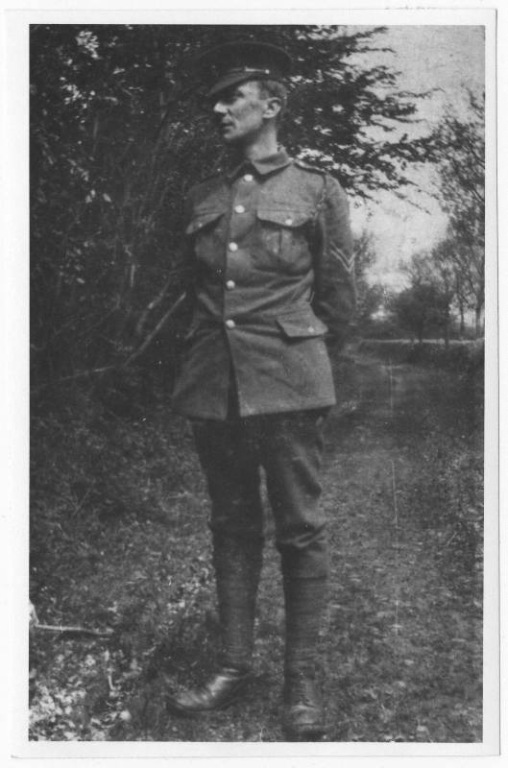
Edward Thomas in his uniform. He was married and past the age of most soldiers, but still volunteered.
.
So, here’s a poem that I think has nothing to do with the war directly – perhaps not indirectly either. “Like the Touch of Rain” seems to me to be a love (or rather a loss of love) poem, though the nature of the relationship is not spelled out.** It uses as its central symbol rainfall, and I suspect it’s speaking of erotic love because of the sensuous opening where the rain, however wild, is caressing the poem’s speaker and he sings and laughs here. The poem ends by telling us he’s now closed in, out of the rain, not by his choice but by some her’s “Go Now.” It’s a turn-about from the typical “Who’ll Stop the Rain” or “Shelter from the Storm” depiction of rain vs. shelter. Here’s a link to the text of the poem that I’ve now turned into a short song.
“Like a Touch of Rain” is not the most complex or virtuosic poem, but it also doesn’t detract from its depiction with any overreaching or stilted poetic diction. There’s a power in that. Reading Thomas’ contemporaries’ poetry in search of material for this Project I’ve read a great deal of published poetry that doesn’t escape those faults. My wife gave me a copy of Thomas’ collected poems a few years back – it’s not a thick volume, and I believe that most of the poems in it were first published in this collection posthumously through efforts of Thomas’ friends.***
After overreaching with my Padraic Colum poem setting earlier this week, and having to settle for an incomplete recording, it may behoove me to leave today’s piece as just voice and acoustic guitar accompaniment – and as rough-hewn as my voice is on this performance, I think it’s better too.
You can hear my performance of Edward Thomas’ “Like a Touch of Rain” with the audio player below. What, has the door to any such player gadget been shut? Well, this highlighted link will open a new tab with its own audio player.
**I have not read a full biography of Thomas, but before the war he seems to have had a complicated set of affections as well as bouts of depression and drug use. Those two things might cause one to suspect a ne’er-do-well life, but through-out that he wrote voluminous freelance reviews and essays to pay the bills for a young family.
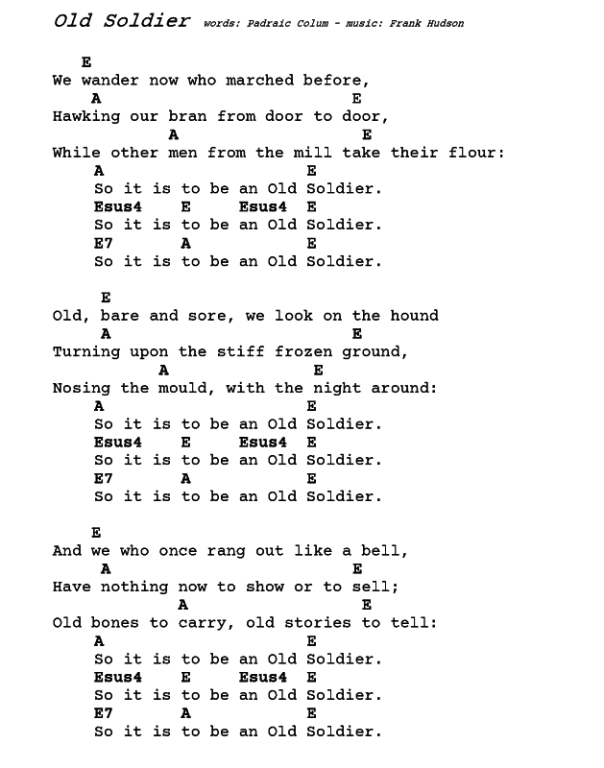
Today’s piece was created from a poem written by the Irish poet Padraic Colum. Colum was born in the 19th century, then traveled through the world of 20th Century Modernism, and lived on long enough to overlap my lifetime. Looking at the outlines of his life I am pleased to report that Colum connects a favorite of this Project, the undercelebrated Irish poet Joseph Campbell* and the American mythological theorist of the “Heroes’ Journey” also named Joseph Campbell. With the American Campbell, Colum connected because he was a folklorist as well as a poet, and he wrote several young adult and children’s collections of folk tales and retold myths which I’ve not yet read. With the former Campbell, besides being Irish literary revival contemporaries, he collected folk-songs.** Like that Irish Campbell, Colum’s best-known work today is arguably a folk song.
Long-time readers here may recall that the poet Campbell is likely responsible for the song “Reynardine” being sung in a version featuring a supernatural, shape-shifting lover. At around the same time, and for the same publisher of Irish folk songs, Colum collected/wrote the lyrics to the song “She Moved Through the Fair.” Why the slash notation on the authorship? There’s some controversy if Colum closely adapted a traditional set of lyrics, or largely wrote original lyrics to an existing tune. Colum claimed he wrote the lyrics, making use of only a few floating lines that are folk song ready-mades. The challenge to Colum’s authorship strikes me as highly suspect: it’s based on another collector writing in 1970 that he came across an old man who told him he’d learned it as a traditional song before Colum’s version was published in 1909.
I suspect there’s someone out there who can do a better job singing this song I created from Colum’s poem.
.
“She Moved Through the Fair” was included as a poem in Colum’s first poetry collection “The Wild Earth”*** which also includes today’s poem. I note that “Old Soldier” has some similarities with the lyrical methods of SMTtF: both use spare details and leave out a great deal. Some of what is implied in the two lyrics may have become more obscure to modern listeners. SMTtF very early on speaks of the singer’s “lack of kind” which uses a now archaic meaning of “kind,” meaning family. “Old Soldier” opens with the titular old soldier going door to door. Since “hawking” (a hawker is a street-seller) is used as a verb in the second line I thought at first he was peddling, but from what I can find, no one sold flour that way. I think he’s begging for bran, which was then the discarded part of the milling of flour. That waste part after the wheat was milled or boulted, was thrown out or used as animal feed, though apparently the poor sometimes made use of it for human consumption.**** In the second stanza we meet the old soldier’s only companion, a dog, and the bran the soldier has garnered may have gathered mold.
I don’t know if “Old Soldier” has been set to music before this, but it seems every bit as singable as “She Moved Through the Fair,” and as soon as I read it, I wanted to sing it. I decided to use an arrangement soaked in South Asian musical influences, perhaps due to the wonderous extended version of the SMTtF tune played by Davy Graham. That link above includes one of Graham’s recordings of it, as well as Anne Briggs wonderous acapella version. Oh, hell, here’s that link again, click it indeed if you haven’t heard the song Colum made. Last week I recorded the basic tracks singing and playing a tune I created for Colum’s poem using my guitar in an alternate tuning driving a sitar virtual instrument though a MIDI pickup. To this first pass, I added harmonium, tanpura, tabla drums, acoustic guitar, and a final vocal.
Every one of those overdubbed passes felt good as I played them (save for my vocals, I’m never happy with my vocals) but the result was a whole bunch of tracks that would require careful mixing so that the instruments blended well. I set about doing that, working until midnight when I figured I might have a piece to present and saved a complete mix down. Awaking the next morning, I listened again, and the result wasn’t just flawed, it was a mess. A useful question for one mixing a piece of music with various instruments in an ensemble like this is “What track is the focus of the piece?” My putative mix had no good answer for that. The voicings of the chords on the sitar and the guitar didn’t mesh well. The harmonium and the tanpura were fighting over the same part of the sonic spectrum despite my efforts to give them their own sonic space. The tablas didn’t mesh with the acoustic guitar’s rhythm.
The wise solution would be to just re-track the piece. Maybe I should have more particularly considered that Davy Graham had made his impressive version of a Colum poem/song with only a solo acoustic guitar. But I would not have another opportunity to record with a sensitive open mic until this week, too late for Veteran’s Day. So last night I went to work stripping back the crud of my failed mix, leaving mostly the acoustic guitar and the vocal, with the tanpura and then the harmonium coming in for later parts of the song in turn. It’s not an ideal recording, but it’s my hope it lets one consider “Old Soldier” as song today.
The more palatable version can be heard with the audio player below. The song itself is simple, and the remixed arrangement that builds a bit as the song continues serves it better. You don’t see any audio player gadget? No, I didn’t remove that, it’s a side-effect of some ways of viewing this blog. I have a plan B for that too: this highlighted link that will open a new tab with its own audio player.
.
*Joseph Campbell, who also wrote under the name Seosamh MacCathmhaoil, was acquainted with the original London Imagist circle, and wrote what I think is some excellent short verse in the form. His life and literary career were brought low by siding with the losing side in the Irish Civil War.
**Given that I’ve been doing this project for a decade, the folklorest/singer/collector and poet is a combination near to my heart. Besides Colum and Campbell, two American poets from the same era, Carl Sandburg and Edwin Ford Piper did both things, and I’ve tried to briefly make the case that Sandburg should be more often cited as instrumental in connecting folk song with progressive politics and literary poetry in the United States, which eventually leads to the case of a Nobel laureate in Bob Dylan. Around the same time as all these others, elements of the “Harlem Renaissance” in Afro-American literature were open to melding folk song with high literature too (Fenton Johnson, Langston Hughes, Jean Toomer, Waring Cuney, Zora Neale Hurston).
I’m going to jump far afield before leaving this footnote: I’m writing this on the 50th anniversary of the release of the Patti Smith Group’s glorious debut LP Horses. The Patti Smith Group started because Smith, a poet personally immersed in colloquial music, a paramour of Fugs-adjacent musician/actor/playwright Sam Shepard, joined up with a guitarist/rock critic/crucial anthologist of garage bands Lenny Kaye, wanting to make unexpected poetry combined with electric guitar.
***Just when Colum’s The Wild Earth was published is unclear to me. My copy has a 1927 American printing of a 1922 edition. Wikipedia says “She Moved Through the Fair” was in a 1916 edition of the book, and then in their entry for Padraic Colum gives a 1907 date for the book.
****What, that’s the healthy part! Whole wheat! At the time the milled pure white flower was prized from making lighter baked goods and for a longer shelf life. The city I live in was growing rapidly at the time of this poem by finely milling the “Best” and the “Gold Medal” flour that had absolutely no bran or wheat germ at all.
A post today for a holiday with complications. In the UK, Canada, and the former Commonwealth, today is Remembrance Sunday and tomorrow is Remembrance Day. In my United States tomorrow is Veteran’s Day. Remembrance Sunday/Day is a bigger deal. Here in the U.S., it’s one of two holidays set aside to honor the armed forces,* and the Spring Memorial Day gets more observance. America moves it around as a Monday workday holiday, so it now rarely occurs on November 11th, the day it was originally meant to commemorate, Armistice Day, the day that WWI ended. In the American observance, the day and the moment being observed are no longer there as they happen to be this year.
But then, all the events of WWI have now passed out of the living’s remembrance, and WWII is entering the time of that leaving — while in England the wound and loss are still felt by a generation that themselves only recall the generations that personally experienced it.**
Historically, poets suffer, fight, and die in wars. Presently in the U.S. this may be less true than was traditionally so, our soldiering ranks now coming from a different cohort than those with MFA and workshop attendance. That too is complicated, and I’ll choose to honor your time today by not going into all of that. Yet I’ll maintain that the experiences of service to country, of organized protection and organized death, of comradeship and loneliness — these words of history aren’t so far away if we only open ourselves to listen to them.
Here are five poems for this complicated holiday that this Project has presented over the years. In honor of the UK preservation of the original reason for the holiday, four of them will be British to one American.
Gone, Gone Again (Blenheim Oranges)
British poet Edward Thomas is too little considered in the United States, but in the run-up to WWI this overworked and underpaid freelance writer started to expend his writing efforts to the least commercial of literary forms, poetry of individual honesty — urged in that endeavor by his expatriate American friend, Robert Frost. Frost left England for America as the war began and he asked his friend to follow him and emigrate to the United States.
Thomas didn’t accept his offer. In Britain Thomas is remembered as a War Poet, as one of the casualties of The Great War, but his poetry doesn’t speak of his trenchside times in the conflict — instead it sings with lovely precision and concision of the British countryside as he is making his decision to take the road well-traveled to enlist to the front. “Gone, Gone Again” is one of his masterful poetic verse-essays on this time of decision, as he observes an England depopulated of its workmen. Why did he go to the front? He explained it mostly as being unable to shake his patriotic connection to the very soil and experience of Britain that his poetry sings of, but I said today’s post would be about complications. Thomas was also a troubled soul, looking for meaning in his life not captured by certainty, and some have speculated that a soldier’s pay was a better economic offer for his family than his Grub Street freelancing. He packs every bit of that into this short poem.
.
Shadwell Stair
Wilfred Owen is another Brit who took up poetry in the context of serving in The Great War. He’s known for his scathing anti-war poems, which to Britain’s credit doesn’t keep him from being honored nationally as a War Poet. But here’s a lonely poem written on the banks of the river Thames, likely during the time he was back from the front being treated for what was then called “shell-shock.” Folks today can experience the poem in a context pointed out later, that the Shadwell Stair location was a gay cruising spot at that time. Historically, there’s a blindness in some eyes to see that not just that poets and artists serve, but that they aren’t all straight.
.
On the Troop Ship to Gallipoli
Rupert Brooke was a rising young poet before WWI started, and even at his young age, great things were predicted for him. Unlike Owen, his war poetry is conventionally heroic, conventionally patriotic. Unlike Thomas, he was under no economic pressure when he enlisted. Would that tone have continued, could he have written glorious battlefield odes, or would the war have turned him into a skeptical Modernist? In an irony that only the Fates could have woven, he was detailed to be part of the disastrous attempt to land at Gallipoli. While on the troop ship steaming there, he fell sick from what I’ve read was an infected insect bite, and died before reaching the deadly front.
I took a fragment Brooke composed on that fatal voyage, and audaciously decided to take a Modernist blue pencil to trim and rephrase it the way an Imagist might. That was a complicated act, one that I’m not sure I can justify, other than to say that I wanted Brooke’s moment on that troopship to stand out more vividly, riding roughshod over his verse to honor that.
.
The Cenotaph
I don’t believe there are any women on WWI War Poet plaques in Britain, but of course they were asked to and worked with the war effort, and were there to tend, mend, and mourn the casualties during and afterward. Here’s a complicated poem of mourning, written as the original Cenotaph*** was erected in London. Its author Charlotte Mew is another British poet little-known in America. From what I’ve read she was seen as eccentric by other artists of her time, and her poetry doesn’t fit easily into any movement or style. Every Remembrance observance in Britain to this day has a ceremony at the London Cenotaph where the current government pays solemn homage to the soldiers’ sacrifice. If I read Mew right, she’s the ghost-at-the-feast here, and has some particular wailing to do.
.
.
Grass
Lastly, for Remembrance Day, here’s the American — and non-more American than the child of immigrants Carl Sandburg. I would post his poem “Grass” every Memorial Day, every Veteran’s Day — and yes, even every Remembrance Day. Yet, this is a poem that sings about forgetting. Is forgetting wars, forgetting soldier’s service and sacrifice, a callous thing? Is forgetting the follies and cruelties of war dangerous ignorance? Is it better to forget wars than to suffer them forever in endless horror? Is forgetting just the way things are eventually, an erasing sigh that fades into new present days — as what humans do that humans can never fully comprehend?
Look, I said it was complicated.
.
*In the US, there’s fine print sometimes invoked to separate the two: Memorial Day for those who died in service, and Veteran’s Day to honor all that served. The UK Remembrance Day is more like American Memorial Day focused on wartime losses and sacrifice.
**Proportionate to population, the US casualties in WWI were much lower. And England’s cities suffered under bombs during WWII. I was going to write too about the World Wars and their effect on the British Empire and colonialism, and America sliding in as a replacement, but that subject is too big for any footnote.
***So great were the WWI deaths that logistics couldn’t see to repatriating all the bodies of British war dead back home, and unidentified dead and missing in action mysteries clouded the situation too. Regional cenotaph memorials, including a great one in the national capitol, would serve as a consolidated gravesite to lay flowers and visit in remembrance.
A great many countries have holidays honoring their nation’s soldiers, often with an emphasis on memorializing the dead of past wars. The United States has two such holidays, a Veteran’s Day on the date of the WWI Armistice and the one that arrives this weekend, Memorial Day.
Long time readers here will know I’ve presented a lot of soldier’s poems in this Project, and poems otherwise about wars. This is fitting, war as a poetic subject matter goes back to Homer and further.
Many soldiers’ poems are at least ambiguous about the worth of war, some are outright harrowing. But that’s poets. Outside of poetry, many in the US have developed a particular carefulness in speaking of our wars, a hesitancy to speak honestly about those ambiguities mixed with a deadened obligatory reverence for veterans — a reverence with no other required obligation or attention. Yet we have these two holidays.
Well, do we have such an obligation to remember the horrors of war and the hard-won realities the warriors helped enforce? Asked this way the answer is suggested: yes, we do. For this year’s Memorial Day, I’m going to present two poems that suggest something else in addition.
The first one is by poet Kevin FitzPatrick, who I’ve been memorializing since his death in late 2021. Kevin was not a vet, but he helped with the arrangements that led to his father Bernard FitzPatrick’s memoir, A Hike Into the Sun, about his WWII experience as a prisoner of war in the Bataan Death March. Let me briefly summarize that, for those for whom this is ancient or foreign history: In the early days after Japan declared war on the US, the Philippines came under attack. The fighting was fierce, with Americans and Filipinos resisting without anything like sufficient logistical support to hold out very long.
After they surrendered the near 70 mile march began, with brutal mistreatment and wanton execution of captives adding to the suffering of the weakened and injured soldiers. Forced labor for the duration of the war followed for those who survived the early days. Death counts vary, ranging from 5600 to over 10,000, continental American soldiers and their Filipino comrades. WWII had many accounts of human depravity. This was one of them.
Kevin’s father survived the march, survived the years as a POW doing forced labor, and then wrote his book about it in the 1990s. That’s only background, this isn’t what today’s poem is about. “Survivor” is about his son Kevin visiting his dad in the 21st century while the infirm father in his late 80s was in a care home. How much can someone like myself know about Bernard FitzPatrick’s experience?
It just happens that one of the Parlando Project’s mottos is “Other Peoples’ Stories.” That motto also admits, understands that I (and you) can only partially understand others’ experiences, even if poems and performances might inform us somewhat.
I’m not going to spoil the ending of the poem, you’ll need to listen to my performance in order to hear it. Without spoilers I can say that when I first heard Kevin’s poem, when he read it in draft form, his tale of a chair transfer reminded me of my time working in nursing homes and like Ray was performing those kinds of tasks, but the ending took it another place I didn’t expect the poem to go. You can hear my performance with the audio player below. If you don’t see that player (some ways of reading this blog hide it), this highlighted link will open a new tab to play it.
.
Knowing how Filipinos and US troops suffered in the hands of the Japanese, what does the ending say? There’s no secret right answer, this isn’t a pop quiz. Instead of defining a clear answer, let me supply another poem in a performance I shared here many years ago before some of you followed this Project. I think of it as a great Memorial Day poem because for it to achieve its greatness you need to think about it, think about what it implies in the compressed story it tells. The poem is Carl Sandburg’s “Grass.” Coincidentally, Sandburg was a veteran of the Spanish-American war, the conflict that made the Philippines an American Commonwealth up until independence just after the ending of WWII around 50 years later. Sandburg as a soldier wore Civil War era heavy woolen uniforms while stationed in tropical Puerto Rico, and his commander was a Civil War officer. That’s how close his time was to the bloody American Civil war whose battles are mentioned. “Grass” was written when the bloody battles of WWI, also mentioned, were contemporary events.
Kevin FitzPatrick and Carl Sandburg. A couple of poets imply some things you’re not likely to hear elsewhere this Memorial Day
.
Sandburg’s poem in its short duration reminds of the costs of war — but what does his ending mean? Does it mean it will be best all-tolled when we have the option to forget their sacrifice? Does it simply observe that time passes, and we will forget, eventually? Is he saying that more wars, more bloody battles, obscure the dead of past wars? Chances are you won’t hear any of those statements in any Memorial Day commentary or post — but you will hear about Memorial Day discount savings, and rote uncomplicated praise for service.
Here’s the audio player for The LYL Band performing Carl Sandburg’s poem “Grass” live several years back. And here’s the backup link for it.
As we enter the week in which we note the ending of World War One a century ago, I want to call attention to some the ways we’ve shown poets wresting with that war in their own time. It’s a longer post, but each one of these pieces presents something different for Armistice Day.
I didn’t start out to feature the WWI generation here. I first intended to include more modern poets’ words, but to do so I would have needed to try to negotiate the issue of finding the copyright holders and getting them to respond to requests for permission when I thought I’d located them. That turned out to be frustrating.
This left me with the pre-1923 generation, the original Modernists, as the most recent voices I could consistently present. Like many limitations this brought an unexpected return. This generation’s members were the pioneers in the new poetic voice that I had to deal with as a young man and young writer, and to some degree we’re still dealing with them now. Even the basic and incontrovertible truth that the majority of published poetry has been free verse in my lifetime is not some inevitable thing, someone had to suggest and prove its efficacy. And the kind of imagery we take for granted as allowed or desirable in literary poetry? That too is their doing.
WWI did not start Modernism. Americans and the French were experimenting with many of its tactics as early as the mid-19th century, and British Modernism was already emerging before 1914. But the events of WWI bent the development of Modernism by their tremendous gravitational pull. Sometimes directly, by poets and artistic allies who were killed, but also by propounding the idea that the established artistic order was incapable of describing the world of the first world war or it’s aftermath. Pre-WWI Modernists writing in English could be straightforward and modest in their poetry. They often valued shorter forms that assumed the elaboration would occur in the minds of readers rather than in endless lines on the page. Post-WWI, the longer poem and much more elaborate and opaque imagery came to the forefront, and the form of the irrational became a large part of the reflected world, even for writers outside the movements like Dada and Surrealism that were formed around that.
It’s been an adventure here reliving those changes. Some of the Parlando Project’s most popular pieces have come from that WWI moment, and here are the six most popular WWI poems we’ve presented here.
6. Christ and the Soldier. Siegfried Sassoon seems to have been somewhat superseded by his friend Wilfred Owen as the representative British War Poet of the anti-war stripe. Owen may have “benefited” by dying in the war, rather than having the long career that Sassoon had. Sassoon was a highly decorated veteran of the trenches when he started to publicly oppose the war, and this lead to the danger that he could have been charged with treason, and a weird compromise was worked out where he was treated instead as a man suffering from mental illness caused by the war instead of being put up on trial, the kind of outcome that Joseph Heller would have relished writing of decades later. “Christ and the Soldier” is not politically anti-war, but it’s stark, darkly-humorous, and yet serious account struck me from the first time I read it. As WWI poems go, it deserves to be much better known.
You probably haven’t heard this one, so use the player below.
5. These Fought. Ezra Pound did not fight in WWI. Pound was an American living in England, which would have complicated his enlistment before and after America’s entry into the war, but in either case a determined man could have overcome those obstacles. Pound’s friend, and co-founder of English Modernist verse in the years leading up to the war, the lesser-known Englishman T. E. Hulme, enlisted, as did others in his wide circle of acquaintances. So, when this post-war poem was published, excoriating the waste and propaganda of the war years, it was in the context of a longer poem that it’s only a section of, “Hugh Selwyn Mauberley.” In the entire poem, Pound, who’s personality seems to have been a strange mixture of generosity and egotism, stubbornness and self-admonishment, also charges himself with failing to decisively deal with the titanic issues of the war. I’d muse that this sounds like survivor’s guilt is mixed in with the contempt for the war stated after the fact. In Pound’s case, his self-correction found him supporting his next foreign home, Fascist Italy, against his native country’s side during the next World War. Ironically, this lead, like Sassoon, to the compromise of “Well, maybe he’s a traitor, but let’s treat him as crazy.”
Still, as a piece of invective, and as a condensed statement of art’s challenges in dealing with monstrous events, I have to hand it to Ezra for his set of words. Pound helped “popularize” the use of phrases from many languages in High-Modernist English language poems, much to the benefit of footnote writers, and in “These Fought” he drops a variation on the same Latin phrase used by Wilfred Owen in Owen’s best-known anti-war poem: “Pro patria, non dulce non et decor” in Pound, “Dulce et decorum est” in Owen. In either case, the Latin phrase, from Roman poet Horace, is about it being sweet and proper to die for one’s country, and neither the veteran Owen or the non-veteran Pound meant to endorse that phrase when they used it. In our 21st century world, large portions of proper Americans would agree with Horace’s original thought, and take umbrage with Pound, or possibly even Owen denying its validity—yes, I could see that being charged against even Owen who gave his life, however sweet or properly.
The gadget to hear Pound’s rant about the waste of it all is below.
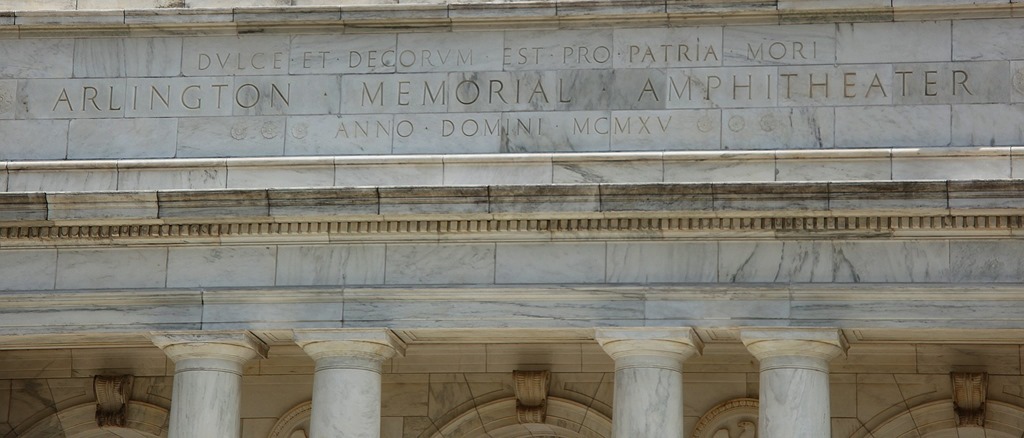
This large American military cemetery engraved Horace’s maxim in 1915. And whether for solidarity, guilt, or respect for duty, many will endorse it still. Some will stand by it with their lives not just a chisel.
4. Trenches St. Eloi. Another poem by a front-line veteran of WWI, one who didn’t survive the war, and a man who was important enough to the founding of English language Modernist poetry that his war death might have alterned post-war Modernism to some degree. T. E. Hulme helped form Pound’s own views on how poetry should “make it new,” and was admired as well by T. S. Eliot, but his own poetry is now little-known because of its sparseness in number and length. Though he was known as a pugnacious talker in person, and was a writer of audacious criticism, his surviving poems have a shocking modesty about them, something I find quite admirable. Though he wrote dispatches to English home-front periodicals during his service (from those I’ve read, they support the English cause) this is his only poem about his experience of the war itself, and it was composed, or rather transcribed, while he was back in England being treated for battle wounds before going back to the front and his death.
To hear Hulme’s ode to soldierly persistence, use the player below.
3. The Death of Apollinaire. Speaking of influential casualties of the war, Guillaume Apollinaire, must be right up there. The man coined the names “cubism” and “surrealism” after all, and his verse influenced not only countless French poets, but Americans like E. E. Cummings. The exact cause of Apollinaire’s death is open to attribution. He was still weakened by war wounds when he was struck down by the infamous 1918 influenza epidemic just two days before the end of WWI. The poem used here is a surprisingly sincere elegy written by a frank shirker of military service, Tristan Tzara, who as a teenager fled the tinderbox of the Balkans where the world war started for neutral Switzerland, where he participated in the invention of Dada at the famous Cabaret Voltaire. Dada had no respect for the pieties of the warring parties, but Tzara’s respect for Apollinaire comes through in my original translation of his poem.
Thinking of Hulme and Apollinaire as front-line soldiers in WWI makes me pause and wonder at the differences in my own time. Can you imagine John Lennon and Bob Dylan serving as grunts in Vietnam? Or Damon Albarn and Jay Z being deployed to Iraq? Of course, there are differences in poet/critics and pop-stars however artistic the songwriters are, but still it’s a different world, and Modernist artists both reflected and helped to form it.
To hear my performance of my own new translation of Tzara’s poem about Apollinaire’s death in the autumn of victory, use the player gadget below.
2. Grass. Carl Sandburg didn’t serve in WWI. He was a Spanish American War vet however. His personal position on WWI is somewhat hard to figure. He was writing for the stalwartly anti-war IWW under a pseudonym and explicitly supporting there the radical IWW line that the war was the Capitalist class enjoying their profits in a cage match between the working people/cannon fodder of both sides. Yet also during the war he wrote pro-war pieces under his own name, taking the same stance as some other parts of the US left: that the Central powers were evil empires lead by ruthless kings that needed to be defeated by the democracies Britain, France and the U. S. In 1918, Sandburg published “Grass” and attempted to synthesize both sides of Sandburg.
“Grass” is sometimes considered a straightforward patriotic poem, a reverent poem about the ultimate sacrifice of veterans, and if read in such a context no one is likely to object. But listen closely. Even though he echoes Whitman’s leaves of grass metaphor, even if you may find it next to John McCrae’s “In Flanders Fields” in some presentation of poems about honored war dead where we might be implored to “Take up our quarrel with the foe!” One might even too-quickly think it’s akin to what Sandburg’s hero Lincoln would say in his Gettysburg Address, that we “cannot forget what they did here.” But, Sandburg’s poem’s point is literally the opposite of Lincoln’s: that we will forget what they did here.
How completely true is that forgetfulness as we approach the centenary of the end of WWI? A discussion point.
You could read “Grass” as an antiwar poem, saying that “It doesn’t matter how important and glorious they tell you the cause you are fighting for is, because the same or equivalent crowd will run things afterward and what you thought you were fighting for will be forgotten.” Speaking of WWI, 50 years after it started, Sandburg admirer Bob Dylan could sing “The reasons for fighting, I never did get.”
I just got done earlier this fall performing Sandburg’s “I Am the People, the Mob,” In that poem, Sandburg makes a subtle point. That thing the leftish political vanguard often bemoans about “the people,” that they forget the injustices committed against their best interests, is in fact how they’ve managed to survive and endure. If they remembered their defeats, their sacrifices, they might not go on, they could be immobilized in grief and despair. Is Sandburg saying the same thing in “Grass?” Is he saying “I was never sure if this was the rich man’s war fought with working man’s blood, or a war to save democracy. It’s over now and the rich and powerful will forget us as unimportant. Or perhaps it was a struggle so our imperfect democratic governments can continue in a long battle to perfect themselves, but that in the end is what we need to concentrate on.”
To hear the LYL Band perform Sandburg’s elegy to soldiers graves, use the player below.
1. On the Troop Ship to Gallipoli. These most-popular-here WWI pieces I feature today: it’s a rather downbeat outlook, even Hulme’s piece is not the sort of thing to inspire sacrifice for one’s country. Pound’s rant openly doubts the beliefs of some that did, and is unequivocal on the base motives of those who lead his host country in the war. WWI war poets did write poems that supported the war effort. A personal favorite of mine, Edward Thomas, volunteered and died at the front with a deep belief in the nobility of service that overwhelmed his suspicion of the war’s rationale. Pete Seeger’s uncle, Alan Seeger, wrote his fatalistic but heroic “I Have a Rendezvous with Death.” Another well-known poem in this mode is British poet Rupert Brooke’s “The Soldier.” If one believes that any active deity must have a dark comic streak, Brooke dying of an infected mosquito bite while steaming to the front lines of one of the most horrific battles of the war could be part of your testimony.
Pound once had to explain that when he was critical of Brooke’s poems he was speaking of their old-fashioned prosody, not his character. When I saw this fragment found in Brooke’s journal after his death I saw an opportunity. What if Brooke’s observation of his fellow soldiers on their way to battle could be shaped to express itself in the mode that Modernists like Pound, Hulme, or Sandburg would have used? You can see the edits I made here, and listen to my performance of my setting of it with the player below.
November 11th was first celebrated as Armistice Day, the day that World War I ended 99 years ago. As wars—even World Wars—continued after that war, the day has been pressed into other service. In the United States it’s Veteran’s Day, a day to think of and thank those that served in the armed forces. In the UK and Commonwealth Countries I hear it’s celebrated as Remembrance Day, making it more akin to the US Memorial Day.
Because I like modern poetry, and the most recent poetry I can use freely here is from before 1924, and because we are marking the centennial of World War 1, I’ve performed a lot of things from the the WWI era here, including poems about that war. Since many of you are new to this blog (traffic has grown considerably since this summer) I’m going to take this day to point out a few poems about the experience of soldiering, many of which are written by the veterans themselves.
“On the Troop Ship to Gallipoli” has turned out to be one of the most popular pieces here. It’s my adaptation of a fragment written by Rupert Brooke. Brooke was a believer in the British cause in WWI, and this piece comes out of words he wrote shortly before his death of an illness he contracted while on the ship taking him to the front in Turkey. It’s a testament to people willing to put their life on the line for an idea.
“The Trenches St. Eloi” is nearly a dispatch from the front in poetic form. It was written by T. E. Hulme, one of the founders of Imagism and modernist British poetry, though his own poetry is less known than it should be. St. Eloi was a major front in the trench warfare that stagnated for much of WWI. Eventually elaborate tunnels were dug at St. Eloi by Welsh coal miners in hopes of gaining an underground advantage. Hulme was wounded there serving in the British Army, came back to England to heal, and then returned to the war where he was later killed in action.
“South Folk in Cold Country” was published in this form during the time of WWI, but it’s a translation (by Ezra Pound) of a work by classical Chinese poet, Li Bai. In it, the lot of the soldier sounds eerily similar to that Hulme was experiencing a thousand years later. Li Bai is the same poet that Pound used as the source for the more commonly anthologized poem “The River Merchant’s Wife.” Anthologies, and perhaps readers, seem to prefer love poems to poems about war.
“Christ and the Soldier” is by Siegfried Sassoon, who was a decorated hero of Britain’s army in WWI. However, he was at least as courageous in publically taking a stance against the war while still in service. A compromise was reached that he would be treated as a casualty of “shell-shock” at a asylum in Scotland rather than charged with treason or some other serious crime. Sassoon published poetry about the war during the fighting, but this one was held back and was not published until later.
As a break from the gravity of these men’s experience, let’s remember that the experience of soldiering, even in wartime, is not without absurdity. After WWII, several artists had a hit with a spoken word record written and originally performed by T. Texas Tyler called “The Deck of Cards.” And it’s been occasionally revived, slightly revised, for later wars—which is only right, as the original concept of the disreputable deck of cards that symbolizes what is holy goes back to at least the 18th century. The song’s performer usually follows Tyler’s model and says at the end of the piece that they know it’s a true story because “I was that soldier.” Well, Tyler wasn’t from Texas and I’m not even sure he served in the second great war, but its enduring popularity says that the story of a disrespected common man who shows the brass that he’s just as pious and knows a thing or two is just so satisfying. English songwriter Robyn Hitchcock performed a parody of Tyler’s song from a more Dadaist angle a few years back, and this is my version inspired by Hitchcock’s. I’m not a soldier, but the story is true: B. B. King did ride a bicycle out of the Mississippi Delta to Memphis.
Finally, a complete change of mood, and perhaps more in the Remembrance Day or Memorial Day spirit, but here’s Spanish American War veteran Carl Sandburg’s elusive elegy to the peace all wars fail to, “Grass.”
Tomorrow is called Veterans Day in the United States, but originally it was Armistice Day, celebrated on the day that World War I ended. WWI was a dark dividing line between all that came before and after. Books have been written about only one or two aspects of what changed, but a whole shelf of books could not tell all.
And this year is the hundredth anniversary of one year in that dark dividing line, 1916, when those that thought war was simple, or had to be simple, brought the 20th Century efficiency of the assembly line to killing in the battle of the Somme, where over one million men were killed or wounded.
One of the soldiers in that battle was a poet, Siegfried Sassoon. Last time we took a look at a funny and pious story from World War II, The Deck Of Cards, and had a little irreverent fun with the form of that story in my parody. In this piece, Sassoon’s Christ and the Soldier, the humor is very dark. I’ve heard that it was dark enough that Sassoon did not, or could not, publish it until the war was over.
As usual, I’m largely going to let he piece speak for itself. One thing I like about it is its use of dialog. For some reason, most poems eschew dialog entirely, and I think poetry misses out on a useful device by avoiding it. Musically it’s a mode that the LYL Band visits often, combining organ or piano with electric guitar. I play the guitar part on my Jaguar, a guitar that was once associated with “surf music” but has since had a revival in indie-rock circles. I play it often because its short scale and spring-softened action are friendly to my arthritic fingers.


 Frank Hudson