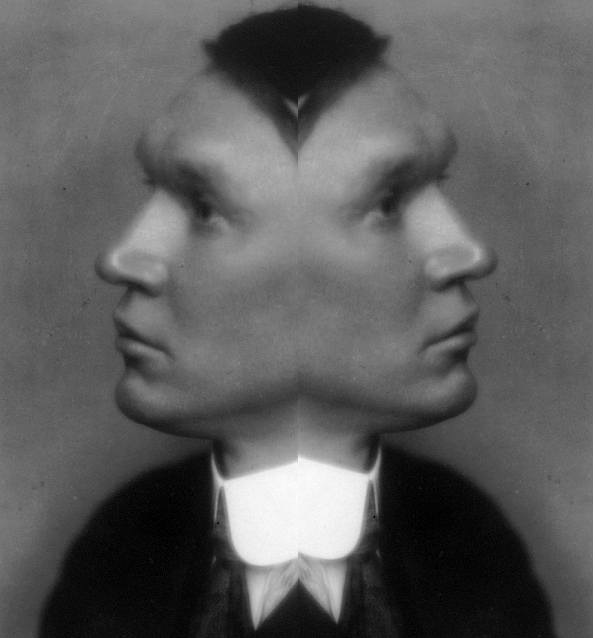
As Halloween approaches, here’s a song that focuses on the playfully frightful aspects of the holiday. Wait a minute – I debated typing “playfully” there with “frightful.” I went with that combination as it’s my best guess at the intent of the Vachel Lindsay poem that I converted into a song, though I can’t be sure.
Playing with fear and horror is clearly a part of Halloween. We expect children to celebrate the holiday, and the adults participating in Halloween celebrations plan them to be happy occasions, even though the decorations will be full of spiders and their webs, and monsters, and skeletons, and those dream-flickering pumpkin skulls.
But if you take the poem (now a song) at face value, this is about a woman who is personified as a predator, the femme fatale trope and her victim fly. Had poet Lindsay felt himself wronged by some lover to come up with this piece? I don’t have biographical evidence to point to with an emphatic gesture,* and the internal evidence within the poem speaks to me of a playful mode to the condensed tale of horror it tells. There seems to be a paradoxical agreement on the part of the singer: they’ve been done wrong, but they’re going to speak lightly about this, and while the song’s fly doesn’t say it out-loud, they might be open to just a little more peril.**
A poem that literally describes tearing the wings off flies, yet I’m still holding it as playful.
.
Earlier this month I wrote about the mid-20th century “folk scare” in passing, and as someone who has some grasp of the songs revived by that movement, I couldn’t help but think that Lindsay referenced a floating verse that appears in some American folk songs. Did anyone else catch it from listening or reading the text above?
The spider takes her prey with the line: “She drove me to her parlor/above the winding stair.” Reading this, I immediately heard a specific tune – cementing the idea that this poem would get the Parlando Project treatment. What tune? One widely sung song that features the verse about a woman taking a lover to her parlor goes by the title “Cindy, Cindy.” Besides the parlor destination – sometimes sung in the folk song as “She took me to her parlor and she cooled me with her fan” – most “Cindy, Cindy” versions have devouring women in them too, with verses like “I wish I was an apple a-hanging on a tree and every time my Cindy passed she’d take a bite out of me”*** or even “My Cindy is a pretty girl. My Cindy is a peach; she throws her arms around my neck and hangs on like a leech.”
Quick research says that “Cindy, Cindy” was sung in America in the early 20th century when Vachel Lindsay wrote his poem. I’m going to suspect Lindsay knew one of the variations of it – and he might have thought some of his audience would too.
So, I’m calling it: playful. Likely erotically playful.
I also suspect my music for today’s performance of “The Spider and the Ghost of the Fly” had “Cindy, Cindy’s” tune in its ear a little bit too. You might be able to hear that performance with the audio gadget below – but like the devouring and dangerous love between the spider and the fly, some of you may find the audio gadget hidden and suppressed. Aha! I have this highlighted link, a veritable grail-shaped beacon, that will open a new tab with its own audio player so you can hear the song.
As December begins, I’m going to be taking some time to celebrate and elaborate the roots and concepts of this long-running Parlando Project as we reach our 800th-released audio piece milestone.
For those who are new here, let me restate again what we do: we take various words, mostly literary poetry that was never intended by its authors to be performed, and combine them with music in differing styles. Sometimes the page-words are sung, sometimes they’re spoken or chanted. Sometimes the music will patently match the text, sometimes not. The latter class are some of my favorite pieces: Emily Dickinson as blues singer or psychedelic ranger, Robert Frost with EDM, Longfellow at a beatnik coffee-house, Li Bai with western orchestral instruments, Jean Toomer or John Keats as performed by an indie-folk combo. I expect long-term listeners to scratch their heads at times, though I also fear that some will sample a piece that they don’t much care for and leave off from future listening here.
No one idea or artist inspired this all, but today’s piece is about the farthest back I can recall anything that might have inspired the Parlando Project. I think this happened when I was around age 10.
I grew up in a mid-century Iowa town of 700 folks, and it wasn’t a particularly musical place. There was a small high-school marching band, a handful of children probably had piano lessons of some kind, if only in hopes there’d be someone to play piano in the three Protestant churches in town. The two best musicians in my childhood cohort played trumpet and accordion. The former was surprised to admire Louis Armstrong despite having personally absorbed dismissive racial stereotypes, the other might aspire to Myron Floren level of showpieces on the stomach-Steinway. The same little town might have over-achieved in literature though. It was named by its 19th century town-platter “Stratford,” and its streets were named for British poets and Longfellow — main street being Shakespeare Avenue. If you grew up on a street that was merely numbered, or an avenue named for some animal or geographic feature, such things never had a chance of shaping your worldview. I grew up thinking of Milton or Shakespeare as being a local possibility.
My father sang, mostly in church. My mother thought he had a good voice (“better than Perry Como” she once said) and I recall it having a very nice timbre when I was a child, but there was no piano or other instrument in the house, and he didn’t sing a cappella that I recall. We didn’t have a TV until I was 7 or 8 (and even then it was a chancy fringe-reception, rabbit-eared, used set that would send its display to snow or tumbling whenever it felt like it). There was some kind of radio, for which I’d hurry home from school to listen to the Lone Ranger on, though I can’t recall what the radio looked like. And at least some of the time there was a phonograph. I recall it was one of those that looked a bit like a portable typewriter with a luggage-finished case that could be clasped-closed. It may have been one of my parent’s from their college years. It sat in a little side room off the kitchen at home that we called “the breakfast nook.” And with it was a small cache of records. And here it gets odd — specifically odd — but applicable to the Parlando Project.
I clearly recall four 78-rpm disks, an unexpected set for a Fifties, small, rural-town-in-Iowa record collection. Two were commercial spoken word recordings, the sort of thing that was a viable genre then.** Record one: Robert Frost reading his poetry. My recollection that the featured poem was his “Two Tramps in Mud Time,” but so far I’ve found no Frost recording of that poem to refresh my memory or share here.*** The second was Vachel Lindsay reading from his “The Congo,” which has an insistent, chanting, rhythmic flow. The fact that I can remember them would be clearly meaningful, but to be honest I have to say that I didn’t like either of them. I’m not sure what I expected from poetry that came from poets more recent than those whose names were on my streets, but Lindsay seemed overwrought to me, and even at a young age I might have been put off by the whole white-guy-doing-primitive-African vibe of his poem. And Frost? I’ve often written here that I didn’t care for him until I started to explore things musically that became this Project in the 21st century. Only then did I discover that he was a supple lyric poet — and furthermore, a much more subtle observer of humanity than I had appreciated in my youth.
The fact that I didn’t really dig these two poets didn’t keep me from playing the records. Experiencing them felt exotic then, and I liked that even if I didn’t admire what was engendering that feeling.
The third record didn’t match suit. It was a recording from the 1940s of a song called “Open the Door Richard.” I didn’t know then, but this was an unusual “Novelty Record” piece, charting in versions by as many as five different musicians within one year, 1947. All those musicians were Black, and before it was one of their recordings it apparently was a Black Vaudeville comic number that the musicians spruced up with swinging jive-cat musical settings and choruses. The musical versions all differ in detail while sharing the chorus. Some of them are largely drunk-act comedy,**** while others are more at down-on-one’s luck frustration and focus on the riffing, musical, chorus-hook. From listens today I suspect the recording I listened to back them could have been the Count Basie Orchestra version or (best guess) this one by the Three Flames. I liked that record, though I thought it a little odd, and I probably didn’t fully understand it. If these first three records have a link, that’s it, isn’t it? I enjoyed the strangeness, the difference.
Tortured Poets Department, but my childhood: disks containing a psalm of comfort, a song of misapprehension,. and two early 20th century Modernist American poets.
.
The final record was the one I listened to the most. It was not a commercial 78, but a recording, perhaps from a record-yourself booth (or offers like that) which provided the earliest Elvis Presley recordings. It was my father reading “Psalm 23,” the famous psalm of David. The voice was someone in my life, no exotic stranger, but I was totally mesmerized. If no one is more mundane than one’s own parents, this everyday, ordinary person had their voice on a record! And the text, in familiar English translation, is one of the most comforting pieces of poetry in the canon. When I’ve revisited the Psalms periodically as an adult I’m sometimes shocked at violent and authoritarian themes I find weaving in and out of Psalms’ religious rapture — but if “Psalm 23” implies frightful things, it does so to say that they pale in comparison to a connection with a godhead.
Parents sometimes comfort their children, do so by saying “it will be all right, we’re here to protect and care for you.” My parents weren’t much like that in expression however, though by action in life they were being that with much effort. This object, this record, did that, using someone else’s words translated from a Bronze-Age king, poet, and musician.
I think I asked about the “Open the Door Richard” record and the “Psalm 23” record. I can’t recall what my dad said about the Psalm recording, though I wish I did. I have a vague memory that he said the “Open the Door Richard” song was something of an in-joke between his brothers. I didn’t get, or can’t remember the full story, but one of my father’s brothers went by the name Richard (one that became a successful Protestant minister). Another brother was named David, though he never talked to Leonard Cohen about secret chords or sling trajectories.
So there you go, in summary: I had formative exposure to poetry on recordings. One case with my own father’s voice offering comfort; and another, an Afro-American tale of misapprehension. It would be years before I had any idea to do likewise, and decades before I could do something from this early experience regularly in ways that you could hear.
Longish post, but here’s a short musical piece called “Records in Childhood” using a sonnet I wrote this year casting some of that remembering my early experience with recorded words. You can hear it with the audio player below. No player? This highlighted link will open a new page with its own audio player
.
*There may have been other records, though it was not any kind of large stack. The fact of memory that these four are the ones I recall testifies to their impact.
**Besides poetry recitations, sermons, and even some secular speeches were released on disk — and spoken-word comedy records were often big general-interest sellers. In a previous post I talked about how vividly I experienced Hal Holbrook’s one-man stage show of Mark Twain Tonight on an LP record in a library in Iowa.
It’s possible that my home’s Frost recording was a separated part of a set. 78 RPM records were sometime sold in a bookbinder of page-sleeves holding multiple disks, which is the reason we still call a longer form vinyl LP, CD, or issued-together set of digital files “an album”
Today, somewhere, someone probably asked this question for the first time, and yet I’ve been aware of this question for my entire adult life. So, before I try to address the question, let me ask first, how long have we been asking this?
The ancients didn’t ask it. It seems clear that if one goes far enough back in most cultures it was taken for granted that poetry would be sung or accompanied by music. It seemed to make little difference if it was an epic story or a condensed lyric expression, music was assumed as appropriate bordering on required.
Was there a progression away from music being expected with poetry in those times? I wish I could say I was scholar enough to answer that question here. As literacy became widespread, as the collecting of libraries increased, I assume more people may have read Homer or Sappho* on the page than heard their works performed. And similarly, when Confucius and his school collected The Book of Songs they may not have assumed that each student would learn to sing and accompany each of them. Still it would have been absurd then for someone to judge that these works could not be poetry because musical accompaniment and performance had been associated with them.
Let’s see, one of these ought to work….And Sappho holding her plectrum in right hand
If we stay with English language and move on, we know that the Elizabethans recognized some poetry as destined for the printing press’s page, some for performance on the stage, and some for musical settings as songs. Poetry could be associated with music, but it wasn’t the default.
Continuing to sweep forward quickly, a few Romantics like Robert Burns wrote songs and Blake was reported to sing some of his work as well. Some of the prime British Isles romantics wrote literary ballads or the like, works that referred to song forms but without associated music, meant to be seen on the page.
Likewise, there seem to be only a scattered few in the late-Romantic/Victorian era and onto the early English language Modernists who were musical composers and poets or who assumed musical performance for their chief works. Long-time readers here will know that I like to point to Yeats as an exceptional example to this. For a time he pushed for poetry as performance with music and may even have composed or aided in the composition of some of the accompanying tunes. Little of his crusade survives, though it’s possible that one of the tunes to which his poem “The Song of the Wandering Aengus” aka “The Golden Apples of the Sun” is sometimes sung might be his, or personally approved by him.
That Yeats was closely associated with drama and theater may have something to do with this. Newly composed poetic drama is an uncommon form in the modern era, but drama normally presumes performance. Although readings by poets are common in the 20th and 21st century, the nature of the performances vary considerably, and it became common for poets to give dry readings that by the writer/reader’s nature or intent drained dramatic and performance elements from the reading.
Let’s stop for a moment and consider two unlike American poets who emerged in the early 20th century: Vachel Lindsay and T. S. Eliot. Lindsay, who came and went well before the first Beat poet stepped in front of a jazz combo can easily be seen as the original slam performance poet.
He wrote his poetry expecting to perform it. Associated with that expectation, his writing is designed to impact the back row of the auditorium immediately, and if he ever wrote a poem with layers of meaning or intentional ambiguity, I’ve never come upon it.
Eliot on the other hand, read somberly in public, but as much (or more) as Lindsay he seemed to inform his poetry with music. As I return to my serialized performance of his masterwork “The Waste Land” this month I’m reminded of music’s considerable presence in it. He samples music in his great poem just as a modern hip hop composer might, dropping in scurrilous barracks ballads, pop songs, Wagner opera, and birdsong. He didn’t perform it as floridly as he wrote it, and so even if “The Waste Land” bore an original working title of “He Do the Police in Different Voices” Eliot does not do the voices when reading it, nor does he sing the music he’s decidedly referencing. It can be performed however, and while the poem’s detailed layers and references won’t come through in one sitting, a performance like Fiona Shaw’s illuminates the emotional and character range in it better than anyone’s silent first (or probably tenth) reading of it will.
My performance of “The Waste Land,” now about half complete, attempts to bring the abstracted music back to life in the poem, even if I reserve the right to select genres and modes of expression that Eliot might not expect.
When I perform a poem like Vachel Lindsay’s “Abraham Lincoln Walks at Midnight” I expect you’ll get as much, or perhaps even more, from hearing it once as you would reading it on a page.
One of the knocks on poetry with music, or performing poetry in general, has been that it doesn’t help subtle and complex thoughts in poetry come through the way that slow reading on a page where one can look up and down the page at will does. I’ll agree there’s a non-linearity in reading poetry on the page that is difficult to translate into performance. But does musical performance of words prevent “re-reading”?
Music rejoices in repetition. Words used with music often take on refrains and repeated sections. I will sometimes create such refrains even if the original page poem doesn’t include them. Gospel and other ecstatic performance styles have been known to drill down to word or syllable level in repetition, again, somewhat compensating for that weakness of performed poetry vs. its non-linear presence on the page.
Particularly with recordings (although repeated performances have the same virtue) you can re-experience the poetic text for comprehension of different levels or different vectors of observation.
When I’m attending a poetry reading, I’m often worried that I will not be able to keep up the level of attention on the poet’s words as they read them throughout an entire night. This is irrespective of the value or quality of the poetry. A good poet is quite likely to cause my mind to explode with exploration engendered by a line, and I’ll find on my return that I have missed the rest of the poem! And a really good poem can blank out the next several poems.
On the other hand, a simple text like Otis Redding’s song “Respect” as performed by Aretha Franklin and band can bear (for me) hundreds of listens. I will notice new things each time, or given the decades over which I’ve heard it, I may re-notice things I’ve forgotten I’ve noticed before. These revisits will also reach favorite moments where I wait for pleasures to return. A knottier text like Bob Dylan’s “Just Like A Woman” once seemed like a way to vicariously experience a certain kind of demimonde I was only peripherally experienced in. Listening to it over my life tested it against theories that it was about gender fluidity, or that it was a patriarchal endorsement of the male gaze and privilege, and now I usually hear it more as an expression of two addicts negotiating their other relationship besides the one to the chemicals and the situation that obtains them. It may be none of those things, or it may not always be one of those things. It may be something different the next time I listen to it.
Why shouldn’t Emily Dickinson’s “Hope is a thing with feathers” or Wallace Stevens’ “To the Roaring Wind” get the same chance? Of course we can re-read a page poem, or read it and double back to check some connection, but particularly with short poems, might not music encourage repeat play?
In this first part we’ve talked more about poetry and the perception that it has become increasingly separate from music. In the second part we’ll come from the other direction, and talk about song lyrics and that old, but not ageless, question about if they are poetry. I’ll leave you with my performance of Yeats’ “Wandering Aengus.” We don’t know exactly how Yeats would have wanted it performed, but his writing on poetry with music indicates he didn’t want the performer to sing it in an art-song manner. Perhaps I’m complying with his wishes, but then I can’t really pull off full-voiced art song.
*My favorite Sappho legend—as a guitar player that must have the right flat pick to approach the instrument—is that she invented the plectrum.
Here’s a piece for today’s U. S. holiday: President’s Day.
Long-time readers here know that’s not going to be simple, but it may be interesting.
For some time in this project I’ve thought I’ll have to deal with Vachel Lindsay. In the early days of poetic Modernism a century ago, when no one knew exactly how that movement would turn out, Lindsay was a force to be reckoned with, with a life story and approach to his art that was so outsized, that if he hadn’t actually existed, and instead you created him as a character, you would be charged with unrealistic and exaggerated imagination.
In the great American tradition of bohemian artistry, Lindsay was not well-off, not Ivy League educated, nor born in some cultural capitol. By force of will he decided that he would make his way in the increasingly business-oriented world of the 20th Century as a poet.
How’d that work out? Better than you might imagine, if only for a time. He made most of his bones touring the country intensively, reciting his poetry in a flamboyant style. Much like the life of a musician, it worked only to the degree that he was able to keep up a relentless road-dog touring schedule. Between tours, what time he had to write was also the time that he fell into debt and doubt.
If you think that poetry should be, at least in part, a spoken art form, Lindsay was there before. If one wants poetry to be appreciated as a popular form, with no academic prerequisites, Lindsay lived that. If you want poetry to be a force for social good, Lindsay too. Slam poetry? Lindsay was doing that before there was a name. Poetry inspired by and linked with vernacular music? Lindsay, a century ago.
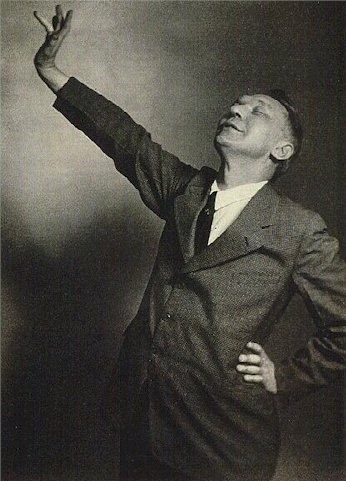
Vachel Lindsay is not doing the hokey-pokey here, but performing poetry.
So why haven’t I presented Vachel Lindsay before today? Three reasons.
One, he wrote a lot of bad or flawed poetry. Awkward, sentimental, not particularly striking in imagery, and despite his spoken word and musical inclinations, not always in tune with my sense of music.
Secondly, though he always claimed his heart was in the right place, his treatment of other cultures was so clumsy and ignorant that it’s too often indiscernible from racism. This isn’t a close call, or some case of modern politically correct revisionism, even in his own era this was noticed. It was more than 50 years ago when I first ran into one of his set pieces, “The Congo,” and from that I figured I was done with Vachel Lindsay.*
These are both general reasons why Lindsay is not seriously considered along with his contemporary Modernists of the early 20th Century. But there is another, more personal reason: I fear the Vachel Lindsay in myself. When I see in my own writing awkwardness and flawed art, when I stop to consider the un-earned audacity of my own spoken word and musical expression, when I catch myself assuming that good intentions are sufficient, when I write here of other cultures and experiences, and despite my provincial and limited knowledge of them, perform works associated with them—then I fear I’m becoming my own variation of Vachel Lindsay. I continue to do those things anyway, stubbornly—again, like Lindsay.
Art is not just a place to model human potential. It’s also a revelation of human failures. Bad art can inspire good art. Failures illuminate as much as successes.
With that long introduction, let me now tell you that today’s piece, “Abraham Lincoln Walks at Midnight (in Springfield Illinois)” is still worthy of four minutes of your attention. Unlike China or the Congo, Lindsay knows Lincoln’s adult hometown of Springfield Illinois, as it was his hometown too. “Abraham Lincoln Walks at Midnight” is not a piece that extends language, it has no clever images that re-calibrate how you experience something, its word-music is not so beautiful that you’d be drawn to it before you even care what it’s about. We have long celebrated Abraham Lincoln as the President of our greatest national traumatic event, the American Civil War, fought over our greatest national sin, slavery. So, the poem has only an emotional, empathetic message, but this is all art delivers to us however plain or fancy the wrapping.
President’s Day is not a simple holiday today. Here’s my performance of Lindsay’s Lincoln poem. I kept the music simple enough and in that hometown key of C. The high melody part that sounds like a synth patch is actually 12-string guitar run through a lot of time and modulation effects and a compressor. The player is below:
Sara Teasdale wrote some of the saddest love poems I’ve ever read.
Less-well remembered than she should be, for a time about 100 years ago Teasdale was the most popular and esteemed love poet in America. In 1918 she won the Pulitzer prize for a new collection of her poetry, labeled right there on the cover with the title “Love Songs.”
Harriet Monroe, the founder and editor of Poetry, the indispensable American poetry journal of the day, said of Teasdale “She was as delicate as a lily, but under the white-petaled perfume one felt in her presence an impassioned intensity of feeling which her brief lyrics were then beginning to express.”
So, what did Teasdale know about love? More and less than you might expect. Born in 1884 in a wealthy and religiously conservative St. Louis family, she was protected and sheltered* until she was nearly 30 when her poetry career took her away from St. Louis to New York and Chicago.
As her poetry expresses, she dearly wanted to fall deeply in love, but she also wanted the independence to write, and though she moved in bohemian circles during a time of great social change, she’d internalized some of her family’s conservative values.
Romantic stories revel in love triangles, but Sara Teasdale, the woman who’d get the Pulitzer Prize as a love poet was about to deal with a love rhombus. She was crushing on a young poet she admired, John Hall Wheelock. She told Wheelock he was “The greatest living poet.” He wasn’t, though he was flattered. Wheelock, like Teasdale’s family, was a bit of a blue-blood, and he respected Teasdale’s poetic talents, but he was not interested in marrying her.
Then there was Vachel Lindsay, a literary phenom of the time, who had vagabonded about the U.S. trading his poems for meals and then bootstrapped that into touring the country’s speaking halls giving flamboyant readings of his chanted poetry. Lindsay, unlike Wheelock, wanted to marry Teasdale, and he plied his troth by dedicating books of his poetry to her**, but the reserved and sheltered Teasdale was both intimidated by his bluster and worried about his ability to provide the kind of stable home that would allow her to continue writing.
Who’s the fourth rhombus side? A St. Louis businessman, Ernst Filsinger. Like the other two, Filsinger appreciated Teasdale’s poetry, and like Lindsay he wanted to marry her. Problem solved? Well, Teasdale wanted to be deeply, mutually in love, and she wasn’t sure she loved Filsinger that much.
Tuning up for her Pulitzer-winning “Love Songs” Teasdale was tempering her intonation with three men.
Wheelock says that Teasdale asked him to decide who she should marry. “You know Vachel. I want you to meet Ernst. And I want you to tell me what to do. Which of these two good men should I marry? Should I marry Vachel Lindsay, who’s a genius and whose poetry I love? Or should I marry this fine, tall, dark, good-looking businessman who seems to care for my poetry?”
Wheelock may not have been the greatest living poet in 1914, but he seems a sensible sort of guy.*** He says he told Teasdale she must make the choice. She replied that no, he had to tell her which to marry, that she wouldn’t blame him if anything went wrong. OK, he said, he didn’t see her being happy with Lindsay “I don’t think you are one who could live in the kitchen doing all the housework and scrubbing the floors.”
She married Filsinger.
The next year she published the poem I used for today’s piece “I Am Not Yours” in a collection titled Rivers to the Sea, whose title came from a poem by Wheelock. “I Am Not Yours” also appears in her Love Songs collection that won the Pulitzer.
It’s possible to read this poem quickly and read it as a crush poem, a supple lyric about being madly in love with someone, where the title and opening phrase is poised rhetorically in the moment before love’s inevitable consummation will occur, as a poem written by someone who realizes her autonomy, but is willing to submit it to overwhelming passion. Teasdale’s poetry was not just prize-winning, it was popular in its time. Someone might read this poem at a wedding. It’s likely that Teasdale, who wrote this the same month as she married, wrote it thinking of hers.
Go ahead, listen to it now. Here’s the player gadget.
So how did things turn out for the Sara Teasdale love rhombus?
Wheelock lived until 1973. In his memoir of his life in publishing he said that the best way to edit poets is to not edit them. “If a person needs to have his poems edited, then he’s not a poet, because poets are perfectionists, and by the time they get through with all their agonizing work on a poem, either they’ve ruined it by revising too much or it’s the way it should be.” He’d tried to apply that principle to Teasdale’s marriage choice.
Vachel Lindsay may have been too odd and flawed to ever last long, but the Eliot and Pound wing of cultured expatriate High Modernism crushed him by the late 20s, and the mid-century New Criticism could barely bother with the effort to find the grievous lapses in good taste in his “higher vaudeville.” In 1931, depressed by his inability to keep his debts at bay as his touring revenue dried up, he drank Lysol and killed himself.
At first Sara Teasdale’s marriage seemed to work. Filsinger allowed her to concentrate on her writing, but she eventually felt the loss of not being lost in passion. In 1929, while Filsinger was overseas on a business trip, she headed west to a state with easier divorce laws and informed him by telegram. By the Thirties, Teasdale’s lyricism and complex emotional content fell out of favor with High Modernism/the New Criticism too.**** The poet who had won the Pulitzer Prize for a book called Love Songs felt unloved and forgotten. A little over a year after Lindsay’s death, she took an overdose of prescription meds and died in a filled bathtub.
And Ernst Filsinger? No one cares for the biographies of businessmen much after they die. We are not likely to sing the book he authored Exporting to Latin America to music decades later. His obituary claimed he gave the first transatlantic after-dinner speech by radio in 1929, speaking from Berlin to the National Foreign Trade Council sitting in Baltimore. Who now notes what he said? He died in China in 1937. In his memoir, Wheelock says he heard Filsinger too committed suicide, but I have no confirmation of that. Is it possible that he, Prufrock-like, heard the mermaids singing, but pointedly, personally knew they had, at least once, sang for him?
Even if we largely ignore it, we store away beautiful things like prize-winning lyric poetry, so we can read and hear what Sara Teasdale wrote the month she married. Listen again to “I Am Not Yours” or read it here. Looking to be the I that is I, but longing to get lost in love and knowing she was not, speaking of her light, a mere candle lit at noon, and asking for it to be plunged, put out.
As you read this, I tell you again that the first duty of an artist is to survive
Love poetry if it’s any good is as varied and complex as love is, as life is. Sara Teasdale wrote some of the saddest love poems I’ve ever read.
*Like Elizabeth Barrett Browning, Teasdale also had some kind of long-standing (and hard to diagnose via remote historical methods) illnesses. This only increased the family’s protectiveness.
**Another admiring poet who dedicated work to Teasdale was Witter Bynner. Bynner was gay.
***Wheelock eventually had a long career in publishing, and he prided himself with befriending, scouting and signing poets from Louise Bogan and Conrad Aiken to May Swenson and James Dickey. His memoir is The Last Romantic: A Poet Among Publishers.
****Teasdale was born in St. Louis only four years before T. S. Eliot, even if she seems like she was born to a different generation, one both before and after Eliot. Their families, though Midwestern at their birth, shared similar New England backgrounds, and Teasdale attended a private St. Louis prep school founded by Eliot’s parents, and that was located next door to Eliot’s home until he was 16. One wonders if the two young poets were aware of each other as children, but Eliot left town at 17, Teasdale’s sheltered upbringing reduced the chances of social interaction, and Teasdale’s family were staunch Baptists while the Eliots were Unitarian.
Oh, and by the way, that Prufrock of Eliot’s first great poem? Prufrock was the name of another St. Louis businessman. If Eliot considered other name options from his St. Louis youth, Filsinger was less iambic as a name. Teasdale could have sounded its own connotations, but it wouldn’t fit with measuring with coffee spoons.