I’ve mentioned this Fall that I’m on a project to clean out the accumulations of my long life. There are various battlefronts in this effort, but last month I worked on emptying my stuff from a small storeroom in my house, which was filled with boxes, some of which hadn’t been unpacked since I moved 40 years ago. One box was completely stuffed full of spiral bound notebooks.
I had once saved the notebooks I used in my high school years and then throughout my twenties. This meant a slowly growing cache of them had traveled from a tiny hometown in Iowa, to a dorm in a small college in that state, and then to the locations I lived at in New York for six years, and onward the four places I’ve lived in Minnesota.
I had a typewriter, which I used for some more formal things and finalized school assignments, and then in the ‘80s I got a personal computer,* but for 20 years or so, my creative work began and was recorded with handwriting in these college-ruled notebooks. Early, when there were only a handful of them, I mentally cataloged them by the color of their covers. Even after all these years I recall a couple of the earliest ones as “The Orange Book” and “The Green Book.” Like Emily Dickinson I didn’t always save working drafts, written on whatever was handy, but when I felt I had finished a poem I’d make a good copy in my most legible hand inside one of the notebooks to be saved.
I’ve written briefly at least once about starting to write poems as a teenager, and I won’t go on much more about that today, but I was surprised at the urge – it was not planned. I felt compelled to do this for reasons I couldn’t tell you then, or now. Living in my tiny town I had no idea how many people were writing poems, but I presumed it a small number, as the literature anthologies I had in school made me think the number at any one time was a select few. This misapprehension led to a grandiose feeling that I was writing poetry! – this grand art-form of literary geniuses.
Clearly there was a lot I didn’t know, but in my case this helped me, giving me a sense of accomplishment. Did writing poetry give me an unearned, unrealistic, sense of self-worth? Yes, I think it did – but we all need a minimum deposit in that bank, and that was the source I had. And after all I was a teenager, and few of that age have any substantial achievements.
In that process of pulling aside these old notebooks I came upon “The Green Book” that I recalled when there were only a couple of these, and I set it aside to look through first. In it I saw my good copy of a poem I remember quite well from my early work, one I had thought was one of my better ones then. Looking at it as an old man who’s read much more, written much more, lived much more, I think enough of it to present it here in performance today.
I didn’t have many poetic models to draw on, but this one certainly came from reading John Keats “Ode on a Grecian Urn” in my high-school literature class. I’ve performed Keats’ poem here, and I think I was already impressed at the ambiguity in the poem’s famous ending back then. My “Ode to a 1953 Automobile Ad” was on the surface a free-verse parody, burlesquing Keats classical art object – but I was at least partly conscious of wanting to make some solemn points too, though I don’t recall thinking out all the themes the poem includes, so my best recollection is composing the poem without knowing all I was including in the text under my pen.
I think there was a 1953 automobile ad in my memory, though I haven’t found the one described in the poem.** Sometime in my early teenage years, a man in my little town – no doubt doing the same “death cleaning” I am doing in 2025 – gave me several dozen 10-15-year-old Popular Mechanics/Popular Science/Mechanix Illustrated magazines. I devoured them, first because I adored the hyperbolic writing of the self-styled dean of journalistic automobile test drivers Tom MaCahill who wrote for Mechanix Illustrated – but this was a strange genre of magazine. Part reviews of new models of cars and novel ideas in consumer goods, part pre-Whole Earth Catalog handyman tips and project plans, and part more general writing about science and technology including predictions for the future.
The soft golden car in front of a Greek colonnade, or a peaceful ride in a Paris that 8 years earlier would have been in the midst of a World War.
.
I enjoyed the time-travel aspect of reading these magazines, visiting as an abstract thinking teenager the world of early childhood. The too fantastic flying car future has since become a meme – but the junior historian in me would think: the Korean Conflict was being fought as some of these old pages went to press (little mentioned in these mags, little remembered now too), the new age of atomic war fear was beginning, and in the sixties as I wrote this poem, Vietnam was echoing the Korea situation. So, as the poem was being written, there was then too the feeling of a glorious and blest domestic United States – yet with a “conflict” acting as a far-off minotaur ready to take sacrificial children.
So, I wrote this in the 1960s linking those times in the 1950s, and sublimation of killing young men is the topic. Inexperienced as I was, I tip my hat to the images the young person that would become me put in there: the camera and/or coffin dark box capturing the bright sunlight of the ad, the rust-holes in the teenaged car as the wound in the son. The use of Whitmanesque (or Sandburg or Ginsberg in their Whitman mode) extra-long lines is not something I do much now, but as I performed them this week, they seemed to work well enough.
This old poem is now published with a musical performance in the lead up to the holiday that was once known as Armistice Day – the very day that World War I ended at a moment when it was just “The Great War” and didn’t need a number, and didn’t expect to gain one – but now our wars don’t get the roman numerals, though fantasy film franchises and Super Bowls do. We didn’t get flying cars. We got armed drones.
You can hear me performing my “Ode to a 1953 Automobile Ad” with the audio player gadget below. Has the audio player gone with Studebakers and saving old magazines? This highlighted link is supplied as an alternative which will open a new tab with its own audio player.
.
*My penmanship was erratic and not consistently easy to read, so a typewriter was essential for things of any length destined for others. But I didn’t do creative writing on a typewriter – something about the mechanical nature seemed an authorship firewall: the machine made the letters, keys and levers away from the writer, and one couldn’t easily cross-out and add little marginal changes as one wrote.
One of the things found in the storeroom with the notebooks was a postcard about requirements for receiving a rebate on what would be officially my first personal computer: A Timex-Sinclair bought in 1982 – but that tiny $85 plastic wedge wasn’t able to take over from a pen or typewriter since it had a small membrane keypad that was only useful to learn to write computer programs with. In 1984 I got a Commodore 64 which could do limited word-processing, but I couldn’t afford the software that did that. In 1987 I got an Amiga 500 which came with a copy of Word Perfect – the then leading word-processing software product – and I began a slow and inconstant transition to using computers to do initial drafts over a decade or so.
**The 1953 year of the car in the ad makes me sure it was a Studebaker ad, for a remarkably beautiful new 2-door coupe was introduced for that model year. When I look for examples of the ad campaign, I see many of the Studebakers are depicted in yellow, but never in a family tableau described in the poem in the ones I could find. And there’s the chrome bird hood ornament. Was I thinking of the Packard swan? Looking at pictures of the 1953 Studebaker I see there’s a 3-bladed chrome insignia on the peak of the hood – meant to be a propeller, or bird, or abstract shape? I appeal to Brancusi on the bird.
Thinking of the late Nineties, I think of the Sixties, 1970, and then the end of the 19th century. When you’re an old man, that’s the kind of swift mobility you retain.
It’s difficult to comprehend how short the careers of some musical figures from The Sixties™ were. This month I watched a documentary on Jeff Buckley, the charismatic late 20th century singer. One of the challenges of his foreshortened life was to deal with the artistic inheritance and distraction of being the son of another singer, one of those Sixties™ artists, Tim Buckley.*
Here’s something I think remarkable, comparing those two. Jeff Buckley was two years older than Tim when he died at age 30. Jeff left one full-length recording, his extraordinary, eclectic debut album Grace.** Tim, beginning in the onrushing Sixties, and continuing through its continuance in the early Seventies when rock performers were increasingly hobbled by drugs of dependence, released nine LPs! Nine, moving between three distinct personal stylistic eras in eight years.
Neither Buckley ever made it to the toppermost of the poppermost, but obscured by their creative and commercial hegemony, posthumous fame, and trailing post-group recordings, consider that even the Beatles band was a living presence for only seven years in America.
Back to the Buckleys – there’s a sharp line ending in their careers: Tim died of an overdose of drugs stronger than he expected, Jeff drowned in river currents during an unwise spontaneous swim. We may expect our artists to be audacious – risks come with that.
Which brings me to today’s annual duty, where I mourn the death on September 18th 1970 of my patron saint of The Sixties™ music martyrs, Jimi Hendrix.*** Time and again in these observances here I’ve tried to make the case that Hendrix – the rightfully proclaimed pioneer in expanding the electric guitar’s vocabulary – is underrated as a songwriter, and particularly as a lyricist. I say this, even if I believe such things shouldn’t be reduced to a rating, because his strengths there are just so under-considered. In the pursuance of this goal, I’ve done things like make the lyrics of “Third Stone from the Sun” audible, and illustrated in a video the scenario of “Up from the Skies,” but today I’m going to link the lyrics of one of Hendrix’s greatest compositions to a trope not of the 20th century, but more the 19th.
Are you ready for:
Mermaids.
In his song “1983 A Merman I Should Turn to Be” Hendrix skillfully unravels a Science-Fantasy story without much wasted exposition: in a troubled world beset by wars and violence, a couple of lovers enter the ocean, find they can breathe underwater, and return to the salty brine from which we all have emerged through birth or evolution. Hendrix’s first-order inspiration for this tale is likely mid-century SF writing which he had been reading from childhood – but his imagination made this material his own and he should be remembered as an early Afro-Futurist – but let’s trace those SF stories he read back: the SF pulp writers were still following on from the Verne/Gernsback/H. G. Wells/William Morris late 19th century genesis of their genre.****
This week I went looking for literary mermaid/merman poems, thinking that a possible route into my Hendrix memorial this year. Surprise, there’s a lot of them! I don’t have a theory as to why this would be, but a great many British Isles poets had a mermaid poem somewhere in their collected works from around the turn of their centuries. In some of the poems the sea maidens are depicted as sirens, luring men to danger or soggy death in their arms, and this kind of naughty sex/death double feature might be a good fit with Victorian decadence. Then there was the highly successful Little Mermaid story of Hans Christian Anderson, but that’s an opposite plot from most of the poems: Anderson’s heroine wants to flee from the sea to the land, not from the land to the sea, and the mermaid is the story’s protagonist, not the landlubber male poets hearing sea maidens. Baring the example of Hendrix’s song, mermaids in my lifetime more likely follow Anderson fairy tale path onto dry land.
What turned the tide with this poetic trope? It might be T. S. Eliot’s famous use of sea-girl sirens in “The Love Song of J. Alfred Prufrock,” his first prominent poem. The satiric uncommitted romanticism of the poem’s Prufrock concludes with human voices awakening us from the sea girl romantic/decadent dream. We’ve largely followed suit ever since.
So, for a text for today’s piece I decided to weave together sections of five mermaid poems from that earlier era,***** but I am putting them in the context of a memorial to Hendrix, on the anniversary of Hendrix’s death, which came to him slept-under from unfamiliar pills, drunk on wine – when and where the man who dreamed a tender escape into the sea died on dry land in the middle of London. He was 27, yes too young, only four years in the general public’s eye, yet he had created his revolution for the guitar, and four albums of songs, songs I maintain that are good enough to be remembered alongside the guitar playing. What mighty things to have done in such a short time.
Selections from mermaid/siren poems by Tennyson, Beckett, De la Mare, Symonds, Eliot, and Yeats were woven together to make the lyrics to today’s musical piece.
.
My song “I Should Turn to Be” had to be created in a small amount of studio-space time, but I’m reasonably happy how it turned out. I was aiming for some dynamic range in this tale of doomed fantasies underwater, and I was able to get there. I haven’t been able to play electric guitar much for simple enjoyment this month, but even the focused playing to realize this composition felt good, so forgive the indulgence in two guitar solos – The Sixties™ would forgive me. You can hear the performance with the audio player below? Has any such player slipped beneath the waves? It’s just that some ways of reading this blog suppress showing the player gadget, so I provide this highlighted link that will open a new tab with its own audio player.
.
*I recommend that film, It’s Never Over, Jeff Buckley. For a music documentary about a male artist, it’s remarkable that it relies largely on testimony from women. Yes, like most music documentaries it avoids talking in detail about music – and the musical examples are short clips, which may not convey enough of the man’s art for the uninitiated – but the emotional narrative is richer for this uncommon choice by the makers.
Tim abandoned Jeff’s mother to focus on making his first record and subsequent touring. Jeff broke up with his partner in the midst of trying to launch his own career, though without a child being involved in his case. Questions about his father bedeviled Jeff, understandably – more so in that both père and fils were taken with a strong ethos of living in the moment. Still, it’s hard not to note the similarities in the two singer’s unbounded singing, and the two even sounded a likeness when describing their dedicated artistic drives.
**In Jeff’s defense, his career as a recording artist was only 4 years, having not made his first recordings until his mid-20s. And the range of musical approaches he assayed over fewer recordings is comparable to his father’s.
***The tight cluster of the Jimi, Jim, Janis deaths in 1970 gave rise to that gothic “27 Club” thing. I’d be risking a lot of “who’s that?” shrugs if I’d say that I myself am probably more like Al Wilson, the singer/guitarist/folklorist who died on September 3, 1970, also at age 27. But Hendrix is my choice because he was as much a poet as Jim Morrison, and doubly an artist when he played his guitar.
****Reviving 19th century Victorian fashions and art was a significant part of the English psychedelic era. This undercurrent too might have led Hendrix to compose his merman/mermaid song.
*****One couplet introduces the piece that isn’t from a late 19th-early 20th century poem. Those two lines are from the most-covered Tim Buckley song, lyrics written by his high school friend and collaborator Larry Becket for “Song for a Siren” – another late contribution to the mermaid genre Tim Buckley released in 1970. It’s a haunted song, and it takes only a little dose of gothic romanticism to wonder if Jeff Buckley heard the sirens beckoning from out across that fatal river in Memphis. See, I wasn’t wasting your time with that Buckley stuff at the beginning, it’s a plan.
I don’t know what I should tell him about the performance.
I think I know some things he doesn’t, but of course all knowledge is transient, subject to new knowing, new conditions. And the matter is complicated because the person whose performance I’ll present today is by my teenage self.
I was a few weeks into being 19. I was beginning my second year of what will become a foreshortened higher education at a small college in Iowa. The year before, my first year there, had been a high point of my then shorter life. I met my continued friend and musical co-conspirator Dave Moore there, along with his partner Celia Daniels; Jim Scanlon from Chicago, a right guard football player who wore an ankle length wool cape and shared lefty politics; John Schuler, a southern Illinois boy who soon grew a full John Brown beard and became a searcher for American ideals; and Louis Fusco, an east-coast kid who told me he’d sat right next to Steve Winwood’s organ on a stage back in Fusco’s hometown, and who like me had a little cassette deck and liked to record with it. Since I had grown up in a 700 population town near nothing much more than that, I’d never met anyone with these varieties of interests and experiences. I had made do with reading. First, 19th century gothic Poe, then iconoclasts like Mark Twain, George Bernard Shaw, and William Blake. Listening too: The Fugs and the Mothers of Invention, the skeleton key blurt of Bob Dylan, the psych-fi of the Jefferson Airplane, and that Rimbaud of Venice Beach: Jim Morrison.
But all that was assimilated inside my own head — an empty auditorium. Now an old man, that’s where these things, and much since, still echo.
I’d likely tell that teenage me that I was not conscious of class differences. I’m largely right in that — but the 19-year-old might say I knew of those differences, he was just ignoring them. In this time-spanning colloquium I’d reply ignoring this is close-enough-same to ignorance. The school had rich kids, and kids more secure in the mid-century middle-class than my family was. Besides the loans that seemed massive to me in Sixties dollars, I made ends meet as a “Work-Study” student, washing dishes and doing other tasks for the on-site food service. Most of the students were there enjoying their draft deferments and class-appropriate dating and social opportunities — education was largely a customary set of exercises secondary to that.
At the end of my first year, Dave, Celia, and Jim all left this small Iowa college for a better one in Wisconsin. We’d all worked on an “underground newspaper” at the little Iowa college — mimeographed pages filled mostly with satire, though one page printed my first published poem, an ode to the new Brutalist student center on campus that owed a lot to my fresh fascination with Wallace Stevens. That newspaper may have been how I was selected as editor of the official college newspaper for my second college year at the end of my first. I was the last man standing from that independent effort, even though I knew nothing of the editorial role. Celia gave me a crash-course in print layout and production, and I learned in a day from her things that I still used years later.
I’d first met Dave Moore when he presented a Sunday service at the college chapel in the fall of my first college year. The service included his reading from Dalton Trumbo’s Johnny Got His Gun and Bob Dylan’s “With God on our Side.” So, as the new school year began, this elevated-by-vacuum me decided to present something similar.
There were a couple of problems with that: I was (still am) a lousy performer — but I didn’t know this yet; and I would have to find something to present, choose a message which I’d justify by what was billed and playing inside the auditorium of my head. For some people this might be a good enough idea: their internal repertory aligns with the zeitgeist. With mine — not so much.
What was playing in my head? Leonard Cohen. In my last year of High School I heard a recording by Noel Harrison, the nepo-baby son of famous non-singer Rex Harrison performing Cohen’s song “Suzanne.”That 45-single record had briefly fallen within the nether borders of the local Top-40 format radio station, and hearing it with no introduction or other context was profound. It starts like a somewhat genteel love/or crush song — but bang! there in the second verse Cohen brings Jesus in, as a character fully as present in the song as the love object — and then, as you’re reeling from this, the final verse assays a synthesis of the first two verses while folding in some workman sailors. Sixties pop songs were allowed psychedelia by then, but few leapt and gathered with such craft and reach. “Suzanne” and its value had been discovered by Judy Collins the year before, and it was placed on her LP In My Life where it kept company with songs by the Beatles, Brecht/Weill, and Dylan. Since hearing Collins’ version presumed access to the LP, it was Noel Harrison on the radio who did the job of introducing Cohen to me before I encountered Collins’ better version.*
There was a strong resemblance later in Cohen’s career: in the 21st century Cohen’s song “Hallelujah” went from his own recording of it that his record company deemed uncommercial** to a widely beloved song of generalized endurance. How many were drawn by the similar jump cuts of devout psalmist David and his functional harmony lesson, the same’s Biblically accurate homicidal lust, and the light bondage of being tied to a kitchen chair? How many elided over the sex and stuck with the spirituality? I can’t say, but my judgement then, like my judgement of the bubbling under “Suzanne” in the Sixties was that many heard a different song than I was hearing. And expressing that difference could be, well, easily felt as snobbish.
My campus memory fades, so I’m not sure this is the correct side of the library where the performance took place. The library was less than 5 years old then, and subsequent landscaping may have changed the grassy area.
.
So, one early fall dusk, in The Sixties, on a small Iowa college campus, I gathered my coterie for this chapel service, outdoors on a grassy mound by the library. I can’t recall why outside rather than inside the chapel, though the chapel bells can be heard on the recording announcing the start. Brian Lynner, who’d founded the college’s SDS chapter but was now concentrating on becoming a good actor would sing “Suzanne.” Another student, who’d I’d met just a couple of weeks before, Don Williams,*** would play a fine rendition of a Leo Kottke song,**** and talk briefly about selfhood. And I would perform — for the first time really. I didn’t play guitar. I didn’t sing. I’d read from Leonard Cohen’s 1966 novel Beautiful Losers.
Beautiful Losers is an unusual book, ostensibly a novel. It contains everything found in the jump cuts of “Suzanne” and “Hallelujah” and then some. There’s polymorphous sex, a lengthy sub-plot on the as yet uncanonized 17th century Native-American Catholic saint Kateri Tekakwitha, a hilarious deconstruction of the famous Charles Atlas comic book ad, a vibrator that attains sentience, and much, much more, including a remarkable litany about magic that seemed apt for performance to me,***** but I started my Cohen reading with something else from the book: a satiric recounting of the contradictory desires a likely Cohen stand-in character had for his life before flowing into the more celebratory and spiritual litany of “God is Alive, Magic is Afoot.”
Not the best order I’d tell that teenager now. The first section likely alienated the audience before the second could beguile them. And to conclude the service as a matter of benediction, I read short poem of my own, one that sounds presumptuous and pretentious to me now. That teenager thought he was being brave. Is he right, at least in part, at least from his side? Oh, if only we could sit, separated as I pretend today, and talk.
You can hear my part of the chapel service, recorded live on a cassette tape in The Sixties with the audio player below. If the player doesn’t appear out of the mist of memory, it’s only that some ways of reading this suppress it, and I provide this highlighted link that will open a new tab with its own audio player.
.
*Collins is largely responsible for Cohen becoming a musical performer. When he played “Suzanne” for her, he told her he wasn’t even sure it was song (it had been a page poem first) and Collins assured him it was a very good song. Shortly after this, and her recording of it, Collins cajoled Cohen to perform “Suzanne” at a benefit concert. Her account of this is somewhat surprising, as Cohen had been documented previously as a skilled performer reading his own poetry in 1965’s “Ladies and Gentlemen Mr. Leonard Cohen,” and in broadcast interviews on cultural programs he was consistently provocative and confident in even the earliest extant interviews. But the Collins story has it he stumbled only partway into the song, tried to leave the stage, and was only able to complete the song with Collins returning to the stage and singing the song beside him. I knew none of this in The Sixties, but Leonard Cohen, the man who was to inspire this simultaneously over-and-underconfident teenager in Iowa, was in this account capable of conflicted shame in calling forth his performing nerve.
**The immortal words of his record company said after hearing and rejecting the album containing “Hallelujah” were “Leonard, we know you’re great, but we don’t know if you’re any good.”
***I keep saying this to the void, but I owe Don Williams an immense debt. His approach to guitar (I suspect secondary to his family’s ability to provide him lessons back in his Minneapolis hometown) formed the basis of my approach to the instrument to this day. Due to Don Williams’ entirely generic name (no, he’s not the late 20th century country crooner) I’ve never been able to track him down to thank him.
****Kottke would have been largely unknown outside of the Twin Cities at this point. His 6 and 12-string Guitar (the “Armadillo LP”) was freshly released on John Fahey’s tiny Tacoma label, and the Kottke song Williams sang was written before that LP.
*****The same year, singer Buffy Sainte-Marie thought so to, and recorded a musical performance of the “God is Alive, Magic Is Afoot” section of the novel. Other than that passage, nothing of Cohen’s novel made much of an impression on the culture, even among the eventual admirers of Leonard Cohen as a singer-songwriter. Cohen himself didn’t retrospectively speak much of it, describing it as a grab-bag, last-ditch effort to make a literary reputation beyond his native Canada just before his pivot to music. Cohen did recount though that when he first met Lou Reed at the Chelsea Hotel in NYC in 1966, Reed immediately gushed: “You’re the one who wrote Beautiful Losers!”
OK, it’s time for my Frank Zappa story. I’ve told this story a few times, but it’s appropriate that I tell it here as part of this series where I discuss the ways the Parlando Project’s meshing of poetry and music became an idea, and an idea I could implement. This post will be exactly as short as I can make it in order to move the story from Francis Poulenc to Frank Zappa.
Last time in this series you met Dave Moore and Jim Scanlon. During the year the three of us were all at this small college south of Des Moines in Iowa, we worked on an “underground newspaper” called The Gadfly that Dave and his partner ran. The content consisted of a mix of things, often with a strong satirical streak, commenting on politics, culture, and music. The capsule overview younger people of later generations get of The Sixties* is that every white young American was a hippie, everyone had long hair, and we all lived in bohemian haze coincidentally stoned and angry at political situations and injustices. The reality, as I saw it in Iowa then, was that 1968 was not that different from 1961. One common complaint reflected in The Gadfly was that the problem wasn’t just The Establishment, it was also our own cohort (at least the ones we were living among) who seemed mired in apathy. We thought new ideas and some ridicule of the old order might change that. Were we, and others like us elsewhere, slowly changing things? Observations differ.
Then came the spring of 1970, when for a brief moment the political activism spirit seemed to change in the matter of a couple of days.
My friends Dave Moore and Jim Scanlon had left for another college in the fall of 1969, Beloit in Wisconsin, where they hoped they would get a better education and find a more responsive group of students. I remained at the small college in Iowa where I had become the editor of the official school newspaper at a premature age. Over the school year, that responsibility slowly spiraled out of my control. I had no idea how to lead a group of people (still don’t). My working theory was to let them exercise their talents and see what happens.
Here’s what often happens under that scheme: many people will valorize what they think is their talent, then not actually exercise it. What will some conclude from that? That they must be restricted yet, somehow — that the actuality that they can’t deliver must be due to outside forces. For those, any extra degree of freedom doesn’t free them, it exposes them.
If you’re considering that carefully, you may wonder, is that what I was suffering from as well? I’d been given this opportunity/responsibility after all. Was I ducking it? Was I not taking advantage of it? I will say this: I wasn’t blaming outside forces, I was blaming myself. The romantic me wanted to see others blossom. The romantic me thought that blossoming was a natural process. Like an inconstant gardener, I was looking at a lot of failed plantings.
Then the spring of 1970 arrived, and with it the shootings at Kent State University, shortly followed by further deaths at Jackson State in the context of the now official expansion** of the Vietnam war into neighboring countries. This led to an extraordinary expansion of activism on college campuses around the country. I was frankly surprised at the speed and the rapid spread of the college student response, even after the shootings. There had been for at least a couple of years an eminent fear among the young men regarding the draft risk, which while it had helped fuel the anti-Vietnam War efforts, it hadn’t engendered this level of response. Tens of thousands of Americans, our generational contemporaries, had died in the combat, and that’s just considering “our side.” Activists being shot or killed wasn’t new either. Activists knew all this. I knew this. What had I discounted was that the Kent State shootings were at a very ordinary midwestern university, that dead included non-activists who just happened to be between classes, and that the dead included women.*** Across the country hundreds of colleges were shut down by a fast-rising wave of student activism, including my little Iowa college.
As quickly as the tide of activism rose up, the wave subsided. Our college-based headquarters and its plans for increasing political pressure to end the war depopulated as students returned to home or summer jobs. Eventually it was a few people in an apartment on the town square, lieutenants without any troops.**** I left for New York in an adventure I don’t have time to recount today.
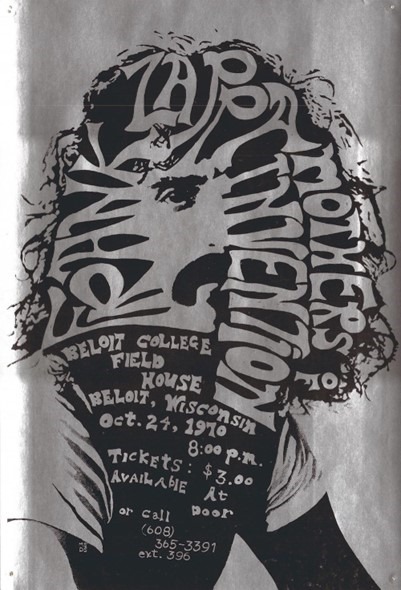
Returning that fall, I was living in a sort-of-commune in the college town, without any funds to attend college, trying to figure out what I should do. Not only didn’t I know that, I didn’t have any idea how I would know that. That’s when I heard that Frank Zappa was going to play at Beloit, at the college my friends had left for over a year before.
I probably heard this news by reading it in a letter. Yes, younger readers today, there was no other way. There was no Internet. There wasn’t even timely press coverage of national tour dates, everything being done through local promoters and short-lived rock concert halls. Phone calls beyond your city were “long distance,” charged by the minute and too costly to use for entertainment gossip. I found out in 1970 the same way as someone would have exchanged this information in 1870.
My interest in Zappa had grown over the two years since I’d first heard Zappa’s Mothers of Invention on recordings. I didn’t realize it fully, but wider music listening and observing Don Williams’ ability to construct music on the fly was mixed with another rare thing my small college supplied me. This little college 20 miles south of Des Moines, with enrollment of barely a thousand students, had a burgeoning opera program. Opera of course is — what does it say up at the top of this blog? — a place where music and words meet. The opera curriculum would grow over the years, but at this time the program was still emerging. The theater used for performances (also the site of some of my classes) was a small old building, with seating for a few hundred. I’ll summarize one part of my experience in this: to see opera sung in a grand opera hall, with elaborate sets and pricey tickets, with a complete orchestra, is a very, well, operatic way to view the realization of that art. All art is artifice, sure, but the human connection to me in those situations is stilted. Not so, opera sitting a few yards away from another person singing it, perhaps even a person your own young age who you might see in your classes or on campus. That’s another experience, far rarer.
You have not likely seen that impact reflected on my adult life, or on the Parlando Project that you know here. For one thing, my voice is not operatic, it’s barely a singing voice. Yet I can write this today, that I remember seeing for one exact example, a performance of Poulenc’s Dialogues of the Carmelites, and being carried away about what performed music, voice, and words could do in that small space. It may have helped that this opera makes an extensive use of recitative.
Listening to Rock music in my daily life then in The Sixties, it occurred to me, who in Rock could bring something to opera? Besides the differences in the use of the voice, or the nature of projecting character as opposed to ones seemingly authentic personal voice, there was the problem of extending the instrumental colors. My thought-answers then? Jim Morrison, who had performed a bit of Brecht/Weill on the first Doors album, and Frank Zappa, who claimed the ability to be “a composer,” and was even allowed to demonstrate that he could compose for larger ensembles including orchestral instruments.*****
That I could consider that was consistent with Zappa’s brand then. In those early, heady days of Rock Criticism, it was a given that Zappa was a genius. He wasn’t the sort of musical act that many people listened to with addictive, ear-worm pleasure, sure, but still a genius. Well, there were those smutty lyrics, and an assumed swimming pool of contributory drugs, but still a genius. It was The Sixties, we assumed impossible things could happen, but we still felt genius was rare and worthy of note.
So, a chance to see this genius in a live concert, this artist whose recordings had opened up other considerations for me, couldn’t be missed. I drove there, 300 miles, with other share-the-gas people in a Fiat 1100D.
Cost of the concert? $3. An amount similar to my portion of the share-the-gas cost too.
.
The concert? Not life-changing. The acoustics in the fieldhouse hall were atrocious, and our seats were in the galleries far from the stage. The music was good, but with the sound bouncing around and the typical poor vocal PA of the time, the result was a mixed pleasure.
We got back in the little car to head back to Iowa. Finding our way through the unfamiliar streets we saw another car occupied with hair as long as ours inside. That car contained some young women. For some reason they wanted to share with the fellow freaky-looking folks that they knew the hotel where Frank Zappa was staying and that they’d been invited to visit him.
Of course we believed them. Of course we followed them. What did we assume was to happen there? Some sex, drugs, and rock’n’roll orgy? I’d just turned 20. I didn’t know what I was going to do with my life, or how I’d figure that out. So, why would I worry about might happen for the rest of some single night in October?
When we arrived, the bunch of us from the two cars, maybe 8 or 9 people, spread out around the non-descript motel room. A couple members of the band were checking in with Zappa. There was a short discussion at the doorway between Zappa and George Duke about what Duke had played at the concert, which got approval from Zappa. The band that night, though billed as the Mothers, was new, containing vocalists who had once been part of the pop band The Turtles, now billed as “Flo and Eddie.” One of the young women from the other car bounced on one of the beds. Most of us seemed like me, passive, waiting for something to happen. Zappa turned his attention to us, asked us what we’d thought about the concert. There was some short discussion. I think I may have mentioned that a lot of the material seemed new. Best as I can remember, that was accurate. Zappa replied that they were doing some of the old stuff too. Memories fail, but I believe “Concentration Moon” was replied as one of the veteran numbers. The male part of the room had some hard-core Zappa fans, who started to geekout on questions about the band’s history. I recall one asking about Doug Moon who had played with early versions of Captain Beefheart’s Magic Band. Were they trying to impress the genius with their knowledge, even in the midwest, of the places Zappa had come from? Zappa replied Doug was some guy who’d worked at a gas station. Zappa was patient about the questions, however trivial. At one point he took out a movie camera and filmed us in the room. I remember he moved in close to my face as I was missing one bow on my eyeglasses after that part had broken, and I had no funds to fix or replace the frames yet.
Here’s a few things Zappa conveyed to us in the roughly hour that I, and maybe others in the room, didn’t know before meeting him.
When asked about his doo-wop music parodies, including the Cruising with Rueben and the Jets LP, he corrected us that he liked that music. He spoke about Fifties R&B records he was inspired by. Since the lyrics in those songs were satiric, I’d assumed the music was also something he held in contempt. Far from it, he lit up talking about this. In The Sixties there was a widespread critical assumption that good music was “progressive,” meaning that we were to drive our plows over the bones of the dead, so this was news to us.
He nonchalantly corrected any impression that he was inspired by drugs. How he did this without sounding like a “Listen kids…” PSA I can’t exactly recall.
He seemed genuinely interested in us, and what we thought about the music — though at times, such as when he wielded the camera, the idea that we were natives and Zappa was an anthropologist occurred.
For me, the important thing happened near the end of our time in the room with this “…But, a genius” guy. I asked him how much of the show was improvised and how much was composed. He went over to the side of the room and picked up an oversized portfolio. Opening it, he showed it to me. Multiple staves of music, a rather full score as I recall. Dialogue written out, seemingly informal and back and forth, as if the band members were speaking off the cuff. In retrospect, I believe I was looking at scores for 200 Motels which would be filmed a few months later with a full orchestra. As he showed me this, he talked briefly about the effort he put into it, which the score showed. I was immediately impressed with the formality of the effort to achieve what seemed like chance informality. There must have been some serious seat-time in getting that done. The intent of it!
Imagine instead if I had somehow visited the hotel room of Jim Morrison in 1970. Perhaps my romantic notions of the creation of art would have gathered more poète maudit forces. Did something in my subconscious connect what Frank Zappa conveyed that night with William Blake, who when not out talking with the visions of angels, was innovating printmaking techniques and making books with his own skills?
After that significant side-trip, we left the room and returned to Iowa. If you’d asked me that day, I still didn’t know what I wanted to do with my life — not a whit more — but what I did have was a piece of information, and an outlook. From that night I could remember that doing was a large part of doing something with your life.
This is already a double-length post, so enough for today. To tip my hat to Mr. Zappa, here’s the LYL Band roughly approximating one of his later tunes in a we’ll-give-it-a-go live performance.
We flattened Zappa’s music and arrangement here, but as the video points out, if Zappa were performing this song today he’d be sure to include more screens than just TV.
.
*This oversimplification is more accurate about youth in The Seventies than the Sixties, even the final three years of The Sixties. In terms of clothes and hair, look at a range of contemporary photographs and film from the actual Sixties. Beards and long hair will be sparse on the young men, not movie wardrobe department common. Yes, use of marijuana and other drugs increased during the last half of The Sixties from a very in-group secrecy thing to a sizable minority, but in doing so it lost a bit of its bohemian rhapsodic connotations and became just another illegal high like drinking alcohol before the age of 21 had previously been. Real “counter-culture” bohemianism in an artistic sense had grown from the beatnik Fifties — maybe even doubled or tripled — but was still something a single digit percentage of people engaged in with any seriousness.
**In reality, this regional expansion of the conflict had been going on by proxy and by secrecy for a long time — but in the run up to the Kent State shootings it had become stated policy, driving hard-to-escape fears that there were now going to be additional para-Vietnam Wars.
***This is a complex point, one I need to leave off too briefly. Women of course were involved in anti-war activity before Kent State, but it occurs to me that this small factor may have been more important than recognized in adding to the explosion of activism in the spring of 1970. In case you’re wondering: yes, the anti-Vietnam war organizations, like the counter-culture, weren’t significantly less patriarchal than the rest of Sixties society — and though it may rankle some, I’ll add this as well: the victims at Kent State were also white.
****Any reading this who participated in Occupy Wall Street or the Black Lives Matter activism of this century may have a moment of recognition here. The emotional high of sensing that something is finally being said loud enough, that mass pressure is finally being brought by an unprecedented number of people is shared from this time. The emotions following, when such movements crest and seem to dissipate, need to be considered too. Here’s one piece of wisdom from someone else from this time worth listening to.
*****Will some Classic Rock oldster reading this think “Well, Rock Opera, what about the Who’s Tommy?” Tommy had yet to be released.
Ready to go on a roundabout trip with today’s blog post? Keep your hands inside the car, we’re going somewhere back to here on another wild-mouse ride.
Not every record had those lyric sheets. Some artists opposed them on principle—Bob Dylan was one—though to a large degree the reason we got them was due to that hold-out, Mr. Dylan. Dylan revolutionized song lyrics. Before Bob Dylan, no one wrote songs with lyrics like he did.* After Dylan, a lot of everyones tried their hand at it. In the 21st century when we hear or see lyrics that use an accretion of rapidly changing metaphors and a kaleidoscope of dark-cylinder mental outlooks, we no longer notice that they are Dylanesque. It’s just a mode that songwriters can draw from the common.
Would that have happened if Dylan hadn’t happened? Possibly. And plausibly, only similarly, but distinctly different. Would Richard Farina (sans motorcycle accident) or Leonard Cohen have won a Nobel prize for reshaping a word form?
One argument that it would have still happened was the psychedelic phase of pop music that followed Dylan’s revolution. There, later in The Sixties, opaque and strange lyrics got another push, one that was largely ascribed to intoxicating chemicals which produced visual sequalae and baroque mental turns. Now of course the intoxicated or drug altered poet was already a thing in literary poetry, and the sober cold-water-army songwriter was likely a minority long before “The Sixties.” But Dylan had punctured the membrane that separated those two crowds, and so we got the Canyons of Your Mind school of songwriting too.
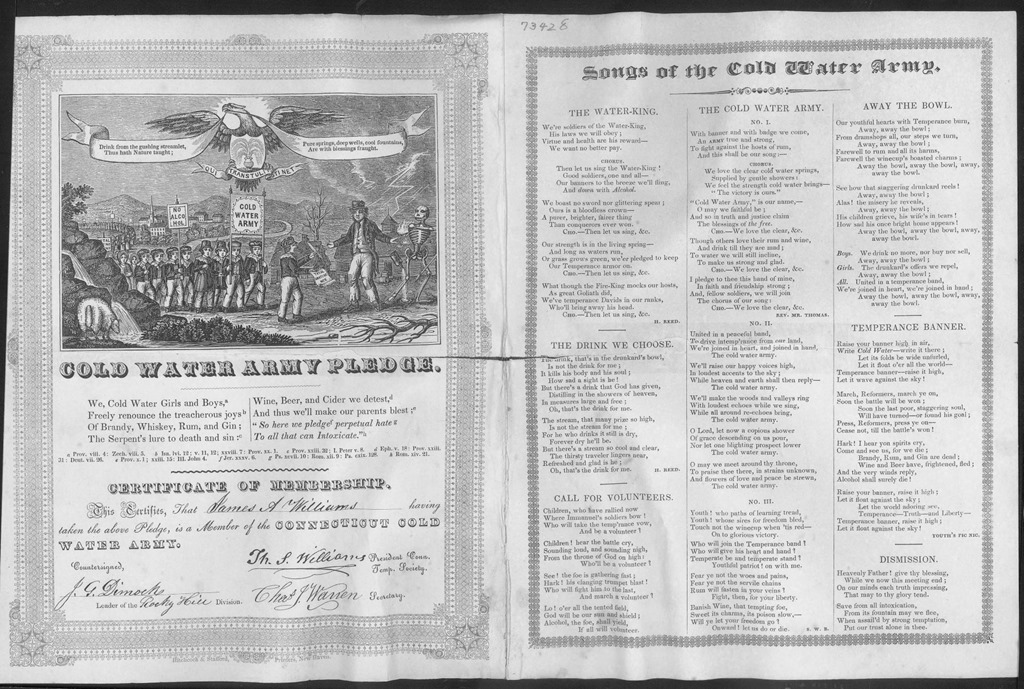
19th century straight-edge punks on dihydrogen monoxide, usually also anti-slavery and pro-women’s rights too. Comes with a lyric sheet!
Some of it was good, some of it bad—but then we might see lyric sheets to the wind like these:
Oh where are you now
Pussy willow that smiled on this leaf?
When I was alone
You promised the stone
From your heart….
Brandish her wand
With a feathery tongue
Or
A mien to move a queen
Half child—half heroine
An Orleans in the eye
That puts its manner by
For humbler company
When none are near
Even a tear
Its frequent visitor
Or
If you were a bird and lived very high
You leaned on the wind as the breeze came by
Say to the wind as it took you away
“That’s where I wanted to go today”
And
Bedouin tribes ascending
From the egg into the flower
Alpha information sending
States within the heaven shower
From disciples, the unending
Subtleties of river power
The chorus sings: “OK Boomer,” and you can ascribe all of these to chemical traces, wonder about their authors consequent mental damage, or coldly appreciate them as word music, but I’ll come at you from a minority report: the trip’s in your head, not in the drug. I gave up stuff you can smoke (mostly nicotine) around the time I passed the trustworthy border age of 30. I never spun the pill roulette wheel. Needles are for records or loose buttons.
Next stop for the psychedelic bus is some credit for those lyrics above. The first is from Syd Barrett’s post-Pink Floyd song “Dark Globe.” The second is the beginning of an arresting if mysterious poem by Emily Dickinson. The third is by children’s writer, humorist, and WWI vet A. A. Milne quoted by songwriter Paul Kantner to begin the Jefferson Airplane’s “Ballad of You and Me and Pooneil.” And the fourth is the start of “Slip Inside this House” from the 13th Floor Elevators’ Tommy Hall and Roky Erickson.
A little day glo paint or patchouli and Emily Dickinson fits right in when she writes in this mode I think, even if she’s a century too soon, “The Eighteen-The-Sixties.” When I ran into that first stanza of her 1861 poem known by it’s first line “A Mien to Move a Queen” earlier this month, I was immediately captured by its strange mystery, so much so that I worked out the music you hear today without even knowing that the poem was longer than that one stanza, and I was so entranced by it that the piece you hear today uses only the first and last parts of her poem because I think the middle parts break the mood that first stanza gave me. Want to see the entire poem? The link is here.
The omitted middle section seems playful to me—even as the British would say, twee, but I am of course editing a genius here. I still like my selection as I hope it adds some weight to the whimsey. What was Dickinson on about in this poem? Even living with it for a few days, I’m not entirely sure. The opening stanza is often read as connecting to Joan of Arc. Some read the poem as Emily reflecting on herself and constructing her own persona, and the middle section I omitted gives some evidence of that. Beside it’s general mysteriousness, there are to my mind two pieces of particular heightened sensitivity or even hallucinogenic imagery: the “Orleans in the Eye” line and the sensuous and heard quiet of the “Like Let of Snow” image.
So, we started with musty cardboard squares and moved through two steps of an era of wilder and wilder metaphors sung to music, and finished with Emily Dickinson, sewing 1861 fascicles by whale oil light while listening to Syd Barrett or A. A. Milne feedback on her record player long into the night. In between songs, the needle stops shimmying and she can hear the sound of snow moving across snow outside, filling, and not, summer’s empty room.
The player to hear my musical performance of a selection from Emily Dickinson’s “A Mien to Move a Queen” is below. Thanks for reading and listening!
*Yes there are examples that made it into popular or semi-popular music pre-Dylan. Modernist poetry had already done all of these things earlier in the century, and in addition, a big part of what Dylan used in creating his work were the un-acknowledged Modernists who created the Afro-American blues. None of that disproves the point that Bob Dylan showed that you could do that sort of thing in a proximate way that led to a revolution in the possibilities of song lyrics.
The Parlando Project is mostly about presenting other people’s words. I like that. It adds variety and it lets me write about what encounters with those words bring forth. We’ve done that over 400 times since this thing kicked off publicly in 2016
So, we’re always ready to celebrate National Poetry Month. Any month is poetry month here! But every once in awhile I slip in one of my own poems. Sometimes it’s just because I have something I want to say to this adventuresome audience, but it’s often because I’ve read something someone else wrote and I think of something I wrote (or should write, and then write) that relates to it.
A blog I read regularly by Paul Deaton has ranged over various subjects in the past couple of years, but lately he’s been writing some about the past, including lives that range back into his parents and grandparents generations. I’m not going to go back that far, I’m only going to go back to when I was a young man. Given my age, this is “Boomer” territory that’s been already over-farmed—but bear with me. This isn’t really a poem about the past, it’s about someone in my generation who has a past, but presently. For those Gen X and Millennials who find this insufferable, I remind you that I’ve been priming my High Schooler who isn’t a Millennial to blame Gen X and Millennials for ruining things for the current and subsequent generation. I urge other geezers, crones and wise-ass elders to do the same. As our aged, but still very stable emperor demonstrates, the best thing to do to deflect blame is be proactive in shoveling it elsewhere. I don’t know why that should work, but it does!
Anyway, I’ve presented quite a few poems this year by younger-than-mid-life poets whose poems speak as if they are aged.
Besides National Poetry Month, April is supposed to bring us Record Store Day. It would have been last Saturday, an annual celebration of those venerable little stores that once again were selling dark flat petroleum circles that sing when you poke them with a needle. Our current crisis has canceled that.
Now back in my day…Oh man, having a past and dragging it around does make one insufferable doesn’t it…this sort of thing was serious business for me. I had little spending money, but I would hope to have it in order to buy one of those foot-square pieces of art with the circles inside. Something cool. Something that represented my generation.
I can remember a particular spring afternoon. Somehow my girlfriend and I had caged a ride in a keyboard player’s new AMC Javelin to travel to Iowa’s capital city where there was a “head shop” (which is where the best new records were sold, along with, well, “smoking accessories.”) On the way we listened to an 8 Track tape of the Moody Blues To our Children’s Children’s Children. When we got there, I could merely marvel, as I had barely enough for one record album, and couldn’t decide which one to get or if I might need the money for something else. So, the only thing I bought was a pinned badge: a smaller, paler circle, containing a bit of the cover art to the Cream’s Wheels of Fire record.
A circle from “The Sixties.”
Recalling this day 50 years ago or so, says paradoxically to me what music and recordings meant to me then. A record was a precious clue to take me through days or weeks. Foolishness? It’s always been partly that.
But of course something else was on my mind, and the mind of some of my generation on that non-official, just another record store day. War. Justice. The cutting edge of the then gap between generations and elders that had been through WWI, WWII and the Korean War, and were often sure we were ducking our war turn. Our best thoughts of ourselves were that there were more important battles, and of course some of us didn’t succeed in avoiding the war they wanted us to fight. And some of us went off looking for Eden, a place you can sort of find, and then lose track of again.
What else does that memory mean? What does it mean presently? That’s what today’s short piece is about. The player gadget is below to hear it.
Poetry as an immediate witness to momentous history is not a common thing. Poems of events tend to autobiography, deaths, love, births, personal injuries and triumphs. Today’s piece has both elements—memorable on both counts.
Guillaume Apollinaire is a major figure in Modernism with an influence across the arts as a critic and theorist. He popularized the term Cubism, invented the term Surrealism, and using his own name “Orphism” helped explain and formulate abstract expressionism. In the era surrounding WWI his influence and omnipresence was stronger from his base in Paris with French-speakers than Ezra Pound’s was for English-speakers from London. As a poet Apollinaire bridges the 19th century Symbolists to the Dada and Surrealism to come, and though he wrote in French, many of the English-language Modernists looked to French models for their verse.* While his work is experimental with form and language, it’s also very open-hearted and joyous in a way I associate with later 20th century American Frank O’Hara.
“The little car” tells of a day of Apollinaire’s that would change his life. On that biographic matter alone it would be of interest to literary historians. But it also tells us about the early days of the most influential event in Modernism, the outbreak of WWI. Apollinaire’s poem is comparable to W. H. Auden’s better-known beginning of WWII poem “September 1, 1939.”
So, let’s begin talking about the poetry as history today.
World War I started over a series of days earlier in the month of August 1914, kicked off by a ham-handed assassination in the Balkans at the end of June, followed by a slow enactment of various alliances and agreements plunging the whole world into warfare over the course of weeks (or in the case of the U.S., years).
Unlike the reputation of WWI as a brutal struggle of attrition between trenches, the opening August weeks were fast-moving. German troops cut through Belgium taking over that country in short order, putting them at the northern border of France as they met the French army. Large military movements and formations just slightly modernized from the Napoleonic era, that still included cavalry charges and fife and drum, met modern artillery and rapid firing weapons. Aerial bombings were introduced to warfare (though ground-based actions were more deadly to civilians). Soon amplified by propaganda, there are widespread accounts of bestial atrocities by the advancing army.**
Before the events of today’s poem, which self-dates itself to the end of August 1914 and into the following September day, during the Battle of the Frontiers, France’s army had suffered its largest single day of deaths and casualties in this or any war before or since, a staggering total of 27,000 killed in one day, with a figure of 300,000 casualties. The French army was reeling, withdrawing back toward Paris, which was the Germans’ objective in this first month of the war.
Apollinaire and his friend the artist André Rouveyre are in Deauville on the northern, English Channel coast of France. The poem doesn’t say, but I’m assuming they feel that the German advance is threatening their location, and so they do what threatened people unsure of the future often too, they head for home, Paris, not weighing that the French capital is the objective of that invading army.
Here’s my new translation of Apollinaire’s “La petite auto” used for today’s performance
That they leave “a little before midnight” is not just an image of imminent dark change, it also may say something of a necessity not to wait, or perhaps a decision that traveling at night, as difficult as it might be with primitive headlights, may be safer under the cover of darkness.
The poem continues with a series of Symbolist images, assembled in whatever order, as a Cubist painting might be. These are not mere inventions. Although expressed symbolically, they are reportage. Indeed, some of the symbolic events which may seem mundane to us in our world, would be accounts of dreadful wonder in 1914: men fighting in the sky, submarine monsters of war—the masters/merchants of war with their opulent and extraordinary wares.
Another feature of this poem is that the text begins to wander on the page and eventually is laid out in a manner that Apollinaire called “Calligrammes” to form the shape of “The little car” of the title.*** I’ve not included that concrete poetry text in my new translation for reasons of length and focus on the spoken potential of the piece.
The poem ends with Apollinaire and Rouveyre arriving in Paris on the afternoon of September 1st. I note the poem says they stopped for a bit in Fontainebleau, just south of Paris, which indicates that they took a round-about route that day since Fontainebleau is south-east of Paris though they were coming from the north-west of Paris.
The “mobilization posters” he speaks of that were being put up as they pulled into town tell of the irony of their route to escape the Germans. The German army is now threatening Paris itself, advancing to between 20-30 miles from the city, and legend has it that the French army was able to redeploy quickly by dragooning the entire taxi-fleet of Paris.****
What happened after the events recounted in this poem? Apollinaire fought in WWI for his adopted country France, and in 1916 was seriously wounded. Still weakened by the wounds, he’s felled by the infamous flu epidemic of 1918, two days before the end of the war that would reshape and extend Modernism, as Tristan Tzara would say in his moving elegy “He would have rather enjoyed the fact of victory.”
Many of Apollinaire’s WWI generation lived on as forces in my post-WWII lifetime, as still-living actors in the culture, but Apollinaire was not to be one of them. So influential as he was in the early-20th century’s cultural ferment, it could be said that his death during the war was the single most important cultural casualty, more important than the death of promising poets such as Edward Thomas or Wilfred Owen because Apollinaire, like another casualty, T. E. Hulme, was more than just a writer, he was a leader and promoter of ideas. You can make the case that his death is the same magnitude as some alternate-time-line where the world lost Picasso in 1918. Or you could make another judgement: he was so effective in the pre-1918 years, and the Modernist urge was so strong and then intensified by a world war that made the old artistic forms seem like a cavalry charge against machine guns, that his continued life was not crucial. That’s a cold debate. His friends sure missed him, and kept working.
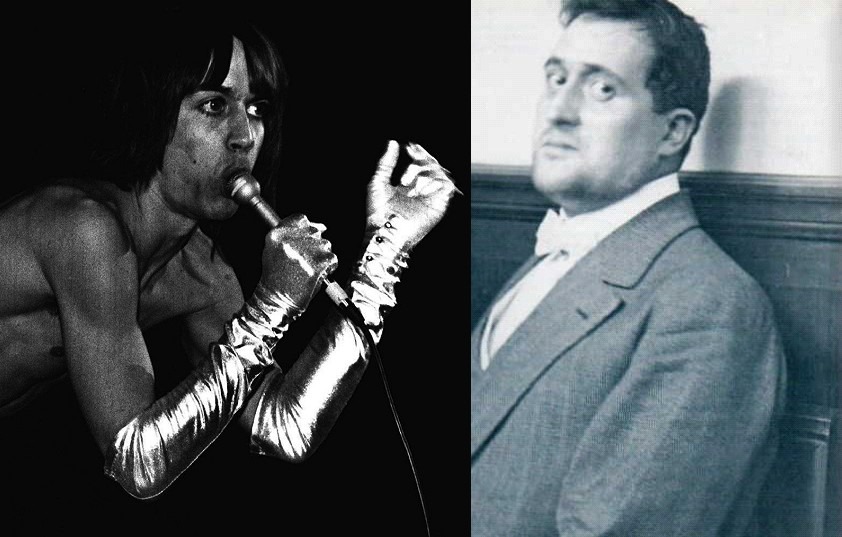
Dionysus and Apollinaire.
Musically I’ve had this thought lately that I’ve avoided use of some of my most basic musical genres. And Iggy and the Stooges are the definition of that. They started as an art project, making free-form noise on stage, with Iggy Pop, a converted blues-band drummer as their front man. Somehow they decided that the most elemental and elementary expression, however untutored and unvarnished was the way to go. Iggy Pop’s lyrics were the “Blue Undershirts” of 60s rock, the rejoinder to “you call that poetry.” A song such as “1969” from their debut LP is a bored and hedonistic critique of a year deep in another war, cultural and shooting. Robert Lowell it’s not. It’s really not. No, it’s really really not.
For this performance I’ve enlisted my son, the “in his first year of it” bass player and singer, who from his interest in punk and indie-rock can explore that aesthetic with a fresh set of fingers. Conceptually, this song is inspired by the Stooges “1969” because here we have (with “The little car”) two songs about war across a nation,***** but in my tribute I simplified the Stooges’ typical 3 chord trick into a 2 chord chug. Of course, to my son the Vietnam era is exactly as old as WWI was to Iggy and the Stooges. All wars should be so old.
The player for our performance is below. Click on play and turn it up.
*And the French in turn sometimes looked to American Walt Whitman, who never found full favor with the English language avant garde, making the French vers libre writers poetic money-launderers!
***E. E. Cummings was heavily inspired not only by Apollinaire’s dropping of punctuation, but his freeness with placement of text on the page.
****The taxis that saved Paris legend may not hold up. But my favorite part of this linked story? The account that the taxi owners kept the meters running and presented a bill to the government after the battle. Paging Joseph Heller or Milo Minderbinder to the white courtesy phone.
*****Or not—at least by intent. On the rattling plastic luggage record players of the time, I always heard Iggy Pop’s opening lines in 1969 to be “It’s 1969 OK/War across the USA.” Some cover versions say I’m not the only one who heard “war” as part of the folk process. The published lyrics and close listening with headphones say Iggy was singing “All across the USA.” Well, excuse me while I kiss this guy. The Iliad was carried by an oral tradition long before it was written down. Regression analysis says Homer wrote it about some sunny Mediterranean partying and dancing. The homoerotic and warfare parts were just misheard by the folks in the back row.
Today is May Day, a day that combines many things. Neo-Pagans can point to it as Beltane or the morning that follows Walpurgis Night. Since the late 19th Century it’s been “International Worker Day” associated with labor and Socialist movements. It’s about midway between Spring Solstice and Summer Equinox.
It was also once a more or less secular holiday celebrated because by now it’s likely Spring in essence, not just Spring in some calendar’s notion in northern climes. A long time ago, in my childhood, in my little Iowa town settled by Swedes, May baskets were still exchanged—this before Easter had become one of the commercial candy holidays paired with Halloween. In Britain May Day still a bank holiday, celebrated next Monday with sundry celebrations.
In Minneapolis, this Sunday is the date of an annual parade organized by a local urban puppet theater. We will sit on the curbsides as Indigenous dance crews, drum bands, anarchists, political candidates, stilt dancers, decorated bicycles, giant papier-mache puppets, and various cause marchers pass by to music by flat-bed truck rockers and strolling brass bands. The Minneapolis May Day parade combines all those May Days into one thing, a Whitmanesque democratic cultural event, a container of multitudes spilled open on a city street.
I used to take pictures and film it, but now I just go and watch it. It may be just me, but in the past couple of years the level of invention in the costumes/puppets seems to have fallen off, but that may just be me and nostalgia filters. Ah, for the good old days of 2010! I’m holding that this is just random variation—but in the end it’s the gathering of South Minneapolis people, parading and watching who make me most appreciate it.
The 2010 theme incorporated William Blake, and my soundtrack to this slideshow features Blake’s “The Tyger.”
Today’s audio piece, “I Thought It Mattered,” has words and music by Dave Moore, and is sung by him along with our more spontaneous incarnation, the LYL Band. Dave’s song speaks of lifetimes, marchers and causes. I think it’s one of his best songs, so give it a listen using the player below.





 Frank Hudson