Paul Éluard’s “The Life” and behind the veil of translation

I’m starting on one of my New Year’s Resolutions early: to spend more time presenting fresh translations here. I expect a sizeable portion of them will be from French. Today’s piece, from the poet Paul Éluard, will be one example. Since there will be others, I’m going to start today with an aside about the translator’s tasks and my tactics and credentials for doing them, before we get to today’s combination of poetry and music.

I am not a native French speaker, nor do I have great facility with that language. Growing up in a little Iowa town, I had the luck to be able to take French at our small community high school, and later attempted to study it in college. French was Hobson’s choice for any foreign language classes at my small high school, but I welcomed that particular chance. In at least one previous post I’ve mentioned some of my accidental connections to the French language, but let me summarize them for newcomers. I first encountered French during my father and his brother Bill’s fishing trips to Ontario Canada, where I, a grade-school aged kid, was amazed to find the labels on many boxes and cans were bilingual, French and English. Around the same time my beloved Auntie Red, found herself and her young family stationed in France when her military husband was restationed there. Back stateside, she would amaze me by reeling off French phrases still retaining elements of her Southern US accent. That there was such a thing, an entire other language to describe the world, presumably as rich as English, seemed marvelous.

My academic career with French was none-the-less fraught – both in high school and college. Much of the work was based on getting conversational mastery, and I was terrible at it. I have something (I’ve always suspected neurological) that frustrates me with vocal mimesis. It’s likely part of the reason I struggle with singing. Helpful correction of the “no, it’s pronounced like this” kind only made me seem stupid or uncooperative, because my second and further attempts would still be way off in trying to make the right mouth sounds. Though my academic career was eventually stunted anyway, I sometimes wonder what might have happened if I had lucked into a class based on silently reading and appreciating literature in another language.

But that wasn’t on offer, or affordable, to me. So, in my 20s, largely out of school, I started to translate French poetry. This was a laborious process. I would page through a French to English dictionary for all but the most common words. I still retained a smattering of knowledge of French syntactical and grammar practices back then, and putting the two together I was able to produce a handful of translations. One that survived from this work was my translation of Paul Éluard’s “L’Amoureuse”  which was presented here some years back.

My activity then, and my activity now, might occasion questions, ones I don’t know that I have a good answer for. Should I be doing this? Wouldn’t it be better if someone fluent in both English and French did any such literary translation? Isn’t the answer the that last question obvious?

My answers (then and now) would be: some of these poems don’t seem to have English translations I have access too, and even if translations exist, isn’t an attempt to do my own translation just another variant of doing one’s own “deep reading” of a poem? If for example, Helen Vendler has written an essay on what she found in a poem, does that mean I shouldn’t look at the poem myself and ask what all is in there – not because I think of myself as more learned or insightful than Vendler, but more at because I’m another human consciousness engaging with the consciousness of the poet.

What gave me such audacity, with so small a mastery of French, to do this? Well, I wanted to – enough for a stubborn young man. Now as an older man, still translating without mastery in the source language, I also tell myself that I did (and do) self-consider myself a poet, a chooser of words, focuser of images, composer of word-music. Part of the task of translation is to do the primary work of literal translation, but to produce the full pleasure to the reader of poetry, the poetic work is at least as important. Decades ago, I read that Ezra Pound used only someone else’s English glosses of Li Bai to create his landmark Cathay  collection. Eventually I became aware that Pound’s Chinese translations were not very accurate depictions of Li Bai – and since learning that as a young man I’ve sometimes “checked” translations of poems to see how varied the translator’s version may be from some literal word for word, or from other translators’ versions. I was too uncertain of my own translations to think I was doing better work, but what I read as taking liberties bothered the younger me. Are translators like Pound “cheating” by not serving the original poet faithfully? These resulting English poems (I would say of Pound’s Li Bai) were as much or more the translator’s poem as the source author’s.

But what if I publish my translations? There are what I call “guild concerns” there. In the same way that I worry that my naïve musical compositions and make-do musical skills are, in their small way, part of a flood in the musical culture that reduces the shrinking opportunities for “real musicians” and trained composers, am I doing the same for translators with better knowledge and cultural grounding? Back to Pound: his work out-shadowed other translators who knew Chinese, and I’ve featured here a contemporary of Pound, Shigeyoshi Obata, whose Li Bai translations are largely unknown.

As a guild concern for people who depend, or wish to depend, on income from their art, this can be considered an existential issue, and I wish them no harm. Yet they may think: no matter, you are  harming us. And now there’s another monster in the forest that they might view me as riding in on: computer-based artificial intelligence.

Since my early thumb-worn French-English dictionary forays, computer translations have become quite facile. An instant’s click will produce a literal gloss on one’s screen of a poem such as today’s selection. Let me stipulate to all, and to those that fear and dislike AI, these instant computer glosses are not good poetry.*   I will click for them, but I will still spend time with dictionaries. What are the various contexts of a word? Which choice in English brings the most to the poem?**

Herein lies one problem. I’m trying to read the source author’s mind, and that will bring in my own mind, experiences, and knowledge to filter that process. This part of translation is unavoidable for causing both errors and accuracy! As I’ve grown older, I now often understand those “cheaters” as other blind ones assessing the elephant of the poem. If, as Frost had it, poetry is what is lost in translation, then a translator’s job is to reclothe the poem’s bones in English poetry, using modern English poetic expression. Doing this has limits, dangers: readers may like their foreign poetry to sound, well, foreign, with an exotic awkwardness – and having ancient poets sound like your contemporaries at a local poetry reading risks unintentional humor.

So, here we go: an early poem by French Surrealist Paul Éluard, “La Vie.”   I start with a machine translation.
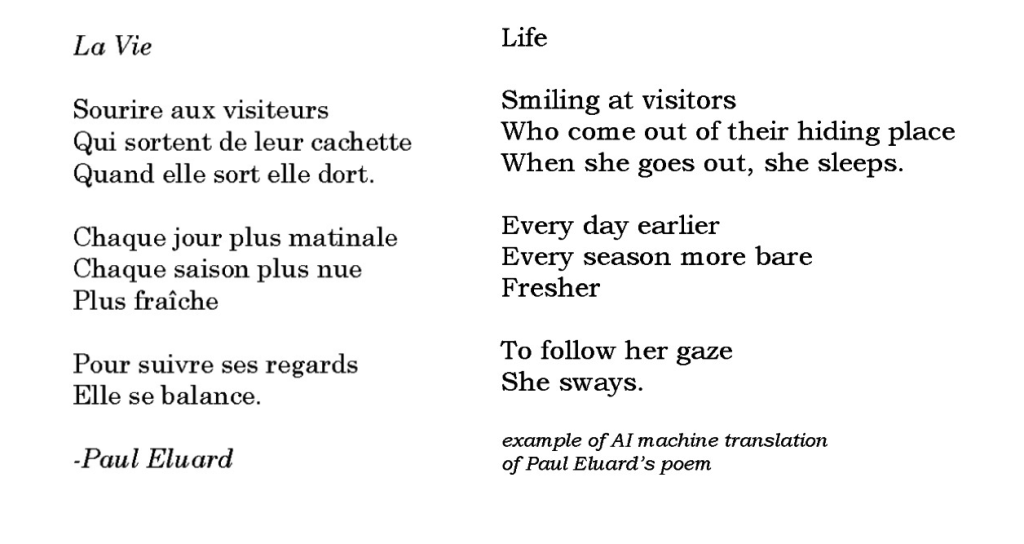
Life x2

The 1926 poem in its original French, and a computer translation

.

The syntax comes out somewhat scrambled or hard to follow. As a prime Surrealist, one that knew and went through the Dada predecessors to Surrealism, this is likely there in Éluard’s original French I think. My first questions are what are the images: what does the author want me to see, or otherwise sensually appreciate? This can be hard with Surrealist poetry or the like: they often seek strangeness or even nonsense in images. All good imagery works with some degree of mystery or novelty, anything less risks cliché. Even one of those images that you read and think “I’ve never seen it like that before, but once I’ve read this, I’ll always think of this comparison” has to surprise you, cause you to take the leap of likeness. Surrealism says you need to outright react that’s impossible or outrageous to fully free and implement the imagination. So, my primary task is difficult with Surrealist poetry – they may want to be impossible or impenetrable, yet I still try to make the images clear, and this may be subject to mistakes. It’s also possible that in psychoanalyzing the poem that I may be putting things in there that the conscious intent of the original poet didn’t intend. ***

Examining the gloss, I think Éluard is describing a woman whose consciousness is either in a dream state mimicking waking life or living her waking day informed by, or as if, in a dream state. I think the image wants that ambiguity, to have it both ways. Either way, the people and things she meets are like strangers who have been hiding and she has found them for the first time.

The Life tranlated by Frank Hudson

My translation, used in today’s short musical performance

.

I take the liberty while translating this image in giving double meanings to some words, using more than one English word to stand for a single French word. I’m doing what “rescaling” a lower resolution digital image does, I intersperse additional pixels/words to bring the image out. “Neu” is rendered “naked” and “new;” “fraiche” becomes both “cool” and “fresh.” This is a judgement call, and my choice may be wrong. In making those word choices, using a French dictionary with multiple meanings and usage examples of the word used in context remains useful. Another thought, that AI will miss, but bears considering: the author may have intended a pun or other wordplay .

The final two lines gave me a word-music chance to put a rhyme in to tie things up, what with “gaze” and “sways.” I was so pleased how that worked out that I overlooked one word, a mere possessive pronoun, “ses.” I’m enough of an idiot regarding French usage that I can’t be sure if it’s a male pronoun such as “his” or a general pronoun, a “he/her/it” equivalent. Who’s gaze is it? The woman in the poem? The poet, the male Éluard? Something else, life or imagination?

In my ignorance, and as an admitted failure of craft, I just put down “her,” because at the time I finalized my translation my focus had moved from the word-for-word elements to what is the vivid image; and I thought, this woman that Éluard is admiring in the poem, living the Surrealist outlook, is confident in her own gaze as she sways in either the intoxication of fresh experience or the artistic refinement of dancing her day forward, and so I wrote in my translation “her.” I thought the poem is about the woman – even should be about the woman in the conclusion if I was writing it – but Éluard might have chosen to end it with his gaze evaluating the woman’s experience: I’m the artist, they’re just “life.”

So unintentionally a feminist recasting of the poem? Surrealism does have a problem there: open to women as muses, yet not as open as it should have been in allowing them to be concrete artists themselves. Shades of Éluard and Breton, may I call my ignorant choice a “Freudian slip?”

Today’s music? This was a little exercise on my part using a depiction of a couple of chord progressions from a Joe Pass performance as the basis for the music. Pass was a great Jazz guitarist – but for external practicalities, once more there’s no guitar in this version at all! Dada composition! You can hear my musical performance of Paul Éluard’s “The Life”  with the audio player gadget below. No player visible? Not a mistake or slip, it’s just that some ways of reading this blog won’t translate into showing the player. If so, here’s a highlighted link that will open a new tab with an audio player.

.

*They don’t generate good literary prose either – producing as they do some estimate of the most probable word to be used, not the one chosen by another human’s consciousness that may not be the most common one-for-one. Moreover, with poetry the word-music issue is ignored by the AI translations, and poetry is musical speech. I generally don’t do rhyming accentual-syllabic translations, the cause of many an “inaccurate” translation, but I want the resulting translated poem to sound like poetry in modern English.

**These choices are a reason I highly recommend translation as training for poets. I don’t believe I undervalue topic, message, or prose-level-meaning in poetry, but many poets are stuck in finding the best combination of what they want to say with how it’s said. While I acknowledge the real issues with AI, for a monolingual, working with a literal/prose gloss of another poet lets one develop those selection-skills of the right word, right order, right connection, while one-step-away from their own experience and desired message.

***This may be proper since Andre Breton, another founding Surrealist, thought Sigmund Freud was on to something crucial with his recent theories and psychoanalysis. That Breton may be wrong about Freud or that Freud may be wrong about how the layers of consciousness and personality work only reinforces my stipulation that this outside consideration of the poet’s fellow consciousness is necessary for accuracy and errors.

Beautiful Justice

This poem by the French Surrealist poet Paul Éluard wandered into my view earlier this month, and it seems like it, and my work translating it into English, slots right in between my late wife’s poem I performed last time and this Saturday’s planned #NoKings protests planned around America.

I’ve mentioned earlier this year that in my youth I became interested in the French Modernists because I had gotten the impression that they were a key force in English-language Modernism. Later, from my work for the Parlando Project, I came to learn that this is only partially so. I wasn’t far into the Project when I realized that there was in London before WWI (at that time still the center of English-language literature) a “reverse British Invasion” going on as crucial as the 1960’s British Invasion that helped revitalized rock’n’roll music. Americans: Pound, Eliot, H.D., Frost, and even the important British Imagist theorist T. E. Hulme who had spent some expanded-sky time in Canada, were all there shaping up a make-it-new freshness. Now it’s also true that Eliot and Pound were fond of some French poets,* but as I later traced those French poets with the greater resources I could obtain this century, I found that some of those French writers were taken with Whitman and Poe.

Still, the French Symbolists, and the more internationally-sourced but eventually Paris-centered Dada and Surrealist poets were  important. Having only High School French it was hard for me to absorb a great deal of French Modernist poetry, but what I was able to find in translation, or painstakingly translate myself in the 1970s was an important influence on me.

It was soon enough that I came upon Paul Éluard then, who as far as the French were concerned, was a big deal, often rated as the greatest Surrealist poet. Well, ratings are silly – ought to remain so – but his poetry had striking imagery and was often concerned with some combination of erotic love and anti-fascist politics. In the 1970s, the first attracted me primarily, while the latter seemed a noble history lesson.

Ha ha! History, it seems, has jumped out of the past, and the anti-fascist Éluard is due for a revival – and so I welcomed seeing his poem “Bonne Justice”  appear on BlueSky in its original French. I could make out enough of it (my French is even more scant than it was in my 20s) to want to do a translation and possible performance.

bonne-justice-paul-eluard-manuscrit

I don’t know why his handwritten manuscript uses a circular format. Éluard may be trying to convey the eternal in natural law. Cynics might read “circling the drain.”  Young moderns seeing this would need to start with the translation task of reading cursive.

.

Translation moved quickly. Vocabulary issues are easily handled by computer these days, and online sources help to drill down on a word’s flavors.**   Éluard’s language here is not fancy, there are no obscure or archaic words, and he seems to me to be speaking to a general audience, not artistic theorists or avant-garde cadres. I proceeded as I normally do when translating from a literal gloss: first finding the images and what word choices will most clearly illuminate them, while giving care in preserving the “music of thought” in how the poem introduces the images and sets them off in the context of each other – though then I will take a hand at using a modern English word order and sentence structure that has some new music of sound in its new language. I rarely try to make rhyming translations. This poem’s word-music retains Éluard’s original repetitions, which I think are sufficient.

Beautiful Justice

A chord sheet presented so that others can sing this fresh song created in English from Éluard’s poem.

.

So, my “Beautiful Justice”  keeps all of Éluard’s parallels, though I made one set of considered changes, both for the benefit of myself as the performer of the result, and from my reading of Éluard’s intent. This poem seems to be speaking of qualities and situations of mankind as a whole, but he uses “hommes” (men) for this, and in another case a masculine noun for brothers (“frères”) which I rendered as “family.” I decided these gendered words were outdated conventions that would benefit from translation. Yes, I was thinking too of my late wife’s poem, “In Another Language,”  performed here last time, who in those same 1970’s was dreaming a genderless language.

It’s just a single acoustic guitar and my rough-hewn voice for this performance. If one wanted to remember this poem, now song, when marching on October 18th, it could be portable that way, though I don’t think my own performance is a stirring march – it’s more a reminiscent prayer. Prayer is focused speech. Song adds intensity of breath and music to speech. Marching and standing together, as simple as that is, adds action from our bodies (even this old man’s body). There may be more going forward that we will be called to do – who can tell with accuracy – but I think it’s not a bad start to be praying in song for those laws old/yet new, those always perfecting laws that protect us, the laws that aren’t capricious decrees to persecute and sever us.

You can hear my song in English made from Paul Éluard’s French poem with the graphical audio player below. No player? This law says you’re permitted to click on the highlighted link and it will open a new tab that will have its own audio player.

.

*Core Imagist F. S. Flint, working-class-born, but a native Londoner, worked hard to promote modern French poetry in this pre-WWI era for one.

**Though an online French dictionary I use for that had a service outage while I was working, and I began to dismay that I’d given away to charity my large old French-English dictionary volume.

William Carlos Williams’ Thursday

How many poems celebrate the poet’s dream, or dreams? This one doesn’t.

It’s fair to say that American poet William Carlos Williams had a curmudgeonly streak. In this poem from his 1921 collection Sour Grapes  he holds the line for the style that early Modernists had championed to break free from the poetic fancies that preceded them. By the 1920s the Modernists were moving on to new things, and it’s safe to say that many of them had developed new fancies. Indeed, in three-years-time the first Surrealist Manifesto would be published. The Surrealists went further than our usual sentiments about the value of an individual’s personal dream presented in the context of following one’s dream with the idea that it would integrate into our plans for work or a place in society. The Surrealists didn’t want to domesticate one’s dreams to society, they wanted to bring the full wildness of dreams to the fore and let society make whatever of it.

But, here’s Williams’ poem “Thursday,”  which you can find by following this link. First off, I see that he uses very plain language here, and there’s little trickery or poetic obscurity in his manner of speech either. There are no references to ancient myths, no quotes from Latin or Greek, or even Elizabethan English. He starts by noting the ubiquity of dreams, and at least for the purposes of this poem, he doubts their worth. I like the choice of words he uses here for why he’s going to skip the value of his dreams aspirational or Surrealist: “carelessly.” In other words: I don’t care about that all,  at least in this poem’s now. Instead, he spends the body of the poem inhabiting the body of the poet — as we the reader may too if we come along with Williams.

WCW at the Wheel

WCW at the wheel. “Yeah, but I’m driving and we’ll have some good ol’Imagism and none of that pretentious stuff.”

.

This is part of what I found intriguing when, as part of this project, I revisited the original English-language Modernists early work. I loved Surrealism as a young poet. I liked Dada referencing nothing and T. S. Eliot referencing whole libraries. But before those evolutions existed, what Modernism first used in English to break free and “make it new” was very concrete and radically simple: the presentation of the experience of brief charged moments that could include the revolutionary act of taking notice of the mundane and unexalted.

Like just a “Thursday”  in Williams’ life, in your life, in mine.

The player gadget to hear my performance of Williams’ “Thursday”  should be below, but if your blog reading software doesn’t show it, this highlighted hyperlink will do the job too. More work with piano this time and a return of an orchestra section. I keep hoping to return to more fierce electric guitar soon here. We’ll see.

Gargoyle

I said last time that the Midwestern American poet Carl Sandburg is not often thought of as an Imagist when we recount the Modernist revolution in poetry. Indeed, I get the impression that his work as a whole is summarized as folksy/clumsy by academia, the efforts of a low-fi Modernist with middlebrow pretensions to real artistic innovation.

I wonder if some of this is an unexamined hold-over from the High Modernists who made a cult of academic culture and credentials in the mid-20th century. Sandburg certainly intended to be a Modernist and wrote thoroughgoing Imagist poems. And yes, he can present himself in a friendly, non-pretentious way in some of his poetry. T. S. Eliot or Ezra Pound rarely seem to welcome in the casual reader, Wallace Stevens or William Carlos Williams may puzzle us on first encounter. Amy Lowell will let us know this is salon-worthy art. E. E. Cummings may charm us in a playful way while still remaining elusive. Marianne Moore likes the seemingly earnest statement, but when I try to absorb an entire poem I’m often at sixes and sevens.

Sandburg can seem a bit too straightforward. Which he’s not, or at least not always. Williams can have his red wheelbarrows and plums, Pound his wet petal Metro pedestrians, and we understand this is willful simplicity in the context of their more elaborated work. Poor Sandburg. He’s misunderstood for being thought understood. Understood too quickly  perhaps.

Here’s an example of a poem that hardly seems like Sandburg at all. If I presented it, unattributed, as translated from the French it might seem Surrealist, but it was published in 1917 before Surrealism was a movement. Even at the time I was performing it, I had only been able to absorb it as a sensation, and I’m not sure yet if I could paraphrase it even now. Here’s the link to the poem’s text if you’d like to follow along. It seems to be a poem about violence and strife, about suffering and infliction of suffering. Is the poem’s gargoyle war, Moloch, capitalism, the demonized exploited, or the demon exploiter?

Is it possible that Sandburg intended this ambiguity? The sensation of this poem is so strong, yet it doesn’t seem easy to solve into a one-to-one allegory. One could use Orwell’s famous decades-later statement as a gloss on this poem:

If you want a vision of the future, imagine a boot stamping on a human face—forever.”

Two things ground this poem, and Imagism wanted to be grounded, not intellectually abstract. First is the gargoyle, which was a commonplace building ornament in Sandburg’s Chicago, secondary to the beau arts style popularized by the 1893 Worlds Fair there and to the widespread availability of immigrant stone carvers in the city. Gargoyles are ugly and often open-mouthed,* as this poem’s gargoyle is.

But Sandburg’s poem subject is metal, which is not impossible—there are cast metal gargoyles. I’m no expert on metalwork trades, but the actions described in the poem sound like hot metal riveting. Is the “gargoyle” some metal construction which is having red hot molten rivets being pounded into holes one after another?


A riveting video? Maybe not for everyone, but a few minutes of watching will show how a four-person team works together in hot metal riveting


Or is this poem’s subject a child’s nightmare? After all, twice Sandburg wants us to know a child could visualize this.

So, an elusive work, but the horror certainly comes through. My performance is straightforward, just acoustic guitar and bass. Sort of a folk song, if the kind of folks you hang around with like Michael Hurley. The player is below.


*They are sometimes functional downspouts, designed not just as ornament, but as a way to direct roof rain water away from the building and it’s foundation. Gargoyle as a word is derived from the French for gullet, or throat.

Rimbaud’s Eternity

I started out this January trying to translate Rimbaud, and it’s only as the month is ending that I’ve finally got something to present. Why was this such a struggle?

Well, some of it’s me. I’m having a harder time this winter keeping up this project, and by focusing recently on translation I’ve only made it harder on myself. Why do I do these translations on top of composing, recording, and playing most of the instruments in the pieces? That’s more than a rhetorical question, I’ve sincerely asked myself that this month. I’m not a speaker of any of the native languages of the poets I’ve translated, so I work with the highly welcome online dictionaries and computer translators available—but I’m not a literary scholar or expert on any of these poets, and I’ve never lived as part of their culture. I worry about getting it wrong, doubly so in that I present them publicly.

I think I have three reasons. First is that it expands what I can present here. As I’ve mentioned before, it’s difficult to get permission to do what I do for work that’s not in the public domain, and I don’t want to use other people’s translations that are in copyright without permission. Second, I think this is a great practice to improve one’s own poetry. Do any creative writing programs these days require or assign translation of poetry?*  I don’t know, but if not, I’d encourage that. The struggle to find the best English word, to not harm the strength of an image, and to shape the poem so that its word-music works are directly transferable to writing one’s own poems. And here’s the last reason: I think performing a poem illuminates it for the reader/performer, it makes it part of your breath. Translating it imbeds it even more so in one’s mind.

So why was Rimbaud a tougher task?

Unlike other poets, I’ve never been a Rimbaud fan, even though Modernist French poetry was an enthusiasm of my twenties. I think I bought a translation of Rimbaud’s A Season in Hell  at the same Savarns book store on the Minneapolis West Bank where I picked up poetry chap books by Patti Smith and collections of French language Surrealists. And Smith and Surrealists liked Rimbaud a lot.  Smith has spoken reverently about how her copy of Rimbaud helped her through her own early twenties, but Rimbaud didn’t perform that service for me.**

Arthur Rimbaud
Sentinel soul. Teenage poet Arthur Rimbaud

But even just as myth, Rimbaud has an inescapable pull. There’s no story like it: a bright teenager drops out of secondary school, flees to the Paris of the Paris Commune in 1871, takes up with celebrated poet Paul Verlaine. Disasters ensue, including taking the most famous non-fatal intra-author bullet from a disordered Verlaine. In the midst of this, he writes furious poetry, poetry capable of impressing the most avant garde writers of the 20th century to follow.

Bang Bang My Baby Shot Me Down

“Situations have ended sad/Relationships have all been bad…” Plaque marks were Verlaine shot Rimbaud.

All this as a teenager. As his teen years end, he stops writing and moves to Africa to work as a commercial trader, never returning to the writing life and by accounts actively distaining it. He dies of cancer at the age of 37.

As we’ve seen recently here, there are other teenaged poets who’ve produced work we still read today. But very few of them produced their greatest work at that age—and arguably none of their youthful work was as influential as Arthur Rimbaud’s.

I’ve dealt with the trouble that hard-to-grasp, obscure, and Surrealist poets present to translations. Rimbaud was as tough as Mallarmé in that regard. In one Rimbaud poem I finished a complete translation draft, but was left with an “is that all there is” feeling that the result wasn’t all that compelling. I started another and then another, but again the early results didn’t seem like I’d grasped them or that they’d work here.

Then it hit me, at least with his poem “Eternity,”  part of its power is incantatory, it’s in the metrical and rhyming effects in the original French! This shouldn’t have surprised me. While there are other ways to achieve similar effects: parallelism, repetition, old-English alliteration, even a certain kind of intellectual rhyme in imagery itself, rhyme is still used in most songs and hip-hop rap flows, not because there’s some kind of rule about it, but because the expectation of return to the rhyme gives a certain fatalistic drive to the verse. And “Eternity’s”  meter is also unusual, it’s a very short line, just five beats.

Do you remember me saying that I almost never try to bring over the sound of the original verse into my translations, that I’d rather focus on making the images vivid and for the poem to have whatever good word-music in English? That’s still a practical rule, which may go double when translating from a language like French which has the benefit of so many more rhyming words; but in this short poem I decided to move over to respecting the syllable count of the original line and to a ABCB rhyming scheme.

Eternity

For good or ill, this did cause me to play more fast-and-loose with some of the more difficult images and phrases in Rimbaud’s poem, ones where other translators had other readings. If it sounded good, if it kept to the scheme, if it seemed to advance some overall flow to the poem’s meaning from image to image, I judged it “close enough for rock’n’roll.”

In the end, my main diversion from other translations of “Eternity”  I’ve seen is that many other translations make this poem more of a brag that Rimbaud has absorbed the infinity of the titular eternity and is now it’s master. My version has a more elusive eternity and a sense that others are seeking to apprehend it, much like a search for an underground partisan. Because the other translators may be Rimbaud scholars with a greater mastery of French, there’s a good chance they’re more correct—but if there’s a possibility that the “I is another” in Rimbaud’s poem, there may be an element I’m bringing out that was always there. Here’s a link to the poem in the original French for those who’d like to check.

Musically, this is rock in the ragged sense that rock’n’roll is a loose and inclusive form. There’s no tight backbeat, the bass is a bowed contrabass with some filtering, and the guitar won’t really play the blues—but the overall guitar timbres are from the rock palette. For the chord cadence I made a nod to some of those who did help me get through my 20s. The line in Rimbaud’s poem that ended up being translated (loosely in this instance) as “I see no escape” brought to mind “All Along the Watchtower”  sideways to me, and the chord cadence I use is also somewhat similar to Patti Smith/Bruce Springsteen’s “Because the Night.”  The lines in my translation “Murmur our desire/Night that is nothing/A day that’s on fire” could well fit into that sort of expression. Some of you know the drill to hear it: the player gadget’s below, but what if you don’t see a player? Here’s an alternative, this highlighted hyperlink will also play my performance.

*I know in the past students were assigned translations from classical Greek and Latin poets as part of general studies. While this came from the idea that classical grammar and vocabulary were the basis for mastery of English (a suspect notion) I think it must have helped many a budding poet.

**It was poet/musicians did that for me: Leonard Cohen, Bob Dylan, Jimi Hendrix and Smith herself. All of these are controversial figures in purely literary circles. I can tell you that none of them helped my standing in those 1970s years when I should have been establishing the peripatetic poetry career that I didn’t have. It would have been better for me, influences-wise, if I could have said Rimbaud instead.

Do Not Frighten the Garden

Long time readers will know the Parlando Project is generally about the encounter with, and performance with music, of other people’s words. But I have mixed in words I’ve written here from time to time.

Today’s piece combines both threads. I wrote it, but it was engendered by reading another poet who publishes online as well as on paper.

I actually don’t read many poet’s blogs. This is likely because I’m searching through and reading a lot of other poetry that is in the public domain and free for this project to use. So when it comes time to take a break and catch up with other folks in the blogging community, I may be reading about music, history, politics, or visual art. I do follow one blog almost entirely devoted to the blogger’s own poetry: Robert Okaji’s “O at the Edges.”

Okaji posts often, and I’d describe his poetry as solidly in the post-WWII Surrealist tradition. A typical* Okaji poem will have strong lines with images often formed from opposites or unlikely combinations. In many of his poems you may not recognize exactly what he’s getting at, as he often approaches his poems “meaning” in the Surrealist tradition of surrounding it with miscellaneous statements.

I too can stay puzzled by the elusive “meaning”, even though I’ve read a good deal of Surrealist poetry and spent a fair amount of my 20s focused on writing in this manner, and then cautioned readers here that the lyric poetry I most enjoy is not so much about ideas, but the experience of ideas.

In most human writing we’re tasked with being clear, and even in poetry, poets often choose to puzzle us as readers only a little bit, asking readers to focus on only a small set of questions around the meaning in a poem. I happen to believe that the arts work best in multiplicities. Writers that ask readers to puzzle more make the poems that ask readers to puzzle less work better—and vice versa; just as music that avoids expectations and common methods of loveliness makes simpler and more consonant music stronger—and the converse of that too.

And remember, Okaji is a writer of striking images. Outside of the stand-and-deliver classrooms where we are asked to tremble out the “real meaning” of poems, one can simply take pleasure in the thought-music of an image.

You do not have to write Surrealist poetry to treasure the infusion an unexpected, even inexplicable, image can give you. Trying to write poetry without reading poetry is like trying to write music without listening to music. How many times when I’m listening to music do I hear something and suddenly realize: you can do that in music!  Okaji’s work may inspire you, even if you do not write in his style.

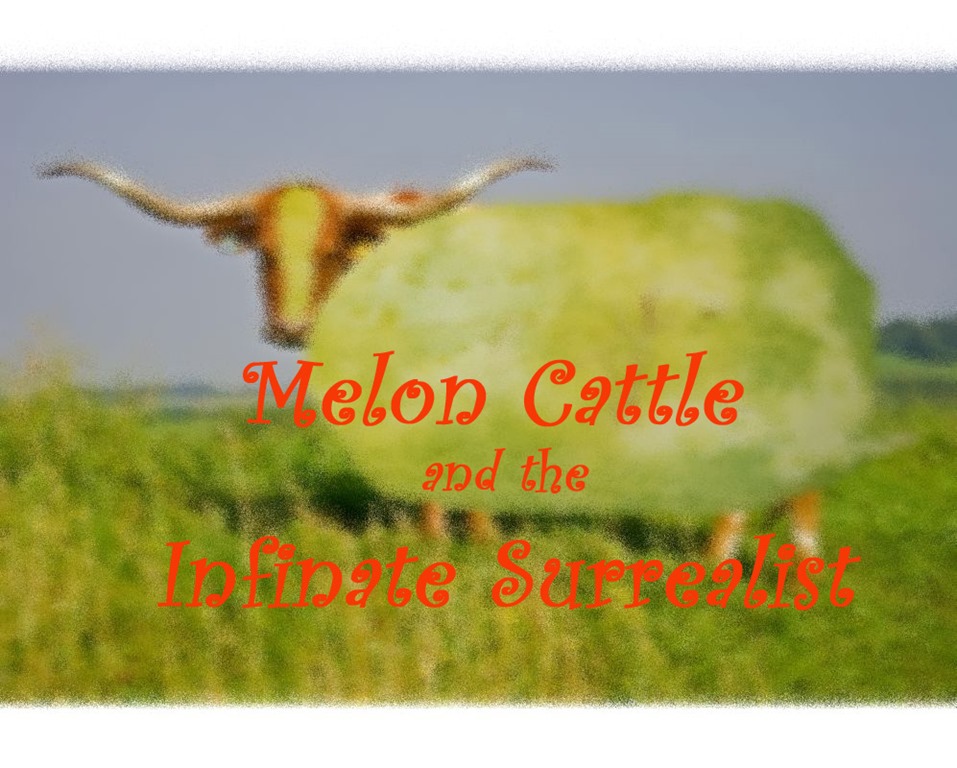
So a little over a month ago I’m reading this August post and poem of his, “A Herd of Watermelon,”  and one couplet attracted me so much, I started writing my own poem immediately, which now has become this post and piece: “Don’t Frighten the Garden.”

Melon Cattle and the Infinate Surrealist


Magritte had his apples, but Texans go for bigger fruit


Other than Okaji’s image of a herd of watermelon able to bolt, what else did I take from him for inspiration? Well, his scene and scenery has been to some degree Texas-based and I’ve been thinking a little more of Texas myself because my father’s family spent time in that state, and one of his brothers, an uncle of mine who was born in Texas, had just died this summer.

And so my watermelon herd is Texian.

I wrote my first few lines fairly quickly, and the rest of the poem developed over a month or so to full 14-line free-verse sonnet length. The final couplet seemed almost another voice coming in over the air as I composed it. Here I was, happily in Surrealist Texas free-verse land, when all of a sudden an Alexandrine pair of lines breaks in at the end! Did the spirit of Mallarmé know I was coming for him next?

Here’s the text of my poem “Do Not Frighten the Garden:”

Do Not Frighten the Garden


I’ve been playing more guitar lately, trying to maintain what I call, in my more pretentious moments, “my technique.” So, surreally, today’s music is orchestral. However, the top line melody was actually played on guitar, which—via the magic of a MIDI pickup—played the violin you hear. I also was able to make effective use of a timpani virtual instrument that’s new to my collection of orchestral colors. Give a listen to it with the player below.


*Okaji is more eclectic in his style than I can briefly outline here. Nor is all of his poetry elusive with its denotative meaning. Among other things I like that he does: English translations of classical Chinese poetry.

3D Blues

Man Ray was sort of Man Ray’s real name. His family immigrated to the U. S. in the 19th Century and like many families they changed their name along with their country, and so Radnitzky became Ray. His birth first-name was Emmanuel, which would be conventionally shortened to Manny, and with just a bit more compression you arrive at Man.

I think I’ve mentioned in passing that in my 20s I developed an interest in Dada and Surrealism. I’d never pass myself off as a scholar of these subjects, it was more a matter of feeling that some of their ideas resonated with ones I had already been using. As evidence of my lack of scholarship, I’ll mention that I had always assumed Man Ray was French. Well, no. He grew up and began his career in Brooklyn and moved to Paris in his early 30s, before he could speak any French, That must have increased the Dada potential of the move!

Man Ray always felt free to range about in media and approaches. He was creating Dada assemblages and “ready-mades” by 1920 and Andre Breton called him one of the “pre-Surrealists” who had been creating art in harmony with that movement before it was officially a movement. Man Ray pioneered the idea that photography could be non-representational, made short experimental films, but also shot portrait photographs. And, luckily for this Project, he also wrote poetry. Ray once said that his artistic credo was seeking pleasure and liberty. “I simply try to be as free as possible, in my manner of working and in my choice of subject. No one can dictate to me or guide me.”

His short poem “Three Dimensions”  was published in Alfred Kreymborg’s NYC-based Modernist magazine Others  in 1915. As I understand Ray’s poem he’s looking at houses at night, not a city but outer borough or suburban scene. They’re lit up, representing the lives within. I suspect he’s punning when he says the luminous houses, walled off and oh so separate, should not be viewed “as masses.” They seem weightless, but in their separations the are as well not “The Masses.” The dark spaces between the houses, the hedges and walls, are then compared to shawl-covered heads as would’ve been worn by old women in his day. Ray concludes, still recognizing the separateness of the houses and the lives within, but perhaps with a hint of their potential. Mystery and curiosity are separated when we know that if they were to be combined they would combust!

So, what can I do with Man Ray’s poem?

Glover Ray and Ray

Glover, Ray and Ray. Tony Glover on blues harp, Dave Ray on 12-string guitar, and a Man Ray self portrait


Dave Ray* was a singer and guitar player. In the early ‘60s he was part of Koerner Ray and Glover. I guess you could call Koerner Ray and Glover a group, though they themselves didn’t.** Dave Ray was 20 years old when KR&G released their first LP***, half-a-decade younger than when Robert Johnson first recorded a side, and much, much younger than Leadbelly was by the time John and Alan Lomax recorded him. Ray kept up playing his whole life until it ended while he was still too young in 2002.

KR&G formed in Minneapolis and were part of the early days of the West Bank and other folk music scenes here. I can’t say for sure (I’m a late arrival), but Dave Ray was probably one of the reasons that the Twin Cities area has a higher percentage of 12-string guitar players than anywhere else.**** Shortly after I moved to the Twin Cities in the ‘70s I bought a cheap 12-string at a record store on Hennepin Ave. It seemed mandatory, like learning the snow-emergency parking rules.

Cortez 12 string 1080

Why yes I can prove I’m a Twin Cities guitarist: here’s my 12-string.


Today I made a Dada assemblage. I’ve recast Man Ray’s “Three Dimensions”  as “3D Blues”  and I played it on that still surviving 12-string—not as well as Dave Ray could have done it, but then it wouldn’t exist if I hadn’t done it. The old 12-string has a soundhole pickup which I played through a little combo amp. KR&G started all acoustic, but Dave Ray often played plugged in later in his career. I rearranged some lines and phrases in Man Ray’s poem to fit it into a blues form. You can read Man Ray’s original here. You can hear my revision with the player gadget below.


*As far as I know, Man and Dave aren’t related. Dave Ray’s youngest brother, the equally well-named Max Ray, played the saxophone with the Wallets and still plays around town. If I was to Kevin-Bacon-game Man Ray and Dave Ray, Max Ray and the Wallets would be my move.

**Koerner Ray and Glover never broke up because they never joined up, performing solo or in various combinations from the first to the last. Dave Ray claimed they should have been truthfully billed as “Koerner and/or Ray and/or Glover.” Koerner made a record with Willie Murphy back in the 60s. Tony Glover wrote an important early instructional book on how to play blues harmonica as well as writing about the new Rock music that emerged later in the 60s.

***That first LP was called Blues, Rags and Hollers  and just like it says on the cover, they played a wider-range of material than what was labeled “Blues” as time went on.

****Both Koerner and Ray played 12-string guitar, in the tradition of Leadbelly and Blind Willie McTell. As time passed, the blues 12-string tradition became forgotten in many places, and I’d encounter people online who thought acoustic-guitar blues must be played on small-bodied 6-strings or resonator guitars.

China Mouth, a Changeling

I’m reading another critic/minor poet’s book about the early 20th century British literary scene, Edward Shanks’ First Essays on Literature.  He’s in general more backward looking than Herbert Monro’s 1920 Some Contemporary Poets  where I discovered Charlotte Mew (Shanks’ book has essays on Keats and Shelley) but I was interested what he had to say in his chapter “The Later Poetry of Mr. W. B. Yeats.”  Shanks seems ambivalent about Yeats, and this is one of the pleasures of reading contemporary assessments of still active artists. He notes with approval that Yeats’ language has with the 20th century become less formal and fusty, though Shanks feels that gain comes at a loss of a singing quality.*  Another conclusion he reaches is that Yeats’ is best when he’s describing the fantastical: “It is not Mr. Yeats’s business to describe the actual world, but to make beautiful pictures out of his dreams.” Though giving Yeats his due, Shanks doesn’t seem to think this is a good thing.

Interesting comment that, though I was already aware of Yeats’ appreciation of Irish myths and his dabbling in his era’s contemporary occultism. It caused me to stop and connect Yeats, and the two lesser known poets I’ve presented this month: Charlotte Mew and Yeats’ associate Walter Turner. Both have aspects of fantasy in their poetry too. And even our staid prelate of High Modernism, T. S. Eliot, while seeking his correlates within the whole timeline of culture, picks out elements of unreal gothic horror to weave into “The Waste Land.”  Elements so broad as to make me compare a section of “The Waste Land”  to Metal bands.

Did the horrors of WWI and the shifting ground of artistic Modernism impel some poets of the time to retreat (or advance) into fantasy? With the war poets, many of which had been “reporting” from the front-lines, no longer lining-out contemporary events while those events’ questions of outcome and action were pressing on all, was there now after the war a countervailing mode to step away from the pressing real?

If so, it’s no simple thing, and not just a matter of “give me some beautiful art to not let me think about hard questions.” Fantasy is just metaphor presented on another layer of art. Eliot, who unlike many of his contemporaries did not serve in WWI, would have trouble writing about the war as the veterans did after all. And the Surrealists—well their whole point was those “pictures out of…dreams” might reflect something essential.

Sir Joseph Noel Paton - The Reconciliation of Oberon and Titania

Fantasy. Escapism? Surrealism? Metaphor presented in another layer of art?


Mew’s “Changeling”  from my last post? Yes, it’s a fairy story, as is Yeats’ great “The Song of the Wandering Aengus,”  but either connects first on an emotional level deeper than any amazement at the fantastic. Talking fish or fairies knocking at windows are mundane compared to the loneliness of old age or the alienation of being an unlike youth.

Well, let’s end for now with an audio piece, an old one of my own. I wrote “China Mouth, A Changeling”  over 40 years ago, after listening to a conversation where someone else was bemoaning their alienation. During the conversation the main talker paused to reapply some very red lipstick, its deep red the China in the mouth of the title. Unlike Mew’s changeling—who will run off, who cannot be stopped—there seemed to me to be an element of stasis in that overheard conversation. They seemed resigned that they would have their art and their alienation in a frozen balance. That brought to mind a story in Robert W. Chambers’ “The Mask”  from his 1895 collection The King in Yellow  in which a liquid turns living things into statuary. That idea informed the last verse. Depending on one’s taste for mystery, it either saves or ruins the song. Use the player below to hear it and decide for yourself.


*I don’t think I agree, Yeats never stops being musical to me. Shanks himself has an interesting connection between poetry and music, as another chapter in his book “Folk-Song as Poetry”  deals with Cecil Sharp and other contemporary attempts to conserve British Isles folk music. Shanks’ first book was a collection of poetry called Songs, one of which lifts the floating verse that found its way into many folk songs, the one that starts “The cuckoo is a pretty bird, she sings as she flies.”

Crepuscule (I Will Wade Out)

Another short break in the Dave Moore series to present an unabashedly ecstatic poem by E. E. Cummings.

The kind of Modernist poetry we often use here rarely presents itself like this, as the early 20th Century pioneers tended to be a downbeat and skeptical lot, even before the great tribulation of the First World War. Cummings isn’t the only exception, but a poem like this is so extraordinary in its exuberance that it will always stand out.

E E Cummings self-portrait

Lipping flowers…the ecstatic poet’s self-portrait in pencil

As a page poem, “Crepuscule”  is laid out on the page in staggered lines sans punctuation, something Cummings may have picked up from Apollinaire, but the syntax isn’t as jumbled as some E. E. Cummings poems. It actually reads fairly easily once I lined-out the dismembered sentences. The images are surreal, though written before official Surrealism, and paradoxical sensations and states come one after another. Can one gather what is happening in the poem beyond the welcoming of sensation and exploration?

Crepuscule as a page poem

Cummings’ “Crepuscule” as a page-poem.

The title is “Crepuscule,”  an antique word for twilight, and so the poem is set in that proverbial border time. The poem goes on to either explore sleeplessly and fearlessly in the unknown darkness, or launch itself into the imagination of dreams, which surreally complete and supersede the “mystery of my flesh”—at night exploration, or dreams, at once, indistinguishable.

I didn’t see this until after I finished performing it, but I suspect the poem may have bookended images near the start and at the end, the twilight beginning with the swallowing of the sun, the ending with the moon setting the teeth (on edge) with the metallic bite-taste of the moon.

As sometimes happens when I compose the music for these pieces I find out or remember that others have done this before me. As soon as I saw the title I thought immediately of Thelonious Monk’s instrumental compositionCrepuscule with Nellie  and the idea was planted to use piano in my music for this. I did end up with some piano, but I reverted to guitar, my home instrument, to express the unrelenting long line of this poem that leaps into the bothness moment of twilight.

Embarrassingly, I had forgotten that Björk had performed all but the last part of Cummings’ poem as Sun in my Mouth  on her album Vespertine.  Björk brings big time sensuality to Cummings’ words, bringing out the eroticism that was always there, not just by her commitment to the performance, but by ending on and repeating the “Will I complete the mystery of my flesh” line, bringing fleshiness to the mystery. But this is a poem of the borderline, and the flesh is also hymned to complete a change to something else.

My fearless borderline tonight is presenting this music which would have difficulty reaching the level of originality of Monk or Björk. To hear my performance of E. E. Cummings’ “Crepuscule,”  leap into the ripe air by clicking on the player below or click this highlighted hyperlink to open a new tab window that’ll play it.

Pig Cupid

Today we return to the early 20th Century Modernists with a piece using words by Mina Loy. Last post we had a poet taking a political stand: Longfellow aligning himself with the movement to abolish slavery. Decades later, the Modernists joined political movements too.

One might suppose that since Modernism sought to overthrow the old cultural order and revolutionize artistic expression that many Modernists would be attracted to political radicalism—and to a large degree that’s so.

You might also assume that these artistic radicals would be leftists, aligned with the growing Socialist movements in England and the United States, or attracted after 1917 to the as then untested promise of the new Communist government in Russia. Or perhaps they’d make common cause with anarchism. Or maybe they’d create their own playlist mixing all of the above.

And yes, you can find that. Carl Sandburg in the U. S. Midwest, most of the Surrealists, bohemians in New York’s Greenwich Village, Herbert Read and some other British Modernists.

However, one can also find Modernists who aligned with the right wing in this era—and not only garden-variety Tories, or even those who allied themselves with the “respectable” racist strains of U. S. politics. Even in the years before WWI, the social theories that would coalesce into Fascism found adherents in the new literary avant garde. As to Americans, the most famous case is the indispensable Modernist poet, editor and promotor, Ezra Pound, eventually charged with treason at the end of WWII.

Modernists seemed something like stem cells as their artistic revolution kicked off—they could develop into followers of any kind of political radicalism. At a time when political engagement for artists was common, there must have been a feeling in the air that a side must be chosen if one was to be a thorough-going cultural Modernist.

So, much as the French Surrealists once sought to make Communism a dictate for membership in the Surrealist movement, the slightly earlier Italian Futurists eventually made Fascism a core value of their artistic circle.

mina-loy

I love my baby, cause she does good sculptures, yeah!” The young Mina Loy

.

It’s now we get to Mina Loy. No, not the delightful Hollywood actress—that’s Myrna Loy (Myrna Loy was the stage name for the woman born Myrna Williams, and it’s just possible that Loy could have been chosen to refer to Mina).

It’s 1905. Modernism is kicking off first in the visual art world, followed just behind by the poets. Loy, in her 20s, has already done the visual art thing in London and Paris, but her marriage is failing, and she’s just had an infant child die. To change her life, she moves to Italy. She befriends Futurist artist Carlo Carra, and if you follow along on your Futurist score-card she had love-affairs there with two principals of Italian Futurism: F. T. Marinetti and Giovanni Papini.

Let’s re-set our scene. Here’s a young woman in a foreign country going through life stress events. The art-world is shifting under everyone’s feet. As a movement that will eventually fancy itself outright as the cultural well-spring of Italian Fascism, the circle she’s fallen in with isn’t just about making it new, it’s militaristic, paternalistic, nationalistic, and it worships violence. That isn’t what jealous opponents say about Futurism, it’s what its own manifestos brag about.

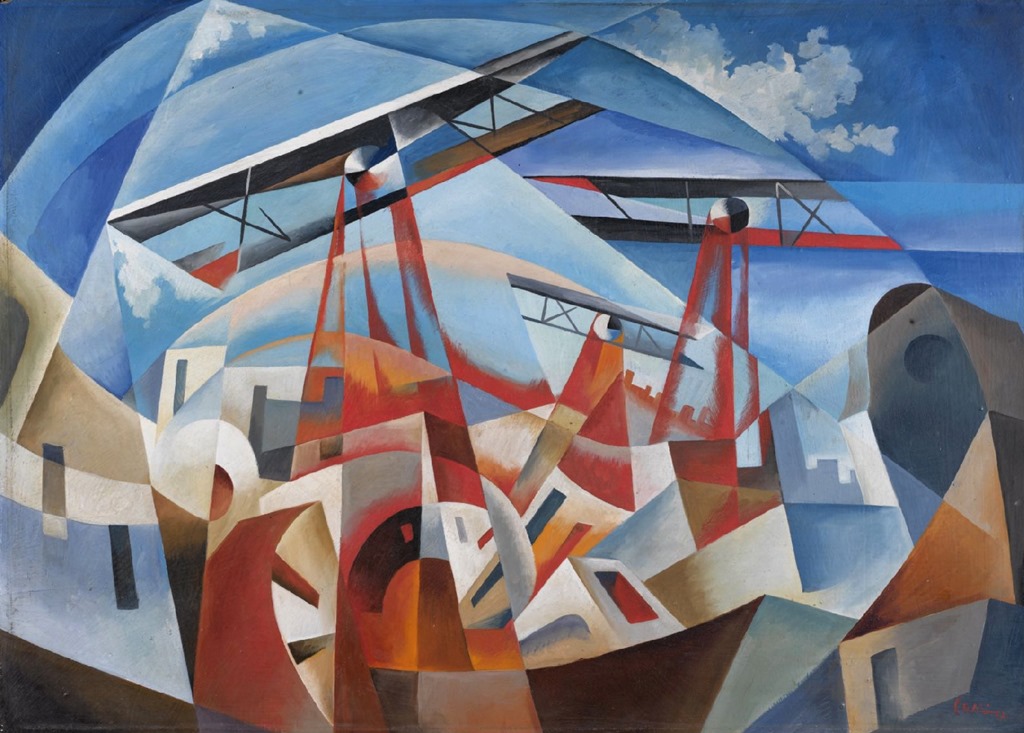
Tullio Crali - Bombardamento-aereo (1932)

Futurist war painting. Compare its outlook to Guernica or Flint’s poem “Zeppelins.
Marinetti’s Futurist Manifesto declared “We will glorify war—the world’s only hygiene”

.

As preparing actors say, all that would be part of the work to figure out what Mina Loy is experiencing. Here’s another bit of business you might grab onto: young, ambitious, male artists. I doubt some not-uncommon tropes have changed in that field.

What happens?

Mina becomes a poet. A fierce poet. Artistically she uses some of the new ideas that the Futurists are thinking about. Her poetry moves between time and tenses, voices and outlooks, in machine gun bursts. Conventional expression and sentiment? Blow them up, run them over with a locomotive. Sixty years later Harlan Ellison would write “Love is just sex misspelled” and be thought provocative. Mina had already been there in the horse-and-buggy era. How can a woman keep her selfhood (or for that matter, how can any human being do so) in the minefield of desire and relationships? What is deep and inherent in motherhood that society will not express openly?

Though she used some of the artistic ideas of Futurism as effectively as any writer, Loy seemed to resist most of its political ideas and she satirized the pretentions of the “Flabergasts” while writing about her Italian time as being in the “Lion’s Jaws.”  Leaving Italy, she next moved to New York, where she joined the Greenwich Village circle.

Today’s piece uses selections I took from a 34-poem sequence called “Songs to Johannes,”  inspired by the relationship with Giovanni Papini (Johannes and Giovanni are variations of the same root name). Loy published these in 1914, near the end of her Italian time. Within the little-magazine world of Modernism she made an immediate impact. Eliot, Pound, William Carlos Williams, and Gertrude Stein said good things about her work. Legendary founder of Poetry magazine Harriet Monroe seems to have been scared by Loy’s frankness. Amy Lowell, poet and influential anthologist, was so put off she is supposed to have said that she would not publish in any magazine that printed Loy.

If the patriarchy may have lost the battle with Mina Loy, for a long time they seem to have won the peace. It was only in the last few years of the 20th Century that Loy’s poems of the first part of that century began to be looked at again. Now, Loy has become a key poetic Modernist for literary scholars tired of the usual sausage-fest, but that opens up the danger that work like “Songs to Johannes”  may be introduced, academically, like this: “Loy in effect diagnoses an end to love poetry in the light of historical circumstance, anticipating that poststructuralist line of inquiry which urges a rereading of ‘lyric’ as a culturally responsive construct. Instead, her poetry constitutes a critique of the very demand that lyric expression be viewed apart from the social world.”

There’s nothing wrong with that view, but I find Loy’s pre-WWI writing here a lot more immediate assuming one has some applicable life experience to bring to it. Her diction sometimes reminds me of Emily Dickinson, and like Dickinson figuring out what is ironic, and what is earnest, and what is both, can sometimes be a challenge. In performance, any of those three choices seem to work for most phrases here. The greatest error would be to make them all of the same tenor. Also, like Dickinson, Loy will move from speaking concise abstraction to vivid metaphor using very few words. Thus, the high minded and the sensual nitty-gritty are juxtaposed.

My appreciation for this sequence grew tremendously as I constructed this performance. There are strong images, richly ambiguous expressions, and yes, lines that one could deconstruct at thesis length. I didn’t even have room to include the phrase from “Songs to Johannes”  that I’ve chosen to title today’s selection, but I can never look at a plump rococo cherub again without recalling it. But the real gift I got, the unique gift of art, is that I could experience some of Loy’s moments in the hot-house nexus of Fascism and Modernism.  “Pig Cupid”  would probably be more authentic if this was performed in a woman’s voice, but alas my voice is what I have available today. To hear my performance, you use the player below if your reader displays it, or this highlighted hyperlink will also play it.