Remember that “Reverse British Invasion” that happened 50 years before the Beatles landed in New York in 1964, when American modernist poets landed in London just before the outbreak of WWI?
One of those American poets was Robert Frost, and he soon struck up a friendship with an British writer Edward Thomas. Thomas was in his mid-30s by then, and he was writing this and that for whoever would pay, but he was not writing poetry. Frost and Thomas enjoyed walks about the Cotswolds together. Frost was encouraging Thomas to write poetry. On his part, on the walks Thomas would often puzzle at which country lane to take a crossroads, and Frost noted that.
Last summer I had the opportunity to take my own ramble about the Cotswolds with my wife. My itinerary was mixture of bicycling with some linkages between sections via train. During the biking part of the journey we often found ourselves lost. Just as with Thomas and Frost back in 1914, there seemed to be few straightforward crossroads and few road makers on the country lanes. It was the hottest summer week in recent record in England that year, and at one train station stop the arrival of our train kept falling farther and farther back off-schedule as the trains were slowed and sometimes stopped by the fear that the heat would buckle the rails.
Well there was nothing we could do about it. We spent the next hours just sitting in the Kingham railway station in the heat we were somewhat accustomed to, watching the wind play with the trees and foliage, listening to the birds.
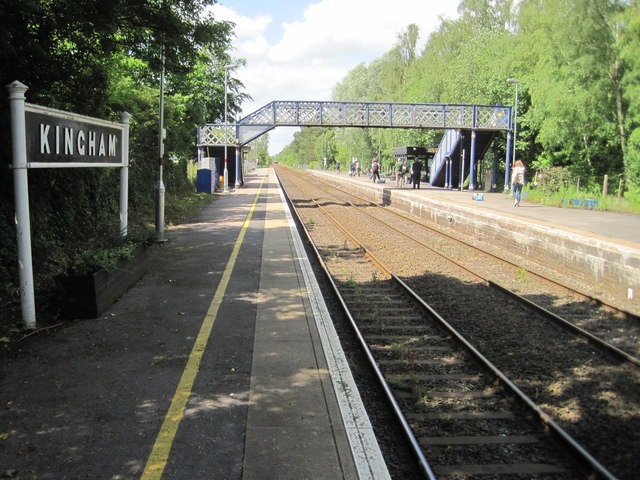
A few hours listening to the trees, breeze and birds at Kingham
This month in 1914, Edward Thomas had a train ride that stopped “unwontedly” in at the small Cotswold village of Adlestrop. Despite being a beginner at poetry, Thomas seemed to immediately grasp the modernist concepts, perhaps because he had no outmoded Georgian and Victorian habits to break. His June experience lead him to write today’s piece, named after this village rail stop: “Adlestrop.”

No rail stop in Adlestrop today, just this sign and bench remain. The present stop in Kingham is 3 miles away.
Thomas’ “Adelstrop” has most of the markers of a modernist poem as Frost was writing them. It’s metrical, but not so strictly as to call to much attention to that. It’s rhymed, but again, the rhymes are not showy. There are no “hey look at me, I’m a clever simile or metaphor for something” tropes. In the place of that is the clean presentation of an exactly observed moment in time, peaceful, off the clock, yet clearly set in a time when the countryside’s nature and the train were in equilibrium. Thomas didn’t know it, but the moment in the poem gathered context after he wrote it, his village train-stop happened only a few weeks before WWI broke out, and England and Europe would be changed forever.
Robert Frost had returned to America, but he sent his friend a poem he had just written, one that was inspired by their Cotswold walks together, “The Road Not Taken.” Frost’s poem famously ends with the lines:
Two roads diverged in a wood, and I—
I took the one less traveled by,
And that has made all the difference.
It’s been Frost’s fate that his irony and dry wit, as well as his uncompromising assessment of human nature, has often been missed by his readers. I first read “The Road Not Taken” and thought, as do many to this day, that this was a simple homily— a boast that taking one’s own, perhaps less popular path, is the road to success and happiness. But read again, more closely, Frost was gently making fun of his friend’s indecision, Thomas’ puzzling at if there are meaningful differences between the two choices in their rambles.
Thomas, though himself a discerning poet, missed Frost’s intent as well. He thought it was reminder of the necessity of making correct decisions, and he warned his friend that readers would misunderstand it. At the same time, Thomas was mulling his decision regarding enlistment in the British army, which was grinding up men at a prodigious rate against the weapons of modernist war. He enlisted, and within a few weeks of deployment in France, he was killed by a bullet through the chest.
Sometimes when I compose music for one of these pieces, I find at the end that I have written something that reminds me of another piece of music, one I can’t quite place. Often when I solve this internal puzzle there is a mysterious connection revealed. The music I played and recorded for Edward Thomas’ “Adlestrop” reminds me a bit of the Edgar Broughton Band song “Evening Over Rooftops”—and the hidden connection for all that (different but shared) flanged and phased melody over an insistent strum, is that like Thomas’ fine poem, they both are hymns to the eternal moment.
To hear my performance of “Adelstrop,” use the player below. And another reminder that you can use the social media share buttons here to let other people know what the LYL Band and myself are doing here at the Parlando Project.
 Frank Hudson