The Wind Began to Rock

Someone on social media this week suggested this conversational opener: “Remember when talking about the weather was just small talk?”

I was thinking about this as I worked to finish today’s musical piece that I’d started a week ago. Since then, American news has been filled with accounts of one major hurricane’s aftermath and the approach of another one. The kind of fun I have meshing poetry with a variety of music I compose and realize is hard to set beside disasters of this scope. I think: here I am privileged to explore unusual connections when other citizens are dealing with hardship and immense losses. In the end I saw the Dickinson poem speaking to those differing situations, and I’ll finish by talking about making this musical piece and the style of its playing which also lets two strong differences coexist.

“The Wind Began to Rock”  presents as a narrative, with well observed descriptions of the storm’s arrival and then deluge, but Dickinson chooses the odd conclusion. You can read the text of her poem here.  We don’t get a tale of devastation. We don’t get the following suffering. We’ve had the fury — and then what? The incongruity of that ending — if it isn’t a mistake, what is it? I think we should be convinced of Dickinson’s genius enough to make our default assumption it’s written with intent. I’m already risking insensitivity, could I add humor to this and say that with the anti-climactic ending of the narrative arc here, I could have appended a subtitle “Started early, took my shaggy dog.”

I’ll just briefly note that Dickinson could be writing from experience. During the 1861 hurricane season, her hometown of Amherst got the inland tail-end of two storms. But I’ll note another metaphoric storm too at the same time: America’s Civil War. That this huge storm occurs, and the Dickinson household damage reported at the end is only “quartering a tree” may be her point.   Some are losing more, up to their lives. The question of enslavement’s onerous human property and the continued existence of the nation that her father served in the Congress of are at risk.

Even the seemingly inconsequential summary of “quartering a tree” is an odd choice that bears consideration. Is this a reference to the particularly cruel execution practice of “drawing and quartering?”

The storm has not made her  house divided and not standing, but the tree may say her privileged situation has a crucifix of more complete suffering in view. Questions may arise to us, if we are privileged to not be in the direct path of hurricanes or oppression, looking out on our own storm season and the drifting path to an election this Autumn. All those thoughts arose after I’d completed the recording of today’s musical piece. My earlier performance was innocent of them, but let me present the music anyway.

As I mentioned last time, Emily Dickinson’s wide-ranging poetic spirit had possessed me with this charge: “I wanna rock!” I have no idea how rocking Dickinson’s own parlor-piano music-making was, but her poetry often indicates to me a mood of loud slyness that could front a rock band.

Rock music famously doesn’t require a lot of compositional undergirding, and the harmonic framework of the music here was minimal: two chords (B and A), their roots a full-step apart. Yet, it really doesn’t correspond with typical chordal cadences in Blues or Rock — it’s a tactic I associate with the Velvet Underground, a smart people in a rock band collective whose formative association once traded under the name “The Primitives.”
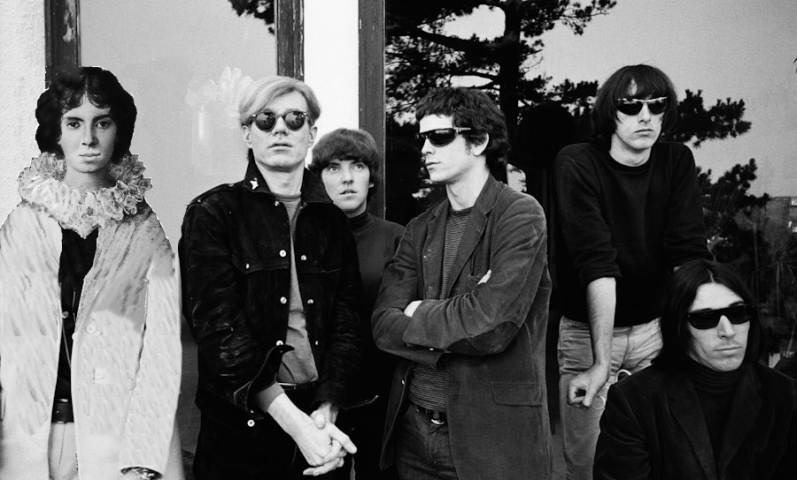
VU with ED2

Today’s musical piece doesn’t sound much like this band, but “All Tomorrow’s Hurricanes” was a cut on the first Velvet Underground and Emily Dickinson album. Andy Warhol’s cover had a picture of a peelable ghost flower.

.

As much as I was working with piano, bowed strings, and acoustic guitar lately, I was itching to get back to loud electric guitar — but my situation in this era of my life makes two poles of music making more difficult to schedule. My quiet stuff has to be recorded when outside noise won’t scrape and bark into sensitive microphones, and the loud Rock that asks for interaction between the electric guitars and amplifiers pushing rude airwaves into a room risks disturbing others. Sometimes the situation, that I can’t whisper in an otherwise silent room, only makes me want to turn up the electric guitars all the more.

As you’ll hear if you venture to the audio player below, I was able to turn the guitar amps up for this, though I had a limited window to shatter.

The kind of guitar playing that steps out to the lead in the ensemble today is a style I worked with quite a bit back at the turn of the century. Like the chord progression, it’s not Rock-band-conventional. The framework is two lead guitars each free to explore melodic lines without strictly alternating (e.g. obligatory “call and response,” “trading fours,” or the like) or playing pre-composed harmonic intervals between their melody notes. It’s still Rock-music-like in that the two lead instruments reference the Rock beat, but this kind of simultaneous, spontaneous lead playing happens only rarely in the Rock genre. You can hear something like it in some folk musics, in early Jazz, and much later in Free Jazz — but for all its “let’s make a racket” ethos, Rock music generally avoids this.

Anyway, if you want to listen to this as it’s intended to be heard, don’t use ear buds or quiet levels. Use a set of stereo speakers and turn up the volume level. You can dance if you want to.

Audio player washed out on your way to reading this?  This highlighted link is an alternative that will open a new tab with its own audio player.

.

Heaven and Hail

I sometimes think I’m working against gathering a larger audience for this.

Twice in the past month or so I’ve had an opportunity to speak in passing with poets about what I do with the Parlando Project. I’ve got my elevator pitch carved out: “I combine poetry, usually literary poetry not intended to be performed, with original music in different styles.” Both poets came back with this replying question: “What kind of music?”

Maybe I should start hitting that word “different” with hard emphasis — but Midwesterners know that kind of spoken underline could be parsed in our regional argot as cloaked disparagement. If I was to say:

“I’ve written a piece for a string quartet in which the instruments are placed on the floor and filled with nuts and seed. A herd of squirrels is then unboxed and will proceed to chew through strings and tonewood for the course of the musical evening.“

The Midwesterner is bound to reply “Oh, that sounds different.”

Squirrel Quartet 3

For Friday the 13th: presenting the unexpected, not gnawful, just “different,”  the Squirrel String Quartet.

.

Now, I believe both of those poets this past month are perceptive, I read it in their admirable poetry. If they miss the word “different” it’s because many people have strong feelings about the music they care about.* Long before reaching the age of those poets most listeners have strong affinities for some music and equally strong dislikes for the sounds that they don’t wish to put in their ears. The idea of combining poetry with music is attractive, but what kind of music is an unavoidable point in describing the Parlando Project, and I can’t encapsulate that. Elevator pitch? If I tried, I’d be out of breath and walking up flights of stairs. To both poets I was reduced to trying to start my response with “That’s my problem: it varies.”

Readership of the blog posts here continues to increase through the years, while listenership to the audio pieces has been for the last half of this Project’s life flat to somewhat lower. This bothers me, and I have theories, but one that seems particularly plausible is that the variety itself turns off listeners. One day acoustic guitar folk-scare strumming, the next day some kind of synthesizer sound, a garage-rock quality electric combo, something like Jazz, small orchestral ensembles, Blues slide-guitar, or alt tunings in a matrix somewhere between John Fahey, Joni Mitchell, and Sonic Youth. And then on the third day, a combination of one or more of the above.**

How well do I (who much of the time needs to play or score all the parts) present that variety? I think my own judgement approximate, but it goes like this: on good days I think I do it well enough, on bad days I feel embarrassed by the faults in execution and conception I hear. So, my limitations are a factor here, but even if I was a master of all these forms, I think the problem would remain. In this theory it takes only one or two “bad fit” musical pieces for a new listener’s taste to judge the work has no value, and no further listening occurs.

What will I do about this? I don’t know. I can’t help the eclecticism — it’s been in me since my youth*** and I don’t think I want to try to scrub it out.

Today’s musical piece comes from that “We’re a garage band, We come from Garageland” mode — looser still in that like most of the LYL Band pieces presented here over the years it’s spontaneous, not the execution of parts each instrument is supposed to play. As keyboardist Dave Moore says at the end, the words are “a personal experience story,” an exception in the Other People’s Stories texts the Parlando Project finds, experiences, and presents. Just over a year ago a storm with 60 mph winds and golf-ball sized hail struck Minneapolis. Overall, it caused 1.1 billion dollars in damages. On my roof, my shingles were totaled (the classic hail-storm result), windows were shattered, and there were plenty of cracks in the siding from the wind-driven hail. As “Heaven and Hail”  tells it, it took months, well into the winter, for overwhelmed builder crews to get all the home damage repairs completed in my neighborhood.

Last year at this time work started on fixing the damage at my place. One experience amid the hammers, ladders, and supply pallets: hearing one of the crew’s boomboxes playing a record of garage rock classics all sung in Spanish. Another Rosetta Stone moment, like reading those cereal boxes in French.

To hear this short account of the storm and aftermath you can use the audio player gadget below. No player? This highlighted link is an alternative that will open a new tab with its own audio player.

.
*Neither asked me —and few people ask me — “What kind of poetry?” With non-poets, I ascribe that to the lesser interest in poetry as an art and therefore a lack of strong likes and dislikes.

**This leaves out the subjective qualities of my voice, something which I recognize is of overwhelming importance to most listeners.

***”Top Forty” rock’n’roll radio was extraordinarily broad in “The Sixties™” and I was listening to the classical music station and a country-western station along with that format. Hootenanny was on TV, folkie music was part of church camp. Other than the occasional cross-over hit I’d hear on the radio, the Jazz waited a bit to creep in late in my youth. Eventually the smart programmers figured out that a pop music station that played a “button pusher” record would cause the listener to switch to a competitor. I’m the odd-duck that when I hear a record I don’t like, right after one I do like, I want to hear the third and maybe fourth or fifth record played, particularly if any of the small sample (liked or not-liked) is something I don’t think I’ve heard before.

The Wind Didn’t Come from the Orchard Today

Today is World Poetry Day, and if I want to represent the United States poetically to the world, one of my first thoughts for a representative poet would be Emily Dickinson. Dickinson has many “Greatest Hits,” poems remembered, poems anthologized, poems that literary critics have generated essays from.

Today’s poem isn’t one of those, for whatever reasons. I suspect it seems too playful, even child-like. The Dickinson I was taught in my youth, when she was considered a less important poet than she is today, was at least eccentric, often gothic. But here there’s no death in a carriage, no fly-funerals — there seems no novel slant of light or truth being told. It’s just the wind, an ordinary thing — or that’s the first impression.

The other immediate impression the poem might give is from its sound. This is Dickinson’s prosody at its most exuberant. No stern march of iambs here, and the use of unpredictable rhyme, end and internal, near, imperfect, and perfect. I love the loosening of rhyme personally, though I know there are others for whom imperfect rhyme grates. But this poem is so rich with the rhyme and pararhyme:  today, hay, hat, very; bur, door, fir, where, declare, ever, there; odors, clovers, ours, mowers, hours; pebble, stubble, steeple; hay, day, say, stay.

The Wind Didn't Come

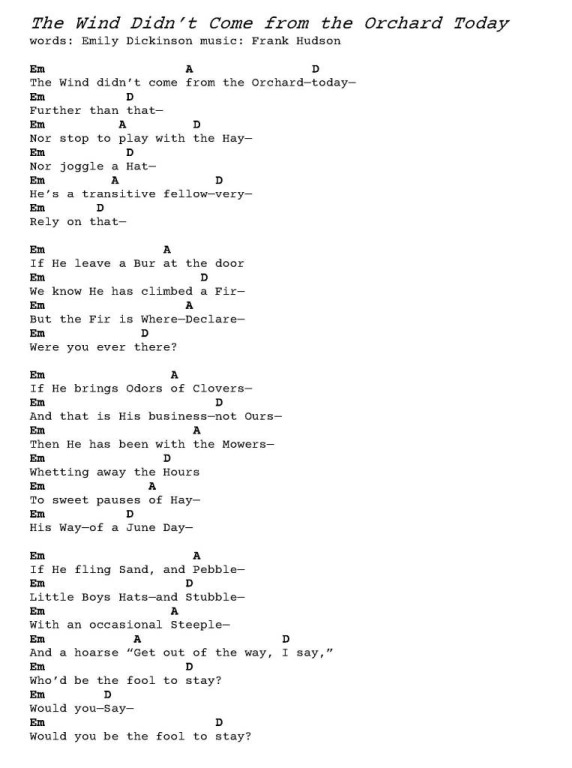
A chord sheet in case you want to celebrate World Poetry Day by singing it yourself. For performance I broke-apart Dickinson’s text, which is all one stanza —  indeed, a single onrushing sentence!

.

America is a big country, a big culture. We certainly have our perfect formalists. But we have artists, like Dickinson, for whom form, and perfection in duplicating the form, is but an armature on which to improvise variations. While I’m one small ear compared to American Culture, I’ll take Dickinson’s side and place this poem in evidence.

Another thing to love in this one: the asides, set off with famous Dickinson dashes. “He’s a transitive fellow — very — rely on that” for example.

OK, so is this a musical slight-and-light poem about a playful wind we might meet in Spring?

Maybe.

Note that the poem starts off with a difference. The wind doesn’t come from the fruitful orchard.*  It’s from somewhere distant. When I performed the poem, I began with the sense this must be an important fact to lead the poem off with it, but I didn’t know more. A playful breeze is mentioned, but again in the negative,  this wind is too much in a hurry, that “transitive fellow — very,” and we can rely only on its capriciousness.

The sound of the “fir/where/declare” is so delightful, but what has happened here? Is the fir tree gone, uprooted, now out of place? Or is it just branches and seed-cones carried away from the location of the tree?

The sound of the mowers section is also delightful — and the work of hand mowing is so poetic one could create a whole suite of poems mentioning that kind of work — but it’s also the decapitation of anything above a height, and that’s always been part of the metaphor.

The final segment of the poem suggests a fiercer wind. An unremarkable wind might raise a little sand, but pebbles are being flung.**  A playful March wind might dislodge a hat, but here it’s a steeple that has toppled off its head and the thing is like a run-away carriage.

In my Midwest, tornadoes are a common and feared storm with extraordinarily intense, though localized, winds. Dickinson’s New England has few of these. However, in the fall of 1861 during Dickinson’s most active years as a poet, two hurricanes, storms that can have high winds spread over a larger area, hit New England. Detailed contemporary meteorological measurements for that sort of thing don’t seem to exist, but sustained 60 mph winds are estimated. Ships were damaged, a ship was lost only a mile from the Boston harbor light, there were storm-driven high tides, and so forth. How far inland to Dickinson’s Amherst and at what force level it reached there I can’t say, but Dickinson could have been writing from regional news reports.***

In the many decades since Dickinson wrote her poem, we might not at first be able to hear the runaway roar of storm winds when we brush up against this poem — just the rush and song of Dickinson. So today, I will prod you to sense the mystery of the weather and the wind which we do not control.

For those of you who may have noticed a bit of a break in posts this month, it was not due to anything bad, more at a lot of effort toward new composing and recording. For the first time since last fall, The LYL Band reconvened last week, and you can hear their full folk-rock band performance of my song made from Dickinson’s poem with the audio player below. Has that audio player gadget seemingly blown away? Some ways of viewing this blog suppress showing it, so I provide this highlighted link as a backup.

.

*The Dickinson household was engaged in raising some of its own food, with Emily and her mother being known as experts in that field. The landscaping has changed at the Dickinson Homestead, but I understand that fruit trees were part of their domestic garden in Emily’s time.

**An incident from my own life. After a tornado at a branch radio network studio a few decades ago, I got a box containing the studio’s Macintosh tower audio computer to see what could be done for it. I took the computer out of its carton, and opened it to see what I could see, and the interior was packed with pea-sized landscaping gravel that had surrounded the building that housed our branch.

***I first read about the hurricane here.  More about the pair of two Fall 1861 storms and how they impacted Civil War operations at this New York Times story.

Before Summer Rain, or we get to Rilke eventually

How do we determine what a poem is on about? That this should be a question is a reason many flee poetry. Plainspoken poems still exist, and some poets manage to pull off the technique where there’s an easily accessible layer, and then on further consideration, deeper ones beckoning beneath. But the plainspoken poems are not always honored in the school anthologies that introduce growing minds to the art; and too many when introduced to deeper readings fall away from poetry thinking that either they “just don’t get it” or that those pointing out these subtleties are hallucinating angels and cows in cloud forms.

Even a poet like Robert Frost who was able to pull off that trick of relatable surface and deeper, more complicated undercurrents, must suffer from party boors like myself reminding trapped conversation subjects that “The Road Not Taken”  is about the over-consideration of choice not the necessity of stalwart individualism. Damn, the listener thinks, looking for an out, “I thought I had a poem, my poem, and now this fellow is saying one or the other of us is an idiot or a fool.”

There’s another route, another signpost that may help, one couched in the informal phrase “Where are you coming from?” Given that literature in our age has been to a large degree taken over by memoir,* we may employ this tactic as readers or listeners. In this frame, poets are about their lives, and in an even more contained sense, about the important facts of their lives: a trauma, a struggle, a novel life story.

In this view, to consider “The Road Not Taken”  in the context of the tragic friendship between Robert Frost and Edward Thomas walking in the wandering lanes and paths of the Cotswolds may help us understand that that poem isn’t just a self-contained piece of art, though it can be that, but also an artifact of something complicated as lives are.

So, I promised I’d get to Rainer Maria Rilke. Last month I started to translate his poem “Before Summer Rain”  from the original German. I sometimes do my translations before reading existing English ones. I’m not sure if that is a good idea, but I like the surprise of a poem coming into view for the first time as I work out the language. I finished a draft of it, and then found two or three other English translations in short order.

My “Before Summer Rain”  that I could view when this draft was done was a fairly light, fairly clever nature poem about the onset of a thunderstorm. Summer, leaves are all green—then sunlight, perhaps even the chromatic range of the light’s color, takes on a new cast. A bird calls, but we sense it more as a warning omen or a call for others of its species as the storm brews. Inside the house, sunlight no longer illuminates things. Will it storm or will it not quite reach ignition and fade off? A few drops or a deluge? The poem ends.


Before Summer Rain


Right away I doubted my translation in light of the others. I didn’t get the picture entirely wrong, but a couple of significant details diverged, ones that seemed to take the poem elsewhere. Here’s a link to the most common English translation I found. The translation is by Edward Snow, though almost none of the Internet sites that use his work credit him. Snow published his translation in 1991. He’s an award-winning translator who concentrates on Rilke’s poetry—plenty of reasons to respect Snow’s authority on the accuracy of his Rilke. Other than our differing attempts to make compelling English poetry from Rilke’s German, here are the two things that stuck out.

The end of Rilke’s German line “man denkt an einen Hieronymus” (literal: “one thinks of a Hieronymus”) is in Snow’s, and I think every other English translation I found, translated as “St. Jerome.” This indicates strongly that is how the word would be understood in German, and Hieronymus is  the Greek version of the name Jerome. This may be problematic for the poem, however. Assuming that the more knowledgeable translators are correct, this leaves many readers in the dark. What the hell does St. Jerome have to do with this reasonably vivid and non-allusive description of an oncoming storm?**  In my first complete draft I thought it better to leave it Greek, which would be mysterious in a more mysterious as opposed to a “what the…” way. My second choice, the one I used by the time of my performance, was to use the literal translation of the name from Greek: “sacred name.” This increases an immediate sense of the moment being described by Rilke. The bird’s call is so urgent, so important, that the sacred is invoked.

OK, if I’m going to worry about a single word, what next? The concluding two lines of Rilke’s poem in German are: “das ungewisse Licht von Nachmittagen, /  in denen man sich fürchtete als Kind.” (literal: “the uncertain light of afternoons, / in which one was afraid as a child.”  Snow renders these as “the chill, uncertain sunlight of those long / childhood hours when you were so afraid.” I had a completely different sense in my draft, that it was still the external object, the changing light of the summer afternoon threatening to storm, that was being depicted. In poetry the observer, the poem’s speaker, and the object may often be merged, but Snow says this is not just an oncoming storm, this is a trigger of something darker than even that. Snow seems to add “chill,” which I can’t find in Rilke’s German, to intensify that sense.

I had read the poems mood as mostly light, mostly clever. Snow had read it, I think, as darker, more chilling. A day or so later I started to think. Did Rilke suffer some kind of childhood abuse?

And so, just in trying to do a translation, trying to figure out what a poem was on about—so that I could bring you an audio performance of a piece that otherwise wouldn’t exist, I found myself thinking I had two roads: throw out my attempt at translation as a misleading embarrassment, or dig more into Rilke’s life.

Turns out I knew even less than I thought. I had this sense of a lean, sickly, aesthete melding art and spirituality, a purist willing to risk lyrical excess. In looking at the highlights of Rilke’s life, it’s stranger than that. I began to think Midwesterner Don Marquis would have made of Rilke something of his poet character Fothergil Finch in his Hermoine and Her Little Group of Serious Thinkers  satire. But Rilke’s childhood did  have elements that we, and he, might view as abusive.

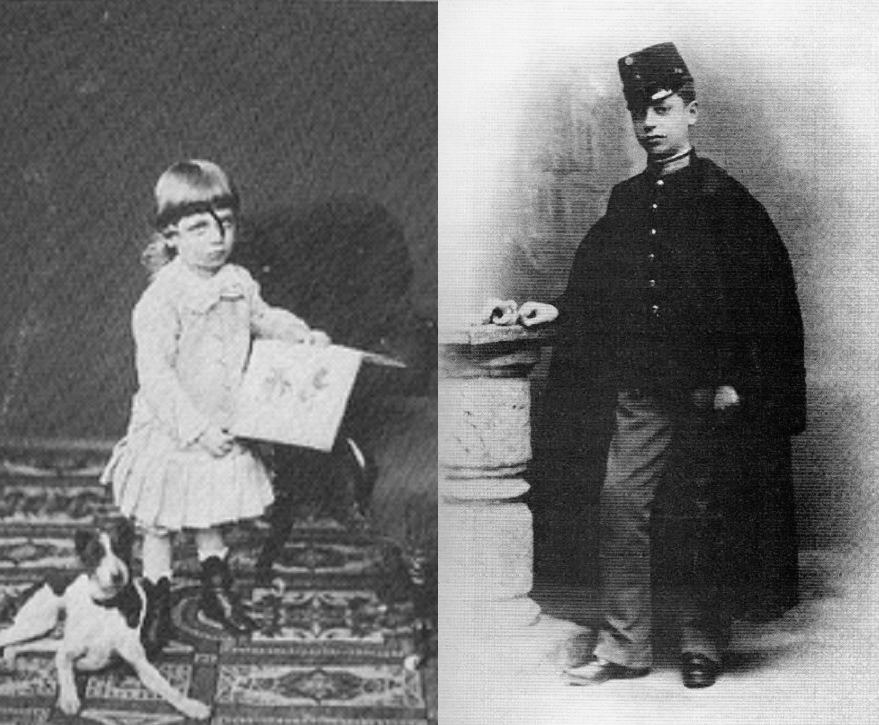
Rilke age 4 and Rilke age 11

Rilke age 4 dressed by a mom who missed a dead daughter, and Rilke age 11 sent off to military school to butch-up by his dad. Yes, 19th century children’s clothes are a different sensibility, and some kids respond to a disciplined and regimented life. Rilke didn’t seem to, and his teen years in the school were not good, clashing with the other students who were more into it.


And so I concluded, I needed to revise my translation or abandon it.

Then yesterday I had a chance to record with acoustic guitar, and I grabbed a few things that might work presented that way. I thought, “Before Summer Rain”  needs revised words, but maybe I can compose the music while I’m at it, and I could record the revised words later.

The tune came fast. The chord progression has similarities to a strain used in Ray Davies Kinks’ song “Rainy Day in June”  (another song about sudden summer rain), but given that I had access to a quiet room where I could record acoustically, I decided I’d go all the way and use an even quieter nylon-string guitar available there.

Nylon-string guitar might bring various things to mind: “classical guitar,” Willie Nelson, Latin American music. I’ll often associate it with two things: learning to play guitar on a J C Penny’s nylon string guitar in my youth, and the early albums of Leonard Cohen where Cohen would play his “one lick” effectively on nylon string guitar. Testing the melody against the existing words, I recorded a couple of takes, while trying to reacquaint myself with the different sound of nylon strings.

There, with live mics and the recorder running, I realized I had already written the translation that could bring out the personal darkness, the undercurrents of childhood abuse, with my version of Rilke’s words. It was simply a matter of performance.

You can hear the performance below with the player gadget.


*I don’t object to this except to the degree that as a contrarian by sensibility, I don’t want any mode or approach to become so predominant without at least asking what else could be done. This is part of the reason that this project has been focused on “Other People’s Stories” and isn’t as much about a personal journey (though those elements can’t be avoided).

**Wikipedia’s entry for St. Jerome, who I only knew as the man credited for translating the Bible into Latin (then the common language of educated Europeans) includes an anecdote about the guilt-ridden Jerry after a night of too much party trying to atone by visiting Rome’s dark catacombs to commune with the decaying bodies of apostles and martyrs. Major goth points, and possibly even a reason why he might be mentioned in Rilke’s poem. But how well is this known? I also find it odd that the German to English literal has it “a  St. Jerome” if we remove the Greek. Was St. Jerome enough of a big deal meme-wise that you could refer to him as a type, like calling someone “a Judas?”

Summer Silence

I’m trying to get back into the swing of production of audio pieces here, so maybe the best way to get around that is to not “produce” an audio piece. Here’s a field recording I made just south of the Canadian border this month while working out music for E. E. Cummings’ early poem “Summer Silence.”

In normal times I’d probably have added a bass guitar part and perhaps some more instruments. Even the acoustic guitar and vocal that’s present would sound better for not being recorded on a cell phone—but it’s a fair representation of what I was aiming for in the piece and it doesn’t sound terrible or anything. If you listen carefully as the last note fades out you can hear some bird song in the background.

E E and John W Cummings

I can’t find out if they’re related: E. E. Cummings and Johnny Ramone (born John W. Cummings). Down sagging air with shimmering bars of sullen silver vs. relentless down-strokes of sullen barre chords.


On the printed page “Summer Silence”  looks awfully conventional for an E. E. Cummings poem. It was published when Cummings was a Harvard sophomore in 1913 in a college publication. And as printed there, it contains the sub-title “(Spenserian Stanza)”  as if this was possibly an academic exercise in trying Edmund Spenser’s old form. The poem reflects 19th century poetic language somewhat. Though the rhymed and metered lines follow the form, there’s a lot of enjambment and phrases beginning in the middle of the printed line, a hint of Cummings later more scattered pages. The imagery shows tendencies toward the Modernist/Imagist ideal. This might be the experience of a real night. The images in the poem aren’t presented as stock-photo stand-ins for what the poet wants to say even though there’s a bit of emotional adjective-overload here and there which the pure Imagist would excise: “Eruptive” and “sullen” for example.

Summer Silence as originally published

Today’s poem when first published in the Harvard Advocate in spring 1913 by the 19-year-old E. E. Cummings.


I don’t know that Cummings ever really abandoned those overt romantic and emotional expressions, a tendency to unabashed overstatement rather than pure Modernist show not tell. That’s part of why many like him while others down-rate him. In the end a set of words either work for you or they don’t. Aesthetic theories may give you a different way to look at them, but why should they take away any pleasure they give you?*

I had collected this poem in search of some summer poems to compose music with last month, but then particularly I was able to work on the music after a night with distant heat lightning over Lake Superior in July. This led me to interrogate the night with Cummings’ poem. Out on the edge of the lake the thunder in my night was distant, muffled by windows and walls, a broadcast on the edge of reception. Its intermittent bark highlighted the “panting silence” in-between lit by the avant garde of the heat lightning. My night had no stars, translated or not. Perhaps Cummings’ night had a storm front approaching a less cloudy night on his lake shore?

So, as tardy as I am with more complex productions recorded more formally, the drill for you my valued listener is the same: use the player gadget below to hear my performance of E. E. Cummings’ “Summer Silence.” 


*There are answers to that question. I used to know some of them, but I’m old now and have forgotten them. Theories and suggested other ways and contexts to look at poems are still fine with me though, adding another soul’s experience to the artistic transfer may enrich it.

The Hunter

A couple of mornings ago, I awoke after a night’s sleep, and as I took my bicycle out to the alley to ride off for breakfast, I was surprised to see the road dusted in torn blossoms and several small tree branches cast about on the wet ground.

While I had been still and sleeping, a storm must have come up.

That contrast, the stillness and the broken change is at the heart of today’s poem by William Carlos Williams, “The Hunter.”   Williams opens his poem with an allusive image. “In the flashes and black shadows of July.” Is this the lightning of a summer storm? I thought so at first. But it might be just what one sees lying on summer grass and looking up through the boughs of a tree. The whims of a breeze or the caprices of squirrels and birds on the thin branches will flutter the leaves’ fan of shade revealing the sun in a flash.

Yet, summer “seems still.” The animals of summer appear “at ease.” But what if there is danger in the world, as in the unmet character in the poem’s title, the hunter?

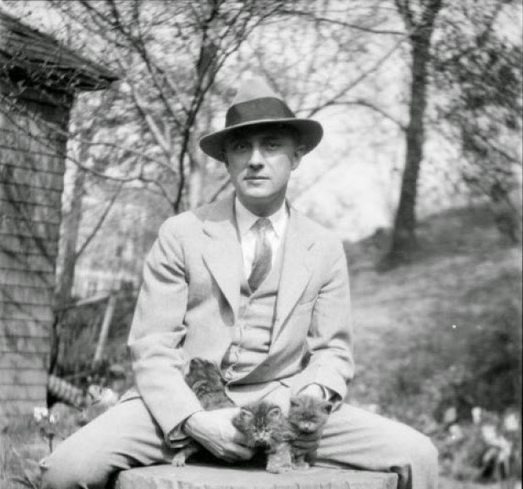
William Carlos Williams with Kittens2

In a last-ditch attempt to increase readership of his poetry, William Carlos Williams decided to try that Internet staple: cute kittens.


In Williams’ poem, the hunter does not appear, ready to shoot the game. The hunter is invisible, as the hunter is time, the hunter is change.

For today’s music I combined an orchestral ensemble and electric guitar with an appearance of a harpsichord.  The player gadget to hear my performance of “The Hunter”  is at the bottom of this post.

I’ve noted that there has been a steady listenership for the other William Carlos Williams poems posted in the archives lately, and that helped inspire me to look for more of his work to present. As we move into summer, I remind visitors that there are over 220 pieces available here. Use the search box or just wander through the monthly links on the right.


The Heart of the Woman

There’s two things that attracted me to T. E. Hulme, the lesser-known Modernist poet and theoretician that I’ve featured a few times this summer. The first is the sense in his poetry and critical writings of the limits of humankind. The other is his poetry’s surprising modesty and restraint, something embodied in the very brevity of its poetic expression and his images linking the mundane and the cosmic.
 
This was a man who wanted to overthrow hundreds of years of poetic tradition, and a person whose stubbornness kept him in trouble with authority figures throughout his youth, and yet Hulme expresses himself in these spare lines, as if the first lesson he’s teaching himself is to know his own limits. This seems to be Hulme’s problem with Romanticism as he saw and opposed it: humankind is not limitless, though our imagination says otherwise.
 
Today’s piece, William Butler Yeats’ “The Heart of the Woman”  moves in opposition to that outlook, but not in opposition to that expression.
 
Here in North America, many in the southern region are spending this week either cleaning up from a massive hurricane or clenching their jaws in anticipation of an even larger one due to strike this weekend. Peaceful, Rousseauean nature this ain’t. Hobbes is is a weatherman.

Hurricaine Irma

“Come in she said, I’ll give you, shelter from the storm.”

Yeats’ poem is as measured and modest as one of Hulme’s, though it is rhymed and metrical. When one is a good as Yeats is at that, one hardly notices the form. 12 lines, not even a sonnet in length. Like Hulme, this is no great ode of endless argument. On the face of it, it’s a love song, a basic trope of Romanticism, the reason we talk about human attraction and pairing as “romantic.” Its images are centered on a couple embracing.

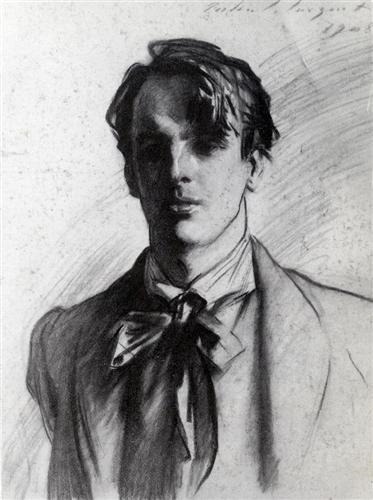
Yeats by Sargent
Why Mr. Yeats, I didn’t realize you were, well, dreamy, without your glasses

But look closely in those dozen lines. The woman who’s singing it, has left religion (“prayer and rest”) and family, and has followed a lover’s invitation into what is introduced as “gloom”. Merely the dark of night?

No, in Yeats’ lovely line, darkness is found inside the “Shadowy blossom” of her hair which will hide the lovers from the “bitter storm.” Now we are fully in the Romantic world, where our own darkness may be willful, wishful, blissful, ignorance of the “hiding hair and dewy (blurry) eyes.”

Are there any more Romantic and romantic three lines as Yeats’ final three that conclude this piece? If there are, I can’t recall any at the moment. That the simple murmurs of human breath can seem to equal a hurricane’s—is that glorious or folly or both?
 
In the spirit of defying human limits, this is the first time you’re going to hear me sing a Parlando Project piece acapella. And though Yeats’ poem doesn’t rule out the same romantic faith on the part of the “he” in this poem, I’m somewhat troubled by the idea that romantic devotion is presented here as female, from the poem’s title onward, so I’ll undercut that by singing this. My less-able singing voice is one reason that we chant or speak-sing a lot of Parlando Project material, but my young son’s carefree acapella singing is reminding me of the value in the singing voice. To hear “The Heart of the Woman,”  use the player gadget below.

A Spring Morning

Imagine a world where what you thought was poetry was entirely different. A world where short poems could be as celebrated as longer literary works. A world where the most admired poems could be clear as can be about what is happening in the poem (the poem’s plot) with no elaborate obfuscation in the language; and yet the meaning, the thought and feelings the author means to convey, may remain allusive enough that the poem’s meaning seems to change over time as your experience grows. Imagine a world where poems can seem to have no metaphors at all, poems that don’t so much interpret the book of nature, but seem to be a page from that book itself.

That’s what Chinese poetry seems like to me.

It’s a refreshing change from the Western canon. I can see why a grumpy modernist like Ezra Pound, who wanted to sweep away the rot of his culture, would find it influential. Or why the forefathers of the “beat generation” in the western United States looked further west than California for a way to apprehend reality on the page.

I’m no scholar of Chinese poetry. These are the feelings of someone who likes what he reads and finds lessons in translating it.

For today’s post, I’m going to go over how I work on these translations with the aim of stripping away the mystery. I’ll use a short poem by Tang Dynasty poet Meng Haoran “A Spring Morning.”  It seems to be a good first task for Chinese translation, and the original poem is apparently known almost to the level of a nursery rhyme in Chinese.

Meng Haoran

Texas guitarist Billy Gibbons…whoops, no, this is Meng Haoran


I do not read Chinese, however, it’s now possible to find glosses of many poems literally translated from the original ideograms. Here’s what “A Spring Morning”  looks like when each of its lines five characters is translated into an English word :

Spring sleep not wake dawn
Everywhere hear cry bird
Night come wind rain sound
Flower fall know how many

The first problem is there is no punctuation, nor anything like English syntax. Still that’s an interesting way to approach a poem, where in English we are often trying to find the word to fit our flow of thoughts and music, but in working from this gloss we have the words, or at least “a word,” but need to find the flow instead.

I decided to render the first line as: “I slept late this spring morning, awaking just after dawn.” keeping the season (spring) and the more specific time of past the daybreak moment. I added late, which is not in the glosses’ words, because I thought the poem needed some reason why past the dawn was significant when I connect it with the third line.

The second line required less thought: “From everywhere I hear birds calling out.” The main choice here was the word I’d use for the sound of the birds. “Cry” used in the gloss has connotations of sorrow in English (not always, for example “war cry”) and I didn’t want to tip my hand toward sorrow in this line. And in Spring I know these bird calls, they are in fact just that: birds calling out for potential mates, birds setting up their territories, birds that want to say something to other birds.

The third line I write as: “Last night I tossed and turned in the sound of the wind and the rain.” This gives a reason for why the poet slept late, adds a note of drama and, in a particularly personal choice I made, alludes to a traditional English song refrain “Oh no, the wind and the rain.”

Now the final line: “Who knows how many petals have fallen?” Here seeing other people’s English translations helped, as it otherwise might not be clear that this is a question. In a vacuum one might render this as “I know how many flowers fell.” And that ending has validity, essentially saying “(in such a storm as last night) I know for sure how much my lovely spring blooms are going to be damaged.” Others who know more about Chinese idiom have chosen to make this a question, so I’ll trust that, and this makes the concluding thought more like “(I’m worried about the damage of Spring storms. but it was night and I was asleep) and no one can change the way Spring does this, blooming and storming, so it’s a mystery to you and me.”

Overall, notice how this modest four-line poem, suitable for children, encapsulates a sophisticated thought, one that young children wouldn’t need to understand yet.  It shows us Spring, as a sleeper sleeps past the now earlier dawn, through a rain storm that grows and destroys (compare our nursery rhyme “April showers bring may flowers” meaning “you might get wet, but it’s good for flowers” vs. this Chinese storm), alludes subtlety to the love and war of birds, and concludes with a wise line that says our ability to comprehend this cycle of growth and destruction, change and renewal, is limited. To a child, that last line may mean no more than the thrust vectors that allow that “a cow jumped over the moon;” but to an older adult, it reminds us more, that we will never know.

For the music to accompany “A Spring View”,  I used some drums playing an odd rhythmic figure, fretless electric bass, electric guitar, and two soft synthesizer voices: a washed out horn and another which is supposed to suggest a Chinese flute, which unlike Bob Dylan I did not take from a dancing child. Today’s audio piece is very short, and to play it use the gadget below.