I’ve told some folks that I’m working on Emily Dickinson’s “No Kings” piece this week. Now, that’s hardly true. There is a king in this poem and he doesn’t come off so well in its telling; but there’s a naïve maiden too, and Emily’s going to paint her as much a fool as the pompous potentate.
If much has been made about the use of hymn meter in Dickinson’s verse and connections there to her skeptical view of conventional religion, plot-wise this poem takes its tale from an extremely common folk and folk-broadside trope: the foolish maiden. In countless variations some man of high-degree dallies with a young woman of the common folk, and it usually doesn’t turn out well for the girl.* In the best of it, he’s a cad and leaves her; in the worst, there’s murder most foul in the offing. Many folk songs, including those in this grouping, open with it being a Spring morning. Springtime promises, it seems, aren’t to be trusted the voice of folk music says.
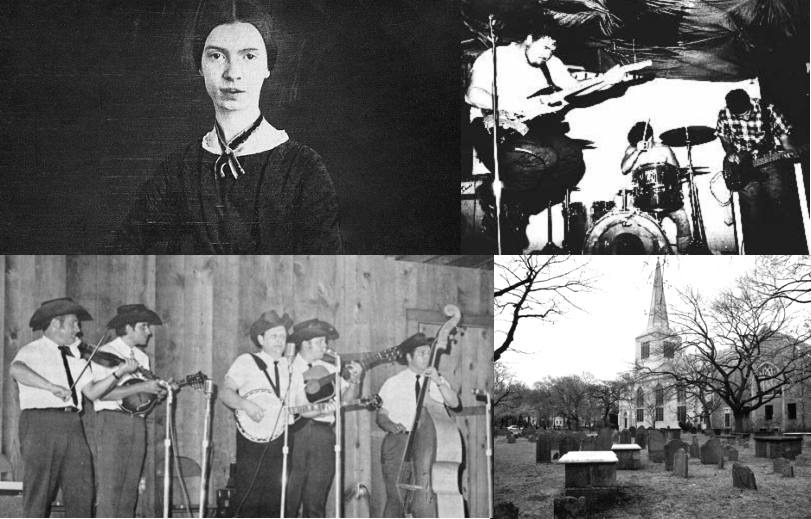
I’m not scholar enough to tell how many such songs Emily Dickinson knew, but they were highly common in her time, and I suspect she was using that folk-music plot here to make her point about what life promises us, and about trusting kings.
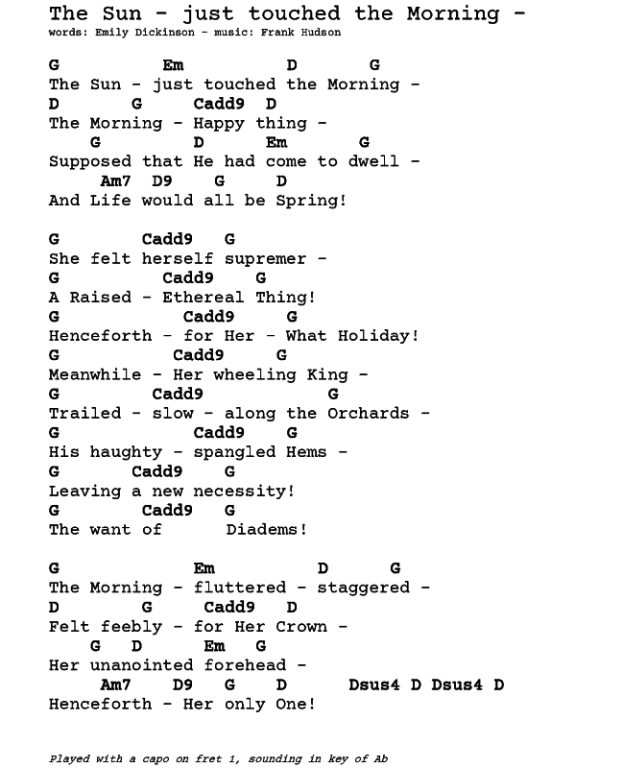
Here’s a chord sheet to assist if you’d like to sing this in your parlor. I like the sound of 9th chords, but they were chosen here to ease my fingering on guitar and can likely be simplified if that suits other players.
.
In “The Sun – just touched the Morning” we have the morning herself playing the foolish maiden and the sun is the sun king who likely believes that when you’re a king they just let you grab it. The sun, as we might guess, soon has to be moving on doing important stuff like making dew into a passing mock-up of glittering jewels, but Morning thinks she is to be his queen. Dickinson reports Morning trying to act like the imperial Sun, crowned with a dew-drop diadem: “She felt herself supremer – A Raised – Ethereal Thing!”
Dickinson knows how this comes out: there’s no crown on offer, no coronation. Some divine right will not tell us who is right, honorable, reciprocal, or trustworthy – that will be up to our “unanointed foreheads.”
So it is: hymns generally tell us how to live right, how to praise a beyond-human perspective, while folk songs take on the task of telling us not to be a fool.
As I composed this, I tried to use a 19th century popular song kind of feel, but ended up being enticed by rock quartet instrumentation with a chiming electric guitar element. If I was to do another version, I might lean more into parlor instruments – but this’ll have to do for now, for we have present business with kings we refuse to allow.
You can hear this song version of Emily Dickinson’s “The Sun – just touched the Morning” with the audio player below. What? Has the king refused to fund any such audio player? No, it’s just that some ways of reading this blog won’t show the player, and I offer this highlighted link which will open a new tab with its own audio player so you can hear it.
This Saturday in Minnesota was marvelous. We already go a little crazy when the temps reach 50 degrees Fahrenheit – there are always folks out in shorts and short sleaves as soon at the bulb’s red rise tips over 49 degrees, but Saturday my thermometer read 79 degrees by the afternoon, and everyone that could was outside. Walkers were everywhere, and if they had dogs, they had a shared happiness. The smaller crew of hardy bicyclists I see within Winter were joined by a fresh multitude of carefree riders in summer attire coursing through the city. I myself rode to a place a block or so away from my wife’s apartment when we were courting, and there I had a double scoop of ice cream which I ate sitting on a bench outside soaking up the sun.
I’m feeling my age as more than just an additional year in 2026, but to be old or young or anywhere in-between in such a Minnesota day induces a feeling of specialness. Perhaps for the young the coming spring and summer can have an interval long enough to induce boredom, a sense of regular expectable warmth, and a dispensable ease of adventure – but to be old is to know the shortness of things.
Sunday returned to gray skies and an ordinary chilliness. Saturday seemed like a dream. Spring and Summer are still promises, more sure than many human promises in this corrupted world, but promises still.
All that dilly-dallying with ice cream delayed me completing making a song from this Edna St. Vincent Millay sonnet. Earlier this month I was saying Millay wrote complex love poems. Well, she wrote complex Spring poems too. The sonnet I was working with is one of the Spring ones, but like her apostrophe poem from earlier this month speaking to mankind, this time it’s an apostrophe to the season. It’s an intimate dialog with elements of greetings to Spring, but as that season arrives, the poem tells us it also knows it will depart.
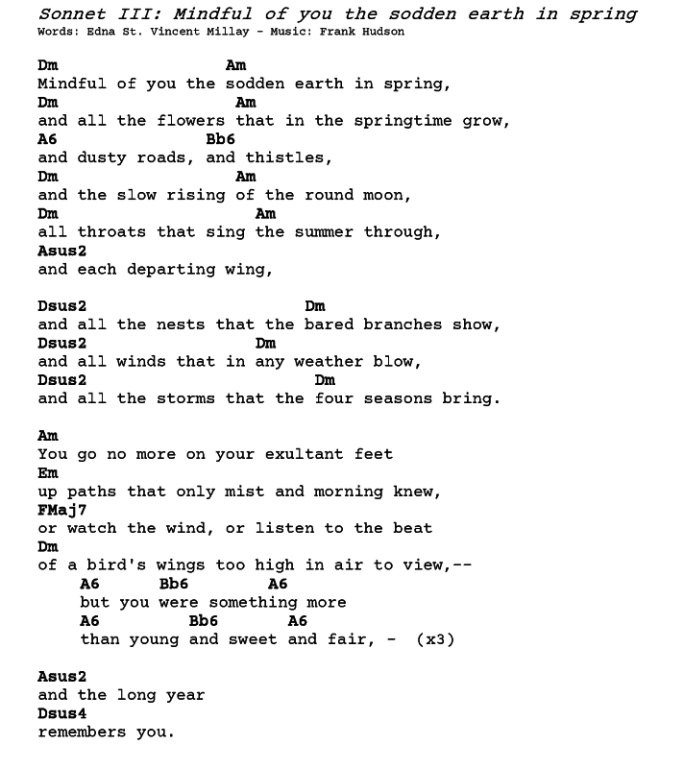
I’ve found that Millay’s poems often improve with performance. While not exactly a slam poet with planned-in applause lines, Millay’s language (even with its touch of archaic poetic diction) has a pleasing sound, and near rhyme and rhyme add a sensuous chime to the lines. It really is one of those poems that ask to be sung. That said, I found myself modifying Millay’s line breaks as I set it to music. The chord sheet version I provide today can be compared to this link of the printed text to see how I adapted it. I also added a refrain again.
Some less common chords in this one, but I offer these chord sheets in hopes that other singers will try these songs out.
.
One last thing developed from the poem as I did this work: the poem, ostensibly addressing Spring, may be speaking also to the passing youth of the poet, and the line I chose to refrain is repeated to bring forward that which I felt on that extraordinary warm Saturday when I performed Millay’s poem, that we can cherish (and be considered) being more than young and sweet and fair. We all live as promises.
To hear that performance of Millay’s sonnet you can use the audio player gadget below. No audio player seen? That throat isn’t gone on departed wing, it’s just some ways of reading this blog suppress showing it, and so I also offerthis highlighted link that will open a new tab with its own audio player.
Another poem for April Poetry Month. Another Emily Dickinson poem. Once more, wildflowers. Once more they’re that early spring flower, daffodils. Once more the poet is looking back because something’s missing.
Chord sheet because someone else might sing this better than I can
.
Last time the voice in Dickinson’s poem was also alienated from Spring, but there was a taunting wit to that one. The mode in today’s Dickinson is more abstract, and the second, final, stanza is so gnomic here I can’t say I know fully what it’s conveying. Even the first stanza is tied in knots, tangled with those Dickinsonian dashes. Is “an April Day” the “Absent Place” — or is the April day, with present dancing-in-the-breeze daffodils, in contrast to the Absent Place? The stanza’s final line asking us to consider the viewpoint of “the Souls that snow” could be saying then the snow is more full of motion and drifting shapes than mere blossoms — or that April brings forth feelings that makes the Absent Place snow-Souls uncomfortable?
In intent or effect, it may be a shifting Tao — an all of the above in motion with each other?
But the final stanza? I assume “Drift” within is of the snow-Souls’, a self-impediment worse than snowed-in roads or walks, but the concluding two lines are harder to follow. Perhaps she’s saying that snow-Souls are the ”Him” in the last line, and their change and emotion is as strong as (“duplicate”) as the wind-moved daffodils? But “duplicate” is a strange word choice. Even within slant-rhyme it’s quite strained to rhyme with “without.” I even toyed with pronouncing the duplicate as the noun, not the verb, which would be a nice sound-pair with “but.” However, that’s syntactically sour and doesn’t follow the first stanzas ABAB rhyme scheme.
For awhile I engaged in a little fantasy extension of this brief poem while asking why daffodils, rather than another Spring flower. Poet Dickinson famously knew her plants — not just as an avid gardener — but as a woman with more education than most in her time and place (which included science, considered a presentable ladylike field). She was the maker of an impressive book of pressed flowers labeled with their scientific names. Did she know her Greek myths as well as the scientific name for the daffodil, Narcissus? The essential piece of the Greek myths of Narcissus is that the youth of that name dies because he becomes entranced by his reflection, his duplicate. Is the last line’s “Him” Narcissus or something like him?
Or is she taking another route into the roots of the word narcissus, related to narcosis, a drugged numbing? Does the final stanza mean to say that springtime joy can be as numbing as wintertime sadness?
It may be wise to consider my thoughts about the final stanza over-thinking. They’re surely speculative, but it still seems likely that the poem means to link the emotions extracted from Winter and Spring landscapes.
As April National Poetry Month winds down, I’ve fallen into a theme without designing it. Many of us are feeling crabby, dismayed, disgusted, frightened, but Spring doesn’t know that. The cold of Northern April is now behind us, and May lays out ahead with greening and warmth. Is it taunting us by being pleasant and hopeful?
For the music in the performance you can hear below, I fell into it too, as certain and mindless as Spring. The recording started with the chordal guitar part, which I played on my jangling Squier Jazzmaster instead of an acoustic guitar because I was telling myself I’ve been stuck on acoustic playing too much lately, and I hate to be predictable. In timbre and volume it was hardy enough to easily accept the drums and electric bass that I matched with it. The final part was the lead guitar line played largely on the B string of the guitar up and down the neck, in that “I’ve just heard a Ravi Shankar LP” way that was popular in The Sixties — the 1960s, not Emily’s 1860s. You can hear it with the audio player gadget below. No such gadget to be seen? The authorities haven’t shut down the psychedelic ballroom, it’s just that some ways of reading this blog suppress showing the audio player. This highlighted link is an alternative which will open its own tab with its own audio player inside.
The attention I’ve been calling forth this National Poetry Month has been divided up between “civic poetry” about the state of nations, and poet’s examination of Springtime. Today’s piece continues with the wildflowers and wildlife side of April, but because it’s by Emily Dickinson, it’s a complex statement.
Dickinson here uses the ballad meter as she often did, a form also used for many Protestant hymns. This form as common as the robin. Simple music, startling images, another disconnect.
.
This poem, approximately dated at 1862, can still startle the modern reader. Over a century and a half of poems have been written since then, yet the language, images, and play of thought within it still seem fresh and surprising. And there’s no wait for the surprise in this one, beginning with the idea that I used for a title for the resulting song I made of it. Dread of Robins? This common North American bird is anything but frightening. It’s not large, or fierce, no raptor or raven. In the context of the poem, the outstanding thing about the American Robin is that it’s a migratory bird whose arrival is a sign of Spring. Yet it causes pain somehow.
The next stanza seems to amplify sound. The song of the robin is not that loud, but the sound of wild birds in Spring taken together does have a choral aspect. In their territoriality and mate-seeking, there is a shout to their throats. Dickinson hears some music in it, but it’s not altogether pleasant. The Piano in the Woods image delights in sideways incongruity. The piano is Dickinson’s instrument, the one she played, but as an acoustic guitarist one thing I know about the piano is that it can be overpoweringly loud. And placing the piano with its wooden case in a woodland implies a metamorphosis. Perhaps ED hears a piano whose notes are bird calls? “Mangle” here is another characteristic unusual word choice by Dickinson. In her day she’d know the machine named with the verb: the wringer for squeezing water out of laundry. Spring is putting the speaker in the poem through the wringer.
Many of this April’s pieces have featured wildflowers, and specifically daffodils, but the colorful brightness of the flower here does not delight even after the dreary monochrome of a Massachusetts Winter.
Bees are everywhere in Dickinson’s poems, more than angels in Blake or Rilke. She often speaks fondly of their seeking sweetness, their industry, their pollinating agency in horticulture. Dickinson had by interest and education knowledge of these details, yet here the Spring bee too is unwelcome and she feels alienated from them.
In the penultimate stanza the creatures and flowers of Spring are present. She grandiloquently calls herself, “The Queen of Calvary,” suffering as if the crucified Jesus of Lenten Spring.
In the final stanza there’s a parade of sorts, with drums and salutes. “Plumes” here strikes me as an odd choice. It may be a bereaved funeral procession. Black ostrich plumes were apparently used for funeral decorations in the 19th century, so oddly we start with a modest small bird and end with the plumage of one of the largest. The poem’s speaker dreads the robin, yet seems accepting of the plucked raiment of the giant.
Is this a poem of disappointment and depression? Yes, that is there — but it’s majestic too. The poem is a catalog of Spring’s changes, all of which the poem’s speaker is unable to find pleasure in: dreaded little robins, pianos in forests, piercing yellow wildflowers, the energy of bees. There’s wit here, and like a Blues singer, there is a power of being able to sing knowing the score of a bad outcome!
I think this is a poem of a divided mind. I can relate. Spring remains wonderful, much as this Spring I’m experiencing this year, but my civic world has presented us with discordant changes, public cruelty, careless acts, all cloaked in self-serving bluster. Dickinson’s poem is dated to 1862 — the American Civil War, which for now still has a singular name, had started.*
I originally tracked my musical setting here with just my voice and acoustic guitar. I thought that spareness might contrast with the last two musical pieces here with full-on Rock ensembles. I had second thoughts though: this may be a poem about internal sensations, but it’s also about change in a fuller natural and national world. Eventually this arrangement, one that evolves throughout with high wind instruments and emerging synth seemed better suited. You can hear it with the audio player gadget below. No dreadful robin, I mean player, to be seen? You may be reading this blog in a way that suppresses the player, so here’s a highlighted link that will open a new tab with its own audio player.
.
*One reader of a Dickinson blog has a detailed theory of the personal particulars that might have faced ED when the poem was written. Deadly Civil War or mentors splitting for the coast would be matters of mismatched scale. Is the Spring of closely watched bees, and little birds and yellow wildflowers smaller or bigger than those things?
Attention is an investment. Today’s piece combines two poets that had my attention this Spring. Regarding one poet, this expenditure was long-standing, for the other, the attention is more short-lived, conditional. My attention requests yours, so let me get on with this as I try to be brief while providing context.
Fifty years ago I had just bought a cheap nylon-string guitar from the unsold Christmas stock at a local J. C. Penny’s store. I was learning to play it because I, a poet, wanted to write songs. I can’t say much for how substantially I’ve mastered guitar playing, but I have learned how to make songs.
I had models in early 1975 for what I was trying to do. My internal list of influences was shorter than it would be now, but it wasn’t just one or two. Certainly one was a young woman roughly my age who I’d read was performing her poetry with an electric guitar player and who had written a few literary pieces I’d seen published.* In the Fall of 1975 she released her first record album. I bought that LP the week it was released, likely at the sprawling Lloyds store on the edge of town.
The Seventies were a heyday for recording. The record business had recently become bigger economically and Rock music was huge culturally. Oddly, at the same time of this growth there was a falling off of the visionary and exploratory stuff that had attracted me as a teenager. Key artists of the previous decade had died or been diminished. Commercial filters along with endemic chemical narcissism and dependency reduced the force of many of those still recording. That debut record I eagerly bought — Horses, by the Patti Smith Group — was nothing like those compromises, and it retains considerable uniqueness to this day. It’s a poetry record as much as it’s a Rock music record. Large portions are chanted rather than sung. Smith’s words, however delivered, demanded a listen from the heart and the pelvis before taking the long-way around to the brain. What Smith was doing wasn’t unprecedented for a woman (or a man for that matter), but it was rare then, and still is. But I don’t want to diminish the music on the record either, the band, the Patti Smith Group, were also doing things underrepresented in 1975, despite their irregular formation. Writer Lenny Kaye had been the electric guitarist backing Smith at those NYC poetry readings earlier in the decade, and now he had another guitarist, Czech refugee Ivan Kral, to expand the sound, along with a rhapsodic keyboardist Richard “DNV” Sohl, and a drummer, Jay Dee Daugherty, who had joined the group just before going into the studio. They were fellow explorers to Smith, willing to go places they didn’t have charts or established trading routes for.
Horses gathered some attention. It was the spearhead of a musical revitalization movement that soon got a reductionist name: “Punk Rock.” Released on a major record label in this era meant that it had to be reviewed. While Horses is now recognized as a landmark, a signpost to new paths, the reviews then were mixed, though usually respecting its ambition. It was not a commercial blockbuster, sales were modest, but that was OK then as first albums were allowed mere “worthy of attention” response. My own reaction wasn’t as a critic or chart watcher — I needed inspiration, and I overwhelmingly welcomed it.
To get to today’s Parlando piece we need to move on to the PSG’s meeting up with the problematic-second-album syndrome. That album, Radio Ethiopia, sold even less than the first, and the Rock critics were even more mixed in opinions. It was a shot-by-both-sides response. These contradictory judgments were issued: it was even less commercial than Horses, it was trying to be a mainstream Rock record and so wasn’t Punk; it indulged too much in Smith’s self-mythologizing (evidence: she, a woman without credentials, played naïve guitar on the LP’s longest jam), it was too much a band-record featuring the Group instead of Smith.
I liked Radio Ethiopia. More inspiration as far as I was (and still am) concerned. A song from that doomed follow up has remained in Smith’s repertoire for the rest of her career: the breakup song “Pissing in a River.” In this linked 20 minute 21st century account of Radio Ethiopia and that song, Smith herself movingly describes her state of mind while making that expression. She was so full of doubts that the wholly committed vocals that mesh with Ivan Kral’s compelling four-chord cycle in “Pissing in a River” are credited by Smith to her brother, who came to the studio just to stand next to her, silently, at the mic. Last time here I spoke of how our relationships with others broaden what we see and report as artists. I teared up listening to Smith’s account this week, another testimony.
The version I used for performance is roughly half the length of the original poem.
.
This Spring, as I made tentative plans for National Poetry Month pieces here, I made a note next to a poem “Lilacs” by pioneering early 20th century Modernist poet Amy Lowell: “Long. Maybe do it Patti Smith style?”
I have not played much attention to Lowell, though one musical performance of a poem of hers is a personal favorite of mine. In the landmark era when English-language Modernist poetry emerged, she was a controversial figure — those mixed reviews again. It’s undeniable that she helped popularize the new free-verse style as a poet, anthologist, critic, and promoter — but otherwise these were arrayed against her: she was a woman, not gender-conforming, overweight, and suspected of being a wealthy bougie poetic interloper on the bohemian Modernists. I’ll add my own personal count against Lowell: a lot of her poetry doesn’t consistently reward my interest. My current theory is that she’s something like Wordsworth, a poet whose best work may be diminished by a mass of undistinguished work, and great lines sit next to meh ones. But also like Wordsworth, her value in theorizing and promoting a new prosody must be acknowledged.**
“Lilacs,” the poem that gathered some of my attention, is an example of the good and bad as I see things with Lowell. There’s immediacy in the poem that attracts me for performance (Lowell was an enthusiastic public reader). “Lilac’s” theme, remembering her New England ancestry,*** would befit her cousinoid Robert Lowell later in the 20th century, and I loved lines that sounded like Allen Ginsberg (“Clerks….reading ‘Song of Solomon’ at night, so many verses before bed-time, because it was in the Bible”) and Frank O’Hara (“Parks where everyone walks and nobody is home.”) ****
So, I did one of my “use what fits me best” editing jobs on Lowell’s original text, excerpting what I thought of as the most vital images in the poem, reshaping some of the lines, and following through on my first-thought of performing it in the manner of the Patti Smith Group.
That incantatory “Pissing in a River” chord cycle was a good match. I needed to rotate myself into each player’s role to create the ensemble, getting the rhythmic core down with a drum program, adding a bass line, and then performing each channel of the song’s double-tracked rhythm guitar bedrock. I used a sophisticated arpeggiator to create a right-hand piano part, but on evaluation I was so proud that I could get the just-little-different precision of the doubled guitar parts that I removed the piano.*****
Now it was time for the vocal recording pass. I made an unusual choice to try to improve what I fear is the least successful part of my recordings: as my expedient to Patti Smith’s brother undergirding her resolve, and only as preparation for the take using Amy Lowell’s words, I recorded an entire “scratch take” performance of “Pissing in a River,”
My four-chord riff cycle isn’t played exactly as the PSG recorded it, but the last part of my recording was an even larger departure from my inspiration. As a musician I’m a full-idiot/half-way savant. The part I’m most comfortable in is lead guitar playing, so my version isn’t a copy of theirs, I looked to another mode, their adventuresome NYC scene-mate guitarists: Tom Verlaine, Richard Lloyd, Ivan Julian, and Robert Quine. The performance in my recording of “Lilacs (version)” includes what some (many?) would consider overplaying. As I (too?) often do, I continue to play during the vocal passages. I know this is incorrect — but more than correctness, I worry that it might detract from the song. Asking myself why I do this, my answer is that because my voice can’t provide the melodic elaboration I’d offer if I was a more skilled singer; and as a poet, I think the words can be (are?) powerful enough to compete with wailing electric guitar.
I leave that last thought with this restatement: as a writer, it’s OK to whisper — understatement has its power — but even if you read unaccompanied, or write for the silent but companiable page, consider if your chosen words are committed so they could go toe-to-toe with a cranked guitar. Sometimes you might want that.
You can hear my performance melding impressions of the 1970s Patti Smith Group with parts of the 1920s Amy Lowell poem “Lilacs” using the audio player below. No player? It hasn’t been dropped by the record company man — it’s un-displayed by some ways of reading this blog. This highlighted link is an alternative way to rock it, as it will open a new tab with its own audio player.
**As I mentioned recently, the issue of being too prolix and prolific with putting out work is something I worry about with the Project and myself.
***Like fellow New Englanders Cummings and Millay (and the British Housman) already performed this National Poetry Month here, Amy Lowell is presenting Spring as a memory of the quill-written past wafting through graveyards unkempt by their Modern age.
****As with a lot of early 20th century female Modernists, Amy Lowell dropped off the canonical map in mid-century as High Modernism and the New Critics came to the fore. Lowell’s popularizing efforts gained little credit as poetry sought a refuge in elite understandings and “serious subject” male-centric viewpoints. Our current century is re-evaluating that.
*****As a naïve keyboard player, arpeggiators are a crutch I often lean on. Give them a chord and their rule-based fingers will present a more sophisticated output. I border on shame when using them, though similar tactics are all over modern music. I’ve tried to bargain with my guilt by referring to my favorite arpeggiator as “DNV” — the nickname Lenny Kaye gave to Richard Sohl who was a vital elaborator of the earliest PSG records. “DNV” stood for “Death in Venice” because Kaye thought Sohl looked like an actor from the movie version of Thomas Mann’s story.
I wrote down this poem earlier in the year as a good fit for an April National Poetry Month piece. It’s author, Edna St. Vincent Millay, was from Maine, and I write from another northernmost American state, Minnesota. If a southern-born St. Louis boy like T. S. Eliot who went to live his life in temperate England wants to ironically write about April being the cruelest month, dryly riffing on the Middle English of a Chaucer’s pretty “Aprille with his shoures soote” — well, what with all the flowers and pleasant nourishing rain, that kind of puts a climatic brand on the month poetry-wise.
I rise with Millay to contradict: we have birdsong here, but it’s a more desperate, assertive song, not some celebratory strope — because it rained, sleeted, and concludingly snowed a sloppy wet mix all night and afternoon as I worked on completing today’s musical piece, and this morning everything — tree branches, overhead wires, yard fenceposts, garbage cans — had, to the very limits of toppling, piles of sticky snow as high as any booklover’s stack of unread books.
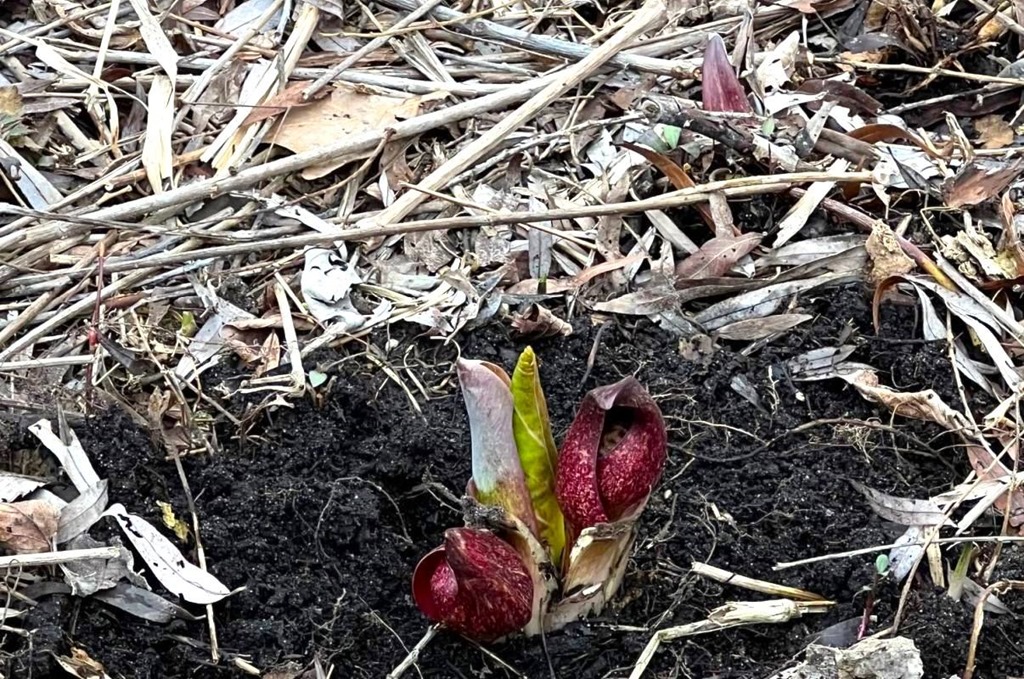
My nature loving wife took a European-born friend on a hike last week and showed the friend skunk-cabbage, a strange red, raw-meat looking early Spring plant that is exothermic — it creates its own heat like some huddled mammal so that it can bake through the snow cover. Nearer to home, indeed right next to the foundation, a small surviving clutch of tulips has sent up green leaves, but no buds yet. Their leaves course with some green antifreeze, as nighttime temps remain consistently below freezing.
“O April, full of blood, full of breath, have pity on us!”
.
My wife and I have varied memories of who planted the tulip bulbs. I remember it was my late father, long ago — while she thinks it was her mother more than a decade ago. There are only a few left. Brazen squirrels dig them up, or perhaps they are only perennial in the same sense that we are, bound to rise in many springs, but not forever.*
So, if the theme of this April’s Poetry Month is The Shared World, I certainly felt I was sharing the world within Millay’s poem “Northern April.” The wind, the resonance of a creek with remaining ice, the just warm enough to be rain/rain. At least for me, in my northern clime, there’s a rich sensuousness in the poem, and enough word-music inherent in it to command me to sing it.
I’ve noticed that I haven’t used my 12-string guitars much this winter. They are a little more stout to play, and I think they show less forgiveness for my less-than-pristine technique, but I tried to plant today’s piece in the furrows dug between my limitations.
My music today makes use of a couple of instruments playing at the edge of their ranges. The bass guitar part is entirely played in the upper octave of the instrument, giving it an unusual sound I found I liked; and for a bit of melodic embellishment, I played an oboe line, again at the upper reaches of the instrument. Why an oboe? I thought of a 20th century band called Oregon who would mix 12-string guitar with reed/woodwind instruments, and I wanted to revisit that set of timbres from the composer/player side instead of from my listener’s memory.
*I took leave from poetry and music to very briefly look at that issue from gardening knowledge. It appears that the bulbs shoot off other child bulbs, a process hidden in the dark underground in the later, non-flowering, part of the year. If so, appropriate for the idea that we think these spring flowers are from our parents.
This E. E. Cummings poem is often read as delightful. And it is. It’s also a poem some encounter in childhood. At least in my youth, it was an anthology favorite that vied with Carl Sandburg’s “Fog” as an introductory example of free verse. And no verse is ever more free than this: the letters smattered like mudprints all over the page, capital letters not yet grown, stuff smushed together. No colonnaded sonnet, no astringent exhale of meditative breath like a haiku. On your poetic menu, this is a mudpie for Spring.
Is it just this?
I set it to music. That’s what this Project does in Spring, and Fall, and Winter too. Every chord in the music I made today is a minor chord. Is this a sad poem, did I want to force it to be one? Not that simple. Just lowering the 3rd note in a scale a half-step to form a chord from it, is that really determinative? These are just sounds playing together.
But this is a considered song about Spring and the distance in half-steps from childhood, not just some neutral exhalation of it. The poem itself grew up, or blew up, over a few years. It was first submitted for a class assignment by a Harvard college student in 1916, and that version, while free verse, lined up this way.
I found this excerpt of the original version of the poem in a section on Cummings written by Michael Webster included in A Companion to Modernist Poetry published in 2014.
.
That college student would soon go overseas into a world war as an ambulance driver, and Cummings and his cohorts there took exception to simplistic war piety. I’d guess the logistics of suffering didn’t firm up the young man’s patriotism. In something I see echoed in this week’s American news, his talk was deemed an imprisonable thing to say, and Cummings was imprisoned in France. It’s one thing to write free verse, it’s another to convert the currency of one’s free thought into loss of freedom. I wonder if at this point the blood-soaked mud of WWI’s trenches were known to the young man. Anything but mud-luscious.
Cummings had enough luck or privilege to be released. In 1920 The Dial publishes a new version of that college poem. In a few years more this magazine would publish an expatriate American’s poem that indicted Spring, starting “April is the cruelest month…” But this is Cummings’ poem, and this is how it looked on The Dial’s pages.
On first publication it’s largely the poem we now know, but it doesn’t have a title. And curiously, the second instance of balloonman is “balloonMan.” Did a proofreader just get exhausted editing Cumming’s manuscript?
.
In 1923 Cummings published a poetry collection, Tulips and Chimneys. He put the still untitled poem in a section “Chansons Innocentes” (Innocent Songs). By innocent did he mean from childhood’s sensibility, or a plea of not guilty? And this is how that version went.
Nope, the balloonman to balloonMan thing must have been Cumming’s intent.
.
We’re near the final version, but at some later date (I’d assume a selected or collected poems publication) it converted its first line (strictly constructed) into a title with some typographical marks to make it look like Cummings was establishing Bon Iver’s song titling methods a few decades before the bard of Eau Claire. In the end, the poem that a lot of folks informally recall as “In Just Spring” is [in Just-]. I can’t help but read that title as a pun.
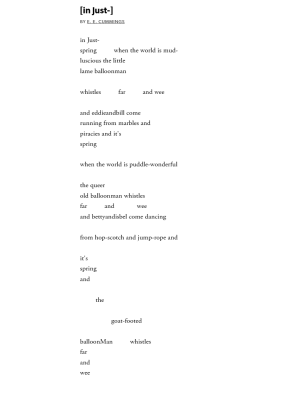
Here’s how the poem in it’s final form appears collected on the PoetryFoundation.org web site. “Just” is the only capitalization and man stays lowercase.
.
And now decades have past — and I, an old man, have gone to perform this poem for this year’s Spring, and I pick minor chords. Much has past us, dancing toward or running from: another world war, and current cruel wars happening somewhere further than the far distance whistle of the balloonman. Cummings’ childhood was close enough to me that I can actually recall playing marbles in the dry dirt finger-writ circle of a schoolhouse playground.* I know how a hopscotch chalk field is laid out. Do children still jump rope with rapping rhymes, and if not, what has poetry and hip-hop lost? If there’s a balloonman, his creatures are mylar and determinedly decorated no doubt. All this 20th century stuff is now as archaic as the arcadian goatfoot-god Pan who whistles like escaping air. I, and once-girls with names like Betty and Isbel, know this. Now, as I experience the poem this year there’s more distance there than there was for a twenty-something poet who wrote it. I put a distance far and wee in the music — for Cummings was of an age that he knew he was to be an adult now, while still young enough in years to know within his body’s memory the lost experience of the playing children delighted at the balloons. Balloons that would either fly away or deflate — escape/ascent vs. air loss or a pop as sharp as a bullet.
It’s the first day of spring. My chords have a third a half-step deflated. Disordered self-important dolts are running things, and I think better to have an old halt body with a bouquet of floating hearts. If the world can still seem puddle-wonderful — to be aghast is not to wonder. So, I must recall how to wonder, far and wee.
You can hear my performance of E. E. Cummings “In [Just] spring” with the graphical audio player below. Did someone let go of the string and a player is blown away? Don’t whistle, just use this highlighted link alternative that will open a new tab with its own audio player.
.
*And playing pirates without extra-faceted dice, is a lost quattro too — but I wonder if Cummings was thinking of Barrie’s Peter Pan in choosing that manner of play. I’ve just finished watching an absorbing 2022 TV documentary series called Wonderland on BBC Select that often asks over its episodes how much childhood trauma, WWI, and social injustice informed English children’s literature a hundred years ago.
Something about the Spring I noticed this year — oddly, this year as an old man who has had a full lifetime of Springs — is the intensity of natural sounds in my city. There’s a tendency, demonstrated in many poetic tropes, to make nature a portrait or a silent movie, putting nature in contrast to the noise of our civilization’s hum and bark.
I ride my bicycle nearly every day off to a café to have a breakfast, sometimes early enough to feel like the single soul on the street, but by the return trip certainly part of the city waking and doing: kids on their school bus stops, sometimes with a parent, sometimes waiting with their own cohort only, folks holding coffee flasks unlocking their car doors to go to work, a few other bicyclists, including those on big front basket bakfiets or long-tail rear-seat-shelf bikes holding small kids, this observant cargo watching whatever in the morning beneath their pastel helmets. The human noise is slight and clicking. In such mornings we are more like crickets rubbing their wings.
But the birds! When most of those humans are making only accidental noise this early, and the kids waiting for the yellow bus aren’t always talking, perhaps practicing quiet for the ordered schoolroom, the birds are singing at the tops of their voices in the morning. Like miniature feathered fiddles, their song cuts through larger sounds, it insists on being heard. “Ladies, I got your genetic material here!” “This is my and my kind’s tree!” “Whatever this is, this Spring, I am here, and I’ll use my breath to say it!”
Like us bipeds lacking much fur, other mammals aren’t sounding much. Yard bunnies are suspicious and quiet. The squirrels don’t chirp, and their little feet make quiet footfalls. The dogs on leashes: all nose-leading in an alternate sensory dimension. But the frogs and toads are singing out too — whole amazing choirs of them, all wanting to contest Emily Dickinson’s Nobody with a harrumph and high whistle of who they are.
So, it is this Project’s nature to add sound to page poetry. Today’s audio piece is just me alone with a Telecaster electric guitar during a hurried session early this Spring to put down some musical ideas. In the poem that I’m combining with my music, “The Birds,” William Carlos Williams follows Imagist principles, melding a moment into concrete images. Given that we’ve just had a set of rainy days throughout the long holiday weekend in my city, I resonate as Williams poetically paints the bird-morning wet as undried paint.
Is the world not “wholly insufflated” as he says at the start? The bird song is breathing into our world — nature is not silence, but poetry aloud.
My wife found these* stapled to poles around our neighborhood on Sunday.
.
You can hear my performance of Williams’ “The Birds” with the player gadget below. No gadget to be seen? This highlighted link is an alternative that will open a new tab with its own audio player. Want to follow along with the text of the poem? Here’s a link to that.
.
*This bird couple’s heads are superimposed over a human pair of heads from the cover of The Magnetic Fields Holiday album. The quatrain quoted below is from a song found there “Strange Powers.” Despite being a substantial Magnetic Fields admirer myself, I had never seen this album cover.
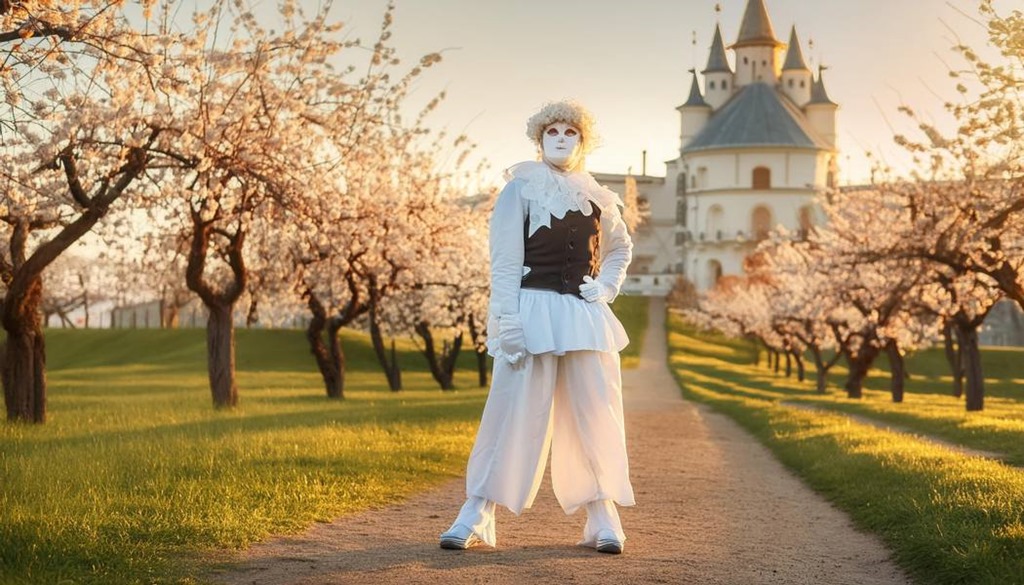
Today’s musical piece uses another very short Spring poem by Emily Dickinson “A little Madness in the Spring.” I was reminded of this poem when I attended the May Midstream Poetry Reading Series this month where Thomas R. Smith opened a set of his own poems by reading this one of Dickinson’s. If you’d like to follow along, here’s a link to the text of that poem. Spring madness is not an unique poetic subject, but there’s an odd character we meet in this 6-line poem: a clown. Smith told us that “Clown” in his mind is best illuminated by understanding that the word emerged from a character that would have been understood as a country bumpkin. Checking on this, I confirmed that. The silent, white-makeup, big-shoed, red-nosed presentation that likely arises in your mind when you read “Clown” has not yet come into its full form when Dickinson wrote her poem, but the rural clod stock character reached back through commedia dell’arte to the works of Latin and Greek comedic playwrights.
I can’t say how Dickinson visualized clowns in her mid-19th century. I don’t know her access to whatever comic drama or the opera bouffe, but she might have run into clown characters in books or periodical reviews too. One thing that occurs to me: an American form that uses stock buffoons that was popular in Dickinson’s time and place was the minstrel show. Minstrelsy is infamous for using largely white actors playing black slaves acting foolishly, a context which cannot be disengaged from the larger social evils of slavery and white supremacy. It’s not to excuse our parochial evils to note that these character tropes existed outside of the peculiarities of America and white blackface.
When I had seen “A little Madness in the Spring” with its “Madness,” “King” and “Clown” before I heard Smith read it, I casually thought the poem referenced Shakespeare’s King Lear. Looking at that today, I can’t find evidence for it. The Fool in Lear is always The Fool, the word clown is never used. Nor is Springtime evoked in the play.
“As if it were his own…”
.
So, I think Dickinson may have a generic King and Clown in her little poem. The meaning I’d extract is: It’s fine to be irrational in Spring, even if one has powerful responsibilities, but even more so we should note the foolish notion of the innocent peasant or farmer clown who observes all this new growth of spring, the “whole Experiment of Green” and believes it is their property. One fine point I’ll put onto that last part: even an unschooled farmer — and avid gardener Dickinson too — would know the work and craft that goes into starting a garden, crop field, or orchard. A King might puff himself up and portray that husbandry as “his own,” but the man or woman dealing with the exact logistics and labor knows well their part, regardless of who owns the crop or the field.
Is Dickinson winking at that difference in her comparison of the King and Clown? But neither labor nor legal papers and titles make the Earth and Springtime fully our own. We sing it, but the music comes from elsewhere.
You can hear my musical performance of Dickinson’s “A little Madness in the Spring” with the audio player gadget below. No gadget? This highlighted link will open a new tab with its own audio player.
For a cluster of reasons, it’s been increasingly difficult to create new audio pieces for this Project. For one thing, having done over 750 of these pieces during the past 8 years, a lot of musical ideas, poets, and poems have been explored already. For another, my increasing age and high-mileage body have decreased my stores of reliable energy and dexterity. But one other reason is that I no longer have a predictable and luxurious access to times when I can record something that involves a microphone. Oh, I still get such time — but I don’t always know when it’s coming — and so an opportunity may arise, and I’m committed to something else, or it comes about and I’m weary and spend it napping or resting my aching old frame, or it opens up, and I have nothing prepared to record.
This frustrates me even as I realize that what I do have to bring to the Parlando Project in terms of resources and time is something to be grateful for.
Yesterday I had foreknowledge of one of those recording times coming. I collected two things I wanted to do something with: a well-known poem by Emily Dickinson and another musical piece that I wanted to record just for my own personal enjoyment. As I sat down in my studio space to record my musical performance of the better-known Dickinson poem, I noticed on my music stand a chord sheet for a lesser-known Dickinson poem I had done the music for early this spring: “Sexton! My Master’s sleeping here. ” “Sexton!” hadn’t been recorded, even though it was ready — I didn’t have the time in early Spring as I rushed to do all the pieces on the children’s verse theme I had chosen for National Poetry Month.
Dickinson’s “Sexton!” is an early Spring poem, a season that arrives at different times in different climes, but I figured that I needed to record it right away if I was going to keep it at all timely. I grabbed a dreadnaught guitar (a larger, more powerful sounding guitar than my usual instrument) and quickly refreshed myself on how I had intended to perform “Sexton!”
I was so eager to record on this occasion when the restrictions to making a sound had fallen away that I ripped into the piece at a reckless tempo. A choice or a mood? Moot point, I had to get on with it. Thinking about that tempo today I also wondered if my teenager’s hardcore punk listening had seeped into my mental metronome. But then “Sexton!” does start with an exclamation point, and the whole poem is that: an exclamation of Spring.
Of course this is Goth Emily — so even if her poem and performance are as short as a cut by the so-rapid punk bards of San Pedro The Minutemen, there’s context crammed into 90 seconds. Here’s a link to Dickinson’s poem if you want to follow along. What do we find in those words?
This is what you come to the Parlando Project for: stuff that’s stuck on each other like cockleburs.
.
A sexton* takes care of church grounds, typically including a graveyard. The sleeping Master’s bed chamber is therefore likely a grave. Spring has come with flowers and birds expecting new life.**
Spring isn’t stopping to reflect on this, like the tempo of the song it’s got work to do. Dickinson is in a churchyard, but it’s full of death departed and life arriving, not dogma. What replaces that dogma, sermon, homily? Bird-troubadours, secular Spring-song: its shortness, its insistence. You can hear my performance of Emily Dickinson’s “Sexton!” with the graphical audio gadget you should see below. No gadget? This highlighted link is a backup that will open a new tab with its own audio player.
.
*By anachronistic coincidence, the poem’s sexton made me think of Anne Sexton, a 20th century American poet. Poetry is like a cocklebur: its tropes and metaphors will stick to anything.
**More coincidental connections: in considering Dickinson’s poem in the context of a song I thought of this Earl Sykes song, best-known from a Ralph Stanley bluegrass version, called “A Robin Built a Nest on Daddy’s Grave.” I wonder if Sykes knew Dickinson’s poem, or if there’s some third source that both the poet and the songwriter tapped for this springtime combination. My Dickinson poem-now-song would make a good medley with Sykes’ song —and good bluegrass high vocals and harmony would certainly spruce up my rough-hewn singing performance.





 Frank Hudson