The Wood-Pile

Robert Frost is every bit the master of word music as Yeats and Millay. What makes Frost stand out is that he was every bit the thoroughgoing early 20th Century modernist as any of his free-verse contemporaries, while retaining an ease with accentual syllabic meter.

Here’s an example of Frost handling a subject just as a free-verse Imagist would. His aims, his presentation, hold to the Imagists’ principles. He deals with the thing directly (as we shall see, two things, but still…), and there are no tacked-on metaphors, no stock comparisons, no extraneous “poetic” language. Context is shown, but not explained. He loosens and varies his meter, so the poem sings and never seems to be a shackled march. At 40 lines, it’s a bit longer than Yeats’ poem considering “The Wild Swans at Coole,”  but Frost’s extra detail is even more specific and concrete than Yeats, though both begin their poem with the poet walking in a rural wetland. Yeats slough is a well-known place to him, conditioned with 19 previous visits. Frost is far enough into his swamp to not know exactly where he is, and so experiences what he sees with a first-time immediacy. Yeats’ slough then contains tradition, Frosts’ the more Modernist “Make it new!” place.

Though presented as one simple rural scene and story, “The Wood-Pile”  is more at two poems, though each part speaks to the other. As Frost’s tale starts, we are in the midst of one of his characteristic journeys, just as we are in other famous Frost poems. There’s a need for decision (“Turn back” or “go on farther”) and his choice, also made in other Frost poems, is to go on regardless of whatever doubts brought the question. If he’s lost in the dark by a wood on a snowy evening, keep going. If you come to a fork in the road, pick one and go on. If you’re walking in a swamp in winter and your foot is sometimes falling through the frozen crust, well, keep going “and we shall see.”

And so, here he sees his bird. No Keatsian nightingale, not Millay’s elusive flying swans with their awkward dangling legs and cries, nor Yeats’ majestic 59 swans, but a small bird. This bird becomes a mirror to the poet. Frost’s bird too must make choices in direction, and the poet, sensibly, thinks the bird’s guided by fear. “Keep something between little me and the big lummox trodding through the winter swamp,” he humansplains. And there’s a bit of humor at human’s expense as the poet muses that the bird, like humans with their self-importance, may think that the only reason for Frost to be out in the swamp is to go after the little bird.

Gackle with white tail feather

“He thought I was after him for a feather—the white one in his tail”


But, we don’t know why Frost is out in the frozen swamp explicitly. The only reason he’s given, or will give, is the Imagist poets’ reason: “and we shall see.”

The bird leads Frost to the second thing the poem wants to present: an abandoned fire-wood cache. Here Frost zooms in close. Every detail of the cut wood and the once neatly stacked and propped wood-pile is stated. Frost turns forensic, like some New England Sherlock Holmes: this pile has been abandoned for years. Mature vines have grown through it.

wood-pile

“The slow smokeless burning of decay”


Here is another context left unsaid. Why would someone abandon a purposeful wood-pile in a swamp? Frost leaves it for us to be detective and to solve the mystery. This isn’t some lot of fire-wood left temporarily to be gathered later in the day, care has been taken to stack and prop it.

The only thing I can think: someone once built a shack (now completely disappeared) on the swamp land. Frost muses, sardonically, that only someone so busy with “fresh tasks” could abandon such effort in cutting and stacking. Does he mean to say, “only a fool would be so industrious to cut and stack this wood and yet not notice he was building his shack on a swamp that would not support a homestead?”

Now, the small bird with his “little fears” and oh-so-human misapprehensions of reality—and now, the steadfast Frost of miles to keep going, even if you may be lost, are set in contrast to this choice. Your fears may lie to you—but so will your optimism.

I once heard an astringent biological statement that the length of our lives can be reduced to a slow-burning chemical reaction. Frost’s last line here is a sad and beautiful analog to that truth.

Turn back or go farther? Go on, and we shall hear my performance of Robert Frost’s “The Wood-Pile”  with my original music. Just use the player below.

Tired

I’m going to close out our investigation into the little-known early 20th Century Chicago Modernist poet Fenton Johnson with one of his most emotionally moving poems. James Weldon Johnson first included “Tired”  in his “Book of American Negro Poetry”  in 1922, and it has been anthologized several times since. “Tired”  remains the poem of Fenton Johnson’s that one finds most often shared on the Internet today.

You can see why. Only a few beats in, that powerful line is spoken: “I am tired of building up somebody else’s civilization.” It may take no more than that line alone to have some tag Fenton Johnson as the first radical Afro-American poet.

I cannot categorically disagree there. I know little about Johnson’s political views, and though the two short-lived magazines he founded before 1920 are said to have included political philosophy, I know nothing of the particular stances he took or supported. At least at the time (the first two decades of the 20th Century) “Tired”  along with a few other of Johnson’s poems caused some Black cultural critics to remark that Johnson was too pessimistic, too given over to despair. You might find that strange, but in that moment, there was a feeling that educational and cultural uplift could soon raise the Afro-Americans along with the time’s large and wide immigrant demographics into a new, more accepting America. We know now that didn’t happen, that indeed 20th Century racism and poverty had some mighty blows to land on America and American Blacks with KKK branded racism, Great Depression poverty, and world-wide Fascism—but at the time, that uplift was what many Afro-American elites were pulling for.

However, just by going on what Fenton Johnson poetry I have available to me, I’m not entirely sure Johnson was, at this time, a political radical or a thorough pessimist.

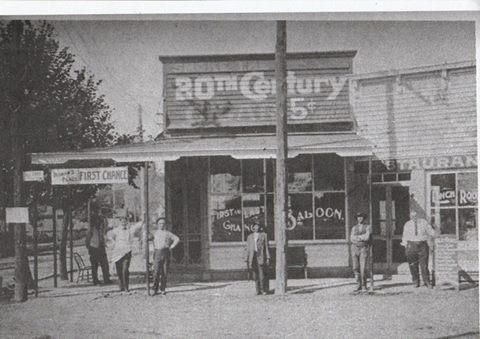
Last Chance Saloon

Somebody give me my gin.” Mike is out back serving warm gin to ladies.

After all, the speaker in “Tired”  is not Johnson himself, no more than the banjo player in our last post’s poem is Johnson, the middle-class raised, college educated man. Even the Last Chance Saloon, where the banjo player played for tips, returns in “Tired”.  Johnson didn’t live in a shanty, he wasn’t married to a laundress.

True, this is a character that Johnson wants us to hear, an important voice that maybe even the Black “Talented Tenth” wasn’t listening to then, much less White America. And though it’s free verse, this is a poem, not an incisive political analysis or program. It’s a dramatic speech with rhythm, repetition, and a rise in despair from gin-houses to the stars.

It’s not hard for me to see in “Tired”  the ancestor of August Wilson’s great play cycle, or the range of characters and voices in Walter Mosely’s detective fiction.

Musically I stepped at least as many decades into the future here, concluding this audio piece with a short burst of the kind of free jazz that allied itself with the Black Arts movement in the later part of the 20th Century. I’ll allow that this music is an acquired taste, but at its core is an ethic of allowing individual voices and modes of expression even in a group context. Free Jazz is not always as raucous as what I played for this, but it does not forbid it either. That’s consistent with what I try to do (within my limits as a musician) with the Parlando Project. When I say we combine words with various music, I mean it.

That does mean that you may not like all the writers’ words I present, or all the kinds of music I write and play to combine with those words, but it means that I’m also not going to stick with one thing and repeat it until we are both tired of it.

I’ve ordered these last four posts here on Fenton Johnson purposely, so to present the man more in full, and because, to be honest, I didn’t feel I could earn any license to speak these words without doing something more than just putting them in my mouth. To listen to Johnson’s “Tired”  as I performed it, you can use the player below where it appears, or this highlighted hyperlink.

A Dream

Here’s a second poem by Afro-American Modernist poet Fenton Johnson. Like the first piece of Johnson’s that I presented earlier this week, there’s a religious element, but it’s handled this time with a remarkable framing device.

As published in 1921, “A Dream”  is the longer of two pieces which are grouped together as “Two Negro Spirituals.”  What strikes me about them is the extraordinary knife-edge irony held in them between spirituality and reality. If the Language Poets descended from the Modernists will not find in “A Dream”  the novel uses of language and syntax they look for, perhaps the Post-Modernists will appreciate Johnson’s conveying a vivid religious vision framed in a way that causes a reassessment of the foreground material.

That’s more critical theory and bin-labeling that I usually engage in, so let’s move away from that to the piece itself.

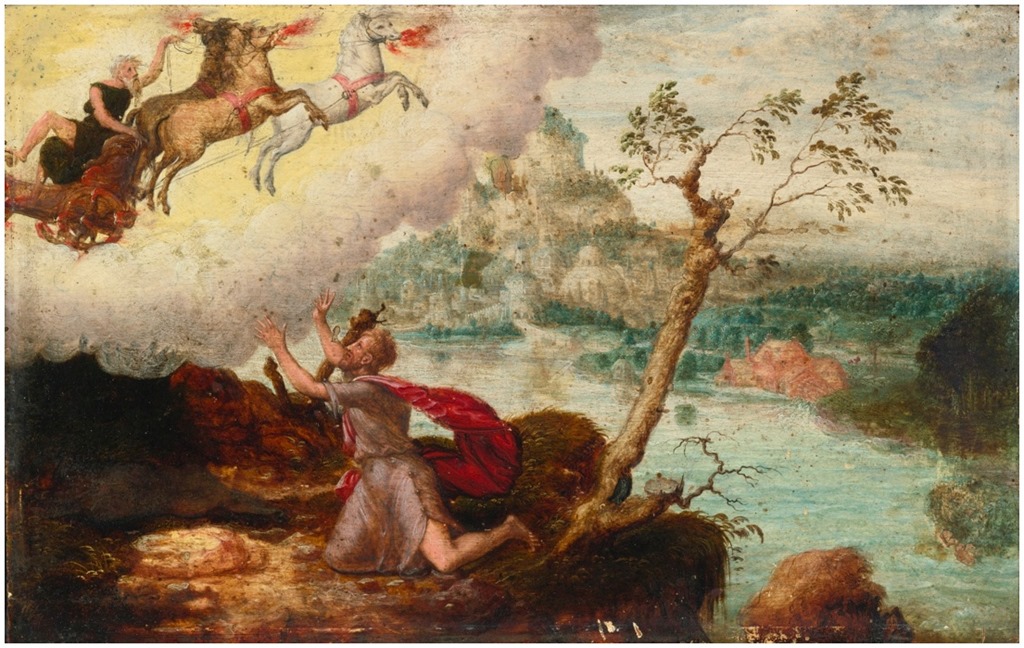
Elijah and the angel with a firey chariot

Elijah’s angel-fire chariot. Be sure your seatback is in the upright and locked position.

Is this texturally a “Negro spiritual?” Not really, though Johnson significantly chooses to call it that. The vision he presents, after a brief “Oh, my honey” aside, would not seem out of place in William Blake or any of a number of 18th to 20th Century Christian revivalists. The “spirituals” of the title were largely folk hymns, and the language here is more literary. Johnson wants us to know it’s an Afro-American who’s speaking, yes; but also, a man who could read and know these non-folklore sources. Yet, the recounting of the titular dream is not a scholastic catalog of mystical religious elements, it’s a deeply felt vision of a glorious reward. One does not need to be a Christian to feel the ecstasy of this vision, any more than one needs to fully understand all of Blake’s idiosyncratic religious precepts to sense their “thereness.”

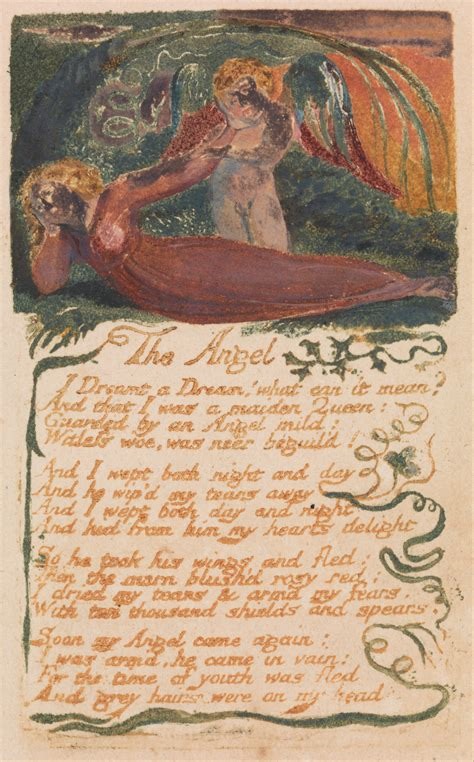
William Blake The Angel

Like Fenton Johnson, William Blake frames an angelic vision

Johnson concludes the poem with a single line of a contrasting vision that recasts all that has come before it. Listen to the piece with the player below to hear it as it occurs.

Musically, this piece caused me all kinds of trouble, and, to be frank, I don’t think I got all the way to what I wanted to achieve. The difficulties of being my own composer, arranger, reader, ensemble of musicians and recording engineer should cause this kind of trouble more often than it does. However, I did so want to continue to present the things that this too-little-known poet Fenton Johnson did, that I have “called time” on this piece, and present it here now for you to listen to. Use the player below to hear it if you see that, or if not, this highlighted hyperlink will also play it.

God Is In the All Time

I’m continually a few days behind in the past month or so, what with Winter holidays and other appointments and responsibilities. Some of the audio pieces have been recorded especially expeditiously, and another part of this project has been neglected: the searches I take to find words (mostly poetry) I combine with original music.

Because publishers do not respond when I ask for permission to use works that may be in copyright, I am constrained to use written work outside of copyright, typically works published before 1923. Although I respond to, and use, poetry written in various eras, my desire to mix in more contemporary voices leads the Parlando Project to use a lot of poetry from the first two decades of the 20th Century. This is not altogether a bad thing. I happen to like a lot of what these pioneering Modernists did, and in some cases, what we find in the mouth of the “Post-Modern” poetry mainstream delta is worthy of reconsideration in the light of the Modernists. Have stagnant currents deposited silt and detritus at our end of Modernism, its own Mannerism that says that poetry must be written in a special poetic language and syntax, because that is the language that serious poems use? If popular poems are to be about recounting internal personal experience and serious poems are to be about hermetic personal language, what is missed?

Maybe we answer these questions by doing, as we answer other questions (even ones we never ask) by living. In my case, the doing may be by continuing this Parlando Project.

So earlier this month, returning to the research that goes on behind the scenes of this blog, I read two old anthologies of poems now in the public domain, looking for some new material. In one I was attracted to yet another piece by Carl Sandburg, a poet I believe should be reassessed in our time, but hardly an unknown, particularly to readers/listeners here. In the second one I came upon the work of Fenton Johnson for the first time. I’m willing to bet most of you haven’t heard of him.

Johnson, like Sandburg, like William Carlos Williams, wrote Modernist verse while remaining in America. Like William Butler Yeats, his career was long enough that he wrote poems that sounded like the 19th Century before transitioning to a 20th Century voice. Here’s a difference: Fenton Johnson was Afro-American.

OK, let me drop a term here: Identity Politics. I was recently reading a thoughtful blog post on Carl Sandburg compared to Post-Modernist poetry, when the author remarked that Sandburg was able to write in a time preceding Identity Politics. I don’t know enough about Left Write & Centaur’s full thought on Identity Politics, but the implication was that Identity Politics, characterized as the idea that we are silos of individual experience based on membership in social and ethnic groups, who then by implication need to be treated and considered primarily by that identity, is a bad thing.

I agree, that’s a bad thing for the most part. I also believe it’s often a real thing.

The first half: the separation, at least to some degree, of individual experience, is so self-evident I don’t feel I need to argue it. Poetry and literature is to a large part a demonstration of the things that we find unique in individual voices—yes, along with things we can find in common in our lived lives—but if our take on experience wasn’t varied, literature would soon become dull and repetitive (at least to me). Even for those things that we find in common as we read or listen, how would we know without literature or other arts letting us share this?

If we feel that separation is a bad thing, then art is where we go to heal that. The arts are simply a name we give to that sharing of experience.

The second part, that this separation can be handled and considered with bins of people labeled with ethnic origin, sexual orientation, gender, age, class, and so forth, this is where it gets real. We cannot wish away with imagination the ways the world labels and files its temporary inhabitants.

Should I care that Fenton Johnson is an Afro-American poet? Should I mention it? Does mentioning it imply some kind of special pleading? As I present a smattering of his development as a poet, will his work become “Well, it’s a Black thing”—a separation surrendered to?

Fenton Johnson

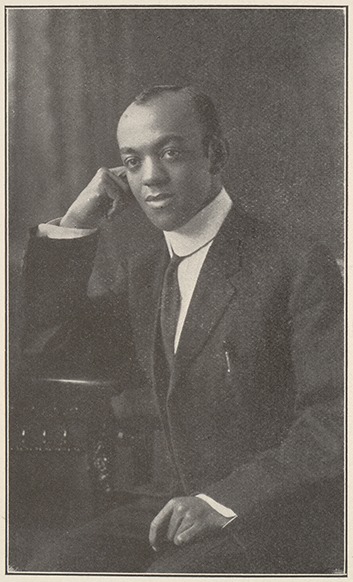
The younger Fenton Johnson. I’m unable to find any later portraits of him.

However we dream our ideal world to come, I know that Fenton Johnson had to deal in the real world of 1918 Chicago, just as he would in 1968 or 2018 Chicago, with his ethnic skin color label on a daily basis. That label doesn’t peel off. No doubt, many he encountered imaginatively filled out that label with a long list of contents, but instead, let’s look from inside Fenton Johnson out at the world.

Will it be the same and different as Frost, Tzara, Sandburg, Rossetti, Tagore, Yeats, and Dickinson? Yes.

Early Fenton Johnson poems often start from a religious theme. This one, “God Is In the All Time”  portrays things from a universalist perspective. To hear my performance, use the player below.

California City Landscape

I beg your indulgence, but once more I feature Carl Sandburg’s words in today’s piece. Variety is a goal here, so perhaps I need to take a personal no-Sandburg pledge for a decent interval. And, honestly, I wasn’t seeking another Sandburg piece when I read through a yearly anthology of American poetry from 1922 last week, looking for fresh public domain material. Reading it I came upon the interesting poem that is the basis for today’s piece.

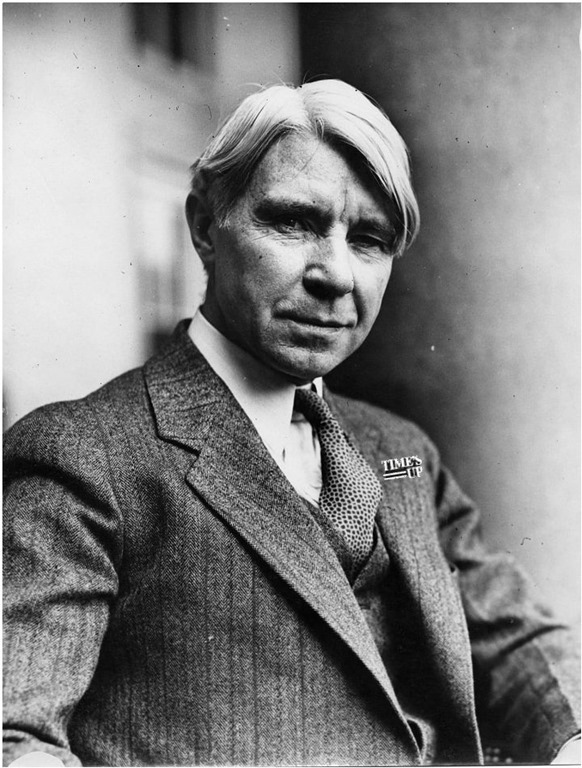
Carl Sandburg Times Up

The younger Carl Sandburg. Prophet?


Besides variety, I like to see connections, and “California City Landscape”  is rich in that. As a poem it may not be as sharp and condensed as Sandburg’s Imagist poems that I like to call attention to, but it does bring to the table Sandburg’s youthful journalism. “California City Landscape”  starts off like a feature story, and the story it tells is like ones written about gentrification in the 21st Century, even though it was written no later than 1922. The incumbent residents may be displaced. But like a poem, or a piece of carefully written prose, the reportage includes sentences which send a reader or listener off into entire dimensions of reality outside its moment in “the peace of the morning sun as it happened.” It was those things that arrested my attention as I read this in the midst of this old annual anthology.

It starts out with this anecdote about a second generation Irish-American goat farmer, connecting as it does to one of second-generation immigrant Sandburg’s great themes: American immigration. But how carefully barbed is the sentence Sandburg uses to sum up the changes this man has seen in California by 1922. He arrived in a covered wagon, and “shot grouse, buffalo, Indians, in a single year.”

If we were Tweeting: “OMG! He went there!”

But there it is in a sentence. An Irish-American, coming from a nation that is widely despised, colonially oppressed, and mired in poverty and starvation, travels in a generation across and ocean and a broad continent, and in the process shoots (and presumably kills) indigenous Americans, an act linked as if it was like hunting for food.

I’ll admit, at first moment I thought it offensive, but I’ve read enough Sandburg to know his toughmindedness, his instinct to not sugar-coat. That Sandburg wouldn’t have included this detail as a thoughtless, bloodless, “Oh, those good ol’ days, when men knew how to handle a rifle” comment.

His next anecdote: two Japanese families, truck gardening for the growing city of Los Angeles. And once again, the undertone: immigrants whose race and culture is understood barely enough to be widely disapproved of in their new country. We don’t need to credit Sandburg with the gift of prophecy, but historically we may know what will happen in 20 years: the Japanese Americans on the West Coast will be taken from their homes by legal fiat and detained in makeshift rural camps.

So, a 95-year-old poem about a problem we might write about today (if our poetry would be politically engaged and socially observant): gentrification. And in talking about it, Sandburg brings in racism, and immigration from those, ah, um—what’s the Presidential term—oh, yes, less desirable countries.

And then the third anecdote: the McMansion of the Hollywood director, with the “whore-house interiors.” Here I’m not completely sure about Sandburg’s prophetic dimension. The epithet of whore-house décor remained even into my time in the second half of the 20th Century as a charge on nouveau riche ostentation, a term used without a direct linkage to sexual oppression.

That Sandburg the poet goes on to add “ransacked clothes,” an odd adjective choice that he could have intended as a knock against Hollywood costumers knocking off “real” European couture—but that sounds more snobbish than Sandburg could ever be—and he next adds the “In the combats of ‘male against female” line. From the era we know the director is male, and Sandburg associates this anecdote specifically with a struggle of “male against female.”

Maybe I’m missing an obvious alternative, but is Sandburg predicting a 95 year #timesup statement?

Finally, I love the last line, echoing a common Sandburg trope about modernity and timelessness: “How long it might last, how young it might be.”


And now for something completely different: Sandburg in his 80s. “Ernest Hemmingway?”


Musically, I’ve been a little short of time. I wanted to do something reminiscent of the mid-20th Century word-jazz bag, but the typical beat poet reading to jazz backing in a small club used piano, and my piano skills are entirely rudimentary. Frequent Parlando Project keyboardist Dave Moore is currently fighting a right hand issue, so I couldn’t go that route, so I used by love of jazz guitarist Jim Hall and my audacious tendency to fake styles beyond my abilities to create this jazz trio with drums, bass, and electric guitar for my reading of Sandburg’s “California City Landscape.” Hear it using the player below.


A Certain Slant of Light

The Parlando Project combines various words (usually poetry) with music as varied as I can make it. When I planned the Parlando Project I did not intend to post detailed examinations of the poems’ meanings.

After all, I thought, listening to music is a sensuous experience, and poetry, as it is musical speech, also has its impact when hearing it, independent of any final meaning one could extract from it. Of course, assuming the poetry is in one’s own language, it’s nearly impossible to escape meaning if one allows oneself to listen at all. Some words and phrases will mean something, even on first hearing, even with the most confusing and difficult poetry.

In the end, we may experience a difficult or elusive poem as if it was a set of flat-pack furniture, or a jigsaw puzzle, or as one of those plastic model kits that I bought and glued together in my youth. But in those cases, a wordless black and white sheet with numbers and pointed arrows inside the carton tells you this is to be assembled as a dresser or end table, and the puzzle or model kit has the beautiful color picture on the box top that tells you the pieces’ assembled meaning.

With a poem like Emily Dickinson’s “There’s a Certain Slant of Light”  there is no picture of it complete, there are no assembly instructions. If you try to put it together, you may feel there are pieces missing.

The pieces, though, are beautiful, even left unconnected, even if we don’t know what the whole is to be. Slanted light on a winter’s afternoon with a heft like music. Shadows holding their breath. Heavenly hurt without a scar.

The Emily DIckinson Internal Difference

See Emily play?

There’s no harm in going to the bottom of this post and using the player to hear my performance of “There’s A Certain Slant of Light”  without reading the rest of this. There will be no test. There’s no correct answer. You never need to put down your pencil and close your test booklet. Dickinson didn’t write about what she intended with this poem, and intelligent readers have differed in what they found there. Some found an end-table, others a fine art painting, others a plastic 1940 Ford sedan built one of three ways. Some listeners will just enjoy the pieces. There’s a little piano motif I play in it: A, B, C, E ascending and then back to A again. What does that mean? It’s an arpeggiated A minor (add 9) chord, or it’s just a series of notes that sound “meaningful” in sequence without knowing the harmony.

AMT 1940 Ford 3 in 1 model car kit

It could look like this after you put it together

Here’s that player to hear my performance of Emily Dickinson’s “A Certain Slant of Light.” No assembly required.

Mirabeau Bridge

Earlier this month I announced that my performance of Tristan Tzara’s The Death of Apollinaire”  was the most popular piece here last fall. Seeing this, it’s past time to present a poem by Guillaume Apollinaire himself.

If one was to draw a graphical map of the French Modernists of the early 20th Century, corresponding to the English-speaking ones we’ve been talking about a lot here, Apollinaire would be at a central place like Ezra Pound. Apollinaire knew everybody, he influenced everybody; as a critic, he wrote about everybody. Although, like Pound, he held strong opinions about what a more modern art needed, what little I know about how he was experienced as a living artist says that he was also loved by most everybody that he met as well.

Like Tristan Tzara he was an example of a European, though his work was centered in Paris and he wrote largely in French. His mother’s family was Polish or Belarussian, depending on where the borders were drawn at any one time. His father’s background was never definitively known. Born likely in Italy, he had traveled and spent time in several countries, and spoke several languages, before settling in Paris before he was 20.

Portrait of Guillaume Apollinarie by Picasso

“Don’t you be L7!” Picasso’s cubist portrait of Apollinaire

In the visual arts, he invented the word Cubism, and he also was the first to call his work Surrealist. He knew modernists in music, like Satie. He knew the young artists, like Picasso, Chagall, Henri Roussseau. Dadaists considered him an influence and a co-conspirator.

In 1913 he published his best-known collection of poetry “Alcools”  (Alcool is the French word for alcohol). In it, Apollinaire set out his direction in modern poetry, using various forms, often imbued with contemporary colloquial speech and connections to modern technology and urban life. One tic he adopted in “Alcools:”  he dropped the punctuation from his poetry, emphasizing the flow of his words, an effect that could be seen as presaging a modern rapper’s unstoppable flow.

Am I guessing at that? It just so happens, I’m not. On Christmas Eve in 1913, Apollinaire was recorded reading one of the poems from “Alcools:” “Le Pont Mirabeau”  (Mirabeau Bridge), and that recording, encrusted though it is with the scratch and noise of time, survives.

So, today’s piece, with my music and my English translation of his words, leads off with Apollinaire’s own reading of his poem in French.

1280px-Apollinaire_Sous_le_pont_Mirabeau

Mirabeau was the longest bridge in Paris when it was built using using new steel-reinforced methods in 1893.

Translating “Mirabeau Bridge”  was a challenge. Having heard and been transfixed by Apollinaire’s intensely rhymed and recited version, I had to bend my usual translation approach, which skips any attempt to keep the original “music” (the rhyme and meter) of the poem. And as I look at the many attempts to translate this poem to English, I see most tried to at least rhyme it. The Pogues used a rhymed English translation for a nice sung version a few years back.

As I approached “Mirabeau Bridge,”  I whined to my wife: “Richard F’ing Wilbur tried to translate this, and his  version is awkward—and Wilbur’s a master of poetics!”

Why do I usually skip trying to rhyme-up translations? It adds a great deal of difficulty to conveying the poem adequately. It almost always leads to awkward English, particularly when you try to follow a rhyme scheme from the French, with many more words that rhyme, using English, whose poetic tradition did not grow out of rhyming. Having been influenced by French poetry at an early age, when trying for similar effects I often use a variety of imperfect and near-rhymes, something an audience may accept or find grating, depending on their tastes, and that’s what I did here, along with a free and not regular rhyming scheme.

Give a listen. Consider it a trip-hop battle between Apollinaire and myself. Respect to Apollinaire. Can’t bust his moves.

In the Bleak Midwinter

Tomorrow is Christmas, a holiday that in the English-speaking world owes a lot to the English Victorians in conception, which gives me an excuse to present once again the words of the Victorian poet Christina Rossetti, this time in the guise of her popular and explicitly Christian-religious Christmas song “In the Bleak Midwinter.”

Burne-Jones' Nativity

“You could have brought a casserole.” Victorian painter Edward Burne-Jones’ nativity.
Is it just me, or is Mary looking a little non-plussed by all the visitors?


The song used for Rossetti’s words seems to be attributed to Gustav Holst, a composer who is best known to me for his orchestral suite “The Planets,”  which has been admired or borrowed from by both Frank Zappa and King Crimson. In my rush to complete this today I can’t say that I’ve done as much justice to his tune, though I used a rough approximation of it.

The tune is quite pretty, and it makes it a fine solo for any good singer, which therefore makes it a challenge for me, so I’ve resorted to my usual parlando. On the other hand, a great many versions of this song in hymn books and elsewhere seem to have modified Christina Rossetti’s words, changing terms and phrases, even dropping some stanzas, where I’ve been faithful to them. I don’t have my usual time today to research why this would be. The meter of her original text is slightly irregular, and so it may have been modified for better singability or for audience reasons.

Botticelli's Mystic Nativity

Botticelli’s “Mystic Nativity.” Painted before the career of Raphael
So literally, a first-order “Pre-Raphaelite”


Rossetti’s approach makes use of her characteristic modesty in approaching religious subjects, with some lovely lines in the first verse picturing our northern Midwinter, and then going on to describe the stable setting, and the supernatural surrounding sentimental maternity and spiritual imminence.

Musically, I tried to compensate for my speaking the words by unleashing my bass playing. Like some gifts you may get this Christmas, it may not be the right size or color—but it was given in a good spirit at least.

To un-wrap it, use the player below.


My Feet

Today’s piece uses words from a more modern poem from a Minnesota poet: Renée Robbins. I met Renée after this piece was written, but I recall going with her to a very nice soirée celebrating the publication of this collection of poems by Minnesota poets, including her “My Feet”,  40 years ago.

A Coloring Book of Poetry for Adults

A good attempt at a broad-view of 70s Minnesota poets, including Renée.
Oddly, I can’t find the credit for the cover artist. Anyone know?


This was the 1970s, and from our age or our ages, an optimistic time to be a poet in Minnesota. Running down a list of names, I’ll slight anyone I leave off out of concerns of length and focus, but locally it was still the age of Robert Bly, John Berryman, and James Wright. Minnesota literature, at that time, seemed to have placed poetry at least equal to the novel or memoir.

I had come recently from New York and had reconnected with Dave Moore who had finished college. I was writing furiously, filled with a Twenty-Something desire to set on the page all the patterns I could see in our still forming lives. Renée had taken a shorter trip, going to college first in Duluth and then in Marshall Minnesota where she studied with Phil Dacey.

There is a longer story here, full, like most life stories, with twists that seem meaningful to us—even if not invested with the same importance by fatebut let’s return to poets, and the 1970s, and Minnesota.

Renee Robbins 1970s

Renée Robbins, later the 1970s


Note that truncated list I gave of the exciting characters, the names of poets that would be in someway connected to Minnesota in that time. No women. I find that odd. No similar list of the most notable contemporary poets in the United States made the middle ‘70s would be so gender singular. Is this an accident, a side-effect of the stubborn impact of Robert Bly locally, a reflection of a lingering patriarchy, or just a reflection of my own framing as I look backwards? It could be all of them I suppose. Established names or not, woman’s voices were coming forward.

Renée and I fell in love. Eventually we married. Eventually she got sick and died shortly after the turn of the century. As I said, these twists in the stories we hold as ours seem meaningful to us. Perhaps it’s a meaning like a deep poem, one with a deep image, one that doesn’t stand for anything other than itself, one that can bend light around it, leaving the densest shadow, as life still glitters around it, with a strange margin where they meet.

Robbins’ “My Feet”  may not be that kind of deep poem, but as I tried to argue here recently, poetry is richer and less constrained when we feel we can use it for more than the deepest things. And Robbins’ choices in “My Feet”  implicitly make that argument I think. Ozymandias may have two vast and trunkless legs of stone and those meaningful sands mocking them, but the rest of us have only our tired dogs, like to those Renée can apprehend with her characteristic artistic focus on close looking. Her time on the farming plains of Southwest Minnesota may have given her a new landscape to appreciate those feet.

To hear my music and performance of Renée Robbins’ “My Feet,”  use the player below.

Parlando Project Winter 2017–the Most Popular Piece of the Last Season

The last few days I’ve been looking back over the past three months at the audio pieces that received the most listens and likes from visitors here, and we’ve now counted up to the post revealing the most popular piece.

But before I get to that, let me let newer visitors here know what the Parlando Project is. For the past few years I’ve been experimenting with the ways that words can be used along with music. Most of the words are going to be poetry, if only because I like shorter pieces for this, and poetry accommodates that desire most easily. The music? My goal is: as varied as we can make it. The “we” here are largely myself and Dave Moore, who I’ve played with as the LYL Band since the late 1970s. Dave also is the alternative voice of the Parlando Project, one that’s read or sung several popular pieces during the history of this project.

Dave and I have also been writers (Dave’s also a cartoonist) since our youth, but this project is not, in it’s greater part, about presenting our written work. Rather it’s about looking at a variety of other people’s experiences and expressions, reacting to them, and seeking to embody them in a way we hope you’ll find interesting.

Do we turn the poems into songs? Sometimes. Sometimes they were, or were meant to be, songs anyway (Tagore and Campion for example). But often we aim for something that is cast between spoken word and chant. As best as I can figure out, this is akin to what William Butler Yeats once aimed to do with poetry and poetic drama, and he thought William Blake, Sappho and the Celtic bards did the same. And for myself, in addition to those Yeats pointed to, it’s my spin on what Jack Kerouac, John Lee Hooker, Allen Ginsberg, and Patti Smith (along with others) did.

Rap/Hip Hop does this too, but as varied as those artists’ approaches are, most of their tactics I can’t make work for me. No disrespect, it’s just my limitations.

Well, here’s the Parlando Project’s most popular piece from the last three months: Tristan Tzara’s “The Death of Apollinaire.”  It was number 3 last September, so it’s been getting the listens since last summer, yet it’s not one I selected because it was well-known or sure to be popular.

Tristan Tzara by Robert Delaunay

Accessorizing with knitted wear was the most important artistic dictum of Dada

Tristan Tzara, one of the founders of Dada, is not that widely available in English, and even the subject of this elegy, the influential Polish-French writer and critic Guillaume Apollinaire, has a fame that doesn’t transfer with full brightness off the European continent. I did my own translation from Tzara’s French for this piece. And though I’ve attempted to do this, off and on, since my youth, translating Surrealist, much less Dada, poetry into English has it’s extra complications: to what degree is an image meant to be impenetrable and random, meaningless as a stance; and to what degree is it instead a shockingly fresh juxtaposition?

I have a prejudice for the later. When I am translating poetry I take it for a given that I will not be able to convey the auditory music of the original, though I try to retain the musical development of its statements, and above all, I try to find English words and idiom that will grab the English-speaking reader’s interest with vividness.  This approach has it’s dangers, as I’m not enough of a scholar of the lives of writers or of the their languages to make the most informed decisions, but in the case of “The Death of Apollinaire”  I feel this leads to a very effective and affecting statement about the death of an artist still suffering from his battle wounds just after the end of the WWI.

My limitations aside, I hope I was faithful to Tzara’s voice, and I hope you’ll find it moving too. You can listen to it with the player below.

New pieces will be coming soon, so come back and check, or hit that “Follow this Blog” button up near the top-right to get notices of new pieces.