I do make something of an effort to look for other folks doing something interesting with poetry and music online, and to check out the blogs of folks who’ve commented or otherwise contributed here. I really should be more consistent in doing this, but particularly this month as I’ve attempted to ramp up production of Parlando Project pieces as part of the National Poetry Month celebration, I’ve fallen behind. Come May I’ll have a lot of blog reading to catch up on!
But this one caught my ear just after posting my own attempt at presenting a Wordsworth nature poem. A group of Keswick School students working with Durham University in England have posted a couple of audio pieces connected with William Wordsworth and his sister and collaborator Dorothy Wordsworth’s Lake District observation of nature and the resulting landmark poems. This one has the students speaking about the book of nature and some of Dorothy’s journal entries on the siblings walks. There some nice, spare music added to this one as well.
As we read over the poems composed by the students, it was fascinating to see how many of them – the majority of the group, in fact – had fixated on the idea of more modern distractions from nature, and in particular, the role of smartphones in quite literally ‘filtering’ nature for us. While William’s poem admonishes its addressee to abandon books and ‘hear the woodland linnet’, the year ten pupils from Keswick School used their poems as a chance to reflect on the need to abandon their phones and enjoy nature in its own right.
I keep asking my middle-school aged son what his generation has decided the rapidly aging Millennials don’t understand and that his generation will have to fix. He looked at me funny when I asked him again this week
. “Is that some kind of Dad joke?”
Perhaps he just doesn’t want to divulge yet his generations secret plans to fix the worst mistakes of those who came before, or maybe he’s still formulating the answer. But one of the time-tested ways to look for answers or better questions is to skip back a few generations and see what someone observed and thought before those now running things made their decisions.
Continuing in our April Poetry Month serialization of “The Waste Land” by T. S. Eliot, it’s come time to perform the next section of the poem, which I call “Rats Alley.”
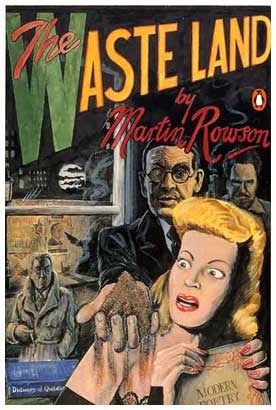
It just happens that this week I got a copy of Martin Rowson’s “The Wasteland,” a 1990 comic-book riff on Eliot’s poem as if written by hardboiled-detective fiction writer Raymond Chandler and filmed like “The Big Sleep” or “The Maltese Falcon.” Rowson notes that in “The Long Goodbye” Chandler had referenced Eliot’s “Prufrock” with a character quoting “In the rooms the women come and go, talking of Michelangelo” and having the character ask his detective Marlowe “Does that suggest anything to you sir?”
Marlowe replies, “Yeah—it suggests that the guy didn’t know very much about women.”
Though that’s clever repartee, charges that Eliot was naïve about women or even misogynistic can be difficult to disentangle from his general misanthropy. A female Chandler character may be given more apparent agency than the women in Eliot’s “The Waste Land,” but both the male and female voices of “The Waste Land” are frankly damaged and the minor male characters, wraiths and zombies.
Sometimes with a dame you gotta show’em some quotations in Greek or Latin.
In any case, Rowson’s comic-book/graphic novel is a lot of fun for fans of Film Noir and Chandler, or Eliot and Modernist lit. His drawings have more in-jokes than a season of “The Simpsons” watched with a finger on the pause button. And from his notes Rowson supplies in my edition on dealing with Faber and Faber and the Eliot estate, it could have been even funnier if any of them had allowed the comedic-take to use any of the lines from the poem. I laughed often reading the Rowson, but never so much as when he recounts being refused the rights to use the ancient Greek and Latin quotes Eliot dropped into his poem, because Eliot’s rights now include them as part of a unique compilation. That may well be legally sound, but it’s also howlingly funny. Eliot as he wrote his “Waste Land” was clearly borrowing widely from other authors’ work, because he thought it would show us something new when he put them in another context—the same thing that Rowson’s book sought to do.
Which is also what we try to do here as part of the Parlando Project, show you familiar and unfamiliar words in the context of different music and performance styles.
“We are in Rats Alley, where the dead men lost their bones”
“Rats Alley” is a dialog, and the two speakers are clearly broken vessels. The woman dissatisfied, depressed, afraid, maybe even unstable. The man, numbed, haunted, unable to express even the short expressions of discontent the woman speaks. When he (once in the poem, three-times in my performance) breaks into the cryptic “We are in Rats Alley, where the dead men lost their bones” I decided to alter the voice, to make it a third voice. She’s asking him to speak, to tell her what’s going on, but she doesn’t seem to have heard him say anything, other than a litany, literally, of “nothing.” And so, I’m portraying the Rats Alley line as his inner torment, his monster, that is heard loudly, but only in his head.
“In the rooms the women come and go, digging riffs from Ahmad Jamal”
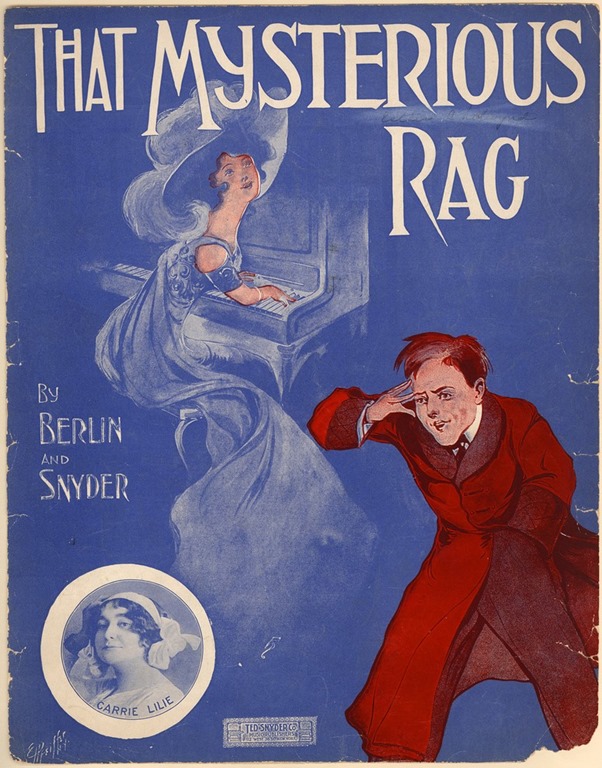
Rats Alley sounds like yet another reference to some dark Jacobean revenge play, samples from which Eliot has already peppered his poem with. If it is, no one has found that work. Some speculate it sounds like the darkly humored street-signs WWI trench-soldiers hung on their subsurface battle lines. If so, then the last voice, the fourth voice of the piece, an imaginary, comic ear-worm song Eliot has made up, “That Shakespearean Rag,” could also be an internal voice. It’s sometimes been considered to reference Irving Berlin and Ted Snyder’s “That Mysterious Rag,” a giant pre-WWI hit with lyrics that say “Did you hear it? Were you near it? If you weren’t then you’ve yet to fear it.” In the hit parade context, the lyrics turn out to be just bragging that this rag is a killer hook “because you never will forget it.” Eliot substitutes Shakespeare in his parody, but is this male voice a soldier, haunted by the trenches and dead comrades to whom old tunes now take on a new context, a sinister edge? It’s a bit of a stretch, but could Eliot have planned to use “That Mysterious Rag’s” mock-dangerous lyrics as a counterpoint to his scene—wouldn’t that have been a powerful sample!—but was enjoined by copyright issues?
To hear my performance of “Rats Alley,” today’s segment of Eliot’s “The Waste Land,” use the player below. You can hear the first section, “The Burial of the Dead” or the first part of the “A Game of Chess” section which I performed as “Visions of Cleopatra” by looking in our previous posts this April as we celebrate #NPM2018.
Today’s piece uses words by Robert Hayden, who was a 20th Century American poet who often wrote about that essential American subject, Afro-American history. He was born just before WWI, and was writing poetry both before and after WWII, during the rise of the New Criticism, which held that the poem exists as a thing created as a conscious work by an author but is best judged irrespective of who that author is.
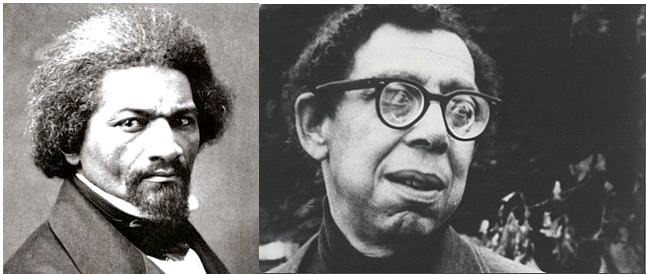
Frederick Douglass used the power of the charismatic portrait as well as his powerful words
Robert Hayden had to rely more on the words alone, but what words they are!
To the degree that this theory was actually practiced, it solves a number of problems. One of them are the issues of discrimination, old-boy networks, and literary log-rolling where who you know or where you are in the social and academic order pre-emptively decree the worth of writing. It helps deal with thorny problems, like having poetic Modernism’s great progenitor Ezra Pound becoming a Fascist propagandist during wartime. If it was still in vogue, it might assist in considering issues around artists in our time who’ve committed heinous acts or supported political opinions we judge to be beyond the pale.
There’s a saying: in theory, there is no difference between theory and practice; but in practice, there is. Historically, the New Criticism as a critical movement didn’t consistently break down cultural barriers, though things like the post WWII GI Bill certainly did. Extra-academic movements like the Beats and their successors, and the Black Arts Movement did so as well. Great cultural shifts such as the civil rights movement have literary impact. In the end, the New Criticism seemed to restrict itself to giving students and academics a framework to discuss literature without the need to refer to the problems in their authors lives.
Perhaps too, it’s just easier to judge works based on friendship, affinity groups, or cultural and political stances. Even for an artist, how much can we live in an artistic world separated from the daily, inescapable effects of the political and economic world?
But let’s not be too unfair to the New Critics. They cared about the work as it exists, treating art not as inessential decoration for something else. They offered open structures, criteria that were open to any to master. When Robert Hayden, born in the crowded Detroit ghetto swelling with southern migrants looking for industrial work, mastered those structures, he (eventually) earned a place in the culture of his time. How did this play out as my generation, born after WWII, came of age? Let’s look at the tape.
15 minutes from a Robert Hayden interview in 1975.
This is a time capsule from over 40 years ago, yet it could be longer for all the patina of time. The monochrome of the film makes the impassive white interviewer, the smoke from his constant cigarette, and the later-life Hayden all look gray. You see the coke-bottle glasses on Hayden’s face, but not the tint of his skin that would have born him instant misjudgments throughout his life, misjudgments that he would have to have dealt with along with his art. You will hear him make the claim I made to describe him at the beginning of this: that he’s an American poet who will write about Afro-American subjects, and hear him begin to make the case as to why this distinction is important. I can clearly hear how important he believes this is.
Around 10 minutes in, he’s asked to engage with the separatist strain in Afro-American culture, and he offers his full-throated disagreement with what he thinks are their goals. That’s too big a subject to deal with here, but apparently at the point at which he was finally achieving some recognition for his poetry, some aligned with the Black Arts Movement saw him as an assimilationist. Some might view this part as a “damn kids, get off my lawn” generational moment.
Also, in the film Hayden reads two poems. One is probably his most well-known work “Those Winter Sundays,” and the other is today’s piece, “Frederick Douglass.” In the later, using only the eloquent words in his sonnet, Hayden makes that argument that he could write a political statement timeless and yet incisive, and in the former, he writes a poem of gratitude to his foster father, an unpoetic man who made it possible for him to be a poet.
“Those Winter Sundays” will be featured this month on Poetry In America on PBS. It’s a fine poem, and I’ll be interested in seeing what they do with that poem’s details, things that one needs to linger a bit to see. I, on the other hand, had already chosen to present “Frederick Douglass” for my first Robert Hayden poem here. If you take the poems together, you’ll see two arguments for paying attention to Hayden. One the universalist for liberation (a political theory Hayden shared with Frederick Douglass) and the other the argument for gratitude to those, however imperfect, that helped us.
When I first read Hayden’s “Frederick Douglass” this year I was immediately struck by the poem’s uncanny details, laid in-between the eloquent flow. It was written over 50 years ago, but it’s more current than that B&W film from 1975. Perhaps you’ll hear them too if you attend to them: freedom that can be beautiful and terrible, hunted aliens, metal statues more valued than lives made possible.
Here’s my performance of Hayden’s words about Douglass. Use the player to hear it.
Well, the rooks were wrong about Winter passing, at least for now. As much of Minnesota is covered with a foot or more of forgetful snow, with more remembering to fall over the top of us all day, it’s a good time to return to T. S. Eliot’s landmark of Modernist poetry “The Waste Land,” the poem that, by beginning with the famous line “April is the cruelest month” is largely responsible for National Poetry Month being set in April.
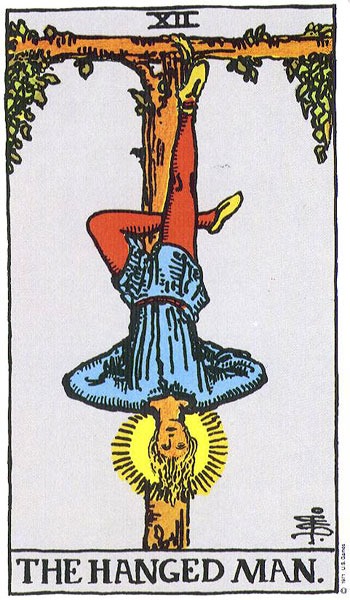
Other than the “Dead” thing and the sinister Roman numeral, seems normal enough;
but “The Waste Land” will soon get stranger and darker than anyone expected in 1922.
We’ve been performing it on the installment plan this month, following up on our performance of the first segment of it last April. But, it occurs to me that because so many of our listeners hear us via the podcast section of Spotify, which perversely doesn’t allow podcasts to be placed in playlists, that it might be good to combine what we have completed into one longer piece.
So, here’s the more-or-less complete first section of “The Waste Land” titled “The Burial of the Dead.” Eliot intended his poem to be musical, so even though it’s sprawling and includes many voices, it’s been fun to make audible the musical implications in it. As I do this, I’m reminded again of my first encounter with “The Waste Land.” I didn’t understand any of it—well, that’s not completely true, I could extract meaning from a few lines—but the whole thing could just have well have been a symphony with notes in place of words. Even now, for me, “The Waste Land” remains a hard poem to love, and unlike many poems and poets of our current scene, it’s not asking us to love it.
So, if it’s hard to understand, and hard to love, why listen to it?
Because it is a great poem? I doubt that would work. Because it was so influential historically? Well, that influence is now largely historical. It did move things powerfully one way, and then, after decades, things moved another way, in part in reaction to it. Because there are still fresh experiences to encounter in it? Now we’re getting closer. Art isn’t immortal only because it’s great in some ideal way, an art work’s immortality happens from our mortal human actions, our human reactions to it, and some of those become richer when the work has become strange to us from a change in fashion.
But in the end, I ask you to listen to it consistent with our overall tactics here in the Parlando Project: listen to it as music first, do not worry at the overall meaning immediately. I hope I can illuminate some meaning with my performance and music, but simply to comprehend “The Waste Land” as this suite of voices and moods is to comprehend much.
Here’s the player gadget to hear “The Burial of the Dead.” Since it combines what had been four pieces issued separately here, it’s longer, at 13 minutes, than our usual stuff. If you’re looking for something brief, why not take a random walk through our archives for one of the more than 200 shorter pieces we’ve available.
I like to mix up our musical encounters with poetry here, using both well-known and lesser-known poems. Here’s one you probably haven’t heard before, written by a poet who is less-known in the U.S. than in his native Britain, Edward Thomas.
In 1913, Thomas was 36 years old and was scratching out a living for his family as a freelance writer on whatever topics could generate a check, but his real passion seemed to be as an enthusiastic naturalist. He liked nothing better than to walk about the countryside reading the book of nature, jotting down notes about what he’d seen. Then he met a similar no longer young writer, a 40-year-old American who wanted a career as a poet.
The American had not found his own country in agreement with his vocational desire, and so he had flipped a coin to strike out somewhere else: Canada or England? He knew no one in either place, it was just a hunch that someplace different might change his lot. The coin came up England. He took a cottage in the Cotswolds, near to where Thomas was living. The 40-year-old American poet? Robert Frost.
Over the next couple of years, the two men developed what would be the most significant friendship in their lives. Now Thomas had a companion besides his notebook on those nature walks. Although Frost had published only a handful of poems in periodicals at this point, Thomas saw his talent, a man who could write metrical verse so supple that it didn’t seem like poetic diction. In turn, Frost saw another poet in this self-described “hack writer” with his avocational notebook.
Nearing 40 years old and yet thinking about poetry. Edward Thomas and Robert Frost.
Frost published his first two books of poetry in England, “A Boy’s Will” and “North of Boston,” and Thomas reviewed them enthusiastically, helping launch Frost’s literary career. And with Frost’s encouragement, Thomas’ notebook jottings became poems.
In 1915 Frost moved back to the U. S. where publishers would now publish American editions of his poetry. Edward Thomas, and his family, were to follow. The two poets were to live near each other in America and continue their fruitful friendship.
These two men, these two friends, who each could write tremendously concise poems in which a natural drama could play out in but a few lines, had one constitutional difference. Frost was reconciled to chance and fate. He would jump oceans with a coin flip. If lost on a road by a snowy woods on the darkest night of the year—well keep on driving that buggy onward in the dark. Thomas, on the other hand, believed that introspection and judgement, an ever-closer reading of the book of nature could discern the right choice. If two roads diverge (as they would when he and Frost walked the Cotswolds) your honor derives from making the correct choice from the inconsistent evidence.
Back in the USA, Frost wrote his famous, misunderstood, poem about those two paths and sent it to his friend, still tarrying in England, and Thomas became the first person to misunderstand “The Road Not Taken.” No matter how much we honor the author’s intent, the poem exists after it’s creator. Thomas’ outlook saw the undercurrent in the poem, that choice could be important. Thomas thought: if Frost was making gentle fun of that, no matter, that was the point.
Here’s a small, four-line poem that Thomas wrote about spring, “Thaw.” As often with Thomas’ poems “Thaw” is set on a nature’s large stage, but it’s a very short drama. Winter’s snow, as it is here in Minnesota today, is half-melted. Crows are cawing in tree tops, as the crows I saw today on my morning bike ride to breakfast were too, speaking the inscrutable language of crows. I saw one swoop down and frighten a foraging squirrel on a lawn, the black bird somewhat larger than the squirrel—and then, larger yet to it when the rook spread its wings and hammered out its hard-consonant caw.
The squirrel hopped like something had exploded underneath it and disappeared. These natural decisions could be read if one picks up the book of nature.
In Thomas’ “Thaw,” the poet has come to understand that the crows know spring is coming, they are nesting already, and their treetop kingdom, unlike the ground beneath the poet’s feet, is snow free. They have read the book of nature more perceptively.
In Frost’s “The Road not Taken” the comic narrator will sigh “ages and ages hence” about not having read nature right, of having lost the experience the road not taken would have given him. Edward Thomas decided not to move to New England to live next to Frost. Edward Thomas decided, though he was nearing 40 years old, and with a family to leave behind, that honor and his sense of correct decision required that he enlist in World War I, then half-way over. Within a few weeks of arriving at the front, a German artillery shell, following the arc of nature’s laws for men’s unnatural needs, killed him outright.
Thomas had continued writing his nature poems through his boot-camp training, and presumably at the front. He was still seeking to find what it knows that he doesn’t.
You can hear my performance of “Thaw” using the player below. In the middle section I tried to give the impression with electric guitar of the sounds of a flock of crows.
If you like what we do here, particularly as we celebrate National Poetry Month (#npm2018), you may want to let others know about The Parlando Project on social media or elsewhere.
In a dreary London day cast with brown fog, the poem recounts a hellish procession of desultory men walking to work over London Bridge. Compare this to Carl Sandburg’s Chicago-set treatment of a similar bridge scene written just a few years earlier. Sandburg, the working-class political radical, knows well the worldly bargain the workers face in addition to the human condition. Eliot, the conservative bank officer personally grappling with depression, will connect the weary enervation to a spiritual brokenness.
Readers differ on what level of reality we should ascribe to Eliot’s scene, which after all is labeled “unreal.” Is this a vision of the dead of World War I arising in a zombie walk? Or is this some level of Hell or Purgatory, in which urban London is only imaginary set-dressing for immortal torment? Or is it an actual observed moment in Eliot’s London living life which seems as trapped and without options as death? Imaginary gardens with real frogs in them, or real gardens with imaginary frogs?
Eliot develops this scene with the deepest gallows humor in the whole poem. One of the sighing walkers on his unvarying path is called out, greeted by the speaker in the poem as a fellow veteran of a naval battle between Rome and Carthage in 280 BC. I’m sure Eliot would have appreciated the anachronistic pun before its time, as by happenstance that Punic Wars battle at Mylae can now pun on the infamous 1968 My Lai massacre during the Vietnam war.
“The Waste Land,” which had begun with lilacs bred by Spring, now speaks of a corpse planted in a garden as if it was the bulb of a prized perennial flower. Eliot’s writing this nearly a hundred years ago, but poetically his iconography has taken a step toward a late 20th Century Heavy Metal album cover. I’ve double-checked Eliot’s notes on this poem. No, he wasn’t listening to Iron Maiden when he wrote this poem.
Would Ezra Pound have said: Make it New! (Wave of British Heavy Metal)
The section closes with a French quote from Baudelaire that translates to “Hypocrite reader! My fellow, my brother.” Eliot is inviting us into his nightmare, asking us to come along with him. If you haven’t read “The Waste Land” before, or recently, where do you think Eliot will go next, now that he’s put us in grisly post-World War unreal corpse garden land? Fulfilling his poem’s design, it will be somewhere completely different.
Musically, I didn’t attempt NWBHM to accompany this section of “The Waste Land.” Instead, I combined a fat synth motif and Rhodes piano with some electric guitar stabs and burbling bass. Listen to my performance with the player gadget below.
Today’s audio piece marks the 200th published by the Parlando Project! Since presenting our first piece, Carl Sandburg’s “Stars Songs Faces” back in 2016, we’ve combined words (mostly poetry) with original music as varied as we can make it. Those who’ve followed along know that the words we use are generally written by others, because that lets me encounter them, as I hope you do too, freshly, to discover anew what charms they have.
Not only does the music vary, but how we present the words varies too. Sometimes we sing the words, sometimes we just speak them, sometimes we chant or intone them.
“Like a horse that feels a flea” Marianne Moore around the time she wrote “Poetry”
Through this past couple of years, Dave Moore has been the alternate reader here, and I expect that you enjoy the break from my voice once in awhile (as I do). For today’s 200th piece, and for April’s National Poetry Month, I’m pleased to present Marianne Moore’s “Poetry” read, not by me, but by the “Lake Street Writer’s Group,” a small group of usually poets who’ve met since the 1970s, which took it’s name from the inner-city commercial street near where they lived. The first voice you’ll hear is poet, musician, and comics artist Dave Moore again, the second is poet and writer EthnaMcKiernan and the third is poetKevin FitzPatrick, who has the honor of having the latest book published by a member of the group, “Still Living in Town”.
MM of another color. Minneapolis-Moline once built tractors in a Lake Street factory. Marianne Moore was once asked by a car company to suggest the name for a new model. One of her suggestions: Utopian Turtletop
It was my idea to ask them to read Marianne Moore’s poem, since Moore herself breaks her poem up into various voices, not only from abrupt changes in diction but with the use of quotes. My thought was the changing voices would emphasize the poem’s stance of speaking for poetry’s audience.
I broke this on the group of poets cold, and they are reading the poem off a page I gave them, which divided “Poetry” up in small beats and phrases of the poem. Remarkably—well, maybe not all that remarkably, Dave, Ethna, and Kevin are all excellent readers of their own poetry—what you hear is one take, just as they read it, just as they handed it off verbally from one to the other around a room. They had no musical backing to hold their cadence, only Marianne Moore’s words. I wrote, played, and recorded the music later: drums, bass, guitar, and piano.
What I hear coming out of this is the same thing I aim for often here. Just as you are encountering the poem’s words freshly, as they hit your ears, the performers are doing the same. Sure, we may have heard or read the poem before, but it’s another’s voice, happening now, that is conveying it to you. We use music with the words here, and with the other Parlando Project pieces, for several reasons: it reminds us that poetry is musical speech, that poetry works in its sounds, its rhetorical flow, and the harmony of imagery like music; and because it offers the option to relax the cause of the words meaning.
There’s not one missed word in the trio’s cold reading, which is more unusual than an accident. When I’m improvising melodic lines freely, I accept that I’ll need to deal with “wrong” notes, musically creating (to vary from Moore’s famous line) “imaginary gardens with real clams in them.” To hear the group read “Poetry,” use the player gadget below.
Look at a picture of T. S. Eliot. Chances are you’ll see a proper English gentleman looking back at you. You might suspect a teacher, or if not that, a bank officer. By the time he wrote “The Waste Land” he’d been both, and the later job was considered by some in the Modernist circle a small scandal from which he needed to be rescued. Respectable, English, settled—you would trust him with your money or your child’s education.
T. S. Eliot in costume to play Harry Potter’s great-grandfather
Eventually Eliot became a British citizen, a confirmed Anglican Church believer, and a canonized poetic figure. So that man in the picture is what he intended to become. But the man who wrote “The Waste Land” wasn’t him yet, even if he could dress up as him for a portrait. What he was, was a thirtysomething American trying to engage a European culture that itself was now refugee after an unprecedented World War, a man also in a disastrous marriage and suffering from “doctor’s orders” depression.
Except for the World War part, one could, from some standpoints, look at this and file Eliot’s situation under “first-world problems, see also: middle-class white male.” And while WWI had profoundly changed Europe, Eliot seems to not have had any direct experience with the war, unlike many of the Modernist circle, so you could add to that “survivor’s guilt.” Let’s just center in on that depression part. That’s apropos, depressives are often told that their real situation is not as bad as all that.
I’ll blindly wager that many, probably most, reading this have suffered at some time from depression. Considered as a disease or syndrome, it’s a very common one, like aging or pregnancy—it’s not some rare, god-sent, lightning strike calamity. Yet, that’s not how it’s most often experienced. A depressed person feels trapped in themselves. One thing that is common to many in depression is the distrust of any judgement or decision. Whether it’s your own, or some outside others’, whether it’s a judgment of praise or damnation, you distrust that it’s true and fear that it is.
Is he being punished, or just looking at the world another way?
As we reach the “Madame Sosostris” section of “The Waste Land” we meet a fortune teller, a line of work that should be helpful to one in this depressive trap. In Eliot’s intended scheme for the poem, she serves as a Deus ex Machina to introduce, as part of a pseudo Tarot card reading, some mythological themes of the poem. But if we are to understand the emotional core of “The Waste Land,” which is the poetic expression of a person suffering from depression, the undercutting of her authority begins right away. If Madame Sosostris is some kind of enlightened and advanced being, she’s suffering from a mundane head cold. Her patter as she reads the cards is perfunctory, only occasionally rising to the level of oracular obscurantism, and she all to quickly jumps out of her clairvoyant trance to the details of delivering some work for the comically named “Mrs. Equitone.” There’s no relief, no reliable guidance here.
To hear my performance of “Madame Sosostris” from T. S. Eliot’s “The Waste Land,” use the player below. We’ll be returning to “The Waste Land” as April, National Poetry Month (#npm2018) continues, but our next post will be celebrating a special milestone in the Parlando Project.
Here’s what we do here, usually a couple times a week: we combine original music written for the occasion with some words, which are usually poetry someone else has written.
Of course, poetry. The compression of poetry lets us fit the words into shorter pieces and leave room for some notes. And, of course music, because every poem has a music within it, even when hidden, that wants to come out.
There are lots of ways to do this, and we do many of them. The reader will speak the words, sing the words, chant the words. The music can be simple spontaneous band recordings or more elaborate compositions recorded a track at a time until the larger sound-field is filled in.
There’s something about that push and pull of combining words that want to sing with music that wants to say something. Even when I’m doing it casually and off the cuff as a musician or a reader, I can feel the two parts wanting to connect, asking to connect, demanding that the other half listen!
If you look at the over 190 audio pieces we’ve already published here you’ll see that we don’t usually feature our own words, though Dave and I have written poetry for decades. Even when we do use something we’ve written, it’s usually about someone else.
There is nothing intrinsically wrong with poetry about your own experience, but I’ve often felt that something extra is felt when the poetry tries to cross that gap from one person’s head to another person’s lips—that kiss you feel with the momentary connection that begs you to find its meaning. And music too, created silently inside the shadowed choir-loft of a musician’s head, becomes itself only when touching a little membrane of sensitive skin inside another’s ear before it can become part of the dancing bones.
The Internet’s shown up with poetry again, and there’s them musicians with’em this time!
Using other people’s stories, other people’s words—this lets us experience the poems with you. Encountering poetry with music lets us meet them with only the expectation that something will happen.
I’m planning to present more audio pieces here during April’s National Poetry Month (#npm2018) than ever before, so check back often. And don’t forget there are lots of poems with differing music, from the most familiar to the unknown, already here in our archives to check out.
Here’s a tribute to a couple of other American originals who are inspirational to this Project.
“Side-Walks” is the second piece here using words taken from a Laurie Anderson interview. In the earlier piece, Anderson was talking about how the sky of her Midwestern childhood taught her to realize that she was “nothing and everything.” Today’s words are quoted from a 2015 interview where she’s talking again about childhood, but particularly her childhood as she can revisit it in memory.
The phenomenon she talks about is extraordinarily common, while still extraordinary: the intense memory of childhood, rich enough that one feels they are experiencing it in fully dimensional, traversable, 3D space, with access to senses other than vision (such as smell and touch).
If you don’t feel you have this ability, Anderson suggests a method to engender it in her story. Although, I took this account of hers from a written interview, anyone familiar with Anderson’s speaking style from her work, may hear it in her performance voice, that slow, measured coo that never rises in intensity or volume, and varies only in a slight, auditory smile that can indicate any number of stances without determining one.
As I mentioned last time I used Laurie Anderson words, her performance voice is hypnotic, and influenced as I am, I can sort-of imitate it, but choose not to. But as I listened to this piece over and over as part of the mixing process, I began to realize that I was somewhat imitating the performance style of another influence of mine, Ken Nordine.
At some point, in another post, I’ll probably need to discuss Ken Nordine at some length, but hearing that echo, I said to myself “I bet no one has ever connected Laurie Anderson and Ken Nordine. Wait until I tell everyone about how these two unique American artists have these striking similarities!”
Nordine and Anderson. What if I’m not a spoken-word artist, but a listening-word artist?
Because I write, my mind immediately starts writing, all in my head, all the ways their work connects. Both are native Midwesterners, who can carry that mindset to any cosmopolitan location. Both use that very even speaking style in performance, with Nordine allowing just slightly broader bemusement to sneak into his affect for contrast to Anderson’s often present, but more muted, smile. Both use music in combination with their hypnotic words, but both will choose music that is not calm, conventional “music beds.” Both love the sideways movement from one topic to another that seems alternately random and deeply meaningful, and both enjoy the shaggy-dog story conclusion that doesn’t overdetermine which.
I pop Laurie Anderson and Ken Nordine into a search engine, and find…
Here’s a single dip into the 50 years or so of Ken Nordine’s audio pieces
Well then, let’s go back to Anderson’s story of how she can revisit a vivid childhood time, as many of us can. Her story is vivid too, even if she’s telling it off-the-cuff in an interview, not in performance, but what I found most striking were her conclusions. A couple of centuries ago, William Wordsworth wrote “Intimations of Immortality from Memories of Early Childhood,” the poem that ends with the line “Thoughts…too deep for tears.” Do we think that means, too sad for tears—and, if so, what does that mean? Or is it, as Wordsworth had it in his ode, the “meanest flower”—or as Ken Nordine and Laurie Anderson speak it, is it that smile, however broad, that is deeper?
The player for my performance of this brief story Laurie Anderson told is just below.







 Frank Hudson