Two Minnesota-based Irish-American poets who Dave Moore and I knew and worked with (Kevin FitzPatrick and Ethna McKiernan) used to give an annual St. Patrick’s Day poetry reading in the Twin Cities, a tradition that was ended by their final illnesses and death a few years back. It’s occurred to me that I can carry on that tradition here, so, let’s do that. I’ll start with one of Kevin’s poems.
Kevin’s poems are often parables. He’ll tell a story, most often using simple, off-hand language, though that story may encounter unexpected jumps. A bit of dry humor will often stop by. From working on and talking about poetry with Kevin I learned about the craft and intent in his language. The poems rhythm, sequence, and word-choice were honed – what seemed casual was thought out, and being able to see many of his poems move from earlier drafts to final versions, I’d see Kevin’s poems ending up working like good, even more highly compressed short stories. Like Joyce in Dubliners, the mundane and the particular are a setting in which to find an epiphany.
Here’s a poem, “Two Cities,” from one of his earlier collections, 1987’s On the Corner. It’s set distinctly in Minnesota’s Twin Cities (Minneapolis and St. Paul). These are two, barely fraternal twins. Minneapolis: larger, traditionally more Protestant (its early civic leaders were often New England WASPs) including a strain of tony liberal Republicans that have all but disappeared. St. Paul, more Roman Catholic, smaller, less seated with secular high-culture institutions, a stronger union town. Though not identical twins, they are cojoined, their borders entirely coincident.
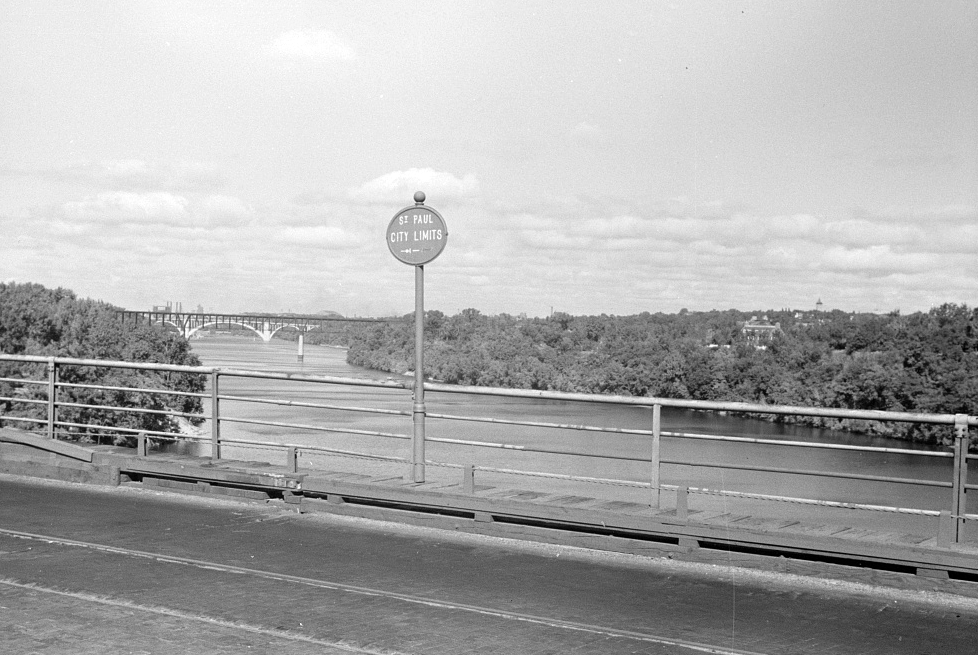
Kevin starts this poem with a tiny, vague head fake about an empty pole, and then drives right into one of the borders. Is it real, even if no one cares to maintain the sign? There are certainly different governments as he shows us in an efficient aside, different even to something as central as time zones. Some residents think the differences in the two town’s citizens are strong, shown in the dive bar anecdote that had me laughing again as I re-read the poem.
The Lake Street Bridge in the mid-20th century at its St. Paul border. I can’t find a picture of the missing bi-directional sign FitzPatrick writes of in the poem
.
He wraps his poem up with another character – and Kevin’s poems are full of characters. Unlike the typically solipsistic modern poem, he casts voices that ask us to consider something/someone else. How quickly Kevin draws him! “Jim” is a military man’s son, not a stay-put native who thinks his birthplace tells who someone is. Perhaps too, from the nature of his family business, he knows the violence that maintains borders more than chipped signs. And “Jim” gets the last word, or rather a last hope: that we can rise above things like borders, see ourselves as ourselves, not as cliches of birth or origin, bound by imaginary map-kept lines.
Is Jim the fool for his hope, when even two neighboring cities in the same state can divide themselves up with rough and ready human pattern matching? The poem sits between those alternatives. By bringing it up, the poem, the poet, asks us to decide.
So, a parable. Yes, its detail is about two cities Kevin and I lived and worked in for several decades. Yes, I’m remembering Kevin for a national culture observance, and remain here, after him – honoring, as it happens, poets with an Irish background. But I write this winter in a time when immigrants are held in a bureaucracy with cruel penalties and moving/sign-less lines. And with wars now too, where the lines of governments are crossed by a mad emperor. Kevin FitzPatrick’s poem reminds us, we all make ourselves (people, towns, nations) what we are, and we might waste our time making someone else what we think they are.
I performed the poem, reading it, to the best of my ability, as I think Kevin might have. I did add one of my “inline epigraphs” to the poem’s text, a line from a song that you’ll hear at the end. Musically I once more unleashed my company of electric guitars, though the Telecaster solo in the middle got caught out by someone’s arrival that meant that would be the last take. While I’m a guitar cosmopolitan, there is something special available from a Telecaster when it and an amp mesh up. You can hear this performance with an audio player you should see below. Has it disappeared like that border sign? No, it just that some ways to view this blog will 86 showing the player, and so this highlighted alternative link is your asylum, able to open a new tab with its own audio player.
Apologies to those who came to this post in expectations of a follow-up to my (however simplified) approach to Art Song last time. I’m looking forward to finding time to use my acoustic guitars and imperfect singing voice – really, I am –but sometimes you have to deal with the internal question “You’ve got a strategic stockpile of electric guitars, so why don’t you use them?”
A midcentury person, I grew up in a world with the fear of nations who for ideological supremacy or imperial colonialist designs, would bomb, invade, and make war on others. My country, the United States, was to be a bulwark against this – and so, might these other countries launch an attack, perhaps on a pretext that they were preempting our weapons and opposition to theirs? The scenarios were detailed in dream shadows: missiles across the arctic, a covert foreign army across our southern border, some manifesting murderous domestic fifth column.
And now I have those fears again – only it’s my own country that will be the attacker. Manifest Destiny seems to have a new expansive definition: the whole world. The mad despot I fear now sits in my capitol. First, we got the flavor of what government round ups of our neighbors would feel like, and then our “warfighters” blitzkriegs across this-and-that border. The borders that are preeminent principles in the former are of no matter in the latter.
Perhaps I’m oversimplifying things – or you wish it was simplified in the way our leaders rule correct in their current mood Yet, perhaps, we haven’t simplified these things enough. I’m not writing this to be clever or to lord over you with some moral superiority, I’m just disgusted by warfare cast under shoddy precepts by callous and vainglorious men.
When Millay wrote “Man” in her title, did she mean a general, genderless, “mankind?”
.
So let me get on with it – we should have some poetry and some purported music. I recently read this Edna St. Vincent Millay poem. You might think of Millay as the writer of wistful poems on inconstant love and desire. Yup, she wrote those poems, and some of them are quite good. Desire and how we keep or loose it is a deep subject, worthy of verse, and metaphysics and theology elsewhere in poetry have less to testify about the times we are naked before the shroud.* But there’s an angry Millay that I’ve also featured here too, and this one suits my household’s current mood. When this poem of hers, “Apostrophe to Man” was published it was not some sort of detailed position paper in verse either. Here’s a link to the text of that poem. I suppose one could try to make it sound pretty in spite its spite, but there’s a Stratocaster not Stratofortress that wishes to launch ordinance on you there today. You can hear my assertion of something much like music around Edna St. Vincent Millay’s poem with the audio player below. No player to be seen? It’s not a stealth fighter or secret police thing, merely the inability of some ways you might read this blog to show a graphical audio player gadget. Use this highlighted link then, and a new tab with its own audio player will appear so that you may hear a screaming coming across the sky.
.
*No real footnotes this time, but I still hope to have other musical presentations that attempt beauty this spring.
On the page, and probably in my recorded musical performance, this poem is an odd combination. Here’s a link to the text of Claude McKay’s “The Tired Worker.” Its subject is altogether common: the fatigue of someone who is overtaxed by their job, and a night whose worry and weariness has paradoxically robbed them of enough rest to hope for a better tomorrow. Claude McKay, the author I’m featuring this month, knew these feelings firsthand from the jobs he’d held to support himself as a newly landed US immigrant. I dare say most who read this poem have had nights like this too. As poem subjects go, it’s likely as broadly relatable as love and desire.* McKay doesn’t go into detail what kind of work the poem’s titular subject does – but calling them a “worker” and expressing their experience of tired hands and aching feet would indicate a manual labor or a service job.
And here’s what strikes me (and perhaps you) as odd, encountering this in my 21st century time: the poem is written in flowery, elevated, 19th century language. For a 1920’s worker to speak of their daily lot as if it’s an 1820 poem contemporary with John Keats seems anachronistic. I’m trying to think of what a current equivalent of this would be, and maybe that’s impossible in that we can’t see, as we can with history’s perspective on McKay’s poem, how out-of-place this poem’s language is with the daily language of its worker or worker-reader.**
That this poem was first printed in The Liberator, a radical socialist publication founded and edited by Max Eastman may be one clue. I’ve spent a few hours this week paging through its early 1920’s issues published from within the Greenwich Village progressive ferment of its time.
I’ve been fascinated by this scene, partly because I had a shirttail relative Susan Glaspell who was an integral part of it, but also because it was a rich mixture. Political, sexual, and artistic radicalism were literal bedfellows. The Liberator featured a great many ads for political tracts, but also for literary books, and many of latter were low-priced reprints aimed at a bohemian’s or workingman’s budget.
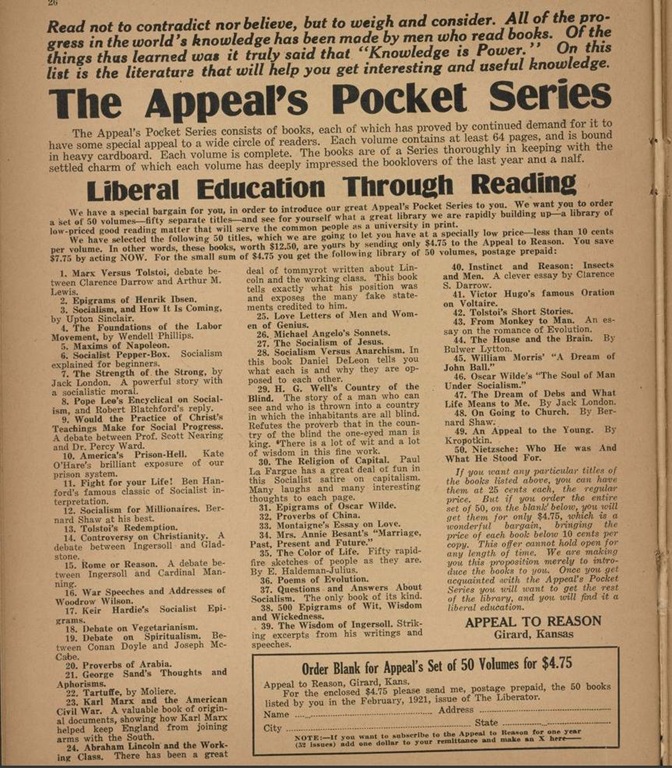
Doomscrolling in the 1920s? Michael Angelo’s Sonnets, Tolstoy, William Morris, Shaw, Voltaire, Wilde, and Nietzsche. Also socialism and the story of what Karl Marx did during the American Civil War. 10-50 cents a piece, or all 50 for $4.75. If one can’t sleep after a long workday, such a TBR pile near your bed could reach out to you.
.
And in between John Reed and Eastman’s first-hand reports from the Russian Soviet Revolution, there was much art and poetry. The art included political/social satire cartoons, illustrations/posters (often in a bold style depicting heroic workers or radicals,) and black and white art depicting nature or the human form. The latter was Modernism of a kind, though I don’t recall much full-fledged abstract works. The famous NYC Armory Modern Art show was nearly a decade past at this point. Carl Sandburg*** had won a Pulitzer in 1919 for his Imagist and free-verse poetry. From the same NYC scene as The Liberator, Others: A Magazine of the New Verse had completed its 4-year run publishing avant garde poetry. Yet, there was much less free-verse in The Liberator than one might expect.
It turns out The Liberator founder/editor Eastman was an early opponent of literary High Modernism. **** If the world and society needed to change, change radically, the old verities of prosody could still serve well to elevate mankind as they strove for that change.
Did Claude McKay feel the same way? I don’t know enough to say. During the early 1920s, he’s listed as an editor on The Liberator’s masthead. Its broad progressive outlook generally supported racial equality, and the NYC Harlem Renaissance and the Greenwich Village scenes overlapped.
Claude McKay and Max Eastman
.
Is that why McKay wrote his worker’s poem this way? There could be more to that choice – he apparently liked the sound of 19th century British verse; and knew how to extract some word-music beauty from it, as I hope examples I’ve performed may show. Perhaps he felt he was expressing his own soul existing within that workday fatigue – he wasn’t some generalized Worker, but his own particular self, Claude McKay, a man taking pride in knowing this part of his received culture. If so, a man, an Afro-American man, could express that dull proletarian grind with the same word-sounds that once extolled Grecian urns and English nightingales.
Yet, there’s a palpable disconnect here, and I was going to perform the song. I decided to just do my best to not linger on its anachronisms, the “O….thou.…wilts” of this poem. Maybe, the combined character speaking here as I performed it in 2026 is a man living in three centuries simultaneously while speaking in the manner of one class while living in the manner of another. McKay may be not so much colonized, as a colony-creature, a siphonophore banding together more than one mind and tongue. As I wrote talking about McKay earlier this month, poets are often, in effect, immigrants or exiles by their natures, souls seeking and divided from the world and nations they find themselves in.
You can hear my musical performance of Claude McKay’s “The Tired Worker” with the audio player you should see below. Has the graphical player gadget said screw-it and called in sick? No, some ways of viewing this blog suppress showing the player, and so I offer this highlighted link that will open a new tab with its own audio player.
.
*Once more I’ll remind readers that I’ve encouraged something I call “The Sandburg Test.” The test is to ask, does at least one poem in any substantial collection of poetry deal with the world of work? If you’re reading a Carl Sandburg collection, the answer will be yes. Other poets? Well, read, and ask yourself.
**The closest I could come up with would be the trope of some Americana artists of adapting decades-older styles of music and lyrics to express modern problems – but most of those borrowed styles are less formal and more-or-less reflect working-class speech of the past times.
****Eastman is a character I don’t have room to go into today. Escaping by the skin of his teeth from the grasp of the first American Red Scare as an editor of The Liberator’s radical forebearer The Masses in 1917 – that magazine was shut down by the federal government and he was arrested, charged, and tried with only a final hung jury keeping him out of prison. His long life saw him continue to resist the rise of obscure Modernist literature, while moving from founding fiery left-wing magazines in the WWI era, to becoming an editor of the Readers Digest during WWII, to contributing to the post-WWII launch of the conservative The National Review. and to at least qualified support for the second great American Red Scare in the 1950s.
I’ve long wanted to do a Parlando Project piece using the words of early 20th century American poet Michael Strange – but there was this one problem: her poetry wasn’t very good. Or perhaps I should restate that: her poetry doesn’t consistently work in the ways that I appreciate poetry. What about her poetry causes problems for me? It’s not just that it risks being ecstatic to a fault, or that it seems grandiose at times. I’ve forgiven other poets those excesses. It’s certainly not her overall poetic approach, as her verse seems to me to be highly influenced by Imagism, that early 20th century poetic movement that continues to inspire me. She also seems fond of Whitman and Nietzsche, but so were other writers of her era that I’ve presented here. So, if not those things, what? If I’d pick one term for what keeps me from enjoying her poetry it would be “over-writing.”
Here’s an example, an ekphrastic poem about an art song by composer Claude Debussy which used a text by François Tristan L’Hermite. I’m not sure if Strange is portraying L’Hermite’s French lyrics (which are quite good and bring in the myth of Narcissus) but she talks of sound and gives the musical composer the sole place in her title:
To Claude Debussy’s La Grotte
Your song
As the hale of mysterious exotic intention
Drifting in palpitating echoes
O’er the pallid oval
Of night-closed flowers -—
Your song
As the increasing shimmer
Of some exquisite nearness —
Clad in those steel-dark foils
Of sinister fancy —
And once more your song
As the moaning hush of a human soul
Receding — from the Divine Moment
.
The images here constantly suffer from the Donald Trump school of interior decorating. They’re not just curlicue ornamented, they’re coated in gold leaf. The “hale of…intention” image is a fine one, but adding both “mysterious” and “exotic” as modifiers cloaks its originality. Are “echoes” so unclear as a sound description that they need “palpitating” to clear up that they repeat at intervals? Why the somewhat archaic “O’er” when the modern “over” will chime nicely with “oval” and “flowers?” And that’s just the first stanza, first 21 words. This over-egging hurts not just the sharpness of the images, it hurts the word music too. As with Trumps White House confessions of gilde, this can be read as a lack of confidence in her own vision and place in poetry. I must include “poetic” words, I must show the specialness of each facet with modifiers and more modifiers, I must show that I’m writing.
Now I’m not writing this to dunk on Strange. I’ve committed every sin above, and more. What I write has enough faults to repel readership. Strange is not a particularly famous or widely-read poet, but more people have likely read her poem, and maybe even more people would like this poem of hers than any I’ve written. Still, I want a better poem than this one printed more than a century ago if I’m going to perform it. Yet what I did is risky ethically – that Strange is dead and her work fully in the public domain doesn’t erase the issues with what I chose to do this week with her poem. I rewrote it.
Your song,
the hale of exotic intention
drifts in echoes
Over the oval night-closed flowers.
Your song,
the shimmer comes nearer,
some steel-dark foils of sinister fancy —
And once more
your song,
the hush of a human soul
receding from the Divine Moment.
.
I tell my self-accusing self that I did this in service to what I think Strange was portraying in her original poem. Indeed, what I did there is similar to what I do when translating a poem from another language: find the images the poet was portraying and convey them in contemporary English with a word music that works in that destination language – though here I’m able to use more of her original words since she wrote in English. I’m opening myself up to a charge of patriarchal overreach, but in my defense, I’ll say I’ve done this to Robert Frost and Rupert Brooke. So, I may just be an asshole when I do this.
Before I move on to a few notes on the musical performance that prompted me to do this rewrite, let me just give the briefest outline of Strange’s fascinating life, a history that gave me such high expectations as I sought out her verse. Strange was born into a socially prominent East-Coast family, and was married (three times) to socially prominent men. Photographs and contemporary testimony portray her as exceptionally beautiful. Despite her background, she was a feminist, a left-wing social activist, and moved in bohemian circles. During the WWI years she published her first poetry collection and used the masculine pen name Michael Strange for this. Wikipedia’s summary says the name was used to shield her family from the poetry, which was claimed to be erotic and scandalous, and it’s also easy to suppose that she may have made (at least in part) a tactical choice to avoid sexist devaluation of the work. Whatever the initial reasons, she soon came to use the name generally, in subsequent writing, when she appeared on stage as an actress, on radio as a host* and, I gather, “in real life.” I’m not an expert on Strange’s life, but it appears she used feminine pronouns.
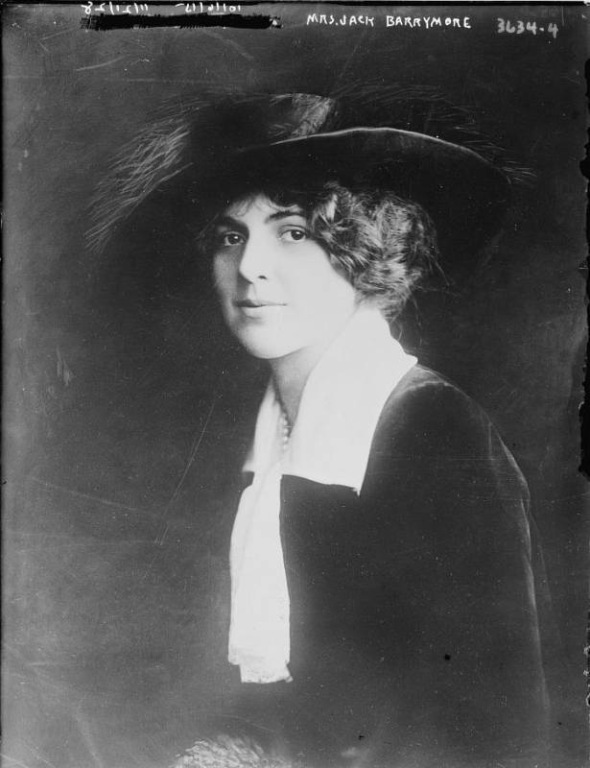
Pleased to meet you. Hope you guess my name. Born Blanche Oelrichs, became Michael Strange, was a member of the Lucy Stone League dedicated to married women keeping their own name – and this photo is labeled “Mrs, Jack Barrymore” (the name of her second husband, the famous actor).
.
It’s possible I would have run into Strange, on her own, at some time in this Project, since I enjoy examining lesser-known poets from her era here. Instead, I first encountered her because of her relationship with another author who produced popular Modernist work, Margaret Wise Brown. What? Yes, Margaret Wise Goodnight Moon Brown. Early this century, in my fatherhood role with a then pre-literate child, I was the bard of such stories as Goodnight Moon or The Color Kittens. And it may not be only because this overlapped my adult reading that I heard them as part of the same world of early Modernism.** For the last decade of her life Strange lived in a committed relationship with Brown, and so it was in reading about Brown that I first read Strange’s name.
All right, on to this short musical piece using adapted words from Michael Strange. I was working on composing with the intent to use minimal motifs, ones that my minimal keyboard skills could play without using an arpeggiator or other automated extensions. I built the music using a variety of alt-techniques and “prepared” piano sounds. In the middle section there’s an organ part that does use an arpeggiator, and a percussion part that had me playing parts on some struck metal objects over a more conventional drum-set pattern. Not exactly Debussy,*** but perhaps evocative of other 20th century avant-garde musics. You can hear it with the audio player below. No audio player? It’s not gender panic, but some ways of viewing this blog suppress it, and so I offer this highlighted link that will also play the musical performance.
.
*Her radio program was titled Music and Poetry. Just as with today’s poem – despite my problems with its prosody – Strange’s bio can’t stop being catnip to me.
**Another “could he really be serious” suggestion: if we might well include Robert Louis Stevenson and Lewis Carroll in studies of Victorian lit, should Brown be read next to H.D. and Pound as Imagist texts?
***Musically, while I’ve listened some to the Impressionist musical school of composers, I came to them largely from instrumental guitarists who were directly influenced by them. So, Dadaistically, today’s piece has no guitar whatsoever.
Around a decade ago I was looking at how to launch this Project, trying to figure out what service to carry the audio and where to host this blog. I knew I had some things I’d already recorded that fit my design of combining various words (mostly other people’s literary poetry) with original music in differing styles, and so I created a computer folder with those pre-existing Parlando candidates along with a spreadsheet to catalog them. There were 30-50 pieces in there, and if you go back to the first year of the Parlando Project in our archives here, you can hear about half of them. One piece, “Forum,” was in that pre-launch list. “Forum” had been recorded in 2007 live in my studio space by the LYL Band on a 4-track cassette Portastudio.
Why didn’t it make the cut? Two things. First, while I didn’t want the Parlando pieces to always use literary poetry, I planned to focus on that, but the words of “Forum” were a compilation of phrases used on turn-of-the-century interest group forums and Usenet “newsgroups”* when users would get into a dispute loop and a “flame war” would erupt. So, not conventional literary poetry – though I suppose I could have appealed my case citing “found poems” or Catullus’ invective. The other issue: though a step up from my older mono or stereo cassette performances I’ve featured occasionally this year, the recording quality had issues. After that initial year, I stopped considering it for Parlando use.
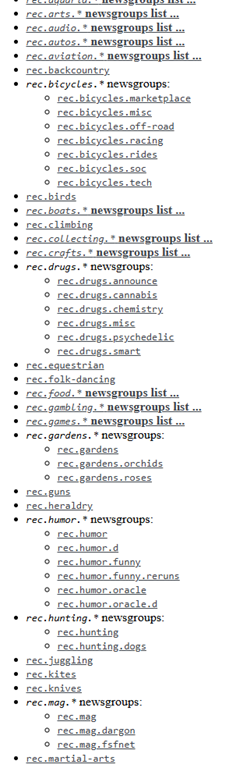
It’s impossible to picture the massive number of interests and sub-interests that Usenet Newsgroup served around the turn of the century. There were hundreds of thousands of separate topics that could be subscribed to and argued about.
.
This month I read someone (online) writing that elements of our current public culture include the historical novelty that nearly everyone can (and many will) try to communicate their opinions and thoughts in writing to a wide range of strangers. Communicating has difficulties. Communicating in writing has further difficulties. Communicating with strangers? More so. Socratic dialog assumes good faith and a certain rigor, and even then it can be exhausting. Now that we have an immense quantity of stranger-to-stranger debate, base human nature is often showing itself bare-assed in the forum.
I thought once again of “Forum” as I read that, this performed snapshot of early Internet culture. The phrases I selected and performed in it were the G-rated ones, skipped the racism and homophobia, and included little to none in the way of political specifics. That curation made the resulting text almost quaint when I relistened to the recording. This 2007 composition was now old enough to vote, and the text seemed like a folk song now, archaic as a sea shanty or hawker’s cries. After 18 years, is it time to share that piece now?
Well, there were still the considerations of its music and its realization on the old recording I had. Should I do a new performance? It might be difficult for me to rise to the level of intensity that version of the LYL Band had back then. The 2007 performance is what the MC5 would have called “High Energy Music,” and if you listen to it – like it or not – that’s how I wanted to present it.
But we had used a drum machine that day, and the energy in the room as we played this in one take/one-pass-through overwhelmed its timid tick toc.
Then I remembered: along with ubiquitous dispute loops, our modern computer age also provides wonderful tools. I can put this old recording digitized from cassette tape into a computer program, and in a few minutes of hard thinking signified by the CPU fan wheezing up, it can remove the drums from the old recording, even though they are buried in a mix full of furious other sounds. I did this, and then spent some time this Sunday putting in a new sequenced drum part with an energy that more appropriately matches the rest of the piece.
You can hear the result with the audio player gadget below. No, this is not like the gentler pieces I’ve been doing lately – that too is part of the design of this Project, and the next one may be gentle acoustic guitar or something – but what, you’re all ready and willing to blow out your speakers with this and you don’t see any audio player? Some ways of viewing this blog won’t include it. No flames, I offer this alternative, a highlighted link that will open a new tab with its own audio player.
*”Newsgroups” makes these sound like it was the AP or something, but Usenet newsgroups were started and were made up of those who’d figured out how to use the Internet in the 20th century, so more male and more STEM/academic/nerdy than the modern Internet. Usenet provided a large hierarchy of interests their own categorized newsgroups on which to share their knowledge – or their opinions about the validity of someone else’s knowledge. I’d suppose Reddit is the most similar common modern equivalent, but that’s more centrally architected and moderated.
I’m going to write about 20th century poet Langston Hughes’ pioneering Jazz poetry. I’m hoping to condense a lot, trying to make this short – but we’ll see. Like someone commencing a Jazz improvisation, I’ve got an idea – and maybe have some sight of where that idea goes – but what happens after that? That spirit, going there with maybe a first idea to see what you can develop from it, is what makes Jazz improvisation possible. Some skilled musicians, able to translate written scores into music straight off the page are terrified of that leap. Perhaps it’s because they know how to play those set-down compositions right that they’re frightened – if I must improvise, they may think, how will I know what’s right?
Langston Hughes published the words I’ll be using today in 1926 – but I must be in a hurry telling today’s story, because I’ll start in 1835, or thereabouts. Wikipedia puts “circa” next to that date, so there aren’t any attested records, but one Mary Sampson Patterson was born a free woman of color at about that date in North Carolina.
At around age 20 her Wikipedia entry says she fled for Ohio due to an attempted enslavement.* Records again are sketchy, but in Ohio she in some way studied at Oberlin College – as an Afro-American woman, this a double rarity in the first part of the 19th century. Her education trailed off in 1858 when she married Lewis Leary, a fugitive slave also from North Carolina. Leary was not just a fugitive slave, he became part of the Harper’s Ferry Raid, John Brown’s attempt to start a mass slave rebellion by attacking a military armory in Virginia. Brown attempted this with only 22 men, including Leary. Under the element of surprise, Brown’s men took over the lightly guarded armory, but a little over a day later a full military detachment under the command of Robert E. Lee easily defeated the small band. Nearly half of Brown’s raiders died in the subsequent battle – Leary being one of those – and seven more were executed afterward. Lee didn’t need to be any kind of military genius to win this battle, and whatever Brown’s beliefs, he wasn’t a great tactician either. Were they both improvising? I suppose they were.
The widow Mary married another abolitionist, Charles Langston, and they moved to Lawrence Kansas to raise a family. One of their children was Carolina “Carrie” Langston. That Carrie Langston married a James Hughes. The marriage was short-lived, though it produced a son given the first name from the mother’s family and the last name of the father’s: Langston Hughes. That was 1901 or maybe 1902 – accounts differ. Anyway, we’ve reached the 20th century.
Carrie needed to find work, and so the young Langston Hughes was largely raised by his grandmother Mary. So here you go: a Black woman, born around 1835, in the age of slavery, flees slavery’s grasp, gets at least a smattering of higher education, gives that up for a husband, then in turn gives up that husband in the fight against slavery, and in the end gets a chance to nurture a literary innovator. No one composes such a life and scores it out ahead of time.
I believe this is a photograph of the woman born Mary Sampson Patterson. The place I found it credits Yale’s Beinecke Library. Oddly enough I found two other photos claiming to be the Mary Patterson I write of above. Image search says one is another abolitionist woman from the same era. The other, of an older woman, may be Mary Jane Patterson, who was the first Afro-American woman to get a BA, coincidentally in more than the name, from Oberlin.
.
Hughes started writing poetry as a child. His first publication was as a teenage contributor to W.E.B. DuBois’s short-lived kids magazine. In the 1920’s he’s a young member of what gets called “The Harlem Renaissance.” Like his grandmother, he starts to get some higher education, but that effort is thwarted.** In 1923 he takes a job crewing on an Atlantic ocean merchant steamer.
How far is he planning ahead? Like many an improvisor, Hughes might have an idea in his head, he goes there, and he sees what happens to fit next. In 1924 he jumps ship while it’s in Rotterdam, and makes his way to Paris. One of the things he finds there: other Black folks, some of them playing Jazz, which in Paris has an added layer of exoticism. Here’s a link to a good short account of some of what Langston Hughes found there.
Hughes is an Afro-American. Jazz isn’t exotic to him, but furthermore he’s part of a smaller group (even among Afro-Americans) who are developing a deeper understanding and appreciation of that music.
Given what Jazz is in our current century – a largely select-audience concert art – I feel I have to go on another expository aside now, filled with what I have absorbed from history. In the early 1920s Jazz is viewed as fast-tempo music, suitable for dancing, drinking, and carousing. Intellectually, it’s considered thoughtless, or perhaps comic, a burlesque of real musical structure, timbres, and practice. It’s associated with criminality, intoxication, and sexual promiscuity to the degree that it isn’t just guilty of being an accomplice to vice but the cause of it: just taking in that hopped-up primitive music might drive its listeners to excess and ruin. Believing that I have a wide generational and geographic range within the readers of this Project, rough analogies to the initial cultural assessments of Rock’n’Roll and Hip Hop may be made – but I have no sure metaphor for those of you who grew up in our present century, for whom those later musical movements are history too.
Just like Rock’n’Roll and Hip Hop, Blues and Jazz are Afro-American musical forms, though both soon-enough have non-Black practitioners, and this points out something that the intelligent 1920s Afro-American young man in his 20s, Langston Hughes, is facing when he writes about his experience of Jazz. In a class or vocational level, is he going to be the college-degree middle-class artist or is he going to be a crewman on a steamer or a servant-job worker? Could he be something else beyond that dialectic? Hughes must have thought of all of this even before he took off from that freighter job, and every poem he writes may be notes and directions to himself in these matters.
I don’t know when Hughes first started to write poetry about Blues and Jazz, but some things I’ve read say that his poems about them go back to his high-school poetry – and I also don’t know when he first performed his poetry with Jazz accompaniment, though I think that music is present anyway in the word-music implied in much of his early poetry – but this was unsure ground to stand on in the 1920s.*** The novelty of a genteel high art like literary poetry speaking with appreciation about Jazz had some controversial power, but cultural gatekeepers, including some of the nascent Black critics, considered the music embarrassing and detrimental. Concert music, particularly Afro-American Spirituals, overtly concerned with the Abrahamic Godhead and Biblical stories (even if metaphor for temporal, earthly liberty and respect) were a competing, easily praiseworthy art that elevated the race. Meanwhile, Jazz, including the way it was adopted by some white listeners and practitioners in the 1920s, reeked of black-face minstrel shows, with white folks playing Black folks playing the fool.
So, once more I’ve taken the long way around, but here’s the 22-year-old Langston Hughes, an Afro-American poet and college dropout, so-recently raised by a Black woman who intimately knew the serious costs of seeking freedom and respect, with $9 in capital equity in pocket, who’s jumped ship from his job, and is in Paris, a capital of European Culture – and he finds, of all things, a Jazz band. Here’s a link to the text of his resulting “Jazz Band in a Parisian Cabaret” if you’d like to read along.
There’d be a temptation in this for a long poem of internal monolog, or some mighty external manifesto. A great poem might be written thusly, stuffed with much of what I’ve taken your time to discuss today. Instead, Hughes wrote this sly, shorter poem, one that assumes you know this history, assumes you know it in the same way that some other poet assumes you know Ovid or the Trojan War – and goddammit, if you are an American you should know it! Hughes little poem is made up of contrasting voices, a floating democracy of understandings and misunderstandings, breathing together as Jazz plays. The diverse audience calls out, wants this music. Hughes’ voice inside this colloquy, needs it – not just to remind him of home, but to let he see that home and his culture in perspective – and so he joins the chorus of “Play that thing, Jazz band!” European high culture and wealth enjoys it – and it’s a testimony, not a detriment, to its powers that the demi-monde likes it too. Are the American millionaires (perhaps as culturally stunted as modern techbros) slumming for idle amusement, or covert in foreign secrecy allowing a forbidden release? No matter, schoolteachers, the most modest keepers of culture, find it worthwhile. And oh, this statement, summing up something that Hughes can see in this moment: “You know that tune/That laughs and cries at the same time.” Hughes reports a little babel of European languages is going on around this recognition on his part that the Jazz band knows inherently what he knows. Then Hughes’ voice speaks again in his poem, another remarkable realization about Jazz music, “You’ve got seven languages to speak in/and then some.”
This epiphany then: Afro-American art: Jazz, Blues, Hughes’ own poetry, can go over the heads of the domestic gatekeepers or the reactions of racism.
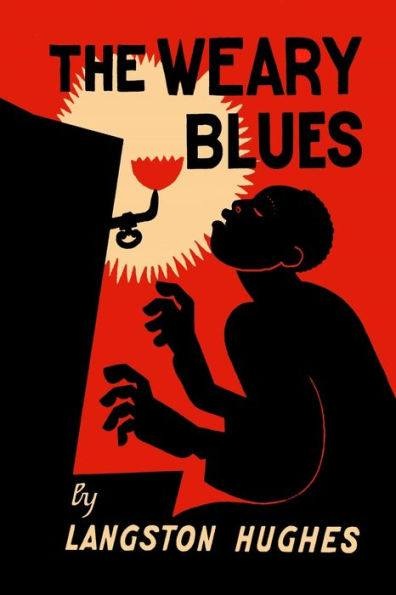
Hughes chooses to close his poem with a three-line final scene, one which a further dramatic program note might illuminate. Someone is picking up someone else for the night. No gender is lined out, and while it could be Hughes, it may also not be, or it may be Hughes constructing a metaphor.**** The person they’re attracted to is said to be from Georgia. I think that’s an important detail, because the poem’s dialog has it “Even if you do come from Georgia.” Hughes, Northern-raised, recipient of a white-privilege-level high school education and some Ivy League University is portraying this amour as an uneducated rural person. Metaphorically then, Hughes’ concludes that Jazz and Blues folk-music ancestry isn’t important compared to what it does – and by writing Jazz poetry, eventually performing Jazz poetry, that’s the choice the young Langston Hughes makes. When this poem appears in his first poetry collection, that book is going to be titled The Weary Blues – right on the cover he’s making a point of his decision on what’s worthwhile art.
.
Now that I’ve written all that, I’m left with handing off to my musical performance of Langston Hughes’ poem. I felt compelled to “make a Jazz noise here,” as one of my models once titled an album. As a composer I don’t have the theoretical training that most modern Jazz composers do, but I put something together using a characteristic Jazz harmonic cadence. Then the composer called on the inconsistent musician me to realize it and improvise the top line melody. I’ve been practicing my poor chord-comping skills a little bit lately, so I was able to portray the set of written chord changes passably. Spontaneously creating while playing the melodic guitar line was easier for me, as I’ve always been open to improvising that sort of thing. When I start something like that, when I don’t know how to play it exactly – I may have an idea, go there, and see what would fit next. You can hear the result with the audio player gadget below. Is there no visible audio player? No, your ship didn’t leave port without you, it’s just that some ways of reading this blog will suppress showing the gadget, so I offer this highlighted link that will open a new tab with its own audio player.
**Hughes and his mother were estranged from his father, who had become a company man with the Pullman Company working out of Mexico City. Langston’s father agreed to support his education as long as it was aimed at practical matters such as engineering, not the arts. Langston Hughes agreed to make a go of that, but found he couldn’t leave his literary interests. The train trip to work out this ultimately-to-fail detente produced one of the greatest poems ever written by a teenager.
***Unintendedly, I seem to have stumbled into a theme this fall: literary poetry which has absorbed folk-music forms. Folk revival acoustic-guitar-based music and electric Rock are in my page poetry just as they are more explicitly in my Parlando Project pieces using other people’s words.
****Hughes sexuality is, best as I can determine, hard to determine. Some say he was gay, others assume bi. Some who knew him well paint a somewhat asexual person, or they just say, as I do, that they don’t know.
I’ve mentioned this Fall that I’m on a project to clean out the accumulations of my long life. There are various battlefronts in this effort, but last month I worked on emptying my stuff from a small storeroom in my house, which was filled with boxes, some of which hadn’t been unpacked since I moved 40 years ago. One box was completely stuffed full of spiral bound notebooks.
I had once saved the notebooks I used in my high school years and then throughout my twenties. This meant a slowly growing cache of them had traveled from a tiny hometown in Iowa, to a dorm in a small college in that state, and then to the locations I lived at in New York for six years, and onward the four places I’ve lived in Minnesota.
I had a typewriter, which I used for some more formal things and finalized school assignments, and then in the ‘80s I got a personal computer,* but for 20 years or so, my creative work began and was recorded with handwriting in these college-ruled notebooks. Early, when there were only a handful of them, I mentally cataloged them by the color of their covers. Even after all these years I recall a couple of the earliest ones as “The Orange Book” and “The Green Book.” Like Emily Dickinson I didn’t always save working drafts, written on whatever was handy, but when I felt I had finished a poem I’d make a good copy in my most legible hand inside one of the notebooks to be saved.
I’ve written briefly at least once about starting to write poems as a teenager, and I won’t go on much more about that today, but I was surprised at the urge – it was not planned. I felt compelled to do this for reasons I couldn’t tell you then, or now. Living in my tiny town I had no idea how many people were writing poems, but I presumed it a small number, as the literature anthologies I had in school made me think the number at any one time was a select few. This misapprehension led to a grandiose feeling that I was writing poetry! – this grand art-form of literary geniuses.
Clearly there was a lot I didn’t know, but in my case this helped me, giving me a sense of accomplishment. Did writing poetry give me an unearned, unrealistic, sense of self-worth? Yes, I think it did – but we all need a minimum deposit in that bank, and that was the source I had. And after all I was a teenager, and few of that age have any substantial achievements.
In that process of pulling aside these old notebooks I came upon “The Green Book” that I recalled when there were only a couple of these, and I set it aside to look through first. In it I saw my good copy of a poem I remember quite well from my early work, one I had thought was one of my better ones then. Looking at it as an old man who’s read much more, written much more, lived much more, I think enough of it to present it here in performance today.
I didn’t have many poetic models to draw on, but this one certainly came from reading John Keats “Ode on a Grecian Urn” in my high-school literature class. I’ve performed Keats’ poem here, and I think I was already impressed at the ambiguity in the poem’s famous ending back then. My “Ode to a 1953 Automobile Ad” was on the surface a free-verse parody, burlesquing Keats classical art object – but I was at least partly conscious of wanting to make some solemn points too, though I don’t recall thinking out all the themes the poem includes, so my best recollection is composing the poem without knowing all I was including in the text under my pen.
I think there was a 1953 automobile ad in my memory, though I haven’t found the one described in the poem.** Sometime in my early teenage years, a man in my little town – no doubt doing the same “death cleaning” I am doing in 2025 – gave me several dozen 10-15-year-old Popular Mechanics/Popular Science/Mechanix Illustrated magazines. I devoured them, first because I adored the hyperbolic writing of the self-styled dean of journalistic automobile test drivers Tom MaCahill who wrote for Mechanix Illustrated – but this was a strange genre of magazine. Part reviews of new models of cars and novel ideas in consumer goods, part pre-Whole Earth Catalog handyman tips and project plans, and part more general writing about science and technology including predictions for the future.
The soft golden car in front of a Greek colonnade, or a peaceful ride in a Paris that 8 years earlier would have been in the midst of a World War.
.
I enjoyed the time-travel aspect of reading these magazines, visiting as an abstract thinking teenager the world of early childhood. The too fantastic flying car future has since become a meme – but the junior historian in me would think: the Korean Conflict was being fought as some of these old pages went to press (little mentioned in these mags, little remembered now too), the new age of atomic war fear was beginning, and in the sixties as I wrote this poem, Vietnam was echoing the Korea situation. So, as the poem was being written, there was then too the feeling of a glorious and blest domestic United States – yet with a “conflict” acting as a far-off minotaur ready to take sacrificial children.
So, I wrote this in the 1960s linking those times in the 1950s, and sublimation of killing young men is the topic. Inexperienced as I was, I tip my hat to the images the young person that would become me put in there: the camera and/or coffin dark box capturing the bright sunlight of the ad, the rust-holes in the teenaged car as the wound in the son. The use of Whitmanesque (or Sandburg or Ginsberg in their Whitman mode) extra-long lines is not something I do much now, but as I performed them this week, they seemed to work well enough.
This old poem is now published with a musical performance in the lead up to the holiday that was once known as Armistice Day – the very day that World War I ended at a moment when it was just “The Great War” and didn’t need a number, and didn’t expect to gain one – but now our wars don’t get the roman numerals, though fantasy film franchises and Super Bowls do. We didn’t get flying cars. We got armed drones.
You can hear me performing my “Ode to a 1953 Automobile Ad” with the audio player gadget below. Has the audio player gone with Studebakers and saving old magazines? This highlighted link is supplied as an alternative which will open a new tab with its own audio player.
.
*My penmanship was erratic and not consistently easy to read, so a typewriter was essential for things of any length destined for others. But I didn’t do creative writing on a typewriter – something about the mechanical nature seemed an authorship firewall: the machine made the letters, keys and levers away from the writer, and one couldn’t easily cross-out and add little marginal changes as one wrote.
One of the things found in the storeroom with the notebooks was a postcard about requirements for receiving a rebate on what would be officially my first personal computer: A Timex-Sinclair bought in 1982 – but that tiny $85 plastic wedge wasn’t able to take over from a pen or typewriter since it had a small membrane keypad that was only useful to learn to write computer programs with. In 1984 I got a Commodore 64 which could do limited word-processing, but I couldn’t afford the software that did that. In 1987 I got an Amiga 500 which came with a copy of Word Perfect – the then leading word-processing software product – and I began a slow and inconstant transition to using computers to do initial drafts over a decade or so.
**The 1953 year of the car in the ad makes me sure it was a Studebaker ad, for a remarkably beautiful new 2-door coupe was introduced for that model year. When I look for examples of the ad campaign, I see many of the Studebakers are depicted in yellow, but never in a family tableau described in the poem in the ones I could find. And there’s the chrome bird hood ornament. Was I thinking of the Packard swan? Looking at pictures of the 1953 Studebaker I see there’s a 3-bladed chrome insignia on the peak of the hood – meant to be a propeller, or bird, or abstract shape? I appeal to Brancusi on the bird.
I mentioned earlier this month that my late wife took creative writing classes with poet Phillip Dacey in the mid-1970s. Later, through her, I met Phil and was able to talk to him a bit about poetry. Phil was generous about this, and I’ve never forgotten that.
It’s always hard to accurately, objectively, analyze where one is in in their writing craft. I knew I was only partway in craft, but I self-judged myself as better than average in the imagination aspect. Looking back at that young man I was then, I’d re-set my judgement now to say I was even less far along in craft than I thought, but I still think my imagination was as good or better than many. Those models that I looked to back then: Blake, Keats, Sandburg, Stevens, and the Surrealists were good enough for starters.
Of course, old men can be wrong when looking at themselves too – presently or retrospectively. I’ve come to consider self-judgment as so unreliable that I treat it as a traveler’s tale: something to listen to, but with a duty of skepticism. If I get time, I might extend this informal series engendered by finding old 1970’s manuscripts packed away in boxes with a few of my youthful poems. If I do, I’ll try to make it worthwhile for you rather than self-indulgence.
This Project takes author’s rights into strong consideration, and you may notice that we almost always perform works in the Public Domain.* As the Parlando Project was starting I learned that Phil Dacey had died. I hadn’t seen him in over a decade at that point, but I contacted his website on hearing the news, and got permission from one of his sons to perform a couple of his poems here. This autumn, while in a dusty boxes clean-out, I came upon a letter from Phil to my late wife dated November 1977, and within the handwritten letter was a typed copy of a poem of his about this time of year.** I felt I had to perform it for you. Phil’s personal site is no more, and I retain no contact info for the family, but this not just a non-profit – non-revenue – Project would propose that the promotional/educational aspect far outweighs any abrogation of the rights holders. If one wants to seek out and read any of Phillip Dacey’s poetry collections, you’d be following my recommendation. I don’t know if today’s poem made it into a collection (I only have some of Dacey’s many books), but you will find poems like this in them.
The subject matter of Dacey’s poetry when I met him was spread out between memories of his childhood in St. Louis (a city that punches above its weight in modern American poetry), a Roman Catholic upbringing, erotic desire and its complications, and family and marriage. He came into a long-term teaching gig at a rural Minnesota college, and stayed in the state during his retirement; and as a result, the setting for many of his poems is distinctly Midwestern. In my early posts here where I wrote about Phil’s poetry, I stressed the humor in it and the unusually engaging way he presented his work to audiences. Both of those things might endear him to listeners and readers, but I fear they might blind the completely earnest (or the envious) to other strengths in his poetry.*** I don’t know how he taught the craft professorially, but he models for young writers a subtle kind of poetry, and the piece I perform today is an example of that strength.
“Frost Warnings” begins – and with only casual attention might remain – an occasional poem about the present point in an Upper Midwest autumn. Afternoons remain warm, yet the hours before dawn drop lower and lower until they eventually sink below 0 degrees Centigrade – frost and freezing time for plants. Food gardeners must make their household harvests, flower gardeners, preserve their late bloomers. The poem’s bed sheets with rips and out-worn baby blankets start as reportorial items in a task to stave off frost-burn, but are, if we think again, stealthy deep images of desire and parenthood, the kisses from which we make mankind as Éluard had it our last post.
Then a third of the way in we meet the bedding again, cast as shabby Halloween ghosts. Dacey’s unshowy poetic compression of the worn-life of young parents “too much revelry and worry” is masterful, but might you overlook it on first reading? The modesty of how Dacey uses his craft pleases me – and then he playfully indulges himself by breaking into Wallace-Stevens-voice for the word-a-day-calendar delight of writing down the ridiculous sounding “tatterdemalion.”
On the page it’s also easy to miss the use of rhyme and near-rhyme in this poem: that “revelry” with “worry,” “find” and “vine,” and the comic “jalopy” and “credulity.” Finally, the poem sticks the ending with a rhyme: “Fall” and “mortal.” For at least a while, I think Dacey was associated with “New Formalism” in poetry. “Frost Warnings” is Formalism unfettered.
I wish I’d spent more time on the music I made for this one. It’s been a busy week or so for me, getting vaccinations, some banking business, attending a large gathering against cruel and capricious authoritarianism, getting my own “garden” of bicycles and composing/recording equipment ready for the upcoming winter. As a result, the music I performed with Phil Dacey’s poem is quite short, and is just a trio. I wanted to add a melody instrument, and strip back or deemphasize the piano part for a guitar, or even a horn or wind instrument part, but that would delay things, and I have a half-a-dozen other pieces in WIP state that also want completion.
Phil was a great performer of his own work. He’d have done a great job presenting this, so I tried to use my memories of him to guide me. I attempted to memorize the poem for the performance (Phil often did poetry readings without “reading”) and I hope I brought out some of the elements in my recording that a quick reader of the page poem might miss. So, it’s done, and you can hear Phillip Dacey’s “Frost Warnings” with the audio player below. Worried that someone’s taken the audio player away and spread it over last roses in the garden? Don’t wilt, I’ll provide this alternative: a highlighted link that will open a new tab with its own audio player.
.
*Yes, I have bent the rules a few times – and as the Project was beginning, I thought I’d get permission to use more recent poems by sending simple requests, only to find that would too often require prodigious effort and persistence.
**Here my late wife and Dacey were operating like 19th century Emily Dickinson and Thomas Wentworth Higginson well into the 1970s. By the end of the 20th century it’d be emails, and by now, social media or chat software. My dusty boxes and my late wife’s metal box held things for near 50 years, but who knows at what interval current inter-author correspondence-in-effect goes all Library of Alexandria.
***Often humor has a shorter shelf-life and lower canonical trajectory in literature. Using humor, or other approaches which seem to attract a wider audience, can attract a distrust of “mere entertainment.” The argument here, to be fair to detractors, is that such an audience is shallower even if broader, and that “fan-service” audience-pleasers keep an artist from growing and dealing with difficult subjects. My personal belief? Those most difficult subjects are absurd, incongruous, impossible mysteries and dichotomies to solve, and that humor can portray them as well as any other mode.
Phil read a few times with musical backing, as I present him today. One performance I attended was with his sons’ alt-rock band. His “readings,” even if acapella, could have performance elements. He’d weave well-told stories into the poems in such a way that you didn’t always know when the poem had started and explanatory introductory material had ended. He sometimes sang lines when he quoted a song inside a poem. Again, let me concede this sort of thing can be cloying. I’ve heard poetry readers down-rated for an “AmDram (amateur drama) style of presentation, and the “You are hereby sentenced to attend my one-man-show” jokes are easy to make – and that’s sometimes justified. My summary? This can be done badly. Just about all ways of presenting poetry can be done badly. I thought Phil did it well. Other than talent and attention to his craft (including presentation) one reason it may have worked for Phil was the modest and subtle nature of his poetry that awaited and welcomed being presented more expressively than on the silent page. Still, and unlike some performance-oriented poets, Dacey’s poetry does stand up on the silent page – I just have had the pleasure of seeing it in that other framing.
I mentioned last time that I’m cleaning out things I can no longer reasonably expect to use, and found a box which included poems by my late wife. Perhaps such things are past the use test, but I asked what use can I make of them?
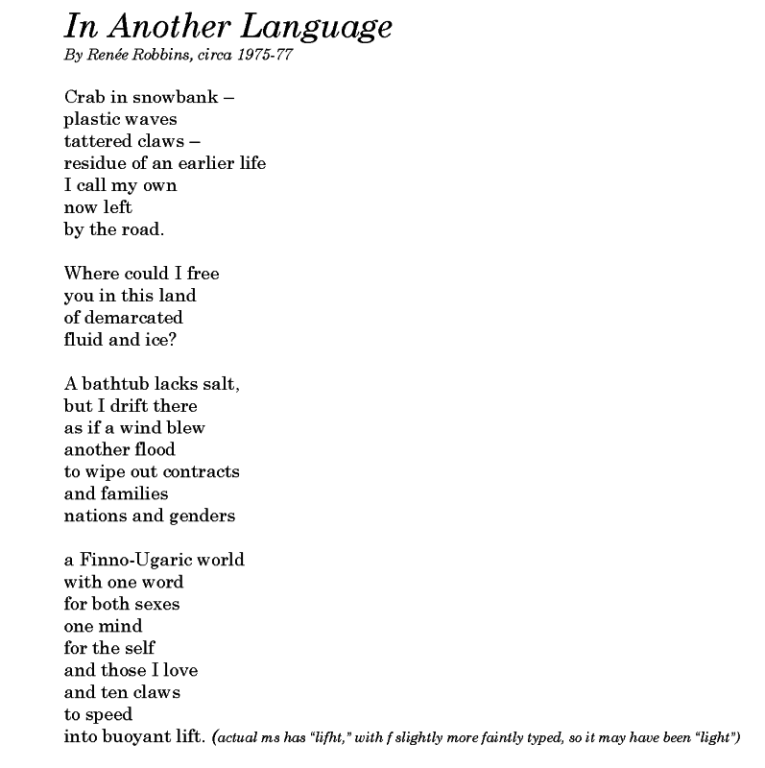
After paging through the papers, I transcribed the handful of poems I found, typing them into documents on my computer, a now ordinary device which would have been a SciFi marvel to her back when she wrote these poems in the 1970s. Could I perform some of them, here, as part of the Parlando Project? Could that seem like special pleading, an enforced overlay of widower husband wants you to shed a tear for his dead wife? Let me try to move you past that. Decades after a death, and when one is old enough to reasonably consider one’s own death to be a nearish interval, shorter than the one from that loss, loss begins to take on a universal and obligatory aura. These aren’t sentimental poems – my late wife, Renée Robbins, was funny and was wearing the full costume of life when she wrote them. Those costumes of life go back into storage, kept for use in later productions. Perhaps her poem “In Another Language” can be worn by someone still treading the boards?
Yes, these poems are little pieces of someone I loved deeply, written early in her too-short life, and bringing them on to you extends a tiny bit of what she was. Yes, it was particularly nice to feel I was working with and playing this part of her when I performed this poem this month – but yes too, it’s October: everyone’s wearing costumes and pretending they can see ghosts.
I can hear her responding to this situation. How? I’ll explain it with a quote from Woody Allen* that has been reverberating through my mind:
I don’t want to achieve immortality through my work; I want to achieve immortality through not dying. I don’t want to live on in the hearts of my countrymen; I want to live on in my apartment.”
So here you have it, a poem likely written while she was still in college, studying writing under Howard Mohr and Phillip Dacey. I’m fond of the obscure strangeness in the framing image. I can’t be sure what she, the author, was seeing. My best guess is a whole crab or lobster on ice in a seafood display, a mundane piece of unintended Surrealism – and being in a world of frozen water is also an accustomed strangeness to Minnesotans. I like the poem’s leaps, like the dream of the crab escaping to her bathtub, and the totally unexpected leap into the genderless cross-shifting-borders of “Finno-Ugaric.”**
Besides the crab image, I see Noah’s flood in the third stanza. I chose “lift” from the alternatives for that last line because it’s more sensual.
.
I performed Renée’s poem in a style that still hadn’t gone-out-of in the Seventies, as spoken word with an approaching-Jazzy musical backing: drums, bass, and two electric guitars. I believe the music, taken by itself, might shows the subliminal influence of a current band, Khruangbin. It’s subliminal because I don’t use as much reverb.
So, there you go. Looped through with the footnotes, we’ve got Khruangbin, Krasznahorkai, Woody Allen, my late wife Renée Robbins, Phil Dacey, The 1970s, and a fifty-year-old poem by a twenty-something. There’s a lot of intervals and strange harmonies there, but I’ll end with another quote from an artist (actually, from his less famous brother). I read this one in a recent interview answer given by Ken Burns when asked how he makes those famous “Ken Burns Effect” intelligence flights over photos as he edits his work:
It’s all music—my brother, Ric, said that all art forms, when they die and go to heaven, want to be music.”
So, there you go Renée, not immortal from non-dying – but you get music.
As you can see today, we stay narrowly focused on the topic here at the Parlando Project, and we will return with poems by more famous literary poets soon – but to hear Renée’s poem “In Another Language” as I performed it with music, use the player gadget below. No graphical audio playing gadget? I offer this heavenly highlighted link that will open a new tab with its own music player.
.
*I know a fair number of possible readers of this have strong opinions when they hear his name. I’ve got at least half of those myself. There’s a second, artistic, set of subjects regarding his work that would overwhelm the focus of this piece. To stay on topic, let me just say that my late wife was a comedy fan who could recite from memory the entire 30-minute Firesign Theater Nick Danger radio drama parody, and that Woody Allen movies were a constant date night thread in our relationship. Renée had opinions too, consistently caring ones, but she would have laughed at that quote, and I’m laughing now too, but with a deeper resonance to that laugh.
**My memory of seeing Woody Allen movies with my late wife was intensified by the recent death of Diane Keaton, but there was even more coincidence as I worked on this: the Nobel Prize for Literature went to László Krasznahorkai, who writes in a Finno-Ugaric language. And yes, that language group is non-gendered, even the pronouns – at least from what I find when I checked on Renée’s reference in her poem. And if I may risk one more Woody Allen reference, in my life back then I was (roughly speaking) playing more the Annie Hall role.
I’ve already mentioned that I’ve been dispensing with a lot of stuff, the kind of winnowing that I like to refer to as “Death Cleaning.”* This has included going through a series of stored-away boxes and plastic bins which dated back to moving into my present house in the 1980s. While somewhat illogical, this isn’t, I think, unusual. When we move, we’re moving forward, and there’s a tendency to liberally bundle and box up those things we think we might still want – and then in the new place, present time takes over and one never gets to unboxing things one doesn’t need right away.
Things of mine I found in these dusty bins? Music tutorial books, and books on French poetry and language. The former because this was the height of the LYL Band’s live performance era and I was hoping to increase my skills and knowledge, the latter because I was interested in translating Symbolist and Modernist French poetry.** More than 40 years have passed. I now know that I know just a bit more about music: mostly what I’ve found out about in order to create the over 850 Parlando Project pieces composed this century. That’s what became my tutorial: doing. I never got around to translating as much French poetry as I planned, though you will still see that interest playing out here sometimes. Back then, I thought French poetry was the key to English-language Modernism, and while that’s not entirely untrue, I now know the American influences some of the French poets took note of.
One night in this clean-out task, working in a small room with shelving that I think had once been the coal or oil bin for our Edwardian house’s early furnace, I pulled open one of the stacked boxes there.
It was likely the contents of a desk or file cabinet drawer packed away by my late wife in the 1980s. Inside the larger cardboard one, there was a metal box, the kind one might keep important papers in – but this one was filled mostly with things she had written. Looking through the pages, there were a few things that might have dated back to high school, and a selection of poems and short-stories, some for college classwork,*** some for her just post-college time when she submitted and had published poetry. A couple looked like work for articles she had published in Seventeen, then a glossy magazine for the teenage girl market. Also in the cardboard box were the contents of many a desk in that era: sheets of typing paper, the chalky white strips that one could carefully pinch just above the belettered hammer of a typewriter to blank out a mistyped character, and a few miscellaneous things from a job she’d had with Control Data.
I was steeled for the job of getting rid of things that had an adjudged expiration date of meaning or usefulness. I could easily chuck the general detritus of this typewriter wielding ghost, but I couldn’t throw out the manuscripts. How many poems were in the stack? Might I be able to perform some of them here? Maybe. “Death cleaning” sternly says you won’t get around to it. The Parlando Project whispers otherwise.
In this case, Public Image Ltd was not involved: Renee’s metal box and folder of youthful creative writing work.
.
So, the metal box went into the to be saved pile – but of course there is no real keeping. I’ve survived my late wife for 24 years, and I’ve been with my living wife for almost exactly as long as I was with my wife who died all too young at 43 years old. Actuary tables say I will die before any more such multidecade interval. Death cleaning has its solid argument: the writings of a young woman, or those of myself, the young man she partnered up with, will not have any enduring memorial. It’s a near certainty that is so too of all the poets I’ve known. We write words like the immortals do, with the same goals, to the best of our craft – but there are only so many niches in the pantheon.
Today’s musical piece is a poem I wrote condensing that experience. I can imagine the readers I used to have in my small group of poets wondering at an imperfection of the poem’s ending. “Why end this personal poem with such a mundane little observation about – what? – a business you don’t even name? Needs another draft.”
And I confess to you here, that’s the thing I’m trying to say. The most practical and commercial things we do in life come to an end, are forgotten – all that stuff we’re told we should be doing instead of writing poems, making music, or creating art. So then, forgive us our arts.
You can hear my musical performance of the poem I call “Exhumation” with the audio player below. I wanted this to have rough edges, and so the guitar recording tries to capture and leave in pick and fretboard noises that you’d usually not hear by intent. What if the intended audio player gadget is not where I say it will be? No worries, some ways of reading this blog toss it out, but I supplythis highlighted link that will open a new tab with its own audio player.
.
*I think when I first heard the term it was “Swedish Death Cleaning” and the process was imbued with practical Scandinavian modesty. The florid sentimentalist of objects within me has to listen to the memento mori enlightened elder in me: these are simply artifacts of one person’s life that are meaningless once that life ends. Somewhere in the corner, there’s a Modernist, smoking unfiltered cigarettes, in an Existentialist infested coffee shop, who exhales in blue and says to no one in particular, “Well, it’s all meaningless, save for what you compose it to be.”
**Mixed in were some faded to brown music papers from the Seventies and Eighties: Punk, New York Rocker, Sounds. I had them in the to-the-trash pile, but my kid wondered if they could digitize them and upload the scans to the Internet Archive. I doubt they will ever get around to that, but they’re young and should enjoy those provisional ideas.
***The little college she attended allowed her classes with Howard Mohr and Phillip Dacey.






 Frank Hudson