Poem 16 from Neruda’s 20 Love Poems: translation, and civic poetry

I must apologize for how rapidly these new pieces for National Poetry Month are being released. That must tax some of my valued reader’s and listener’s time. I planned — and still plan — heightened activity here during Poetry Month, but I expect it won’t be near-daily posts.

In announcing this April’s observance, I said that following #NPM2025’s theme of “The Shared World” that I’d like to include some poetry that wasn’t originally written in English. I’ve done a fair number of translations here, despite not being much of a linguist. I’m also not a creative writing teacher, but I highly recommend for poets to follow my example in this and to do their own poetry translations. When I first started doing French to English translations in my 20s I had only my high school French to guide me, and I relied heavily on French to English dictionaries. This was a laborious process, but approachable with short poems. Nowadays, online dictionaries and even reasonably fluent automatic translation features are available on computers or the Internet. Just plugging in a poem’s text into Google Translate isn’t translation, or a translation that will help your poetic skills. The machine translators are pretty good these days for denotative texts, news accounts, manuals, advertisements, directions — that sort of thing. But poetry asks for at least two other things beyond that: a heightened sense of which exact word brings something to the poem, and those word choices are also part of how the sound and flow of the poem is presented in its new language. As a teaching exercise, sitting for a few hours beside the spirit of another poet and their poem of another language, helps one find skills in making those choices when one writes their own poems.

As a non-native speaker, it’s entirely possible you will make mistakes (even embarrassing ones) or come upon mysteries where even experts will not know what the poet intended in the original language. No matter. That’s scholars’ work — honorable work — but as a poet that’s not necessary for your translations.*

Yesterday I went through some poetry books I have in Chinese, German, French, and Spanish looking for candidates to develop. I found a handful, but still had a couple of books to look through this morning. After early breakfast and grocery shopping, I picked up the next book: Pablo Neruda’s Twenty Love Poems.  This passionate early 20th century work is extraordinarily popular among Spanish language readers. I did the first and the last of the set of 20 earlier in this Project and Poem 1 remains one of the most popular pieces of the more than 800 Parlando musical adaptations. I started looking randomly at the rest. It’s there I came upon “Poem 16.”

The imagery and the refraining way it’s presented made me think this a good candidate to sing. Looking at a couple of machine translations, I started work on making a poem in singable modern English out of it. This poem is not entirely straightforward to me, but it seemed to be about separation, though I cannot be sure it’s not about a subjective, obsessive, or jealous sense of separation, a “I want you so much, all the time, and all to myself” kind of feeling. As I started to work on the images — the shared-world-vision that the poet’s voice wants to invoke — and those word choices and sequences necessary for word-music, I was overcome with a connection likely unintended by Neruda.
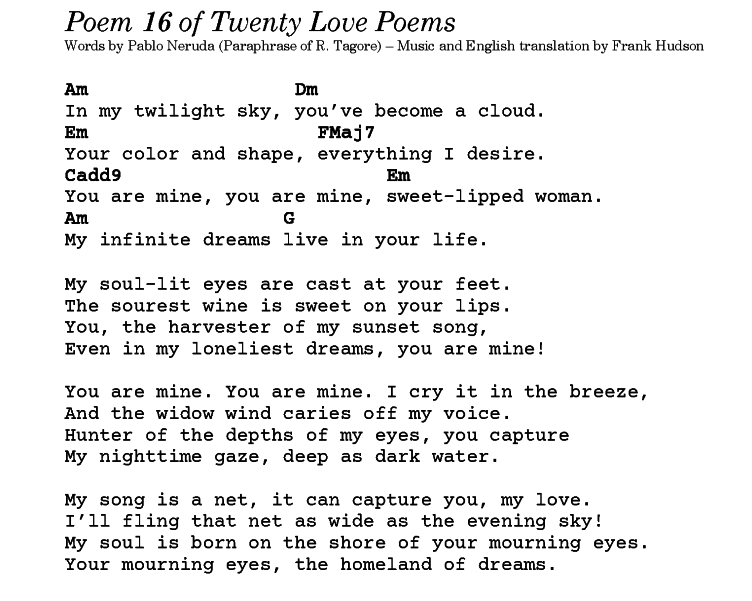
Poem 16

I include a chord sheet because I was inspired by folk revival publications Sing Out! and Broadside back in the day. You might sing it yourself as a prayer and plea for the two Garcias.

.

The poem’s speaker talks about being captured, even imprisoned, constrained as he speaks of his beloved. I thought of a pair of recent news stories of men taken abruptly from their families, one hauled off to a brutal prison in El Salvador, the other pried from the embrace of his wife and children.** The charges, the evidence? They are, what, maybe gang members. How do we know that? “Oh, we just know” says our government. OK, what are their crimes? “No matter, we just have to say so — or maybe we don’t have to say, we can just do.”

It’s possible we have nonsensical laws, though I’d hope our consideration is better than that. But there seems no way this can be just.

I stopped trying to make a better translation. I’d normally want to take more care — after all, this is a work of a young poet who later won the Nobel Prize. I just wanted to put together the sense of this way I could hear the poem’s speaker speaking across our Shared World, because I wanted to sing it to salve my own heart.

The poem, as I now shape it in English, is speaking as a man who loved America, loved his wife, loved his family. All this can be taken away. In one case some executive branch functionary in court, being asked of one of these men, is said to admitted his deportation and subsequent imprisonment there was “an error.” With such slipshod execution, this might be expected. What is to be done? “Nothing can be done. He’s in another country now. Out of our hands.”

This is a project about poetry and music. There’s nothing those two things can do but sing. I did say I would share civic poems this month. Why? To sing a poem, or to listen or read it closely, you must feel it somehow. What you do afterward, I don’t know.

You can hear my performance with the audio player below. No player?  This highlighted link is an alternative that will open a new tab with its own audio player.

.

*When sharing such translations publicly, I often take the example of another poet I came to read through this blogging adventure, Robert Okaji. Okaji, like myself, sometimes takes literal, non-poetic, glosses of classic Chinese poems and renders something vital in modern English out of them. He uses the traditional note of “After a poem by…” which indemnifies either of us from lack of fully understanding the Tang dynasty and ancient Chinese.

As it so happens, Neruda in “Poem 16”  writes at the top of this poem that he’s paraphrasing another poet and songwriter, Rabindranath Tagore. Tagore’s poetry and song lyrics are sometimes psalms to his country or godhead, written in the language of love poetry.

**The two men are Kilmar Armando Abrego Garcia & Jorge Garcia. Their wives and  children are American citizens.

The Guitar, after a poem by Federico García Lorca

Today’s piece is a fairly well-known poem by the Spanish poet. Given that I’ve played guitar nearly for 50 years and been interested in poetry for more than that, I keep thinking I must have run into it before this year. If that’s so, why don’t I recall considering it?

My answer is going to sound more judgmental than I mean it: bad translations. No, maybe I shouldn’t use “bad” here. I don’t suspect any moral failing or lack of effort by translators of this poem. And given that I’m not all that knowledgeable about the work of Lorca and have only the most limited grasp of his native language, I should have no standing to rate other published translations of “La Guitarra.”   What I do know is that native speakers find his poetry passionate and vivid, and the English versions seem to my ears and heart (those being the entry points for poetry) stilted and muffled.

I’m not going to link any of the English translations I found of “The Guitar.”   None I’ve seen seem fully effective to me, though I cannot say that they might be effective for others. I’m not going to link or line-by-line dis the translations I’ve seen. I will say that the first one I saw at one of the leading poets and poetry organization’s site was representative. I didn’t find it musically compelling, and it was a jumble of abstracted images that had little sock, little immediate feeling evoked. I assume the translator had the advantages I must clearly concede I don’t have. Why might their work not succeed, at least to this reader?

Two theories. Other translators may have been too literal in carrying over Lorca’s original sentence structure, which might be natural and unaffected in his Spanish. This is poetry, so one can make a case that how it’s said is essential — but when languages order words differently, following the original sentence structure and word order too exactly damages the natural vividness of a person speaking. Secondly, Lorca to my slight knowledge connects to Surrealist expression, a style of poetry I loved as a young man and still like to connect with today. Surrealism likes the wild and incongruous image; and from its ancestor Dada, it’s often willing to take an image in a random, raw and undercooked state. This creates a problem for me when I translate Surrealist and Dada work.

You see, I view my task as a translator to primarily find the images in the work and to then portray those images in clear modern English, and secondarily give the poem a word-music in the new language that gives pleasing movement and return to the poem. What if the original intent was to mystify the reader, to present an image that was intentionally confounding? I risk, while puzzling out the text in a language I don’t know well, to over-simplify or over-determine an image. I fear embarrassment of doing that, but I think it’s the better risk because vivid images that the reader/listener grasps and gasps are compelling to me.

As to the word-music, my version of “The Guitar”  rephrased Lorca somewhat, aiming to make him sound like an English speaker. While doing that I tried to make the poem musical in English. The poem was already using repetition for poetic effect in Spanish, and I added just a touch more.

The Guitar - Lorca

A chord sheet as I urge you to sing this yourself. Here’s a link to Lorca’s poem in its original Spanish.

.

As you might imagine, this poem about the expression of a musical instrument has been set to music before my attempt you can hear today. While not a Lorca expert I know that he connected too with Spanish Deep Song and the evocation in that tradition of “Duende,” a difficult to translate term that some Afro-American musicians have seen as analogous to the Blues. I played a nylon string guitar for my setting, the type of guitar associated with Spain, and the simple chord progression I used would not be foreign to that tradition. But both from my skill level and inclination what I played for this song was simple and sparsely ornamented. Though the harmony wasn’t Blues, I approached playing this as if it was American Blues. Another Blues element I introduced that wasn’t in Lorca’s poem: my version has a gendered call and response. The guitar is a her, the singer (there’s no singer in Lorca’s poem) is a he.

You can hear a performance of my translation after this poem by Lorca with the audio player below. No player? No problem, this link is an alternative that will open a new tab with its own audio player.

.

William Carlos Williams’ Summer Song

One of my favorite Indie rock band names is Yo La Tengo. The name comes from a convention that was formulated decades ago as talented non-English speaking players began appearing in North American baseball teams. “Yo la tengo!” means “I’ve got it!” – a useful term as two or more fielders with their eyes fixed skyward tracking a fly ball might otherwise collide. In such a situation, the most confident player needs to call off the others who also think they might have a chance at making the play.

Today’s piece is by William Carlos Williams, who grew up speaking Spanish. It was published in Williams’ 1917 collection Al Que Quiere!   Wikipedia quotes from a later memoir by Williams where he translates that phrase as “to him that wants it,” a cry that he associates with playing football (AKA soccer). I don’t have access to that memoir, but he expands on that definition to make it sound like it’s an in-game cry meaning “I’m open, I’m confident, I have advantage on the defenders, get the ball to me!”*

Odd to think of WCW as a young athlete. I always picture him in his later years, the time that overlapped my lifetime, as an older man.**  But there is another element of his nature in that cry: if not exactly a poetry ball-hog, he seems to have been a poet who was not ashamed to make claims for his artistic validity. He got the Modernism bug early, and went right on to the business of “Making it new” even before this collection was published. Confidence. Or stubbornness.

William Carlos Williams’ poem “Summer Song”  starts out straightforward, with the Moon still visible just after dawn. If you’d like to follow along, here’s a link to the text.***  WCW is right-off attributing personhood to the Moon. If self-aware, the Moon must know it will soon be washed out by the rising sunlight, but Williams says the Moon is indifferent to that, it goes on smiling, for even if it’s a “wanderer” it also seems to understand that it will come to a new place, a new town, a new day, soon enough.

In the final section I’m a bit less clear at how surreal WCW is going. Let’s presume he’s the poem’s speaker, the man observing this moon in the summer morning. I try to picture the image he portrays. He says he might buy a shirt the color of the Moon (white? gray? silver? ruddy?) and accessorize it with a sky-blue tie. I’m puzzled. Wouldn’t the blue of the sky be the field (the shirt) on which the moon would (whatever color) be the tie in the foreground? Is he purposefully reversing foreground object and background field? Perhaps his intent is to say that the wanderer moon is really bigger than the present blue morning sky?

decalcomania by rene magritte

Painter Rene Magritte reversing field.

.

I’m unsure, but his final line is clear — if he too may be overshadowed — he may wander too, even if fading into invisibility, until his time might come. And here we are, some 106 years later, and I’m singing his words in front of a rock quartet today. You can hear that performance with an audio player you’ll see against the field of this web page. Or not? Well, then this highlighted link will tie you to a new tab which will supply its own audio player.

.

*I’m unable to find any confirmation in a quick search that this is some kind of standard on-field player cry. The Wikipedia excerpt from WCW explaining it also goes on to have him say that “I was there willing to pass the ball if anyone did want it.” So, is “al que queire” the cry of the player who wants the ball — or the cry of someone putting up a long kick in hopes one of their teammates will be there to receive it, a soccer equivalent of an American football “Hail Mary pass?
Again, Willians was like that. He was willing to write and to publish, put himself out there, without the level of attention and praise that some of his Modernist contemporaries received during their lifetimes. Anyone know anything more about this Spanish phrase?

**Also like the band Yo La Tengo, Williams was based in New Jersey.

***Here’s a link to an earlier version of this poem as published in 1916 in Poetry  magazine. As I improvised while singing, unaware of the this alternate version, WCW extended and refrained his ending there.

Beneath the Poplars, César Vallejo’s Easter Locus Solus

As National Poetry Month continues, let me take a brief break from the personal history of Parlando inspirations to again do in the present what this Project does: explore a poem as I combine it with new music. A few weeks ago I found an early poetry collection by the Peruvian poet César Vallejo. Before looking into this collection Vallejo was just a name to me, a poet who is best known as being a favorite of other poets whose work I had read.

If I had time to write more tonight I could go into his troubled life, but I do not. Suffice to say he grew up poor in rural Peru, and by paths he traveled to Lima and studied some in Peruvian universities, but poverty and trouble with the authorities seems to have always followed him. He fled to Europe and had down-and-out adventures there, but eventually died there 85 years ago this April. In a brief interchange with another poet on Twitter this spring we agreed that from what we know Vallejo seemed to always be an expatriate, an exile — and unhappy from that. If so, unhappiness for a man, but poetry deals with diaspora often and well — perhaps because even when we are dealing with our native language, the dialect we spoke from childhood, we are seeking in poetry to find its real home. So often poets stand in the midst of other native speakers of their language and find this so.

My adventure with a poem in a foreign language forces by nature a greater travel. Even if I have another English translation, I try to find it in the original and start again with the awkward literalness of a machine translation of that. Other translators likely have smoothed over the troubles of a literal with their chosen solutions, and out of some pride and a desire to not appropriate the work of other living writers, I then try to make a vivid poem in English out of it. Besides recreating the poem’s images and music of thought* in English, I often drill down into individual words by looking at foreign language dictionaries and examples of usage to see what plausible other English words might convey the author’s intentions. Though I feel conflicted about this, the process of collaborating with a dead author engages me as if I am writing my own poem, and from that arises a danger that I may be tempted to extend the poem or add variations on the original’s theme. In this Vallejo poem, my translation has a couple of gray areas, which I’ll note for accuracy’s sake.

Here’s my translation of “Bajo Los Alamos”  into “Beneath the Poplars:”

Beneath the Poplars

Jose Garrido was another young Peruvian writer that Vallejo knew before exile.

.

A few notes on my translation. In the first line “bardos” might well be translated into poets or bards. I made an eccentric choice, “scriptores,” trying to make the image more clear and mysterious at the same time. I thought of the poplars branches swayed over in the pasture wind would be like monks hunched and copying manuscripts, and that would be consistent with a poem that I feel is about labor and respite. I believe poets labor, but as a word poet doesn’t suggest it directly enough.

The 11th line was difficult for me, and I can’t right now recall all the struggles I went through to arrive at the line in my version. Given that the poem is about an old shepherd falling asleep in autumn, a clear image of the falling leaves being like sheared wool may have attracted me more strongly than a literal line translation.

I think the 12th line describes a sunset — and while Vallejo didn’t say sky, I decided to clarify the sense of “azul” here as the blue sky, as we mean it when we say “out of the blue.”

Lastly, did you notice that this poem mentions Easter, but is set in autumn? Peru is south of the equator and April is autumn there. All those easy connections we northerners feel about Easter and spring as a resurrection metaphor fall apart in the global south.

A gorgeous poem of work and rest, and I hope my rustic music helps set the mood for it. Given Vallejo’s life it seems he’s writing here of his locus solus, his essential place that he’s exiled from. Here’s how you can hear my performance of it: there’s an audio player displayed below for many of you. No player? This highlighted link will open a new tab with an alternate audio player.

.

*I give priority to transmitting what I think are the poet’s images to our eyes through our words. The word-music, such as rhymes and meter where present, I generally take as what is unfortunately lost in translation, though I like the resulting poem to have an attractive sound in English. The “music of thought” is my own term for the order and manner of repetitions in the presentation of the poem’s substance by its images and statements. This has its own musical structure and can more easily be transferred into a different language.

Poem 1 from Twenty Love Poems

Last post I said that Pablo Neruda’s departed lover was by definition absent by the time we got to the final love poem in his Twenty Love Poems and a Song of Despair.  I’ve now read the entire collection in an English translation, and I’d have to say that the lover is to a large degree absent throughout—not just in the sense that elements of a doomed romance are woven into the whole series, but in the sense that she isn’t really given a living presence.

Still, quiet, and dark are all attributes Neruda sees or applies to her.*  Erotic attention is  given, moments of apparent mutual intimacy are sketched, and most importantly to us as readers (as opposed to actual partners of Neruda) a range of striking imagery is used to represent her and the poem’s apprehension of his experience with her.

This last point may be crucial. Without it, this poetic series would be only another example of the syndrome of “The Male Gaze.” If that sort of thing, and the patriarchal power dynamics associated are a point of pain, this series of poems by the eventually Nobel Prize winning poet may not be for you.

Sexuality and its expressions, its inescapable intertwining with the rest of society’s hierarchies and prejudices, is not a simple thing. Twenty Love Poems’  popularity testifies that not everyone in the past 100 years sees it this way or is equally bothered by that element.

I’m willing to put Neruda on the stand, but only in our moot court, since he is now long dead, and no one now living likely had to try to negotiate an erotic relationship with him. He’s now become his writings, and his youthful lovers too have become the imagery that he preserved them as. Take that in the balance as we weigh the once living beings and their kindnesses, cravings and blindspots against the art that one of them has left.

“Poem 20”  in the series began by launching one last extravagant image about the love affair as it writes that there can be no more, but as I now turn to the opening of the series, the 19 year old Neruda is going to try numerous audacious images to describe his beloved and their relationship. They’re all going to be one-sided. She never speaks. Her emotions can be sometimes made out if one reads the poems in an Imagist manner (where emotional words are not used, but depicted with external description) but they are not the point of the series which is focused on the male speaker’s suffering, confusion, and dissatisfaction.

I’ve mentioned before that I fear that I may ere in my translations because my prime goal is to make vivid the images I discern in a poem. In Neruda’s “Poem 1,”  I differ from other translations I’ve read of it in that I see some images they have muted or made more abstract and “prettified.” I worried about my tendency here so much that I pulled back from some rawer translations I considered. This may be cowardice on my part—but the most noble explanation I can give is that to make a sure judgement on that level of tone I would need to be a fluent speaker of the source language and more familiar with the entirety of Neruda’s work.

Poem 1

Here’s the translation I mined from Neruda. “It’s much cheaper down in the South American towns where the miners work almost for nothing.”

.

Here are some brief notes on my experience of “Poem 1”  in making my fresh translation of it from the original Spanish.

The poem opens with an audacious image: the beloved is portrayed as an immense (if inhuman—not even animal, but mineral!) landscape. My reading is that Neruda is making an extended metaphor that erotically he’s engaged in mining his lover’s body. Are there subtexts here (I assume unintentional, but who knows) to foreign corporate exploitation of Chilean resources?

The first quatrain ends with what I read as a brag that lover-man Neruda is so potent that his lover could only conceive a son from his mining operation. See what I warned about? Either Neruda or I—or both of us—is risking risibility here.

In the second quatrain, Neruda recovers. This is flat-out marvelous and mysterious writing. Perhaps it benefits in that Neruda is no longer trying to describe his beloved, only himself here. In my translation task I worked a bit on what word to use for “túnel.” “Tunnel” is the obvious choice, but I never liked it as word-music when I tried it. I chose “cave” instead, preserving the anima subtext I sensed.

The third stanza, problematic again. It opens well, and as word-music compels. The “de leche ávida y firme” phrase is rendered by all the other translators in whatever their best Surrealistic/poetic manner finds. I’m more base it seems, and was struck by secondary Spanish meanings for “leche.” I could also have chosen the idiomatic meaning of smacking or bumping, even though other translators haven’t. Third line? If she was to speak: “Neruda, my absent eyes are up here!”   Fourth line. “Rosey pubis” is just bad, and I couldn’t justify linguistically my alternative.

OK, you in the back row. Stop snickering. Or otherwise we’ll stop with erotic poetry and go back to Longfellow right now!

Last stanza. How self-aware was Neruda when he wrote this?** As he refrains on woman and body, he goes and drops in the “my woman” formulation with it. Given that in the course of this series of poems or even the rest of this stanza, this isn’t going to be a long-term commitment, I’m not sure how he gets the deed and mineral rights on his beloved’s mortal corpus, but if you like you can just say that I’m 2020 anachronistically considering 1924. The final three lines make plain, even if it’s lovely verse, that, well: a man’s gotta ramble, I can’t be satisfied, and the problems of us little people don’t amount to a hill of beans in this crazy world.

Am I being unfair to Neruda? Even here as a 19-year-old he’s an accomplished poet who found an avid audience that bonded with what they received in his art. When reading his Twenty Love Poems and Song of Despair   I came across as many “wow!” lines as problematic ones, and I wasn’t bored. Not everyone looking for a lover, much less a love poet, is going to ask for the correct dialectic to get them through the night.

A possible defense is that this isn’t poetry as memoir (a common form today) and that the woman in the poem seems soul-less and silent because she is intentionally an abstracted metaphor. As I said when we started—whatever, she is now.

For my performance I chose not to go romantic for this as I did with “Poem 20”  last time. While there is a tender cello present, the main music is carried by pianos playing astringently. I performed it more as if it was a Browning-like dramatic monolog—for monolog it is. Feel free to hiss or sigh with the character of this very young dramatis personae.***  The text in Neruda’s original Spanish alongside another English translation is here. The player gadget to hear my performance is below. If you’re reading this in some blog reading software you may not see the player gadget, but this highlighted hyperlink should alternatively play the the performance.

.

*In “Poem 15”  the poet says to her “I like for you to be still: it is as though you were absent,/distant and full of sorrow as though you had died.” This may be taking a Goth stance a bit too far.

**In “Poem 14”  he shows a moment of sympathy, “How you must have suffered getting accustomed to me.”

***Former REM frontman Michael Stipe had one of those interviews via a standardized questionnaire recently. To the question “To whom would you most like to say sorry, and why?” he answered:

“Anyone I slept with before the age of 27…”

Poem 20 from Twenty Love Poems

This should be embarrassing to admit, but I’m not that familiar with Pablo Neruda’s poetry. This project is a great motivator to fill in such gaps. English translations from Chilean Neruda’s Spanish exist, but there may be no better way to become truly familiar with a poet than to translate them yourself.

As 2020 began, I saw a list of some works that came into public domain status on January 1st. Neruda’s Veinte poemas de amor y una canción desesperada (Twenty Love Poems and a Song of Despair)  was one of those 1924 books that are now free to perform and use.

Published when Neruda was 19, it has reached a large audience for a poetry collection: the Wikipedia article says it’s the “Best selling poetry book in the Spanish language ever” and gives overall sales as 20 million copies. These are poems of erotic love and desire, and that subject no doubt helps its popularity. I think it’s safe to assume that some of the sales would be love-token gifts.

Veinte Poemas Title Page

“If you see her, say hello. She might be in Tangier…” Pablo Neruda’s 1924 “Blood on the Tracks”


I’ve only translated one poem in the series completely: the final love poem. But on a cursory examination this collection of poems is an example of a genre that if presented as a sung recording would be called “a break-up album.” That is, it’s an expression of the author’s experience of a romantic relationship that has come to an end. It’s a common enough trope that many singer-songwriters have one in their catalog, and most of the rest could support a playlist to create one in effect.

A problematic element in the break-up album, sung or printed, is that the hard-end of a relationship tends to leave the writer who gets to document it a number of not always elevated states: self-pity, anger, hopelessness, revenge, grief, confusion, sorrow. By definition, the singer is “working through this.”

The former beloved likely appears, but they often don’t get a very well-rounded portrayal—the author’s pain is the side that gets sung. Sometimes you get Blood on the Tracks, and other times you get “Ballad in Plain D”  from Another Side of Bob Dylan. Where’s Neruda, who was a few months younger than the Dylan of Another Side when Twenty Love Poems was written, in this continuum? The poet’s beloved here is referred to mostly in the sense of her absence in this final poem. Not much is said about who did who wrong and in what ways, and by this it’s a universal poem.

Universal can risk banality. Against this danger Neruda arrays considerable musicality in his poem. It’s not a strict form like a villanelle, but repeating lines and phrases work like that form and remind us of the stuck-ness and the self-mantras at the end of a relationship. From my start at a couple of other poems in the series, the whole collection seems to be full of sensual imagery, but this last poem, so full of loss and lack, challenges this tactic.

Neruda wrestles with that right from the start, saying in one of the refrains that the dissolution has caused him to be able to write “the saddest lines” and he then immediately launches into some of the most elaborate images in this poem:

‘…The night is full of stars
And the dark stars on the horizon are shivering’
The night wind swirls the sky, singing.”


Yet the rest of the poem is not consistently in this voice. Alternating with the more striking images are lines you, I, or the next person might say at the end of a relationship. This may make the poem more inviting to those not ready for a full-on array of Surrealist images.

This also made it easier for me as a translator. I feel my task as a translator of surreal images is to make them vivid for speakers of contemporary English, and that leads me to feel I should understand even the most hermetic image to render it as well as I can. I’ll often spend a long time on just one phrase, one image. What is the poet’s mind, however disassociated from convention, sensing, seeing, in this?

As a performer, my other task was to invest this poem about the end of a passionate state with appropriate emotion. How much to understate? How much to state with extra conviction or extra doubt? What I lack in skills there I can try to shore up with music. The composition’s core is an acoustic guitar part that while it isn’t exactly based on a drone tone, doesn’t have the kind of progression that takes the listener on an irresistible linear route. I let my strings sing with the bass guitar part, an instrument that can portray a heart-sob better than most. Standing in for the stars, the night winds pushing clouds, the distant singer, and the lost beloved is a high melody part off in the right-channel distance.

The player gadget to hear this performance in English is below. If you’d like to hear the poem read in the original Spanish, you can find that here. Normally I’d provide the full text of the poem—in this case, my fresh English translation—but this one is rather long on the page. I’ll post it separately if I get some requests for it.


Thanks as always for reading and listening.

The Parlando Winter 2018-19 Top Ten part 3

Should I stop for a moment in our count-down of the most liked and listened to pieces this past winter to describe briefly what the Parlando Project is? After all, there are always new people coming upon this stuff.

What we do is take various people’s words, mostly poetry, and we combine them in various ways with original music. The music too is not one style. Sometimes we sing the words, but not always, or even usually. Sometimes we read them or chant them or talk-sing them. Singing gives a particular effect to the words, and though I admire many examples of art-song, including some examples that use the same texts that I’ve used, I think there are other facets of the poetry that can be shown with other performance styles.

I wish we had more modern or semi-modern poetry here, but very soon in this project I determined that the effort to obtain the rights to creatively engage with work still in copyright protection would reduce the amount of encounters we could produce.

Limits and restrictions often engender creativity though. I’ve found that being largely restricted to the pre-1923 public domain world still allows me centuries of material to pour over, and there seem to be a great many under-appreciated and forgotten writers to discover. A lot of what I end up using is work from the first part of the 20th century, the Modernists that established the world of literature we are still continuing and reacting to. It’s been fascinating to experience this early formative time of Modernism by adapting and performing their words.

Now let’s return to our countdown with numbers 4, 3, and 2 in popularity this winter. Yes, they’re all early-20th century Modernists. And one poet takes two slots in the countdown today.

4. A Winter’s Tale.  D. H. Lawrence is another novelist who was also a poet. In my youth he was probably better known for his novels, and their spicy rep in the mid-century world no doubt helped his youthful readership. I recall reading some Lawrence poems in the sixties and I remember liking them then, but I have to say that my interest in them didn’t continue. Now in this project, in this century, I’ve run into him again. The Imagists who kicked off British literary Modernism considered him one of them.

I liked this poem of his, even though I still can’t say for sure what’s going on in it, but we often can forgive that in the context of music and words. My musical setting for an early 20th century poem kind of took some small inspiration from the late 20th century music of Mark Hollis (of Talk Talk) who died last month.


D H Lawrence in Mexico 1923

D. H. Lawrence asks “Is that a Mexican poncho, or is that a Sears poncho?”


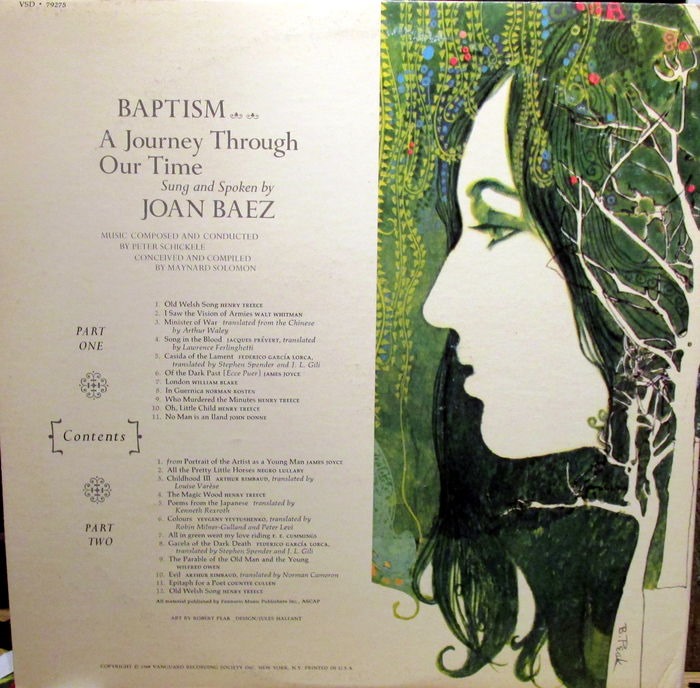
3. Gacela of the Dark Death.  Here’s another work that I translated into English myself for presentation here, a poem of passion and wit from Spanish poet Federico Garcia Lorca. I actually first heard this poem as part of a project that attempted to do something like what the Parlando Project does: Joan Baez and Peter Schickele’s 1968 LP Baptism.  Baez read Stephen Spender’s translation of Lorca’s poem earnestly there, and the poem’s title would lead one to read it as sorrowful. As I translated Lorca’s Spanish I sensed a more playful and mocking attitude in some of the images, and my performance tries to bring that out from my translation. As part of conveying the emotional range of the piece, I sang the opening and closing sections while speaking the middle of the poem—an example of how singing and speaking words changes the experience of them.


Baptism back cover

Baez and Schickele do Parlando 51 years ago


2. Self-Pity. D. H. Lawrence again, but a different kind of poem from “A Winter’s Tale.”  Shorter, and superficially an Imagist poem, it so clearly makes its “no whining” point that it was once used in a film by a drill sergeant. Poetry that makes straightforward self-improvement/empowerment points was not that common in early Modernism, and it’s not the usual way to literary cred these days either. I’m not sure why that would have to be. There’s an audience that likes it, and the 19th Century revered some poets who plied lessons like this poem does, although usually with many more words and stanzas. My best guess is that artists, particularly now in an era when literary poetry is something of an outsider art, like novelty and rebelliousness too much to settle for earnest self-improvement.

Well, this poem isn’t one of my favorites, but you know something: I need its message some days as much as anyone. I may have worked extra hard on the music I wrote and performed for it to compensate for that.


So what will be the most popular piece from last winter? I’ll be back soon to reveal that.

Gacela of the Dark Death

Here’s a piece using a fresh translation I made this month of a Spanish poem by Federico García Lorca. I’m sure there’s much to say about Lorca from those that know his work better than I do. That group of Lorca admirers includes many other artists whose work I respect, so it’s about time to present something by him here.

I’m told that a Gacela is a traditional Spanish form, but that Lorca’s poem follows the form only in spirit. Because Lorca was executed during the Spanish Civil War, not long after this poem was written, some view it as reflecting his experience of the war, but I get the impression that death elements were present in Lorca’s work even before the war. While encountering this poem in order to translate and perform it, I came to believe there’s a compound commentary on human mortality and more here.

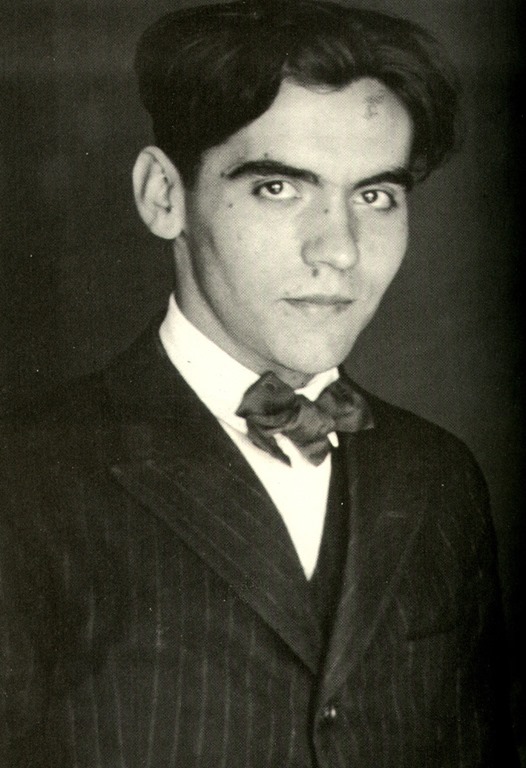
Federico_Garcia_Lorca

Federico García Lorca, a poet with open heart dreams


The poem opens and closes with a refrain that ends with a strong, bloody, and yet ambiguous last line carrying the image of a boy wanting to cut his heart. I chose not to overdetermine that image because I believe its ambiguity should remain. It could be an image of desire, or of self-harm, or emotional outreach—so let it be any or all of those things.

The middle portion of the poem, which I chant rather than sing, has a tone in my reading that has humorous elements, even if that seems to go counter to other readings of the text I found. When this section starts with what sounds like folk aphorisms about the dead, I take them as dark humor. In the next line “No quiero enterarme de los martirios que da la hierba” I decided for the only time in my translation to intentionally make the image stronger to American readers, by making the hierba, the grass, “leaves of grass” to connect to Whitman and his great image forged in the American Civil War. I can’t be sure, but I spent a long time on that stanza’s moon with a snake’s mouth image, “la luna con boca de serpiente” and what with the punch line about that mouth always working before dawn got me asking the question if this was a vampire image, which I decide to refer to sideways by determining that fangs were what serpent’s mouth means. Consistently in this stanza Lorca is giving us death images, but he’s also saying he doesn’t want to hear them.

I think the next stanza is meant to be humorous too, starting off with the wanting to sleep (perchance to dream?) for a moment to maybe as long as a  century—but “pero que todos sepan que no he muerto,” “let everybody know I’m not dead” as I translate it. Yes, like Hamlet he wants to compare sleep and death, but he’s playing with it. I’m at a loss if the “pequeño amigo del viento oeste,” “little friend of the west wind” is referencing something. It sounds almost like a children’s story or lullaby. I think this stanza’s concluding line is so wonderful that it transcends mood and attitude: “soy la sombra inmensa de mis lágrimas,” “I am the immense shadow of my tears.”

This stanza’s concluding line is so wonderful that it transcends mood and attitude: “soy la sombra inmensa de mis lágrimas,” “I am the immense shadow of my tears.”

The final chanted stanza before we return to the sung refrain also seems to me to be playing with death. Are we meant to take the insects here as accomplices of the grave’s earth? But this sounds like a boyish schoolyard dispute “He threw ants at me!” And what’s with the scorpion claw? As a northern North American I don’t deal with actual scorpions (hey, tropic readers, let me tell you about black flies…) but isn’t it the stinger that’s the weapon? I’m left wondering if there’s some idiom here that I just don’t know, even some kind of schoolboy pestering like unto a “noogie.”

And then the poem returns to a variation of the refrain, mysterious, beautiful, and I think serious. As to the intent of the poem, I felt I could perform the mystery and commit to the humor I found in the middle section without knowing the poem’s heart entirely. I think you can listen to it the same way. It is a darkly playful meditation on death? A comment on the outbreak and casualties of a civil war? Or is it a longing for childhood life and adventurous dreams? Or a love poem to a young man in Lorca’s life at the time the poem was written? Walt Whitman could sing all those things together, so why couldn’t Lorca?

I felt I could perform the mystery and commit to the humor I found in the middle section without knowing the poem’s heart entirely. I think you can listen to it the same way.

Musically, I sought to contrast the two refrain sections from the poem’s middle one. I was going to play my nylon string guitar for a Spanish flavor on this. Sadly, when I opened its case this week I found that its bridge had come completely off the top. Oh well, my battered Seagull Folk guitar had to stand in. My orchestration brings a bassoon part forward.

You can hear my performance of my English translation of Federico García Lorca’s “Gacela of the Dark Death”  with the player gadget below.