Another poem for April Poetry Month. Another Emily Dickinson poem. Once more, wildflowers. Once more they’re that early spring flower, daffodils. Once more the poet is looking back because something’s missing.
Chord sheet because someone else might sing this better than I can
.
Last time the voice in Dickinson’s poem was also alienated from Spring, but there was a taunting wit to that one. The mode in today’s Dickinson is more abstract, and the second, final, stanza is so gnomic here I can’t say I know fully what it’s conveying. Even the first stanza is tied in knots, tangled with those Dickinsonian dashes. Is “an April Day” the “Absent Place” — or is the April day, with present dancing-in-the-breeze daffodils, in contrast to the Absent Place? The stanza’s final line asking us to consider the viewpoint of “the Souls that snow” could be saying then the snow is more full of motion and drifting shapes than mere blossoms — or that April brings forth feelings that makes the Absent Place snow-Souls uncomfortable?
In intent or effect, it may be a shifting Tao — an all of the above in motion with each other?
But the final stanza? I assume “Drift” within is of the snow-Souls’, a self-impediment worse than snowed-in roads or walks, but the concluding two lines are harder to follow. Perhaps she’s saying that snow-Souls are the ”Him” in the last line, and their change and emotion is as strong as (“duplicate”) as the wind-moved daffodils? But “duplicate” is a strange word choice. Even within slant-rhyme it’s quite strained to rhyme with “without.” I even toyed with pronouncing the duplicate as the noun, not the verb, which would be a nice sound-pair with “but.” However, that’s syntactically sour and doesn’t follow the first stanzas ABAB rhyme scheme.
For awhile I engaged in a little fantasy extension of this brief poem while asking why daffodils, rather than another Spring flower. Poet Dickinson famously knew her plants — not just as an avid gardener — but as a woman with more education than most in her time and place (which included science, considered a presentable ladylike field). She was the maker of an impressive book of pressed flowers labeled with their scientific names. Did she know her Greek myths as well as the scientific name for the daffodil, Narcissus? The essential piece of the Greek myths of Narcissus is that the youth of that name dies because he becomes entranced by his reflection, his duplicate. Is the last line’s “Him” Narcissus or something like him?
Or is she taking another route into the roots of the word narcissus, related to narcosis, a drugged numbing? Does the final stanza mean to say that springtime joy can be as numbing as wintertime sadness?
It may be wise to consider my thoughts about the final stanza over-thinking. They’re surely speculative, but it still seems likely that the poem means to link the emotions extracted from Winter and Spring landscapes.
As April National Poetry Month winds down, I’ve fallen into a theme without designing it. Many of us are feeling crabby, dismayed, disgusted, frightened, but Spring doesn’t know that. The cold of Northern April is now behind us, and May lays out ahead with greening and warmth. Is it taunting us by being pleasant and hopeful?
For the music in the performance you can hear below, I fell into it too, as certain and mindless as Spring. The recording started with the chordal guitar part, which I played on my jangling Squier Jazzmaster instead of an acoustic guitar because I was telling myself I’ve been stuck on acoustic playing too much lately, and I hate to be predictable. In timbre and volume it was hardy enough to easily accept the drums and electric bass that I matched with it. The final part was the lead guitar line played largely on the B string of the guitar up and down the neck, in that “I’ve just heard a Ravi Shankar LP” way that was popular in The Sixties — the 1960s, not Emily’s 1860s. You can hear it with the audio player gadget below. No such gadget to be seen? The authorities haven’t shut down the psychedelic ballroom, it’s just that some ways of reading this blog suppress showing the audio player. This highlighted link is an alternative which will open its own tab with its own audio player inside.
The attention I’ve been calling forth this National Poetry Month has been divided up between “civic poetry” about the state of nations, and poet’s examination of Springtime. Today’s piece continues with the wildflowers and wildlife side of April, but because it’s by Emily Dickinson, it’s a complex statement.
Dickinson here uses the ballad meter as she often did, a form also used for many Protestant hymns. This form as common as the robin. Simple music, startling images, another disconnect.
.
This poem, approximately dated at 1862, can still startle the modern reader. Over a century and a half of poems have been written since then, yet the language, images, and play of thought within it still seem fresh and surprising. And there’s no wait for the surprise in this one, beginning with the idea that I used for a title for the resulting song I made of it. Dread of Robins? This common North American bird is anything but frightening. It’s not large, or fierce, no raptor or raven. In the context of the poem, the outstanding thing about the American Robin is that it’s a migratory bird whose arrival is a sign of Spring. Yet it causes pain somehow.
The next stanza seems to amplify sound. The song of the robin is not that loud, but the sound of wild birds in Spring taken together does have a choral aspect. In their territoriality and mate-seeking, there is a shout to their throats. Dickinson hears some music in it, but it’s not altogether pleasant. The Piano in the Woods image delights in sideways incongruity. The piano is Dickinson’s instrument, the one she played, but as an acoustic guitarist one thing I know about the piano is that it can be overpoweringly loud. And placing the piano with its wooden case in a woodland implies a metamorphosis. Perhaps ED hears a piano whose notes are bird calls? “Mangle” here is another characteristic unusual word choice by Dickinson. In her day she’d know the machine named with the verb: the wringer for squeezing water out of laundry. Spring is putting the speaker in the poem through the wringer.
Many of this April’s pieces have featured wildflowers, and specifically daffodils, but the colorful brightness of the flower here does not delight even after the dreary monochrome of a Massachusetts Winter.
Bees are everywhere in Dickinson’s poems, more than angels in Blake or Rilke. She often speaks fondly of their seeking sweetness, their industry, their pollinating agency in horticulture. Dickinson had by interest and education knowledge of these details, yet here the Spring bee too is unwelcome and she feels alienated from them.
In the penultimate stanza the creatures and flowers of Spring are present. She grandiloquently calls herself, “The Queen of Calvary,” suffering as if the crucified Jesus of Lenten Spring.
In the final stanza there’s a parade of sorts, with drums and salutes. “Plumes” here strikes me as an odd choice. It may be a bereaved funeral procession. Black ostrich plumes were apparently used for funeral decorations in the 19th century, so oddly we start with a modest small bird and end with the plumage of one of the largest. The poem’s speaker dreads the robin, yet seems accepting of the plucked raiment of the giant.
Is this a poem of disappointment and depression? Yes, that is there — but it’s majestic too. The poem is a catalog of Spring’s changes, all of which the poem’s speaker is unable to find pleasure in: dreaded little robins, pianos in forests, piercing yellow wildflowers, the energy of bees. There’s wit here, and like a Blues singer, there is a power of being able to sing knowing the score of a bad outcome!
I think this is a poem of a divided mind. I can relate. Spring remains wonderful, much as this Spring I’m experiencing this year, but my civic world has presented us with discordant changes, public cruelty, careless acts, all cloaked in self-serving bluster. Dickinson’s poem is dated to 1862 — the American Civil War, which for now still has a singular name, had started.*
I originally tracked my musical setting here with just my voice and acoustic guitar. I thought that spareness might contrast with the last two musical pieces here with full-on Rock ensembles. I had second thoughts though: this may be a poem about internal sensations, but it’s also about change in a fuller natural and national world. Eventually this arrangement, one that evolves throughout with high wind instruments and emerging synth seemed better suited. You can hear it with the audio player gadget below. No dreadful robin, I mean player, to be seen? You may be reading this blog in a way that suppresses the player, so here’s a highlighted link that will open a new tab with its own audio player.
.
*One reader of a Dickinson blog has a detailed theory of the personal particulars that might have faced ED when the poem was written. Deadly Civil War or mentors splitting for the coast would be matters of mismatched scale. Is the Spring of closely watched bees, and little birds and yellow wildflowers smaller or bigger than those things?
Attention is an investment. Today’s piece combines two poets that had my attention this Spring. Regarding one poet, this expenditure was long-standing, for the other, the attention is more short-lived, conditional. My attention requests yours, so let me get on with this as I try to be brief while providing context.
Fifty years ago I had just bought a cheap nylon-string guitar from the unsold Christmas stock at a local J. C. Penny’s store. I was learning to play it because I, a poet, wanted to write songs. I can’t say much for how substantially I’ve mastered guitar playing, but I have learned how to make songs.
I had models in early 1975 for what I was trying to do. My internal list of influences was shorter than it would be now, but it wasn’t just one or two. Certainly one was a young woman roughly my age who I’d read was performing her poetry with an electric guitar player and who had written a few literary pieces I’d seen published.* In the Fall of 1975 she released her first record album. I bought that LP the week it was released, likely at the sprawling Lloyds store on the edge of town.
The Seventies were a heyday for recording. The record business had recently become bigger economically and Rock music was huge culturally. Oddly, at the same time of this growth there was a falling off of the visionary and exploratory stuff that had attracted me as a teenager. Key artists of the previous decade had died or been diminished. Commercial filters along with endemic chemical narcissism and dependency reduced the force of many of those still recording. That debut record I eagerly bought — Horses, by the Patti Smith Group — was nothing like those compromises, and it retains considerable uniqueness to this day. It’s a poetry record as much as it’s a Rock music record. Large portions are chanted rather than sung. Smith’s words, however delivered, demanded a listen from the heart and the pelvis before taking the long-way around to the brain. What Smith was doing wasn’t unprecedented for a woman (or a man for that matter), but it was rare then, and still is. But I don’t want to diminish the music on the record either, the band, the Patti Smith Group, were also doing things underrepresented in 1975, despite their irregular formation. Writer Lenny Kaye had been the electric guitarist backing Smith at those NYC poetry readings earlier in the decade, and now he had another guitarist, Czech refugee Ivan Kral, to expand the sound, along with a rhapsodic keyboardist Richard “DNV” Sohl, and a drummer, Jay Dee Daugherty, who had joined the group just before going into the studio. They were fellow explorers to Smith, willing to go places they didn’t have charts or established trading routes for.
Horses gathered some attention. It was the spearhead of a musical revitalization movement that soon got a reductionist name: “Punk Rock.” Released on a major record label in this era meant that it had to be reviewed. While Horses is now recognized as a landmark, a signpost to new paths, the reviews then were mixed, though usually respecting its ambition. It was not a commercial blockbuster, sales were modest, but that was OK then as first albums were allowed mere “worthy of attention” response. My own reaction wasn’t as a critic or chart watcher — I needed inspiration, and I overwhelmingly welcomed it.
To get to today’s Parlando piece we need to move on to the PSG’s meeting up with the problematic-second-album syndrome. That album, Radio Ethiopia, sold even less than the first, and the Rock critics were even more mixed in opinions. It was a shot-by-both-sides response. These contradictory judgments were issued: it was even less commercial than Horses, it was trying to be a mainstream Rock record and so wasn’t Punk; it indulged too much in Smith’s self-mythologizing (evidence: she, a woman without credentials, played naïve guitar on the LP’s longest jam), it was too much a band-record featuring the Group instead of Smith.
I liked Radio Ethiopia. More inspiration as far as I was (and still am) concerned. A song from that doomed follow up has remained in Smith’s repertoire for the rest of her career: the breakup song “Pissing in a River.” In this linked 20 minute 21st century account of Radio Ethiopia and that song, Smith herself movingly describes her state of mind while making that expression. She was so full of doubts that the wholly committed vocals that mesh with Ivan Kral’s compelling four-chord cycle in “Pissing in a River” are credited by Smith to her brother, who came to the studio just to stand next to her, silently, at the mic. Last time here I spoke of how our relationships with others broaden what we see and report as artists. I teared up listening to Smith’s account this week, another testimony.
The version I used for performance is roughly half the length of the original poem.
.
This Spring, as I made tentative plans for National Poetry Month pieces here, I made a note next to a poem “Lilacs” by pioneering early 20th century Modernist poet Amy Lowell: “Long. Maybe do it Patti Smith style?”
I have not played much attention to Lowell, though one musical performance of a poem of hers is a personal favorite of mine. In the landmark era when English-language Modernist poetry emerged, she was a controversial figure — those mixed reviews again. It’s undeniable that she helped popularize the new free-verse style as a poet, anthologist, critic, and promoter — but otherwise these were arrayed against her: she was a woman, not gender-conforming, overweight, and suspected of being a wealthy bougie poetic interloper on the bohemian Modernists. I’ll add my own personal count against Lowell: a lot of her poetry doesn’t consistently reward my interest. My current theory is that she’s something like Wordsworth, a poet whose best work may be diminished by a mass of undistinguished work, and great lines sit next to meh ones. But also like Wordsworth, her value in theorizing and promoting a new prosody must be acknowledged.**
“Lilacs,” the poem that gathered some of my attention, is an example of the good and bad as I see things with Lowell. There’s immediacy in the poem that attracts me for performance (Lowell was an enthusiastic public reader). “Lilac’s” theme, remembering her New England ancestry,*** would befit her cousinoid Robert Lowell later in the 20th century, and I loved lines that sounded like Allen Ginsberg (“Clerks….reading ‘Song of Solomon’ at night, so many verses before bed-time, because it was in the Bible”) and Frank O’Hara (“Parks where everyone walks and nobody is home.”) ****
So, I did one of my “use what fits me best” editing jobs on Lowell’s original text, excerpting what I thought of as the most vital images in the poem, reshaping some of the lines, and following through on my first-thought of performing it in the manner of the Patti Smith Group.
That incantatory “Pissing in a River” chord cycle was a good match. I needed to rotate myself into each player’s role to create the ensemble, getting the rhythmic core down with a drum program, adding a bass line, and then performing each channel of the song’s double-tracked rhythm guitar bedrock. I used a sophisticated arpeggiator to create a right-hand piano part, but on evaluation I was so proud that I could get the just-little-different precision of the doubled guitar parts that I removed the piano.*****
Now it was time for the vocal recording pass. I made an unusual choice to try to improve what I fear is the least successful part of my recordings: as my expedient to Patti Smith’s brother undergirding her resolve, and only as preparation for the take using Amy Lowell’s words, I recorded an entire “scratch take” performance of “Pissing in a River,”
My four-chord riff cycle isn’t played exactly as the PSG recorded it, but the last part of my recording was an even larger departure from my inspiration. As a musician I’m a full-idiot/half-way savant. The part I’m most comfortable in is lead guitar playing, so my version isn’t a copy of theirs, I looked to another mode, their adventuresome NYC scene-mate guitarists: Tom Verlaine, Richard Lloyd, Ivan Julian, and Robert Quine. The performance in my recording of “Lilacs (version)” includes what some (many?) would consider overplaying. As I (too?) often do, I continue to play during the vocal passages. I know this is incorrect — but more than correctness, I worry that it might detract from the song. Asking myself why I do this, my answer is that because my voice can’t provide the melodic elaboration I’d offer if I was a more skilled singer; and as a poet, I think the words can be (are?) powerful enough to compete with wailing electric guitar.
I leave that last thought with this restatement: as a writer, it’s OK to whisper — understatement has its power — but even if you read unaccompanied, or write for the silent but companiable page, consider if your chosen words are committed so they could go toe-to-toe with a cranked guitar. Sometimes you might want that.
You can hear my performance melding impressions of the 1970s Patti Smith Group with parts of the 1920s Amy Lowell poem “Lilacs” using the audio player below. No player? It hasn’t been dropped by the record company man — it’s un-displayed by some ways of reading this blog. This highlighted link is an alternative way to rock it, as it will open a new tab with its own audio player.
**As I mentioned recently, the issue of being too prolix and prolific with putting out work is something I worry about with the Project and myself.
***Like fellow New Englanders Cummings and Millay (and the British Housman) already performed this National Poetry Month here, Amy Lowell is presenting Spring as a memory of the quill-written past wafting through graveyards unkempt by their Modern age.
****As with a lot of early 20th century female Modernists, Amy Lowell dropped off the canonical map in mid-century as High Modernism and the New Critics came to the fore. Lowell’s popularizing efforts gained little credit as poetry sought a refuge in elite understandings and “serious subject” male-centric viewpoints. Our current century is re-evaluating that.
*****As a naïve keyboard player, arpeggiators are a crutch I often lean on. Give them a chord and their rule-based fingers will present a more sophisticated output. I border on shame when using them, though similar tactics are all over modern music. I’ve tried to bargain with my guilt by referring to my favorite arpeggiator as “DNV” — the nickname Lenny Kaye gave to Richard Sohl who was a vital elaborator of the earliest PSG records. “DNV” stood for “Death in Venice” because Kaye thought Sohl looked like an actor from the movie version of Thomas Mann’s story.
Here’s a poem by British poet A. E. Housman that’s not an Easter poem — and then again, might be. On its heathered surface it’s a poem about wildflowers. My wife, who likes to hike in natural areas, could probably make good sense of it on first reading — but if you don’t know your wildflowers and aren’t attune to some Britishisms, you might be left with just a pretty set of words.
Right off in the poem we’re rambling on “brakes.” As a bicyclist, “hilly brakes” might make me think of brakes squealing on my old much-missed mountain bike. While I’d like to think of Housman in a tweed jacket enjoying such a ride, the “brakes” here are a Britishism for a thicket or area of shrubs and other undergrowth. Other words that would have “special” British or archaic English meanings? Young girls are asked to “sally” — which is not the given name of one of the girls, but a word meaning to go forth. In the first stanza besides the “brakes” Housman calls the place of the flowers “hollow ground,” a word-choice that’s a little harder to parse. Hollows are an old word for a small valley, which is likely what Housman means (he calls out valleys in the last stanza). One reading I came upon thought the “hollow” a variant of “hallow,” as in “hallowed ground,” and derives from that the idea that Housman’s wildflowers have sprouted in a graveyard. I can’t find a cite for that variation, but hollow is a somewhat odd choice here, and without regard for hollow meaning hallow, graves do produce hollows in the ground.
Our first wildflower, primroses, are found in that opening stanza. Next stanza, next wildflower, the windflower, which I first thought was a Gerard-Manley-Hopkins-like compound word, but windflower is the common name for another wildflower. The stanza goes on to introduce the flower featured in the poem’s title: The Lenten Lily which the poem tells us “dies on Easter day.”
Third stanza, the primrose and windflower are still present to decorate May Day, but the daffodil we’re told is not. And the poem ends with a final stanza telling us again that the daffodil dies on Easter day.*
Here’s more wildflower ignorance on my part: the Lent or Lenten lily is the daffodil — just another name for the same flower. I’d never heard that Lent lily name, but for a long time I really didn’t know the daffodil either. The daffodil is a common wildflower, but unlike my wife, I don’t know it to call it out by its name and properties on sight. I knew the daffodil not from the book of nature, but from the famous poem by William Wordsworth** “I Wandered Lonely as a Cloud.”
A few years ago while visiting England in the early Spring I came upon an entire lawn at Kew Gardens filled with yellow flowers. “Daffodils” my wife told me. This was a London park, not the hilly brakes of Britain’s Lake District, but I suddenly found myself, from her knowledge imparted to me, inside Wordsworth’s poem and the physical, now knowing, presence of this flower. The dark green grass and the sunny yellows in array before me were ever brighter because back at my home in one of the most northern states, things were still snow covered in early April.
My view soon after entering Kew Gardens.
.
Housman is telling us something else about the daffodil: not only is it one of the earliest blooming Spring wildflowers, giving rise to the Lenten lily alternative name for it, but it’s also one of the quickest flowers to die and disappear. That name, that property, gets us to the question of “Is this an Easter poem?” Housman is not at all a Christian devotional poet — he was a devoted academic classics scholar and agnostic.
Well, maybe that’s his point. Easter is the particularly Christian holiday of resurrection and eternal life. Housman, not a Christian believer, has written a poem that refrains on something natural — this flower — that’s not spiritual like a soul or godhead, but a piece of lovely, wind-caressed carbon that dies by Easter Day. In that natural order, this brief wildflower certainly dies. A Christian apologist could easily counter: that’s the promise of The Resurrection, that it is something else. One can read the poem and see either side. Of course, there is a thumb on the balance: Housman has written a poem, and I’ve gone along with him and made a song of it. Poems are not so much about what they say — because they have sound and a carefully selected order, they are more about what it feels to say or see or sense something.
You can hear what I made of what Housman’s poem portrays with the audio player you should see below. What, has any player disappeared like the daffodil? It’s not that — some ways of reading this blog don’t believe in showing the player. So, you can roll away the stone and use this highlighted link to hear it instead.
**As it turns out, William Wordsworth based his daffodil poem partly on journaling done by his sister Dorothy Wordsworth who had accompanied him on his Lake District walks. That’s a wonderful thing about our relationships with others: what we see and sense can be informed by them.
I will not write much about the Yeats poem I present today. Unlike some others I’ve performed here, it’s quite well-known. Phrases in the poem like “things fall apart; the centre cannot hold,” “the ceremony of innocence,” “the best lack all conviction, while the worst are full of passionate intensity,” and “what rough beast…slouches towards Bethlehem to be born” have been quoted, reused, and brought out as touchstones and summaries alongside distressing events. Still, if you’d like to see the entire poem “The Second Coming” as it appears on the page, here’s a link.
Where folks do explainers for this 1919 poem, it’s usually pointed out that the Irish poet William Butler Yeats studied mysticism and magic, and alongside this short poem, he wrote other texts explaining his esoteric theories of the rise and fall of epochs. This was more than colorful stuff for poetry for him, he believed it, and believed that the 20th Century was some kind of end-times. Now that we’re a quarter of the way into the 21st Century, we seem to be running a little late — but Yeats was writing of millennia, so being off a hundred years or so might be a rounding error. And as he starts off writing of the cycles, the widening gyres of history, his sonorous phrases of dread keep coming back to us.
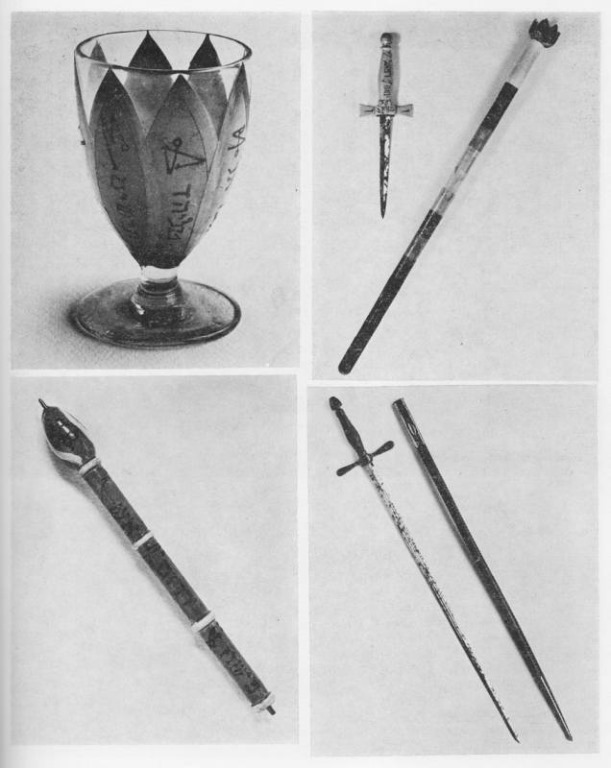
Yeats as wizard. Here are some of Yeats magical weapons. Photos from “Yeats, The Tarot and the Golden Dawn by Kathleen Raine” which I found at this web page.
.
Even ignoring all the mystical back-story, this is a poem about the breaking of nations. Therefore,“The Second Coming” fits with the theme of civic poetry, and I put this poem down on a short list of poems to consider combining with music for this April’s National Poetry Month, but we’re nearly half-way into the month before I could complete a version that I felt was presentable.* Given its grand scope it called for some big music, and my orchestral scoring skills have atrophied from where they had developed earlier in this project. Another way to make a large noise is to perform it with a full rock band, and I have been trying to recover my skills in that kind of ensemble playing this Spring. But there was another obstacle: I found that, unlike other Yeats’ poems, this one isn’t easy to fall into singing. The blank verse here tends stentorian, and I’m not a big-voiced powerful singer. For one stubborn section of the poem, I felt I needed to break into chant rather than try to keep the lyrical lift of singing. This sort of thing is a consequence of a composer needing to rely on a limited singer to realize the work.
The raw tracks I recorded for today’s song were somewhat messy due to the number of instruments: three guitars, organ, piano, bass, and drums, It was quite the operation to mix them even to my “good enough” level. You can hear that musical performance of W. B. Yeats’ “The Second Coming” with the audio player you should see below. What, has that rough beast not slouched onto your screen? It’s not the end of the world — some ways of reading this blog suppress showing the player gadget. Here’s an alternative, a highlighted link that will open a new tab with its own audio player.
.
*As I write this sentence, I take stock and consider that since this Project began 9 years ago, I’ve been composing and recording the more than 800 pieces presented here at a rapid pace. To create a single album’s worth of music in a month is considered a challenge — since 2006 there has been an “RPM challenge” to write and record an album of songs during the month of February. I’ve been doing something like that, nearly every month, for nearly 9 years!
Has that been good for the quality of the work? I don’t think the answer is a straightforward “Of course not.” While there are times when I wonder about some months-long work focused on a single composition, at my age I figure anything I want to explore or express needs to be a matter of getting down to it and getting it done as well as my current skills allow.
I’ve been dealing out the civic poetry so far this American National Poetry Month, but for today’s Poem in Your Pocket Day here’s a charming poem by Edna St. Vincent Millay. If I understand Poem In Your Pocket correctly, its idea (as distinct from the entire Poetry Month) is to put emphasis on publicly sharing other people’s poetry. The rest of Poetry Month has a lot of examples of encouraging the writing of poetry oneself: poetry prompts, daily haiku writing pledges, poets putting forward their own work, and so on. That’s all fine—but this Project from its beginning has sought to go beyond the supply side to encourage the consumption of poetry. With the recorded musical versions we make here, there’s a modest hope of community in singing or speaking the poetry aloud. A song not heard is one of those trees-falling-in-an-uninhabited-forest things—whatever the result, it means to be a sound. Now onto today’s poem, situated in a forest.
.
“Counting-Out Rhyme” indicates with its title that it should be considered as that children’s game or process. As a game, a counting-out rhyme is a delineated incantation, each beat accompanied by a pointed indication around a group until the ending beat arrives and the final pointed-to individual is chosen. The most common folk poem in this manner in my childhood was “Eenie, Meanie, Miney, Moe.”*
I, having emigrated from the republic of childhood so long ago, have no idea if kids still use this process on playgrounds. From my more recent experience as a parent, modern younger children who would use it seem more supervised more often than my cohort, and responsible adults might be likely to select without rhymes. In my day, when the 20th century still had decades to run, kids just knew how this worked via the folk process.
Despite its title, as I worked with Millay’s poem I couldn’t really think she authored it for playground uses. Though not a long poem, it’s longer than it needs to be for selection, and the poem seems utterly beholden to its own, internal, incantatory powers. It picked up from the Imagists the flagrant naming of colors, decoration not needed for utility. I suspect Millay is remembering her own New England childhood here, much as E. E. Cumming was recalling his in his Spring poem, and the poem is rather more a magical spell, one meant to bring on Spring or bring one back to when the woodland sights of it were unprecedented and wonderous. It’s lovely word-music, and I heard it from off the page — and then played it in the musical version below — as a languid song, not the hurried rota of trying to make a quick, randomized choice.
In a week when chronological adults (whatever their maturity) are playing counting-out games with numbers that will empty or fill pockets and prisons, I share this poem from my pocket — not legal tender, but Spring tender. With the audio player below you can hear me perform this with 12-string guitar and sparse contributions from an ensemble of viola, violins, flute, clarinet, English horn, and silence. No player? You won’t need to find a wood-nymph to cast a spell, I provide this highlighted backup link that will open a new tab with its own audio player.
.
*In my experience from my times and place, the following line always included that dammed ethnic slur that makes the opening line of nonsense words almost offensive in anticipation. I noted in the Wikipedia article on that verse that the ethnic slur was an American variation, and there are multiple theories of the rhyme’s origin without it. I have no full accounting of the harm the slur brought by its childhood ubiquitousness — but I was somehow pleased to read as an aged adult that it was something the folk process added in America, and in order to form a more perfect playground republic, the same process can remove it.
The other similar selection process I recall from childhood was deciding which side would bat first in kids-run baseball games by alternating two kid’s hand-grasp up the length of the barrel of a bat until the final grasp topping the length was up first. Wouldn’t flipping a coin be faster? I’m not sure we had coins in our pockets back then.
I woke up to economic tumult around the world this morning after finishing a mix of this song I made from a poem by Carl Sandburg last night. I’d gone back and forth on mixing this simple piece of music. At one point I thought it needed piano. I tried an arpeggiated part. Hmmm….no. I tried a coda with underlying low-register sustained intervals. Nope too. So, no piano. I was going to post the remainder yesterday when I began to wonder if the bass line was mixed too high. I told myself I’d reconsider in the morning and went to sleep.
Awaking, I found the news of international economic fears overlaying the world of our current sustained carelessness and cruelties. Well, I thought, maybe it’s not all that important how perfectly the song is recorded or mixed. It’s time to get this little bit of Carl Sandburg out to our modern world for National Poetry Month.
This Project spends a lot of time in the previous decade to be called The Twenties, a time when all the arts and poetry had to deal with a changing culture that ended with a great falling of commerce. For much of the decade it was written up as a time of fashionable Modernism, easily pilloried as a faddish, brainless rush. The label “The Jazz Age” wasn’t meant as cultured praise. Even Afro-American intellectuals were worried that Jazz was just some fast-tempo frivolity, a soundtrack for licentiousness. Luckily for us, some Black composers and songwriters kept on making their form of Modernism.
From our time, we know the plot arc of that last Twenties. A great worldwide depression began in 1929. Fascism rose in multiple countries. Poets may have started the decade engaged with new, freer verse modes, but by The Thirties they’d be charged with dealing with the IRL world of racial-nationalist authoritarians, widespread economic hardship, and war.
I believe it’s easy to forget what an early and fervent Modernist Carl Sandburg was. He was close to his brother-in-law Edward Steichen, who was thoroughly engaged in the international visual arts Modernist revolution. His poetry helped popularize English language free-verse. His collections were peppered with clean, concise poems as Imagist as any written within that vanguard. It appears to me that he may have written Jazz/Blues literary poetry even before Langston Hughes.* Like some others in his American Modernist cohort, Sandburg had early ties to political economics of a leftist kind. How would he traverse this change in the artistic climate?
He was going to go folksy.
Much of his energy would turn from poetry to a giant biography of Lincoln, who he’d portray as a canny folklore-sage. He would publish a popular landmark book of collected folk songs. He brought his guitar to poetry readings. A Robert Frost may have made much of his farmer neighbors, but his blank-verse eclogues were orchestrated with a more academic formality.**
Sandburg’s long-form poem “Good Morning America” is a case in point. It’s a civic poem, a stock-taking set of observations of the United States, peppered with folk-wisdom admonishments uttered in Sandburg’s version of contemporary vernacular. I picked out this section of it to use here because I noticed it riffs on a phrase also used in a remarkably durable American folk song: “Sitting on top of the world.”
As a lyric refrain that phrase appears in a song by The Mississippi Sheiks, an Afro-American jug band. As members of the continuum of the folk-process (i.e., appropriating and reusing any good stuff they could grab) these non-Arabian Sheiks stole a harmonic cadence from Tampa Red, who had used it in another oft-covered Blues song: “It Hurts Me Too.” “Sitting on Top of the World” quickly integrated itself into American folk music. It became a country and Bluegrass standard, but it could also be done with the force of a Howlin’ Wolf or by a classic British rock power trio like Cream.
It would be a neat package for me to say that Sandburg heard the Mississippi Sheiks and shaped this poem from their music, but the timeline doesn’t work out, though it gives me more connections to mention. Sandburg published “Good Morning America” in 1928. The Sheiks record of their song was released in 1930. Sheik Walter Vinson says he came up with it while playing a white dance. He and that audience might’ve been familiar with a 1926 hit song sung by Al Jolson which used the same phrase. The Jolson “I’m Sitting on Top of the World” is a friendly ragtime ditty about a man who cites his tenuous status in the economic prosperity around him as beside the point because he’s about to marry his sweetheart. Vinson on that dancefloor stage is going to fuse Tampa Red’s riff from a song about a singer who confesses empathically that his sweetheart’s troubles trouble him, because “when things go wrong…it hurts me too” with some new lyrics.
We don’t know what lyrics Vinson sang on that first performance. As the song proceeded over the years, new verses were plugged in by various singers, but the Sheiks’ recording we can hear starts off with both economic and romantic losses. Objectively, the singer isn’t presenting a happy life, but still he refrains he has “no worries…because I’m sitting on top of the world.” This is an ambivalent statement. Is it a mantra of positive thinking in the face of misfortune? A call to party on the dance-floor even if the rest of life is hard times? An easily seen-through statement of questionable bravado? Is it even possibly sarcasm, an answer-record dis of the happy sap in Jolson’s song?
In between Jolson’s Roaring Twenties white song using that title and Vinson’s post-Black-Friday Black version, Sandburg wrote his poem, closer to Vinson’s version that would follow. Sandburg’s poem is about national wealth and hegemony, but it wants to say that that’s temporary. All it takes is one mad king blind to any contradiction. So, I sang this part of Sandburg’s poem this month, with music leaning more toward the Mississippi Sheiks. You can hear that version with the audio player below. What, has a circuit-breaker stopped trading in graphical audio players? No, some way of viewing this just won’t show it, so I offer this highlighted link that will open a new tab with its own audio player.
In adapting the 14th section of Sandburg’s long poem, I doubled the number of times “I’m sitting on top of the world” is refrained and re-lineated it from the page to fit the music.
.
The audio player for my version:
.
*As I read the two of them, Hughes and Sandburg, I often feel an American kinship in their voices.
**The Southern Fugitives took another, if Copperhead, path on Modernist poetry tied to an agrarian tradition in the era between the World Wars. Sandburg would leave the urban center of Chicago, first to Michigan and then to rural North Carolina and a working goat farm in the between Wars era — but he never fell into the reductionism that the “real Americans” are Anglo-Saxon-stock farmers.
If Frost didn’t haul a guitar around like Sandburg, Edwin Ford Piper recounts that between-Wars Frost was willing to offer his own renditions of folk songs at informal poet’s after-party hootenannies.
I must apologize for how rapidly these new pieces for National Poetry Month are being released. That must tax some of my valued reader’s and listener’s time. I planned — and still plan — heightened activity here during Poetry Month, but I expect it won’t be near-daily posts.
In announcing this April’s observance, I said that following #NPM2025’s theme of “The Shared World” that I’d like to include some poetry that wasn’t originally written in English. I’ve done a fair number of translations here, despite not being much of a linguist. I’m also not a creative writing teacher, but I highly recommend for poets to follow my example in this and to do their own poetry translations. When I first started doing French to English translations in my 20s I had only my high school French to guide me, and I relied heavily on French to English dictionaries. This was a laborious process, but approachable with short poems. Nowadays, online dictionaries and even reasonably fluent automatic translation features are available on computers or the Internet. Just plugging in a poem’s text into Google Translate isn’t translation, or a translation that will help your poetic skills. The machine translators are pretty good these days for denotative texts, news accounts, manuals, advertisements, directions — that sort of thing. But poetry asks for at least two other things beyond that: a heightened sense of which exact word brings something to the poem, and those word choices are also part of how the sound and flow of the poem is presented in its new language. As a teaching exercise, sitting for a few hours beside the spirit of another poet and their poem of another language, helps one find skills in making those choices when one writes their own poems.
As a non-native speaker, it’s entirely possible you will make mistakes (even embarrassing ones) or come upon mysteries where even experts will not know what the poet intended in the original language. No matter. That’s scholars’ work — honorable work — but as a poet that’s not necessary for your translations.*
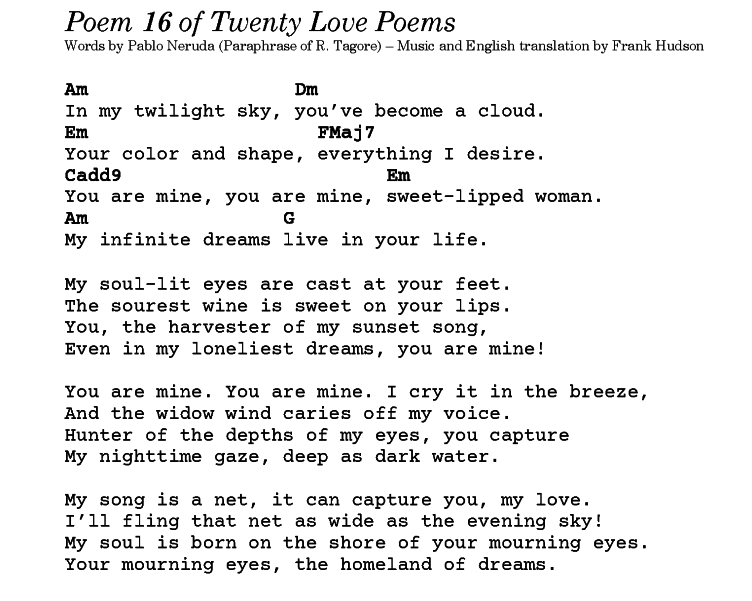
The imagery and the refraining way it’s presented made me think this a good candidate to sing. Looking at a couple of machine translations, I started work on making a poem in singable modern English out of it. This poem is not entirely straightforward to me, but it seemed to be about separation, though I cannot be sure it’s not about a subjective, obsessive, or jealous sense of separation, a “I want you so much, all the time, and all to myself” kind of feeling. As I started to work on the images — the shared-world-vision that the poet’s voice wants to invoke — and those word choices and sequences necessary for word-music, I was overcome with a connection likely unintended by Neruda.
I include a chord sheet because I was inspired by folk revival publications Sing Out! and Broadside back in the day. You might sing it yourself as a prayer and plea for the two Garcias.
.
The poem’s speaker talks about being captured, even imprisoned, constrained as he speaks of his beloved. I thought of a pair of recent news stories of men taken abruptly from their families, one hauled off to a brutal prison in El Salvador, the other pried from the embrace of his wife and children.** The charges, the evidence? They are, what, maybe gang members. How do we know that? “Oh, we just know” says our government. OK, what are their crimes? “No matter, we just have to say so — or maybe we don’t have to say, we can just do.”
It’s possible we have nonsensical laws, though I’d hope our consideration is better than that. But there seems no way this can be just.
I stopped trying to make a better translation. I’d normally want to take more care — after all, this is a work of a young poet who later won the Nobel Prize. I just wanted to put together the sense of this way I could hear the poem’s speaker speaking across our Shared World, because I wanted to sing it to salve my own heart.
The poem, as I now shape it in English, is speaking as a man who loved America, loved his wife, loved his family. All this can be taken away. In one case some executive branch functionary in court, being asked of one of these men, is said to admitted his deportation and subsequent imprisonment there was “an error.” With such slipshod execution, this might be expected. What is to be done? “Nothing can be done. He’s in another country now. Out of our hands.”
This is a project about poetry and music. There’s nothing those two things can do but sing. I did say I would share civic poems this month. Why? To sing a poem, or to listen or read it closely, you must feel it somehow. What you do afterward, I don’t know.
*When sharing such translations publicly, I often take the example of another poet I came to read through this blogging adventure, Robert Okaji. Okaji, like myself, sometimes takes literal, non-poetic, glosses of classic Chinese poems and renders something vital in modern English out of them. He uses the traditional note of “After a poem by…” which indemnifies either of us from lack of fully understanding the Tang dynasty and ancient Chinese.
As it so happens, Neruda in “Poem 16” writes at the top of this poem that he’s paraphrasing another poet and songwriter, Rabindranath Tagore. Tagore’s poetry and song lyrics are sometimes psalms to his country or godhead, written in the language of love poetry.
I wrote down this poem earlier in the year as a good fit for an April National Poetry Month piece. It’s author, Edna St. Vincent Millay, was from Maine, and I write from another northernmost American state, Minnesota. If a southern-born St. Louis boy like T. S. Eliot who went to live his life in temperate England wants to ironically write about April being the cruelest month, dryly riffing on the Middle English of a Chaucer’s pretty “Aprille with his shoures soote” — well, what with all the flowers and pleasant nourishing rain, that kind of puts a climatic brand on the month poetry-wise.
I rise with Millay to contradict: we have birdsong here, but it’s a more desperate, assertive song, not some celebratory strope — because it rained, sleeted, and concludingly snowed a sloppy wet mix all night and afternoon as I worked on completing today’s musical piece, and this morning everything — tree branches, overhead wires, yard fenceposts, garbage cans — had, to the very limits of toppling, piles of sticky snow as high as any booklover’s stack of unread books.
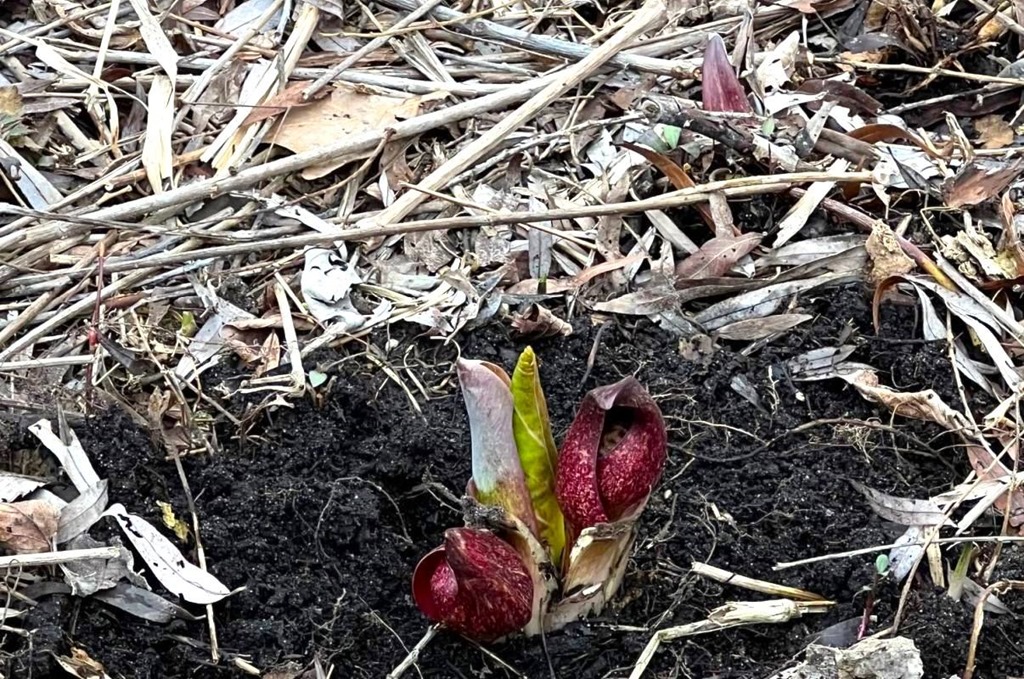
My nature loving wife took a European-born friend on a hike last week and showed the friend skunk-cabbage, a strange red, raw-meat looking early Spring plant that is exothermic — it creates its own heat like some huddled mammal so that it can bake through the snow cover. Nearer to home, indeed right next to the foundation, a small surviving clutch of tulips has sent up green leaves, but no buds yet. Their leaves course with some green antifreeze, as nighttime temps remain consistently below freezing.
“O April, full of blood, full of breath, have pity on us!”
.
My wife and I have varied memories of who planted the tulip bulbs. I remember it was my late father, long ago — while she thinks it was her mother more than a decade ago. There are only a few left. Brazen squirrels dig them up, or perhaps they are only perennial in the same sense that we are, bound to rise in many springs, but not forever.*
So, if the theme of this April’s Poetry Month is The Shared World, I certainly felt I was sharing the world within Millay’s poem “Northern April.” The wind, the resonance of a creek with remaining ice, the just warm enough to be rain/rain. At least for me, in my northern clime, there’s a rich sensuousness in the poem, and enough word-music inherent in it to command me to sing it.
I’ve noticed that I haven’t used my 12-string guitars much this winter. They are a little more stout to play, and I think they show less forgiveness for my less-than-pristine technique, but I tried to plant today’s piece in the furrows dug between my limitations.
My music today makes use of a couple of instruments playing at the edge of their ranges. The bass guitar part is entirely played in the upper octave of the instrument, giving it an unusual sound I found I liked; and for a bit of melodic embellishment, I played an oboe line, again at the upper reaches of the instrument. Why an oboe? I thought of a 20th century band called Oregon who would mix 12-string guitar with reed/woodwind instruments, and I wanted to revisit that set of timbres from the composer/player side instead of from my listener’s memory.
*I took leave from poetry and music to very briefly look at that issue from gardening knowledge. It appears that the bulbs shoot off other child bulbs, a process hidden in the dark underground in the later, non-flowering, part of the year. If so, appropriate for the idea that we think these spring flowers are from our parents.
The song below using the words of William Butler Yeats had a direct, contemporary inspiration: John “Paddy” Hemingway died this St. Patrick’s day. He was Dublin born, and in Dublin he died — and he was in the news because he was the last surviving RAF pilot from the Battle of Britain during WWII.
Reading the notice, I immediately thought of this Yeats poem, about a fatalistic Irish pilot during WWI who flew into battle having no love for the British Empire. John Hemingway’s Wikipedia summary mentions nothing about his weighing of the enormous risks he took in RAF battles, but a recounting of the number of times he was shot down and got back to flying again makes me think he’d accepted his death as a probable result of his service. Fate had sport with him, he lived to be 105.
Not much research required in this case, it’s widely recognized as a poem written as an elegy to a particular doomed Irish Airman, Robert Gregory, the son of a friend and ally of Yeats, Lady Gregory.
I know nothing of how this poem was received by the mother who’d lost a child. Yeats portrays a peculiar heroism with the poem’s subject. Using only the evidence within the poem’s boundaries, it’d be a fair reading to say that the titular airman here was driven to mortal combat because there was no hope otherwise in his country’s situation. Another reading, more specific to the man Yeats had in mind, might be that the airman was drawn to air warfare for the pure sport and sensation of it, but that latter reading still incorporates, if not an outright death wish, a sense that the most intense love of the moment asks for an acceptance of imminent death. So, an odd poem, poised between self-destructive despair and dark romantic thrills.
Well, whatever — it is a poem by Yeats, so of course it’ll sound wonderful, and reading it on the page will cause any number of its silent readers to want to sing it. After I completed my version, I listened to nearly 10 other musical versions, yet I still hope that my version isn’t superfluous.
Here’s the chord sheet for today’s song version of Yeats’ poem. Feel free to improve on my attempt. As I play it the G and A chords in the last line of each stanza are played at the 3rd & 5rh fret positions.
.
I chose to make my song entirely jaunty, a reverse of my minor key remembrance in the E. E. Cummings Spring poem last time. That doesn’t mean I want the listener to take it as a recruiting poster or an endorsement. Poetry is portraiture you can feel in your ears or breath, but you’re still allowed to think. Whatever his internal motivations or conflicts, the singer of Yeats’ words seems proud of his choice. John Hemingway likely thought he was in for the same deal that Robert Gregory signed up for. Fate laughed. Reports say Gregory, the brilliant Irish WWI flying ace, may have died either from friendly fire or pilot error secondary to a case of the flu. Another man, a proudly stupid one, once said that he liked pilots who didn’t get shot down. Hemingway, as it happens, was shot down several times in WWII, and yet had decades to live other pleasures I’d find more delightful than combat. And that otherwise unrelated man, the one who truncates his thought, but not before he asks to be judged by his judgements — how is he weighed?
You can hear my performance of Yeats’ “An Irish Airman foresees his Death” with the audio player below. No player to be seen? You can hear my performance stored somewhere in the clouds above by clicking this link, which will open a new tab with its own audio player.





 Frank Hudson