I was long-winded last time, so let me try to minimize the gab today. I went to sleep last night wondering if I’ve ever done anything for an Indigenous Peoples’ Day. Though I’m going to keep my own comments brief, I can hear over the Internet a few groans. “Indigenous Peoples’ Day? Isn’t that one of those woke-ish things with a work-ish name meant to single out some small subsection of Americans?” Well, objects in my mirror are closer than they may appear to you.
The Twin Cities is home to a lot of what used to be called Urban Indians. “Indians” of course being part of Columbus’ “My dog ate my GPS” report back to the royals in Spain, where he imagined he had found a route to the frontiers of South Asia. My part of the Twin Cities has a lot of Mexican and Central American immigrants — immigrants that have DNA that says they were in the Americas before my ancestors were. We’ve got folks around here from India too — makes things confusing.
But for any complaints about special holidays implying special pleading, this day is still widely known as “Columbus Day,” which with footnotes and explications, can be said to mark the start of European colonization of the Americas. But it’s widely known that the day became a holiday through the desires of Americans with Italian heritage wanting a day to celebrate that. I’m fine with that too, it’s just that where I live in our big and diverse country I’m more likely to be around folks who think of themselves as Native or Indigenous Americans.
So, here’s what I did today to hurry up and figuratively meet the Spanish boats with an Italian commander, and to celebrate Americans discovering them. Yes, what happened as a result is a complicated story, and I said I’ll be brief.
I recalled that the LYL Band had once covered a couple of songs on one past version of this holiday. One was Patti Smith’s “Amerigo” from her under-rated Banga record. I listened to it, and it’s kind of long and languid, and I’m not in that mood today. Then I listened to the other, a cover of a song from the Nazz.* Now that was more like it, though my mix of the rough and ready performance from six years ago was not very good. So, I took some time to remix it today, not so that’s it’s sophisticated or genteel. No, it’s still LYL in its immediate punk mode. No acoustic guitar or my approaches to Jazz-my-way. This is turn it up and roar music. Also, some notes escaped being hit in the mayhem. Sorry about that, but in the right punk mode you may be able to deal with it.
You may want to turn it up loud.
.
*The Nazz were a group from the late Sixties that never got as much traction as their records deserved. Think of an American band that sounded like Laura Nyro or Loving Spoonful-era John Sebastian writing songs for The Who or The Yardbirds. Connoisseurs know The Nazz as the band Todd Rundgren emerged from. Todd’s talents as a producer and musician made sure their recordings sounded a lot more polished than our cover, but maybe he’d like our energy? After all, he did get the job producing the first New York Dolls LP (and the Patti Smith Group’s Wave too). I think I even casually assumed “Christopher Columbus” was a Rundgren song, but it seems that it was written by the band’s bass player Carson Van Osten. Van Osten went on to have a considerable career behind the scenes at, of all things, Disney.
Every so rarely I treat this Project as a “regular blog” and talk about what I’ve done recently. Not my usual mode, but this is one of those.
In case you’ve noticed a gap in posting, this week I’ve been in a yurt situated in a forest a few miles from Lake Superior. No cellphone service, no Internet, just books, bicycles, an acoustic guitar, and my woodland-nymph wife for whom this is just the right sort of place.
A yurt is a circular tent adapted from Central Asiatic designs.* The tent fabric is stretched over a wooden lattice so that it becomes in effect a small rustic cabin with no corners and soft walls. In the example we rented for our stay it had an elevated wooden floor, a conventional bed, a couple of chairs, and a door and windows that looked out onto the woods it sat in. In the center of its fabric roof, where the smoke from a central fire would exit in the original yurts, the modern version substitutes a clear plexiglass dome, a device I always read as an emblematic Sistine Chapel of The Sixties: like those domes fitted to Ken Kesey’s Furthur bus or Ed Roth’s Beatnik Bandit.
Three Plexiglass domes. Salad bowls of my salad days.
The three from the poets I know were particularly piquant reads, Kevin having just died, Ethna facing serious illness, and Dave and I both a little worse for wear. This post won’t allow me to speak at length about those five books, which I read completely from cover to cover in the yurt. The Hirsch book turned out a little too basic and introductory for my mood, though it might well serve for someone seeking to get more involved with poetry. The Logan book was outrageous in a way that made me shake my head and yet keep reading.
I never assumed the Parlando Project was going to involve as much short essay writing. The reason that the Parlando audio pieces (which are available as podcasts in the usual places like Apple Podcasts et al) are simply the performances, not discussions and descriptions, is that I wanted to present and to allow listeners to experience poetry in the ear without a lot of framing or explaining, the same way that they largely experience lyrics in a song. But over the years I’ve fallen into writing here more about experiences with the poems, even delving into explications and musings about how the poems are set into poet’s lives.
When I enter into that mode and come upon a question — where many bloggers would simply say “I don’t know” or “One could guess” — I often make an attempt to find out if there’s an answer. These searches can take up more time than composing and recording the music. One of the most consistently popular posts here was my presentation of Yeats’ “To A Friend Whose Work Has Come to Nothing” where I felt I had to find out who the friend was that the poem addresses, and what the work was. That wasn’t something easily discovered on the web — and apparently thanks to my post, it now is.
Logan takes this sort of thing to another level and then another, and another and…. I sensed him smiling and shaking his own head to the levels he was driven to go. In his discussion of Frost’s “Stopping by the Woods on a Snowy Evening” Logan makes sure to determine what livery Frost’s farm owned in order to estimate what the speaker in Frost’s poem might be sitting in. In his discussion of Keats’ “On First Looking into Chapman’s Homer” he takes note of a story surrounding it: that a draft of the quickly-written sonnet was in the hands of the other young man that Keats’ had spent an all-nighter reading a rare copy of Chapman’s English translation with, by early the following afternoon. Logan tries to determine if this was possible via normal “penny post” service in London at the time, or would it have to have been a specially hired courier service. For poetry obsessives, Logan’s book will wear you out with “do we know, can we find out” side-trips like that.
Meanwhile, back at the yurt whose woods we are knowing, upon a peak above Lake Superior, we had planned to ride our bikes into town for breakfast, a distance figured at three miles via GPS maps. The same maps accessed at home warned me that it was a nearly 400 foot elevation climb on the way back to our yurt’s address, but I have done double that and more in my dotage. Both of us took our original generation “mountain bikes” which by modern standards are both heavy and altogether too mechanically unsophisticated, but this was good in that the first-part of our journey was a rutted gravel access road from our yurt to the local highway which descended steeply for about a half a mile.
From that point on into town I could have passed for a motorcyclist, coasting at 30 mph on the steep downward slope of the blacktop highway. At a stop sign I looked over to my wife and said, “You know, we’re going to have to climb this on the way back.”
After breakfast, she went off to take pictures, and I started the ride back by myself. **
Three years ago this autumn, I climbed 800 feet in 25 miles on Minnesota’s Iron Range. Not only am I older but doing 450 feet of climb in 3.3 miles is different. Different, as in harder. Different in as pedaling up a wall verses pedaling up a ramp. The temp that day was in the 50s and I wore a light vest and a non-zip long-sleave shirt, both of which were good during the speed of the descent into town. But when I finally arrived back at the yurt, I was quite tired and soaked in sweat — an autumn mixture of hot and chilled as soon as you stop.
Graph of the climb back to the yurt from town. My research said 400 feet net climb, but it didn’t include the steep gravel access road at the end which added another 50 feet. Well-conditioned bikers will scoff at this climb, but where’s your understanding of Robert Frosts wagons?
.
That night as we went to sleep in the yurt, the leaves falling on the taunt roof gave us a sound like we were inside a scattered drum-roll. Off in the distance then we heard piercing owl cries*** that this musical-obsessive would liken to Eric Clapton signaling the wind-up of Ginger Baker’s drum feature “Toad” — but then this person, whose Project has made him equally poetry-obsessed, also thought of Edward Thomas, and his poem “The Owl.”
Thomas besides being an avid walker (he was the actual walking companion Frost was chiding in “The Road Not Taken”) was also a bicyclist, and “The Owl” appears to be telling of a bicycle tour ride as it begins “Downhill I came…” and the full text goes on to describe that cold “yet heat within me” feeling that vigorous exercise produces in changing temperatures like my October ride. Thomas’ poem and his welcome rest at nightly lodgings on his tour turns in the middle on the sound of an owl’s cry.
Thomas’ thoughts are turned in that cry not to the band Cream and rock power trios of The Sixties, but those who didn’t have shelter in the night. And I had been reading the new poems section of Ethna McKiernan’s New & Selected which is dedicated by her to “the hundreds of homeless clients I’ve worked with through the years.”
I performed Thomas’ “The Owl” a few years back, but it’s one of my performances that I don’t think got all it could out of the piece, so here’s a fresh performance of my setting of that poem, recorded back home, but in yurt-style with acoustic guitar. For some, you can use a player gadget below to hear it. Others won’t see that, so this highlighted hyperlink will also play it.
.
*This Wikipedia listing about yurts says that a Mongolian Buddhist variation is called “uyangiin ger” which means “home of the lyrics.” I didn’t know that.
**She too had to struggle with the climb. While she stopped often to take pictures, breaking up the exertion somewhat, she found it difficult to overcome gravity to get her old bike going from when she stopped on steeper sections. Pictures of what? This and that in the local scene, though the highlights were a catalog of closeup pictures of various fungi in their autumn-leaf colors and fairy architecture.
***I’m not sure what species of owl. It might have been a barred owl or a horned owl. The calls were not the characteristic “who cooks for you” barred owl melody, but it had a similar pitch and timbre.
If you’ve followed this Top Ten countdown series of the most liked and listened to audio pieces this summer at the Parlando Project you’ve taken a bit of a journey, and I thank you for coming along. The kind of music I create and present here varies, and lately I’ve been doing some louder stuff with electric instruments which may not be your cup of noise. Stick with Parlando, we’re like Minnesota weather — we’ve got four Seasons! and they play in repertory. Now on to the most played audio piece here this summer.
A Cradle Song by William Blake You can think of this honest lullaby as a Blake out-take. It sounds like it belongs in one of his pair of engraved books of short poems, Songs of Innocence and Songs of Experience, but for whatever reason it was never engraved by this artist/printer/poet.
In the original post* I commented on why I chose to perform this piece of worry and comfort. I said then that lullabies are designed to comfort the parent and the child, and this piece still comforts me as transitions proceed around my life. Perhaps it’ll comfort you too. And as a bonus, here’s a chord sheet of my music for this text of Blake’s. I played this with a capo on the 4th fret, so the recording sounds in the key of C# minor, but the chords shown here have more open strings, and acoustic guitars love open strings.
Blake’s lullaby, with my music to suit.
.
Speaking of musical variation, I spent time yesterday in my studio space playing a Stratocaster electric guitar as part of my yearly September 18th commemoration of the death of Jimi Hendrix, and that squall delayed by a day this wrap-up of our summer Top Ten countdown. During this, a sixteen-minute torrent of notes was recorded yesterday, and being in the room with that sound too comforted me as much as this lullaby’s soft acoustic guitar. I’ve edited the live take down to six and a half minutes, and there are words too, a sort of found poem. Follow this blog or check back, it’ll be here in the coming week.
*Each bolded piece’s name listed in this countdown is a link to the original post and presentation of it, so if you like a piece or want to know more about my original encounter with it, clicking those bolded links will take you there.
Continuing our countdown of the most listened to and liked pieces here this past summer we move today to the numbers 4 through 2 on our list. I’ve mentioned that blog traffic and listens have dropped off a bit this summer, which from looking at past years stats follows a yearly trend. Things are picking up this month, which is encouraging — and even before autumn has begun, we’ve already rolled up our most page views and visitors for a year ever. Most of the blog visits come from those using search engines stumbling onto a particular page, and there are some perennially popular Parlando blog posts that draw visitors month after month and year after year. Maybe sometime this fall I’ll talk about those, but when it comes to listens to the audio pieces this summer, the list is all recent work, so let’s move on to them.
4. I, Too by Langston Hughes I did a double post for American Independence Day, using texts from Walt Whitman (“I Hear America Singing”) and this answer piece by Langston Hughes. Hughes’ piece easily outdrew the Whitman in listens, perhaps because it’s fresher to some listeners (Whitman’s piece has already had at least one widely-sung setting). Then too, the music I wrote for “I, Too” was a catchy little cycle of chords that I played in full strums on acoustic guitar. To my ears, and apparently many of yours, it was simply effective.
Hughes wrote his poem as an individual Afro-American’s story, one paralleling his own biography, but it’s easy to see he intends it as a fully-earned addition to Whitman’s catalog of Unum’s in the E Pluribus. I decided to add onto Mr. Hughes’ lyric one short phrase at the ending, “If not us, who else,” in part to double-down the Independence Day point being made. Questions of cultural appropriation may prick us, their needling will establish these concerns have small if sharp and painful points, but the overall issue of who tells, who sings is long past decision. Story tellers will tell. Singers will sing. Poets can do both at the same time.
If you haven’t heard this one, or want to hear it again, there may be a player gadget below, and if not, this highlighted hyperlinkcan also play the piece.
.
3. Sappho’s Old Age by Sappho Speaking of cultural appropriation, yesterday in this Top Ten countdown we had a piece written by pioneering Canadian poet Bliss Carman presenting himself as if a reincarnated Sappho. Is that ridiculous? I guess it can’t help but be, but I honestly enjoyed his poem and performing it. However, this piece in today’s part of the countdown was somewhat more popular this summer and was actually largely written by Sappho.
Now it’s my turn to respectfully appropriate her work and twist it my way. Ancient Greek being — oh what’s a saying for this? Oh yes: “It’s Greek to me.” — I worked from literal glosses of the text and tried to turn it into singable modern English idiom. Then I got to the poem’s conclusion, and enchanted by the parallels with a poem by 19th century French poet Arthur Rimbaud that I presented here this spring, I decided to replace Sappho’s metaphor with one drawn from Rimbaud and his life.
Bliss, I guess you and I are in the same boat, probably on one of the lakes between my state and yours.
To hear the performance in my old age of Sappho’s song of her old age a lot of ages ago, you can use the gadget below or this highlighted hyperlink which will open a new tab window and play it.
.
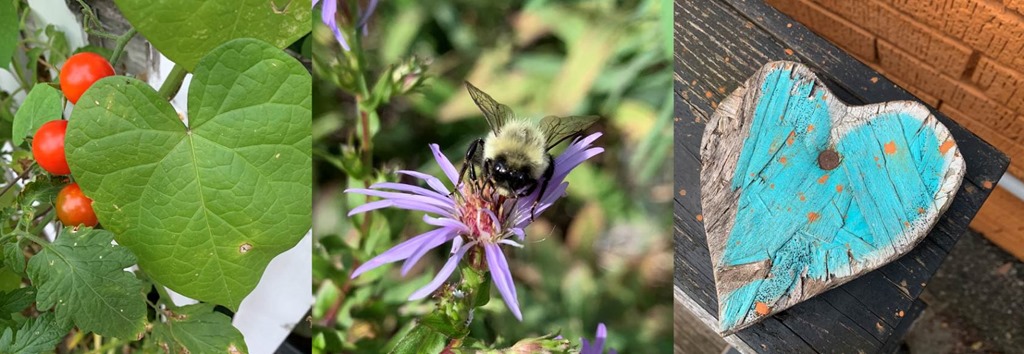
Bee busy! Hearts! Summer photos by Heidi Randen.
.
2. The Poem ‘The Wild Iris’ by Heidi Randen Heidi wrote the text I used here at the end of a post at her blog this summer, though I added the music and additional repetitions and pauses of my device to the piece you’ll hear. In turn Heidi was resonating with something she had read in a poem by Louise Glück. So, in the end, I appropriated her work appropriating Glück’s. This process by which I appropriated the text as well as the musical repetition give it a rondeau effect if not that exact form.
Oddly, all this repetition was to present a thought about transitions, which Heidi and I are both going through this summer. Things cycle, things repeat, and then they don’t. Every day for months a parent picks up an infant and carries it somewhere. Then the toddler asks, and the parent lifts their toddling body to hip or shoulder and carries them bidden. One day they no longer ask, the parent no longer lifts, and never lifts again. And then sometimes, with time and age, the parent, will be carried by the child.
That and more. We can be so nearsighted with doorways, they sometime appear only when we are on the threshold.
It’s time for our quarterly look back at the pieces here the got the most listens and likes. We start today with the numbers 10 through 8. Each bolded listing as we count down from 10 to 1 is a link to the original post where I first discussed my encounter with the text used, and those original posts will also include the text of the poem used or a link to it.
10. I Am Laughing in the Dark Underground by Frank Hudson The Parlando Project has from the beginning aimed to put other folks words to music we compose and play. Dave and I are both writers, so I could predominantly present work we wrote the words for here — but I find the encounter with other people’s words interesting for myself, and I hope it adds variety for you the reader and listener. Therefore, it was with some hesitation that I posted this self-written piece for the blog’s 5th Anniversary last month.
You can click on the bolded title above to read what I wrote about writing the words then, but in summary, this text came largely from my interrogating one of those vivid dreams that happen around dawn when you’re half waking and half still asleep. To hear the musical piece, you can use this highlighted hyperlink, or a player gadget that will appear below for some of you.
.
9. They’re Not the Grateful Dead by Dave Moore By chance the next piece as we count down to number 1 is by alternate Parlando Project voice and frequent keyboard-contributing musician Dave Moore, though I wrote the music, sing it, and contributed one verse.* This one mentions a series of dead-too-soon musicians well-to-little-known to folks around our age. Anyone remember that sacrament to saccharine paean “If There’s a Rock and Roll Heaven (you know they’ve got a hell of a band)? Well, this is Dave taking a skeptical look at that idea.
There’s a player device that some of you will see to hear Dave’s song as I performed it, and if you don’t see that, this highlighted hyperlink is another way.
.
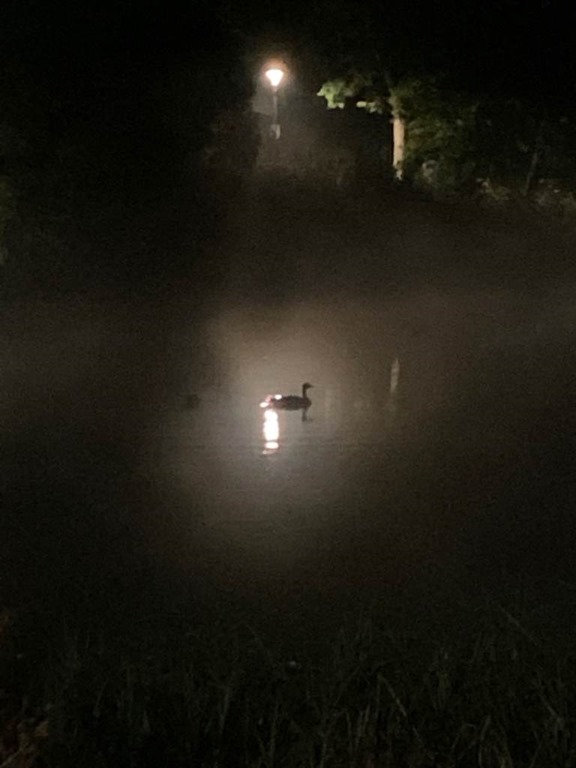
“By Moonlight A Goose Can Be a Swan” a late summer photo by Heidi Randen
.
8. August by Helen Hunt Jackson Speaking of deceased musicians, recent new member of the choir invisible Michael Chapman had a musical life that ran with some marvelously miscellaneous combinations. Early in his career a singer/keyboard player wanted him to join his backing band. Chapman would recount that he figured his own front-man career was launching just fine, and said no thanks. The keyboard guy? Elton John. Chapman was based out of Leeds in England then, and he wanted another electric guitar in his band. He picked up just such a fellow from Hull who had to be lured away from his band for Chapman’s. That guy’s name was Mick Ronson. Having been pried away from one band, Ronson soon left Chapman’s group for another, becoming the notable guitarist and arranger for David Bowie’s breakthrough Spiders From Mars band.
Musicians love those kind of stories, because it’s assumed that many will have “close, but missed it” tales of successful opportunities slipping from their grasp. How about writers? I give you Helen Hunt Jackson. Jackson was a grade school classmate of one Emily Dickinson. Like Dickinson she connected with Thomas Wentworth Higginson, the late-period Transcendentalist critic, activist, and editor. Higginson, you may remember, later gets his knocks from history for not fully recognizing and promoting Dickinson’s unorthodox verse, though after Dickinson’s death he arranged and helped edit the publication of collections of Dickinson’s work that started Dickinson’s career posthumously.
Jackson on the other hand ardently pushed Dickinson to publish while she lived, and for that effort she got little support from the living Emily.
I first ran into Jackson around the same time I watched the often satirical Wild Nights with Emily movie a few years ago. That mixed-bag film portrayed Higginson as a nincompoop and Jackson as a simpering all-to-Victorian fustian. I’ve read a lot of bad 19th century verse looking for stuff to use here** so I figured it worth the risk to look at some of Jackson’s own poetry.
No, it’s not Modernist before it’s time in the same way that Dickinson’s can sometimes strike you, but it can be more vivid and effective than many of her contemporaries with higher surviving profiles, and this sonnet “August” is a fine example of that. Here’s the highlighted hyperlink to play my performance, and some will see a player below that can do that too.
.
*Dave, a keyboard player, led off his song with Nicky Hopkins, who’s one of the lesser-knowns in the grouping. As a bass player I couldn’t let that role in the song’s “catacosmic” band go unfilled, and so I added the Jaco Pastorius verse.
**My general read on the later 19th century was that the Modernists were correct in rejecting what poetry had come to by the beginning of the 20th century. Stale metaphor, simple messages, perfunctory expression, hard-walled gotta make my rhyme and meter exact verse — there was good reason to make it new.
Today’s piece uses a very short poem I wrote in immediate reaction to some sad news I heard this weekend. Despite that news’ immediacy and particular sadness, the poem that resulted became something else, and I’m not sure why, even as I was writing it, revising it, and then figuring out today’s music and performing it. Being present throughout, shouldn’t I know?
Without stepping on anyone’s own living story, and my limited understanding and participation in it, let me just say that not one, but two poets that Dave Moore and I have known for many years have been dealing with potentially mortal illnesses this summer. I started intending to write a personal poem about considering their possible deaths, and some very tangled words started to emerge.
Why those words? I’ve already told you I don’t know for sure. Perhaps the words were tangled because I don’t feel I’ve been a supportive friend in their time of illness for complicated reasons which include my social awkwardness and not really knowing to what degree they would welcome that in their situation. The tangled words were awfully impersonal, even if the person wrestling with them was infused with emotions.
I decided to leave the tangled syntax of what came out, because I came to feel that their odd flow was a potentially striking effect, slowing the reader to consider them more closely. I made attempts to bring the personal in, but none of my considered words seemed to fit when I did. Could the impersonality too be part of the way the poem means? Yes, by this point I truly wondered what my poem — my own poem — meant.
Why Now, Vocalissimus
Why now, when it is already so
when I listen to people sing in the night,
that so many of them are dead?
And some of the words that comfort us,
or cause us to wonder at why we’re not,
were written by those who now never talk.
But if you go to silence for after all,
leaving just words, sundered breath,
will they be but husks, after seed has left?
When I completed the draft I used today, I thought it had become a poem that isn’t about particular people, but about us (you, I, anyone) wondering about what a poet leaves when their poems no longer have a choice but to remain silent on the page. I know that is a problematic mode. T. S. Eliot, who like many effective poets was right and wrong about why his poetry — much less poetry in general — worked, would approve of this poem’s impersonality; but in our century now we often expect poetry to include diaristic detail, and while the muse wouldn’t supply it, I myself expect that the poem should be specific about those that I’m thinking of — and yet to include explicit thoughts of that while they live seemed morbid and presumptuous. Even though I present this piece today, I’m not sure the poem is done with me yet.
Poetry. Seeds. Speak it!
.
What’s with the weird Latin word in the title? It’s to lead you away from me and my particular poets in my thoughts, and back to just about the only appearance you’ll find of that word used in an English language poem: Wallace Stevens’ “To the Roaring Wind.” In that poem “vocalissimus” is that voice of the muse that asks to become the voice of the poet; and by extension asks us to be the voice of the poet beyond their lifetime, which is what this project is about in our normal course of presenting other people’s words.
Let me leave you with one thought: you here who write, read, speak poetry are part of a continuum. Poet’s poems dream of being more than your poem — the ones with personal details, the ones without. Few will achieve that dream, but still they dream it, before and after the dreamer.
I thought I might get a second American Labor Day piece in from a few ideas I had last week, and this is the one that survived the cut. Well, maybe it’s more than one, as it’s a two-in-one, combining poems written 40 years apart: Lola Ridge’s “Wind Rising in the Alleys” and Dave Moore’s “Big Kids in the Alley.”
Ridge is a figure that could fascinate several different ways. She has a life story that would defy the most expansive novelist to invent. She was “on the scene” in both the literary avant garde of the NYC area of the first half of the 20th century and in touch with the political radicalism* of that era, and as woman who clearly saw the limitations of gender roles, she was allied with the wave of feminism arising then as well. A several-time immigrant herself,** she wrote with insight into the immigrant experience.
Having an interesting life isn’t the same as writing interesting poetry or poetry that compounds its interest over time, and I blow hot and cold myself as I once more start to read some of it. She has more than one style of poetic diction, occasionally sounding a little bit 19th century, and then sometimes flat and spare, to other times striking out with passionately with intense tropes of natural phenomena intending prophetic power. The first time I featured her work here I could easily see how that last kind of writing could link in with our era of Climate Change. In my second time into her work this summer I may be starting to “get” her, and Ridge may be one of those poets who one needs to get over the ways she seems “wrong” before understanding what she’s doing that’s uniquely “right.”
Accidents or coincidences, can sometimes help me do that. Reading her poem about a so red sky in contemporary times of widespread fire-smoke is one such connection. And my second time with Ridge happened when I saw this poem where nature in an urban alley is portrayed at a prophetic level. When I read this poem first published in 1920 I thought of a Dave Moore lyric used in the first Fine Art record in 1978. I made a note immediately to myself that they could be combined.
Are these Labor Day poems? Sandburg’s piece from “Smoke and Steel” I used last time is certainly one in the context of the larger poem it concludes. “Wind Rising in the Alleys” is the concluding poem in Ridge’s Sun Up, a collection of mostly short, sometimes Imagist style, poems and “Wind Rising in the Alleys” is the last one printed in the book’s final sub-section which also includes poem-portraits of famed Anarchists Emma Goldman and Alexander Berkman. The poem for which the section is named, “Reveille” starts “Come forth, you workers!” and ends “Let us meet the fire of their guns/With greater fire/Till the birds shall fly to the mountains/For one safe bough.” “Reveille’s” militant final lines compress parts of Ridge’s rhetoric: fervent radicalism combined with a “who would guess it would come next” poetic image.
As I mention here political beliefs and calls for direct action following from them, I’m thinking that some of you may not share those beliefs. So, let me stop for a moment and mention something important to poetry as an art. Poetry is not a very efficient method of communicating ideas, much less particulars of strategy and tactics. To say that it fails in these things (or to overstate what it may do in some part) is to find the obvious, for poetry fails as expository work or argument closer to the degree that music does. What poetry can do instead, is to tell you what having some idea or intent feels like. Do you recognize what it feels like the moment that someone you love or desire lets you know that they feel the same? That’s what poetry can do, and do intensely. Of course, it may happen that that lover turns out to be flawed, or an outright heal, just as much as they can turn out to be a partner for a lifetime and the treasured ancestor of ancestors.
That moment of love and connection is powerful to feel, and it’s not just romantic love poetry that can present that connection.
The optimistic winds in the alley Ridge speaks of have hope in them, hope for change. I can’t say exactly when it was written, but for publication in 1920 it may have been written in a time that was not at all hopeful for American labor and political radicalism. Berkman and Goldman were deported in 1919, and that year saw red-scare round ups and a particularly deadly year for anti-Black race riots. Whatever it is, “Wind Rising in the Alleys” is not a victory march.
I write about poetry and music on May Day or Labor Day, you can easily find others who will discuss political and economic matters. Let me just summarize a lot of complex history to say that workers and capital have both advanced their lot in the United States greatly since 1919. Hooray for Labor Day. Has justice advanced too? Yes, but the argument that that has been to a lesser and insufficient amount is strong. Hooray for Labor Day — and the days afterward.
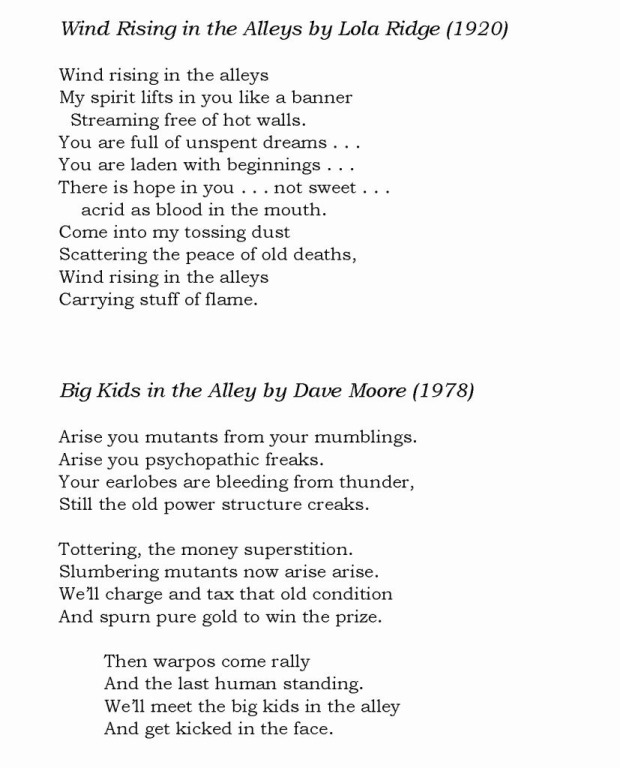
Here are the texts of the two allied alleys that I’ve put together today.
.
Step forward to 1978. Dave Moore’s “Big Kids in the Alley” was written at the request from a rock band named Fine Art forming and making its debut album. I’ve written elsewhere a short history of that band, one of the earlier bands in the Twin Cities area to make and record original music in the Punk to New Wave transit station on the route-way of Indie music. Just as “Wind Rising in the Alleys” was the “album closer” for Ridge’s Sun Up,“Big Kids in the Alley” closed Fine Art’s record and was the encore or set closer for a lot of live sets I saw. At this time it remains one of two studio-recorded songs of theirs that can be found on the Internet, and it was even sampled and used in a hip hop record in our current century. Here’s the YouTube link to that cut from the vinyl record.
You may think that’s quite the intense showpiece. On stage it could be even more so, and it’s certainly not the kind of song you’d want to put in the middle of a set list with other songs immediately following. Rhythm guitarist Ken Carlson was always solid and tasty, and vocalist Terry Paul used a more aggressive style here than what was customary for her, but “Big Kids in the Alley” was also a feature for Fine Art’s lead guitarist Colin Mansfield. You can hear effects pedals sweep frequencies in the song, and Colin would usually play all or most of the parts using the edges of a Zippo lighter in his right hand as a string and pickup exciter as well as a pick. Colin had some understanding of avant garde and other orchestral instrument music under his belt before Fine Art, and while what he was doing here was unprecedented in punk and new wave bandstands in the Twin Cities in the 70s, unorthodox sound generation methods had some pedigrees there. Outside and Free Jazz players would also do similar things, though because those styles were usually wind instrument based, the precedents are less direct. A short-lived rock band movement in NYC at the same time (documented in the No New York LP also of 1978) used random noises and alternative guitar tunings often played by naïve players.*** Colin wasn’t a naïve player.
Lyrically, Dave Moore’s words for “Big Kids in the Alley” starts as a parody of “The Internationale” the 19th century labor anthem. If you read this Wikipedia article compiling the various versions of “The Internationale’s” lyrics over time and in many languages, you can see that they vary considerably, but the opening’s general thrust, retained with some intensifying language in Moore’s parody, is mostly honored. I sometimes wonder how many folks in pioneering venues that supported “punk” or “new-wave” bands in the Twin Cities 40 some years ago recognized the reference. You never ask such things when dancing.
The final chorus of Moore’s version adds an unexpected departure. This morning I realized I’d never asked Dave what his intent was in what he wrote there. I called him up, and he explained “That you’re going to have setbacks, that they are going to react violently. That you should realize that.” Note that the arrangement on Fine Art’s version ends on Dave’s final thought, which emphasizes its impact.
I didn’t use Fine Art’s music for this performance, and my musical setting is simpler while referencing a similar flavor. I did dig out an old Zippo lighter I keep in a drawer in my studio space, but I didn’t quite get Colin’s exact effect in my “get’er done” charge to record today’s piece.
You can hear this loud rock band combination of these two texts written 40 years apart with the player below, or if winds haven’t blown that up your alley, this highlighted hyperlink in an alternative way to play it.
.
*Early American Modernists, unlike an appreciable number of European or European-based Modernists, tended to be left-leaning, even radical. Many of the American publications that printed the work of Modernist poets or visual artists were equally if not more so concerned with social reform or outright restructuring.
**Though, I do not consider the elements in anyone’s background determinative, I enjoy on a superficial level the diversity of ethnic and regional variety in English language poetry. Ridge is a case where the hyphenation cannot cope. Born in Ireland, immigrated to New Zealand at 8, then to Australia where her career in the arts gained a foothold, then to the American West Coast were she at least touched bases with the contemporary arts there, and finally to New York City where she lived the majority of her life, including time in the teaming immigrant Lower East Side.
***A less-remembered pioneering American punk band Pere Ubu was working some of these ideas as early as 1975. Sonic Youth was connected to and arose after the NYC No-Wave scene was receding, becoming a successful band in the Indie Rock era. In the Twin Cities, The Wallets later presented a more song-oriented version of what some of the NYC No-Wave bands did.
This is the weekend that ends in American Labor Day, and I’m going to see if I can put up at least a couple of pieces celebrating that.
The relationship between poetry and labor is complicated. On one hand, unlike entertainers, popular prose writers, or some other fields in the arts, almost no poet earns enough solely from poetry to escape a complete lifetime of some other everyday work. This could lead to the world of work and the concerns of those that do it being widely incorporated into poetry, but in my observation that’s not so. Why should that be? Well, as much or more than any other art, poetry, in self-image or in public image, sets itself apart from ordinary work.
Poets are seen as dallying with the muses, observing unsullied nature, being drawn to erotic passion, explaining the godhead and the nearly unreal, or engaging in an endless spree of derangement of the senses. None of this seems related to the world of work. Things like that may be a way to spend the weekend or a holiday, and so poetry may be attractive to those seeking to temporarily escape their workdays — but then not an art used to understand them, or to interrogate them.
American Modernist poet Carl Sandburg conspicuously didn’t avoid work and workers as a subject. Some elements of Modernism liked to write about the products of early 20th Century industry — odes to locomotives and airplanes could stand in for birdsong or daffodils just fine for the make-it-new crowd — but the systems that built them and the human effort involved were largely not viewed as fit subjects. Satires of the management classes could be undertaken, and by damning their mundane concerns, the world of work could be dismissed as a fallen human state.
In variety and extent of opportunities to observe work the poet Sandburg may have had an advantage, and he didn’t squander it. Itinerant laborer, municipal government functionary, labor-union agitator, journalist, small-time farmer — Sandburg certainly had his perch to observe work. He wrote about all of those trades from inside and beside. Today’s piece is taken from the very last section of the long title poem in his 1920 poetry collection “Smoke and Steel.” In the poem Sandburg concentrates on that backbone of American industry in his time, the smelting of iron ore into steel, and he does so by focusing on the laborers in that system. While he’s in a long-winded Whitmanesque mode, he brings to this task the miniatures of Imagism, and in this final section, if separated out as I did here, he presents an Imagist poem. Earlier in his poem we meet a lot of people and their tasks involved in the manual labor of steel making; and now in this Imagist ending we’re left with three or four objects. Once he violates the unity of the charged moment, but otherwise it follows Imagism’s rules. Here’s a link to “Smoke and Steel”, and the section I adapted and used today is at the end of the opening poem.
We first meet cobwebs, called “pearly” to indicate a beauty in them, and they’ve caught and held raindrops. Just a “flicker” of wind tears them away from the scene. Moonshine, golden and so also portrayed as beautiful, perhaps in a pool of rainwater, is likewise shivered and dispersed by the wind. Finally, a bar of steel is presented, and there’s contrast. It’s not so transient. Violating the unity of the moment, the poem says it’ll last a million years, even if nature will coat it with a “coat of rust, a “vest of moths” and “a shirt” of earth, images that seem to me to connotate the grave when we are also told the steel bar will “sleep.”
I’ll admit that while I could visualize the cobwebs with pearly rain drops and the moonshine rippling in short-lived puddles, just exactly what the steel bar was as an image to be visualized was puzzling to me. A railroad track? We don’t usually call rail tracks bars. A fence, or even a jail cell (“steel bars” as shorthand for jail)? Nothing earlier in the poem prepares us for that reading in this section. Some steel ingot stockpiled and stored outside? But destined to be forgotten and left for a million years? Other than that “million years” permanence we’re told only one other thing about the steel bar: that it looks “slant-eyed” on the cobwebs and pools of moonshine. I understood this as “side-eye” and that reading seems pretty solid to me. The steel bar knows it’s going to be there longer than the cobwebs and moonshine, so it can dismiss them as ephemeral.
Then looking to confirm if a slant-eye look would have been understood to Sandburg as side-eye, I could only run into the use of, and disparagement toward “slant-eye” as an ethnic slur. Though that slur wasn’t news to me, it hadn’t occurred to me as I don’t think it’s what Sandburg intends.* Realizing this after I’d completed recording today’s performance, I considered that it might harm the ability of some listeners to receive the poem’s intention, and if I was to perform the poem again, I might take my privilege with a work in the Public Domain and sing it as “side-eye.”
Coming as it does at the conclusion of Sandburg’s longer poem “Smoke and Steel” what do I think the cobwebs, steel and moonshine mean as they are met by the wind of time and change? We may abide by the convention that poetry and work are separate things, but as Sandburg has just written a long poem about work, we know he wants these things to be combined. The things we do everyday for pay, the work we do in arts like poetry — are the later the cobwebs and moonshine, beautiful, transitory, little noticed; and the former the steel, the solid, useful things that will last? Or is the steel the “real” that is buried, and the cobwebs and moonshine it distains the eternal now that returns fresh?
And then, can either be both?
The player gadget to hear my performance of an excerpt from Sandburg’s longer poem that I’ve titled “Cobwebs, Steel, and Moonshine” will appear below for many of you. Don’t see a player? Then this highlighted hyperlink is another way to play it.
.
*Sandburg is too comfortable with ethnic slurs for many modern tastes in his poetry, and “Smoke and Steel” contains a handful of them earlier in the poem. The unabashed way he uses them in his way argues against this ethnic-Asian slur being a 1920’s dog-whistle.
As promised, here’s the very next piece Dave and I tracked last July after our take on Bob Dylan’s “Went to See the Gypsy” which eventually broke out into a full orchestrated arrangement. It’s one of Dave’s songs, his words and music, a piece he wrote a couple of years ago called “E Flat.”
Dave says he wrote it after reading a report that planet Earth’s fundamental vibration was determined to be at the pitch of E♭, though this pitch was at an octave range much lower than human instruments or hearing go. I did a little searching today to see if I could re-find that report, and I’ve come up blank — though the concept of our planet having a frequency has been trotted out, often with a dose of cosmic woo-woo. The most popular Earth frequency I found was “Schumann’s Resonance” discovered in 1952 by a German electro-physicist Winfried Otto Schumann.* Schumann’s observations were made of electrical wave activity between the earth and the ionosphere, and were calculated to be on a fundamental frequency of 7.83 Hz. What pitch is that? Well, it depends, and if you follow some esoterica, that’s an important depends. Most musical stuff these days is set so that 440 Hz is an A note, but that was not historically the only way the pitch we call A was defined; and there’s a belief that one such past standard, 432 Hz, is better. Some of this belief is buttressed with “hear me out, this is very scientific, an objective fact” talk about powerful natural vibrations that have perfect ratio relations to a 432 Hz A.
So, I found that — but at A=432 Hz, 7.83 Hz is closest to a C note. At A=440, 7.83 Hz is closest to a B. So, no E♭ either way.
As of today, I can’t relocate the report Dave read, but that doesn’t mean his song isn’t close enough for rock’n’roll. When we performed it this summer, I set out a time-keeping drum beat, and while Dave sang I played a free-form guitar track swinging close to the amp speaker for feedback sustain. Some days after the live tracking I fancied up the drum track, added electric bass, and played the electric guitar chordal part that dominates the final track you can hear below. When Dave and I play we decide things very fast, and I didn’t do a great deal of thinking or composing for what I added later either. Working on this song was like painting with wet oil paints.
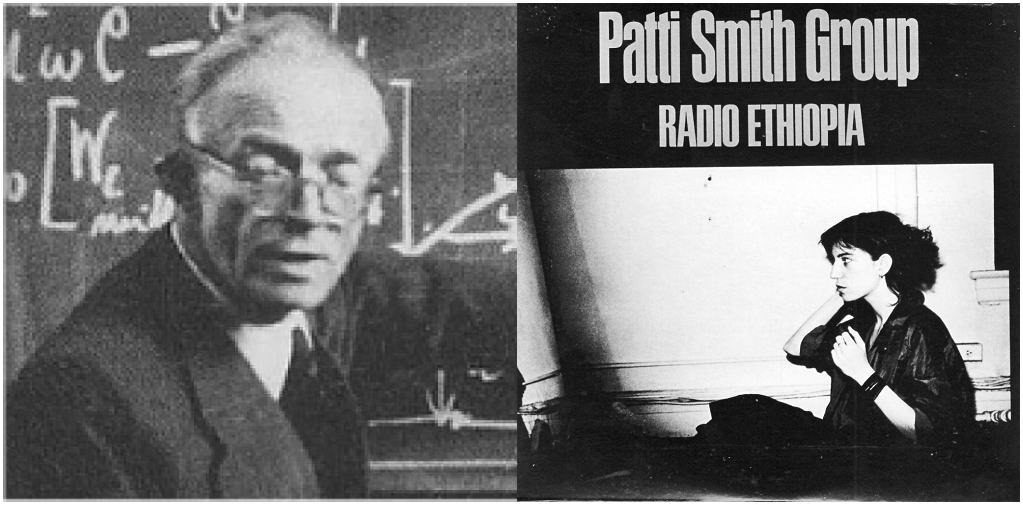
W. O. Schumann at the chalk-board and Patti Smith looking to run her nails on it.
.
By the time I was throwing on the last guitar track I was verging on consciously aiming for the sound of the Patti Smith Group’s “Radio Ethiopia,” the title track to Smith’s second LP. Not a very famous or prestigious record. Why’s that? Here’s the punk-rock-speed history.
A significant group of people (though not top-the-American-charts-sized then, or modern Internet multi-million-follower sized now) had taken Patti Smith’s first album, Horses to their hearts. I was one of that group. The chanted and declaimed poetry, the open references to rock’n’roll — that record’s sound was balanced between passion, looseness, and intent, unembarrassed in its declaration and performance. I also believe that impact was intensified because it was fronted by a young woman who acted unencumbered by gender roles.**
But that’s the first LP. I spoke above about the second LP, one that got tagged with the “difficult second record” label. “Difficult second record” syndrome is usually explained by a band having had a reasonable period to develop a range of material for their debut album, material that they have confidence in while still retaining a sense of freshness in their own experience of it. The second record now has expectations that have to be dealt with, expectations to either be mostly “the same, but better” or if not that, “different, but every bit as good.” But there’s less time to develop that second record while they tour to exploit the interest from the first.*** What was it they did right to make a splash with the first? Does a band have time to figure that out? What to keep, what to add?
Radio Ethiopia, the album, kept an element from the tracks that are often less remembered from Horses: the first record’s more conventional rock songs as opposed to the longer, idiosyncratic spoken word mixed with rock-references tracks — but in place of Horses longer pieces like “Gloria,” “Birdland,” and “Land,” we got a different style on Radio Ethiopia in songs like “Poppies” and particularly and problematically on the 10-minute title track. Smith’s vocals were mixed lower in these new long-form songs, at times down to a subliminal level, and the chordal guitar work got denser. Few liked it. Not “few” as in dedicated, knowledgeable fans — “few” as in not-very-many.
I liked it.
Here’s the lyric sheet Dave was singing from. Yes, the song’s in E♭
.
Will you like what I did to Dave’s song here then? Who can tell? It sure is musically different than the piece we performed just before it this summer, and the final resulting pieces you can hear here, even more different. I like different. If you don’t care for it, I’ll say that my aesthetic here is like Minnesota weather: don’t like it, or like it, today? It can, and will, be different tomorrow. Some will see a player gadget to play it below, but if you don’t here’s a highlighted hyperlink that will open a new tab window and play it.
.
*It would be so resonant if he was related to the composer Robert Schumann, but I’ve found no cite claiming that.
**One could, and likely someones have, written a treatise on Patti Smith’s relationship to gender, which is complex. Those hadn’t been written in 1975, which didn’t mean it didn’t have impact then. What some felt, got, resonated at pitch, would be emotions recollected in intellectuality later.
***Radio Ethiopia came out just 10 months after Horses.
In discussing last May how much fun it is to perform Bob Dylan songs I mentioned that when Dave Moore and I get together to play we often throw in a Bob Dylan song along with our own music. Last month* we finally got together after a long break due to Covid-19 and other infirmities, and as per that tradition the next to last song we played was a Dylan number.
Dave has been extraordinarily prolific with songs over the past few years, so it’s most often I who bring the Dylan to the table. Hipster-wannabe that I am, I often like to cast a wide net for the less-covered or celebrated Dylan songs. This time it was “Went to See the Gypsy” off of Dylan’s little-remembered New Morning LP of 1970.
At the time it came out New Morning seemed important, as Dylan had stumbled badly with his previous record Self-Portrait. Self-Portrait seemed to many a lackadaisical record about being lackadaisical, and those many weren’t having that in the turbulent and searching summer of 1970. Think about this: that LP was released almost exactly a month after nine college students were shot and four died on a Midwest college campus. Of those four dead, two were protesting what seemed a widening war in Southeast Asia and two were somewhat distant onlookers between classes. A few days later two more students were killed at Jackson State in the South. The average youthful Dylan fan was less likely to be interested in tunes about all the tired horses in the sun at that moment.
So, less than six months later this other Dylan album, New Morning, came out. In retrospect it wasn’t really a return of the fiery prophet of Sixties Dylan, but a lot of rock critics had made their bones considering that earlier Dylan style and made the best of what they had in it. One song, and one song only, could be parsed as if it was in that style “Day of the Locusts,” a protest tune about getting an (honorary) degree from an Ivy League university while that year’s crop of “17 Year Cicadas” chirped their Dada chorus. Maybe some college students dug that one.
With the passage of time, New Morning’s necessity to rehabilitate the great songwriter’s reputation has lost its utility. Dylan has had at least two greater “return to greatness” moments since then, easily supplanting the importance of New Morning. And of course the measure of the artist over such a long and important career makes bumps in the road disappear in the trailing dust. Though little thought of now, New Morning is what it may have been intended to be, a much better record of relaxing with the mundane and interrogating it.
“Went to See the Gypsy” is about nothing happening, a topic that many of the fraught students of 1970 would eventually need to come to grips with, and maybe it fits this second summer of Covid-19 too. The singer goes to meet the undefined titular “gypsy,” who maybe only figuratively that (the word derives from a now considered pejorative term for the Romany ethnic group). I think that character title is used to convey someone exotic and transitory. There may also be a suggestion that the gypsy could be a fortune teller, as many songs that Dylan would have known would have made explicit. The meeting is a big nothing. The two have a nighttime greeting in a hotel room (transitory housing), and then the singer has to go to the hotel’s lobby to make a call. Modern people, sit down in a circle around the fire, and let the old ones speak of this: in those days you couldn’t text anyone if you were running late or you had to get some info or agreement, you were required to go to a place where there where iron-clad telephones chained to a wall that took coins to accomplish that.
In the lobby an attractive girl (“dancing,” intimation of transient movement) begins to do a hype man spiel about the gypsy. How much time passes? We don’t know. Does the singer try to make time with the girl or vice-versa? The song doesn’t say. It only says that dawn is approaching (often the signal to end a song or poem) and the singer returns to the gypsy’s door, which is open and the “gypsy is gone.” The door being open is a telling detail, as it indicates that this wasn’t some planned leaving. The gypsy rushed out or was rushed out by someone. The singer returns to the lobby, the dancing girl is gone. Was she part of some planned distraction? We don’t know. The song ends with the singer instead “watching that sun come rising from that little Minnesota town.”
Now this song all could have happened in a little Minnesota town. One thing that many non-Minnesotans think about Dylan’s home in the Iron Range was that it must’ve been some ethnic Northern European monoculture, which it wasn’t in the least. Personally, I’ve always thought this final scene is a poetic jump cut, and that Dylan’s final sunrise is times and miles away from the events before in the song, but that’s just me.
In summary, a song about things just happening that keep things from happening. Your fortune won’t get told, nor will the mysterious guru tell you what to do, you won’t get to go through the mirror, and a pretty girl may have her own agenda.
Here’s today cover version of Bob Dylan’s “Went to See the Gypsy” Alas, there’s a couple of typos in the captions that flash by. I blame working too late.
.
Musically this is me on electric guitar with Dave playing some soft reed organ sounds at first. After those tracks were laid down live, I decided it’d been too long since I had done a full orchestral arrangement, and so after the fact I did just that and had the orchestra instruments come in partway in the song to represent the potential big something that hovers out of reach over this non-event story. I know dawns in little Midwestern towns, far from the chance of Las Vegas, gurus, or those who can tell one’s fortune. There you make your songs and self, yourself.
I should be back shortly with the song we did right after this one, a Dave Moore original.