The Subway

I think I’ve established that I like examining lesser-known Modernists, or even writers who weren’t always considered part of the Modernist movement. Now today I may cause a few literarily knowledgeable readers to throw up their hands and do a spit take. Why? Yes, today’s piece is a sonnet, but we should note that not all Modernists rejected rhyme, and after all this is also a piece of down-beat gritty urban experience. Just look at the opening two lines:

Tired clerks, pale girls, street cleaners, business men
Boys, priests and harlots, drunkards, students, thieves…

A litany that wouldn’t be out of place in the Unreal City a few years later. It could sound like the opening of a piece by Whitman or even Lou Reed as it starts out. As it continues, it doesn’t stint on the darkness literal and figurative. Those subway riders are riders, without agency. With fixed tracks underground they go their “sunless way” with “reluctant feet” as our Modernist Dante tells us. When I first read this* having seen the author’s name before reading, my thought was “Could the writer of this piece be misattributed?”

Go ahead, go to the bottom of the post and listen to the performance I put together using this early 20th century New York City poem about ordinary and agentless people lost in underground darkness. It’s less than 3 minutes long. Hear it first without knowing who wrote it.

Joyce Kilmer in uniform

Is this something of a belated Memorial Day post? Today’s author would die serving overseas in the U.S. Army during WWI.  But stop reading and skip down to the bold-faced section at the end for a chance to hear the audio piece first.

.

OK, now let’s take off the Masked Singer costume: the author of the sonnet that I used as the text for today’s audio piece is Joyce Kilmer. I expect two responses to that information: “Huh?” and“What!”   The former “Huh?” might be from my younger readers, as this is less likely a poet they’ve run into in our present century. That was not always so. Those my age or older will likely associate Kilmer with a single poem which was once so well-known and liked that it became a point of contention with many educated folks. That poem was “Trees,” the one that begins “I think that I shall never see/A poem as lovely as a tree.” My first High School English teacher Terry Brennan explained that he had had a High School teacher who had recited it while bodily enacting the “lifts her leafy arms to pray” part of Kilmer’s “Trees”  poem. I believe he told us this to establish that he was not going to inflict a similar pedology on us (thanks Terry for that, and much more!) A columnist I liked to read in the Des Moines Register as a teenager, Donald Kaul, loved to pillory Kilmer’s “Trees”  as a crime against better culture.**  They had a point. “Trees”  was ripe enough with pleasant sentiments that it likely did its part to help kill off the pathetic fallacy in modern poetry, but let’s start with its first publication: in Poetry  magazine in 1913, in an issue of that important publication for new verse that also included certified Modernists Ford Madox Ford, Ezra Pound, and Skipwith Cannell, the later a favorite of the Others  circle.

And speaking of Others  magazine, Kilmer was in New York as a young poet in the years before WWI, rubbing elbows with those who would be associated with that city’s fearless avant-garde. Orrick Johns mentions him as someone he knew in those days. When Poetry’s editor Harriet Monroe published her anthology The New Poetry  in 1917, Kilmer and his poem “Trees”  is included alphabetically between poems by Orrick Johns and Others’  founder/editor Alfred Kreymborg. Kreymborg in his interesting memoir Troubadour  recounts that Kilmer was one of the few “actual writers” he was acquainted with in his earliest days as a poet. Kilmer read some of Kreymborg’s short free-verse poems and suggested “You ought to divide those lines and make them rhyme—there’s poetry in them” which Kreymborg considered encouragement. Kilmer was working then for Funk and Wagnall’s, the dictionary people, and even gave Kreymborg some assignments for the dictionary which paid the young man $10, his first check for writing anything.

But all that is circumstantial Modernism. Besides “Trees”  the Kilmer verse I’ve found online is almost entirely religious in nature, and it doesn’t come close to threatening Gerard Manley Hopkins’ gravity and vitality in that regard. If there are other poems that Kilmer wrote that are like “The Subway”  I haven’t seen them.

Why did that “Trees”  poem stick? Trees may not be the Internet Cat Pictures of nature poetry, but readers do seem attracted to those stately greenhouse-gas-absorbing plants. And there’s more: unlike Great Britain, Kilmer was just about the only U. S. poet killed in WWI.***  In England a young poet like Rupert Brooke could gain public attention that persisted after the war even if he was only one poet-casualty out of several of his countrymen. In America, the “Trees”  man received the whole pension, and a large East Coast military base was named Camp Kilmer and served as the place where many of the Greatest Generation embarked and returned to America for WWII.

Did you jump down to here in order to listen to the song I made out of this early 20th century American poem about the New York City subway? If so, there’s a player gadget for some of you, and for the rest, this highlighted hyperlink that will open a new tab/window to play the piece. After you listen to the song you can return to the rest of the post to find out what “Modernist” wrote the lyrics.


.


*I first read this poem over at the Fourteen Lines blog, which, as you might guess, likes to present shorter poems in the sonnet range. This link is their post about this poem, and it also includes the much more widely-known “Trees.”

**Even later in his career, satirist Kaul couldn’t help but get one more lick in against Kilmer and his poem “Trees.”   Kaul also didn’t like girl’s basketball, which I and Iowa were in agreement was a mistake on Kaul’s part.

***The other name that comes to mind was Alan Seeger, the “I Have a Rendezvous with Death”  poet who died ahead of the U.S. participation in the war fighting with French forces. His nephew was Pete Seeger, as Pete liked to point out at times.
Distance Blues (Theory)

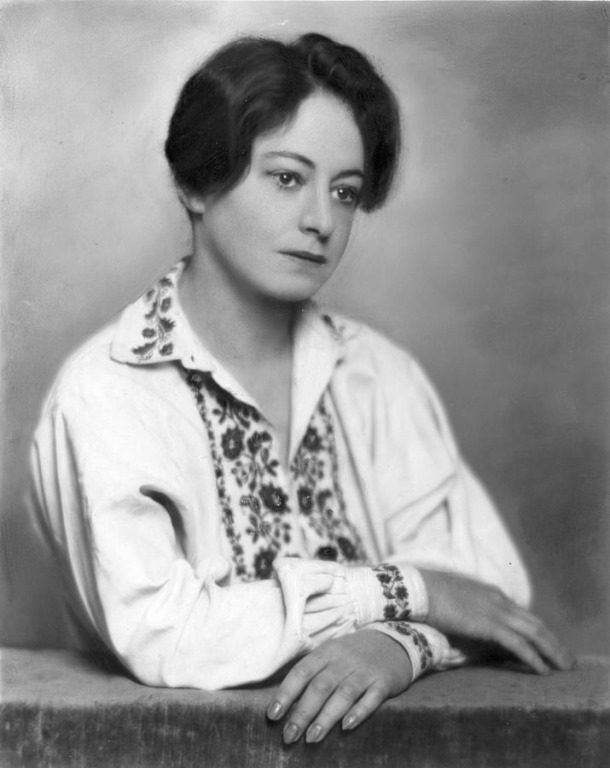
Here’s another woman writing very compressed verse about life and love around a hundred years ago, during that last decade we called “The Twenties.” She’s Dorothy Parker, and you’ll often find her work filed under “humorist.” As I said a few years ago when first talking here about Parker, I suspect that classification tended to prevent her work being discussed as poetry.

Young Dorothy Parker

Let me extend Charles Mingus: If Dorothy Parker was a gunslinger, there’d be a whole lot of dead serious romantic poets

.

That label, used to set humor aside from “important work,” like the idea that verse sung with music is unlikely to be real poetry, seems not just needlessly exclusionary, but ahistorical. The western classical canon didn’t make this distinction when the verse was in Greek or Latin. Maybe translation slows down the appreciation of the jokes in Catullus for example? Perhaps Parker’s real fault (other than being a woman who wasn’t publishing in poetry journals in this era) was in being seen as “only” a humorist, and one that tended to write, like several other popular female poets of her time, about the abundant absurdities in human romantic relationships.*

This April I finished my several-year serial-performance of Eliot’s “The Waste Land,”  a poem that wants to, indeed its innovative design is to, talk about a wide variety of things. Its middle part, like our middle parts, is very concerned with just such human miss-connections — but for good or ill that section is surrounded by an elaborate series of scenes time-adrift and spiritual that wear the mask of tragedy and religious/academic vestments. Does Eliot ever make you laugh at the absurdities? Well, there are a few sly jokes in it — but more in contrast, “The Waste Land”  is long, it’s elaborate, and for me it remains powerful assuming you can accept the way Eliot sung his suite of songs printed silent on paper. Is elaboration the superior art? You tell me. I think it has its powers, as does concision. Are we less likely to be moved or changed by laughter or tears? Again, you tell me, I don’t know.

Where is it that Parker fails if we are not to consider her short pieces, printed in glossy magazines as witty amusements, as actual poetry? Are her observations merely trite, just a chuckle the first time we hear them, and unrewarding beyond that? Does humor outdate faster than solemn meditations?

I’ll sing a couple, and you decide. Today’s audio piece is an old recording where I combined two Parker poems, “Distance”  and “Theory,”  with a bit of acoustic guitar blues feeling. Combining short pieces is a tactic taken by several of the Modernists of Parker’s era:** the idea is that short, epigrammatic poems can gain power if presented as a facet in a collection of other short verses. The player gadget will appear below for some of you, and if you don’t see it, this highlighted hyperlink will open a new tab or window to allow you to hear it.

.

*Parker also ridicules patriarchal attitudes, which might have been minimized as mere jokes without consequence to assuage male privilege, but she’s also rough on some female-gendered behavior. This can be read by some as both-sides-ism, but maybe there’s also a reading that says it’s a more essential, radical critic of gender.

**I’ve been thinking about that tactic, used by poets Wallace Stevens, Alfred Kreymborg, Edgar Lee Masters, and others in the early Modernist era, and just now I recognized that the common practice of Blues singers of combining as series of floating or not directly related Blues verses has at least surface similarity. Perhaps this subconsciously led me to combining two Parker poems in my bluesy singing of them — but it could also be for a practical reason, one that may have obtained for some of the Blues singers: it made a piece out of shorter material that reaches a longer, desired length.

Why Singing Bob Dylan Songs is Enjoyable

This weekend will see a peak of pieces about Bob Dylan as we approach his 80th birthday. Would the young-person version of myself who first encountered his work as a teenager have expected that?

I think probably I would. He was widely written about back then, as in since, though from different viewpoints and judgements. The Nobel Prize a few years back allowed most of the reductionist and disparaging commentators ample opportunity to remind us of his limits, the ways he demonstrates the rule that you must hear me repeat here again: that All Artists Fail. The current moment has not brought those detractors forward, though I’m sure those thoughts are still with them should they be stirred up.

I do not write this for those who have, with whatever wisdom they’ve accumulated, found those limitations defining. I write instead for the much greater mass of people, those who know nothing substantial of Dylan’s work, even if that’s from the framework of having other things that are important in their paths.

Because he’s still living, because he’s still artistically active, those who care to debate the subject of Bob Dylan will often focus on the performer. I will ignore that, as eventually history’s focus will, even though we have film and recordings which we presume will be preserved. So, no talk here today regarding the charges that he’s a terrible singer or indifferent musician or undemonstrative stage presence. All those charges have evidence — and are wrong.

I’m here instead to say that singing and performing Bob Dylan songs is rewarding, enjoyable, illuminating. I won’t go into great length, because I might not convince you of my case. My case must be proven by your experience, if you take it upon yourself to do that.

(Original Caption) File poses of Bob Dylan in 1968-1969. Eat the document, an anti documentary remembrance of Bob Dylan's 1966 concert tour of Europe, has its American television premiere on WNET/THIRTEEN Friday, August 17, 11:30 p.m. Shot by D.A. Pennebaker and Howard Alk, this film conveys the sense of a private diary, a journey with endless train travel, hotel room rehearsals, and late-night post mortems.

In this one photo, Dylan is trying to convince you in a number of ways not to think of him as a performer. He’s almost exactly in the null point of the mic where it’ll hear nothing. Awkwardly, he’s trying to finger an F5 chord on an instrument he was never known to play, and he’s nearly the only Fender Jazz Bass player to ever keep those two chrome covers over the strings and bridge, indicating a straight-out-of-the-box “Here, endorse this!” photo ambush.

.

The songs written by singers of extraordinary technical talents, or by composers with a great deal of musical matter to express can often daunt the general singer. This is not a bad thing, only another kind of limit. Sometime in this century for example, Joni Mitchell has become recognized (yes, tardily) as a songwriter of extraordinary talents. One can enjoy singing her songs; but for some of them, expressing them requires more skills than many of us humans can bring to the task. How well do some of her songs survive a singer of insufficient range, melodic memory, pitch accuracy, and rhythmic sophistication? Or closer to my home, Prince is the most extraordinary performer and pop musician anyone living can recall, but some of his songs are built around superlative vocal effects, and the original arrangements may call for a musical versatility that would daunt most professional musicians. I’m not damming those exemplary songwriters with faint praise. Their achievements are great, and those that want to extend those artists songs by performing them are to be praised.

But to a large degree those merely musical technique challenges are not a problem for those who want to perform Bob Dylan songs. There are a few. Dylan’s most underestimated talent as a singer is his phrasing. With his wordier songs, it can be hard to fit all those word-beats into a regularized musical phrase without successfully playing a game of h.o.r.s.e with his own idiosyncratic phrasing.

What instead does a modestly talented or untrained singer encounter in a representative Bob Dylan song? Two things I think: characters, and a charged, yet ambiguous, emotional environment.

Taking the last first. Many Dylan songs present, as great poetry often does, emotionally intense moments, sometimes several of those strung together. In fewer cases than one might expect, these are not cut and dried here’s-what-we-must-feel presentations. The few times when Dylan does do that —tell us what to feel — those songs in context may gain power for his appreciators because he generally doesn’t. I said I wouldn’t talk about Dylan’s own performances, but over his career he eventually demonstrated different emotional environments that his songs may live in. This design means that we, as individual performers — even those who sing in the shower, while cooking, or going to or from work — are given leeway to impose our own moods and learned outlooks.

Dylan has increasingly peopled his songs with characters over his long career, people who speak from their own varied experience. Actors speak of the enticing challenge of playing Lear or Hamlet and the reams of lines they must master to do that. But in Dylan songs, one may be given a verse or even just a line to embody a character, a challenge of a contrasting sort. I can’t say that the practice of portraying characters not oneself is a sure-fire path to wisdom. If it was, there’d be no foolish actors, and that is not the case. Yet, there is value in that to be found if you want there to be, and it’s fun to not be yourself for the course of a song or a verse! Every child dresses up, plays imaginary games. Adults could need an excuse to do the same, and a Bob Dylan song can be that.

One need not engage with either of those things present in so many Dylan songs in a way that would succeed with an outer audience, that would convey your experience in the songs to some of them. If one can do that, as many professional performers have over the years, that’s great — but it’s not required for enjoyment or reward.

In this project I perform words, mostly other people’s, mostly poetry, because that’s a more intense and intimate way to connect with the text. How successfully it might illuminate something for you, patient listener, I can’t say. As with all art, it will fail some/to most/to all of the time, but if you read other things this month about Bob Dylan, take from this post one thing I wish to suggest to you today: all that commentary and weighing of significance may have some value, but what the man did was write songs, things which do not live or exist other than when some human breath vibrates in a throat. Perhaps some poetry — certainly some writing — exists largely as worthwhile thoughts or impressive inventions. But songs truly exist that way, that way alone: inside us. Why take the hard way to try to generate that experience out of only silent thoughts about Bob Dylan, or even listening to Bob Dylan, when you can put a song of his inside you?

Oh, and not to leave you with the idea that singing Dylan is all heavy going capitol S seriousity. here’s The LYL Band taping up the basement with a set of unused Dylan lyrics a few years ago. Player gadget visible for some, or this highlighted hyperlink for others to play the performance.

.

Christina Rossetti’s May

Here’s a piece using a Christina Rossetti poem “May,”  that’s both simple and spare and mysterious and broad. Early in this project I presented several of Rossetti’s poems, most of which were new to me, because her short, lyrical poems delighted me with their avoidance of the cruft her English Victorian contemporaries often fall into. Nothing’s universally wrong with elaborate poems, but to my tastes, sparer poems can offer us guidance to pay attention, real attention,  to what remains.

Here’s the text of her short poem. The stuff in curly brackets are variations I found in a short search through versions online.

I cannot tell you how it was; {,}
But this I know: it came to pass
Upon a bright and sunny {breezy} day
When May was young: ah, pleasant May!
As yet the poppies were not born
Between the blades of tender corn;
The last egg {eggs} had not hatched as yet,
Nor any bird forgone its mate.

I cannot tell you what it was; {,}
But this I know: it did but pass.
It passed away with sunny May,
Like {With} all sweet things it passed away,
And left me old, and cold, and grey.

These variations are from tiny to small. A semicolon or a comma? Can anyone make any difference from that? “Sunny” or “breezy?” I prefer sunny, breezy is more active, since this is a poem that works its magic by giving us a still moment, and then showing us it’s not. And if sunny, then “sunny” is nicely repeated in the 11th line, when this short poem begins to refrain with itself. “Egg” or “Eggs?” Close call there. Egg lets us see a singular egg (it’s usually easier to invoke a single thing vividly rather than a multitude), but “eggs” make the point that this is an entire reproductive process. “Like” or “With?” I like “like.” “With” followed by that “all” has a sense of this being an immediate entirety. “Like” allows us to hear the poet say some thing, part of an indefinite series of loss or leaving, has gone away. Again, the power of the singular. Do we know what that thing is? The poem decides not to tell us.* How does that choice rank against the power of the singular? If it’s not named it could be anything,  the ultimate multitude of possibilities. Here choices for singular things in this short poem become more important, because it then sets off this missing piece of information about what has gone away in contrast to the specific things named around it.

Wait, that’s not a springtime bird guarding its nest in the lilacs!

.

Do you notice one more variation in the poem’s structure? Hint: how many lines? One, two, three, four…Oh, 13 lines. This works like a sonnet, it even has a turn, a volta, after 8 lines, as in one highly common sonnet format; but the final section is 5, not 6 lines.

It’s too certain a variation not to think that Rossetti decided to make a little meta point that other poets or sonnet fanciers alone will catch. “Yeah, something’s gone and left—there’s no damn 14th line!”

I can’t tell you why the variations in the exact text of this poem. I presume that someone, or Rossetti herself, did a light revision before some level of republication. Which is the latest? Which did Rossetti herself prefer? My scholarship is such tonight that I simply don’t know.

But I did worse. Just today, after I had finished recording the performance that you’ll be able to hear below, I noticed I’d made an error, a variation myself. The copy of the text I was working from had dropped the 13th and final line.

I could simply redo the performance, but it’s become difficult to record acoustic instruments over the past year for this project. Though it blunts the meta-point of the 13-line sonnet, I tell myself there’s power in my unintentional change. “Left me old, and cold, and gray,” the 13th line I inadvertently left out, tells us more about that mysterious thing that has “passed away” with May. My slip-up retains some additional mystery.

The player gadget will appear below for some of you to hear my performance of Christina Rossetti’s trimmed-down sonnet, accidentally trimmed again. If you don’t see the player, you can use this highlighted hyperlink, which will open a new tab and play the song.

.

*Here’s another short write up about this poem, which summarizes some of the guesses about what has passed away. Some love gone sour is one guess, and what with the spring birth specifics in the first 8 lines, perhaps some opportunity to have a child would be another. My accidental deletion of the last line, with its emotional damage curtly listed, adds an element of “All things must pass” to the loss, the possibility of a more Buddhist outlook to a change that’s part of the illusion of possession.

Rimbaud’s Dawn

The last time I created and performed a fresh translation of a Rimbaud poem here, I broke from my usual practice with translation and produced a rhyming poem. I don’t usually do that. There’s too much else to try to bring over from one language to another to add that extra degree of difficulty. But in the case of Rimbaud’s “Eternity”  I felt the incantatory power of the poem was too essential to discard.

Today’s new translation from Rimbaud’s French relieved me of that decision, as “Dawn”  is from his collection of prose poems Illuminations.  I’m still left with the usual problems of translation though. My primary goal when I translate is to make the poem vivid in the destination language, and that leads me to take care with two tasks: to transfer the sense of the poem’s images to the contemporary reader in the new language; and when a poem makes use of scenes or an overall plot, to do the same with portraying that. The translated poem’s sound word-music will almost certainly be diminished (per Frost’s “poetry is what’s lost in translation” declaration) but I try to respect the poem’s music of thought, that sense of harmonic relationships between things, the melodic undulation of its series of images. These primary tasks become fraught when the images and scenes are difficult, or by intent irrational or obscure; and in those cases determining the author’s intent and how understandable they would likely be to the intended reader they wrote them for adds another level of difficulty.

Lately I fear I may go too far in how I handle this, reducing to something determined that which the author wanted to remain mysterious or only an enticing sound or novel juxtaposition — yet still I risk it. Most other translations of today’s Rimbaud piece are less clear than the one I produced. My hope is that the sense of wonder in the poem is enhanced rather than reduced by portraying more exactly what I sensed Rimbaud was showing us. Here’s a link to the poem in French, and then here is the fresh translation I made and used for today’s performance:

dawn

Issues start with the poems opening sentence: “embrassé” has been translated as “embraced” (retaining some of the sound from French) and as “kissed.” From the whole of the poem, this non-native French speaker thinks there’s more of a context of grabbed or taken in here. Unlike others I then chose to make a compound English expression for Rimbaud’s single word: “caught and kissed.” My hope is that this sets up the story that Rimbaud seems to me to be telling, of the poem’s speaker and the dawn of the title being caught up in something between a passionate tryst and an abduction.*

Truckloads of dawn are being shipped while you sleep!

.

The second paragraph shows us an urban early morning as the sun is just rising. Grand public buildings, symbols of power and order, have no crowds or guards. The trees are still shadowing the streets. Warmth is only gradually emerging from the overnight chill.** The last phrase there remains somewhat mysterious to me, so I left it so for the reader. I believe the wings may be the pigeons or other early morning birds in front of the grand buildings, but “pierreries” (gemstones) is harder to grasp. I tried the thought that it might be iridescent feathers on the birds, but little else in this poem looks at such a close level and I suspect more at glints of early morning light breaking in, which helps inform how I handle the next section.

That next paragraph is mysterious too — and left somewhat at that in my translation. But I couldn’t resist making “blêmes éclats” into “gilded splinters.” It was just too good a connection from Rimbaud’s French to Afro-American creole French, known to me from the Voodoo folk-chant once appropriated effectively by Dr. John into a slow-burning musical ritual.

I think the next paragraph is dawn’s light coming in through tree branches, blonde on blonde.

In the next paragraph I once more choose a compound English expression rather than making a singular choice from the French. “Voiles” can be either a veil or a sail,*** an I think the sense of the poem wants it to be both. Dawn (feminine) is lifting veils, and the poem’s speaker (masculine) is setting sail on a voyage. Ecstatically Rimbaud is sailing down the streets in the poem’s mind and camera-eye out to the very borders of the city in a magical instant while dawn is still breaking and unveiling, to reach where in the penultimate paragraph dawn and Rimbaud fall onto a forest floor in what I read as a sexual embrace.****

Some readings of the poem have the final sentence as one of those “It was all a dream” trick endings. Yes, the poem intends to portray a visionary experience, but I think we’re still in the vision at the poem’s end, perhaps with the lovers only about to depart in a mid-day aubade — after all, the speaker has exercised the aubade trope of denouncing the time-announcing rooster. In their union, dawn and Rimbaud have stopped time, if only for an interval.

So, here’s the player gadget and alternative highlighted hyperlink for those who don’t get the player gadget in your reader to hear my performance of my new translation of Arthur Rimbaud’s “Dawn.”


.

*This poem is a vision, a fantasy. Yes, within the fantasy there’s no explicit consent, and we might read Rimbaud as male and the long-haired and veiled dawn as female (see the footnote on linguistic gender below) but that may be us putting our own casting on the fantasy roles here. But again, it’s a fantasy, and the loving and respectful rules of reality may contain it.

Alternatively, in kinky fantasy footnotes, my best-guess that the child (l’enfant) in that concluding embrace is a persona of the young Rimbaud, and that opens up age of consent issues regarding an encounter between the ancient cosmic event of solar dawn and a teenager. Beyond glib jokes, given Rimbaud’s biography, I wonder if that has been more seriously addressed by modern scholars?

**Personal aside: in my early-morning bike rides this May, I’m growing increasingly tired of the WWII-Fahrenheit temperatures of between 39-45 degrees so far. I want to ride with bare legs and arms and make vitamin D with human skin!

***The former noun is feminine in French and the later is masculine. My teenager strongly dislikes gendered languages with a personal dislike, and I’ve never cared for this common language feature for efficiency’s sake. Still, I searched the section to see if I could determine the gender intended and decided it wasn’t certain.

****Discrete Rimbaud leaves out (did I intend that pun?): forest floor matter in nether crevices, bugs more interested in their own desires, and pointy things extrinsic to the coupling. This is why Rimbaud is a poet!

Mother’s Day

I’ve mentioned before here that Laurie Anderson was one of the inspirations for this project. Even though I don’t closely mimic her Midwestern delivery, that subtle mix of the dry and the droll with muted pleasure in observation. It’s more at the idea that things put into a different context reveal aspects you never noticed before. And yes, she often did this mixed with music she composed.

We rarely go to mothers for new aspects. In the usual course of things, they are our original appreciation of reality — and one that we return to, or long to return to, when the novel has taken a bad turn.

That said — and I’ve said so much in the last few posts that you might welcome a break from my long-windedness — when I considered yesterday evening if I needed to make a post noting Mother’s Day, this song, “O Superman,”  by Laurie Anderson came bounding into my head. I recorded a version of it on a similar whim nearly a decade ago, just because it had remained well-balanced in the weird place between understandable and elusive. *

Because “O Superman”  is a work clearly under copyright, you won’t see an audio player today for that version I did. Though I’ve probably bent the rules a few times here, this project keeps away from using work the authors have some legal ownership of. Remuneration for almost all poets almost all of the time is tiny, and increasingly this is true of more musicians and artists more of the time. The YouTube video below is my compromise with that.

Yes, there’s a typo in the credits at the end. Embarrassing! I blame the late hour when I was cobbling this together.

.

My rough understanding is that if my video would ever rise to the viewership level of getting YouTube ads inserted, the owner of the rights could/might get the fraction of a penny that would generate. Anderson herself has this video made of her composition back in the day, and it’s worth observing her presentation of her own art, though I note one recent comment on her video:

I played this song at a party in my house once. Ever since then, no one’s even come near my house again.”

Perhaps that comes of the artistic trick in Anderson’s song as she performs it:  to make mom strange so that we may observe differently. Mother and strange don’t rhyme for many.

My version is an excerpt of the whole song with different instrumentation, and I’ve never been much for “just like the original record” covers anyway. My shorter version focuses more on the mother aspect and where and when we seek that. Call me a Modernist beset by sentiment, but the ending to Anderson’s song nearly always brings tears to my eyes.

.

*Want to read more about Anderson’s work? Here are two articles about it: this one about the creation of the original piece, and this recent one by Margaret Atwood about her experience of it.

Revisiting Stones Under the Low Limbed Tree, and what’s fair in song-making and translation

Many of the visits to this blog are not you, the regular readers who are reading this fresh post, but views of some older posts via a search engine. A gaggle from Google have come recently to a post from a year ago which doesn’t feature one of “Poetry’s Greatest Hits,” though it does use, in a way, the words of one of America’s most loved poets, Robert Frost.

Here’s a link to that post.  I looked at this post, and I’m not sure what brought it to increased attention, though after re-reading it today, I complemented my past self — who I alternately think is wiser or more foolish than the current occupant of my consciousness. I thought I did a good job of describing how we as writers may improve our work through revision, even though the example I used in the post was my own revision, for my own parochial reasons, of the words of a recognized great poet.

I do that sort of thing to the Greats from time to time — as recently as the last post here with a simple addition of a line as a refrain from a poem by Robert Browning, or more extensively with my extension and relocating a poem by Du Fu that many liked last winter, or further back with a piece of Rupert Brooke’s that became one of the most listened to pieces in the history of this project. I usually feel ambivalent when I do this. At the least, I try to warn you when I intentionally go beyond the original text. In each case above, the author’s dead, there can be no personal hurt or slight for them to feel, but with this project I do take on some duty to the text the author wrote. Have I cheated at my task? Am I dishonoring their work?

Cottonwood Catkins Spinal Halo 1080

How is this photo connected to today’s post? I don’t exactly know. So what should some translator do when asked to present it in their language?

.

I’m wrestling with these matters currently with another translation in process,*  a prose-poem by Arthur Rimbaud, particularly with a common issue I come upon in translation: how much did the author intend to be mysterious, and how much did they (or their ideal, likely contemporary reader/listener) understand to be clear in their original language? With translation, one can’t avoid substituting your own words, and likely things like word-order, idiom, and so forth — that’s inescapable, inherent in the task.

In the case of this poem by Frost, my recasting wasn’t so much for immediacy of meaning, or to make an image clearer to our time and place; but to make the poem more sing-able, to fit and obtain impact in a conventional song performance. Yet, the song that I made of it was not very popular with listeners here. When I looked today, it appears that nobody that has visited the post this month has listened to the performance.

Again, complementing my past self, the one I feel I can more often judge objectively; I think I did a pretty good job of the song I derived from inside Frost’s poem “Ghost House” and retitled “Stones Under a Low-Limbed Tree.”  My vocal (often a weak point) was passable — though I idly wish for “cover versions” by a legitimate vocalist for pieces I write and present here — and the rest of the audio piece works well.

So, here’s that audio piece, being presented again for your listening judgement and plausible pleasure. The player gadget should be below, and this highlighted hyperlink will also play it in a new tab if the player doesn’t appear on your device or reader.

.

*Following the practice of Robert Okaji, I’ve taken to casting some of my alterations or freer translations as “After a poem by…” — another way to deal with this, though it doesn’t remove all the questions I ask myself.

In England Now (Home Thoughts, from Abroad)

One of the odd things that can happen to a poem is for a single line to become remembered while the poem itself may fade out of fashion. Today’s poem, which is likely to be our final poem for this April’s American National Poetry Month was published in the middle of the 19th century by an Englishman who was away from his home country in Italy. So yes, this one goes out to my faithful British listeners — but, at least in my country, about all that remains of it is the poem’s opening two lines: “Oh to be in England/Now that April’s there.*”

I didn’t know what poem it came from before this month. I didn’t even know it was from a poem, or that Robert Browning wrote it. A poem like his wife’s Sonnet 43 “How Do I Love Thee? Let me count the ways.”  may be similarly antique in age and language, but I recall, however hazily, something of the whole of that poem, it’s sense, and meaning.

robert-browning

Robert Browning, making the chin-beard somehow work for him.

.

Since it’s likely that many of you don’t know this poem more than I did, here’s a link to the full text as Browning wrote it.

So, what is this poem saying, what is it on about? It’s a poem very much of longing for one’s home. A romantic catalog of nature details from the English countryside is mentioned: birds, trees, flowers. I’m ignorant enough about such things that I can’t tell you the song or plumage of any of the birds (I even mispronounced the name of one of them in my performance), I know little of the exact trees, and only a bit more of the blossoms and flowers listed, but I think the poem survives this ignorance. The catalog is enough to demonstrate that there’s a specific spring, specific to place (and by now, perhaps to time), that Browning is missing.

There are three telling lines in the midst of this nature catalog. Early in the poem Browning says that if someone simply wakes in an English April morning, they are unaware. This is of course not universally true, some will awake to marvel at a Spring morning wherever their bed is, but Browning’s point is that some will not, and by implication that he himself often didn’t. Another telling line: in remembering the birdsong of the thrush** he says that the bird sings each song twice, seemingly to prove that the bird had fully absorbed and internalized the rapture of Spring, so that it can recall it at will. That opens the question of if Browning feels in his poem if he has been able to do the same, to recall what he is now separated from. Perhaps it’s more so than remembrance. It’s often said that nostalgia and memory increase the sense that what is gone was better and more intense than it was.

Which brings us to the third telling line, which is almost a throwaway in Browning’s version of his poem, but the one I’ve chosen to make a refrain that I think changes and reframes the poem: “In England now.”

Browning’s use of the line may have been largely a rhyming choice in the series of “bough,” “now,” “follows,” and “swallows” — but rhyme, like chance effects beloved by some Modernists, may cause the mind to go elsewhere or to bring out things it would not consciously choose. By making “In England now” a refrain, it sits beside and comments on nearly every part of Browning’s original poem. My intent is that this refrain will bring out different responses to different listeners, perhaps even different responses to a single listener as it reappears. To test that out, you can hear my performance with a player gadget if you see it below, or with this highlighted hyperlink that will open a new tab and play it.

.

*Given its English subject matter it may be somewhat more remembered by our British readers. Back in 1995 it placed in the middle of the pack of the best loved poems in a British survey. And in an even more Parlando moment, the poem’s title and its enduring worth were both sung in 1973 by an English singer-songwriter Clifford T. Ward, who had a minor hit in the British Isles with it.

**In other April poetry, we’ve just finished our serialized performance of T. S. Eliot’s “The Waste Land”  which features a thrush singing in its concluding section performed and presented here earlier this month. Eliot’s thrush singing in the pine trees he wrote in his notes to “The Waste Land,” was from his personal memories of camping in Canada as a youth.

April Rain Song

As we continue our celebration of National Poetry Month, I remind us all that not everything in poetry needs to be heavy business. For example, here’s a poem by American writer Langston Hughes, a man known largely for his poetry that deals frankly with the Afro-American experience, and this poem of his was published in a magazine founded by W. E. B. Du Bois during the famed Harlem Renaissance.

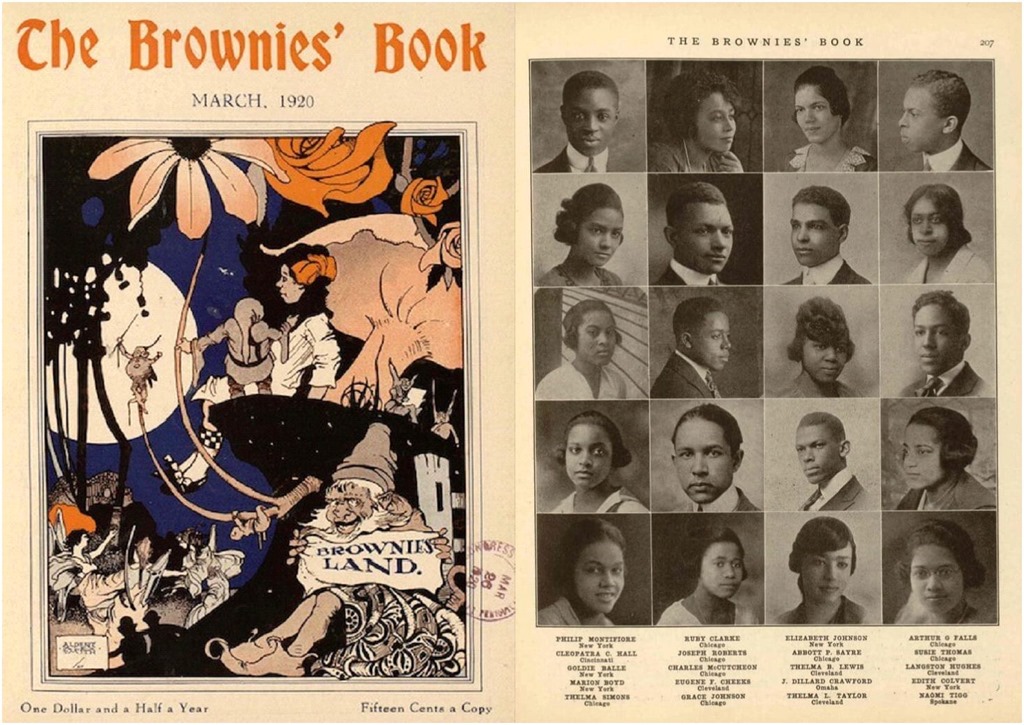
But wait, not only is this a poem about springtime, it’s a children’s poem written for Du Bois’ children’s magazine The Brownies’ Book.  I first learned about this pioneering publication for Afro-American children at the My Life 100 Years Ago  blog, which among other things often covers what was happening with magazines of that era.

Hughes himself wrote today’s poem when he was a teenager, and The Brownies’ Book  was the first publication to publish his poetry. “April Rain Song”  is a charming poem, and in rhythm and poetic tactics it reminds me of Carl Sandburg, a fellow Midwesterner whose writing influenced the young Hughes. Here’s a link to the text of Hughes’ poem if you want to follow along.

The Brownies Book

Check out the high school graduate in far right middle row. Yup, that’s Langston Hughes.

.

It’s been April rainy the past two days in my city, so working on making “April Rain Song”  a Parlando Project piece had overcast and setting. Hughes here shows me a mode I sometimes aim for: it’s a nature poem, but specifically set in a city, not in some rural nature. The rain meets sidewalks and street-gutters, not some Eden.

Rain, specifically spring rain, has a strong memory element for me. Perhaps you share this? Outside in rain I’ll often recall other wet spring days, watching from the current distance my child-self walking beside miniature gutter rivers, observing for no particular reason their sweep around last years’ leaves and last winter’s final dusky ice clumps. Or perhaps you recall a particular roof on which fell our general rain? Was Langston Hughes too young yet to have that experience of memory when he wrote this poem? I cannot say, but I have that now, and so I add a bit of wistfulness to his words today.

The player gadget to hear my performance of Hughes’ “April Rain Song”  is below for many of you, but if you don’t have it, this highlighted hyperlink will also play the song I made of it.

.

Musicians Wrestle Everywhere — Emily Dickinson hears songs as they are created

I’ve just spent much of a day with Emily Dickinson. I’ll tell you it was enjoyable, not the least because there is a factor in many of her poems: they grow when you spend time with them.

It started late last night. I noted that I had been looking at early examples of “jazz poetry,” poetry from the previous Twenties that celebrated jazz music and jazz musicians. A thought occurred to me: I’ve gone too far into #NationalPoetryMonth without a Dickinson poem. Which of her poems might deal with music?

“Musicians Wrestle Everywhere”  came up in searches, though it was not a Dickinson poem I’d seen before.*  Here’s a link to the full text, and here’s another to a manuscript of it in Dickinson’s own hand. After my first reading of it, my reaction was, “I don’t know if I can fit this with the jazz poetry. While ‘Musicians’ is the first word, the musicians largely go away and we’re off into Dickinson’s headspace.” Well, my second thought was, “This could work some other way and time, disconnected from the Jazz poetry stuff. Let me see what I can do about making it a song for later use.”

Dickinson attracts composers. She often uses a folk-music meter adopted also by many Protestant hymns,** and the compression of her poetry leads to short texts ideal for art-song. “Musicians Wrestle Everywhere”  has already been set by eminent American Modernist composer Elliott Carter.

I didn’t want to go toe to toe with Carter. My mood today was to make this somewhat foggy poem more immediately understandable on first listen, while Carter emphasized the poem’s more abstract thought-music. Wrestling with Dickinson’s words and my desire today as I tried singing it and working out my music, I decided to make some minor changes to the words*** and to add a refraining line. The former tactic is generally frowned upon, and many a living author will forbid it. The later, repeating a line or section, is generally allowed. One of the reasons that page poetry often seems less effective as song is that we have a strong desire for repetition in song. I think if even when silently listening we are “singing along,” and we desire to know when some part is recognized as coming around again. Refrains bring us into the song, even on first listen.

So, what is the poem’s point that I hope to make clearer in my song and performance? I believe that Dickinson is saying that musicians, and herself, extract from the time and vibrations of crowded reality our new tunes, rhythms, timbres, and harmonies. Those composing ears aren’t merely transcribing. They might refine melodies within the strife of conflicting environmental sounds, but to some larger degree they are hearing the unheard music that does not exist, though founded or surrounded, in observable reality or philosophy. In the final verse she mentions some think what inspires composers is the pagan “music of the spheres” or some choir of angels, or the departed in heaven — the later a place the skeptical Dickinson is not sure of.

So where does new music come from, if not just imitation, transcription, a cosmic mechanism or ancestral angels? This is the reason for my refrain, to make more adamant what I think Dickinson may be saying. Why are our April trees budding? Why is there new life in our spring without our trying or thought — and in notion of our stewardship of the Earth, despite our neglect? “I think it’s that new life” the now refraining line repeats. Life, creation, poetry, music, it wants to happen.

Elmo Hope is a thing with feathers

I would be ahistorical to suspect that Emily Dickinson’s piano improvisations were anything like Elmo Hope. On the other hand, if my lame joke tempts you to listen to some of Hope’s recordings…

.

By the time I’d worked out a meaning to Dickinson’s poem I’ve come to think that it is a compliment to the Jazz poetry I was looking at before after all. The Jazz poems of the previous Twenties I’d seen mostly observed the musicians and provided a listener’s appreciation of what they were putting down. In Dickinson’s poem, she’s the musician, the composer themselves.

By late this afternoon I’d completed the music and recorded the acoustic guitar, bass guitar, cello and violin parts for my song setting of “Musicians Wrestle Everywhere.”  The player gadget to hear my performance is below for many of you, but if you don’t see it, this highlighted hyperlink will open a new tab to play it too.

.

*She wrote over 1800 poems, so another fine thing about exploring Dickinson is that there can easily be a new poem to experience. Which reminds me to point out that this project has over 500 pieces to experience here too.

**Yes, I know the bit about how you can sing many Dickinson poems to the “Gilligan’s Island Theme,”  or “The Yellow Rose of Texas,” or as this post reminds us, many hymn tunes. The post also has a short summary of what’s known about Dickinson’s musical involvement. The author notes that Dickinson was familiar with mid-19th century string-based dance music as well as having some ability to improvise on piano. I wonder at the Celtic and African strains that might have crept into Amherst by the 1860s. The only instrument Dickinson mentions in her poem is the tamborin, which appears to be an African derived hand-held drum instrument.

***I wanted to modernize the syntax and usage a bit to add to the clarity for the contemporary listener. A line in the third verse uses one of the few archaic terms in this poem “Dames” which has largely fallen out of American usage even as a faux-genteel slang term for women. By expanding the following term from “Men” to gentlemen I echo a somewhat outdated formality and may have helped make clearer that the “bright Majority” of “vanished Dames and Gentlemen” are the dead of the past.