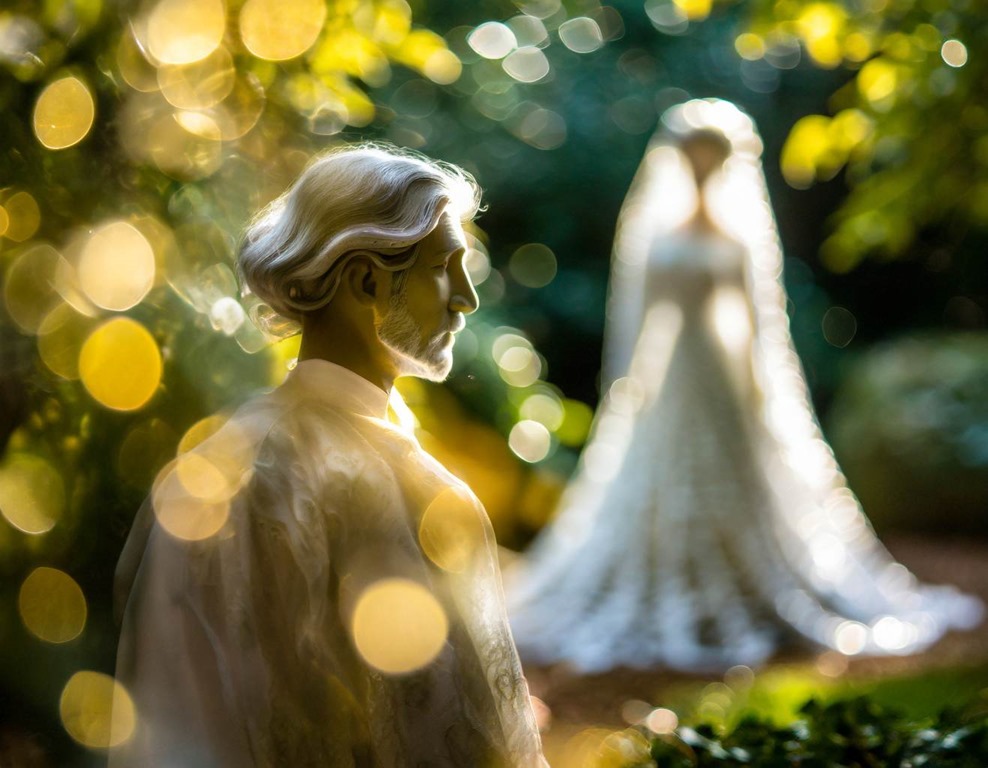
William Blake’s The Poison Tree

There’s much commerce between fantasy and fable — and William Blake, as literal as he may have drawn the angels of his visions, was one such trafficker. In this poem a metamorphical form of pomology creates out of anger a beautiful, attractive, and cursed fruit, so I thought this poem suitable for our Halloween Series.

One question asks for an answer in Blake’s poem: what makes the poison apple grown from wrath, fear, and tears “bright” and “shining,” and eventually so irresistible to the poem’s enemy?

Many readings concentrate on the poem’s singer, the one who instead of forgiving as he had done with a friend, grows their anger, sorrow, and fright into the Poison Tree. But let’s consider the other party, their enemy. Let’s look at the song from their view.

The emotions that grow the Poison Tree are often stronger than the more positive emotions like trust, love, and mere happiness — and the alloys of these negative emotions can be made into purer metals. Thus the human reaction, however unacknowledged, to envy the tactics of our enemies. Oh, what great evil they use, how powerful that is, how greatly we’ve been hurt by it — so, shouldn’t we be allowed at least some of the fruits of that tree? No, not all the root and trunk of that evil —for we are not like our enemies, — we are just owed a little of that power, maybe one apple?

The poison apple “shines” because it seethes with the power of hatred. It’s “bright” because the dark fruit becomes reflective the moment we reach to pick it. A convex apple is a strange mirror. We see ourselves magnified, we see our enemies too, we see wrath distorting us.

Blake’s fable in that reading says then: do not plant that poison tree from the injustice done to you, as the poem’s singer does, for the fruit will be impossible for your enemy to resist. “Oh, that’s not so bad,” you may first think, “the foe ‘is outstretched beneath the tree” as the poem ends. But beyond the poem’s ending there’s another refrain: the foes survivors have wrath, fears, and tears — and a seed poison apple for another tree.

One thing I admired about Blake was his multiple skills, out of which he created the poetry, the book design, and the artwork for his Songs of Innocence and Experience. Indie!

.

My performance of Blake’s “A Poison Tree”  is full of the sound of an American invention most often used by British bands of the late Sixties and early Seventies, the Mellotron. The Mellotron was supposed to be a home or light theater/salon entrainment device. It had tape recordings of instruments, including recorded sections of orchestral strings and woodwinds, one recording for each note to be triggered by a keyboard. When it was discovered by rock bands they found they could saturate their recordings in these orchestral textures. Because the articulations of the taped instruments were “canned” not freshly played, the result was a little ersatz — but eventually this was embraced and the output of the polite Mellotron was sometimes patched through overdriven amplifiers like an electric guitar might be. That’s part of the sound in the LYL Band performance of “The Poison Tree”  that you can hear with the audio player gadget below. No player?  This highlighted link is an alternate way to hear it, as it will open a tab with its own audio player.

.

The Listeners: a classic of mystery

Judging from the numbers of its inclusions in Internet lists of spooky poems, Walter de la Mare’s “The Listeners”  comes to mind to more than just me when people are asked to think of Halloween poems. Yet it has no monsters, no sudden scares, no wicked battles, no fully-described supernatural events.

It creates its strange effect in this strange way: it gives us lots of details which may seem inessential, and next to nothing of its central situation. The plot is simple: a man travels to a building on horseback. He knocks at the building’s door. No one answers. He leaves. As an elevator pitch summary, it has little to call us in or disturb us. Why does it leave us with a wondering chill? It’s those details. Here’s a link to the poem.

First off, there’s a supporting character in the poem which seems to have only one for sure, the Traveller. That character: his horse. We meet the horse right at the start, noticing that it is unconcerned and grazing as the Traveller opens with his door-knocking announcement of arrival.

We’re also told it’s night. Only slightly unusual, in that one generally doesn’t schedule appointments at night. The Traveller knocks again. We’re told the building has a turret. Castle or fortress, or just a decorated Victorian era house? We know by this it’s not a small hut or cabin. The listeners that are spoken of soon are something of some means.

The Listeners Illustration 1080

Our two characters: the Traveller, and the horse he rode in on. One thinks it’s very important to be there, the other couldn’t care less.

.

We’re told the Traveller has grey eyes. What an odd detail! We’re not filling out his driver’s license after all. Grey is a quite rare eye color in de la Mare’s Great Britain or Western Europe. Does the poem mean to suggest the Traveller is coming from a far distance?

Is there anyone inside the house? The poem mentions “phantom listeners” and these listeners are in the title. “Phantom” says they aren’t in the house at present in the way the Traveller and the horse are outside the door. We learn that the house has a hall, reinforcing by detail that the building isn’t small. The Traveller senses these whatevers, their “strangeness.” How are they strange? Nothing is said — but our second character, the horse, remains only interested in grazing.

The Traveller is insistent, pounding louder, shouting the intriguing line “Tell them I came…that I kept my word.” This is the plot’s climax, we don’t know what duty brought the Traveller there, perhaps from a long way off. Of course, we wonder what the bargain is, what the promise was. Is our wonder stirred by not knowing? Mine always is.

Another detail: we’re told the Traveller is “the one man left awake.” How are we to take that statement? That the “phantom listeners” are asleep and can’t be awakened? Or should we take it more catastrophically: that the “phantom listeners” aren’t human, never were, and that the Traveller is the last man at all, anywhere, awake? I never considered this latter reading until typing this tonight —perhaps I’m over-reading — but if so, is the Traveller coming to ask them to lift that spell, the only man still with agency to plead?

I love the final quatrain of this poem. Our horse returns, and the listeners, we’re told, can hear the creak of the leather from its saddle stirrup — a lovely detail, and a quieter sound compared to the pounding and shouting that has preceded it. Finally this sound: the evocation of the horseshoes ringing on hard stone inside a world of otherwise silence. The horse may be unconcerned by the silence, perhaps even the lack of any other awake people is not of any matter to it.

My music for this features the electric 12-string guitar, an instrument that I love. You can hear me perform Walter de la Mare’s “The Listeners”  with the audio player below. If you can’t see that player, no need to knock louder, use this highlighted link which will open a new tab with its own audio player. Thank you for being The Listeners for this Project!

.

Does your garden have ghosts, part 2: Hardy’s “The Shadow on the Stone”

Yesterday in our Halloween Series I mused on the appearance of ghosts in a garden with Millay’s blithe apparition. As I present today’s musical piece adapted from literary poetry, Thomas Hardy’s “The Shadow on the Stone,”  let me start by asking questions. Many others will follow.

Do you want to see a ghost? Is that wanting part of what makes it appear?

Hardy’s poem is poised in that first question. As I have performed it as a song with music that I wrote for it, I should wonder if the words are clear enough in themselves to tell us what the situation is. Looking at the text of Hardy’s poem, I think it’s mostly self-sufficient in that regard, though some mystery (possibly useful mystery) remains if nothing else is explained.

When I first presented this in 2021, I went into the biographical specifics that engendered this poem, but for today let me just say that the “she” that the ghost is supposed to be is Hardy’s dead wife who was completely estranged from him before her death.  Nothing in the poem spells that out, nothing tells us that when living she had grown to find Hardy completely unsuitable. Well nothing, save for a line that we can hear as modern idiom that Hardy may have intended only as a brief metaphor: “Her behind me throwing her shade.”

The Shadow on the Stone illustration 1024

Ghost from a machine: illustration from Adobe Firefly, the AI engine that proclaims it doesn’t use uncompensated artists work.

.

Such a complex ghost, or a wish for a ghost, this is!

Does Hardy want to see the ghost? Does Hardy fear to see the ghost? Can either of them speak? Are either of them changed from what they once were? Is he haunted by her, or haunted from her? All the answers are all the answers here. The curly shape of the question mark the shifting curve of an ghost manifesting.

Spontaneously when doing the vocals for this piece I decided to throw in some more answers at the end of my song in the form of “inline epigraphs” that Hardy didn’t include with his poem, but this performer did.

You can hear my performance of Thomas Hardy’s “The Shadow on the Stone”  with the audio player gadget below. You don’t see a player?  This highlighted link will make one appear in a new tab.

.

A fantasy wherein death and death predicted is balanced: “Her Strong Enchantments Failing”

Today’s piece in our Halloween Series is clearly fantasy. What value has fantasy?

Well, it’s often fun; it exercises the imagination by giving it an unlimited field. This potential has a natural limit however — humans are uncomfortable with the unlimited. We are animals quite tied to limits, to the actual, the particular. Even fantasy not intended as allegory must reference those things inside the everyday limits of our world, of our time. The SF of the past is often quaint with those make-dos, specifics that seem anachronistic to the stories unknown time. Watching a Sixties Star Trek TV show we see the family on the Enterprise bridge, the patriarch in an easy chair, the subsidiaries at kid’s-height tables, mom at the Radar Range — and all are watching one screen in front of them. Their haircuts are all in style for our now past mid-century. The warfare tactics: broadsides and boarding parties, already obsolete when freshly filmed. Watching it now, the other side — our present-day watcher’s side of the screen — we are farther into the future than these characters are.

I don’t believe poet A. E. Housman retains the readership in the U.S. that he retains in Britain. His best-known poetry collection A Shropshire Lad  is as series of poems considering rural adolescence and youth in the 19th century. UK readers might likely find that place in cultural memory more easily than Americans — but Houseman was not just local color. He was a classical translator and scholar of achievement. He knew how to put classical restraint, objectivity, and concision to work in poetry, like in this fantasy poem I set to music a few years ago, and will present today: “Her Strong Enchantments Failing.”

Her Strong Enchantments Failing

I like to include these chord sheets here from time to time. It’s my hope that better singers will improve on my own performances. Lot of suspended chords here, as this song’s moment is suspended.

.

The poem is set in a timeless place, though time still has days and death. There’s magic and spells there, laid out in a sharply chiseled first verse. I love the cinematic zoom from falling castle towers, to empty potions, to a knife at the titular her’s neck. And as page-poetry it’s eminently singable; and for a performer, the compelling force of the storytelling is what every singer would want in a lyric.

The situation violently balanced in the final two verses may just be plot for the author. The Queen’s slayer is about to process his knife’s edge. The queen, who’s emptied her spells and potions knows that they will work in magical or biochemical time by the next day. I have no idea if Houseman had any intended allegory to a situation here, something that might have been clear and present to his contemporary readers. When I performed this in 2020, it was then a fine fantasy poem, so well-drawn and easy to sing. Today, I can look at this autumn’s news and find easy parallels to current events.

You can hear my performance of A. E. Housman’s “Her Strong Enchantments Failing”  with the audio player gadget below. Can’t see a player? Not a spell, just the limits of some ways to read this blog. Here’s a backup highlighted link that will open its own audio player.

.

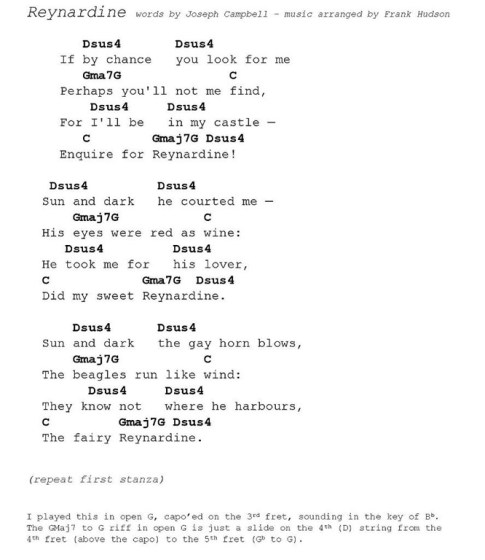
Exit the were-fox, chased by the land-holding patriarchy, “Reynardine"

Did T. S. Eliot for Halloween* suffocate our audience with too much of the musty air of the classroom? I hoped those loud synth fanfares would set such terrors to run. Maybe not. Well, I’m ready to tempt you back with a bit of love and seduction, a song set away from graveyards and into castles. Our Halloween series continues, and this time with 100% wooden music I played on an acoustic guitar.

So, ladies in nightclothes flaunting impossibly flowing but still in good array hair, running through the forest under a moon over the branches kind of stuff? Maybe. First some literary history. Don’t worry, I won’t take long with that, and there’s a good creature-feature song at the end.

We started our Halloween series with Frost and Eliot, poets that many will know even if poetry isn’t an interest. Today’s piece uses words from a well-known name that when applied to a poet isn’t well-known: Belfast writer Joseph Campbell is that name. Yes, every cursèd time I mention his name here I’m required to say “No, not the Power of Myth guy.” Poet Campbell was a contemporary of Yeats. And like Yeats he visited London when F. S. Flint, T. E. Hulme, and the “What’s with the initials guys?” Yank-transplant Ezra Pound were taking up their make-it-new idea to be called Imagism. Several years before Pound and Flint published their famous essay on the tenants of Imagism, Campbell published some of the earliest Imagist poems.

Campbell’s relationship with Yeats is complex. They both were heavily into valorizing Irish culture. Campbell was even more so into Ireland throwing off its exploitative English colonial status. Both seemed to have an interest in the faerie and spirit realms, though Yeats had an interest in practicing wizardry, while Campbell, AFAIK, didn’t. Both had interest in music, but Yeats was specifically resistant to having his poems sung conventionally, while what of Campbell’s work survives (underrecognized) is as a lyricist** for songs better-known than he is.

As a song, today’s piece, “Reynardine,”  became oft-performed in the British 20th century folk revival. When those performers would present it, they would introduce it as an old song — which is true in part. Its melody is largely based on an old air. The name of its main character, and something in the general trope of “I’m in love with a mysterious bad boy” did have old ballad antecedents. But those revivalist performers would usually want their audiences to know that the main character, the haunting love interest the singer knows but society doesn’t, is a shape-shifter, a were-fox.

Campbell’s words as printed in “The Mountainy Singer” are better, more direct, than the lyrics usually used for performing this song. I made one change: Campbell has “took me for his leman” in his, and I translated this to “lover” for clarity.

.

As I discussed briefly when I first presented this one a couple of years ago: that doesn’t seem to be so in the extant pre-20th century versions of this song. In 1909, our “Reynardine,”  now a were-fox eluding the patriarchy and foxhound driving hunters, was published in two books: as a collected Irish folk song from Belfast, and as a page poem in Campbell’s poetry collection The Mountainy Singer.  This idea of the song’s dark hero emerged that recently, and I have every reason to believe it was the little remembered Joseph Campbell who cast him that way.

I did my best with my performance of this one, thinking I was emulating those folk revivalists whose work I greatly admire. The one special thing I did was use Campbell’s set of words as printed in his poetry collection. With one small alteration, I think they work well to sing to modern audiences, and his version has the compression and specific mystery that can make Imagist poems and short lyrical songs compelling when contrasted with lengthy poems and discursive sung ballads. Audio player to hear the performance below. No player? This highlighted link will open a tab with a player.

.

*Unlike the other pieces I’ll present in this series, my settings of Eliot are not listener favorites. I watch the stats here while not spending much time trying to maximize them. Eliot draws some interest outside the U.S., and very, very little from here in the States.

I also want to say that I want to celebrate Halloween this year (more about why later in this series) and I want to do it as Emily Dickinson once wrote she did in approaching some topics in her poetry “I sing, as the Boy does by the Burying Ground — because I am afraid.” But writing as Eliot did of his unreal city of corpses that can’t be hidden, and casting it as a song of fantasy, vision, or delusion, can be offensive in a time where real corpses are piling up not from natural death, but from human intention.

If I offend you, you likely aren’t reading this far. I assure you I offend myself in doing so. “You! hypocrite lecteur! — mon semblable, — mon frère!” “You! Hypocrite reader! — my fellow, — my brother!” quoted Eliot, quoting Baudelaire, quote I.

**Even as the composer part of most of the Parlando Project, I want to say that a pet peeve of mine is folks crediting a song solely to the music composer. I hear this all the time with contemporary songs, particularly when the melodist has sung the piece: Brian Wilson, Carole King, Elton John, and so on. Besides his unacknowledged work in recasting “Reynardine,”  Campbell is the lyricist for “The Garten Mother’s Lullaby”  and “My Lagan Love.”

Our Halloween Series begins with “Stones Under the Low-Limbed Tree”

What’s coming up? Halloween! And I’ve decided to dedicate the rest of this month to accelerated posting of some of the Parlando Project’s favorite pieces of fright, fantasy, and the uncanny. There will be ghosts a-plenty, curses, creatures, spells, and graveyards. The Project has done over 700 combinations of various words (mostly literary poetry) and original music over the past 7 years or so. The poetry is of different styles and eras, and the music differs to, at least as much as I can make it do so.

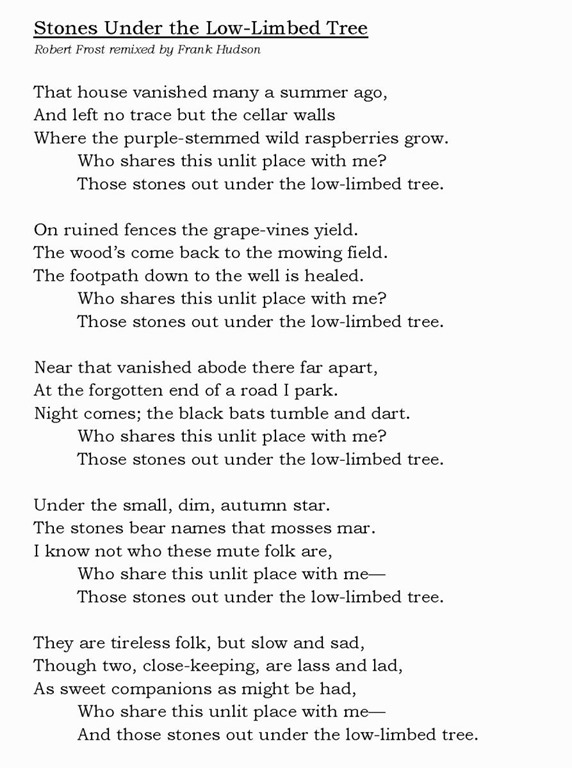
Here to kick things off is a poem by one of America’s favorite poets, Robert Frost, that I adapted and recast in making it into a song. Can Frost do eerie clothed in nature’s homespun? I think so. Frost called his poem Ghost House.”   I revised it enough that I decided to use a different title when I presented it in 2020 as “Stones Under the Low-Limbed Tree.”

If you compare my lyric to the original poem hyperlinked above, you can see I refrained things more than Frost did in his page poem

.

You can hear the resulting song with the audio player below. No player to be seen?  This highlighted link is an alternate way to hear it. It’ll open a new tab with its own audio player.

.
The Poet’s Afterthought

Does any poet know if their work is any good? Some perhaps have that conviction, but at least during substantial moments I think the majority of poets have doubts. This drives some poets to ever tinker with and improve their writing, and causes others to abandon the idea of poetic writing as a useless pretention. Some even numb themselves to the question — yet anything that numbs doubts can overshoot and numb creativity too.

Do bus drivers and child-care workers have these doubts about their work? Do politicians or generals? Is a poet’s lack of confidence in their work generally less than other artists? Let me only take the last question. I do think more poets have more doubt, because their audience is usually small, and that audiences’ response is so muted. Actors, musicians, or other performers can expect immediate audience response, it’s in the nature of their work that it exists only in front of others. Poets, even successful ones, read publicly much less often than they write. The attempts at bringing performance to poetry, with slam and other spoken word variations are seen by many literary poets as corrupting the complex and more contemplative aspects of their art. Novelists, screenwriters, the authors of non-fiction and memoir, can lucidly dream of paydays that would be fantastical for poets, and it’s not unusual for poets to step aside from their poetry to those other writing fields seeking something they can touch and deposit on account from their work. Visual artists are as abstracted from their audiences while doing their work as poets, but we have no auctions of living artists poetry that bring bidders to the alexandrine numbers.

So, in such solitude, such silence, or even within the quiet, diffuse reverence of award-winning poets, there is most often doubt. What would it be like if poetry was on most everyone’s mind, if living poets were giants in our culture?

Since I started this project I’ve sometimes thought of Longfellow, an American poet who reached that level of achievement. The American culture of Longfellow’s era wasn’t more educated or entitled to access to high culture that we are today. Yet, I grew up in a town, and live in a city now, which from that time created streets and spots, and named them for him like we would for Presidents or Generals. My father and his father would know, would memorize his work. We do not need to travel back to Classical Greece or the Confucian Odes to imagine that level of poetry in our culture.

And yet. Longfellow has disappeared, and as far as those that do care about poetry this is regarded as neither mistake nor injustice. This isn’t due to scandal. AFAIK, Longfellow lived a praiseworthy life. He must have said or written some things we could condemn, but on the big issue of his age, slavery, he was on the side of the angels. He was a nationalist, but an internationalist too. He may have appropriated First Nations names and legends with insufficient grounding, but he did it to ennoble not dehumanize them. No, the main reason we have dumped Longfellow off the bookshelves of our culture is that he doesn’t excite or move us in the least. His poetry seems like old civic statuary covered in pigeon dung, not worth noticing, and not worth any effort to replace.

American poetry is a different country now, and Longfellow is exiled from it.

Inside poetry, in its provinces, and within old classics where we might still retain interest, there’s current discussion about Emily Wilson and her fresh translation of Homer’s Iliad.  Wilson has been clear in discussing her practice of translation. She assumes or assays that there must be something there in the archaic Greek. Her task, she writes, isn’t to make a work that sounds like the original text, or to bring us its most exacting word-for-word translation, but to make a new poem that works like the original must have worked for it to have had the impact it had — a version which we can by extension expect to be something like the authors best intentions. We believe this is what Homer deserves, regardless of if our tactics vary from or agree with Wilson’s.

We do this for Dante. We do this for Du Fu. We even do this to some degree with Shakespeare’s plays. We don’t do it with Longfellow. Why not?

We may think there’s nothing much there. We may think that Longfellow’s English is close enough to our modern English that to do so would be presumptuous or dishonest to the work. This last objection is a funny combination with the first. If there’s nothing worthwhile there, who cares what we do with it?

For a recent live in the studio LYL Band recording I decided to “translate” — or more exactly, extract and arrange for greater direct effect to the modern ear, a portion of a lesser-known Longfellow poem, one he titled “Epimetheus, or the Poet’s Afterthought.”  Epimetheus, for those not up on your Greek mythology is Prometheus’s contrasting brother. If Prometheus is a hero, however tragic his fate, Epimetheus is the “Oops! I did that?” guy, a total fool. Prometheus is the I’ll give humans fire and suffer the eagle eating my liver forever hero. Epimetheus is the ”What’s in that cool box, Pandora. Let me have a look” disaster.

In my version I left Epimetheus out of it. Pandora too. Longfellow’s poem is a Friday-the-13th thirteen stanzas long and would require more melody and virtuosity than I can muster to capture a modern listener’s attention. I cut it to three stanzas, modified a couple of pieces of archaic word-order, killed one perfect rhyme for a near one. I did this because I think there’s a core in the piece that might speak to me or you without delay or overly baroque elaboration — and that’s the intent I found in Longfellow’s subtitle. If you write, particularly if you write poetry, you likely know the feeling: that joy and initial appreciation of the inspiration that carries you into the first draft, only to be followed by the problems of realizing the best poem that escapes us. And the completed poem? It travels out to a place where there are only wanderers like us.

Poets Afterthought

Here’s my much shorter adaptation of Longfellow. The full poem as originally published is linked here.

.

You can find that performance of my revised version of Longfellow with the audio player many will see below. Don’t see any audio player?  This highlighted link will open a new browser tab that will have such a player.

.

Touch lightly Nature’s sweet Guitar

This week while attending the online reading of all 1789 Emily Dickinson poems as part of the yearly Tell It Slant Festival, I have been noticing how many Dickinson poems use music as a metaphor. I know she played the piano herself, but I know little about what her personal musical aesthetic was, or if there were other musical instruments played in her home. Piano could be then, as it still was in my mid-century lifetime, a home entertainment device — provided that the family could afford the space and the cost.

For whatever reason though, Dickinson chose to use guitar in this poem, and seeing my “home” instrument in it attracted me.

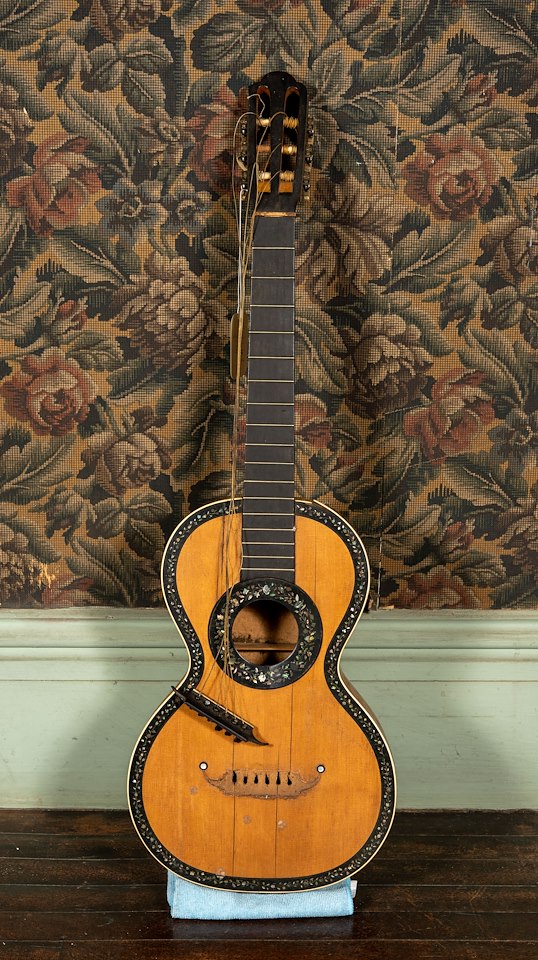
In Emily’s 19th century, guitar also played such a home entertainment role. I have a somewhat worn-out, very small bodied six-string that I sometimes play, and in today’s guitar marketplace such guitars are often called “parlor guitars.” The historic usage that name honors was that with less cost in space than a keyboard instrument, a home player could entertain themselves or their housemates with a guitar. These small guitars easily suited smaller-bodied women* and many of the players in the home were women.

A parlor guitar from the Emily Dickinson Museum’s collection**

.

When it came to realize my music for this poem, I didn’t play my parlor guitar — I played an electric model — but as I continued to go over the words in the process of creating the audio piece I’m not sure that Dickinson had an actual guitar in mind either.

Touch lightly Nature’s sweet Guitar
Unless thou know’st the Tune
Or every Bird will point at thee
Because a Bard too soon —

The opening line, used in place of a title as we do with Dickinson’s untitled poems, has somewhat conventional words for playing a guitar: “touch” “lightly” and “sweet.” Indeed, a parlor guitar like mine responds sweetly to a lighter touch and isn’t designed for driving picking such as used in some later American guitar styles. But Dickinson is a master at choosing the unusual word, the one you or I might never come up with. Her opening line calls it “Nature’s…guitar.”

Given that she moves over to bird’s opinions by the poem’s third line, I think this guitar may be figurative. Its wood and strings might be tree branches, and the Bard too soon, a too early storm. Still, the final line might be speaking of prerequisites for musicianship or songcraft, seeming to warn that a player should be cautious until they know their “song well before I start singing” as another songwriter once stipulated.***

I left a middle section open for an additional top line when Dave and I recorded the basic tracks last week. Afterward I wasn’t sure what should go there, but I decided to score one of my simple orchestral instrument parts for this featuring a violin. You can hear the result with the audio player below. No player seen? Touch lightly this highlighted link and it will open a new tab with its own audio player.

.

*They weren’t made especially small, the petite size was normal for guitars in that time. The current standard size acoustic guitar in our era, often called a “dreadnaught” (because it was seen on arrival between the World Wars as big and formidable as a battleship) is much larger in dimensions: deeper, longer, and wider, and often with a longer-scaled neck.

Men played these small guitars too. In an earlier post I showed a picture of what purports to be Mark Twain’s own guitar, which is also that then standard parlor size, though Twain said he played it for the roughs in his California sojourn.

**The Museum has only recently been able to digitally document the artifacts in its collection. Perhaps due to the difficulties in provenance because the houses of Emily Dickinson and her brother and important friend and sister-in-law Susan Gilbert Dickinson did not pass immediately into museum curation, there is no online information as to who may have owned it, or even if it was played in Emily’s presence. I’m somewhat knowledgeable, though not a professional appraiser, and think this guitar could be a 19th century instrument. The collection’s picture of the back of the guitar shows a blacksmith-quality repair at the headstock joint. A common guitar injury, then as now, is for the neck to fracture at that place. My somewhat-informed-amateur’s opinion is that the headstock may be later than the rest of the guitar and was grafted onto it.

***A stipulation I disregarded, as the first song I learned to play was the Dylan song containing that line, “A Hard Rain’s A-Gonna Fall.”   I did not touch it lightly.

Like trains of cars on tracks of plush

Later this month I’m hoping to attend remote online sessions of the Tell It Slant Poetry Festival run by the Emily Dickinson Museum in Amherst, perhaps as many as I did last year. Something they do that I enjoyed was listening to all the sessions where a range of readers read all of Dickinson’s 1789 poems.

Now was I sitting in rapt, solitary devotion for every hour of that multi-day marathon? No, though I was paying some attention throughout. I restrung some guitars, reduced the clutter in my office and studio space, put away laundry, and tended to the dishes. If I gardened or cooked, I could pretend I was work-a-day Emily herself.

What makes the marathon meaningful, even if one does it only in part? The multiple voices for one thing. A group of several people read the poems in rotation each session, so there was no careful preparation from foreknowledge of which poems exactly each reader would read. A prepared reading might be powerful — having trained actors or voice artists read the whole corpus would bring something to it. This is not that, yet worthwhile.

I’ve heard a lot of folks read poetry over the years. Several of the readers struck me as better than most, even given that they might be reading the poems that came up in rotation for their turn essentially cold.*  Of course, every so often one of the readers in their turn would get one of ED’s greatest hits, and all of us: the reader, the other readers, and the attendant listeners would perk up. If one pays attention to this, that happenstance, it “dazzles gradually.”

But then too the ordinary readers, the times when someone stumbled on a word, the lesser-known poems, the small ones that might be no more than a quatrain or two — they two are part of the fullness of Emily Dickinson. She may have been a genius, but she produced these hundreds of poems among a more-or-less ordinary life, infusing them with worthwhile attention. With this many poems it’s unlikely anyone (certainly not I) can really hold all of Emily Dickinson’s work in memory. And so it is, in such a complete reading, that some poems will spark with my attention as if they were just written and never before read or heard. With the smaller poems especially, it may be not much more than a glimpse we share in real-time with Dickinson’s ability to see and think differently. Yet, those small visions add up over the hours, grander from their numbers of unique takes.

Which are the poems she drafted while baking, head full of the hymnal meter, hands dusted with flour? Which while in the garden? Which while caring for her sick mother?

Virtual attendance is planned for many of the Tell It Slant sessions that run from September 25th through October 1st. You can sign up for them at no cost at this link. No one’s taking attendance — see or not see any of the sessions as they fit into your life or level of interest. Given the uncertainties in my life, I’m not sure how many I will be able to fit in.

One game I played during the readings — where I eventually jumped into the chat window with exclamations — was whenever the poem cycle came upon a bee. Dickinson closely observes many plants and animals, but she seems to have had a particular affinity for the bee. Is it a symbol of the Puritan work ethic? A chunkier, easier to observe bug? A symbol of fertility? A flying rose with sweetness and a sting? A coworker the knowledgeable horticulturalist knows is essential to pollination?

like trains of cars on tracks of plush illustration

Billy Strayhorn and Duke Ellington aside, sometimes the muse takes the bee train,

.

Here’s one of her short bee poems, particularly extravagant in its imagination. And here’s a link to what I believe to be the authoritative text.**  That opening image alone should astound. Bees as a railroad train, with the plush flowers as directive as train-tracks —yet soft, not iron.***  “A jar” in the second line is ambiguous. A jar as in a container for the pollen it collects? Possibly, but I’m suspecting more at ajar’s meaning as apart or out of harmony. Bees as locomotives and their train of cars makes them outsized from reality’s proportions. They may move the petals on close examination, their industry is harder and heavier than the plants.

In the second stanza, the metaphor shifts. Now the bee is a knight, the flower a fortress or castle they assault. The bee-knight seems a strangely chivalrous marauder, if inconstant and ready to move off to the next bloom.

As an Imagist poem, this then can be apprehended as simply a picture, an observation of a charged moment of attention. How strange to see the tiny bee as a train or even a knight — but yes, it must travel in appointed commerce on its compelled track, and yes, like a wandering knight-errant it must move on.

But this bee could be a muse too, couldn’t it? It knows its schedule, even if we don’t. It arrives, shakes us like a passing train, assails our walls, then bids a courtly adieu and passes on to another artist, writer, musician.

You can hear my musical performance of this short Emily Dickinson poem “Like trains of cars on tracks of plush”  below with the audio player gadget you should see there. No player? This highlighted link is another way to hear it, as it will open a new tab with its own audio player.

.
*I once worked for a radio network. Watching the on-air folks, I was reminded that the ability to cold read text is a skill. It sounds easy to do — when it’s done right.

**There’s a twice as long version out there which I think is derived from the 19th century Mabel Loomis Todd and Thomas W. Higginson posthumous collections. These were straightened up for easier public assimilation and were given, by the editors, their ideas of meaningful titles. Did they append two fragments thinking them connected? My apologies for not researching this issue further.

***As striking as Dickinson’s image is here, railroads were as essential to 19th century American commerce as bees are. Towns grew and shrunk based on their routes. Another plausible reason for the train image: one of Dickinson’s father’s commercial achievements for Amherst was assuring that it’d get a railroad line.

Another Child (“To Any Reader”)

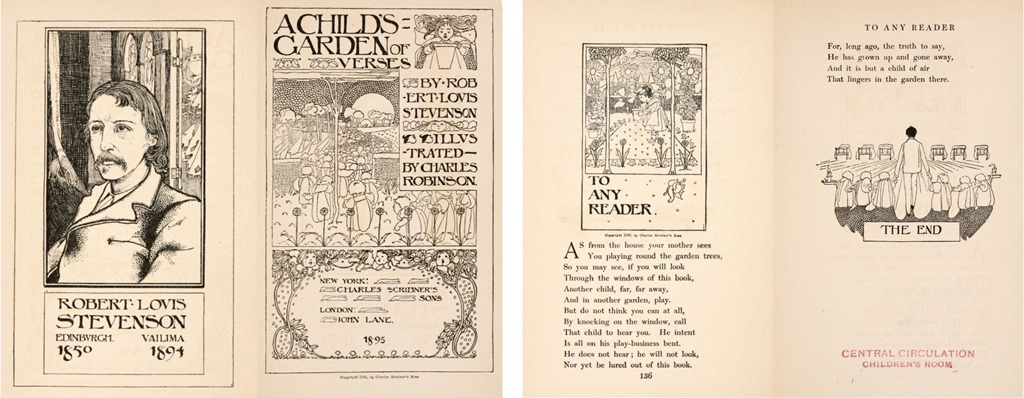
When I used a Robert Louis Stevenson poem last July I wasn’t expecting to follow it up with another. When introducing his “Bed in Summer”  then I mentioned that writing poetry for children, as Stevenson was doing in his A Childs Garden of Verses,  seemed to reduce some of the fustian of a lot of Victorian verse.

So, when I happened upon this other example from that collection I was even more struck by the sensibility of this one. Though I had no reason to believe Stevenson was intending visionary poetry, today’s piece could almost fit inside of Blake’s Songs of Innocence  — though it was written a half-a-century after Blake’s death.

another child layout

Here’s one illustrated edition of the book and the original text with Stevenson’s title “To Any Reader”

.

What was the author’s intent? I first read it as Stevenson making a pitch that even if the poems in his book might someday seem quaint and old-fashioned, they could still relate to like-experiences of some future another child. Was this canny foresight on Stevenson’s part? Stevenson was only 35 when he published this book, so his own childhood memories should not have been all that outdated as he wrote the material. On the other hand, his childhood nurse (to whom the book is dedicated) raised him on John Bunyan, stories from the Bible, and tales of 17th century Scottish Covenanters. That may have made him aware from a young age that tales from past times could be transmitted to young minds.

I do recall encountering A Child’s Garden of Verses  as a young child in the mid-20th century, though I can’t say for sure where. Did someone read it to me in my pre-literate days? Was it a book from my parents’ library, perhaps a keepsake from their childhoods? Did I run into it while exhausting my tiny Iowa town’s small library children’s section?

I would not have minded if it was old-fashioned, for I was from a young age fascinated with the past. It could have seemed juvenile unless I came upon it very early in my reading years, but most editions were illustrated, and illustrations excited the ekphrastic in this young reader. Yet my recall on this is not that specific, I just remember that I had seen it. I have more recall of reading Stevenson’s Treasure Island  and enjoying that.

Oddly, when I finally looked this week, this is not the lead-off, introductory poem in the book. Instead, it’s the final poem — not the place to make the case to continue reading “To Any Reader”  who just happened onto the book. Instead, in this place, it’s a ghostly envoi, a reminder to the child (or to the adult reading to them) that they, their childhoods, will obsolete themselves.

As I did with Claude McKay a couple of pieces ago, I decided to adapt Stevenson’s words slightly for singing. Some changes were to make it less awkward to separate things into a series of sung verses. A couple of changes just fit better to my non-agile tongue. Most significantly, I devised a repeating coda to drive home a final summary to the listener. One subtle thing I did was a covert attempt to speak to my own child’s specific journey to young adulthood.

Another Child song with chords 1080

Here’s my version. Since I want to emphasize that other child of air, I also retitled the poem.

.

An uncomplicated folk-song style setting seemed appropriate. The chords today are simple for the guitarist, though the alt-tuning I used changes the sound of this simple chord progression slightly. You can hear my performance with the graphical audio player below. If you can’t see any player, I also provide this highlighted link which will open a new tab window with its own audio player.