I’ve made note that I didn’t do a piece from Dave Moore for St. Patrick’s Day, but I’m about to deal with that. Readers of earlier posts this month know that I was writing about falling in with a group of Irish-American writers almost 50 years ago. The group in its last decade or so was just four of us, and you’ve heard my performance of words from the two of them who died a few years ago. Dave’s not in that group — well, he was in the group, but he isn’t dead — and I don’t know if Dave ever considered himself an Irish-American writer either. At the other pole, we have Ethna McKiernan who spent time living in Ireland, whose father was a figure in the Irish cultural renaissance, who ran an Irish-arts focused store for many years, and some of her poetry was published by an Irish publisher. That’s more Irish than green beer.
What makes one an Irish or Irish-American writer? I’m just an observer here, but I suppose opinions differ. It never crossed my mind to consider Edna St. Vincent Millay an Irish-American writer, but there’s Irish heritage there, and while her most well-known poems don’t explicitly speak of Irish themes or history, I eventually found and performed this poem of hers that’s quite Irish. Shortly after I discovered Joseph Campbell and was in my first burst of enthusiasm for him, I asked Kevin and Ethna if Campbell was counted in the realms of Irish culture. He was as unknown to them as he remains generally, but he was deeply embedded in Irish culture in his writing and life in both Ireland and the United States, and even his downfall was largely due to ending up on the losing side in the Irish Civil War. Campbell’s clearly an Irish writer who lived in the U.S., but he’s just so little-known. Let me add one more: does anyone consider Frank O’Hara an Irish-American writer? I once did a web search looking for anything written along those lines. If I didn’t come up dry, what I found wasn’t enough to dampen the leather above my bootsoles. If I was asked to find such a connection, I’d point to O’Hara’s manifest sense of mischief and his greater interest than most mid-century Americans in poets who weren’t British.
Perhaps it’s somewhat a coincidence if one is an Irish-American writer or one isn’t. You don’t have to write one way or the other, and it may not have to do with where your parents or grandparents were born. And by coincidence too long to interject here, I came to see that this Tuesday, the day after St. Patrick’s Day, is the anniversary of SciFi writer R. A. Lafferty’s death. I saw this and — ta-da — I remembered that I have a recording of Dave Moore singing his song about that writer. Recalling that, I found that recording and worked today on spiffing it up a bit sonically since it was 10-years-old and reflects some older recording tech. And sure enough, right in the lyrics Dave claims Lafferty as an Irish writer. So, an easy job to complete today’s musical piece and post?
Sort of. I didn’t plan this enough ahead of time to give Dave time to say anything about Lafferty and his writing. I had memories of his telling me, or trying to tell me, about Lafferty’s writing, which had a brief flowering in the 1960s-80s — but what was that he said back then? I thrashed about this afternoon finding a copy of his 1972 short-story collection Strange Doings. I rapidly read a half-a-dozen of his stories just trying to get a flavor, and I got some sense of why Dave had a hard time encapsulating Lafferty’s virtues. At least in this collection, his prose style is somewhat creaky pulp, yet with that instrument he sets out to tell rather strange metafictions in even stranger ways, often ending in a shaggy dog joke. The image I got was I’m at a dive bar, and there’s this man sitting on one stool. He wants to tell me a story. As he goes on, I try to get a read on who he is. Is he some kind of scientist on a weekend bender, or an in-his-cups academic from a nearby Catholic college? Or maybe he’s a man who’s watched too many episodes of Ancient Astronauts, and takes Neil Oliver and Graham Hancock as his vademecum? Are the beverages why the story started to twist, or are you just not ready to understand the essence of the fractal he’s generating? I ask him what he does for a living, and he tells me he’s an electrician.
One thing’s certain: he needs just one more drink to finish his story.
“So why are you so interested in all this you’re telling me?” I ask.
“Oh, I’m also a writer. You said you’re a writer. I thought you might be interested in this.” He looks at me, expecting reply.
“If you write like you talk, you’re more like how I play electric guitar. I run off in some direction until I hit something, then I bounce off in another direction.”
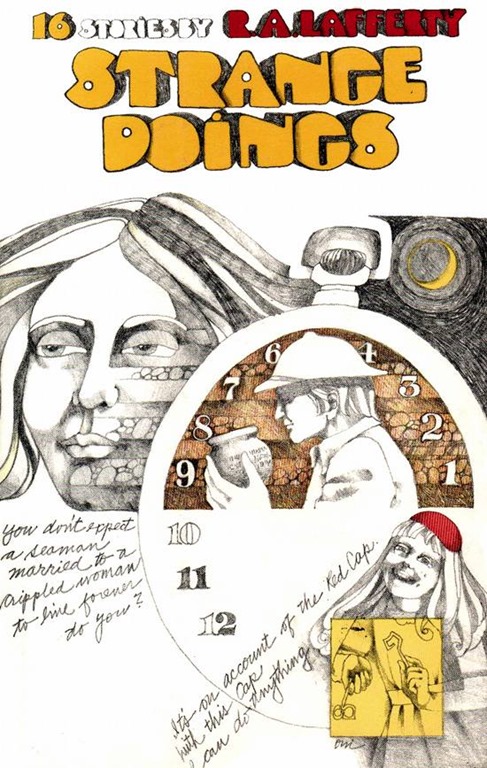
This 1972 collection of Lafferty short-stories credits the cover design to “ONI”
.
There should be a graphical audio player gadget below to hear Dave and I playing Dave’s song “R. A. Lafferty” back in 2015. At the very start of the Parlando Project I set this recording in a folder of possible pieces to use for it, but I never did because I feared the audience for literary poetry might not find much relevance in Lafferty. Well, the imp of the perverse convinced me otherwise. No audio player? You see, Lafferty has documented that the audio player gadget was invented by Higgston Rainbird and — oh never mind, you can use this highlighted link which will open a new tab with its own audio player if you don’t see the gadget.
.


 Frank Hudson