Poe’s The Haunted Palace

Let’s continue our series of fantasy and supernatural poems with a musical performance of a poem by Edgar Allan Poe — a poet that might be expected to appear in any such series. Before we go to that poem and my performance, let me take a quick jaunt back to my mid-century youth.

Poe sat in a unusual place in literature back then (and probably still does now). His writing, including his poetry, remained in circulation. Unlike Longfellow, it wasn’t likely because it was deemed worthy lessons for young people — Poe’s writing kept its place for its gothic sensation into the 20th century. Without Poe or his sensibility, would there have been then a Vampira, EC horror comics, pedantic pulp detectives, Lovecraftian horror, a great deal of Heavy Metal lyrical content, or a post mid-life movie career for Vincent Price? And that’s not even broaching the topic of Poe’s influence on the French Symbolists, who took elements of his strange and abnormal on an emigration journey from the asylum to the academy.

For a year or so around middle school age, I went on a Poe jag, reading a great many of his stories in collections that also included his poetry. It was a short-lived enthusiasm, and I’m not sure what remains of it. Did I start there with my love for an unreliable narrator? Was the on-the-spectrum “Aha” moment attractive to me neurologically anyway before this reading? Since I can’t say, let’s get on with an example of Poe being the inevitable poet that a Halloween series calls forth when the boundary-line between the dead and the living becomes permeable.

The scenery about the ghosts in “The Haunted Palace”  is something of a poetic trope. Poetry loves a ruin, and poets being the unacknowledged back-benchers in the world of political power, there’s a draw to poems about the death of kings — and so we have poets writing “Ozymandias”  or “Jade Flower Palace.”

Poe though is drawn almost entirely to the sensuousness of the decay here. There’s no lesson about unwise or tyrannical rulers in the poem. There’s no tragedy — if we can even guess the kingdom’s tragic flaw it might be that it was all too beautiful.*  On one hand I find the poem a hallow poem of hollowness — but intended by the author or not, that hollowness is a statement about great kingdoms and their lovely riches. And the ending’s invocation of always escaping — and therefore not escaping — unsmiling ghosts of hideous laughter completes the poem with a powerful rhetorical burst.


Take a sideways jump to the genius of SCTV

.

Perhaps because of the simple harmonic structure of my musical setting, I worked some hours unproductively this week on additional musical decoration. I made two attempts at twin bowed-string lead lines for this, and abandoned both those ruins to our mutual benefit. After that wrong turn, I decided that the piece’s feature is more its swaying, understated groove which I left to stand for its value. Mid-century ghosts visiting this music are welcome to do The Frug or The Jerk while listening, but those on any side of the Samhain borders can visit “The Haunted Palace” with the audio player gadget below. Has such a gadget disappeared within a fetid mist? Oh, no matter, you can hear it with this highlighted link then, as that will open a pale-doored new tab with its own audio player.

.

*Poe wrote that the death of beauty was the ultimate poetic theme — the gothic manifesto in short. I’d note in that an undercurrent there that many (most) artists feel: that they create all their beauties, only for them to become abandoned ruins with rare and uncommon audiences. As Frank O’Hara’s fraternal twin brother Count Floyd said: Pretty scary, huh, boys and girls!
Jade Flower Palace

National news and household events continually waylay my attention. Dejected gutters, palace intrigues throwing glances on complicated and duplicitous political alliances, and a middle-schooler with the sniffles—how can one weigh these things against this small but welcomed audience here for music combined with (mostly) poetry?

And so, I found myself short of material as I got ready to record with the LYL Band this week, a problem that the domestic, the national, and the poetic world combined to answer.

My wife had sent me a poem from the Confucian Odes  recently, a loving gesture gratefully received, and as beautiful as it was, I wondered about the poem and its English translation because of my work here. As the news sticks its tongue out at me with screen-edge notifications (mutterings about the Emperor and his possible private derangement issuing from the far-off capitol) I read again some of those Confucian Odes,  an ancient anthology designed to instruct not just scholars or poets, but politicians and bureaucrats.

What an odd idea. I suppose distributive requirements in American colleges still require some exposure to literature for those who will eventually serve in those roles, but this anthology was considered core material in Imperial China. And the Confucian Odes  are not grand works of moral or civic uplift, rather they are compressed, tiny reports of humble activities, decisions, and situations. They sometimes imply or depict correct behavior, but they don’t explicitly end with a moral. Their lesson may be, in the largest part, that the reader must study them and find the lesson in the everyday.

How different would our emperor or his retainers be if this was their schooling?

One collection I read mixed in later classical Chinese poems with some of the Odes.  It was here that once more I was pulled in by Du Fu, one of those aspiring bureaucrats who was steeped in those odes, but who lived centuries later at a time his country was in rebellion and upheaval. The Confucian ethos elevates faithful service, but who was to be served was shifting with the tide of rebellion. Reading Du Fu’s poems from the 8th Century as a small-part-citizen witnessing an empire disrupted in folly can have eerie resonances.

Late Thursday night, worried about material to record the next day, I began to translate Du Fu’s “Jade Flower Palace.”

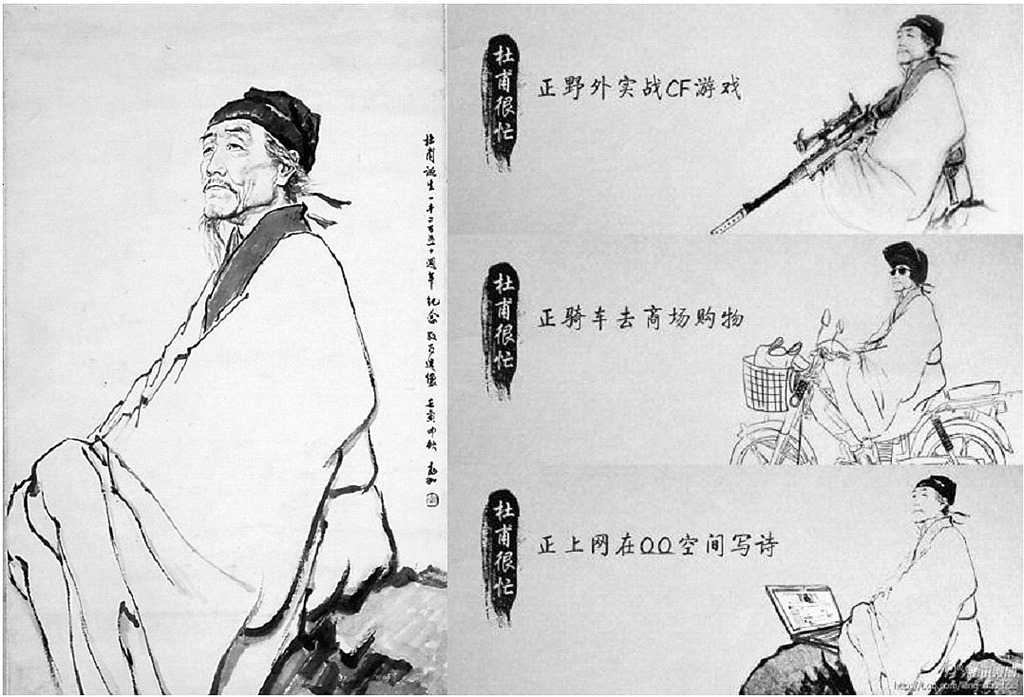
Du Fu and his Memes

If time is boustrophedon, wrapping back next to itself, then Du Fu may still be with us.


I could not find a clean literal translation of the original ideograms for the entire poem, only for about half the lines. I was able to find three previous English translations, which I could at least triangulate for the parts I didn’t have the raw stuff for.

Looking at what I had, I noticed that Du Fu was making constant juxtapositions, comparisons of contrast. Even the opening lines had water pushing and wind sighing and reflecting. That seems conventional, even a commonplace like “oh no, the wind and rain” in an English folk ballad, but it’s followed by a jump to rodents running through a roof, so close to a translation of the English idiom “bats in the belfry.” I decided to take Du Fu as intentional here. Events may seem to push you, or you may sigh and accept them, but “Rats are running in the rafters.” The ruin is real, and for that matter, your mind may reflect that too.

What follows is partOzymandias  without Shelly’s political radicalism, and part ghost story. A ruined palace, once as lush as Mar-a-Lago, haunted by ghosts. I was puzzled by the “green ghost fires” referred to in this section, what with my limited knowledge of Chinese culture. Those three words are wonderous, but I still don’t know exactly what Du Fu is describing. Are there actual fires, lit as protection from ghosts (akin to the tradition of ghost lights in theaters)? Why green? Is it brightly colored moss or overgrowth in the ruins? Is Du Fu seeing luminous ghosts (instead of hearing them as he does later in the poem)? I can’t tell. Looking at some online material on Chinese ghosts, I see that this end of August/beginning of September period is sometimes celebrated as “ghost month” in China, and various things are done both to connect with or protect oneself from various spirits. Offerings, such as burning a pile of currency may be left out. I have no idea if that goes back to Du Fu’s time, but in our current world, the thought of a burning pile of greenbacks to keep one safe from long dead rich people sure seems like a vivid image. And water is running over the palace’s roadways. Just what is the sea level of Mar-a-Lago if global warming isn’t only a political question?

Green Ghost Fires

“Green ghost fires” The “ghost light” on the dark Fitzgerald Theater stage and money being burned as part of the Chinese Ghost Festival


As you listen to “Jade Flower Palace”  perhaps you’ll want to pay notice to Du Fu’s subtle use of juxtapositions. More so than the other translations I read, I sought to bring those forward in mine. Translators seem to differ on Du Fu’s final lines, and that was a part where I didn’t have a literal translation to draw from. As midnight approached, I left two alternatives for my decision of what the final line should be to follow “There are many paths away from here.” It could be “How long are any of them?” or “None of them go on forever.” In the morning I decided that I would keep both, another juxtaposition.

In the performance on Friday I used this as our band warm up, where we loosen up our old and demented fingers, a cold first take. I repeated the first two lines once more at the end both to emphasize that they should be heard as more than commonplaces, and as a reminder (to invert a proverb of mysterious origin) that history isn’t necessarily instructed by rhyme, but repeats.

To hear the LYL Band perform Du Fu’s “Jade Flower Palace,”  use the player below.