Let’s give the lyrical reins over to Robert Frost one more time for another electric guitar driven piece. “The Aim Was Song” is a poem from Frost’s 1923 Mountain Interval collection, and not only is it a reasonably straightforward poetic credo from Frost, it speaks a little to Parlando’s goals too.
I put forward a definition of poetry as I was starting the Parlando Project as “Words that want to break into song.” I don’t recall where I read that definition, but when I searched this afternoon, all I can find is myself, so the source of that phrase may remain a mystery.
Unlike Sandburg and Yeats, Frost himself had no desire to sing or perform to music that I’m aware of, but his desire to use metrical/rhyming verse goads me to use him often here. And Frost had his own theory about how meter and language worked in poetry. He called it “The sound of sense,” and he once described it in a letter as akin to what comes through if you listen to talk in another room from the other side of a door. I don’t think he’s writing there about meter as commonly scanned in metrical poetry, I think instead he’s talking about human vitality that arrives through the panels of a door, the rise and fall, the breath and repetition. Frost’s theory was that you then laid that over the structure of metrical/syllabic prosody, so that each side pushes and pulls on each other. Too much evenness and it’s a motorik machine. Too little and you have only thoughts scattered on the page where only a silent and uncycling eye can gather them. You find that balance with one’s ear and heart.
Perhaps what Frost is aiming for here is the thing musicians call phrasing, but one thing that’s sure is that Frost believes poetry, even poetry of complex meaning or subtle rhetoric, is received through the ear and not the eye. So, even if Frost was not thinking directly of his poetry in association with music as we present things here, he is thinking of poetry as suffused with orality.
In “The Aim Was Song” Frost develops one image throughout: how the human being captures breath, moving air in waves, the essence of that natural force of the fierce spring wind, and shapes it into a smaller but more intimate thing. That is the work of musicians and poets. I could almost hear Lord Buckley read this one, as Frost repeats some words in his short poem that seem to pun on musical terms, to “blow,” “how it ought to go,” and “measures.” I didn’t go that route (if I could) but consider that an undercurrent in this.
To hear my performance of Frost’s “The Aim Was Song,” use the player below if you see it. Don’t see a player? This highlighted hyperlink will also play it. U. S. National Poetry Month is coming up in a few days, and I’m hoping to have a good number of encounters between music and words here in April. Please check back or subscribe, and spread the word.
A bit earlier this month we presented a landmark very short Imagist poem, Ezra Pound’s “In a Station of the Metro.” 14 words, and a prime example of the Modernist’s reaction to the rhetorical flourishes of a worn-out 19th century. Today I’m going to release a Robert Frost response, a 47-word rejoinder, a spring poem with some winter snow left in it.
Frost was born 145 years ago this week. His relationship with Pound is complex. On one hand Pound could view himself as responsible for launching Frost’s career, writing the first substantial review of Frost and seeing to it that his poems were published in Poetry magazine. Without Pound’s endorsement, Frost had submitted poems there which had been rejected.
Frost tells the story of their initial meeting, with Frost’s first book A Boy’s Will so newly published in England that he himself hadn’t gotten a hold of a copy. F. S. Flint (a too-often-forgotten pioneer of British Modernism) had met Frost at a bookstore reading, shortly after Frost had moved to England. Flint noticed Frost’s American shoes and insisted that he must meet his countryman Ezra Pound, now also residing in London. Frost later went to Pound’s apartment, and this is how Frost recounted their meeting:
[Pound] said, ‘Flint tells me you have a book.’ And I said, ‘Well, I ought to have.’ He said, ‘You haven’t seen it?’ And I said, ‘No.’ He said, ‘What do you say we go and get a copy?’ He was eager about being the first one to talk. That’s one of the best things you can say about Pound: he wanted to be the first to jump. Didn’t call people up on the telephone to see how they were going to jump. He was all silent with eagerness. We walked over to my publisher; he got the book. Didn’t show it to me—put it in his pocket. We went back to his room. He said, ‘You don’t mind our liking this?’ in his British accent, slightly. And I said, ‘Oh, go ahead and like it.”
Even in prose, there’s some Frost-ian ambiguity it his account. He notes in passing that the American Pound was putting on a British accent. And his sly quote of Pound “You don’t mind our liking it” before Pound has read it—a subtle dig at poetic politics that—and who’s the “our” here. Pound (and Flint too) were promoting a poetic movement, Imagism—poetry that used direct, concise treatment of “a thing” without any extra words whatsoever.
Frost never liked a movement that included more than him.
And to some degree this soon led to a break between the two poets. Pound thought that Frost fell short on the “use no extra word” dictum of Imagism. He apparently offered to help Frost learn to excise those surplus words—and though similar offers from Pound were taken up by literary giants like T. S. Eliot and Ernest Hemmingway, Frost refused it.
There was a second catch. In Pound’s review that launched Frost, Pound wanted to make a point of Frost’s rejection by American editors, and he was loudly saying this in an American magazine (one of those that had, in fact, rejected Frost). Many musicians and music fans will quickly recognize Pound’s move here. This is the punk/indie/”street cred” claim. This artist has too much honesty and individualism and lacks the subservient guile to please the suits and the mainstream! The problem here was that Frost was a middle-age man with a family—he wanted to cross-over to those editors. Frost thought Pound was pulling this move to show what a discerning critic he was more than to promote Frost as an outsider artist.
But note too in Frost’s account of his first fateful meeting with Pound, the subtle admission he makes about himself. “Oh, go ahead and like it.” He wanted, needed the help—by any means necessary.
Oddly, if you were to read Pound’s short review today, you might be surprised that it worked to launch Frost at all. There are condescending elements, Frost is almost treated as some idiot-savant country bumpkin. And worse for Pound, he goes on record as the first man to misread Frost as simple and earnest (the same mistake that I made as a teenager, but then I’m not Ezra Pound).
A patch of old snow, blossoms on wet dark bough not included
Here’s the text of Frost’s poem I use today and here’s Pound’s 14-word Imagist flagship. Look at Frost’s first stanza. Sure, Frost’s is rhymed and metrical, though Pound uses a near rhyme that many miss. If Frost ended there, his poem is purely Imagist. “Old” in front of snow isn’t a wasted word. We need to know it’s spring now, and that the snow is past its sell-by date. And it’s an interesting choice to say “blow-away paper” instead of blown-away—more immediate, and it indicates that its transient nature is inherent, not something acted upon from without.
Frost’s second stanza? Pound’s editor’s pencil might have suggested he’s restating the image from the first stanza, but Frost might have countered by noting that he’s making clear this isn’t just any crumpled scrap paper the snow is being made equivalent to, but a newspaper or other publication, with “small print.”
Here’s the Imagist difference. In conventional poetry, the images, the similes and metaphors, are only decorative—look, clever I can compare this to this. In Imagist poetry this comparison shouldn’t be just decorative—it’s the meaning of the poem. This last edition of winter is “yesterday’s papers.” And bilaterally, wrong-headed reviews in Poetry? They will pass like the lonely grimy snow-bergs.
The last line, “If I ever read it,” is Frost’s touch. Pure Imagism doesn’t like to draw conclusions, even enigmatic ones. Does it mean one thing? I think it predominantly says, it’s the past, I’ve endured, it’ll soon be gone completely. The poem first appeared in Frost’s third book, the first to be published in America not in England. Frost was on his way. But there’s an undercurrent—with Frost there always is. Is that small print an edition of The Book of Nature? After all, we also know this: winter will return, and should we not read what it has written to us?
Frost will do that too in many of his greatest poems.
This morning I ask myself, what a strange way to spend a weekend full of news and melting snow, reading the small print about two poetic innovators at cross-purposes to each other.
Musically, I wanted to let loose a bit for this one. I’ve been playing acoustic guitar for many recent pieces, so I wanted an unleashed electric guitar. The wild spring bird-whistles near the end are feedback between the guitar’s pickups and the amplifier.
Let’s just name the winner right off, and kill the suspense: Wallace Stevens’ “To the Roaring Wind.”
There was a time in my teens and twenties when Wallace Stevens grabbed ahold of me. I think back at that young man and try to wonder why. Well there was the accident of a very affordable collection of his best work that I mentioned when I first posted “To the Roaring Wind” back in early January. I think that I also liked the way his poems looked. Free verse looked right on the page to me as well to my ear—I was not writing metrical, rhymed poetry when I started—but the poems also looked ordered, focused, a tightly built thing. E. E. Cummings or Marianne Moore with their ragged lines and strange fragmentation looked like that they were confused about how to put things into words, where Stevens looked sure. Other favorites that came to me later in life, like Frost and Dickinson, seemed to my younger self all too pat and superficial then, and there was Stevens, his poems with majestic numerabled sections that seemed to be laying out a lawyerish or legislative structure filled in with an exact poet’s eye.
Poet Wallace Stevens. Gromit not pictured.
That I didn’t understand all that he was getting at in his poems wasn’t a problem. No, that was a benefit. For my paperback edition $1.45 I got work that one could re-read without knowing already how it would come out! I recall writing poems that I didn’t know how they would come out either, something I will still do. There was one longer one from that era, the first one of mine ever to be published. It had Stevens’ influence all over it, copying his Blackbirds-numbered sections.
Frost, who I thought was entirely too conventional then, claimed that he never liked Stevens’ work “Because it purports to make me think.” Isn’t that line so Frost-ian? First you might high-five Frost and shout “burn!” And then, if you pause and think about it, in decrying Stevens Frost makes a good argument for why you might want to read him—indeed, why I wanted to read him.
Oddly, this poet who was attractive to this teenager, published his first collection Harmonium when he was 44 years old. Lewis Untermeyer, one of the canon-gatekeepers of Stevens’ time, reviewed it then:
“…lacking the spell of any emotion, Harmonium loses both itself and its audience. It has much for the eye, something for the ear, but nothing for that central hunger which is at the heart of all the senses.”
Untermeyer and Frost may have been right to some degree. I fell away from Stevens as I aged, not from any conscious choice, but because I had other poetic worlds to explore, ones that often had emotional and visionary aspects that weren’t overt in Stevens work.
Here is where the Parlando Project, which performs the poems with music, comes in. There is no inherent emotional content in any series of notes stronger than what the musician manifests when they perform it.
As I noted that Harmonium, as a work published in 1923. was now in the public domain as of the first of January 2019, I looked for a piece from it that wasn’t one of its “greatest hits,” a deep cut to represent the collection itself rather than an often anthologized and well-known poem. My attention fell on the last piece in the book, this one. As I did this, a connection emerged with a local poet and poetry-reading organizer, David Shove who I learned had died at the turn of the year. “To the Roaring Wind” is a call to two things: to the muse, that time-honored concept that what supplies us as artists isn’t from our individual merits, but from things outside us that we must serve, and then, to speaking poetry aloud.
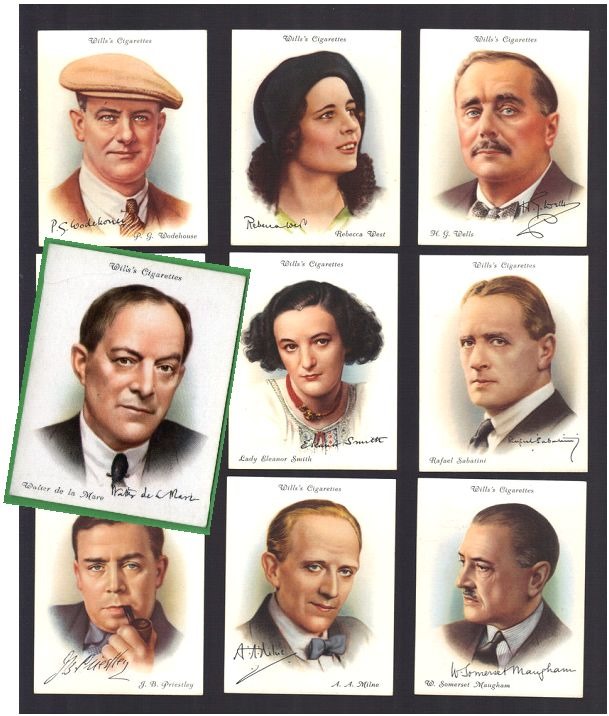
I know nothing interesting about the life of Walter de la Mare—other than he was a successful writer in poetry and prose for roughly half of the 20th century*. There appear to be no interesting movements or manifestos to tie him to, and though his lifetime corresponds roughly to those 20th century Modernists I often like and present here, he’s not considered one of them.
20th century British authors who got trading cards in cigarette packs level fame.
Certainly, his poetry doesn’t sound or look like Modernist verse. It’s frankly musical, and supple yet regular musical verse of his type is not that easy to write in English. Modernists took up with free verse for a number of reasons, partly because they were likewise enamored of the wider and more fanciful rhythms of Modernist music and visual arts, and because they wanted to explore new ways of relating reality, and the tight and formal clothing of metrical forms and rhyming seemed to restrict their range of movement.
There were folks with a Modernist sensibility who worked in rhyme and more regular metrical forms. Early Robert Frost and Edna St. Vincent Millay did. Frost in particular is often writing Imagist poetry with fresh, plain diction that rhymes in the era when his fellow Modernists were immerging.
Today I use a short poem of de la Mare’s, “Winter,” and the first thing that struck me about it is the word-music. Every line rhymes, and with perfect, not partial rhymes. Though de la Mare uses common rhyming words, the poem seems effortless, there are no lines that seem twisted to make the rhyme. But notice something else about “Winter:” the way it treats its matter, as opposed to its music—that’s close to the Imagists credo. It directly shows a winter scene. The opening lines “And the robin flew/Into the air, the air,/The white mist through;” are solidly in the Imagist mode. That opening “and” making sure we know this is an immediate experience. The entire second stanza too is Imagist through and through. Nothing is “like” anything. This is a real, immediate scene, and we stay there. The robin** flying through white mist is a bird flying through white mist, not a mere symbol, a counter for something else. Frozen bushes waver in the slight breeze casting varying reflections from the new rising moon or last sunlight. Yes, what we are apprehending through the poet has connotations, has feelings that will be invoked, but we aren’t told by the writer what they are, he assumes we’re capable of forming those ourselves.
Only in the ending stanza does de la Mare break the rules of pure Imagism. In his last two lines he personifies a speaking star or cardinal direction which speaks the final line. For me this works largely because this contrasts with the rest of the poem. If instead, de la Mare had started with talking stars giving us messages in so many words and continued in that vein through the poem with bushes and birds telling us what the poet wants them to say, the impact of the conclusion would be lessened, and the poem would be trying to work, not just sound, in the old way.
Musically, I unabashedly say I like what I did for this one. The piece began for me with the guitar part, which I was going to play on acoustic guitar, but my family came home early and there’d be no chance to record that with an open sensitive mic, but then many acoustic guitar parts translate well to the Telecaster which I substituted. The bass guitar part is unusual in that it’s played entirely on open strings, a sound that the instrument is rarely allowed to use. But it’s the orchestral parts which really pleased me. There’s a bunch of tracks here combining “real” strings played via a virtual instrument with a somewhat overdriven Mellotron violin mixed in there which brings the string section some grit***. I gave a top line part to an English horn. Use the player just below this to hear my performance of Walter de la Mare’s “Winter.”
English robin showing its all-weather operational capabilities
*I recall reading some of de la Mare’s ghost stories decades ago, but I hadn’t really considered his poetry until I was reminded of that by Toby Darling, who does a lovely job of writing and playing music to sing many de la Mare’s poems to.
**Residents such as I who live in the Northern parts of the U.S. may be surprised that de la Mare has a robin in his winter scene. The American robin is a different species, which migrates south for the winter, and as such the robin here has a strong symbolic association with spring. English robins stay put. The same name for different North American and European species could lead one to read some promise of spring that de la Mare didn’t intend in his poem, in the same way that Robert Frost’s American winter hemlock branch may not have been a Socratic hemlock branch. Anyway, both robins have a bright red-orange breast, which even though de la Mare doesn’t state it, adds a dot of color to the white mist flight.
**The Mellotron was an early, primitive attempt to do what modern “virtual instruments” do. Typically, if a virtual instrument wants to present a “real” violin it will sample a violin playing various notes, and the notes as well with a variety of articulations which are stored and organized as digital audio files to be played later. The 1960’s Mellotron had a simple tape strip of a violin playing a note in one legato articulation assigned to each key of an organ-style keyboard. The former can sound strikingly realistic if care is taken to make use of the various articulations (vibrato, marcato, pizzicato, etc.) while the later sounds artificial despite the tape strips being conceptionally the same. Of course, “artificial” is a state of mind, and the close-but-not-quite sound of a Mellotron instrument always reads as “England” to my ear due to it use on many 1960s and ‘70s recordings by English groups.
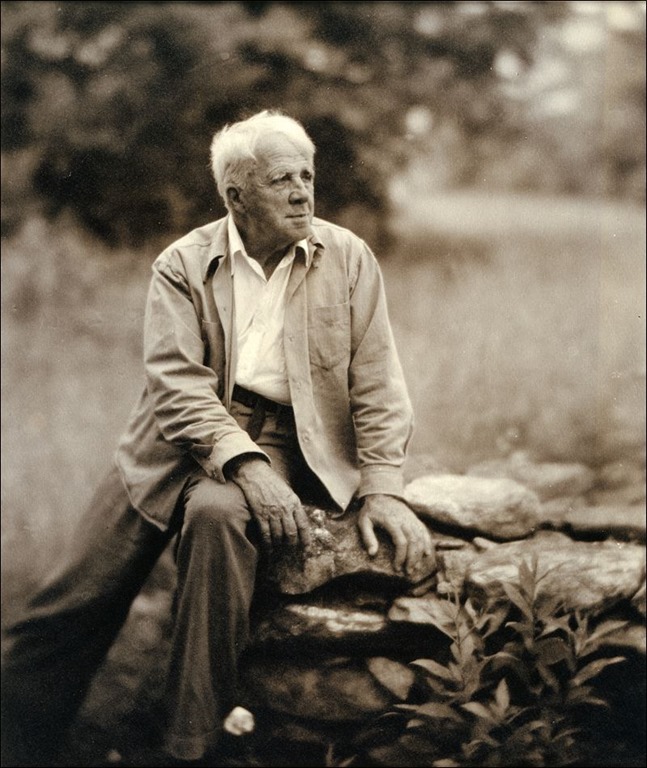
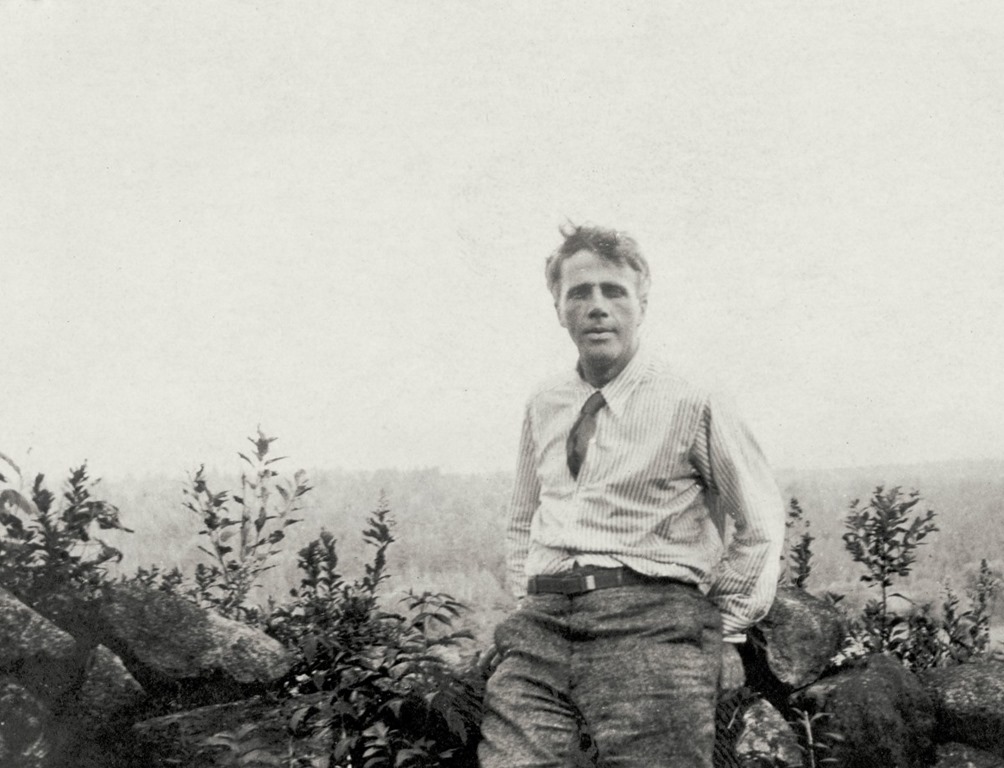
Robert Frost. Wry poet of the good old days—or maybe not?
Today’s piece is instead the hard-boiled Robert Frost. It’s blank verse, but the beat is implied, the sentence structures beat against it, and my performance choice was to not emphasize the meter. What “The Vanishing Red” portrays is, straight up, a racially-motivated murder, and the way Frost tells the tale uses sly ways to frame this story.
He doesn’t get out of the first line before he starts this framing. One of our characters is called the “Red Man” by history. A term roughly equivalent to the N-word for indigenous Americans, but one that in Frost’s time was not considered socially unacceptable.* Frost wasn’t going to shock or disgust his readers in 1916 with that epithet at the start of his poem, like he might some today, but he wants us to know from the start that the race and history of this man is material to what is going to happen—but we don’t meet him yet.
Instead we meet another man, the Miller, who’s talking in a way we might find familiar. He starts out by telling us he’s not guilty of something before he’s even been charged with it, claims too that he’s not one of that PC brigade who “talks round the barn” instead of straight talk, that he’s a get-it-done doer.
Frost adds just a tiny bit of narration after the Miller’s speech. Some may read this narration as excusing the man, but the narrator’s pointing us to think about two things as the story will continue. The narrator says, let’s not consider this as history (“too long a story”) or politics (“who began it”). As we’ll soon see, we’re going to consider this as an Imagist poet would consider it, as a presentation of what Ezra Pound called “an intellectual and emotional complex in an instant of time.” History can be dulled by time. Politics says there are two sides.
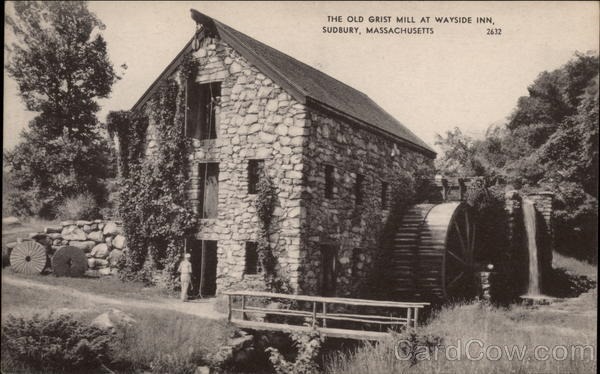
Nostalgic postcard or dark satanic mills? Frost reports, you decide.
But first we have one more exchange of dialog. Our unnamed “Red Man” is at the Miller’s mill, and we hear nothing he says directly, but we do hear what the Miller puzzles about what the other man is communicating. The Miller portrays the other man as without English words, but he interprets some “guttural exclamation” anyway as surprise, and this is somewhat sketchy. Is the native American puzzled by the mill’s mechanism? Surprised at being seen by the Miller?
Is the Miller even reading the other man well? I think not. Afterall, the Miller has another reaction, stronger than his sense of what the other man may be feeling, and Frost’s narrator also doesn’t “talk around the barn:” it’s disgust. But that’s not what our Miller portrays in his next piece of dialog. He acts friendly, offers to show “John” his mill.** Ah, the “Red Man” has a name, he’s not some reductionist cypher for an entire continent’s indigenous peoples, and since it’s an English name, we might surmise that he might even be one of the Massachusetts tribes that attempted to synthesize with the new rulers, taking to Christianity and living in “praying towns.”
And now the Imagist poem begins, ten lines. The Miller opens a trap door and shows John the water-power wheel, and a poem that has been entirely without imagery suddenly gets a vivid image. The wheel’s water forebodingly is like struggling, thrashing fish. The door closes, and the door’s handle (a metal ring) we are told makes enough noise with this shutting to be heard above the noise of the mill. And the Miller returns upstairs, alone. The wheel’s turned around to the beginning of the story where the Miller laughs, though it’s not quite a laugh. He meets a customer carrying more meal to be ground at the mill, who doesn’t understand what has just happened. We ourselves are just understanding what has happened.
What has happened? The racist Miller has thrown John, the “Red Man” into the mechanism and killed him. Frost wants you to feel that by showing you this moment in time, but he also wants you to vividly feel the lack of notice, the vanishing in the title, which isn’t some passive mystery, it’s an act of human cruelty.
Today’s music is two pianos, bass and drums. I’ve been suffering from a cold for the past few days which made completing today’s spoken word component a challenge, and I did miss one phrase in Frost’s text and didn’t get another one completely correct, but you didn’t get to hear any of the coughs and voice cracks from the bad tracks either. To hear “The Vanishing Red” use the player below.
*For example, the college I went to over 50 years ago called its sports teams the Redmen then. I had a tiny part in the beginning of the process to change that.
**Acton Massachusetts had a grist mill and more. I can’t find any pictures of them, but the town still has a Grist Mill Road.
It’s 1956. World War One had ended less than 40 years ago, instead of 100. Robert Frost is the most celebrated living American poet, and he has traveled back to England to receive honors from both Oxford and Cambridge universities, a symbolic laurel helping to mark the 20th Century acceptance of American poetry into the pantheon of our polyglot language.
Two elderly women follow an invitation to an upstairs to-do in London, where the American poet has just landed. Eleanor Farjeon is one of the pair, then 75 years old, and here’s how she described what happened:
We approached a white-haired man who was talking to T.S. Eliot. ‘It’s Helen and Eleanor, Robert.’ He turned towards us quickly, unmistakably Robert. Were we as unmistakably ourselves? Eliot smiled at us and withdrew a little…. Robert muttered, ‘Well, well, well.’ Soon he and Helen were talking of their grandchildren.
Who are these ladies that broke off the tête-à-tête between the two Modernist poetic titans?
One was the widow of Edward Thomas, the man who Robert Frost called “the only brother I ever had.” The other was the woman who had introduced Edward Thomas to Frost in 1913, Eleanor Farjeon. The poet Edward Thomas is not well known outside of Britain, Farjeon even less so, but none-the-less she had a long and varied literary career as a poet, playwright, children’s book author, and songwriter in a life that spanned from the Pre-Raphaelites to Carnaby Street.
Eleanor Farjeon early and late in her life
Back just before and after the outbreak of WWI, the Frost Family, the Thomas Family, and Eleanor Farjeon were a sort of an extended pod of friendship and affiliations. The Thomas marriage had strains, and Farjeon was in love with Edward Thomas. Thomas’ spouse, Helen, surprisingly cast Eleanor Farjeon not as a rival but as a balm to Edward. And so, between her own writing, and typing manuscripts to help D. H. Lawrence (also hanging around this circle*) Farjeon, like Robert Frost, took to accompanying Edward Thomas on his indefatigable walks around the countryside.
Eleanor Farjeon was still a literary stem cell at the time. She later said “In my youth I dreamed of being a ‘real’ poet, but half way through my life that dream died, and whatever figments of it remained went into writing songs** and verses for children.”
When Edward Thomas decided to enlist and volunteer for the front lines in the war, the pod all shared correspondence with Thomas, a correspondence that continued right up to the very week of Thomas’ battle-death. And after that, they all shared the task of putting his literary affairs in order and promoting the poetry of the man who had only started writing it during that short pre-war period.
Robert Frost and Eleanor Farjeon both wrote elegies for Edward Thomas. It may surprise you, but I’m choosing to use Farjeon’s memorial sonnet here to cap off our Armistice Day series on Edward Thomas, instead of Frost’s poem. Farjeon might have thought of herself as not a “real” poet, but it’s us, the audience, that decides. Her poem may seem to be made of genteel English stuff: gardens, Easter eggs, love tokens, so that it has the patina of an antique valentine—but that’s just the surface. How about those relentless repetitions? You can hear James Joyce or Gertrude Stein tuning up in the distance if you listen for those. Did she mean the punning subtext of the repeated “Eve” with the repeated apples? If this were a Joyce poem we’d assume yes, so why not here? And that surface? It’s a paper scrim she means to tear, to rip—and yet when she does it in the last line, there’s no sound, only an invisible gap, an understated “apology”.
Here is what Eleanor Farjeon said, shortly before her own death, writing again about Edward Thomas and Robert Frost when recounting her last, 1956 meeting with Frost in the company of Thomas’ widow: “We do not lose our friends when they die, we only lose sight of them.”
Here’s my performance of Farjeon’s “Easter Monday (In Memoriam E. T.)” that you can hear using the player below or with this highlighted hyperlink.
*Sounds a bit unconventional for an Edwardian village in 1913 doesn’t it—but any bets on who did the housework?
**And it’s in this guise that Farjeon is likely to be best known in the U. S. Back in 1972, three denizens of that Sixties London: Cat Stevens (later Yusef Islam), Rick Wakeman (later caped-keyboardist of Prog Rock fame) and Paul Samwell-Smith (producer and former bass-player with the Yardbirds) created an arrangement of Farjeon’s hymn “Morning Has Broken” for a best-selling LP and eventual #6 hit single on the Billboard U.S. charts.
Let’s return to sing the poetry of a man who’s far better known in Great Britain than in the United States, Edward Thomas. Thomas had a remarkably short run as a poet, only writing verse for about two years after befriending and sharing thoughts about writing and the observation of the countryside with Robert Frost during the latter’s stay in England just before WWI.
Thomas was no longer young when he started writing poetry, and he had scratched out a living as a freelance writer for several years before he met Frost. None-the-less, two years is a very short time to develop as a poet, and today’s piece “Gone, Gone Again” may show some rougher places commensurate with a poet who hasn’t fully developed his game.
As I worked with “Gone, Gone Again” as an audio piece with music, some of its odd poetic faults continued to jab at me, but as is sometimes the case with the Parlando Project, I grew to appreciate the poem and Thomas’ unique read on time and life more fully from the effort spent with it.
The poem’s meter is awkward and uneven, the rhyme unpredictable. A casual reader could hear it as doggerel. As the poem reaches its conclusion, with the only perfectly rhymed quatrain in the piece, the sentence seems twisted in order to make the rhymes.
How much of this is intended and how much of this is a beginner struggling with the verse? Who can say. From working with it, I think the rhyme scheme that refuses to be—well, a scheme—is likely intended. It does keep you off balance, but I think it’s effective. The meter with its odd steps, is likely just as intentional, though I’m still not sure it works as well for the performer or listener. Even in the performance you’ll hear today I didn’t reproduce Thomas’ text correctly, rounding off a few of the rough spots, and revising the last line of the fifth verse. Another musician who has worked with a great many poems, including a number by Thomas, gracefully manages to sing this poem unaltered, though I’m now somewhat attached to my “mistaken” changed line.
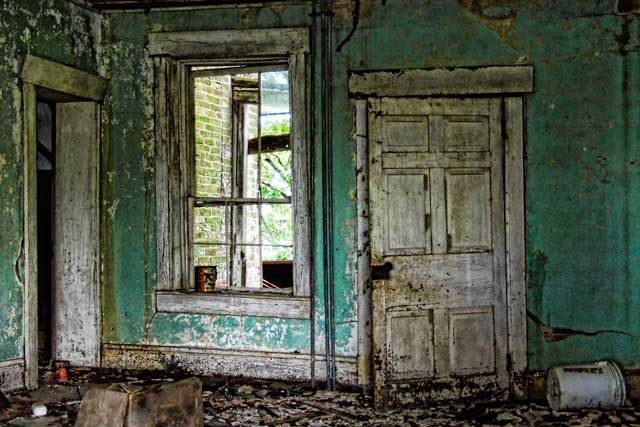
Thomas wrote “Grass growing instead” which would be consistent with a house abandoned an unknown time ago, but I sang “Grass growing inside,” which while a strong image determines it for long ago.
What then comes from repeated readings, or from the time I had to spend with this poem in order to turn it into a song? Thomas is playing with time. He starts off with a common trope: and end of summer poem. How many of us are having this same thought, “Where did the summer go?” Almost as if he’s leaving his own critical note, Thomas’ second stanza says right out, “Not memorable.”
And then he adds: “Save I saw them go.” Already, the poem starts its turn into a poem about survivor’s guilt.
In the next verse, we’ve gone from a ballad stanza style rhyme scheme, to a verse that starts with a rhymed couplet, followed by an unrhymed couplet. You really feel the lack of rhyme every time you sing or say “The Blenheim oranges/Fall grubby from the trees.” The curious pendant in me had to find out what a Blenheim orange is. It can’t be an orange, can it? As the sentry in Monty Python’s Holy Grail reminds us: “Found them? In Mercia? The coconut (like the orange) is tropical! This is a temperate zone.”
The Blenheim orange is instead an English apple variety. Blenheim orange is a flavorful name though. It’s even an alternate title under which the poem is sometimes published. Assuming intention, Thomas may have chosen it not just because the apple is named the same as an imposing palace in Oxfordshire, but because the palace, and presumably the name of the apple as well, comes from a battle that was already 200 years ago when Thomas wrote his poem, a key engagement in the European War of Spanish Succession.
This may be too subtle by half, a College Bowl or Jeopardy-level question about history that almost everyone in the audience will miss.
Here’s where the play with time part returns. The poem next visits an abandoned house site, a trope that Thomas’ friend Robert Frost would go to more than once in his own rural poems.
Thomas is writing his poem in the context of WWI. During his entire poetic practice, he was grappling with the question if he, nearing 40 years old, should volunteer for battle service in WWI. He’s considering this well past any illusions of a grand battle adventure. He’s well aware that modern warfare has turned technology into an efficient killing machine, in his disconcertingly brutal phrase, turning “young men to dung.”
How long as this house been abandoned? Since the war of Spanish Succession? Since the outbreak of WWI (which might be the cause that river barge traffic is absent and those apples falling unpicked)?
Here the poem completes its turn: a compressed meditation on the losses of the cycle of life with or without the fortunes of war, four warm months started us off, May to August; now life is four as well “Youth, love, age, and pain.”
Thomas’ conclusion is stoic, fatalistic. The final verse’s schoolboys are a rich image, at once nihilistic vandals and the reduction of reason and textbook learning to emptiness. In Thomas’ time, WWI has broken the world, and he eventually decides that the call of duty, however irrational, is the only way to take part in the mending and solace of tradition.
I talk-sing this for the most part, but it’s a fairly full orchestration that I mixed in the background of the acoustic guitar/folk music song I wrote for this. The strings are quiet, but I let an oboe, trumpets and a fluegelhorn come a bit forward at times. The virtual instrument versions of brass instruments don’t sound as authentic as strings and keyboard virtual instruments do, but I wanted a bit of that flavor in there anyway. To listen to “Gone, Gone Again (The Blenheim Oranges)” use the player below.
Here’s a story about a poem appropriate for this Memorial Day, though the story includes three Easter holidays.
First Easter: on Easter 1913 in March, a freelance writer, normally so pressed for a paycheck that he worked 15-hour days writing piece after piece, started off on a bike tour across Britain from his home near London to the south-western coast of England. Of course, there was a paycheck involved, a travel book was planned and resulted, which was called In Pursuit of Spring.
Can’t tell the model, but from the front it’s clear that Thomas was riding a classic English “roadster” on his tour.
This trip started in overwork and near the ending of a glum winter, and finished in May with true spring; and this bicycle journey allowed the harried writer to expend a bit more focus on his writing. In the book, his trip ends in Somerset England, but a packet of photos he took during the trip indicates that he must have somehow crossed the Bristol Channel to Wales, the homeland of his ancestors. A tell-tale photo with his handwriting on the back was discovered recently, saying it was taken near Tinkiswood, the site of a Welsh Neolithic stone burial chamber. A year later the site was excavated, and 920 human bones were located. Welsh legend has it that staying the night in the chamber will cause any surviving visitor to go raving mad or become a poet. That wasn’t included in the book.
The overworked freelancer who took this journey was Edward Thomas. Shortly after the journey completed, he met a then little-known American poet who’s work Thomas had reviewed perceptively. The poet was Robert Frost. Frost read In Pursuit of Spring and suggested that Thomas should write poetry.
“How so?” asked Thomas.
Frost told him that Thomas had already shown close readings of the book of nature and the rhythm of verse in passages in In Pursuit of Spring.
So, at this time Thomas began writing poetry, extraordinary poetry that is little known in the United States, but which is much loved by poets and readers in the U.K. Some of it so concise and so infused with deep attention to the natural world’s calligraphy that it rivals classical Chinese and Japanese forms.
And World War I breaks out.
I’ve already written about Thomas’ dilemma in deciding if he should enlist in the war, and Frost’s part in Thomas’ ambivalence, so here I’ll just say that Thomas did enlist. The records say it was in a company called “The Artists’ Rifles.”
Can Americans of our time imagine such a military organization? Of course, artists of all kinds have served in America’s military services, but I can’t envision that sort of name being used here in place of something like “The Screaming Eagles.”
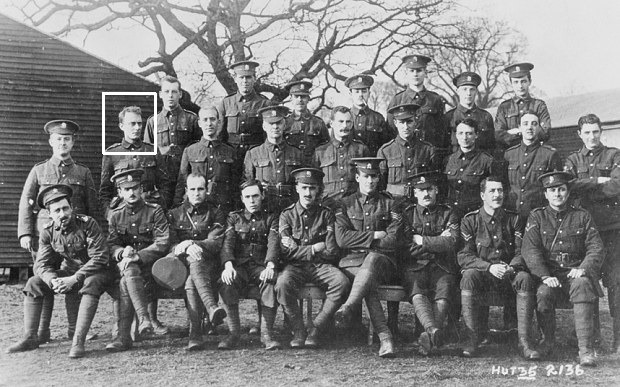
Thomas’ company in training camp
The second Easter: the somber name today’s poem was published under was not his. Thomas in his manuscript simply wrote down the Eastertide date in 1915 when he apparently wrote the first draft of this, two years after he’d started the trip that had indirectly formed him into a poet. That summer he was even stationed for a while on military training in one of the towns he’d passed through on the bicycle journey.
But never mind the name, what a poem. It’s four lines, a single quatrain. Nearly every word is telling, even ones you slide over in the first line. Decades later Pete Seeger wrote a song, “Where Have All the Flowers Gone,” condensing an episode from a WWI novel expressing a similar idea to Thomas’ poem. Seeger’s song is not long as songs go, but it’s a good length for a room to sing along with. Thomas’ poem has only started when it comes to its fourth line. The previous line breaks abruptly, enjambed, with “should,” and its final line reveals itself as it unwinds in heartbreaking fashion.
And Thomas? A third Easter: another spring, 1917. His diary entry in France wonders if the enemy is unseen in the fields ahead of him, which he still must view with the precision of a nature poet. He pauses to light his pipe. A bullet pierces straight through his beating heart that, will, do, never, again.
To hear my performance of the poem eventually published as “In Memoriam (Easter 1915)” use the player below.
I recognize that Memorial Day is an American Holiday, directly derived from the post American Civil War Decoration Day. I know this blog has a large segment of U.K. readers, so to explain: in the U..S. we have two holidays celebrating the armed forces, Memorial Day, which retains some of it focus on honoring the dead who served, and Veterans Day, which is the U. S. holiday that coincides with Remembrance Day. For readers on either side of the Atlantic who’d like to hear the LYL Band present a performance of an American poet for Memorial Day, here’s Carl Sandburg’s “Grass.”
I like to mix up our musical encounters with poetry here, using both well-known and lesser-known poems. Here’s one you probably haven’t heard before, written by a poet who is less-known in the U.S. than in his native Britain, Edward Thomas.
In 1913, Thomas was 36 years old and was scratching out a living for his family as a freelance writer on whatever topics could generate a check, but his real passion seemed to be as an enthusiastic naturalist. He liked nothing better than to walk about the countryside reading the book of nature, jotting down notes about what he’d seen. Then he met a similar no longer young writer, a 40-year-old American who wanted a career as a poet.
The American had not found his own country in agreement with his vocational desire, and so he had flipped a coin to strike out somewhere else: Canada or England? He knew no one in either place, it was just a hunch that someplace different might change his lot. The coin came up England. He took a cottage in the Cotswolds, near to where Thomas was living. The 40-year-old American poet? Robert Frost.
Over the next couple of years, the two men developed what would be the most significant friendship in their lives. Now Thomas had a companion besides his notebook on those nature walks. Although Frost had published only a handful of poems in periodicals at this point, Thomas saw his talent, a man who could write metrical verse so supple that it didn’t seem like poetic diction. In turn, Frost saw another poet in this self-described “hack writer” with his avocational notebook.
Nearing 40 years old and yet thinking about poetry. Edward Thomas and Robert Frost.
Frost published his first two books of poetry in England, “A Boy’s Will” and “North of Boston,” and Thomas reviewed them enthusiastically, helping launch Frost’s literary career. And with Frost’s encouragement, Thomas’ notebook jottings became poems.
In 1915 Frost moved back to the U. S. where publishers would now publish American editions of his poetry. Edward Thomas, and his family, were to follow. The two poets were to live near each other in America and continue their fruitful friendship.
These two men, these two friends, who each could write tremendously concise poems in which a natural drama could play out in but a few lines, had one constitutional difference. Frost was reconciled to chance and fate. He would jump oceans with a coin flip. If lost on a road by a snowy woods on the darkest night of the year—well keep on driving that buggy onward in the dark. Thomas, on the other hand, believed that introspection and judgement, an ever-closer reading of the book of nature could discern the right choice. If two roads diverge (as they would when he and Frost walked the Cotswolds) your honor derives from making the correct choice from the inconsistent evidence.
Back in the USA, Frost wrote his famous, misunderstood, poem about those two paths and sent it to his friend, still tarrying in England, and Thomas became the first person to misunderstand “The Road Not Taken.” No matter how much we honor the author’s intent, the poem exists after it’s creator. Thomas’ outlook saw the undercurrent in the poem, that choice could be important. Thomas thought: if Frost was making gentle fun of that, no matter, that was the point.
Here’s a small, four-line poem that Thomas wrote about spring, “Thaw.” As often with Thomas’ poems “Thaw” is set on a nature’s large stage, but it’s a very short drama. Winter’s snow, as it is here in Minnesota today, is half-melted. Crows are cawing in tree tops, as the crows I saw today on my morning bike ride to breakfast were too, speaking the inscrutable language of crows. I saw one swoop down and frighten a foraging squirrel on a lawn, the black bird somewhat larger than the squirrel—and then, larger yet to it when the rook spread its wings and hammered out its hard-consonant caw.
The squirrel hopped like something had exploded underneath it and disappeared. These natural decisions could be read if one picks up the book of nature.
In Thomas’ “Thaw,” the poet has come to understand that the crows know spring is coming, they are nesting already, and their treetop kingdom, unlike the ground beneath the poet’s feet, is snow free. They have read the book of nature more perceptively.
In Frost’s “The Road not Taken” the comic narrator will sigh “ages and ages hence” about not having read nature right, of having lost the experience the road not taken would have given him. Edward Thomas decided not to move to New England to live next to Frost. Edward Thomas decided, though he was nearing 40 years old, and with a family to leave behind, that honor and his sense of correct decision required that he enlist in World War I, then half-way over. Within a few weeks of arriving at the front, a German artillery shell, following the arc of nature’s laws for men’s unnatural needs, killed him outright.
Thomas had continued writing his nature poems through his boot-camp training, and presumably at the front. He was still seeking to find what it knows that he doesn’t.
You can hear my performance of “Thaw” using the player below. In the middle section I tried to give the impression with electric guitar of the sounds of a flock of crows.
If you like what we do here, particularly as we celebrate National Poetry Month (#npm2018), you may want to let others know about The Parlando Project on social media or elsewhere.
As we continue our celebration of National Poetry Month (#npm2018), today we present one of America’s most loved poems, “The Road Not Taken” by Robert Frost.
This poem is loved, but like many of our lovers, it may not be understood. We think it means, as we think they mean, what they mean to us.
Some love the poem as an endorsement of going against the tide. If an article or personal story includes the line “the road less traveled by” that will likely be the point they are making by referencing this famous poem. So common is this understanding that many people think that phrase is the title of the poem.
Some think of it as a slightly less sure poem that reflects on a common life experience. Many of us can look back at some seemingly mundane choice that we’ve made that has had far-reaching consequences in our lives: that class we took on a whim, that meeting that occurred only because we were late or went to the wrong place, that failed idea that lead to a much better one, and so on. We often love a poem that reminds us of ourselves and the common beats of our lives. We may even be flattered by that.
Robert Frost was adamant that neither of these was the poem he wrote. And if I’m to honor my mid-century teachers—all schooled in the close reading of that then only-slightly-old “New Criticism”—I’d have to say that Frost is right, that’s not the poem he wrote.
As I recounted in my presentation of one of Britain’s favorite poems, Edward Thomas’ “Adlestrop,” Frost was attempting to make a generalized joke derived from a particular foible of his British friend. Thomas, who Frost encouraged to become a poet, was a naturalist, and as he and Frost walked around the Cotswold countryside, Thomas was often unsure about the old and sparsely marked paths and lanes that wander through that landscape. He wanted to take Frost to the best locations to see wildlife, and when he took the wrong path, he would regret it and puzzle all the more the next time he came to a fork or crossroads.
To you it’s a nature walk, to Frost it’s a way to notice your peccadillos
In the poem Frost wrote, the vacillating description of whether there is any actual difference in the roads to choose between at the time of the choice, is meant to describe the difficulty in making that decision. That’s consistent with that second reading of the poem about how seeming arbitrary decisions can have unexpected effects later. We don’t know what meetings to be late for or which whim will turn out fruitful at the time.
It’s the poem’s last stanza that sets out Frost’s poem, in place of ours, despite it ending in the two lines (“I took the one less traveled by, and that has made all the difference”) that are used to sum up the first two subjective readings. First, the conclusion revealed there is stated “with a sigh.” This is not an “I took my own path, and that’s what made me what I am today,” or an “I didn’t know it then, but that mistake was a lucky break” recollection. Those are statements of triumph or benevolent fate, and we don’t make either of those “with a sigh.” And even more subtly, there’s a trick in the two lines before the last one, “Two roads diverged in a wood, and I—I took the one less traveled by.” Did you notice it?
Perhaps the musicians, the poetic or the score-reading kind, or actors will notice it. Frost has the speaker, announcing his oh so firm and final conclusion stated from the certainty of comically exaggerated “ages and ages hence” to repeat a word. It’s almost a stutter. He doesn’t say “and I took the one less traveled by.” He says “I (pause) I took the one less traveled by.” It’s the slightest tell, isn’t it? It’s not the shouty Townshend/Daltry “why don’t you all just f-f-f-fade away,” but the speaker is still divided about what road he should have taken. Frost called the poem “The Road Not Taken” after all, not “The Road Less Traveled.”
As it sometimes is with our lovers, we may have misunderstood what he said by misunderstanding how he said it.
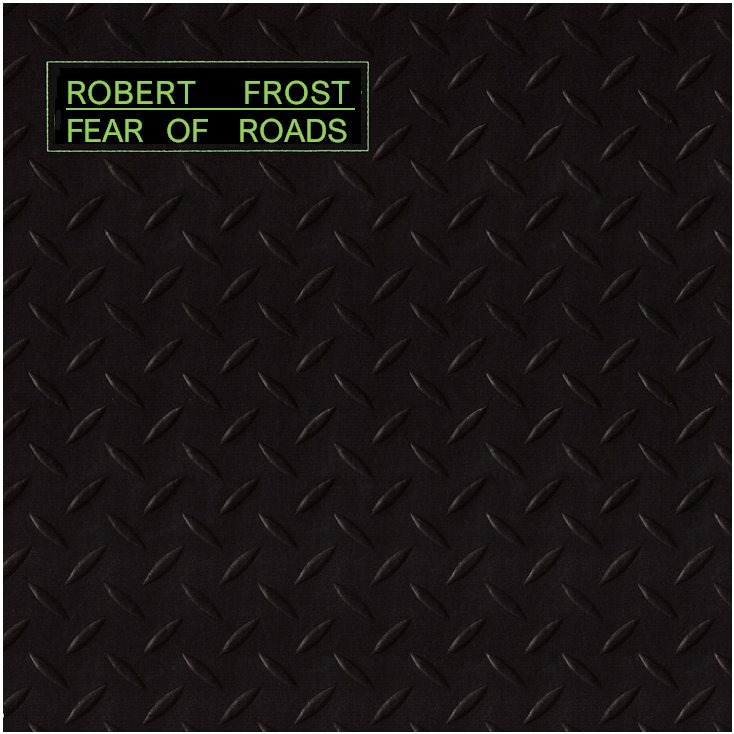
Not the cover to his “More Songs about Woods and Snow”
Musically this started with an idea: do Robert Frost as if performed by the Talking Heads. I came to a fork in the road part way into recording it when it came time to add the keyboard part and I wasn’t able to lay down a part that helped the song. As a result of that choice, I didn’t really use the early David Byrne vocal mannerisms either. In the end I think it’s a clean presentation of the poem, sung. When I noticed the “I—I” thing today after recording the vocal and had finished a final mix, I went back and was pleased to find that hadn’t missed the two I’s, but then I recalled the “I, I, I, I, I!” vocal riff Byrne repeatedly interjects in “Psycho Killer”—so there’s still possible version someone could do to bring that out!
To hear the road I took with this, use the player below.






 Frank Hudson