Records In Childhood

As December begins, I’m going to be taking some time to celebrate and elaborate the roots and concepts of this long-running Parlando Project as we reach our 800th-released audio piece milestone.

For those who are new here, let me restate again what we do: we take various words, mostly literary poetry that was never intended by its authors to be performed, and combine them with music in differing styles. Sometimes the page-words are sung, sometimes they’re spoken or chanted. Sometimes the music will patently match the text, sometimes not. The latter class are some of my favorite pieces: Emily Dickinson as blues singer or psychedelic ranger, Robert Frost with EDM, Longfellow at a beatnik coffee-house, Li Bai with western orchestral instruments, Jean Toomer or John Keats as performed by an indie-folk combo. I expect long-term listeners to scratch their heads at times, though I also fear that some will sample a piece that they don’t much care for and leave off from future listening here.

No one idea or artist inspired this all, but today’s piece is about the farthest back I can recall anything that might have inspired the Parlando Project. I think this happened when I was around age 10.

I grew up in a mid-century Iowa town of 700 folks, and it wasn’t a particularly musical place. There was a small high-school marching band, a handful of children probably had piano lessons of some kind, if only in hopes there’d be someone to play piano in the three Protestant churches in town. The two best musicians in my childhood cohort played trumpet and accordion. The former was surprised to admire Louis Armstrong despite having personally absorbed dismissive racial stereotypes, the other might aspire to Myron Floren level of showpieces on the stomach-Steinway. The same little town might have over-achieved in literature though. It was named by its 19th century town-platter “Stratford,” and its streets were named for British poets and Longfellow — main street being Shakespeare Avenue. If you grew up on a street that was merely numbered, or an avenue named for some animal or geographic feature, such things never had a chance of shaping your worldview. I grew up thinking of Milton or Shakespeare as being a local possibility.

My father sang, mostly in church. My mother thought he had a good voice (“better than Perry Como” she once said) and I recall it having a very nice timbre when I was a child, but there was no piano or other instrument in the house, and he didn’t sing a cappella that I recall. We didn’t have a TV until I was 7 or 8 (and even then it was a chancy fringe-reception, rabbit-eared, used set that would send its display to snow or tumbling whenever it felt like it). There was some kind of radio, for which I’d hurry home from school to listen to the Lone Ranger on, though I can’t recall what the radio looked like. And at least some of the time there was a phonograph. I recall it was one of those that looked a bit like a portable typewriter with a luggage-finished case that could be clasped-closed. It may have been one of my parent’s from their college years. It sat in a little side room off the kitchen at home that we called “the breakfast nook.” And with it was a small cache of records. And here it gets odd — specifically odd — but applicable to the Parlando Project.

I clearly recall four 78-rpm disks, an unexpected set for a Fifties, small, rural-town-in-Iowa record collection. Two were commercial spoken word recordings, the sort of thing that was a viable genre then.** Record one: Robert Frost reading his poetry. My recollection that the featured poem was his “Two Tramps in Mud Time,” but so far I’ve found no Frost recording of that poem to refresh my memory or share here.*** The second was Vachel Lindsay reading from his “The Congo,”  which has an insistent, chanting, rhythmic flow. The fact that I can remember them would be clearly meaningful, but to be honest I have to say that I didn’t like either of them. I’m not sure what I expected from poetry that came from poets more recent than those whose names were on my streets, but Lindsay seemed overwrought to me, and even at a young age I might have been put off by the whole white-guy-doing-primitive-African vibe of his poem. And Frost? I’ve often written here that I didn’t care for him until I started to explore things musically that became this Project in the 21st century. Only then did I discover that he was a supple lyric poet — and furthermore, a much more subtle observer of humanity than I had appreciated in my youth.

The fact that I didn’t really dig these two poets didn’t keep me from playing the records. Experiencing them felt exotic then, and I liked that even if I didn’t admire what was engendering that feeling.

The third record didn’t match suit. It was a recording from the 1940s of a song called “Open the Door Richard.”   I didn’t know then, but this was an unusual “Novelty Record” piece, charting in versions by as many as five different musicians within one year, 1947. All those musicians were Black, and before it was one of their recordings it apparently was a Black Vaudeville comic number that the musicians spruced up with swinging jive-cat musical settings and choruses. The musical versions all differ in detail while sharing the chorus. Some of them are largely drunk-act comedy,**** while others are more at down-on-one’s luck frustration and focus on the riffing, musical, chorus-hook. From listens today I suspect the recording I listened to back them could have been the Count Basie Orchestra version or (best guess) this one by the Three Flames. I liked that record, though I thought it a little odd, and I probably didn’t fully understand it. If these first three records have a link, that’s it, isn’t it? I enjoyed the strangeness, the difference.

Open_the_Door_Richard_sheet_music_cover

Tortured Poets Department, but my childhood: disks containing a psalm of comfort, a song of misapprehension,. and two early 20th century Modernist American poets.

.

The final record was the one I listened to the most. It was not a commercial 78, but a recording, perhaps from a record-yourself booth (or offers like that) which provided the earliest Elvis Presley recordings. It was my father reading “Psalm 23,”  the famous psalm of David. The voice was someone in my life, no exotic stranger, but I was totally mesmerized. If no one is more mundane than one’s own parents, this everyday, ordinary person had their voice on a record!   And the text, in familiar English translation, is one of the most comforting pieces of poetry in the canon. When I’ve revisited the Psalms periodically as an adult I’m sometimes shocked at violent and authoritarian themes I find weaving in and out of Psalms’ religious rapture — but if “Psalm 23”  implies frightful things, it does so to say that they pale in comparison to a connection with a godhead.

Parents sometimes comfort their children, do so by saying “it will be all right, we’re here to protect and care for you.” My parents weren’t much like that in expression however, though by action in life they were being that with much effort. This object, this record, did that, using someone else’s words translated from a Bronze-Age king, poet, and musician.

I think I asked about the “Open the Door Richard”  record and the “Psalm 23”  record. I can’t recall what my dad said about the Psalm recording, though I wish I did. I have a vague memory that he said the “Open the Door Richard”  song was something of an in-joke between his brothers. I didn’t get, or can’t remember the full story, but one of my father’s brothers went by the name Richard (one that became a successful Protestant minister). Another brother was named David, though he never talked to Leonard Cohen about secret chords or sling trajectories.

So there you go, in summary: I had formative exposure to poetry on recordings. One case with my own father’s voice offering comfort; and another, an Afro-American tale of misapprehension. It would be years before I had any idea to do likewise, and decades before I could do something from this early experience regularly in ways that you could hear.

Longish post, but here’s a short musical piece called “Records in Childhood”  using a sonnet I wrote this year casting some of that remembering my early experience with recorded words. You can hear it with the audio player below. No player?  This highlighted link will open a new page with its own audio player

.

*There may have been other records, though it was not any kind of large stack. The fact of memory that these four are the ones I recall testifies to their impact.

**Besides poetry recitations, sermons, and even some secular speeches were released on disk — and spoken-word comedy records were often big general-interest sellers. In a previous post I talked about how vividly I experienced Hal Holbrook’s one-man stage show of Mark Twain Tonight on an LP record in a library in Iowa.

***I did find this professional recording of Frost reading some of his “greatest hits,” and was surprised to hear quiet piano backing was used in a way that could be compared with some Parlando pieces.

It’s possible that my home’s Frost recording was a separated part of a set. 78 RPM records were sometime sold in a bookbinder of page-sleeves holding multiple disks, which is the reason we still call a longer form vinyl LP, CD, or issued-together set of digital files “an album”

****Drunk act comedy goes back to at least Shakespeare’s Falstaff, and in an earlier personal history Parlando piece I found out how my teetotal great-grandfather might have perceived the sometimes brutal alcoholic folk-song “Rye Whiskey”  as stoner comedy.

One benefit of having an acquaintance with this largely forgotten song was that when I first heard the Bob Dylan Basement Tapes song “Open the Door, Homer”  I knew the reference.

Pea Brush

There are more things than well-made that a poem can be — but as someone who’s worked to make their own poems work, I can use that experience to admire what Robert Frost does in today’s piece.

“Pea Brush”  is a rhymed iambic poem, based on four-foot lines, but it throws in enough variation that it never seems like it’s limping along in its gait. The rhymes aren’t fancy, and at least for me, they quietly chime along in the background without calling attention to themselves. This is prosody that isn’t bragging or showing off. It was easy to sing in my rough-hewn manner for the most part,*  but if I was to reformat it into blocks as if it was prose, it wouldn’t seem all that strange either. Indeed, as I performed it, I wanted to stress its conversational quality.

If you’d like to follow along, here’s a link to the text of Frost’s poem used for my performance.

I myself haven’t had a garden in decades, but one friend of the blog Paul Deaton covers their kitchen garden regularly at his blog, and alternative Parlando voice and keyboardist Dave Moore has a garden that we talk about sometimes. I could imagine reading the first-layer plot of this poem as a post Paul might make. “I’ve arranged with a neighbor to use the small limbs from some birch trees he’s clearing as poles for some of my climbing garden plants. When I went to pick them up on Sunday, I noticed bent-over wildflowers** blooming under the brush pile. My reuse of the felled branches will help my pea vines and give the wildflowers room to grow.”

Besides this clear plot line, there are fine clear images in the poem’s story: the smell of sap still in the air from the just-cut trees, the pause in the frog’s song, the near-like to a baby’s grip of an adult’s finger to the tendrils of a climbing plant on garden stakes.

Pea Vine Tendril!

 Wishing good luck to all the gardeners reading this.

.

Below this surface, what is the poem trying to convey? The poem’s speaker (as a character perhaps a more prosaic farmer than the poet and indifferent farmer that Frost was) just notes the practicality of the arrangement — free garden stakes — while letting us in on the blooming of May flowers and the promise of harvest aided by this arrangement. Frost the poet has written this well-made play, painted this scenery, blocked and directed its performance. The play portrays the give and take of humankind in nature. We’ll grow (and consume) the peas with their infant tendrils. Neighbor John has amputated the treescape for his own agricultural designs. These are planned acts of life and death. The episode of the frogs has them portraying those things outside our plans, their Sunday-service silence to hide from a two-footed demigod that might come to capture them to a final silence.

I’ll note too the poem’s ending “had to come” interjection breaking the meter to make a final statement of the budding wildflowers that couldn’t wait for humans to make their plans.

I had to make do with a single hour to get this musical performance down today, and I chose to grab an acoustic guitar to get this accomplished. The results felt right enough to produce this new piece that you can hear with the graphical audio player below. No player?  This highlighted link is an alternative that will open a new tab with its own audio player.

.

*The line “The same as you seize cat’s-cradle strings” is a bit of a tongue-twister. And while I get Frost’s image clearly in that line’s stanza, the syntax is a little disordered I think.

**Frost names his wildflowers as trillium. I don’t know if Frost was the exact botanist that his friend Edward Thomas or his great New England predecessor Emily Dickinson were. Neither am I, but I’m often open to researching specifics like this in poems. I find that one of the species of trillium that grows in Frost’s New England is the Nodding Trillium, a variation that grows crooked stems naturally, not because a brush pile has altered its growth.

Cool Tombs

It’s been too long since I’ve presented a poem by Carl Sandburg here, and awhile since I had the time to make one of my “punk orchestral” pieces accompanying one of the poems.

Carl first.  Unlike Frost (birthday boy today, happy birthday Robert!) I appreciated Carl Sandburg as a young person. A poem like today’s “Cool Tombs”  doesn’t appear to truck with irony or express its perceptions subtly. It appears to say what it means to say. Those schoolchildren sure that poets and their literature teacher accomplices are seeking to make fools of us dense and under-lived students can rest easy with what this poem seems to be. Here’s a link to the full text of the poem, if you’d like to follow along.

I’ve made my point elsewhere in this Project that Sandburg, likely with intent, had other poetic modes. Like Frost (which Sandburg was once considered a peer to in literary merit) he’s always plain enough speaking that one can be fooled into thinking his thoughts are always straightforward. Read quickly enough, seeing only the plain-talking, “Cool Tombs”  has just one thing to establish: that our selves lose and are left-loose from our deaths. Great accomplishments, great enemies, great failures — eventually, nothing.

Where’s the ambiguity? Where’s the deep reading that great poems reward?

My answer, my reading of Sandburg here, is that is to be found in American history — that history a denser poem full of every Empsonian ambiguity — and Sandburg clearly is roping in American history here.   Are his choices incidental/accidental? Well, they do include things that disappear, even if like love they remain inescapable, returning things.

Other than American historians, few readers today will understand what a “copperhead” is referring to when Sandburg speaks of Lincoln, other than perhaps knowing it as a species of poisonous snake. That it was, and is — but in the American Civil War those in the North opposed to fighting the secessionist slave-holding rebels took to using an incised liberty head carved out of the mid-19th century American penny coin as an emblem of their sentiments. If you reach into your pocket now and note who’s on the current copper penny, you’ll see the head of Lincoln.*  Did history write some irony there?

Civil War hero and post-war President Grant suffered from corruption among businessmen in and surrounding his administration, details now lesser-known outside of historians today. The Sandburg that wrote this poem, ex-political operative and then still daily newspaperman, knew that government corruption hadn’t disappeared conceptually. Perhaps he also knew that Grant intended to — to some degree did — try to set up a fairer settlement to those newly emancipated from slavery. In the cool tombs of history, perhaps we remember Lincoln and Grant for those efforts, even if imperfect and eventually abandoned, they were.

Pocahontas’ story, as much as can be deduced from records and oral histories, is complex, and subject from the beginning to substantial romanticization by English settlers.**  An indigenous American, she married an early English-American settler, and legends of this marriage and other friendliness of Pocahontas to the English settlers are the prime reason she became a historical character to the eventual conquerors. From the First Nations standpoint, one can easily see this story rests on a vibrating matrix of love, coercion, or treason. As her story leads into Sandburg’s voice claiming for the lovers in the concluding section, perhaps Sandburg holds primarily for the first of that trio — but he and I were not there, we cannot really tell. I also don’t know Sandburg’s intent, but the previous two situations are suffused with crimes and evil: slavery, murder, corruption, and greed. Is Pocahontas’ story contrast or continuance? The poem’s text allows either reading. Perhaps the fairest reading, the one that was in my sense as I read it, is that Pocahontas’ love was tragic given how the conquest continued with so much killing and subjugation. Note too that Sandburg says a hail-the-conquering-hero parade (perhaps to the tomb?) should be examined as a vainglorious exercise.

Lincoln, Grant, Pocahontas cool tombs

Lincoln’s tomb in Illinois, Grant’s tomb in New York, and Pocahontas’ burial site in England.

.

Is all this external exegesis based on unintended things that I’m artificially assigning to a simple or at least single-minded poem? Most modern academic readers of Frost understand him to be a poet comfortable with intentionally invoking subtext. Certainly, if this were a set of incidents in a T. S. Eliot poem with reference to metaphysical poetry, with passages in Latin and Greek referencing classical history and legend, we’d know he wanted us to consider those connections.***

But Sandburg? I’d caricaturize my sense of how Sandburg’s viewed today like this: he’s written off as a superficial popularizer of unremarkable intellect and talents. He fooled some folks earlier in the 20th century into thinking there was something there, but now we have a better vantage point.

I obviously don’t see it that way. I could be mistaken — in which case it’ll be forgotten in the cool tombs.

Carl Sandburg's grave

Carl Sandburg’s grave in Illinois. Not so grand, but it also asks us to add history to the grave. There’s a little plaque on the footing bearing the legend “For it could be a place to come and remember.”

.

Alas, now again I spent more time spent writing on the words, leaving less time for the music. I recently had enough energy and assured time to try to do something with a larger group of orchestral instruments. Let me be brief. I wrote this originally as a non-harmonized melody, but transformed it into a harmonized piano part via some software that extracts harmonic ideas from a monophonic line, choosing the one that interested me the most, and tweaking it from there. The piano part then became the orchestration by another translational process of placing the piano’s range of notes with various other instruments.

If I had the focused energy or assured time, this could be a movement of a larger piece with other themes, variations, contrasts in color — but that doesn’t fit my life. I’ve come to call these short pieces, often expressing a simple musical idea by whatever means I can bring to hand “punk orchestral.” You can hear the recording of my performance of Sandburg’s words with this orchestral music using the audio player gadget you see below. No player?  This highlighted link will open a new tab with its own audio player.

..

*That liberty head cent had been replaced with a new design just as Lincoln was elected, though still in circulation. The new 1859 design replaced the classical liberty head profile with what? An American Indian in native feathered headdress. The current Lincoln profile penny was adopted in 1909, less than a decade before Sandburg wrote his poem.

**A couple of obscure horticultural details occur in the Pocahontas section. “red haw” is a tree that produces a crab-apple in Autumn. So too is the pawpaw, a fruit widely raised and eaten by native Americans. Sandburg oddly refers to the “pawpaw in May” which would not be a sweet, edible fruiting time for the plant in North America. Is there intentional metaphor there, or a mistake?

***I don’t know if Sandburg had this poem by Thomas Campion, which in turn was a loose translation of Catullus — but the lovers getting as much as they can while tomb-wise element was brought to mind as I newly considered Sandburg’s tomb poem.

Stars: Robert Frost and The Book Of Nature

Robert Frost. Long-time readers/listeners here will know I love to sing Frost’s early poems as part of this Project. We’ll get back to Frost, but another thing long-timers here know: for me, roundabout is the best mental journey — and there will be a piece of music at the end as we rest from our walk.

Ok, let’s stroll.

It’s a famous midcentury half-hour black & white TV episode. So famous that you don’t have to have seen it to know the recognition scene near the end of its story that has become a modern myth that SF and Fantasy fans like to point out their stories aspire to. Given that, I’m going to assume no one will need a spoiler alert for this 1962 Twilight Zone episode called “To Serve Man.”

The format’s so brief, the story must be told rapidly. We’re told that a race of other-planetary beings have landed on Earth. With retrospectable irony, their leader is described as “Christopher Columbus from another galaxy.” They go about setting things here in benign order with advanced technology. They leave behind a book in their language that seems to be a guide to the extraterrestrials’ efforts. Partway in, Earth’s code-breakers have deciphered the book’s title: To Serve Man.  And they seem to be doing just that: ending hunger, gently enforcing world peace, taking selected humans on spaceship rides to their home planet.

Many of you are now speaking — telepathically or aloud — to a device’s screen what is urgently delivered to the story’s human hero once the humans can decrypt more of the book than just the title: “It’s a cookbook!”

I’ve written here often about something I call The Book of Nature. Though not an exclusive American idea, I connect it with the 19th century American “New Thought” movement called Transcendentalism. The Transcendentalists believed that a true scripture of the universe’s higher power was transcribed in nature. By contemplating nature big to small one could discern the highest truths. Our contemporaries who are “spiritual but not (sectarian) religious” may hold to this as a core belief, but it’s likely that every denomination of religious belief can incorporate this too — after all, if The Creator made this, their authorship means there is plausibly something there to be read.

Now we can get back to Robert Frost. Frost no doubt knew Transcendentalist thought, but unlike his fellow great American poet, Emily Dickinson, Frost didn’t hold with its doctrines.*  Yes, Frost wrote seemingly “En plein air” about nature often. His early poems, some of the ones I like best, are suffused with the landscape and particulars of New England nature. Did he see a supreme being’s handwriting there?

If so, Frost would be critical of The SB’s penmanship.

stars

Chord sheet so that you can sing this one yourself.

.

If we look at this example, “Stars”  from Frost’s first book of poems, A Boy’s Will,  what do we “read” from nature’s book? The stars come out at night. What is their nature?** “Countless(ly),” we can’t even get the basic stats correct. Oh wait, Frost can see a primary Roman goddess in there: Minerva, the goddess of wisdom and strategy. No, he reconsiders: it’s a statue of Minerva he sees in the stars, a human-made simulacrum — and her marble eyes are the form of sight organs without any such function. So should we look lower down at our earthly landscape?***  Snow covers it profoundly, drifting “as tall as trees” and so obscuring even the ground-level facts. Wind is blowing — the choreographer of this landscape — yet, this dance doesn’t tell a story, it obscures it, though here at last Frost reads a message. That wind, that obscuring snow, is “our fate.” In the most mysterious part of the poem, the second stanza, we cannot see where we’ve walked or where to guide our steps. The gothic part of my nature reads Frost’s “place of rest invisible at dawn” as death. I read the image in this stanza that in such deep and overblown snow, one cannot even see the walk fate will not reveal to a farmhouse graveyard.

Nature acts “with neither love nor hate.” Robert Frost has decrypted The Book of Nature — and all the pages are blank.

Here’s that song at the end of our mental walk where I set Frost’s poem to music with acoustic guitar. You can hear it with the audio player gadget below, or with this backup highlighted link if that gadget is not shown.

.

*Frost’s friend and fellow poet Edward Thomas was an exquisite nature poet of his British Isles countryside. In regards The Book of Nature, he’s between Frost and Dickinson for he has a horticulturalist’s specific eye like Dickinson — and his consistent naming of natural details and seeing them as readable symbols indicates he finds them plausibly capable of guidance.

** Astrologers, Biblical Magi, and classical constellation dots-connectors of course are reading that sky in clear text.

***In a changeup meant to fool this writer and singer, my specific winter this year has been oddly empty of any expected Northland winter symbolism. We’ve had next to no snow, only a week or so of bitter sub-zero cold, and I look out today on a sunny brown yard over which squirrels are carelessly playing tag and tree as we rise to our predicted afternoon high of (in Minnesota! In January!) of 55 degrees F.

I’ve been riding my summer bicycle with its summer tires most every day this “winter,” where that bike normally stays hung up high in the back of my shed. Spring in Minnesota is famously snowy, my winter bike with studded knobby tires cannot be put out of the way. Perhaps as long as I leave it by the door we may continue to have a mild winter.

Storm Fear

Of all the English language poets who have achieved a general readership, it’s likely that Robert Frost is the most misunderstood. I don’t say that to shame that broad audience — after all, in my youth, when asked to read Frost, he seemed too full of tired maxims and quaint commonplace situations. Sure he comforts folks I ignorantly thought, and maybe I undervalued comfort, but that wasn’t what I was looking for.*

I won’t blame that youth I was then too much. I was onto other things — but as far as Frost goes, I was carelessly understanding his best work too quickly. Decades later, partly as a result of this Project, I came to his short lyrical poems, beginning to appreciate their supple word-music — and then once beguiled, I began to see what he’d put in these concise pieces.

“Stopping by the Woods” isn’t about lollygagging when there’s duties to do“The Road Not Taken”  isn’t about the so-consequential road taken. This poem, “Storm Fear”  from Frost’s first collection, A Boy’s Will, isn’t about settling down to a little hygge-time in a winter snowstorm. Here’s a link to that poem’s text if you want to follow along.

Maybe it’s its concision, or the careful way Frost uses incremental details, but this poem was first published in 1915 and yet the horror it contains seems to have passed most readers by. As I read it this month, now more attuned to how Frost can work, my first thought was this is as harrowing as Bob Dylan’s “Hollis Brown”  or as stark as Bruce Springsteen’s Nebraska  album.

My first reminder as you read this poem is that it’s set in a circa 1900 rural America that was more isolated than you might imagine today. Farm families didn’t always have daily connections with others, and those institutions that offered connections: churches, shopping towns, exchanged labor, and rural schools were episodic. Long winter nights and snowstorms restricted what travel there was. Frost himself went through a brief attempt at living that farm life in this era. Perhaps he had a writer’s lighthouse-keeper fantasy of splendid, thoughtful isolation. His poetry testifies that he learned the reality.

Frost’s poem opens with a snowstorm in progress in the nighttime. How many poems, stories, blog posts, other accounts portray such a scene? Frost wants to let us know this isn’t a greeting card picture. The wind is a “beast” and it’s curiously imploring “Come out!” How many readers will miss this odd inclusion and take it as so much filler merely indicating that there’s a wind?**

The poem’s speaker, who we’ll find out is a young husband in the house with a wife and child, responds that it doesn’t take much interior debate to not obey what the beast outside is requesting. He’s thinking: there’s a storm, I’m staying in.

Then we get a different calculation. He tells us about the wife and child. They’re asleep, there’s no awake partner to bounce ideas off of. Suddenly he’s worried about the isolated farmhouse’s sole source of heat, a wooden fire. I think the implication here is that at the very least he thinks he needs to visit an outside woodpile. Or perhaps the winter has been hard enough that he’s short on fuel.

In the poem’s concluding scene, he’s now set on going outside. In the snowhills and blowing snow, even the barn looks “far away.” Is he even considering trying to make it to a neighbors for fuel? Is he making a difficult but sane decision, or is his isolation and “cabin fever” such that he’s thinking of making a risky trip for less than necessity?

Storm Fear 1

I thought too of the deadly rural winter isolation of Susan Glaspell’s “Trifles” reading today’s Frost poem.

.

Let me note one other thing about the poem. For Frost, the famous formalist, this poem’s form is very irregular. Poetic feet, meter, rhyme scheme? It’s all over the place, though periodic iambs are there in the confusion. Formalists who teach Frost would likely skip over this example for lessons. Workshopping this poem with a formalist? I can imagine the markup.

In setting “Storm Fear”  for performance I was able to deal with the irregularities in Frost’s design, but then I’ve worked in this Project with a lot of outright free verse and have found it not as difficult to sing or mesh with music as some might guess. But when you’re performing (rather than writing a page poem) there are a couple of things you might want to add stress to: a sense of repetitive or choral structure and some additional guidance to the listener to intrigue understanding on one listening.

My choice here was to make the poem’s 7th and 8th lines into a refrain that repeats twice more, the last with a variation. The first time we hear “It costs no inward struggle not to go,/Ah no!” we hear it as the easy rejection of the beast-storm’s call. The second time, as the singer thinks of his wife and child, it seems more as a statement of the imperative for him to take action and leave into the storm. And in the final statement at the end of the song, he’s about to enter the storm thinking he must seek aid.

Would Frost have approved of my changes? Who knows. He was a man of strong opinions and an often brusque manner. Many poets or their rights-holders would forbid changing even a word. But this old poem is in the public domain now, I need no permission, and I hope my setting honors the intent of Robert Frost.***

You can hear my musical performance of “Storm Fear”  with the audio player gadget you may see below. Is that player snowed out?  This highlighted link will open a new tab with its own audio player in those cases.

.

*So yes, I was a dolt about Frost, but not singular in that ignorance. Frost’s first two poetry collections were published in England after he left America for there. One reason for that hejira: American publishers were not in the least interested in his poetry. Frost was nearing 40 when A Boy’s Will  was published. So at least in 1915, the experts were also misreading Frost.

**Some Faustian readings of this poem take that beast as The Beast — that the poem’s speaker is a sinner being stalked by his sins’ debt collector. Frost may have been aware of that implication, though it doesn’t strike me as consistent with what I understand of Frost’s own theology. Making the wind “howl” or “growl” is a commonplace, and calling it outright a beast may be stronger — but if enough readers miss the eminent dread in this poem, maybe it wasn’t strong enough.

***Generalizing, poets who feel they’ve worked their words with a fine touch are often resistant to editing by collaborative outsiders. Since Faust has entered the chat, I think of the collaboration between Bob Dylan and Archibald MacLeish who were slated to do an adaptation of Steven Vincent Benét’s “The Devil and Daniel Webster”  for Broadway. MacLeish knew Benét, and likely thought he could do right by his late friend’s work. Dylan has his ways, and MacLeish had his — so the two fell out, and Dylan’s songs in progress for the play were not used. The eventual Broadway production bombed. Dylan used some of the songs later on his own. His “Father of Night”  is often attributed as one of those rejected songs.

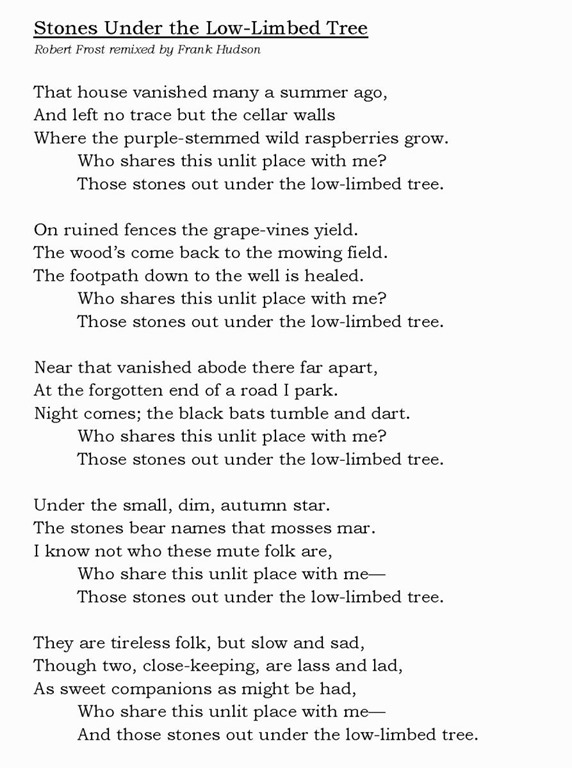
Our Halloween Series begins with “Stones Under the Low-Limbed Tree”

What’s coming up? Halloween! And I’ve decided to dedicate the rest of this month to accelerated posting of some of the Parlando Project’s favorite pieces of fright, fantasy, and the uncanny. There will be ghosts a-plenty, curses, creatures, spells, and graveyards. The Project has done over 700 combinations of various words (mostly literary poetry) and original music over the past 7 years or so. The poetry is of different styles and eras, and the music differs to, at least as much as I can make it do so.

Here to kick things off is a poem by one of America’s favorite poets, Robert Frost, that I adapted and recast in making it into a song. Can Frost do eerie clothed in nature’s homespun? I think so. Frost called his poem Ghost House.”   I revised it enough that I decided to use a different title when I presented it in 2020 as “Stones Under the Low-Limbed Tree.”

If you compare my lyric to the original poem hyperlinked above, you can see I refrained things more than Frost did in his page poem

.

You can hear the resulting song with the audio player below. No player to be seen?  This highlighted link is an alternate way to hear it. It’ll open a new tab with its own audio player.

.

Edward Thomas’ “Song”

1913. 110 years ago. Two people met in England and called each other poets. One of them you might know: Robert Frost. He was almost 40 and hadn’t been making a calling as a poet in America. The other was a British man four years younger who wrote prose furiously as a freelancer for pay, “Burning my candle on three ends” as he described it. That freelancer was Edward Thomas. Some of the freelancer’s work was literary reviews, and unlike American editors and gatekeepers, Thomas admired Frost’s work. Within a year, Frosts first poetry collection, North of Boston, would be published in England and Thomas’ appreciation of Frost’s talent helped make it a success.

A little log-rolling for the work of a nascent poet who just happened to be a friend? Well, Frost’s slim volume included “Mending Wall,” “The Death of the Hired Man,” “The Wood Pile,” “Home Burial,”  andAfter Apple-Picking.”   The evidence says that many readers know these poems over a century later without knowing the man. Friendship aside, Thomas recognized a poet worth consideration.

In looking at some of Thomas’ prose work-for-hire, Frost told Thomas that his close attention, particularly of the book of nature, was the stuff of poetry. Frost also thought Thomas already showed a grasp of musical cadence in his prose writing that was like Frost’s theory of poetic word-music. Neither man was one for high-flown language or trite metaphors — things that were present in much poetry being published then in English. Both men knew the complexity of human acts and emotions. And both men shared something else: they suffered from depression, suffered this in periods of greater or lesser depth.*

Thomas’ hard work as a freelancer was to support his wife and a young family who he loved — but that relationship, that feeling was not simple. He tried to keep some of his demons from his wife to spare her, and while I’m not knowledgeable of all the details, he had at least “emotional affairs” with others which his broadminded wife understood as helpful in keeping Edward Thomas’ spirits up.**

Edward and Helen Thomas

Edward and Helen Thomas. The iconography of a couple with one looking off to the side is inescapable.

.

Within a year of meeting Frost, taking Frost at his word, Thomas began writing poetry. He wrote it just as furiously as his reviews, criticism, or hack work. In his first six months as a new poet Thomas wrote 75 poems. Beyond that quantity, when reading his collected poems I’m struck by how fresh even his early work seems when I read it against most of his British contemporaries. Many of Thomas’ peers of this era knew how to score points technically, and which images and plots would elevate their verse to seem professionally poetic. Thomas (and Frost) don’t seem to care as much for scoring well on the required figures and rules. Even the beginning Thomas’ word-music in English is attractive, his expression rarely seems hampered by a too-tight fitting prosody.

Today’s early piece, which he called simply “Song,”  is an example. Here’s a link to the text if you’d like to read along.  A short lyric that sings off the page should not seem  difficult to do for its reader or listener — but in deed,  it is hard to do. This paradox is a big part of pulling the trick off. Though printed in quatrains, “Song”  is approximately Alexandrines. Rhyme connoisseurs make note that “June/tune” and “sigh/die” have triteness demerits, but the opening pair “beautiful/invincible” delights me. And I believe a somewhat too-common rhyme is forgivable if the matter of the poem is fresh enough.

Without being an expert on Thomas’ life, I’m going to assume this is a poem to his wife. Invincible happiness would build a wall in many relationships with a depressive, yet that difference is acknowledged in the poem, yet accepted. The “She laughs” “I sigh” refrained pairing reinforces this difference. The spoiler cuckoo is a bird known in folklore and folksong as a bird of inconstant love and cuckoldry. Yet the poem says that the couple love each other unto death, as they summarily did in life. In matter, this is one of those rarer love poems that speaks of long-term committed lovers fitting themselves together despite seeming incompatibilities.

The poem’s refraining nature makes it attractive for casting into song, and so that is what I did. I even increased that factor by repeating the 3rd stanza also between the 1st and 2nd verses. I also set my composer-self a limitation in writing the music: to try to effectively use only some of the simplest and most common chord colors in my chord sequence. All major chords, no minors. No suspended chords dropping the third. You can hear how it came out as I perform it as a piano trio with the audio player gadget below. No gadget? This link is an alternative that will open a new tab with an audio player.

.

*Again, I’m no expert on Thomas nor psychology, but the periods of high output and the periods of suicidal depression suggest bipolar.

**Not being overly knowledgeable on the marriage, I can see how some feminist analysis could have different insights and conclusions on this. All my scattered reading says this cluster of friendships was complicated, and that’s enough to give background into why this love poem isn’t one to file in the more common desire thwarted/satiated, muse, heartbreak, or betrayal folders. And yes, Frost’s marriage too had elements of a long-suffering spouse and family tragedy.

Brahma by Emerson

The early 20th century American Modernist poets I often feature in this project were born in the 19th century. What American poets could they look to as their influences while they developed the poetry that rapidly re-shaped English language poetry? The answer/list for American American-Modernist influences is surprisingly short, and as a result these poets looked to writers from outside the United States. A summary list would include the early 19th century British Romantic poets and those still emulating that style in the UK. French writers got attention (even those French writers who had been influenced by American writers). Classical poets were still part of the British-influenced education system, so like Shakespeare the turn of the century Americans might have gotten “some Latin and little Greek” in school.

What are we left with for home-team poets? Poe, that formative poète maudit? Not much — even though his influence on some of the French writers was there second-hand. Dickinson? Less than some now may imagine in our age where she is considered a giant of American poetry. Dickinson was not significantly published in the mid-19th century, and so she was, on the printed page (beginning in the 1890s) a near contemporary of the Modernists. So, for our early Modernists at the beginning of the 20th century, Dickinson was considered more often as a new, interesting oddity than as the canonical mainstream. Longfellow, the massively successful American poet whose own roots lay in recasting European language poetic forms to American English? It is to laugh. Did even Vachel Lindsay or Carl Sandburg, the most populist and public minded of early Modernist era American poets ever dare to tip their hats to him? I haven’t seen it if they did, as Longfellow was already beneath contempt. Sandburg and the Black American Modernists like Fenton Johnson, Langston Hughes, and Gwendolyn Bennett did look to Afro-American Spirituals, Blues, Jazz lyrics and forms, but like Dickinson this influence would become greater later in the 20th century than it was in the first part. That leaves us with Whitman, who “broke the new wood,” as Ezra Pound put it, with his free verse, his hardly subtext eroticism, his ostensibly personal I-am-the-one-who-wrote-these-lines voice, and his poetry of mystical optimism.

Today I’m going to perform a poem by the only poet whose pioneering interests and corresponding influence are plausibly greater than Whitman — and not just because he was a direct influence on Whitman and Dickinson: Ralph Waldo Emerson. You can trace Emerson’s spirit in 20th century (and 21st century) American poetry not by his poetic tactics (he was often a mediocre-to-awkward poet) but by his underlying world-view, one that helped form a widely influential New Thought movement in the United States called Transcendentalism.

What did Transcendentalism give American poetry?*

  • Individualism and equality of office. Every person’s soul has an equal potential to receive important revelations and insights. From the start this included women and eventually it included all ethnic backgrounds and races.
  • The Book of Nature is the scripture. Nature isn’t just a decorative metaphor — it’s the revelation of all that is.
  • The job of poetry is not just to be beautiful, it’s to instruct. Transcendentalists didn’t do irony** that much and they almost never took to the poète maudit stance. That is not to say that it didn’t have stoic threads*** in its weave, or that its optimism was unbounded.
  • America is not only, maybe not even primarily, an Atlantic continent. It’s also a Pacific one. We should be open to China, India, Japan, et al as artistic and philosophic influences.

That last one is shown distinctly in today’s piece, a poem of Emerson’s from 1856 that shows he’s been deep into the Hindu Mahābhārata**** — something I haven’t been. Reading Emerson’s poem to prepare for composing my music and performing it, I’m as lost as an ordinary someone listening to a Tolkien adept, or as a father listening to my daughter talk anime or Homestuck.  My research says that many of the stories in this Hindu sacred epic deal with wars and wars between gods — and that behind it all, though not usually as an active part, is Brahma, the maker of the universe, who, as Emerson’s poem tells us, is above and beyond such struggles. The poem final line, “Find me, and turn thy back on heaven” then says that all else, even some heavenly reward or alliance, is illusion — that nature, the all that is, Brahma’s abode, is the highest revelation.

Emerson reading

Influencer. “Hey, @Fuller, @Thoreau, @Alcott — this easel thing is a great lifehack for reading Indian sacred literature.

.

My musical performance is available below with a graphical audio player. The acoustic guitar composition here is within another Asian and Afro-American influenced musical style, one that its founder called “American Primitive.” I’m not fond of that label, but John Fahey meant it in the sense that it looks to show a direct experience in the music, not that it was unsophisticated or ham-handed. In my case the pork-fingers are a risk, but it fits Emerson’s text (linked here) well. No player visible?  This highlighted link is your alternative way to hear my performance.

.

*Note to readers: I am not a scholar of American literary history, just a curious visitor who writes about my exploration. I’m not an expert on Transcendentalism either. I could be wrong in details or significance in today’s post, or with many others here. All this is offered as “It seems to me (sometimes).”

**Dickinson, who may have been a Transcendentalist, and certainly was familiar with its precepts, does have access to a side-eyed, darkly humorous at times, irony.

***Robert Frost, the stoic, seems to have a deep and dark reading of the Book of Nature which he shared with his British friend Edward Thomas.

****By later in the century, we began to take for granted that South Asian and Japanese religion, philosophy, and art are available for American poetry, while Emerson was there at the beginning. I’d expect the non-Asians, however well-meaning, to misunderstand some of it, even as they appropriate it — but then I’d assume some Asians misunderstand, or differ in their understandings, too. Yankee Emerson was one of the first here, and I have no standing to discuss what he got egregiously wrong or surprisingly right. Let me also note since this is cruel April, that T. S. Eliot, a half-century after this Emerson poem was published, took to studying Indian religion in college, dropping his own samples from Hindu and Buddhist scripture into the Modernist landmark “The Waste Land”  while still an expatriate American.

Love and a Question

While looking for material to combine with music and perform for the Project this week I came upon a specific but little-known connection between two great early 20th century poets. I’ll go into the details of that in a bit, but before I write about that, let me set the scene by mentioning something about one of those poets, Robert Frost.

In the past mid-century, when I was growing up, Robert Frost was a poetic institution. He’d won four Pulitzer prizes, his work was as well known as any living American poet, ordinary readers might have familiarity with some of his best-known poems, and a few phrases from those poems had entered general usage. It was not uncommon for the schoolbook poetry anthologies that I’d encounter back then to end with Robert Frost. If he wasn’t the end of poetry, he was as good a symbol as any of the end of poetry as it was consumed up until that mid-century time, where literary poets wrote verse that was assumed to have a chance at general readership and could have evident value to them. He wasn’t Tennyson or Longfellow exactly (Frost’s sound was more like common American speech) but you could see him as a proprietor in the same trade as the 19th century giants.

He was enough of an institution that schoolboy-me was having as little to do with him as I could. Sure, he was living, but that was no help, because he was old.  Many dead poets left young corpses, paintings, engravings, or photographs of dashing writers, heads cocked with their thumbs and index fingers up against their visionary brains. Keats or William Blake, now there  were my comrades, not Frost. I plead youthful ignorance and concerns, and Frost’s poetry stuck around to eventually inform me in my foolishness.

So, it surprised me to eventually learn that for nearly half his life Robert Frost couldn’t get arrested as a poet in America, and he wasn’t doing all that well in finishing college or finding a steady day gig. Frost may have been trying, but he wasn’t trying very long in any one place — inevitably either they or he wasn’t for having him stick around. Nearing 40 years old, Robert Frost did something next in his unstable life: he went to England. What was this guy, that by my time was the quintessential American-scene poet, thinking?

I’m not enough of a scholar to know for sure, though reading a few Frost bios would probably inform me. One good theory: nature poetry and poetry about rural subjects was having something of a bloomlet in England. If England had led the way in industrialization and empire building, an in-reaction interest for literature about the countryside and country living was arising.

Within a couple of years of arrival Frost connected in England as he’d never been able to do in New  England. He published his first two collections of poetry. He formed a close friendship with British critic Edward Thomas (and in return convinced Thomas to write poetry). He ran into another American ex-pat, Ezra Pound, and the younger Pound trumpeted the now 40-year-old Frost’s poetry back to America as part of the coming new thing.

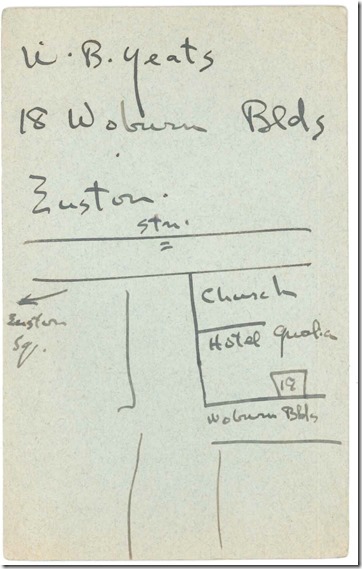
Imagism in action Ezra Pound, acting as a Georgian-era GPS, drew this map to show Frost how to get to Yeats place in London.

.

And there may have been another factor, a hoped-for connection with another poet: William Butler Yeats. Yeats wrote of the rural Irish  countryside of course, and I had never associated Frost with the Celtic revival at all. Just in preparing for this post today, I took note for the first time that Frost’s mother was a Scottish immigrant. Why did I start to look into that kind of connection?

I started re-reading Frosts first English-published collection, A Boy’s Will,  where I came upon this poem with a generalized title: “Love and a Question.”   That poem stood out at first glance because I could easily see how it could be fit to a folk-ballad style musical accompaniment. It even included a close variation of a floating verse line used in several folk songs “Her heart in a case of gold/and pinned with a silver pin.” But then there’s a second line too: the woman by a country hearth with thoughts of “the heart’s desire.” Here’s a link to the full text of Frost’s poem.

That second line would have been unremarkable except for the accident of performing a Yeats poem from an early verse play of his The Land of Heart’s Desire  this past winter. I link to my post on this if you are new or have forgotten, but this play sets up a nearly identical situation to Frost’s “Love and a Question.” A newly married couple are in a remote cottage on a stormy night. A knock at the door, and we are introduced to a stranger who asks for some comfort — but who is, it’s inferred, a fairy who wishes to enchant the new bride.

How well did Frost know this piece by Yeats? In research this week I found out that while in one of his short-lived teaching jobs before leaving for England he’d directed Yeats play with a company of his students. Cites I can find online mention him putting on this play,*  but nothing I found mentions that he also wrote this poem rather directly dealing with the play’s same story.

What does Frost bring to Yeats’ material? While his poem is understandably more condensed than even a one-act play, Frost obscured the situation considerably over Yeats well-told fantasy tale. The few attempts to write about Frost’s poem I found online catch nothing of the fantasy element because Frost makes that so unclear. Yeats’ stranger at the door is portrayed as odd and troubling soon after the character’s arrival, yet other than the continued borrowings from Yeats plot, the only thing in Frost’s text that suggests that the stranger is not a mortal is the peculiar detail of the stranger carrying a ”green-white stick” which if read in the context of Yeats’ tale may be interpreted as a wand or wizard’s staff. The stranger in Yeats is an active character, throwing themselves into the newlyweds’ relationship rapidly. Frost’s stranger is but spoken to and doesn’t act or speak other than the knocking entrance. The bride in Yeats has some action and agency in her own thoughts. The bride in Frost is a single tableau by the fire. The fears of the bridegroom are expressed in both the verse play and the poem, but in Frost’s poem he seems to be talking almost to himself. Endings? Spoiler alert: in Yeats’ play the bride dies, and it may be guessed that her soul-spirit has been taken by the fairy-stranger. Frost’s ending is vaguer. The bridegroom seems to say he understands the protocols of regular alms-seeking, but he can’t understand why someone would be so rude as to interrupt a new wedded couple on their honeymoon. Yeats’ bridegroom is anxious, but wary as he tries to win the occult battle, even though he fails. Frost’s bridegroom seems, well, puzzled.**  Is Frost satirizing Yeats tragic Irish tale, suggesting that a real rural bridegroom wouldn’t figure out what was going on? I might be missing something, but does the poem feel like a satire? For the bridegroom to be a fool wouldn’t surprise a Frost reader. Many kinds of human foolishness, misunderstandings and limitations are portrayed in Frost poems.

This brings up another factor. This early Frost poem isn’t very Frostian. The story, such as it is, isn’t clearly laid out, and the language and prosody — this seems impolite to say about this master — is awkward. I thought this poem would be easy to sing. It wasn’t, and I think that goes beyond my limitations and the brief time I could obtain to work on recording this. The poem strains natural, clear syntax and order at times to make the rhyme, and it doesn’t show well Frost’s famed use of metered verse that sounds like natural 20th century American speech. I don’t know if being so confusing adds to the weird tale, though as an aficionado of handed-down folk music there are times when the stuff that falls out through worm-holes or is forgotten in the folk process does add power by mystery. No one really knows for sure what “Smokestack lightning” is, or what it has to do with the rest of what Howlin’ Wolf sang about, and most don’t know what the hell a cambric shirt is either. We know only that something strange is going on. The listener here may be like Frost’s bridegroom: with some passion though puzzled.

So now you know that Robert Frost wrote a poem after a verse-play by Yeats, and you can hear me work to bring that Frost poem to music with the graphic player below. If that player doesn’t show up at your door, wave your magic pointer and strike this highlighted link to open an alternative audio player.

.

*Introduction to a Frost anthology The Road Not Taken by L. U. (I’m thinking, Louis Untermeyer), Yeats and American Poetry  by Terence Diggory, and Robert Frost: A Life  by Jay Parini. The latter quotes Frost writing that Yeats was able to “make the sense of beauty ache.”

**The ballad tradition includes tales of ordinary folks who by luck, pluck, or guile beat the occult challenger. I don’t know how well Frost knew his Child ballads, but he did know the golden heart box with a silver pin. Still, I can’t think of one offhand where the mortal wins just by being a bit dense about what is going on.

My November Guest

Back in 1916 American Poet Robert Frost published this short poem about what we’d today call Seasonal Affective Disorder (SAD). SAD is that syndrome where the increased darkness and other autumn changes set off depression in some individuals. Like many early Frost poems, it’s a beautiful, graceful poem with effective yet unaffected rhyme and meter — but when I saw it early today in a Twitter post by Cian McCarthy I was struck at the unusual way Frost treated this account of seasonal depression.

“My November Guest”  is set in the time of year we’re experiencing in my part of Minnesota this week. We’ve had two days of dark rain, even thunderstorms, the rain falling unbroken through the bald branches of the trees. It was around 60 degrees F. when I awoke this morning. I rode my bicycle to breakfast at a café wearing shorts as I might in spring, but when I rode past a small pond on my route I noted per the Keats of memory that “The sedge has withered from the lake/And no birds sing.” I returned home and spent an hour or so reading on our porch, but the forecast says it’ll be 26 F by midnight. Snow and ice will be falling north of us over the evening. “Robert Frost” is certainly the correct name for a poet to describe this.

Within the poem’s 20 lines Frost recounts a conversation between the poem’s narrator (we’ll say it’s Frost for simplicities sake as I paraphrase the poem) and his “Sorrow” (the poem’s name for depression.) Most of the conversation are points sorrow (simultaneously personified as external nature) is making to Frost. Sorrow/nature is stating that these dark days could be seen as beautiful. Frost says he is listening to this, feels what his sorrow is telling him has worth. The poem continues: the absent bird song, no colorful leaves on the trees, the cold mist — is it the dullness of grey or the burnish of silver? “You can’t see this as beautiful” nature concludes.

My November Guest

Here is the song I produced from Frost’s poem in songsheet format. I present these in hope that better singers than I might perform them.

.

Frost’s last stanza is his part of the conversation. “Yes, I know how to read the book of nature — or at least the calendar. I wasn’t born yesterday.” His day, the poem’s day, like my day today, may have been dark and damp, but it wasn’t yet the winter that is coming over the walls of the calendar’s date-boxes soon. I know I’ll miss sitting on the porch, biking without mitts, streets only wet not packed with snow or ice. The early and long November darkness may overwhelm us, set off mad clocks inside us, but that’s only dark, only hidden. Or so we tell ourselves and light our LUX lamps. Frost says it’d be vanity to tell his sorrow and this nature this, his mere knowledge, for nature knows the is  of this that surpasses knowledge.

Today’s music is a simple arrangement: me singing with acoustic guitar, as I quickly spent the middle of the day setting Frost’s poem to music and then recording it efficiently in my studio space before I need to hide my microphones from HVAC noises there. You can hear it with a player gadget where you can see that, or with this backup highlighted link for those who can’t.

.