When we last left off pioneering Canadian poet Bliss Carman he was audaciously publishing a collection of 100 lyrics by Sappho. If you read that post you find that such a substantial book of Sappho required Carman to largely imagine what the ancient Greek poet wrote, since much of what survives of her poetry are fragments, often but a line or two.
One could shelve that effort next to Ouija board transcriptions, among literary frauds, or within the loose bounds of historical fiction. Still, the “Sappho” poems he published have their attractions. And there’s a greater reason to look at Carman’s work: he was writing these things in the generation between 1890 to 1915 before English language poetic Modernism fully emerged with new models and freedoms for poetry. Some younger poets then suspected that Victorian 19th century poetry was overdue to be superseded. In England, William Morris and the Pre-Raphaelites had done what segments of young poets, musicians, and artists sometimes choose to do: they rejected their current and parent’s generation and looked to older models of their arts for different forms of expression.
Imitating the ancient Greeks in English was one such idea. Carman went further by treating his recreations as translations, but he may have gotten away with it when English translations of Sappho were still a bit thin on the ground. Other early Modernist poets writing in English like H. D. and Edgar Lee Masters produced original works that echoed the tone and methods of Greek lyric poetry.
Those Sappho lyrics weren’t Carman’s breakthrough however. That happened in 1894 when he and American poet Richard Hovey* published Songs of Vagabondia, the first of a series of co-written poetry collections that sought to break the Victorian mold. For a mid-20th century person like me, I sensed a rhyme in the appeal of these books as I read through them. Is it too easy for me to see them as the late 19th century equivalents to On The Road and beatnik bohemia?
How so? Though the Vagabondia poems have variety in subject and tone, they extol carpe diem, wine, women, and song, along with non-itinerary wandering. Sensuality and beauty are self-rewarding. Respectability, career, and money are for others.
This song is fun to sing, so let me share the fun with a simple chord-sheet to encourage you to try it.
.
Carman’s “The Two Bobbies” speaks to this literary and cultural moment. He jauntily compares the English Victorian worthy Robert Browning with the 18th century Scottish poet Robert Burns. Silent on its now age-beiged page, Carman’s poem was just begging to be made into a song, so this week I came up with a simple setting for acoustic guitar and my voice of subjective quality. You can hear me hold forth with it using the audio player gadget below. No audio player? This link is a backup that will open a new tab with its own audio player.
.
*And what of Vagabondia’s co-author Richard Hovey? I have plans to present some of his work here soon. Rather than looking to the ancient Greeks or to 18th century British poets, Hovey was steeped in another motherload of Modernist-influential poetry: certain French poets of the second-half of the 19th century.
One never knows where strangeness will arise in this Project. Take today’s piece, which I thought was the most routine little poem in a pair of 1920s anthologies of children’s verse I’ve been exploring this National Poetry Month. I wrote down Robert Browning’s “Song from Pippa Passes” as a candidate early in this process. It’s short. It claims in its title to be singable. It contains a well-known line that’s so often repeated we may have forgotten it came from a poem. Those are all good things for a Parlando Project piece. In the context of my planned series, I figured this innocuous poem could stand for the elements of the innocence of childhood portrayed in The Girls andThe Boys Book of Verse.
Here’s the childhood context known and unknown for the editors of these books in 1922. There was much change afoot:
The United States had emerged from a pair of overseas wars — the second, WWI, broader and more deadly.
World maps had been redrawn. Kings deposed and monarchies ended.
American women had just gained the right to vote.
In the arts Modernism was breaking through, music and poetry took on forms that seemed formless.
Children are born into a world they know is new only by definition, but their parents, the ones who’d purchase such books must have sensed these changes. Is this poem a way to rest from all that change?
And then there’s what we know, but the editors would need to be prophets to foretell to those children starting to read or be read to:
The world would soon be plunged into a widespread economic depression.
Totalitarian dictators as cruel as any evil historical monarch would arise with popular backing.
A greater and more widespread world war was to come as these children reached young adulthood.
That great war would end with a fearsome weapon’s deployment and a cold war standoff between two global alliances.
Could they repeat this poem later in a breadline, bomb shelter, or landing craft?
So far this month we’ve learned that the editors would include poems of blood, murder, war, and strife. These weren’t considered off-limits for children. They would almost completely ignore Modernist poetry however (save for our special child prodigy exception). There would be some poems of adventure in the girls volume, but more poems in the realm of imagination, and no notice of women at work (though there’s little about men at work in the boys volume either). The boys volume would have sections of poems on war and battles, and another section devoted to “words to live by” poems of virtue. The girls were not given a similar section of poetic instruction. *
A thorough introduction? It does show that the editors had knowledge there was a context to this short poem. Now read the rest of this post.
.
And Browning’s little poem? Well at least I won’t have to do any research for it. It’s just a poem of Springtime childhood safety and innocence. I think I ran into the poem in schoolbooks in my youth, and it was never explained as anything other than that. Well, I have to write something about it now. Let me check.
OMG, in heaven or otherwise.
Turns out the verse drama the song comes from is a nasty little piece of work. Smutty adultery, political assassination, trickery, dirty deeds done with wills and waifs. I read the first act, the part that includes this well-known poem. It portrays a scene between two adulterous lovers fondling each other and panting about their ardor. We learn this bodice-ripping ceremony celebrates that they’ve just killed off the third-wheel husband. The Pippa in “Pippa Passes” wanders by singing our 8-line ditty, and without an ounce of explanation on the part of Browning, the adulterous man kills the new widow and himself out of guilt for — well, it’s complicated — guilt for being seduced by the hot wife, not thanking the dead husband enough, and maybe a little for the murdering part, though obviously the song has occasioned him being up for some more murdering.
TL:DNR summary: more “Double Indemnity” than “Mr. Rogers.”
My reading? Browning’s intent, however ham-handed, was to draw bitter contrast between humankind’s fallen state and Pippa — a poor, innocent, factory girl, who’s passing by these scenes of mayhem on the only day-off she gets in a year. To give Browning the best I can give him: the total incongruity of this tiny song that ends “God’s in his heaven — all’s right with the world” moving the plot to some new if not exactly benign resolution is Brechtian a century before Brecht.
Now here’s what’s strangest. How the hell did this become a popular short poem all on its own as just a piece about Springtime happiness? What’s the path here? Was there a shortage of happy short spring poems? Did someone misunderstand it and promote it as such? My musical performance is left with just trying to make this set of happiness words seem vaguely strange. I’m writing this in a world with manifest suffering and dutiful cruelty explained by “You don’t understand, we have reasons and rules that prescribe that suffering.” We are slow as snails on that thorn. So, I had help.
The audio player to play my performance of Robert Browning’s “Song from Pippa Passes” is below. No player? This highlighted link will open a tab with its own audio player.
.
*My wife galsplained this: “Girls were supposed to be just naturally good and virtuous.” If you’re wondering why I didn’t prompt you to guess if the poem was from the girls or the boys volume of these poetry anthologies today, this is another one that was in both books.
I keep meaning to write some things in general about the two anthologies aimed at children I’m featuring during this U.S. National Poetry Month: “A Girls Book of Verse” (1922) and “A Boys Book of Verse” (1923). NPM implies an American focus in its name — and these 1920s anthologies were published by an American publisher (Frederick A Stokes) with American editors (Mary Gould Davis & Helen Dean Fish) and they remained in print until at least the WWII years.
Long-time readers here will know that I have an affinity for the first quarter of the 20th century as a literary era. It’s the time of Modernism’s emergence and triumph in the arts, and English language literary poetry was transformed largely by a group of Americans: Ezra Pound, Carl Sandburg, Langston Hughes, T. S. Eliot, Robert Frost, H. D., William Carlos Williams, Amy Lowell et al.
How much of this is reflected in our two 1920’s anthologies?
Close to zero, zilch, nada, nothing,
There’s a single poem by Amy Lowell, “A Little Garden,” a metered and rhymed poem that barely reflects her influence on a branch of Imagism, that indispensable early Modernist poetic movement. There is one Modernist with several poems included in the two anthologies — an American not in the above list, one that I’ll reveal later this month — but most of you won’t know that poet’s name.
This is not because the anthologists wanted to include only older poems from before America was in the game. Most of those published postdate America’s Whitman/Dickinson/Longfellow and the “Fireside poets” poetic emergence. Many of the poems are from the young 20th century or the final years of the old century. OK, let’s quantify how many poems by U. S. poets are in this set of English language poetry from just about a century ago.*
I did a quick and dirty count of American’s poems in these two anthologies’ tables of contents. Remember, Americans are making these two books, and while they might have been sold overseas, I suspect American parents, libraries, and children were the intended audience. Are they going to be flying the red, white and blue from the library ramparts? Cheering the home team?
Apologies for the cursory numbers to follow. Even if I’m reasonably knowledgeable about poets of this era, there are a lot of unknown authors in these two books 237 poems. Stopping to search Pamela Tennant, Jean Ingelow, Cecil Roberts, Alice Meynell, and Young E. Allison, and the like would have delayed this post.**
Here’s the rough count: 42 poems with known U.S. authors. 150 written by known non-U. S. authors (almost all British Isles residents). The poems by unknowns (which still included those in the footnote below when I did the tally) counted as 42. Given the over 3-1 breakdown in the knowns, and the revealed makeup of the short sample of the unknowns, I expect the unknowns would break similar to the knowns.
So, there you have it: about a hundred years ago — within our parents’ and grandparents’ childhoods for many readers of this post — they easily could have gotten the idea that poetry was still largely a British thing. I was surprised at this lopsidedness. I’d also say that before reading through the anthologies this year I expected at least a smattering of the Modernists, though I’m not surprised by the overwhelming rhymed/syllabic metric poetry .
And then I remembered how poetry was taught to me as an American student. Modernism was acknowledged, though things seemed to stop at Frost and Yeats. The art started with Chaucer and Beowulf, quickly moved to the Tudor poets, and spend a fair amount of time on the 19th century worthies that were included in these 1920s books.
However de-emphasized poetry may be in today’s America, I doubt we’d see such a disproportionate mix now. But before I end off today, I’ll reiterate what I wrote last time: I’m not that much of a literary nationalist, and so I’ll leave you with two non-American authors from this gendered pair of books of verse for children, two poems that speak of longing for their home nations. Both were written when the poets were no longer living in their birth countries, intensifying their poetic expressions. As I’m doing throughout this series, I’m asking you to guess if the poems appeared in the girls or boys book of verse.
The first is one of the most famous and best-loved poems to appear in the pair of books: William Butler Yeats “The Lake Isle of Innisfree.” I was at a poetry reading here in America this past Thursday night, and not just one, but two of the reading poets said that one of their own poems was inspired by this poem of Yeats. It’s such an Irish poem that it’s printed on the Irish passport. Yet the poem was written in London, by a man whose father had moved his family to England when the poet was only two. I performed this as part of this Project in 2019, and you can hear it here with this audio player — or if you don’t see the player, with this link.
Can you guess if it’s in the girls or boys book?
The second one, is by Robert Browning, who’d eloped off to Italy with his poetic life-partner Elizabeth Barrett Browning. He called his poem “Home Thoughts from Abroad” and I recast it for singing and call my version “In England Now.” My aim in my recasting was to make the dislocation from an ideal England seem less a matter of geography and more a matter of time and change. You can hear that version with the next audio player gadget, or with this link.
Was this floral longing poem in the girls or boys book?***
.
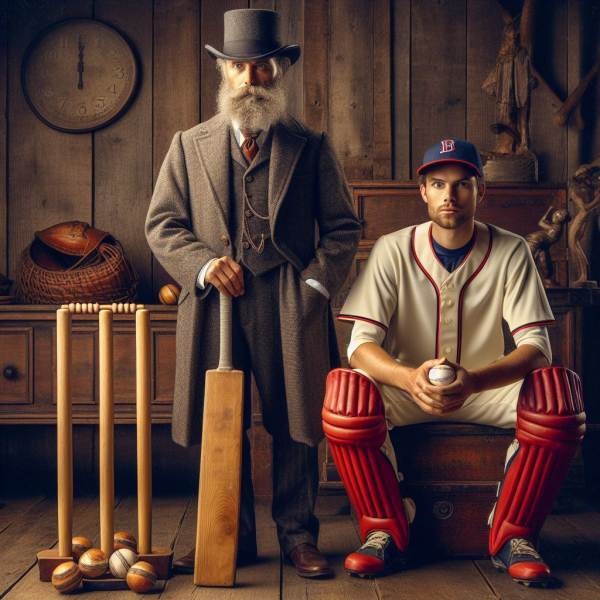
Here at NPM2024 Field the British side has shown up to face the Modernist American 9. The Brits advantages: fine woolens, bats that could also be used in a pizza oven. Americans? Plenty of sharp Latin-American players, closer, more aerodynamic beard trims. Read the post for the score.
.
*In case you’re wondering, I think the only translations from a non-English poet are a pair of William Cullen Bryant translations of Homer, and a KJV Song of Songs excerpt.
**Anyone who knows me, knows that just typing this excuse makes me want to indeed do a web search for at least this quintet. I did. Results: only Allison is an American.
***Yeats’ poem of his bee-loud Mojo Dojo Casa Dream House was the leadoff poem in the “Girls Book of Verse.” Browning’s poem of an April unaware for those who simply live in it was in both the boys and the girls volumes. So, if you’re keeping score, you guessed this second one correctly.
Let us return to the genius of Emily Dickinson, as we have regularly here at this Project. As I look to her work over the years, I find that Dickinson has several modes. In one mode, her approach is charming, a just-between-slightly-weird-friends sharing of concrete observations of people and the physical world. Even when that Emily speaks of death and eternity, it takes as its conveyance and destination a horse-drawn fate and a well-made bed/grave. Another mode, not as well represented in her “greatest hits,” can be puzzlingly condensed and abstract, as if shorthand notes taken from her own mind of states of thought or insight that come upon her.
One aspect of genius is that it can get away with things that us more craft-assigned poets cannot. To be abstract and nearly impenetrable at any length tires out readers even as her other poems draw us in. If one reads Dickinson as an entire collection, these modes are interspersed. We might think, “Oh, there’s our friend Emily in one of her private moments we cannot join — moments we accept with partial-at-best understanding because we’ve come to love the other parts of her poetry.”
Today’s short Emily Dickinson poem bridges those two modes. It opens as arrestingly as any poem could with the striking statement “I am afraid to own a body.” As I did with our last Dickinson performance here, I wonder at that line and immediately relate it to body dysphoria, something that portions of our current society experiences and is more free to express.
The poem then moves on to an allied and contrasting statement nearly as striking: “I am afraid to own a soul.” The soul is by definition incorporeal, but by linking it with the body in the first line we may palpate it none-the-less. As the quatrain finishes these two connected things, body and soul, are described as valuable, and despite our fears, inescapably present. The poem might be too short if it ended there, but I’d recognize it as a complete koan of enlightenment — but it doesn’t end.
1st stanza draws us in. 2nd one confounds. You & I may not be able to get away with such writing, but let us trust in the genius of Emily Dickinson.
.
In the second quatrain we are off in the abstract Emily. I often seek to remind readers here that Emily lived in a house devoted to law with a father, grandfather, and brother who practiced law.* I think there’s passion and emotion in this second and final stanza, but if we are to follow it we must think as if we’re reading a contract or one of those user agreements we so often click “accept” on without reading. This stanza as saying that both body and soul are willed to us, like a “conditions attached” bequest in a will — and then after the stanza’s second em-dash, what? Who’s the “Duke?” Since rural mid-19th century Massachusetts was not supplied with titled nobility, I suspect this is connected to something Dickinson read. I’m going to take a flying leap of wild assumption here, one that you shouldn’t “take to the bank” any more than my “what if?” wondering that the mouldering man who died for truth in this other Dickinson poem could be John Brown, and a link much less certain than the idea that the kept in quotes “hope” bird was a reference to Emily Brontë. Could this poem’s Duke be Robert Browning’s monologuing one who speaks of “My Last Duchess?” I know Dickinson read Elizabeth Barrett Browning, so it’s not an impossible leap to think she read EBB’s spouse too.
If our Duke is exhibiting his deathless painting of his now dead (likely on his own orders) “last Duchess,” Dickinson is perhaps (in a very obscure and condensed way) mentioning drawbacks to our existence as a body** and as a questing soul.*** What then to make of the final line? I’m not sure. Is God the bequeather of the soul and body in the bargain our speaker is afraid of? Is God as cruel and exacting as Browning’s Duke? What’s the closing “Frontier?” The course of our lifetimes not yet mapped out? A “light out for the territory” escape? I’m not sure.
I’ll be honest, I recorded my performance of this second stanza not having figured out even these potentially wrong readings of it. What did I rely on then? There is some worthwhile word-music — and poetry using that tactic can give pleasure and connection before understanding. I trusted the mystery of the words might convey some mystery to the listener even if I had not opened the packet containing their meaning. My hope: that I could be, however imperfect and limited, one who carries Emily Dickinson’s genius to you.
You can hear my performance of Emily Dickinson’s “I Am Afraid to Own a Body” with the player gadget below. If you don’t see the player, there’s this highlighted link that will play it too. Speaking of links, there are other hyperlinks in the post above to some other Parlando Project Dickinson pieces that you might want to read.
.
*Have other better-known and credentialed scholars made much of Emily Dickinson’s connection to the law? I think the last time I searched I didn’t find much of anything. There’s a thesis topic for some young reincarnation of Wallace Stevens.
**Not much of a leap to a feminist reading of a female body here.
***One of my observations on reading my first full-length biography of Dickinson many decades ago was how remarkably determined she was to resist the pull of declaring herself as “saved” during her time and place’s Christian religious revival. Schoolmates, family, and community all declared, and she steadfastly refused.
One of the odd things that can happen to a poem is for a single line to become remembered while the poem itself may fade out of fashion. Today’s poem, which is likely to be our final poem for this April’s American National Poetry Month was published in the middle of the 19th century by an Englishman who was away from his home country in Italy. So yes, this one goes out to my faithful British listeners — but, at least in my country, about all that remains of it is the poem’s opening two lines: “Oh to be in England/Now that April’s there.*”
I didn’t know what poem it came from before this month. I didn’t even know it was from a poem, or that Robert Browning wrote it. A poem like his wife’s Sonnet 43 “How Do I Love Thee? Let me count the ways.” may be similarly antique in age and language, but I recall, however hazily, something of the whole of that poem, it’s sense, and meaning.
Robert Browning, making the chin-beard somehow work for him.
.
Since it’s likely that many of you don’t know this poem more than I did, here’s a link to the full text as Browning wrote it.
So, what is this poem saying, what is it on about? It’s a poem very much of longing for one’s home. A romantic catalog of nature details from the English countryside is mentioned: birds, trees, flowers. I’m ignorant enough about such things that I can’t tell you the song or plumage of any of the birds (I even mispronounced the name of one of them in my performance), I know little of the exact trees, and only a bit more of the blossoms and flowers listed, but I think the poem survives this ignorance. The catalog is enough to demonstrate that there’s a specific spring, specific to place (and by now, perhaps to time), that Browning is missing.
There are three telling lines in the midst of this nature catalog. Early in the poem Browning says that if someone simply wakes in an English April morning, they are unaware. This is of course not universally true, some will awake to marvel at a Spring morning wherever their bed is, but Browning’s point is that some will not, and by implication that he himself often didn’t. Another telling line: in remembering the birdsong of the thrush** he says that the bird sings each song twice, seemingly to prove that the bird had fully absorbed and internalized the rapture of Spring, so that it can recall it at will. That opens the question of if Browning feels in his poem if he has been able to do the same, to recall what he is now separated from. Perhaps it’s more so than remembrance. It’s often said that nostalgia and memory increase the sense that what is gone was better and more intense than it was.
Which brings us to the third telling line, which is almost a throwaway in Browning’s version of his poem, but the one I’ve chosen to make a refrain that I think changes and reframes the poem: “In England now.”
Browning’s use of the line may have been largely a rhyming choice in the series of “bough,” “now,” “follows,” and “swallows” — but rhyme, like chance effects beloved by some Modernists, may cause the mind to go elsewhere or to bring out things it would not consciously choose. By making “In England now” a refrain, it sits beside and comments on nearly every part of Browning’s original poem. My intent is that this refrain will bring out different responses to different listeners, perhaps even different responses to a single listener as it reappears. To test that out, you can hear my performance with a player gadget if you see it below, or with this highlighted hyperlink that will open a new tab and play it.
**In other April poetry, we’ve just finished our serialized performance of T. S. Eliot’s “The Waste Land” which features a thrush singing in its concluding section performed and presented here earlier this month. Eliot’s thrush singing in the pine trees he wrote in his notes to “The Waste Land,” was from his personal memories of camping in Canada as a youth.




 Frank Hudson