Sandburg’s Couples

Time for me to get back on my Carl Sandburg soapbox. I’ll be brief — as today’s poem, now song, is as well. My point (again) is I think there’s more there in his poetry than is currently remembered or considered. Your impressions may be from two stalwarts of American poetry anthologies: the Whitmanesque “Chicago”  with those big shoulders and the quite contrasting short metaphoric poem “Fog”  with its cat’s feet. Not a lot for a poet who wrote so much, so early in the Modernist era, but it does point out a range of expression.

I’ve performed segments of Sandburg’s prolix mode here. I like Whitman well enough. Within limits, I like Sandburg doing Whitman’s mode too. He’s not quite the opera singer that Whitman aspires to be, he’s more of the folk-ballad, song-suite, kind of poet. America’s a big country, so I guess we need big, shouting, poems — and even if that’s not my favorite mode, either poet can move me as they traverse long distances with galloping catalogs and litanies. My point today is that this Sandburg, being bigger, overshadows another Sandburg, one that I particularly treasure, the one that reminds me more of Du Fu than Whitman: the forgotten, pioneering, ground-level reporting, American Imagist, Sandburg. Sandburg’s poems in the compressed style are not accidents, seeds of long poems that didn’t germinate, or little palate cleansers between his important work. His earliest collections are packed with sub-sonnet-length pieces.

On awaking this morning, I was thinking of a set of poems by a couple of the earliest American Modernists, Ezra Pound and Sandburg, where they each showed gratitude for their American forbearers. I paired their poems as one musical piece early in this Project, and here’s a link to that.  Pound, within his characteristic grumpy mode in “A Pact,”  makes peace with Whitman — and while casting a little shade on Walt for being the son of a house-carpenter, he claims his own finely crafted woodcarving is descended from the cross-cut and rip saw of Whitman.

Who does Sandburg say are his native 19th century inspirations? Whitman? Nope. Maybe Longfellow, with his civic-minded striving for uplift and justice? No. Who’s left? Poe? Hmm. Interesting thought, even if Poe is awfully rhymey for a free-verse poet. The other Fireside poets? Well, yes, Sandburg wanted a wide audience, but as the child of an immigrant couple and attendee of a non-descript Midwest school, he lacked their pedigree.

Sandburg in his “Letters to Dead Imagists”  is declaring his allegiance to that spear-point of English-language Modernism, but here he claims a couple of Americans as his predecessors: Emily Dickinson and Stephen Crane.

The poet he names first, Dickinson, will likely seem a more conventional choice to those reading this today than it was when Sandburg wrote his poem in the early 20th century. Dickinson’s eventual rise to genius status would still be early in its slope — she was more known then as an eccentric than as a model for poetic expression. The second, Stephen Crane, is more associated with prose, but he wrote a singular collection of gnomic, short free verse poems, The Black Riders,  in 1895. An inspiration for Crane’s unusual work: the new, first publication of the poetry of Emily Dickinson in 1890.

Sandburg was among the first to try to form a 20th century style combining the “mother and father” of American poetry: Dickinson and Whitman. And I happen to like it when he takes after dear old mom.

Today’s piece, Sandburg’s “Couples”  sounds a little like Crane, a little like Dickinson, and it has a characteristic early Imagist trope of close-focus specifics and vivid color by name. Here’s a link to the text of it.  If one thinks of Sandburg as being a clear-speaking poet, this poem should disabuse you that he’s always about some obvious point. Part of the delay in publishing my version of his poem is that I’m still not sure what he’s describing. There’s parallelism set up between six “women” dressed in green and six “men.” They’re described as dancing, likely haphazardly as the infamously strong liquor absinthe* is mentioned, they make a hissing laughter sound. They are somehow cheating or gaming each other. There’s a worn path of hard packed dirt said to be from the dancing feet. The poem closes with dewy weeds said to be as high as six little crosses, one for each couple.

I’m stumped. A graveyard? Then maybe the dancers are ghosts. But if so, why the specific detail of the dirt floor packed down if it’s a weedy, less-than-well-tended graveyard? A barn-dance? The weeds are described as “mourning veils.” Or are the six live couples dancing around six graves? Why, who are they to the buried, if it’s that? Perhaps instead, the dancers are green plants of some kind, their dance uncoordinated as random winds, and the wind through them is the hissing laughter, and they’re maybe even the weeds the poem closes with. Did Sandburg just choose their number to be six out of desire to be specific? But again, he spends two lines of a short poem on the packed down dirt floor under the “dancers,” and plants dancing in the wind wouldn’t compress the earth.

In summary: as obscure as any of Crane’s Black Riders  poems — but specific, like a closely-observed Emily Dickinson riddle poem. If Sandburg intended mystery, he achieved a stubborn dose of it in this poem of his, and the incantatory power of its spikey, inexplicable details may still carry us through. While it’s unlikely Sandburg’s model, if one was to translate this into French and say it was from Rimbaud’s “Drunken Boat”  how would we experience it?

Carl Sandburg with guitar at mic

Glad to be at the open mic. I’m going to do “Wagon Wheel” and this Oasis song “Wonderwall” now.

.

If forced to a final guess: they are  graves, and the dancers are the living as continuing life-force, not dancing on the graves as revenge, but out of the joy of continuance, and the packed dirt is the mark of our ongoing life-work and dance. The cheating? The unfaithfulness and trifling of love and desire, or they are cheating death by living and loving. The couples of the title then are not only the paired male and female dancers engendering a new generation, but the connection between the living and the dead. Why six? I don’t know.**

I performed this with just acoustic guitar, Carl Sandburg’s own instrument of choice. When assessing his guitaristic skills, Carl would sometime say he was at least one prison sentence from getting any good. You can hear my misdemeanor playing with the audio player gadget you should see below. No gadget? It was pardoned, or impounded, or deported, or took a buyout, or something. No one seems to know, because some vain fool runs things, and there’s not enough conscientious people left to make knowledge from foolishness. But I do give you this highlighted link that’ll open a new tab with its own audio player.

.

*Absinthe is colored green, doubling down on the use of that color in the poem.

**Rejected guesses why six couples and six crosses: six is sometimes used as the number of cardinal directions, sometimes shown as a six-armed cross, but Sandburg seems to be clearly saying six separate crosses. The Oklahoma state flag shows a First Nations (Ossage) shield with six separate crosses on it (the cross is a common indigenous American symbol) — but that flag was adopted a decade after the poem, and I can’t find any source of previous use of that distinct six crosses symbolism that the flag drew on.

The Route of Evanescence

Here’s another little mystery, a riddle inside a riddle, which makes up a new song using the words of Emily Dickinson — but first a little of me sounding like a regular blog that talks about itself.

As assured time to work on this project has largely disappeared, I’ve been turning to simpler compositions and quicker realizations of them to cope with this, but over the past few months a number of pieces have sat in limbo, waiting to be rediscovered, waiting for decisions to be finished or abandoned. In going through some of these this month and I came upon a recording session for “A Route of Evanescence”  from last August.

I recall the session. It was just me and a couple of acoustic guitars, with access to my quiet studio space. I had some advance notice, maybe a day or so, that I’d have that time. On the hurry-up, I prepared a number of compositions to record, and when the day came, I set about laying down tracks singing and playing that pair of acoustic guitars. I’m not an exact or exacting guitar player by temperament, but when I haven’t played as much, my old hands produce more imperfections. None-the-less the limited time meant that I pressed on. I think I may have recorded basic tracks for at least two or three tunes that day. It’s likely that I’ve already presented at least one of the others here, but not this one. Why?

I might have blanched at releasing too many acoustic guitar tunes in a row. Despite my limitations I like what I can do with that instrument, but “like” means that I could fall into doing that over and over, and my temperament also doesn’t like doing that. I might frustrate you a little* by jumping around musical goals and genres, but a bored artist won’t interest an audience either. Or maybe I had some songs more distinctly about summer that I wanted to get out before the end of the season, and so this one was set aside?

Listening again to the raw tracks I thought it sounded pretty good. It’s harmonically different from some ruts I fall into, and the playing and singing is at a level that represents what the composition is. I may have thought I’d record some additional tracks, build out a more elaborate arrangement back then — but it stood by itself when I listened this month. Therefore, I mixed it and made it ready for distribution. **

route of evanescence

Here the chord sheet for today’s Chimera. That 2nd inversion G is a neat sound.

.

And then, as I went to prepare this blog post, there was one additional surprise. I thought it was one Dickinson poem that I performed back in August, the one named in the recording files, but the song was made from two: “A Route of Evanescence”  (F. 1489) and “Ferocious as a Bee without a wing”  (F. 1492).

Why did I combine them? I don’t remember. They sound good as a combined piece, though doing so may confuse Dickinson’s intended mystery, because both appear to be riddle poems. As a poetic or sung genre, the riddle has a long tradition (folk music, going back to the Middle Ages, has a bunch of them). The lyric gives you hints that don’t exactly make sense until you figure out, or are told, what the subject or answer of the riddle is. “A Route of Evanescence’s”  answer/subject is the ruby-throated hummingbird. “Furious as a Bee without a wing’s”  may be a honeypot ant.***  The riddle poem, and Dickinson’s examples of that, are antecedents of the early-20th century Imagist poem, where the moments details are exact, but inference or the title may be necessary to interpret the details meaning. Evanescence, as in the charged moment, is part of that Imagist creed.

Both of these are later Dickinson poems, written in the late 1870s more than a decade after the vast majority of her work written in the 1860s. Dickinson by then may have been like me, writing shorter and shorter — sometimes on scraps of envelopes or the back of food packaging in her case — trying to find autumn creation in the midst of life.

To hear this Chimera song combining a hummingbird and a honey ant, use the audio player gadget you may see below. No player to be found?  This highlighted link will open a new window with an audio player.

.

*Those I frustrate more than a little likely aren’t reading this. I keep thinking there are a goodly number of listeners who’ve heard one to a few of the Parlando Project audio pieces, but finding even a single ill-tasting example, leave off listening here for something elsewhere where they expect consistent rewards.

**I use an audio streaming service that is designed for podcasters, who are typically long-form talkers about their subjects. I could do a talking podcast, more or less replacing these written posts about the exploration that makes up this Project, but I don’t see the demand. So, the Parlando Project podcast is just these musical performances you see at the bottom of the blog posts. You can subscribe to or browse the last 100 or so Parlando audio pieces on most places you can get podcasts — except for Spotify, which for some reason they never shared with me, dropped the Parlando podcast distribution from their podcast section a few years back.

***A fascinating class of creatures that I knew nothing about. I’m not yet even sure if a species of it was found in Dickinson’s 19th century Massachusetts, or if Dickinson knew of this insect. This poem seems to use many similar words to another very short Dickinson poem (F. 1788) that is the penultimate poem in the Franklin listing of the complete Dickinson poems. However mysterious, it’s an image Dickinson returned to.

The only Ghost I ever saw

Here, as promised, is the start of a series of Halloween-themed posts. Today’s audio piece uses words from 19th century American poet Emily Dickinson, and as usual for her it’s titled using the poem’s first line: “The only Ghost I ever saw.”   Dickinson is no stranger to the gothic, but she often approaches it playfully — and that seems to be the case here. Here’s the full text of the poem along with chord-sheet notations for the 12-string guitar part I accompany it with today.

The Only Ghost

Sing along with Emily and the tree ghosts

.

The surface “plot” of this poem is straightforward, if detail sometimes puzzles. The poem’s speaker (presumably Dickinson) has seen a ghost once. She describes the encounter using some expected and unexpected description, and then closes with a puzzling final line. Since the description of the ghost is most of the poem let’s examine that closely. We first learn the ghost is dressed in “mechlin.” What’s that? A type of Flemish lace. The ghost has “no sandal on his foot.” The ghost moves soundlessly but with some speed, bird or dear-like. The ghost’s “fashions” are “quaint.” It might wear mistletoe. The ghost makes no footfall noises, but is not noiseless either. It’s said to laugh “like the breeze.”

The concluding lines say Dickinson doesn’t want to look behind and calls the day she saw her ghost “appalling.” I’m indebted to the Prowling Bee blog who notes that in Daniel Webster’s American 19th century dictionary, appalling may mean to astonish or to grow white among other meanings that have fallen out of use. Over time that we’ve taken it to mean frightening or disgusting.

This sort of mystery with detail is a format which suggests a riddle to me, and Dickinson did write riddle poems. So, is the ghost a metaphor for something else she’s observing? One could hazard a guess it’s snow, which might sweep in on winds like this with frosty lace, but the ghost is said to step “like flakes of snow.” It could be wind —and cold currents are often felt as “ghostly” — except again, Dickinson spends at least three lines in her short poem describing its actions as like a breeze. Snow like snow or breeze like breeze would be tautologies.

If it is a riddle, my best solution is that she’s viewing a tree in a grove of trees. Bark or moss, or even more likely the light filtering through small branches is the lace mosaic. It has no sandal to walk on the ground, its foot is in  the ground — and note that Dickinson says no sandal on his foot (singular), not feet as in a human ghost. It steps in the wind in its swaying, but the noise in that movement isn’t from the foot of the tree, which stays stationary. And the branches dart back and forth like a deer leaping or a bird hopping. The prime clue is that mistletoe. Mistletoe is a parasite plant, it only grows by embedding its roots in trees.  The branches make noise, the laughter, and in the path of the breeze the laughter would spread to other formerly still and pensive* trees around. Dickinson knows botany, I understand she and her family cultivated trees, and she has written other riddle poems with plants as answers.**

So my reading in summary: Dickinson is viewing a tree, perhaps one of the trees that surrounded the Dickinson homestead in autumn, and those flakes of snow its branches are stepping “like” are also  appearing snowflakes in an approaching cold-front. The “interview” is cut short as the day is appalling — growing pale.

Is that an all-too-much a Scooby-Doo “There’s no such thing as ghosts” ending? I’m not certain of it, and the poem charms without the above, letting it stay in mystery. If that’s your worry, who’s to say — particularly at Halloween — that the trees aren’t sentient spirits?

You can hear my performance of Emily Dickinson’s “The only Ghost I ever saw”  with my own musical setting using a player below if you see it. Is that player an invisible ghost for you? Well, summon it then with this highlighted link that will open a player.

.

*In the handwritten manuscript, Dickinson shows that she considered “smiling” instead of “pensive” in the poem.

**See this Dickinson flower riddle poem I recast as flower-power.

I Saw a Peacock

There’s not much to say about the author of today’s words, as they are anonymous and somewhat older than I am—“I Saw a Peacock”  dates to sometime before 1655. Somewhat like Emily Dickinson’s “May-Flower”  poem, this poem is on the face of it a chronicle of wonders and mystery, but it can also be read as a puzzle. Here’s the text of it:

I Saw a Peacock, with a fiery tail,
I saw a Blazing Comet, drop down hail,
I saw a Cloud, with Ivy circled round,
I saw a sturdy Oak, creep on the ground,
I saw a Pismire, swallow up a Whale,
I saw a raging Sea, brim full of Ale,
I saw a Venice Glass, Sixteen foot deep,
I saw a well, full of mens’ tears that weep,
I saw their eyes, all in a flame of fire,
I saw a House, as big as the Moon and higher,
I saw the Sun, even in the midst of night,
I saw the man, that saw this wondrous sight.


The key to the puzzle is to read the lines starting at the middle and continuing to the middle of the next line. Read this way the things connected seem more commonplace and less mysterious. Given it’s age, there not a lot of out-dated words in it. A “pismire” is an ant.

Coppa_decorata_con_scene_di_carnevale

A Venice glass, not actual size.


This is a fairly sophisticated play with the powers of enjambment in a line of poetry, where the stop of the line makes one pause and consider (if only for a moment) the thought contained within the line, even if the thought is not actually completed yet. But I’ve chosen (as I did with Dickinson’s “May-Flower”)  to not perform it as just a riddle or exercise. Emily Dickinson’s poetry for her flower riddle was too mysterious and sensuous for me not to play to the mystery. Similarly, “I Saw a Peacock’s”  surface of surreal combinations of the like/unlike is too strong to not go with that side of the Mobius strip.

Although I just ran into “I Saw a Peacock”  this month, the poem has collected its fans over the centuries. I saw it at the Interesting Literature blog (which is, by the way). Writer Margaret Atwood once wrote that it was “The first poem I can remember that opened up the possibility of poetry for me.”

There is at least one other setting of this poem to music, a choral setting where the composer, Caroline Mallonee, uses a double choir to present both ways of reading the lines. That’s another artistic solution, different from my decision to present it “unsolved.”

My musical setting uses double instrumentation too. There’s a standard rock trio, albeit playing quietly (drum-set, electric bass, and electric guitar) and a quintet of double-bass, two cellos, violin and tuba.

You may have noticed I’ve been away from this blog for an interval of a few days as I work on another project this spring. I’ve noticed that folks are looking at the nearly 350 audio pieces we have here in our archives more and more, which is a great way to get your fix of music and words combining. To hear today’s piece, “I Saw a Peacock,”  use the player gadget below.


See Emily Play: May-Flower

The great thing about Emily Dickinson and her around 2000 poems is that there’s always one you haven’t experienced yet—and just this week over at the Interesting Literature blog I saw this Dickinson spring poem. “May-Flower”  has Dickinson doing her most subtle music to accompany her most Blakean attention. Just like it says itself: it’s a “bold little beauty.”

It’s short and compressed, and if you read it quickly and silently it may seem slight and slide right by you. Spring, May, flowers, check. Robins. Yup, spring. Its abrupt ending might stop you for just a moment. It ends: “Nature forswears/Antiquity.”

Oh, I get it, the flowers in early May are new, there isn’t such a thing as antique flowers. Easy enough to see that—but the undercurrent is deeper, because this is another carpe diem poem, though this time without much bombast and no overt hey-baby-what-about… pickup lines. Yes, there are no old flowers, and so this flower will come and go with May.

Not many words in this poetry-machine, but without choosing any esoteric ones, Dickinson has made some choices that may arrest you the second time you read it. “Punctual,” the flowers know right when to be there. “Covert” those early signs of spring, like some advance spies. “Candid” for May, and spring fully here, no need to hide as a generic bud. Even “Dear” in “Dear to the moss” is a choice I wonder about. I’ve even read it incorrectly as “Near to the moss” once or twice, and sound-wise “near” works very well and is clear in meaning.  Does Dickinson want to pun on deer, another spring poem perennial? Does she want to pickup and connect that D sound from “Candid” in the line before it rather than predict the upcoming N sounds of “Known,” “knoll” and “Next?”

Which brings me to this: if you listen to the poem, or plant it in your own mouth, the sound is exquisite. Rhymes and near-rhymes abound without locking down to a scheme: “small/punctual/low/April/knoll/soul” and “every/beauty/thee/Antiquity,” and consonants and vowels are echoing each other too.

See Emily Play Games for May HD

Foreswears antiquity: I’m not sure if anyone who reads this will remember the poster I’m referencing here.


To perform “May-Flower”  I made some choices. First, to slow the listener down, and to give extra chances to hear that echoing sound-play, I repeated each line. And to emphasize the moment rather than its passing, I interleaved the first and second stanzas as responses to each other. In the last stanza, the responses are just additional echoes of that stanza’s lines.

For the music, I decided to refer to The Pink Floyd. No, not the auditorium and eventually stadium-filling rock band, but the original 1967 Syd Barrett-fronted line up, which was based more around the sound of that era’s electric organs with a taste of Barrett’s unique take on slide guitar. So, time to dabble and wobble organs and break out the Telecaster and a finger wrapped in a vase of glass.

Emily’s poetry-machine obliviates the need for dodgy recreational chemicals. Attention is the drug. This is not the first time I’ve referred to Emily Dickinson’s visionary side here. I see it coexisting with her skeptical wit. And this poem, for all it’s Blakean a heaven in a wild-flower aspect was also intended by the botanically knowledgeable Dickinson as a riddle, the correct answer is a particular New England wild-flower, the trailing arbutus.  See Emily play. There is no other day. Free games for May….

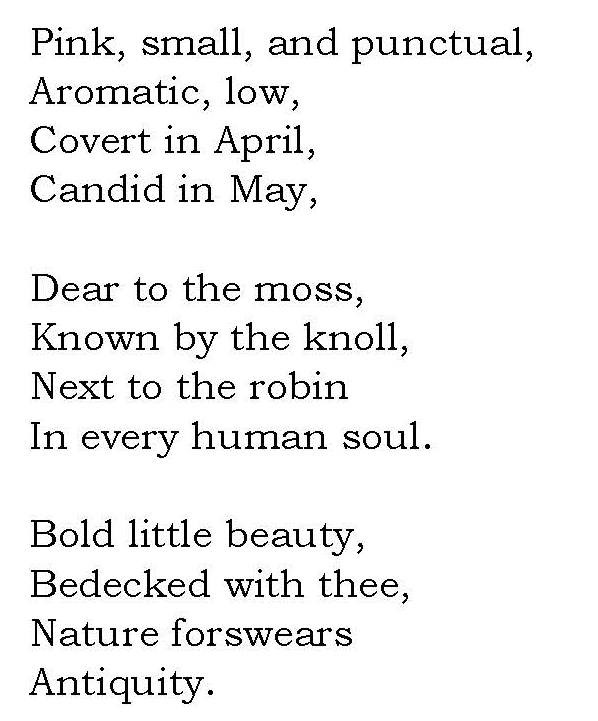
Here’s the text of Emily Dickinson’s May-Flower if you’d like to read along.

May-Flower text

This is the regularized version with conventional punctuation. Emily’s own was full of her dashes.

And here’s my performance of it with original music. Use the player below.