It’s been tough to plan and work around poetry or music this month in Minneapolis.
Every time I write a sentence like that one, I start to compose what I think will be a concise account of why that is – and I find I can’t do that well enough, partly because there so much to say. To try to put down all the things I’m feeling and thinking in this time of daily governmental offenses and stalwart self-less resistance? Impossible – I go the whole gamut, and these instances and reactions don’t wait their turn, queue up to go one at a time: all the emotional and thought-mode flavor combinations rush to be present.
I’m going to assume some of you already have some sense of the constant lying, the retributive violence, the self-congratulatory joy in inflicting pain, and even the sloppy indifference to a lack of competence or good administration.* This operation is like someone took one of our mad and mentally diminished king’s speeches and sought to make them a battle plan: and so the incursion goes on and on, jumping from half-truth to 100, no 200, no 500 percent less truth, never really making a point or achieving an objective, becoming instead an example of how one can, without any checks or accountability, say or do anything (however stupid, cruel, or shameful).
“I must be powerful,” thinks our mad despot and his dukes and vassals – “for I can do something so badly, with so little care, crowing with pride about hurting my own countrymen!”
Those who don’t know this? You’ll need to find out more elsewhere. I urge you to do so. Those that are sure I’m the deluded one? Why are you still reading today? I will be getting back to literary poetry soon if you come here for that.
Yes, I’m tentatively trying to get back into finishing new musical pieces, though events may continue to make that difficult. I do have this for today: another version of the definitely not a topical song“I’m on Fire (and I’ve got mountains of ice to melt)” composed by Parlando alternative voice Dave Moore using some words borrowed from speeches by 19th century American abolitionist Wendell Phillips – but this time instead of Dave’s own voice and piano it’s a solo performance recorded on a cell phone back in 2014, accompanying myself on acoustic guitar. Between these two versions, I gave preference to Dave’s, not just for the justice of having him sing it, but because back when both versions were new, most listeners thought that my performance repeated the chorus too often. Thinking of that now, I’ll adapt William Blake: maybe the only way to know when we’ve said that line about melting mountains of ice enough is to say it too much.
.
*What a lousy sentence that is! People being shot, even killed, families separated, reverse Raptured cars with vacated driver’s seats. Doors busted down with battering rams without a warrant. Supreme Court nod-and-a-wink approved detainments where folks are grabbed, thrown down in the snow, handcuffed, taken to a makeshift jail for a day or so, only to be released with no charges or immigration regulations violations. Tear gas, pepper spray, and “less-lethal” weapons used more likely for sport and revenge than necessity – and I still have the officiousness to end my sentence by objecting to these agents poor organization and the incapacity of their leadership to make a detailed, defensible, consistent case for the necessity of their actions.
When you listen to the song you can hear below you might doubt me – but it is not a topical song written about recent events. It was written by Parlando alternative voice Dave Moore in 2014. Dave’s the keyboard player and the better singer in the LYL Band, and that same year I recorded us playing it with him singing and pounding the piano, and me squawking in with some backing vocals and skidding guitar. Dave tells me today he was writing the song while caring for his father in the times surrounding his dad’s final illness, and he was thinking of the work of someone that goes even farther back than 2014: the 19th century American Abolitionist and speaker Wendell Phillips. Dave’s father was a preacher and a man of strong principles, but Phillips would take a backseat to no one on standing and speaking for his convictions.
As to Phillips’ convictions (as I’ll do once more before this post is done) I’ll try to be brief – but in considering the refrain in “I’m On Fire” it’s important to note that people, even ones who somewhat agreed with Phillips, noted he was a little off the scale in his fervency whenever talking about injustice. And Phillips’ stand on slavery was not the popular, acceptable opinion when he began to express it. Phillips started his Abolitionist calling knowing full well that another prominent Abolitionist speaker had just escaped being lynched by a mob. Dave’s energy with the piano in today’s piece rightfully reflects how Phillips expressed himself.
The Boston Public Garden memorial to Wendell Phillips. Ice or ICE not visible in this picture.
.
And so it was that Phillips was once asked, “Why are you so fiery all the time Wendell?” Phillips replied “Yes, I’m on fire – because I have mountains of ice before me to melt!” More than a hundred years later, a man who became a U S Senator from Minnesota, Paul Wellstone, liked to remember that Wendell Phillips quote. And Dave Moore, our singer and songwriter remembers Phillips too – he has a long-running cartoon in a neighborhood paper where he often brings out Wendell Phillips quotes to assay our analysis and actions regarding current injustice.
Phillips’ ice metaphor, that cry against intransigent injustice will make it seem like Dave was freshly writing about Immigration and Customs Enforcement (ICE) in Minneapolis today. Once more I’ll be brief, but I have foreign readers here, and they might not know what’s been keeping me from working on this Project much in this new year. The following section has been written and rewritten a half-a-dozen times in the past week, and I’m largely going to surrender to highlights, because those that know and see what I’ve seen this past week are already saturated with the things I might try to describe, and those that have certain other judgements that benefit, comfort, or blind them, likely require more vision correction than I can prescribe.
Our home state of Minnesota is currently suffering an intentionally vindictive armed incursion by secretive forces sent by our mad and ill-tempered ruler, who says, right out, this is his retribution. Yes, this is also ostensibly about immigration regulation enforcement, but this is largely a pretext, as the rules for immigrants are being changed week to week, and the enforcement seems capricious and sloppy. If this was some laudable reform targeting people they tag with rote-repeated epithets of being murders, rapists, and gangsters, you’d expect constant published detail of accomplishment, with hundreds of chapter and verse rap sheets to show their work – yet to a significant degree, no one knows completely who is being taken out of their homes, cars, schools, or workplaces. The point, or the result, is to make a great many feel they could be next, particularly if they object to this, since that’s being a “violent agitator.” These so-called agitators are often standing on sidewalks and street corners in their own neighborhoods, on their own blocks, even on their own doorsteps – or they are at their own shopping sites, schools, or workplaces, armed with but cell phone cameras and whistles to call others similarly “armed” to protect them (somewhat) from the masked squads. Some step forward to try to get the names of those who are being detained (since the secretive authorities do not reliably release those names) and getting near enough to hear that risks their own detention. Their cameras minimize, but do not eliminate the street beat-downs and such that would otherwise occur. “Less lethal” bullets, chemical sprays and grenades also get used. They call some of these actions “targeted,” but the targets seem out of focus. US citizens with accents or too much skin color get grabbed, and if you squint a First Nations citizen can look like one of those foreigners. Gotta be hard to deport a Lakota – where’s the plane to fly too? Maybe they put them on a plane, draw all the window shades, make zoom-zoom engine noises, and then let them off?
Given the poorly trained, ineptly led, error-prone outside troops, and all their quick with the ordinance reflexes, these encounters with cruelty-is-the-point apprehensions aren’t prayer circles. Many locals observing this in their neighborhoods are angry and disgusted and they are shouting out shames and curses.
If you’ve seen reports this past week you’re horribly aware that one of these neighborhood observers was shot at close range in the face and killed in front of their spouse, or you might have seen another raid during which a woman driving on one of the busiest avenues in Minneapolis comes upon a half dozen ICE vehicles blocking the street. Some of the agents wave her to turn off to a side street, then others decide she must be a protestor and break a couple of her car windows and drag her out the vehicle still caught in her seat belt as she wails “I was just trying to get to my doctor’s appointment.”
Well, I live between those two avenues. When urbanists talk of walkable neighborhoods they’re likely not thinking of walk-up atrocities, but this is where I, and my little family, live. I’ may have written too much or too little of these things, and just as with other attempts to write about this experience this week I’m not sure I did an adequate job of it – but no gentle poetry sung today though I have this old song that sounds right. Click the audio player below and let poet/cartoonist/pianist Dave sing his song. No player? It hasn’t been detained, it’s just that some ways of viewing this blog don’t show the player, and this highlighted link will open a new tab so you can hear it.
Edmund Vance Cooke was a Canadian poet. At least I think he was. There’s not much on his life I can find, and sometimes his last name is rendered as “Cook.” His sparce Wikipedia entry says he was born in what was then known as West Canada in 1866, and back around the beginning of the 20th century he wrote a type of popular published poetry in a style that has largely died out. Wikipedia calls his genre “inspirational verse,” and some of it I’ve found is that: paeans to earnest striving and social virtues that now-a-days would be reduced to short easily-sharable quotes or the captions on “hang in there” motivational/affirmation posters. But there are indications that social criticism was also part of his repertoire, and this poem I perform today has some bite to it. Though written in 1917, I felt I should work up some music and sing it as a freshly-made song in 2025.
One of the things that irks me most this year is the outrageous lying by my country’s mad despot and his fawning courtiers. I can’t say for sure what drives all these fabulations and alibies across his administration. For some personalities a lie is a demented reflex, a neurological tic. Others spout the lies as a cold tactical choice of propaganda, with a sense that it will gain them some rewards. A more generous assumed motivation: that by saying this or that is so, when it’s not, may help manifest the thing not yet in existence – and this is akin to what affirmations invoke for personal improvement. Alas, most of the things not yet in existence that our current regime members are manifesting by statement are ugly, cruel things. We shudder – while considering the exaggerations, we fear they might not stay lies for long.
Today’s Cooke poem “Sedition” is a statement of the countervailing powers of truth. It reminds me of an anonymous poem about truth that was widely printed in the same era as Cooke was writing, “Truth Never Dies.” Five years ago in this Project, I presented that poem and wrote about what I found about who had republished it. This link will be of interest if you wonder about that. Though it’s a statement without evidence, it’s not impossible that Cooke was the author of the much reprinted “Truth Never Dies” poem – but “Truth Never Dies” is a more religious and spiritual poem than “Sedition.” I composed music for the former with acoustic guitar and strings presenting it as a firm, but gentle prayer. The latter, Cooke’s poem, is more sardonic, defiant, even militant – and so I decided to crank up some electric guitars for it.
Here’s a chord sheet for my version of Cooke’s poem. I won’t take responsibility if you decide to play and sing it yourself, – that might make you part of a conspiracy.
.
I played three guitars in the recording via multitracking. For the electric guitar nerds, the center channel has a Gretsch hollow-body playing the chords, the right channel’s a Jazzmaster solid-body with a pitch-shimmering wiggle stick, and the left side a Telecaster whose wide vibrato here was created by having enough personal frustration to expiate that my fingers directly wrung the strings sideways to way above their fretted pitch.* I associate this kind of guitar solo with Canadian Neil Young’s credo that sometimes your intent is to not sound like a “professional guitarist,” some master of tasteful licks and precise intonation.
You can hear the performance with the graphical audio player gadget below. No gadget? I’m not lying – some ways of viewing this blog suppress the player, so I offer this highlighted link that’ll open its own tab with an audio player.
.
*”Hey, posh-guy, you’ve got a lot of guitars there.” I accumulated cheap imported versions of these guitars over 30 years, using trades, hunting up second-hand examples, and waiting for sales. Coincidently, the current regime’s tariffs are threatening what has been a golden age of reasonable quality, good sounding instruments for musicians with limited funds.
A funny thing happened on my way to winding-up my Summer diversion series of thoughts on Artificial Intelligence. I’d concluded last time: since current AI was capable of producing musical pieces in popular styles that could pass for human works in casual listening – or plausibly even more exacting listening – those who’d prefer music expressed by humans might need to change the things they look for and value in music. What kind of things? Accept more imperfections in the music, cultivate an appreciation for the humanness inherent in live performance, and increase their consideration of the intent and motivations of the musical organizations they support.
That last point, about more significantly honoring intent, had hardly inscribed itself as a blog post here when a mischievous thought came over me: while AI is created by businesses with commercial intent, human-made music doesn’t have to be. As difficult as it is to refine authentic intent from music made by strangers distributed in a marketplace, could we be fooled about intent by entirely software-generated music? So, what if I asked AI music generating software to produce a protest song? What if I went further and presented it in a misleading context?
Disregarding my environmental footprint for the duration of the experiment, I created a free account on an AI music generating site, and I set about creating a new protest song. Out of the many outrages of 2025 so far, I picked the authoritarian assaults on academic independence which have sought fines/bribes/tribute from some of the U.S.’s most prestigious universities (known in America as “the Ivy League”) while demanding oversight into their operations and academic programs on flimsy pretexts.
Like a lot of AI, the one I used for this works on a “freemium” structure, with limited features for non-paying users. To make a song I only needed to enter in a text prompt (length-limited for free users) describing it. I asked another AI engine to suggest a prompt and asked it to create lyrics for a song (though the song-creating AI site would be glad to generate its own lyrics). The more general AI answer-bot suggested including artists whose style the music generating AI site should seek to emulate. I picked Phil Ochs and the Fugs. I wanted something with real anger and satiric bite.*
I created around six songs. None of them gave me that, even when I tweaked my prompt. What came out was sweet-voiced singers with an attitude of pop-music yearning, or acceptably sorrowful disappointment in their delivery. The AI lyrics did come up with a few phrases that had some charge to them, but the lyrics generally suffered from what I personally call “Horse With No Name” defects.** My prompt specified “gruff,” “angry,” rough” or even “sloppy” to describe the vocal delivery I was looking for, and out came the singers with an air of polished regret, and lyrics that groaned under their attempt at machine-constructed sincerity. The best I could say for the lyrics on the songs? They might pass as modern recording-production-style versions of the parodies created for the Spinal Tap acting company’s folk-music parody It’s a Mighty Wind.***
These results fed into the context I chose to present them in. I wrote a script for a podcast, supposedly devoted to American folk and Americana music. I decided the podcast presenter would be earnest, but a bit removed from the less-commercial segments of American folk music, and so I made her British. She would be portrayed by the machine speech that I use on my writing computer as a proofreading aid.**** As the token human in this enterprise, I’d appear as a hype-man for the Parlando Project.***** Over the next day I wrote the podcast script and recorded it folding in sections of the machine-generated protest songs. I slightly degraded the audio quality for the British host’s dialog, though after I finished I now think I should have done that for my own dialog instead, as I’d be more likely the guest relying on a remote overseas link for the imaginary podcast.
I had fun doing this, trying to gauge how many tells that this wasn’t on the up-and-up I should drop before revealing the near total AI nature of the content in the last minute. For the names of the Americana acts that were purported to be performing the AI songs, I decided to burlesque the names of U.S. 19th century Fireside Poets. I think “Greenleaf-Whittier” is a great name for a band in that genre – failing that, Jeff Tweedy if you’re reading here, you’re welcome to it for the next Wilco album title.
Featuring the exciting new song “University Surrender” you heard on the “Kit That Sounds So Real” podcast.
.
The audio player below will let you hear the 18-minute program. The program opens with a snippet of an AI generated folk instrumental whose prompt I supplied was its title: “Obey in Advance.” Though only a small selection, I think it demonstrates that AI generated music without vocals is particularly “real” sounding. The program continues with parts of three versions of a song called “University Surrender” where the AI program supplied the words, music, and fully produced recording in three slightly different Americana styles it thought appropriate. The three versions resulted as I tried tweaking my text prompt – and while distinct, on repeated listening they seem somewhat “samey” to me. More smooth than I was asking for, “Ralph Waldo Bryant’s” version rising to falsetto delivery almost works for the material despite the pitch control artifacts I can detect in the computer-generated performance – but remember, as I said earlier in this series, the same artifacts are now common with recorded human vocalists in current pop. “Greenleaf-Whittier’s” cover did add one, nice, out-of-leftfield, touch: the flagrantly computer-voiced autotuned opening refrain of the title before continuing into its bouncy two-step country groove. And then there’s “Oliver and the Rolling Homes’” version of “University Surrender” whose arrangement serves up a country-music playlist/station format sound. I was laughing hard as I heard the small-town-worshiping-my truck-my girl -I may get a little drunk sometimes-but I’m a hardworkin’ man-like my daddy sonic approach, but this time holding forth on tenure and syllabus issues. And then there’s “Ivy Towers Bow” that is said to be written and performed by “J. R. Lowell.” The lyrics here were written by an AI chatbot and then those lyrics were given to the AI music generating program to make this song. Musically this one doesn’t give me anything – so generic. I almost didn’t include it, but I decided it was an example that a generate-songs-AI was on par with a text-focused AI when writing lyrics. The final song on the fake podcast might be the one of the group that does the best emulation. If I was listening casually and “E. E. Peterbuilt and the International Harvesters ““The Emperor’s New Chains” came on, I’d think it better than many songs in its style. Oddly enough, the AI program produced it when I goofed and clicked generate when I’d only partly written the prompt “Folk or Americana protest song, gruff voice…” and by not having to lyrically add the academic details that made Oliver and the Rolling Homes version of “University Surrender” so unintentionally hilarious, its Horse-with-No-Name lyric faults are not as exposed. If I wanted to pick one AI song from the ones I generated to fool a careful listener, I’d pick this one. You know you’re in the Uncanny Valley when the guitars have faded out and the robot vocalist gives us a little aside into the still open mic. Spooky.
If you don’t see the audio player gadget to play this imaginary podcast, this highlighted link was human supplied to let you hear it, and will open a new tab with its own audio player.
If my courage and energy hold out, I still want to write one more post about what I call “the guild issues” that concern some artists engendered by plausible AI results.
.
*The AI program didn’t object to those two 20th century folk-rock artists of outrage and cutting satire being supplied for models – but it completely ignored trying to emulate them. When I tried “Bob Dylan” – suggested by the separate AI that’d given me a prompt I could use elsewhere – the song AI immediately refused to do so, presumably due to a specific concern about IP.
**”A Horse With No Name” was a 1971 song, recorded in England by a band led by expatriate Americans. The recording, done by humans, not AI, sounded like someone had anachronistically entered our future and asked AI to “Create a song that sounds exactly like a Neil Young record.” The lyrics went forth despite including some awkward lines like “There were plants and birds and rocks and things,” “the heat was hot,” “’Cause there ain’t no one for to give you pain,” and “Under the cities lies a heart made of ground, but the humans will give no love.” To spare us from more lyrical howlers, the song also featured a lot of repeated “la la la’s” in its chorus, well-performed in a CSN&Y style of harmony.
The song was a substantial hit in both the U.S. and Britain, indicating that it worked as a song for its audience none-the-less.
***Hey, I’m a fan of Spinal Tap. Everyone is! And rating art is a fool’s game – but “It’s a Mighty Wind” is every bit as good, maybe better.
****The “read aloud” feature in the current versions of Microsoft Word is a huge aid to my self-proofreading. With my neuro-wiring, it lets me catch a great many errors I’d otherwise miss, and using the female British voice enhances the “hearing this anew, as if I didn’t write it” factor that makes it so effective.
*****The stuff I say in the middle of the satiric podcast concerning the Parlando Project is how I actually feel about the nine-plus years of stuff I’ve put out here.
I’ve largely put off considering the American Modernist poet Marianne Moore. Why? Largely a combination of difficulties in understanding her verse with an inability to appreciate her word-music. When I look at a Marianne Moore poem I’m usually struck by a combination of plain-spokenness with a knotted syntax that obscures the direction of her meaning.
Ordinarily I’m perfectly willing to put up with hard-to-understand-on-the-first-reading poetry—indeed I can like poetry that I can never quite grasp as long as its language makes me gasp. But a Moore poem on the page, and in its first or even second reading often seems more like a set of notes for a poem or one of my own jumbled first drafts rather than an elusive song I’m driven to follow by the impetus of its structure.
But of course all of that is an impression based on limited exposure to her work. Late last year I put down a short list of works that would come into public domain in 2020, and one of those works from the last decade to be called “The Twenties” was Marianne Moore’s first book-length collection Observations.
This month I read Observations. I was puzzled by many of the poems—that I expected—but what surprised me was how consistently the poems take a stance of protest, opposition and stubborn grievance. Don’t ask me to explicate each poem in Observations, I’ll fail that test, and even if my understanding of the alliances of various Modernist has been refreshed and expanded by doing this Project, I can’t say completely who or whose poetic theories are being skewered, but Moore’s first collection can be read as a collection of dis tracks.
Marianne Moore has a few things to say about obstacles and those that put them up
Observations contains Moore’s most famous poem “Poetry,” the one that begins “I too dislike it.” But as it sets out it’s ideas of proper poetry, it’s relatively gentle in chiding those that fail. Other poems in the collection are not so gentle.
Take the one I’m performing today: “The Labors of Hercules.” The title helps us with a reference before we get to Moore’s discursive style. In Greek mythology these were a series of 12 tasks, each one next-to-impossible on its own, all of which the hero Hercules must complete as penance. Moore doesn’t seem to follow the scheme of these classical tasks.* Instead she sets out the tasks that have been made next to impossible for her (or her like) to create their own variation of American Modernist art—and there’s a bunch of them.
Is the mule at the start of the poem then her own poetic muse, not conventionally beautiful and lyrical? The rest of the obstacles/tasks seem more outer than inward. There’s a narrow-minded pianist too tied to the score** to improvise or compose in a new manner. A string of invective brings us some “Self-wrought Midasses of brains” with “Fourteen-carat ignorance” that she’ll disappoint. She sarcastically threatens to rebel and dress up as the specifically male and bearded representation of time and posterity.*** She disputes the theory (propounded by T. S. Eliot and some lions of New Criticism) that detachment from one’s particular personality is required for creative power. She runs into the “High priests of caste” and lashes them with some further, unmistakable invective. Next she says she’ll have to teach saints to atheists to succeed in her penance.
There’s a line I’m not sure of that follows: “Sick of the pig-sty, wild geese and wild men.” Moore might be saying she’s sick of reflexive poetic worship of a timeless nature, as she shared a Modernist interest in observing the man-made and mechanical as worthy of poetry. Myself, I like a poem that freshly opens the book of nature as much as the next person, but there are days when one more poem about majestic wild-geese or another Robert-Bly-has-helped-me-come-to-terms-with-my-masculinity**** wild man poem makes me gag.
The poem closes on a short litany negating a series of common prejudices and ethnic stereotypes. I will not tarry long here to note that several other Modernists of 100 years ago were not shy about displaying each of these bigotries. In the context of this poem, Moore is saying “and besides all of the other things I’ll need to overcome, I’m not going to score easy points with bigots.”
Andy Gill in action with the Gang of Four.
It’s my hope that my performance of “The Labors of Hercules” helps as much as what I’ve written above to illuminate Moore’s poem. Musically I was thinking of Andy Gill, a guitarist who I admired greatly and who died this month. I didn’t mimic his distinctive sound or the can’t-not-dance groove of the group he founded, The Gang of Four—but a little of his attitude was informing me. The full text of Marianne Moore’s “The Labors of Hercules” is linked here. The player to hear my performance should appear below, and all the Parlando Project audio pieces are also available on Spotify or Apple Podcasts. Just look there for (or on other podcast sources) for The Parlando Project.
**”Tadpole notes” made me think of immature notes that haven’t grown into those real toads for one’s imaginary garden, but it appears that Moore’s quoted image is more likely a reference to the shapes of notes in conventional notation with their bodies and tails.
***Moore’s politics are not something I know a lot about. Socialism of the William Morris sort is said to be an early influence, but she was an ardent woman’s suffragist 100 years ago when she still couldn’t vote as a matter of law. At the time that the female “song-bird” poets (Teasdale, Millay, Wylie, and others) were starting to be denigrated by high-church Modernists, Moore was one woman who was going to fight back with her own distinctive Modernism.
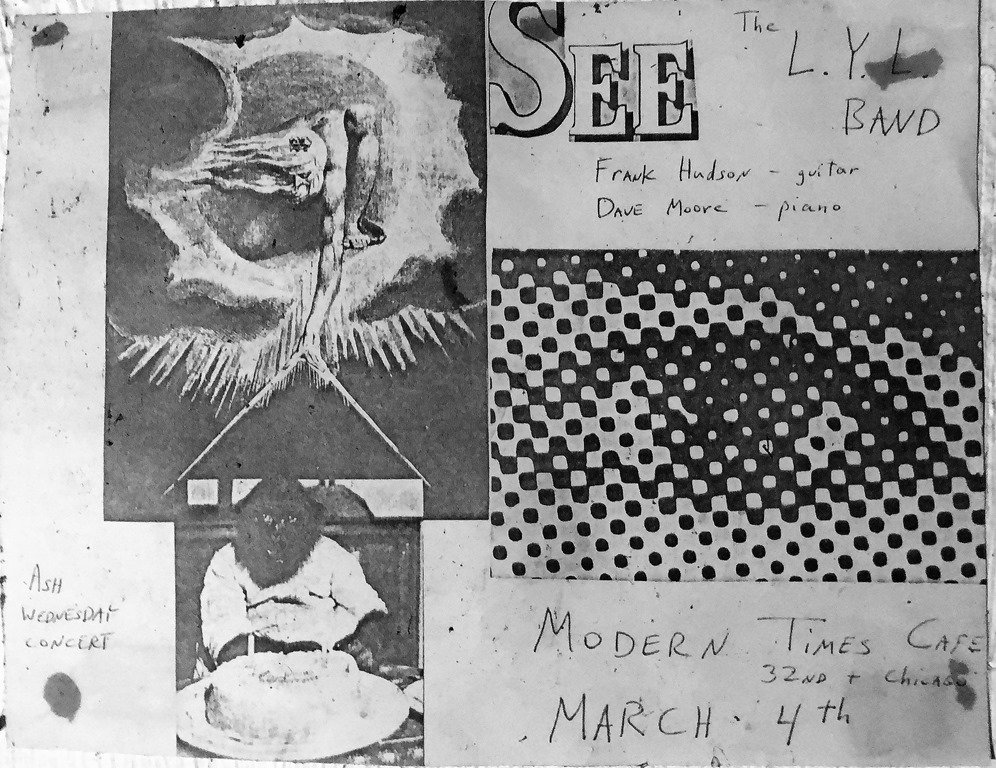
Today we’re going to have our first Parlando Project double-header, two pieces whose words and music were written by Dave Moore back in the 1979-1982 era and both of which appeared on the Lose Your Lunch Band’s only official release, the cassette-only Driving the Porcelain Bus in 1982 1980*.
The LYL Band and Porcelain Bus were not entirely political, but the elements of political protest and social commentary were a big part of it. Some of this was based around the election of Ronald Reagan as US President in late 1980 which at the time seemed to be the culmination of a long conservative struggle dating back to the early ‘50s.** You could say it was like today’s post-Trump election era, and one could point to similarities, although the pendant in me could list considerable differences too. I’ll just let that rough likeness stand to simplify the history for our younger readers. It’s close enough for rock’n’roll.
Dave also points out that his spouse and her relatives at the time were politically interested, and discussions in their circle often included political analysis and issues. I’d add, knowing Dave from a decade before that, that the same could be said about him. Let’s just say that around 1980 it wouldn’t be strange for political dialectics to be part of a casual conversation in South Minneapolis, again, just as today.
But here’s something interesting I noted as I rethought those years, the local music scene really didn’t reflect that directly. I recall folk-singer Larry Long, a man who has sought to continue the legacy of Pete Seeger, as being around the cities during this era, but at least as far as recordings he comes later. John Trudell an activist and singer was based out of the region later in his career, but in the early 80s his musical expression was just beginning, and he was living in California then.
Of course, artists portraying the world and how people relate to it cannot help but reflect political and social connotations in their work, and to that degree that any of the biggest bands to eventually emerge out of the Twin Cities indie scene were political, it was largely that.*** Those bands had something to say about life: what they opposed, what they preferred. An argument can be made on both artistic and commercially-distributed subversion levels for that. But the songs Dave was writing then were sometimes upfront about their political stance. In those songs, subtext, which was also there, was what was beneath the politics, not the other way around.
Traveling to a telephone pole of the past, we see a Dave Moore Dada poster for an early ‘80s show
So, let’s step out of the history and into the songs.
Here’s “Scrap” a companion song to “The Night Inspector” which you’ve already heard here, inspired by Dave’s work in a machine shop in this era. There was a good live version sung by Dave on Porcelain Bus, but I don’t have access to a digital copy of it right now, so in its place here’s a later solo acoustic guitar version where I sing it.
And here is an actual cut from the Porcelain Bus, engineered by Colin Mansfield, just after he was helping Husker Du get underway, a song asking the rhetorical question “What’s Wrong with That?”
If you’re asking yourself, where’s the poetry and various musical settings that you’ve seen here before, know that I plan only about one more history-of-a-band post before returning to our regularly scheduled programing. If, on the other hand, you wonder how this all turned out, the next post will be about that.
And, of course, footnotes, but we reject the hierarchy of superscript numbers for asterixis!
*I’ve just located a few digital scans I made years back of the even then moldering materials form this era, and they show the the Twin City Reader reviewed Porcelain Bus (see footnote below) in their issue that covered the upcoming week interval of January 7th to the 13th 1981. This would mean we recorded it in late 1980 and probably released it before the turn of the year.
**for a detailed history of this conservative effort, I recommend Before the Storm by Rick Perlstein. For me a lot of what he covers was current events, but for most present-day Americans, it’s history. His two follow-up books are good too, but why not start at the beginning?
***Two exceptions I can note, even if neither are the best-known songs in their respective catalogs: Paul Westerberg’s “Androgynous” from the 1984 Replacements LP Let It Be, a heart-felt yet casual sounding and appropriately ambiguous song about busting gender roles, and then Prince’s arch “Ronnie Talk to Russia” from 1981’s Controversy, where Prince sounds like the LYL Band would sound if they had Prince’s skills, work-ethic and recording studio (or at least a drummer and bass player). Perhaps Mr. Nelson was paying tribute to The LYL Band and our sound, but Prince’s song was released a little less than a year before “Driving the Porcelain Bus.” OK, the new date for Porcelain Bus means that theoretically Prince could have heard Dave’s Farisa drenched sound before he used a similar punky combo organ sound on “Ronnie Talk to Russia.” File this under “improbable.”
OK, that last part is irony for you English majors, but Porcelain Bus was reviewed and got a cover blurb on the local alternative weekly in 1982 January 1981, along with Prince protégé’s The Time’s LP. The blurb said “The Time Ain’t No Lose Your Lunch Band,” a statement that I think we can all agree on. The review said we might become a cult band. If you’ve read this far, you’re our last chance as cult adherents. You don’t have to shave your head, sell tracts, move to a compound in the country, or worship Dave as a semi-divine incarnation—unless you think it’ll really help. I believe Dave would rather be worshiped as an Andy Devine incarnation anyway.
Partly for the reason of sadness and disappointment with my country, and partly for disappointment with myself, it’s been difficult to focus on combining words and music recently. This is a value of one of the Parlando Project’s principles: Other Peoples’ Stories. When I cannot put the words together, I can listen and absorb someone else’s.
Yesterday, feeling particularly sad and angry, and holding it in so as to not harm with it, I went looking for someone else expressing what I could not express myself.
I looked first at Carl Sandburg, who after all was a committed political radical as well as a too-often overlooked Modernist. But with Sandburg’s expression love was almost always present—a good thing, but not in tune with my feelings. Sandburg may have been the right medicine, and I took some of him in on Friday for my health, but I didn’t want only medicine.
And then I found my howl, and strangely at that. I knew Edna St. Vincent Millay had written political poems, that in fact they had harmed her artistic reputation. The witty line I recall was that Millay’s anti-fascist poems did more to harm her artistic standing than Pound’s pro-fascist ones. Today’s words are from one of her early political poems: “Justice Denied in Massachusetts.”
I can see where the Olympian “New Critics” docked Millay on the basis of this one. It’s chock-full of that awkward backwards and inside out “poetic” syntax that reads like a stiff translation from another language. The early Modernists, even as they translated, were dead set against this—and they have a good point. Millay’s words here were hard to read with emotion, so stilted and undirect as they are as sentences. However, that could well be part of Millay’s point here (consciously or unconsciously), as the poem’s speaker is not speaking clearly; and for my benefit—however difficult it is to perform—she is speaking precisely in a confused mixture of disgust and disappointment. All the reverse/”poetic” syntax just makes it more twisted in at itself. A poet today might make this matter even more obscure with modern poetic syntax that also abjures plain speaking in the service of art, but in our current context we’d be expected to accept this as the way art talks.
One problem with political poems is that to the extent they speak to an issue they can become museum pieces tied to forgotten events. If they were to be effective, they could even be seeking that fate. Millay is writing here in the immediate aftermath of the execution of Sacco and Vanzetti—a particular cause—but for my purposes, this has little bearing on the matter. She is speaking to women and domestic and domesticated people such as myself. Only the title is tied to then current events—the feeling and her point, ties to our own.
“Let us go home, and sit in the sitting room.” New Critic Cleanth Brooks placed his entry in the contest for most bone-head review of all time by reading this refrain line and Millay’s poem as a straightforward resignation at the course of events, rather than the ironic statement of disgust that it is. I can only hope that the savvy observers of our country are similarly wrong, similarly misreading.
Mr. Brooks, you may notice that I’m not sitting, but standing for something.
My music for this is based around a G suspended chord, where the third of the chord, which would dictate if it’s minor or major, is omitted. This gives the chord a feeling of awaiting change, awaiting formation. At times the replaced note to the defining third is a tangy second, other times a more consonant fourth. Risking grandiloquence, but I feel our country is similarly suspended now, and the cadence is to be ours.
Here’s my performance of Edna St. Vincent Millay’s “Justice Denied in Massachusetts.”
The Paris Review recently selected four guest editors, poets who will be asked to help select and present poems during a project in the upcoming year. To introduce their project and these editor/poets, they asked the poets for remarks on “Where is poetry now?” Each of the poets had interesting things to say, but I was struck particularly by part of what Vijay Seshadri said.
Seshadri is a contemporary poet of some accomplishments, awards and note, but I had not noted those things, nor could I recall any of hiswork before reading his remarks. That alone could be remarkable under the subject of “Where is poetry now?”—but let us ascribe that to my own focus and hit and miss reading habits. Seshadri addressed the question I’ve brought up here a number of times: how can or should poetry address political and social questions?
Words Vijay Seshadri did not say: “And so students, poetry lets you experience Other Peoples’ Stories intimately…but now the part you came for, my acclaimed one-man performance of the first season of ‘Stranger Things.”
Seshadri tells of a recent poetry workshop he taught. He describes his students as “young, sensitive, and deeply empathetic.” Looking to current events in the United States, he asked them “to consider the children in cages,” implying that he would like them to address that with their workshop poems, but he found that they could not do so in the work they presented, at least during the week-long workshop. Another writer could have used this observation as a springboard to that hardy perennial topic: “What’s wrong with the younger generation?” or its broader targeted version: “What’s wrong with our culture or society?” Seshadri didn’t.
What did he say instead about why this might be difficult for artists, and what they might do about that difficulty? This is what I present in today’s audio piece, using words of his that I extracted from his remarks. I use as an epigraph a line from one of Seshadri’s poems, and the title I use here, “Poetry vs. Children in Cages,” is my own concoction, but I hope I am being fair to his thoughts.
These are important questions. I know many of the readers here are poets or other artists. You may not agree with Seshadri’s thoughts on this, but you are still charged to think about this. Perhaps, like Seshadri’s students, you won’t have an answer in a week’s time, but that’s not a reason to stop thinking and trying to find a way to address our world.
To hear my attempt to convey Vijay Seshadri’s thought, use the player below. Musically this time, I’m back to using something like a traditional rock band instrumentation: electric guitars, bass, and drums, but I also made an attempt to use a virtual instrument rendition of a sarangi, which is a Indian sub-continent version of a bowed fiddle with resonating sympathetic strings, conceptionally similar to the Norwegian hardanger. Even in it’s VI guise, I found I had to be careful of those resonances.
A couple of posts ago as I presented a piece using words by American poet Henry Wadsworth Longfellow, I mentioned that his prestige has fallen greatly.
Longfellow was minor and derivative in every way throughout his career…nothing more than a hack imitator of the English Romantics.”
“Who, except wretched schoolchildren, now reads Longfellow.”
And Lewis Mumford sums up his significance with a dagger by declaring that Longfellow could be completely removed from the history of literature without much effect.
Furthermore, while there’s no modern bon mot to extract from the Wiki, Longfellow’s didacticism, a huge defect if detected in modern poets, is noted. Even during his lifetime, that rankled the Transcendentalists, always looking for the more inexplicable sublime.
Akin to one our Parlando Project principles, Longfellow took the idea of “other people’s stories” to what are now considered ridiculous lengths. Instead of writing of intense internal experiences as Emily Dickinson did, or expanding the fleshy personal into a democratic universal as Whitman did, Longfellow wrote about many cultures and translated poetry from many languages. The term “cultural appropriation” didn’t exist as such then, but Longfellow could easily be charged with it. His best-known epic poem, Hiawatha, which has left its imprint all over my own region’s place names, is an earnest and non-hateful mishmash of the mid-19th century’s limited knowledge of indigenous Americans mixed with some contemporary to the time German romanticism. Longfellow would be a cultural criminal if he hadn’t already been reduced to a laughingstock.
OK, so what. All of these charges are true, but here’s what they leave out. To say Longfellow was “an American poet” is like saying Elvis Presley was a rock’n’roll singer. He proved that could be a thing, that an “American poet,” could connect successfully with a wide audience. He imitated Europeans and English romantics. Yes. Who the hell else was there to imitate? He wasn’t as original as Dickinson or Whitman. Yes, and neither is most any other poet you could name, now or then. And Mumford’s dagger? Alas, that can be said of most writers, because literature is a vast swarm of similar literary genetic ideas, but if there wasn’t a Longfellow, someone else would have to establish the idea of a popular American poet. That alternate-history someone else might have been good or bad, but it likely would have lead to some difference, even if the difference would be some other writer to rebel against.
I too wish Longfellow had tempered his didacticism, even if that is a large part of what made it possible for him to succeed. Most Victorian poets suffered from this as well, and it’s part of what the Modernists sought to break free from. To the degree that we are now Post-Modern, we can reassess this. Can poetry stand for something and still be art? If that is difficult to do, should it still be attempted?
Today’s piece is an example of Longfellow seeking to instruct, and the charge of cultural appropriation could be leveled at it too. In 1842, as opposition to slavery started to gather force in the United States, Longfellow wrote a short collection of poems on the “issue”—yes, human slavery, for and against, it was a debate. Longfellow explicitly released this collection for publication and distribution in support of the anti-slavery cause.
The obscenity of human jetsam. I learned about the Zong case only this year while traveling in Britain.
“The Witnesses” is from that collection. In it I think Longfellow transcends propaganda for this noble cause and demonstrates his effectiveness as a poet. He audaciously takes the notorious Middle Passage of over-sea slave shipment as his subject here. Though those travails were not his personal experience, the obscene losses at sea in the shipment of chained-up human beings is portrayed. I chose to further highlight Longfellow’s concluding phrase to all this. “We are the witnesses!” he writes, as the still shackled skeletons speak in his poem—but of course, un-romantically, their remains cannot speak. The poet, the reader, the performer, the listener, are the real witnesses here.
A short note. Wouldn’t you know it, after spending a good part of this year exploring the early 20th Century Modernists, I now have been using 18th and 19th Century sources more this summer. One of my favorite blogs, My Year in 1918 recently noted how I was tackling those WWI-era writers with my musical pieces for her readers who might want to sample that.
Well, I’ll return to those literary Modernists soon. After all, a principle here is to try to mix things up, to not be predictable or to always rely on my established favorites. But even today, I think I’ve been tipping my hat to another key early 20th Century American Modernist. As I was writing and performing the music for “The Witnesses,” with its variations on folk-style melodies that twisted between strains and finished with a louder cadence that didn’t resolve the multiplicity, I asked myself “Where’d that come from?” Early this morning it occurred to me: the composer Charles Ives, who was working at almost the same time as those literary figures. If he had access to an electric guitar he could have been Frank Zappa.
Once more I’ll break with my usual practice and apologize that I don’t feel I’ve fully realized this audio piece, mostly because it really should be performed with a number of featured voices and a chorus. While my computer and inexpensive collection of “virtual instruments” lets me reasonably realize a large number of instruments, it cannot represent vocal works very well. Go ahead and listen anyway, and if you can listen on speakers instead of earphones, crank the volume a bit.
Here’s Carl Sandburg again, this time from his 1920 collection Smoke and Steel. Today’s piece “Long Guns” is a protest poem of a kind. A few decades later, around midcentury, the folk-song revival in America (which Sandburg had helped to kick-off with his pioneering American Songbag collection of folk songs) grew a wing that wrote protest songs. Bob Dylan, a man who thought enough of Carl Sandburg to want to visit him as he was revolutionizing songwriting, wrote a few of them himself, even though Dylan once categorized the usual efforts of the protest song genre as “finger-pointing songs.”
So how does one go about writing a protest song or poem? There are probably lots of ways, and some work more often than others. Sandburg, the early Modernist, would sometimes write Imagist protest poems, which is quite a trick to pull off, though the classical Chinese poets that influenced Imagism had figured out how to do this centuries before. “Long Guns” however, is more in Sandburg’s Walt Whitman mode, what with its parallelism and lists.
Sandburg wants to call attention to the disorder of order established by armaments and guns, but rather than doing this as an essay would, or by leading off with some singular event that will arrest our attention, he starts by addressing an otherwise unidentified someone named “Oscar.”
This is a puzzling way to begin, and I have no idea why Sandburg did this. My guess is that most current readers will just figure Oscar is some random name, and stumble past this, but since I hate to leave specific things unexamined, I eventually had to try to figure out who Oscar was.
It’s likely you’ve never heard of him, but I think it’s Oscar Ameringer, a radical humorist who was styled “The Mark Twain of Socialism.” Ameringer was Sandburg’s contemporary, and both spent time working for Socialist candidates in Wisconsin, though their time in Milwaukee missed overlapping by only about a year. At least to fellow Midwestern Socialists, this call out to Oscar may well have been recognized when “Long Guns” was written.
After this mysterious opening, Sandburg lays out a condensed history of the world, a Genesis story of armed nationhood, a litany of the primacy of guns, speaking too of the long-range artillery that had been part of the new warfare of WWI.
And then, just past midway, Sandburg jumps somewhere else entirely—which is the freedom we allow poetry (as we allow it in music)—to a twisted fairy tale, the payoff. In the end, this is how Sandburg makes his protest point. We are like that child, and we are creating the child in that story.
How would Howlin’ Wolf comment on this Carl Sandburg poem?
In performing and presenting “Long Guns” I decided to throw a frame around it. A couple of posts back I mentioned some other Modernists, largely, but not entirely, separate from the recognized literary Modernists. In the same early decades of the 20th Century, some Afro-Americans were “making it new” with a different lyric language and music, which was labeled “The Blues,” and from which Jazz and Rock’n’Roll and modern popular music draw even to this day. There’s no Ezra Pound or T. E. Hulme to point to here, a name that we can say sparked things off. The Blues’ 19th Century Emily Dickinson or Walt Whitman-like predecessors are barely known as names. I still want to say more on this later, but as a frame for “Long Guns” I used a blues line I know from the singing of Chester Burnett who performed as “Howlin’ Wolf:”
I wore my 44 for so long, it made my shoulder sore.
What a striking and original line! If Li Po or Pound had written it, we might read it in a literary anthology. A man whose fear or anger he must carry, like a heavy revolver, painfully, always. As it happened, I know this poetic line from Burnett singing it, as the Wolf; where as part of his performance style his voice is unnaturally raspy, his delivery as if spoken by a spirit, perhaps not a normal man. A man who lives where the running of the world was all in guns. Is that a normal man?
To hear the LYL Band perform Sandburg’s “Long Guns” framed with music in the style of Howlin’ Wolf, use the player below.




 Frank Hudson