Inconceivably Solemn

I suspect a majority of my readers are looking for something related to poetry when they visit here. Stats show continued high visit counts for older posts on some poems this winter, proof of Pound’s dictum that “Poetry is news that stays news.” I remain a little puzzled by the trailing interest in the audio pieces that accompany nearly all the blog posts. The analyst in me assigns that to the fleeting visits of many internet users who sometimes can’t politely play audio, or who don’t care to expend the 2 to 5 minutes most of my musical pieces would take. Maybe some think the audio player gadget will launch an all-to-typical one-hour-plus podcast with an inefficient, in-joking set of hosts rattling each-other’s funny bones? Or it could be musical tastes that diverge, including expectations of better or different musicianship and a more attractive and commercial voice than mine? If so, fair enough.

I doubt any but a few are here for politics. And this week, more so.

I had a political life, I retain an interest in politics in old age, yet even I am on a political news diet this winter.*  If it looks like I’ve been writing thinly veiled political posts lately, I’ll claim my intent is more to expiate my own emotions — and to, with whatever value, to succor those that William Carlos Williams portrayed last time as “huddled together brooding our fate.”

One of my early poetic heroes, Carl Sandburg, had both a political and literary life. I recall a story that as his early Modernist poetry was breaking out into publication, he was challenged on controversial political elements in his poems. He claimed (earnestly, or with care for his emergent career, I don’t know) that any such was incidental — that he, the author couldn’t fully compartmentalize himself. I have no career. My primary interests here are to promote other people’s poetry and to learn and enjoy myself while doing that, and so I’ll make a similar claim.

Which brings me back, as this Project often does, to Emily Dickinson. There are some things exceedingly modern about this mid-19th century American poet: the compression of her language, her freedom from lockstep prosody or conventional syntax, the explicit use of the mind’s interior as a landscape, her abrupt linkage of the prosaic ordinary and the most high-flown concepts. With all that stuff that still seems modern, folks looking to more deeply comprehend her work may need to be reminded that she is, for all her genius, a citizen of a particular place and era.

I remember a short session I had while at the Dickinson Homestead Museum some years back, when a tour docent made a comment that Dickinson wrote a good deal about the Civil War.

“Huh?” I said to myself. I could recall no such poems. In my ignorance then I assumed Dickinson was largely insulated from that, being in small-town New England, privileged, white, and female. I’ve learned a lot since then, and that’s been one of the joys of this Project.

Today’s musical piece is her poem “Inconceivably Solemn.”   In its abrupt/oblique language, landscaped with the blank horizons of those em-dashes, I can’t catch a definitive picture of what she’s observing. Metaphoric or actual, it seems to be a parade or celebration. What’s the occasion? An Independence Day? A group of newly mustered troops for that Civil War? An election? I lean to the latter two, and remind those who aren’t steeped in mid-19th century American history that those two things were linked as chattel slavery was a huge and sundering political issue for decades before breaking into war. I first thought the poem was troops going off to war from her town, and it still may be. The 1861-65 war overlapped Dickinson’s most productive years as a poet, and her Amherst sent troops which quite likely enlisted and marched out from the town.

Inconceivably Solemn

If you’re tired of politics, poet Emily Dickinson seems skeptical of the celebration here.

.

On the other hand, the poem also seems at times to place the celebration/parade as being far away. Is she imagining the soldiers marching into battles at the battlefields that weren’t near her town? Or reacting to battlefield reports in publications perhaps with “mute” engravings of the troops? The poem starts and ends with clear oxymorons, with that first line’s “inconceivably solemn” that is used as the title stand-in. That “solemn” is soon “gay.” And the penultimate line has “wincing with delight.” So then: portraying great causes, assumed honor and bravery, but also suffering and death.

Allow me one moment of my pedantry, and some very uncertain speculation on my part, regarding something that only occurred to me today after working with the poem earlier this winter to prepare the music you can hear below. You see, there’s this odd line “Pierce — by the vary Press.” Dickinson is no stranger to choosing an unusual word, and that may be all “Pierce” is meant to do here.

But one of my youthful enthusiasms was history, and just today I thought, “Is she punning on Franklin Pierce?” OK, I know I’m defeating audience expectations here to ask you to be interested in poetry and vaguely-indie-folk-rock in one Project — and now there’s a history pop quiz? You see, Franklin Pierce was one of America’s worst and least-successful Presidents. He was a Democrat, though in an era where political alignments under that party differed greatly from today. He was elected President in 1852. Dickinson would have been just in her majority, though as a woman, unable to vote — but her father, Edward, was politically involved.**   In the 1830s and 40s Edward served six years in various offices as a state legislator and elsewhere with the state Governor. In 1852, the same year that Pierce was elected, Edward Dickinson was elected to the national House of Representatives. Edward Dickinson was a staunch Whig party man. Once more I’ll skip the complex details of the political alignments of this time —but during the 1850s and the run up to the Civil War the Whig party disintegrated. And Pierce? By the midterm elections of 1854 Pierce’s Democratic party was reeling as well. In 1856 Pierce became the first American President to seek and be denied the nomination for a second term — but as ineffective as he was a President, his victory in 1852 coincided with the steep decline of the Whig party of Dickinson’s father.

So from that plausible wordplay connection,*** and the absence of any armaments or uniforms in this poem — only flags, drums, and pageantry — I’m open to the thought that it’s one of those raucous political parades that were a big part of 19th century American politicking that’s being depicted. Improbable gay solemnity could describe such a civic event, and the poem’s side-eye to all the noise and celebration would be all the more appropriate if the Dickinson family’s party might have been on the loosing end of the campaign hurly-burly. If written with hindsight after the Civil War has broken out following the failures of Pierce and his successor, the similarly one term and terrible President Buchanan — then  the final “Drums” is reminding us in conclusion that the martial drums of a Civil War were “too near.”

OK, here’s that short musical piece. Perhaps thinking of Colin Mansfield reminding me of the early Woody Allen gag about the cellist in the marching band, I didn’t do a brass band for this, but acoustic guitar, organ, violin, and yes, cello in this song of a parade. There’s a graphical audio player below, but if you don’t see it’s mute pomp and pleading pageantry, I supply this highlighted link that will open its own tab with an audio player.

.

*And Parlando contributor Dave Moore has, at least as of the time being, dropped his monthly comic published elsewhere, which often commented on political issues. He and his partner should be allowed to tell their own story, but he told me recently that he couldn’t bear to do the same comics over again as the country enters its Restoration era.

**I’ve written often here about a theory I have, that Emily picked up information, terminology, and concepts from the family business, lawyering, practiced by her grandfather, father, brother, and maybe even her later-life flame Judge Lord. I’m sure there has been, or should be, some scholar who’ll do a graduate thesis on the use of the Law in her verse. And why not the same regarding the closely allied field of politics?

***Wikipedia says that the Democrats needled the Whigs by campaigning in Pierce’s 1852 race with the slogan “We Polked (successful Presidential campaigner James Polk) in forty-four. We’ll Pierce in fifty-two.”

Libertad! Igualdad! Fraternidad!

We’re going to have some William Carlos Williams poetry turned into a song below. If you’ve missed that sort of thing from me, I’ve returned with time to focus on what we do here.*

I think I’ve already mentioned that I’m disappointed in my country and its follies this past year after the national election. I could take your time and patience with some personal punditry on where to apportion blame for this. The electorate? The winning vassal party and it’s red duchies? The oligarchs and emperors ever-richer and more protective of prerogatives? And then too, the losing party, who gets apportioned blame for everything else on the list as well as bearing the sting of defeat?

I’m not going to do that. A complete list opens up the vulnerability of adding one’s own self to the blame. While many personalities have strong defenses against that self-indictment, I’m not sure if that’s a good or bad thing. By now, if you wanted any variety of that, you’ve already had your fill. Rather, if you’re on the side that lost, you might feel left alone. As we approach the new regency in a matter of hours, let me repeat something I said after the election: we can, we should, forgive ourselves for hope. It is a right-sure prediction that we’re going to need more not less hope in the next few years.

As we approach the new regency in a matter of hours, let me also repeat something I said after the election: we can, we should, forgive ourselves for hope. It is a right-sure prediction that we’re going to need more not less hope in the next few years.

Further in that feeling alone — except for the exchange of blame and shame — I’m not thinking this group are presently at risk of being visited by reporters seeking to understand their sorrow, fear, disappointment, despair. They’ve had over 60 days to file those “I must understand them” stories, but there’s a general silence on that front. Perhaps there will be some stories of the manifestations to come of what some of us fear — though if the worst fears come, those could be harder to find, and stories after injury may be less efficacious than the now-impossible to file stories that could have come beforehand.

Libertad!

I urge folks to sing these Parlando songs themselves, so here’s a chord sheet for today’s piece. Some will likely do a better job than I do, and additional voices strengthen a song.

.

So, I was happy to find, write music for, and sing this short William Carlos Williams poem this winter, even though it was written back in the last decade called The Twenties. I too feel forced into the mud, and so much now depends on the stink of the ash-cart rolling toward us. You can hear it with the graphical audio player gadget that should appear below. No player? No editor looking over his shoulder at their owner-baron has spiked it. No algorithm has ruled against it in court. The audio gadget has always been impartially suppressed by some ways to view this blog — but you can use this highlighted link to open a new tab with its own audio player.

.

*This isn’t the first holiday season that has caused a drop in new pieces or posts, but I’ve spent a good deal of time in this cold bilaterally looking January shopping for a replacement for my 20-year-old car. I had previously figured I’d wait until that car had reached its full majority this upcoming fall to shop for a replacement, but like some others I played the odds that new tariff taxes and repercussions would raise prices.

Millay’s Thanksgiving

There’s a long tradition in poetry of civic poetry — poems not meant for an audience interested solely in the interior intimate experience of the poet, but speaking to larger, more public themes. I suspect modern poetry doesn’t do this mode directly much, even though some individualist poetry infers that purpose. American poetic Modernism began with an emphasis on the concrete, the thing specific: red wheelbarrow, ripples in a pool, a certain Chicago cat-fog, an exit on the Metro on a rainy day. Yet, a focused subject can still be an example that stands for more.

If the subject is small though, perhaps we poets expect our audience most often to be small too, compared to a variety of other, popular arts. But this was not always so. Longfellow and Whitman expected the nation to listen to their poems of democratic virtues. If the literary set eschew the mode, song-lyricists and non-literary poets will still assay it.

Just under four years ago, a poet Amanda Gorman who has written civic poetry, delivered a poem at the last U.S. Presidential inauguration, speaking of the nation’s fears, hopes, promises. The mode of the next Inauguration has changed. I’m not expecting poetry. Some will think, more-the-better — who wants a poet spouting off what I should think.

Why not, are they not citizens? What are the occupations that are allowed to speak?

Nearly 75 years ago. American poet Edna St. Vincent Millay wrote a long poem for the American holiday of Thanksgiving. She expected a good-sized audience: it was published in the Saturday Evening Post, a weekly general interest magazine, the one that often featured Norman Rockwell paintings on the cover, that claimed Ben Franklin as its founder.

Millay NFTG

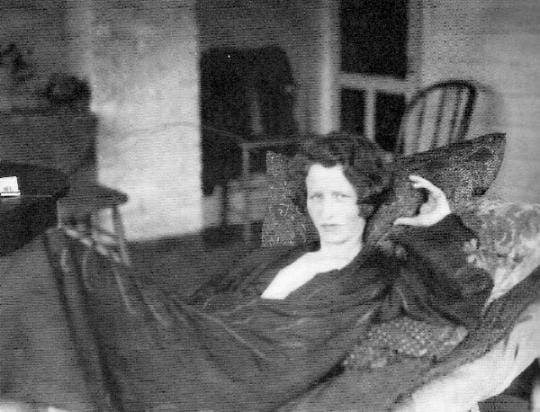
The most often used pictures of Millay show the young romantic adventurer. I’m also fond of this one that seems less all that. The poem which I perform excerpts from today was the last one she published before she died at age 58.

.

I’m sure there were specific things on Millay’s mind, geo-political, American issues. She writes five years after a war ended with two A-bombs. How long would be the peace? In 1950 there was another war going on overseas in Korea, there was a “Red Scare,” and to a large degree some deficiencies in American equality of opportunity were so far off to the side that too few even thought of them as political issues to address then. Millay didn’t cite any of that directly.

Instead, she wrote about how she thinks we, the citizenry, were feeling, assuming a general agreement that might be hard to gather today. Thanksgiving is a dual holiday occasion: it’s our harvest festival, a time to give thanks to what our work brought us, and it’s also a holiday to give thanks for what we’ve come through: it originated in a time of Civil War, and it commemorates the hardy survival of some early 17th century boat-people who landed without papers and survived on American shores. Millay’s Thanksgiving thoughts were more toward the latter than the former.

What will ring true in some American hearts this year will be her words of hopes dashed or at least deferred. Can one give thanks for having hopes that were unfulfilled? Can we at least forgive ourselves for hope? Her poem exists in that question. In the excerpts I performed today for this musically accompanied piece you can hear below, I focused on that sense, felt in my bones. “Cunning and guile persist; ferocity empowers” Millay writes. The lines that stand out for me as a Thanksgiving prayer this year are “Let us give thanks for the courage that was always ours; and pray for the wisdom which we never had.”

As civic prayer goes, that’s humble, but it has some bite in it.

You can hear my performance of portions from Millay’s “Thanksgiving…1950”  with the audio player below. The full poem’s text is at this link. No audio player gadget to be seen?  This highlighted link will open a new tab with its own audio player.

.

.

Be Angry at the Sun

I completed the off-the-cuff recording of my musical performance of this Robinson Jeffers poem a few days ago, but it’s taken me awhile to figure out what I wanted to say about my encounter with it, and secondarily how you, my valued readers and listeners, might receive it. In “Be Angry at the Sun”  Jeffers is ostensibly writing a poem, but it seems he wants to give a political speech about political speech. TL:DNR, he’s not a fan. Here’s a link to the full text of Jeffers’ poem, but since he’s writing about speech, I thought it might best be heard.

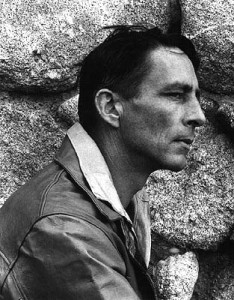
I sometimes make rock music, but like my spouse, Jeffers knew how to build with stone, constructing his own castle-like home from local seaside rocks.

.

Politics and poetry mix and don’t. Politicians will quote poems. A few poets (or diverted poets) have run for, even obtained public office. Personal political engagement by poets is likely no more rare than political engagement by nurses, baristas, bookkeepers, or shopkeepers. In my foray into social media* during the past year or so, I’ve often found an expectation that any posting poet or writer should declare their stance and allegiances.

Let me admit a reluctance to do so. My reaction is internal and perhaps odd: it feels like those calls to the pulpit at a Protestant Christian tent revival or Billy Graham’s mid-20th century adaptation of them to the TV age. It’s not oversimplified to be summarized thusly: make a simple public declaration in your acceptance of Jesus as your savior, and by that simple act, your soul’s continuous existence and the worthiness of your life has been assured. There are usually sub-clauses to that declaration: you will be expected to perform acts consistent with it. How consistent must those acts be with the declaration? Empirically, it varies considerably, which to my outlook makes the insistence and importance of the declaration problematic.

Now, some who read this may be Protestant Christians. You are welcome here. Your outlook, your understanding, your lives, may find nothing troubling about that act. I believe I understand your beliefs there fairly well. Long time readers here will know that myself and two other voices you’ve heard here are “PKs” (Preacher’s Kids). We literally grew up with variations of Protestant Christianity.

I also grew up with politics. I proudly wore my Stevenson campaign button as a grade-schooler. I participated at low-levels with campaigns for office and issues quixotic and successful for decades. I’ve been to political conventions. So, to you the readership here that are politically engaged: I have some understanding of your actions there.

So why this particular Robinson Jeffers poem, and why do I find it problematic yet worthy of considering today? Long-time readers may recall one of the poetic maxims I’ve expressed here: poems aren’t just about a message, an idea the poem wishes to express — they are more about how it feels to experience that idea, the sensations of the moment.

I was attracted to the Jeffers poem because I recognized that moment, that feeling. Perhaps you do to. I’ve been living in it this week: politicians and jurists seeming to speak as political operatives have increased my disgust. And this is not because (as Jeffers, the poet I’m voicing today, might believe) that politics is essentially dirty, though Jeffers and I will agree it’s humanly imperfect. Jeffers wrote this poem in the run-up to WWII. Unsaid within the poem, he’s specifically knocking Franklin Roosevelt,** a great and consequential American President, but he’s another of those Modernists who seems to have had, if not full-fledged admiration for fascism, at least a belief that it was no worse than other existing political schemes. There’s a lesson here: those who believe that politics is exploitative, dirty, always disreputable, will be drawn to or tolerate the belief that it’s best handled by leaders who revel in that themselves — the dirty men who will handle the dirty job, while we can stay clean sweet-smelling artists. Stone, not ivory tower in Jeffers case, but the same idea.

So, as you listen to my performance of Jeffers poem about politics and political speech, know my aim is to say that if you feel pain and disgust at what you’re hearing and seeing, I feel it too. Best as I can tell, I don’t share Jeffers prescription and proscription for politics, but in the world of today’s poem and my expression of it, I’m saying if you despair: you’re likely just one person, one citizen, someone without extraordinary powers. Your choices, your actions alone didn’t cause our country and our world to be in this state. How do we turn our nation away from letting the dirty men to do dirty jobs from being left unfettered? I’m a composer and writer, I can’t say I know more than a nurse, barista, bookkeeper, or shopkeeper.

Audio player gadget below for most of you. Is your sub-caucus not seeing any player? This highlighted link will open a new tab with it’s own audio player.

.

*I’ve given in and now post on short-post-format social media after eschewing it for a decade or more. It’s been good and bad. Like poetry, it lets me practice reigning in my long-windedness; and I can engage in it when distractions abound. Alas, it becomes its own distraction when I do have longer blocks of time or energy. In theory, like poetry, it could be complex while being concise. In practice, it’s mostly superficial —something one can relax with when needed —but that “just give me a momentary diversion while I scroll through my timeline” expectation stunts it.

**To those who might want to remind me of FDR’s faults and bad acts. I have long had a strong interest in history. I know of them.

Once more it’s hard to concentrate on music, poetry, art.

There isn’t going to be any new encounter with a set of words, nor any new musical combination with them today. I’ve mentioned during the last part of 2020 how this project that has brought me much joy and surprise has become more difficult for me. There are complicated reasons of little general interest that contribute to this, but this week there are again public events that have made it harder for me to concentrate on work.

Unless you are meditating in a cave somewhere, and only check in here as religious penance, you may easily guess what events this week have waylaid me. I feel compelled, for no logical reason, to bear witness to them, to watch them closely over the Internet at my shelter-in-place distance. Yesterday and certainly today that Internet will be filled with opinions. Well, that’s always so isn’t it — even if it may be to some degree even more so today. If you need opinions, you can drink of them until you are falling over swollen with them. I won’t fault you if you do, because I have read and will read some of them myself. I say this only to say that there’s no shortage of them, and so I will be brief and circumspect.

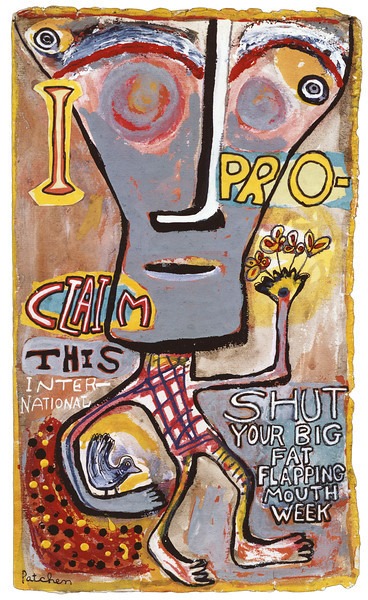
I declare this International Patchen

Painting by poet Kenneth Patchen who was also a pioneer in melding poetry and music, so don’t take this as some universal pronouncement. .

.

I revere democracy. Not because I think it incapable of monstrous acts. All governments are so capable, and if they exist for more than a brief moment, history testifies that capability will be exercised. Not because I think that our particular U. S. government structure is divinely inspired. Not because I’m likely to agree with what the majority of fellow humans believe about a great many things. I revere democracy because its evils are our evils, its good is our good — and that good is redeemable to outweigh the bad in us.

Whether the actors I’m observing are dressed as a Senator or dressed in a jokey t-shirt and a red half-billed hat, the desire — no, the actions — so brazenly presented and recently taken in the cause of maintaining the rule of a man so roundly rejected by our voters are obviously counter to that reverence. The Capitol building, the august chambers, are just symbols. Since many of us are writers, we know symbols can have a heft even if imagined, but still the real thing being attacked should be certain: democracy.

That’s right:  the symbol has bricks and glass, the real thing is something we need to hold in our hearts and minds, another thing that’s a verb not a noun.

Instead of a new piece, here’s one I’ve presented before, by another Reverend of Democracy, Carl Sandburg. Don’t miss Sandburg’s subtlety here. He admits right off that we can be a mob. When he says “The Napoleons come from me and the Lincolns.” He doesn’t merely mean that the notables, the big figures of history arise from the crowd. Sandburg means to contrast Napoleon who quickly became a military dictator with a Lincoln. We can bring both forward.

Here’s a link to the text of Sandburg’s poem, and my performance of it is available in this highlighted hyperlink, or via a player gadget you may see below. I still hope to be back with new pieces soon.

.

Government

Here’s the other pole of Carl Sandburg, a prose-poem about the nature of government. It seems so far from the tight compressed Imagism of “Gargoyle”  that one might wonder how it could be from the same poet. I may have a clue there, so read on, I’ll return to that thought.

But first let me note that Carl Sandburg had some unique experience to bring to this subject. This poem comes from his landmark Chicago Poems  published in 1916, a collection that both established his bonafides as a Modernist poet and as a foundational writer of American proletarian poetry. But before that he’d been a first generation immigrant,* a Spanish-American War soldier, a college dropout from a no-where college, and an itinerant worker. In the first decade of the century, as he turned 30, he was working as a daily paper journalist as he began a period of political activism in Wisconsin as a Socialist party organizer. In 1910, the city of Milwaukee elected a Socialist mayor, and Carl Sandburg took a position in his city administration. He was a self-proclaimed idealist as well as an aspiring poet. In his new job in government he was ready to—well, let me quote how he remembered itin an interview in 1953:

We were to build in Milwaukee the kind of planned city which existed in some places in Germany and in other European cities where socialism had taken hold….Then came the jarred awakening. Hordes of job-seeking Socialists descended on our office wanting the crumbs of victory. They behaved just like the Republicans and the Democrats on that day when they swept into power. This was not idealism; it was the old spoils game.”

In another account he said that his first official act in the new administration was to handle a citizen’s complaint about a dead dog in an alleyway.

Socialist Chickens!

Antifa infiltrator introduces Socialist chickens to Wauwatosa.  Sandburg admirer Bob Dylan was more of a milk and cheese man.


After two years in government, Sandburg kept with poetry but went back to Chicago and to getting his paycheck from the Fourth Estate. Thanks to Ben Hecht, a fellow Chicago newspaperman, we can sense what being a newspaper reporter in Sandburg’s Chicago era might have been like. Hecht’s play The Front Page  has been made into a movie three times, with most favoring the middle version, His Girl Friday,  as cinema, but the original 1931 version is most faithful to the original play and era.**

Sandburg’s “Government”  may not be one of his greatest poems, but I’ve maintained that poetry (like other arts) can serve us even when it’s not some sublime act. You’ve heard me maintain that Sandburg has poems that deserve to be considered in that sublime class, but this one shows us something too.

So now that we’ve detoured in the non-aesthetic realm of politics, let me come back to that thought, however unformed, that I have about the compressed Imagist Sandburg, the one we forget or underestimate, the poet who has poems that can stand with the other Modernists in concrete and incised compression. In “Government”  Sandburg, though in a prose-y and less concise manner than the Imagist Sandburg, shows government in its evil and corruption is us, human us.  It seems an institution as we speak of it in tired language that poets must avoid and repair, an external thing, like a building or statue put up long before our time—or if living, a monster from the other. However impure, however damaged, our republic is; however unclean our language is; however dull, ignorant, insufficient our thoughts are; we are the blunt weapon that damaged it, we are the only tool to repair it. Blunt tools break, sharp tools repair.

Here’s my performance of Carl Sandburg’s “Government”  available with a player gadget below.


*I grew up in a small Iowa farm town with substantial Swedish heritage. In my half of the 20th century I believe I may have underestimated the impact that Sandburg’s parents were immigrants, or that parts of WASP culture may have noticed this about Sandburg more than you or I might think. Last year when reading more about another under-considered Midwestern Modernist Edgar Lee Masters who crossed paths with Sandburg in Chicago, I was struck at how often Masters referred to Sandburg as a Swede/poet in a context that I believe was meant to be read as a natural incongruity, that such a coarse background could be associated with the athenaeum of poetry.

**Footnote fans, be prepared for a wild mouse of a ride in this one. In The Front Page  remember how the corrupt mayor is indebted to “the black vote.” In 1915, the black vote was largely Republican, and the Chicago mayor that year was William Hale Thompson, a character that could give our 21st century President a run for his money. He survived WWI politically despite being pro-German and reflexively anti-English, and with a drain-the-swamp campaign that was working to make sure the money sump-pump went toward his pockets. He was finally voted out of office by the campaign of Anton Cermak, the most important mayor in the history of Chicago. In that campaign, Wikipedia quotes Thompson as Tweeting (well, I guess not, it’s 1931 after all—but the flavor sure sounds reminiscent of our contemporary) “I won’t take a back seat to that bohunk, Chairmock, Chermack, or whatever his name is. Tony, Tony, where’s your pushcart at? Can you picture a World’s Fair mayor with a name like that?”

So, what’d Cermak do that was so important? In 1933 Cermak took a fatal assassin’s bullet that could have hit the U. S. President-elect Franklin Roosevelt standing next to him. Regardless of who took what bribe from who, or who did a better job of expired canine disposal, or even weighed against the epic odyssey of the Afro-American migration to urban centers, the death of Franklin Roosevelt in 1933 would have likely changed America and the world’s history immensely.

By way of footnote dénouement, I’ll note that Cermak’s son-in-law Otto Kerner chaired the commission that was charged with evaluating the urban riots of The Sixties. Read this linked article for a sense of what was said then, and then consider Sandburg’s words in his great poem I Am the People, the Mob:”  “When I, the People, learn to remember, when I, the People, use the lessons of yesterday and no longer forget who robbed me last year, who played me for a fool—then there will be no speaker in all the world say the name: ‘The People,’ with any fleck of a sneer in his voice or any far-off smile of derision.”

Affliction

A dense occurrence of American political events has not quite stopped my reading of poetry and creation of music to combine with it, though there were hours this week when I could not help but wonder and rage at the sachems and attendents readings of the body politic and it’s befuddled head man.

Luckily, on days like these, one can reach into the corpus of poetry, and within little time find something someone wrote years ago that rings with the current day, like an old bell calling us for a current ceremony.

And it’s so that I came upon this poem written around 1650 by Welsh poet, physician, and mystic Henry Vaughn. It was written during the aftermath of the British Civil War (Vaughn’s family was on the Royalist/Anglican side, which had lost). When Vaughn writes of affliction, it’s from an intimate and substantial experience. Biographers tell us he was recently widowed, his family disinherited, his religion suppressed, and that he may have been suffering from some kind of illness as well. And of course, his country was broken, in ways that civil war and its divides make manifest.

This makes “Affliction”  an unusual poem, because it revels in this level of distress, makes of it a necessary part of his and his country’s spiritual maturation. Read with some attention to what I believe is Vaughn’s passion, I can compare it to the hymn “As an Eagle Stirreth in Her Nest”  based on a text from Deuteronomy chapter 32, “The Song of Moses,”  a text and hymn that have inspired many sermons given in Afro-American Christian churches, which also know, oh yes, something of affliction.*

Vaughn doesn’t use the Deuteronomy text, but he gets in his own licks here: “Crosses are but curbs/To check the mule, unruly man” for example. And “Kingdoms too have their physic, and for steel/Exchange their peace and furs.**”

silex cover

The Latin title of the book where this poem first appeared means “The Fiery Flint,” and the engraving shows the image it’s to portray: fire sparked from a heart of stone. And you in the back row who’ve just read the subtitle: stop snickering and read the later definition in the dictionary: “A short, sudden emotional utterance.”


Henry Vaughn has never been a big deal in English literature. Much of what I read checking on him goes on at length about Vaughn being Oasis to George Herbert’s Beatles. He gained a little given the interest on the Metaphysical poets engendered by the New Criticism guys like T. S. Eliot in the 20th century. One fan, who I wouldn’t have suspected: famed SF writer Phillip K. Dick.

Given the amount of time I wasted this week following our modern afflictions, I rushed this piece a bit, using a simple and repetitive bass and drum part I set up quickly,***  a “let’s give it a go” recording of the vocal, and a “live” one-pass guitar part: “Like strings stretch ev’ry part/Making the whole most musical” said Vaughn.

The text of “Affliction”  is here if you’d like to read along, and my performance of it is available with the player below. Will listening to it help one wax metaphysical within our current struggles? Felt good to me to do this one anyway.


*One preacher who famously delivered variations on this text was Aretha Franklin’s father, the Rev. C. L. Franklin, who had a popular recorded version on Chess Records in 1953, which would make him a label-mate of Harmonica Frank from last time.  Please don’t be disappointed if I don’t rise to Franklin’s level of transfixing declamation here.

** Physic is used as a medical metaphor in the poem, and of course, Vaughn later practiced as a physician. In the medical theories of the day, a cathartic drug, a physic, was often used to rebalance or reboot the humours of an ill human. Steel here stands for armor and swords, that is: warfare.

I Am the People, the Mob

Last week was a tough week to bear, from the guns of Louisville through Pittsburgh and the man with the bomb plan and his sheets of flag stamps. Evil should not surprise me, it should not baffle me—and yet it does baffle me. Should I also feel sad along with bafflement? A good question for lengthy political analysis, but that won’t change how I feel beholding this.

I’m not naïve. I’ve lived a long life, and I’ve met a fair cross-section of Americans in it. Ignorance, racism, clan and gender prejudice—humans are prone to this. If I had a great deal of experience outside of the U.S., I would expect to find these things elsewhere too. But now and here, we have a benighted charlatan—in over his head—who trashes around in these things, knowing in some simple, instinctual, skunk’s way that this cloud of stink will confuse us from considering him.

In a few days our imperfect democratic republic will have an election. I do not suppose to know what will happen. I’m a poet and musician, go elsewhere for predictions. Poetry and art allow us to see more vividly across our temporary borders of place and time, but that sort of perspective doesn’t necessarily make us better prognosticators. In poetry and music, like in history, everything is possible, and over the long time, a great deal of the possible will become.

So here I sat, in this mere and disturbing week, having trouble considering the attempted and achieved beauty of my arts—because, in this stink and sadness, what can be meaningfully beautiful?

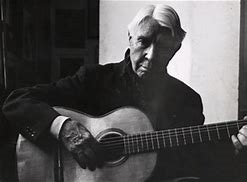
Carl Sandburg wth guitar

Carl Sandburg essays a look that Leonard Cohen would cop to sometime later

As I did earlier this fall feeling like this, I turned again to reading Carl Sandburg for my soul’s sake, for the early 20th Century Sandburg had seen every evil I have seen, and yet retained an embrace of humanity. Often here I focus in on the neglected Modernist Sandburg, the forgotten Imagist Sandburg of short poems that sing our overlooked, ordinary, humanity. Sometimes I fear the more expansive, Whitmanesque voice that Sandburg also used has drowned out the individuality of his shorter, less shouty poems.

But I needed him to shout some of his heart into me this week, so here’s Sandburg’s “I Am the People, the Mob.”  The player is below to hear it.

How to Make Speeches

I’m going to ask you to not read these notes yet. Listen to today’s audio piece first at least once. It’s short, two minutes long, it won’t take long. The audio player is at the bottom of this post.

OK, now you’re back and you’ve listened to the piece at least once. Do you think the words were written recently? Do think it’s a satire, some kind of sly Machiavellian comment on a particular modern politician?  Do you think it’s Donald Trump’s first draft of his recent speech to the Boy Scouts? Or perhaps is a secret litany of personal affirmations? It does at times seem like a twisted take on self-help.

So what is it?

It’s my quick and dirty attempt at a version of a section of the “Surrealist Manifesto”  written by André Breton in the early 1920s. The Manifesto  is sort of a grab bag, part a sincere plea for a deeper and broader application of imagination in art, part a catalog of examples of how unleashed imagination has already been applied, and part is indeed a parody of a certain genre of self-help, the kind published by occult gurus of the time.

Surrealist Manifesto cover

Not the Boy Scout manual

 
My piece is taken from that parody segment, and I’ve departed from conventional translations in two ways. First, to disguise it, I removed one phrase specifically mentioning Surrealism, and secondly, I’ve chosen my own idiosyncratic translation of the phrase “Peau de l’ours” in it. This is a condensed version an old and French saying, “Don’t sell the bear skin before you have it.” (a French version of “Don’t count your chickens before they hatch.”) Breton may have been using that cliché to contrast with the religious campaign-promise of heaven, but he also could have been refereeing to a hedge fund of his time which used that exact Peau de l’ours” name. And critically, what the investor group bought (and later sold for tremendous profit) was modern French art. “Hedge fund” gave me both ideas in a way that would be meaningful to a 21st Century English speaker.

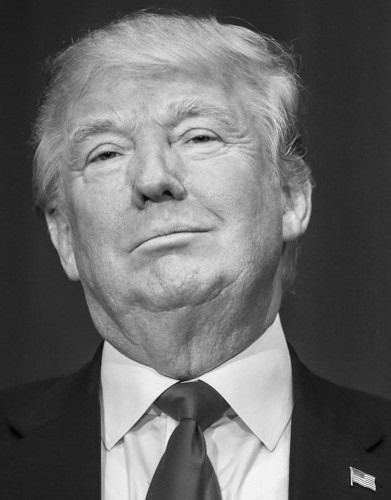
andre bretonDonald Trump

André Breton and perhaps the Surrealist Party’s first President, Donald Trump.

 
So Breton, as he often does in his pronouncements, is mixing the absurd, with recognizable satire, with sincere advice. But briefly, before I go, I ask you to think about a bigger question. What does it say that some modern artistic principles sound like they could be descriptions of Donald Trump’s (or other similar politicians) philosophy? Is it that Trump doesn’t have a philosophy, only that he finds excuses or rationalizations? For past politicians, we would say they lack a sense of irony, but Trump speaks ironically so often that one wonders if there’s a word for unconscious irony. Could it mean that the sincere iconoclastic individualism and commitment to their own personal freedom that 20th Century artists thought they needed as a corrective to disasters like WWI and a restrictive society and its expectations, is now leaching upward to more powerful men in conventional professions?

Artists Hunting Monsters

The motto of the Parlando Project is “The Place Where Music and Words Meet,” but in practice it has been the place where music and poetry meet.  However, just as I want variety in the music used (within the limits of the musician’s talents) I don’t plan to always use poetry for the texts here. Today’s post is an example. I’m going to use a short public speech, but as I have done with poetry in other episodes, I’m going to treat the words as if they are specifically meaningful, and I’m going to treat those words as if they want to sing.

We are also continuing the investigation of artists and politics, something I’ve touched on several times already this winter.

A few days ago, a cast of actors received an award, and the actor acting as spokesmen for the cast delivered the acceptance speech. Though not entirely a political speech, it was received as one, and it was almost certainly intended to make a political point.

The actor, David Harbour, was speaking for the cast of a series available on Netflix called “Stranger Things.” That show is a sort of bumblebee. Like the famously un-aerodynamic bee, it shouldn’t fly, but it does.“Stranger Things” is a show that uses tropes of 1980s movies and books to tell a story set in that same decade. It should be a winking meta exercise where you spend more time noting the references than to the story itself, or a dreary “I’ve seen this one before” drama that plays as an unoriginal re-hash of ready-made plot points and incidents. Perhaps for some viewers it is one of those things, but for many viewers it’s an ingenious contradiction of all the ways it could fail, doesn’t, and instead flies.

bumblebee flying2

I read on the Internet this is supposed to work!

As an actor, Harbour was part of that levitation. In his acceptance speech, he makes a choice as doomed to fail as the concept of “Stranger Things.”  In his awards-banquet tuxedo, standing in front of an audience of actors, he gives his acceptance speech more-or-less in the person of his character, a gruff, down-on-his-heels Midwestern town sheriff.

What’s the percentages on this working? First off, actors are not their characters, often not even close. Humphrey Bogart wasn’t a grizzled tough guy, he was the son of a cardiac surgeon who grew up upper-middle class. John Wayne was a football player and son of a dirt farmer, not a cowboy or a military man. Actors themselves would know this more than anyone else. Secondly, whatever audience size “Stranger Things” has, that audience isn’t everyone. Will folks who haven’t watched “Stranger Things” get your message if it references tropes from your series?

Well, like the series, like the bumblebee, Harbour’s speech worked in the room none-the-less. You can view that short speech and the reaction here.

In turning this speech into today’s post, “Artists Hunting Monsters,” I changed a few things. First off, the video I first saw after the event did not include his prelude to the words I ended up using. In the part I didn’t have while composing, Harbour talks eloquently about his view of an artist’s role today. In editing the words I did have, sifting them down, and dressing them with music, I choose to universalize his rhetoric to the degree I could, so that even those who haven’t seen “Stranger Things” would have access the message; and in so doing, I changed things to address the role of artists in general, not only the actors that were his present audience.

I’m once more going to violate a principle I thought I would hold to here, and “explain” the text. Harbour, and my selection and recasting of his text, says that an artists’ job, an artist’s calling, is to offer succor to the disenfranchised: to show with our artifice, truth; with our play fighting, successful struggle; with our imagined detectives, the underlying monster.  It’s a call to arms for artists to pick up blunted stage-swords and to deploy magnifying metaphors against oppressive decisions, systems and persons.

How did I speak with the music? Well, I won’t be so bold as to dance about that architecture. The main melodic line is a guitar played with an Ebow, a device that drives an individual guitar string into a cycle of feedback where it sustains with increasing volume until the device is moved away from the string. As the name implies it, it can mimic the sound of a bowed instrument, but that increasing volume feedback loop takes some finesse to manage. The secondary electric guitar line that emerges about halfway into the piece is a guitar feeding back with an amplifier, an even more chaotic effect. I was playing that part live in the main tracking session with bass, drums, and keyboards and was trying to get to the feedback “spot” with the guitar, but mics and other stuff were in the way, and it wasn’t until the track was nearly over that I finally got it to howl properly. And so, I was “hunting monsters” during the main tracking session for recording this piece.

Ebow on Telecaster

This guitar D string is about to find out how bumblebees fly

Before we leave the music part, did you know that the way the bumblebee flies is the way those guitar strings vibrate?

There are still questions left to examine on the role of the arts, and more Parlando Project expressions of music meeting up with words to be posted here in the upcoming months. If you would like to be notified about these new pieces when they are posted, you can click  the little orange “RSS – Posts” icon down on the right side of this post. To hear the LYL Band perform “Artists Hunting Monsters”, use the player you should see just below.