The Black Riders XXXIX

In my episodic way here, I’ve touched on the rise of Free Verse in Modernist poetry. Free Verse poetry may still be rhythmic and musical, but it follows no strict meter, nor does it use any rhyme scheme. Now an established tradition, it came to poetry written in English in a non-straightforward way.

I think we can largely assign this happening to Walt Whitman, the American who was writing verse with eccentric line lengths and no rhymes by the middle of the 19th Century. Whitman did not immediately gain imitators in English, but French poets like Jules Laforgue took up the cause of Vers Libre later in the century. In Laforgue we can see a direct link from Whitman through his pioneering French translations of the American’s work.

The main thread of the Free Verse revolution for poetry in English then jumps to England, where before WWI Britons F. S. Flint and T. E. Hulme made common cause with American ex-patriot Ezra Pound. Pound must have certainly been aware of Whitman (more on this later) and though I’m unsure if Flint or Hulme knew of the American poet, all three shared an interest in Modernist French poetry.

I can only surmise, but in starting their Free Verse revolution, it may have been advantageous for this small group to present this as a French idea rather than as an American one. At the beginning of the 20th Century, France was an established cultural force, a place from where new intellectual and artistic ideas were expected to emerge—and in painting and music Frenchmen were the leading edge of artistic Modernism then in a way that Americans were not yet.

This strange path, from America to Paris to London misses one poet, a too often forgotten writer of Free Verse before the 20th Century, Stephen Crane. As a young man in his early 20s he was introduced to the just-published first collection of Emily Dickinson (1890), and mixing his take on Dickinson’s compressed musings on the infinite with the just-died Whitman’s Biblical cadences and love of parallelism, Crane in 1895 published a collection of short Free Verse poetry “The Black Riders.”  Today’s piece uses the words of one of those short, untitled poems from Crane’s book.
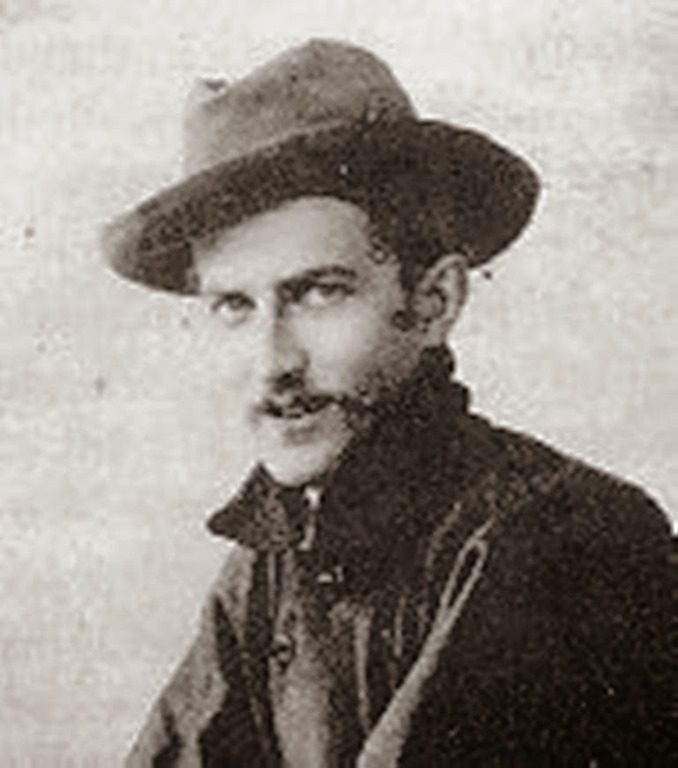
Stephen Crane

Stephen Crane:. He’d written Free Verse when Ezra Pound was still weighing in with sestinas

If, a couple decades later, one of the short poems in “The Black Riders” was to appear in an Imagist anthology, on a quick glance or reading it wouldn’t look or sound out of place, but the pieces in Crane’s collection are not really Imagist poems, not even in the same way that sections of Whitman or Dickinson are. Crane’s “Black Riders”  pieces are too full of abstract concepts and romantic notions—and even though Crane is questioning or mocking these concepts, he’s not presenting the issues through concrete new images as the Imagists would.

It’s interesting to wonder how Crane might have developed if he’d lived a full life, rather than dying at age 28 at the end of the 19th Century. Still and all, here was an American, in America, writing Modernist verse with Modernist attitudes while still a young man and with the 20th Century still on the horizon.

Musically, today marks a return of new pieces recorded with the LYL Band and Dave Moore. The music I compose and play myself can be created over a varied length of time, and in whole or in part, reconsidered and redone. The LYL Band on the other hand, just goes.  When we did some recording this week, Dave told me he was waiting for another instance of us starting off something with no more than my announcing  “G Minor.” Today’s Crane piece “The Black Riders XXXIX”  is not particularly complex or unpredictable musically, but we needed to knock off the rust. To hear it, use the player below.

Union Square

Last month when I dropped Sara Teasdale’s “I Shall Not Care”  hurriedly, I promised I’d return to Teasdale and say a bit more about her.

I’m not sure where Teasdale is in “The Canon” of modern verse now, but back when I was in college, she was even more left-out than Edna St. Vincent Millay, and for similar reasons. Teasdale and Millay were both contemporaries of the pioneering early 20th Century Modernists, both were published in their little magazines, received prestigious literary awards, and achieved a considerable readership in an era when page poetry had a more general readership.

But such status didn’t hold. As the 20th Century wore on, and High Modernism and academic-informed writing became the predominant style, Teasdale, like Millay didn’t seem to have the gravitas High Modernism required—after all, both wrote often about love and desire, a subject that if treated directly wasn’t thought serious enough. You know, “women’s stuff.”

If you’re getting the idea that by mid-century, Modernism was a bit of a boy’s club—well, yes, it was.

Teasdale had all of Millay’s problems with the curators of Modernism, and then some. Millay could write in the more modern style as well as engaging in somewhat old-fashioned-sounding sonnets. Teasdale was more adamantly a writer of metrical, rhymed lyrics that increasingly didn’t sound modern enough. Millay herself was a fiercely modern woman whose persona contrasted against any Victorian trappings in her poetic music, while Teasdale seemed less sure of herself. A typical no-win-situation for female poets by mid-century: assertiveness or originality couldn’t overcome the patriarchal attitudes—while submissiveness and reticence guaranteed its victory.

We’re decades past all that now, and we have a new century well underway. Today, it may seem like less of a crime for Teasdale to use the poetic music of 1875 instead of 1925 in this poem written around 1911. Publishing a poem like “Union Square”  would have not caused Millay any second thoughts, but Teasdale went back and forth on that. In a fascinating run-down of Teasdale’s own doubts about the poem, Melissa Girard recounts early readers giving feedback like “Perhaps it is better, after all, to pursue the lovelier side of existence, and only give expression to what is unmarred in the realm of beauty.” And bizarrely, even after publishing it, Teasdale suggested “If the idea at the end of ‘Union Square’  had not been an accident suggested by rhyme, I should never have said what I said.” Say what? One of the beneficial side-effects of rhyme is that the search for it can work like Surrealist and automatic-writing techniques to jolt the mind’s search for language in directions it might not otherwise go—but none of the lines in “Union Square”  where the poem’s speaker compares herself to the streetwalking prostitutes are rhyming lines.

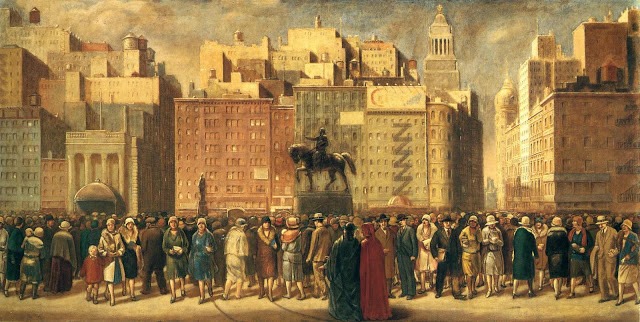
isabel-bishop-virgil-and-dante-in-union-square-1932

Looking for early 20th Century pictures of Union Square I discovered a remarkable painter Isabel Bishop

I found it impossible not to sing this poem when presenting it, the poetry just demands it, even if the poem’s persona is expressing constraint. I think that contrast is what makes this poem, and Teasdale, worth considering. To hear my performance of Sara Teasdale’s “Union Square,”  use the player gadget below.

Anglers

Next weekend is the Minnesota sport fishing opener. Today’s piece, “Anglers”  is appropriate for that—but to that opener I’ll bring 8th Century Irish monks, a strange airship cosmology, a Nobel prize winner, and tenderly, a pair of brothers.

I wrote the words for “Anglers”  combining two things, one biographic and one literary, mixed with some phrases that occurred to me.

The biographic? My grandfather died when my father was a young man, shortly after I was born. My father had four brothers and a sister, and the youngest of his brothers was only a few years older than I was. My grandfather never lived long enough to teach him much, and so my father helped teach his youngest brother some things their father did not live long enough to do. One of those things was sport fishing. As my young uncle grew up, he and my dad became fishermen of the most avid kind.

Over the next fifty years, the two men fished many places in Minnesota, but most memorably for me, in Canada. Not just on the border lakes like Lake of the Woods, but halfway up Ontario to lakes above the little town of Redditt. Their base there was a rustic fishing lodge: log cabins, outhouses, small aluminum rental rowboats to which they’d attach a 1930s Johnson Sea-Horse outboard their father had bought decades ago onto their flat stern. Their routine: out with the dawn, fish until noon, pull in some inlet, fry up some fish for shore lunch, then fish again until late solstice dark. The poem I wrote doesn’t mention it but I was with them as a child on some of these trips, though fishing was not something I kept up with as I grew up and went East. The two brothers though continued their angling until my father before his death became too frail and sickened with senility to continue.

Johnson SeaHorse outboard motor

“Uncoiling the Sea-Horse.” My grandfather’s Johnson Sea-Horse outboard used by his sons


That’s the biographic. The phrases? I often write, at least in part, in my mind’s ear. Sometimes it’s entire first drafts of shorter poems that are composed there, other times it’s only beginnings or endings, or even phrases that somehow seem to mean to be in a poem. I’ve told myself an advantage of writing this way is that poetry often works best if it’s memorable speech, so composing this way pre-tests things by holding them in memory and seeing if they adhere.

As I get older it’s harder for me to memorize works in process, and this piece had only phrases and parts of the beginning and end stanzas in my head before I started my first paper draft. One of the phrases was the idea of the sport fisherman, the angler, being at right angles to the surface of a lake. Another was a phrase which occurred to me, “lattices of fishes,” which I simply loved the sound of, but it also seemed like unto the vertical angle from the surface of the anglers in their boat.

It was that angle word-play that brought in the literary. The anglers point up and down in their angle from the surface. What do they point to? And lattices, obviously there’s another level under the water-surface plane.

The literary? Seamus Heaney, the Irish poet, wrote a poem I much admired about a story from the medieval Irish annals. The story was some monks at Clonmacnoise in 749 A. D. observed an airship snagged on the tower of their monastery and a crewman of that airship who climbed down from it to free his ship.

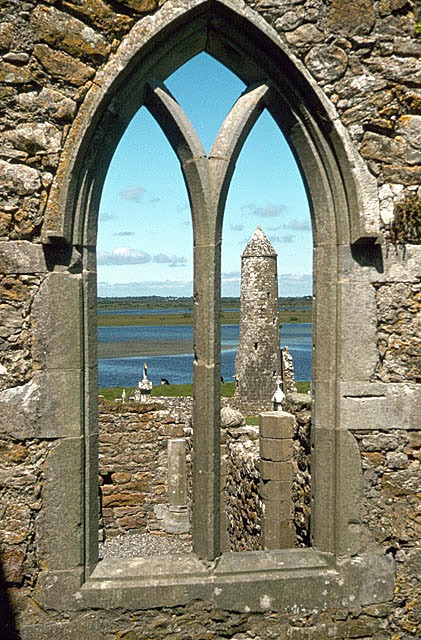
Clonmacnoise tower

Clonmacnoise tower. Don’t snag your anchor on the weeds or rocks.


In combining the two, I created a cosmology where the air breathing anglers on the surface of a lake are like angels, or the crewman of that medieval airship, to the barely comprehending fish who are brought across to the airy world. And that echoed the idea I had developed in my head from the anglers pointing up 90 degrees from the surface of the lake in their boat. They are pointing to the heavens, a place we can no better understand than the fish can know about the world of our air-breathing.

And there you are, that’s the entire poem’s metaphoric magic-trick revealed. Yet that isn’t the poem, much less this audio piece that presents it. I still had to work on the language through several drafts, and I may work on it more after this presentation—but the poem and the audio piece is more than its images or its ideas, because a poem and a musical composition are both machines that think with sound.

So, listen to “Anglers”  using the player below. And please, let others know what we’re doing here. I would so much appreciate that.

I Thought It Mattered

Today is May Day, a day that combines many things. Neo-Pagans can point to it as Beltane or the morning that follows Walpurgis Night. Since the late 19th Century it’s been “International Worker Day” associated with labor and Socialist movements. It’s about midway between Spring Solstice and Summer Equinox.

It was also once a more or less secular holiday celebrated because by now it’s likely Spring in essence, not just Spring in some calendar’s notion in northern climes. A long time ago, in my childhood, in my little Iowa town settled by Swedes, May baskets were still exchanged—this before Easter had become one of the commercial candy holidays paired with Halloween. In Britain May Day still a bank holiday, celebrated next Monday with sundry celebrations.

In Minneapolis, this Sunday is the date of an annual parade organized by a local urban puppet theater. We will sit on the curbsides as Indigenous dance crews, drum bands, anarchists, political candidates, stilt dancers, decorated bicycles, giant papier-mache puppets, and various cause marchers pass by to music by flat-bed truck rockers and strolling brass bands. The Minneapolis May Day parade combines all those May Days into one thing, a Whitmanesque democratic cultural event, a container of multitudes spilled open on a city street.

I used to take pictures and film it, but now I just go and watch it. It may be just me, but in the past couple of years the level of invention in the costumes/puppets seems to have fallen off, but that may just be me and nostalgia filters. Ah, for the good old days of 2010! I’m holding that this is just random variation—but in the end it’s the gathering of South Minneapolis people, parading and watching who make me most appreciate it.

The 2010 theme incorporated William Blake, and my soundtrack to this slideshow features Blake’s “The Tyger.”


Today’s audio piece, “I Thought It Mattered,”  has words and music by Dave Moore, and is sung by him along with our more spontaneous incarnation, the LYL Band. Dave’s song speaks of lifetimes, marchers and causes. I think it’s one of his best songs, so give it a listen using the player below.

Poets to Come

A month ago I began our celebration of the U. S. National Poetry Month with an audio piece using the words of Walt Whitman. Today I bring our month of music meeting poetry to a close with another piece by Whitman: “Poets to Come.”

Which is appropriate, as modern American poetry begins with Whitman.

From time to time in his work, Whitman reminds us that he knows he hasn’t fully realized his poetic project. This isn’t just false modesty. He revised and added to Leaves of Grass  throughout his lifetime, but it wasn’t because he thought perfection was one more edit away. Whitman seems to accept that it’s better to try to do what his ideals say to aim for, to make the effort to become the artist his art asks to exist. It’s better to be 80%, or even half or less, of that ideal Whitman he writes of, sounding his barbaric yawp over the roofs of the world, than for no Whitman to dare exist.

Note though that Whitman isn’t asking himself to do this for self -expression. His expression, even with the particularities of his own person being unavoidable, is cultural expression. He sought to sing into existence the culture he wanted America and the world to have.

Which is what makes this poem a great basis for the last post of this Poetry Month. He had faith for the poets who would follow his innovations and audacity. Many did come forth after him, many of which we’ve presented here. Whitman had, I might suppose, faith in the intentions of the Parlando Project—and I, if I pay attention to the spirit he wrote of, I should have faith too.

Walt Whitman in Philadelpia 1889 by Frederick Gutekunst

Good Gray Poet, Thin White Duke.. David Bowie sang “Ain’t there a pen that will write before they die?” Whitman’s caption says he was about 4 blocks from Sigma Sound studios were Bowie recorded that. TSOP!


During April I’ve created and presented 16 combinations of various words with my music, more than any other month in the year and a half of this project. I took a crack at preforming all of that “April is the cruelest month” modernist epic of T. S. Eliot’s “The Waste Land” —and only got near half-way done. I worked on the finding and understanding the words I’ve used, or composing, playing, and recording music for several hours every day this month.

And you’ve listened to these pieces, and if you’re here, you’ve even read my words about the process, for which I’m grateful. I’ll be back tomorrow with a piece by Dave Moore and the LYL Band for May Day and there may yet be more LYL Band recording before this Spring is over. I do expect to take a bit of a rest after the efforts of this April though. I have a pile of books I want and need to read, a whole lot of interesting blogs I’ve gotten behind reading too, and I’m looking forward to listening to music I didn’t have to think up first.

If you want more, I remind everyone that we have over 200 pieces here in the archives on the right. There’s lots of stuff that you may find better, worse, or at least additionally different there. If you, or someone you know would just like to hear the musical combinations we do, the Parlando Project music is available on all the major podcast services like Spotify, Google Play Music, or Apple podcasts.

Here’s Whitman’s “Poets to Come”  performed with my music. Use the player below to hear it, and if you like it, please tell other folks about the Parlando Project.


My Poor Bagpipes

In search of words to combine with music here, I sometimes find it necessary to translate from other languages. Poetry translation involves following strange paths.

Here’s the path I followed to present today’s piece, Jules Laforgue’s “My Poor Bagpipes.”  Throughout this month I’ve been presenting parts of T. S. Eliot’s “The Waste Land”  as part of my celebration of April as National Poetry Month. This causes me to look more at Eliot and where he derived his sense of modern poetry from. Eliot’s own testimony says that a late 19th Century French poet, Jules Laforgue was very important to his own poetics. That’s about all I knew about Laforgue: important to Eliot.

I search and find some Laforgue poems, though only a couple in English translation. Luckily, there’s a site, laforgue.org that has put a great deal of his work online in its original French. I pick out a handful that have interesting titles or first lines and see what rough machine translations will show me.

As I looked at the rough translations I was struck by déjà vu—only in English of course. “Hey, that sounds familiar! I’ve read something like this poem.” In French it was Poètes a Venir,” and of course it was Walt Whitman’s “Poets to Come.”  It appears that Laforgue may have been among the first to translate America’s Whitman to French in 1886, while Whitman was still alive. And from his work translating Whitman, Laforgue began to write “vers libre”—free verse, himself, helping to pioneer that idea in French poetry.

Chat Noir Poster2

“The very illustrious company of the black cat with his famous shadow plays, his poets his composers.” Remembered by its posters long after it closed, the Chat Noir cabaret was a place where music and poetry mixed in 19th Century Paris. A very Parlando Project thing, no?


I will not be translating Laforgue’s translations of Whitman back to English here. I picked his “Air de Biniou”  to try, primarily because I was intrigued by the first line “No, No, my poor bagpipes.” I’m attracted to incongruity and black humor, and I kept double-checking to make sure that line’s “cornemuse” in French must mean “bagpipes.” The poem’s first verse seemed to refer to the bagpipes’ famously raw timbre and pitch issues: “everything is a mistake, everything turns out bad” claims Laforgue’s first stanza.

Inserting gratuitous bagpipe joke:

Why do bagpipers walk while they play?

To get away from the sound.

As I worked on it, I had trouble with several words, two or three of which I’m still unsure I’ve translated correctly. This may be a general issue for anyone translating Laforgue, as he liked to play with language and meanings, sometimes using unusual words. But I soon had a more serious issue, after dealing with “occit” in the second stanza. A poet’s images are not his literal manifesto, and irony was part of Laforgue’s stance. In this second stanza he says Nature is a wife the artist will kill. I get his point: the artist thinks they can better the mundaness of nature and create something new and above it. And it’s nature—an inanimate concept, not a person. Yet and all, it’s still a too-casual image of a too-serious and widespread problem, domestic violence, for me to be happy with it. Looks like this is a general issue with Laforgue too. He consistently used images of women, sex and relations with women as a repository for his issues with our biologic nature. In a word: misogyny.

Clearly he’s not alone in this. It could be one of the things Eliot picked up from him too. Like Eliot, he’s not stinting on masculine failures, but this can reveal an attitude that men  fail because of their souls  while women  fail because of their gender.  I tried to mitigate that stanza by dealing with another problematic word in it: “carambole.” It’s a word usually used for a particular fruit, but it’s also a bumper pool game, and something like that later meaning I think was what Laforgue intended. I was going to use something like rebound or carom in my translation, but at the time I performed it, I went with a more archaic meaning of the word where it may refer to cannons. At least that put the poet and Nature in a running battle. I may have made a wrong choice there, but that’s one of the things you run into in translation, needing to convey the author’s outlook which may not be your own.

We have little space left to wander more in the twisted paths you find when translating. I think it can be tremendously helpful for poetry composition, because it puts you, hand in hand with another poet, trying to find the right word with the right sound and connotations.

Bretons' with Bagpipes

“Je suis bagpiper!” says the man in the center. “Daddy, can we talk about the patriarchy and your intonation issues.” says the girl on the right.

But one last thing, those surreal bagpipes in this French poem. Laforgue’s family was from Breton France. Bretons are a Celtic culture, and yes, they have bagpipes. As to my music here, while I enjoy composing string parts and breaking out the classical guitar, sometimes I don’t want to be careful, I just want to grab electric guitars and bash something out. “Everything is a mistake” says Laforgue. Nonetheless. Use the player below to hear it.


Tom Rapp has died

Isn’t it odd how you know, and yet don’t know things, even in this world of instant communications and webs world-wide. Yesterday I started work on a new Parlando Project piece, and this morning I returned from a brisk ride to breakfast on a cool sunny April day to write about this piece whose words were written by Sara Teasdale.

I would have said that I was introduced to Teasdale from an LP record by one of my musical influences, Tom Rapp. I figured I’d link to something about him…

…and there I learned, that he had died more than two months ago.

So, I’ll link to this, his performance, Parlando Project-like, of Shakespeare’s song “Full Fathom Five”  from The Tempest combined with Teasdale’s “I Shall Not Care.”

Even though that’s an example of the Parlando Project principle: “Other Peoples’ Stories,” that is to say, it is words Rapp didn’t write, it conveys something of the impact Tom Rapp can have if one is open and receptive to his presentation. He didn’t need  to use Teasdale’s words or Shakespeare’s, because Rapp is one of the best singer-songwriters you likely don’t know about.

Let me not inflict too much biography on you. Rapp is another child of the Midwest, born on the Dakota plains, raised some in Minnesota. While still a grade-schooler, he bested a teenager from Hibbing— kid named Bobby Zimmerman —in a talent contest in Minnesota. That Zimmerman kid moved to New York and changed his name to Dylan. Rapp ended up in Florida in the middle 1960s and formed a band with other kids in his high school. He named the band from a phrase from the Sermon on the Mount:  Pearls Before Swine. Their first LP from 1967, with a cover taken from Hieronymus Bosch painting was the only one with any appreciable sales, and Rapp issued a handful of albums afterward to ever declining audiences. Why?

As you’ve heard me proclaim here “All artists fail.” Even the most successful, have multitudes remaining who couldn’t care less what they have done; and unique ones do not get any advantage. Rapp wrote fewer songs about romantic love, and his best songs did not offer any easy comforting. And he’s as far from get-down, party until you forget as any musician who ever lived. Rapp is a writer of look, and then look deeper, and remember.

Unique can mean mostly that the audience is not shouting for more like him or her. Yet, I’m sure there are in this troubled world a great many who could find solace, as I did, in Tom Rapp.

You can be the 82nd person to listen to this since 2014.


When I found that link to the LP cut of the song he made from Shakespeare and Teasdale on YouTube, I saw that it had exactly 80 views since it was uploaded four years ago. Let that sink in for a minute. 80 views. The clumsiest unboxing video for some appliance will easily garner more. There have been a few successful “songwriters you should have heard” stories this century, where decades-old work becomes better known—Nick Drake or Rodriquez come to mind—but to succeed in finding an audience, such things require luck, and we’ll only allow a few to win when we re-spin Fortuna’s wheel. Pearls before swine indeed.

Feb. 22nd 2019: Thinking about Tom Rapp again today for no particular reason. Here’s a link to an excellent late 20th century run down of his story by Gene Weingarten.

Good Night Ladies

While performing and posting about T. S. Eliot’s “The Waste Land”  bit by bit this month, have I mentioned enough how artistically revolutionary it was? For today’s section let me talk first about form and then about subject, and I’ll share a little-known episode in Eliot’s life that may have contributed.

I call today’s part of “The Waste Land” “Goodnight Ladies.”  Formally, even today, nearly a century later, a section of a major poem written like this would be provocative. First off, it’s not “poetic” in its language. While there’s a minimal irregular structure from the interjected closing-time refrain of the bartender’s call, there’s no striking images, meter, rhyme, melodic flow, and certainly no “poetic diction” in it. It’s part in the musical structure of this very musical poem is to present a section with no music in its words. While politically and culturally apart from the Dadaists working at the same time outside of England, Eliot’s structure for “The Waste Land”  is to throw in jarring and unannounced cuts in voice and setting. Even sophisticated, educated readers cannot agree how many voices and scenes are present in the “A Game of Chess,”  which this passage concludes. I made it three pieces, three scenes, others think differently. Eliot has already used plenty of high culture references in the “A Game of Chess”  section of “The Waste Land”  before today’s scene: Shakespeare, Ovid, and obscure Jacobean playwright Middleton—but he’s also thrown-in a pop song parody. Now he concludes “A Game of Chess”  with a bit of working-class pub dialog absent of any literary allusions (until the very end).

The speaker, an unreliable narrator, as well as her subject are working-class women. There is no sentimentality. This isn’t a “salt of the earth” bit of condescending or ennobling praise. The speaker is unkind and perhaps duplicitous (the implication is that she will, or has, put a move on the subject’s husband), and her subject, Lil, is a woman described uncharitably as looking “antique” at age 31, after multiple difficult pregnancies and an induced abortion.

The monolog, if not poetry, feels authentic. The depiction of class and sexual politics, is sharp and unstinting. A poet like Carl Sandburg, the radical and newspaperman, could have heard such dialog—but where the hell did T. S. Eliot, upper middle class raised, prep-schooled, Sorbonne and Harvard (legacy) educated, international banking officer, and furthermore, a man with a reputation as stand-offish and diffident toward women—even those of his class and cultural background—get informed enough to write this passage?

I couldn’t let that question go without some research, and I think I found an answer. It’s one of those “this would make a great movie” moments in literary biography. I knew Eliot had taken a crack at teaching school at a boys-only school in Highgate. That’s the start of the story, he taught French, Latin, math, history, drawing, beside duties coaching baseball (!) and swimming. One of his students: a 9-year-old John Betjeman.

Schoolteachers will know what kind of workload that entails. The bank officer job that followed was a relief to Eliot.

Here’s where it gets interesting. Through some connections, he was introduced to the Workers Educational Association. They were organizing college-level night school classes in Southall. Eliot applied to teach Modern English Literature there, and he continued to do this from 1916 through 1919. Since WWI was on, with many men overseas, the classes were ¾ women.

The weekly classes were a lecture followed by an hour of discussion. Regular papers and reading were required of the students.

What was the experience like for Eliot and his working-class students? Surprisingly rewarding for Eliot, and (as far as we know) for the students. In letters home to America, Eliot praised the minds of his best students, singling out several women. In an account he provided for the Association’s 50th Anniversary in 1959, he could still recall one in particular:

“There was one poor young woman who was one of my best students, but was an elementary schoolmistress with a very large class of little children in the daytime and (she)…died, I am sorry to say, of overwork.”

Was Eliot being polite in both his contemporary letters and his remembrance letter to the Association? Perhaps he did gloss over, or was unaware of, the difficulties one could imagine between himself and his students—but he did this for three years, as a second job that was presumably not his main source of income, and each year, he asked to do one more. Each year, he developed a new syllabus covering additional authors for his literature night-students, some of whom stayed with him for his entire run.

Students-inscription-to-T S Eliot 1919

Inscription on a gift copy of The Oxford Book of English Verse signed by his students on the day of Eliot’s last lecture. The longer article about this is a must read for those interested in this little-known period of Eliot’s life.


Was that worn-out school-teacher, or some other night-school student, a model for Lil in today’s portion of “The Waste Land?”  It seems possible. After reading this, my thoughts went to those students, hungry to learn and experience more about literature in the London night speculating of Zeppelin raids. How I wish we had accounts from the students as well! In “The Waste Land,”  Eliot wasn’t going to give us anything he learned about their joys, or any compensations they found for the travails of their lives, anymore than he gives anyone that. We’re left, in today’s piece, with this mean girl’s account of Lil, unsparing in scorn, revealing Lil’s burdens as more of the weight of the timeless waste land on post-WWI Europe. Eliot doesn’t even give her story, told so meagerly, any ennobling literary references, nor any poetry, does he? Just a story in a bar.

Wait. Her name’s Lil. Lillith? Possible, but I think not. How did this poem begin? “April…breeding lilacs  out of the dead land.” And the last line, the one I use for the title of this performance? It’s no longer the recounter of Lil’s life speaking (she who says it “goonight” not “good night”). The voice has shifted again, without warning in this unpredictable poem. It’s the voice of Ophelia exiting to her death by water in Hamlet.

Ophelia by John Millais

Ophelia by John Millais. Almost nothing to do with Eliot and “The Waste Land,” but it’s been too long since I’ve been able to put a Pre-Raphaelite painting in a post.


The reader in this performance is Heidi Randen, who does a great job with the words and keeps me from having to inflict my voice in too many pieces here. To hear it use the player below.

Students Making Audio with the Wordsworths

I do make something of an effort to look for other folks doing something interesting with poetry and music online, and to check out the blogs of folks who’ve commented or otherwise contributed here. I really should be more consistent in doing this, but particularly this month as I’ve attempted to ramp up production of Parlando Project pieces as part of the National Poetry Month celebration, I’ve fallen behind. Come May I’ll have a lot of blog reading to catch up on!

But this one caught my ear just after posting my own attempt at presenting a Wordsworth nature poem. A group of Keswick School students working with Durham University in England have posted a couple of audio pieces connected with William Wordsworth and his sister and collaborator Dorothy Wordsworth’s Lake District observation of nature and the resulting landmark poems. This one has the students speaking about the book of nature and some of Dorothy’s journal entries on the siblings walks. There some nice, spare music added to this one as well.

A second one has an audio piece using spoken word alone to convey William Wordsworth poetry combined with Dorothy’s prose. The blog talks about how the students have noticed new, modern diversions from the contemplation of nature:

As we read over the poems composed by the students, it was fascinating to see how many of them – the majority of the group, in fact – had fixated on the idea of more modern distractions from nature, and in particular, the role of smartphones in quite literally ‘filtering’ nature for us. While William’s poem admonishes its addressee to abandon books and ‘hear the woodland linnet’, the year ten pupils from Keswick School used their poems as a chance to reflect on the need to abandon their phones and enjoy nature in its own right.

I keep asking my middle-school aged son what his generation has decided the rapidly aging Millennials don’t understand and that his generation will have to fix. He looked at me funny when I asked him again this week

. “Is that some kind of Dad joke?”

Perhaps he just doesn’t want to divulge yet his generations secret plans to fix the worst mistakes of those who came before, or maybe he’s still formulating the answer. But one of the time-tested ways to look for answers or better questions is to skip back a few generations and see what someone observed and thought before those now running things made their decisions.

I Wandered Lonely as a Cloud (Daffodils)

It may be U. S. National Poetry Month, but one can’t deny the impact that English poets have had on poetry, particularly before the Modernists launched with significant American participation.

Modernism, as practiced by those early 20th Century Imagists sought to cleanse poetry of the rust and rot of “poetic language” and rote abstract metaphors. Strong, exact words, no more complex or numerous than necessary were to describe things that were actual things, not merely decorative analogies to describe something else. By the 1920s, that American import, T. S. Eliot, became the standard of one large stream of Modernism. Although inspired by this fresh use of language, the Eliot wing of Modernism sought to rid poetry of “romanticism,” defined as a relentlessly subjective expression of personal experience unshaped by a greater historical and cultural understanding. Poetic language might be refreshed, but the cult of the great poem returned, and said that poetry is best to be in service of great themes and elaborate—rather than elegant—structures of thought.

Early Imagist/Modernist poems were about moments. The High Modernism of Eliot allowed it to be about eras. Imagists prized images of things formerly ignored or costumed only in the rhetorical finery in 19th Century poetry. High Modernism still allowed the mundane to stand for sublime thoughts, but it often sought to display a level of knowledge and literary scholarship along with the everyday in its choice of images.

This is why it’s important to look at the early part of artistic movements. Often their best ideas become mutated as the movements develop. Their revolutions become the new orthodoxy.

Today’s piece, “I Wandered Lonely as a Cloud (Daffodils)”  is by English poet William Wordsworth, one of the founders of Romanticism. It’s a poem that can be attached to an exact (April, Poetry Month) date: April 15th, 1802, and to a walk that Wordsworth and his sister took in rural England. But that’s not how the poem was written. Wordsworth wrote it a couple of years later. He referred to his sister’s detailed journal entry about the April walk to refresh his particulars. His wife supplied two critical lines for the final stanza. This was not a spontaneous outburst of subjective personal feeling at all.

Daffodils at Kew Gardens

I couldn’t make it to the Lake District, but even a month ago, daffodils were blooming during an English Spring in Kew Gardens
In a few weeks my lawn will look like this in Minnesota—only dandelions, not daffodils.


When I performed the version you’ll hear below, I made one significant change and one minor one. The minor change? I dropped the adjective golden from his line “A host, of golden daffodils.” I suspect I did this by accident as I performed it. Not to dis Wordsworth (and by the way, Billy, what’s with that obvious pen name “Words-worth” for your poetry gig?) but I think I improved the line when I sung it as “A host, a host of daffodils.” First off, daffodils are a common flower, and they are in the wild always yellow. Strict Imagists would say the golden adjective is therefore unnecessary—and it is, well, a gilding of the lily. I can’t recall my reason for the major change, dropping the next to last stanza—I may have desired to shorten the piece for performance—but it is the weakest stanza in the poem.

The resulting “Daffodils”  I perform wouldn’t have been far from what F. S. Flint or Richard Aldington would have written a century or more later as pioneering Modernists. After all, Wordsworth said that he was trying to cleanse English poetry from special, high-flown, poetic diction too, to return it to “as far as is possible, a selection of the language really spoken by men.”

I do retain something else Wordsworth does here, something I don’t recall the Imagists doing much. “Daffodils”  is presented in a framing device, while the Imagists were all about the presentation of immediacy. Wordsworth doesn’t say merely that looking at all these wildflowers, the temporary exultation of spring, was transfixing—and he says that less with that next-to-last stanza removed. This is not a poem only about letting us see them in their wild, external multitude through his eye on an April walk in nature.

No, the poem starts, deliberately, in past tense. “I wandered lonely as a cloud.” And the poem closes even more removed. The speaker of the poem is not the energetic nature-walker strolling in Spring. In the actual, unknown, later time of the poem, he’s lying on a daybed, vacant or pensive. These daffodils are now only obtainable by the “inward eye” of recollection.

Setting something in the past can be seen as a tactic of sentimentality, something the Modernists distained, but what we have here is worth that risk. How so?

I thought it a delightful little nature poem when I read it as a teenager. Then I read it decades later, as my Eagle Scout father, the angler long accustomed to waiting perpendicular on the flat surface of lakes, the man who had bicycled across his rural state many times—while then, as I re-read, he was further and further confined to lying flat in rooms with the erasing of days. In that later time, noting the wild daffodils bliss is told to us in memory, I reversed Wordsworth’s famous dictum on the origin of poetry. In my reading, in that time, it became a poem, a song, of tranquility recollected in emotion.

Here’s my performance of “Daffodils”  as I sang and accompanied it on acoustic guitar.