It’s been a while since I presented a musical performance of a poem by English poet Frances Cornford, but here’s one from her early book-length collection published in 1910 when the poet was 24 years old. The poem is brief, but it presents the speaker as having had their life and soul ransacked by evil. I don’t know a lot about the biography of Cornford’s youth,* but the situation outlined in the poem is so bleak that it brings up the suspicion that it may be a “persona poem” where the young poet is, perhaps as an exercise, trying to write poems from a variety of viewpoints.**
Many poets early books collect material originally drafted a few years before publication, so it’s plausible that this Edwardian-era poem was written by someone even younger than 24, and yet I, an old man living under a disreputable 21st century regime, found its complaints easy to slip into. I think it helps a modern performer (and I hope, a modern listener) that the poem expresses itself straightforwardly without a lot of shopworn 19th century metaphoric baggage which many of Cornford’s English contemporaries might easily fall into.
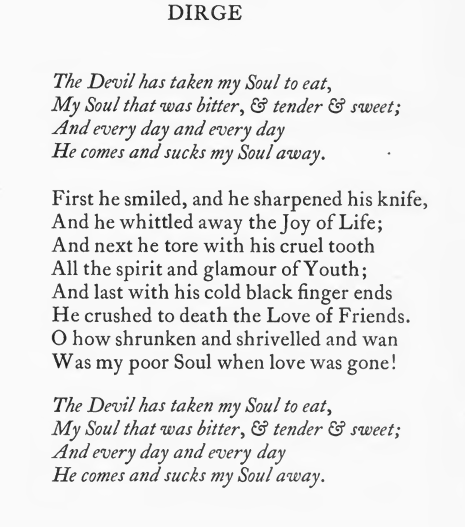
I love that description of the soul that had been taken from the singer, a soul that was “bitter, & tender & sweet.” Close readers will note that Cambridge-scene-raised Cornford eschews the Oxford comma in that inventory.
.
So, if this is a made-up poetic exercise by a young poet, she did a good clean job of making something. Despite its title and the daunting situation cataloged in the poem, Cornford’s prosody seems almost jaunty, and so that’s how I approached creating the music and performance for it. The words in the poem offer no consolation for all that the devil has taken from the singer – but just as in Afro-American Blues lyrics, the very fact that the singer is singing (not whimpering in pain or self-pity) and accounting for what has been put upon them makes its own point of survival and ability to analyze what they’ve suffered.
You can hear my performance of Frances Cornford’s “Dirge” with the audio player below. What, did the Devil take that away too? No, it’s just that some ways of reading this blog won’t show it, but I provide an alternative: this highlighted link that will open a new browser tab with its own audio player.
.
*Nepo baby rating? Cornford will see most any other writer’s hand and bust yah: her paternal grandfather was Charles Darwin, and on her mother’s side she was William Wordsworth’s great-niece. Her mother was a lecturer in English Literature at Newnham College. Her father was a notable botanist that flourished in the shade of his evolutionary father. At time of publication, she was newly married to a Cambridge classics scholar. Fun (and confusing) fact: her father and her husband’s given names were both Francis – so upon taking the conventional married name she repeated the complication of being a distaff homonym-named person in a household. One of her grandchildren, Adam Cornford (still living) followed the clans’ conflation of fields between poetry and science.
**Included in the same collection as “Dirge” was Cornford’s best-known poem, the triolet about “A Fat Lady Seen from the Train.” Similarly clean, spare, and sharply spoken in its verse as today’s poem, it curiously has one of the first plausibly disparaging uses of the term “white” by a white poet – and others took issue with that poem’s treatment of its subject almost immediately.
I think it’s possible that the speaker in that poem may not be Cornford, but an invention or external observation. I’ve even mused that since the “fat white woman who nobody loves” is seen through a train window, that the poem’s speaker is seeing her own reflection in the glass. In photos Cornford looks quite thin, making me then speculate about anorexia.


