Thanksgivings

I’d hoped to have some more new musical pieces ready this month, but as I’ve reached the eve of the American Thanksgiving holiday I thought I’d mention a previous Parlando Project piece that has gotten attention this month as people on the Internet look for poetry about that holiday.

The post, the one people seek, presents this little marvel from Emily Dickinson:

One day is there of the series
Termed “Thanksgiving Day”
Celebrated part at table
Part in memory —
Neither Ancestor nor Urchin
I review the Play —
Seems it to my Hooded thinking
Reflex Holiday
Had There been no sharp subtraction
From the early Sum —
Not an acre or a Caption
Where was once a Room
Not a mention whose small Pebble
Wrinkled any Sea,
Unto such, were such Assembly,
‘Twere “Thanksgiving day” —

Though silent on the page, I can hear Dickinson’s voice start out examining this holiday at arm’s length. It has claims to be a historical commemoration (the landing of English colonialists in her home state of Massachusetts in 1620) but its observance, then as well as now, is basically a big meal, often with extended family in attendance. Many folks reading this today recognize or remember being in that in-between state of age at a Thanksgiving gathering, no longer a child, but not one of the family elders — neither urchin nor ancestor. Similarly, the Thanksgiving holiday in Dickinson’s time was of unclear seniority: it claimed to represent those 17th century English settlers and their harvest feast, yet the promotion of a U.S. holiday that became the one we celebrate now was a new movement of the mid-19th century.

Dickinson at first reviews it as if a pageant, and then as she starts to become a little harder to follow, with “Hooded thinking.” My guess is she’s meditating on it as if a monk or a nun wearing a habit. Her resulting take: “Reflex Holiday.” Fair — most holidays, most of the time, have elements of reflex: they are set celebrations, dates on a calendar. Sincere thanks-giving requires no excuse or appointment. If Dickinson had ended there, we’d have a poem in a predominate style of our age: a sharing of an observation from one sensibility to any and all, not unlike an Internet post.

Thanksgivings with ghosts
“Celebrated part at table/Part in memory —”

.

Dickinson however also has an abstract mode where our less agile minds may not follow as rapidly as her poem jumps away in the next lines. Have we subtracted from the piety of the Pilgrim settlers? And then the most obscure set of lines in the poem: “Not an acre or a Caption/Where was once a Room.” Huh?

I may not understand those lines. I certainly didn’t when I performed the poem a few years back, but this occurs to me: talk of acres as if in a deed, and the use of the curious word “Caption,” reminds me that she was a smart woman in a family where the men were lawyers. Caption is a legal term, it means, I find out, “that part of a legal instrument such as indictment, commission etc., which shows where, when and by what authority that legal instrument is taken, found, or executed.” Understanding that usage I think it highly likely she’s saying that the holiday celebration may not be on firm legal standing. Is she just commenting on the holiday not yet being a national holiday as it eventually became in the U.S.? Or does she have — or do we, her readers today, have — a reading outside the borders and celebration of the poem drawn by a culture of colonizers whose small settlement was under the forbearance of those already there?*

Dickinson closes by saying the original Thanksgiving assembly was like the proverbial pebble that spreads ever widening ripples in the water. Yes, big circles long past the pebbles. History is an unending cycle of theft and accumulation, deliverance and conquest. Kindness and fellowship are short in comparison. Oh, so short. And so sweet. Thanks for the sweetness is what I’ll celebrate.

Here’s an audio player below to the musical piece I performed using Dickinson’s words. Don’t see it? This highlighted link is a backup.

.

*A native American summary statement on this Thanksgiving matter comes to mind, considering the indigenous population brought food to that first harvest feast: “We did the giving. We got no thanks.” Could these matters have been on Dickinson’s mind? I don’t have the scholarship to support that. Should that injustice be our only thought as we celebrate our families and give thanks? No, I’m not saying that, but even as a “reflex,” a required simple thought and remembrance, that thought seems due on this day.

The Route of Evanescence

Here’s another little mystery, a riddle inside a riddle, which makes up a new song using the words of Emily Dickinson — but first a little of me sounding like a regular blog that talks about itself.

As assured time to work on this project has largely disappeared, I’ve been turning to simpler compositions and quicker realizations of them to cope with this, but over the past few months a number of pieces have sat in limbo, waiting to be rediscovered, waiting for decisions to be finished or abandoned. In going through some of these this month and I came upon a recording session for “A Route of Evanescence”  from last August.

I recall the session. It was just me and a couple of acoustic guitars, with access to my quiet studio space. I had some advance notice, maybe a day or so, that I’d have that time. On the hurry-up, I prepared a number of compositions to record, and when the day came, I set about laying down tracks singing and playing that pair of acoustic guitars. I’m not an exact or exacting guitar player by temperament, but when I haven’t played as much, my old hands produce more imperfections. None-the-less the limited time meant that I pressed on. I think I may have recorded basic tracks for at least two or three tunes that day. It’s likely that I’ve already presented at least one of the others here, but not this one. Why?

I might have blanched at releasing too many acoustic guitar tunes in a row. Despite my limitations I like what I can do with that instrument, but “like” means that I could fall into doing that over and over, and my temperament also doesn’t like doing that. I might frustrate you a little* by jumping around musical goals and genres, but a bored artist won’t interest an audience either. Or maybe I had some songs more distinctly about summer that I wanted to get out before the end of the season, and so this one was set aside?

Listening again to the raw tracks I thought it sounded pretty good. It’s harmonically different from some ruts I fall into, and the playing and singing is at a level that represents what the composition is. I may have thought I’d record some additional tracks, build out a more elaborate arrangement back then — but it stood by itself when I listened this month. Therefore, I mixed it and made it ready for distribution. **

route of evanescence

Here the chord sheet for today’s Chimera. That 2nd inversion G is a neat sound.

.

And then, as I went to prepare this blog post, there was one additional surprise. I thought it was one Dickinson poem that I performed back in August, the one named in the recording files, but the song was made from two: “A Route of Evanescence”  (F. 1489) and “Ferocious as a Bee without a wing”  (F. 1492).

Why did I combine them? I don’t remember. They sound good as a combined piece, though doing so may confuse Dickinson’s intended mystery, because both appear to be riddle poems. As a poetic or sung genre, the riddle has a long tradition (folk music, going back to the Middle Ages, has a bunch of them). The lyric gives you hints that don’t exactly make sense until you figure out, or are told, what the subject or answer of the riddle is. “A Route of Evanescence’s”  answer/subject is the ruby-throated hummingbird. “Furious as a Bee without a wing’s”  may be a honeypot ant.***  The riddle poem, and Dickinson’s examples of that, are antecedents of the early-20th century Imagist poem, where the moments details are exact, but inference or the title may be necessary to interpret the details meaning. Evanescence, as in the charged moment, is part of that Imagist creed.

Both of these are later Dickinson poems, written in the late 1870s more than a decade after the vast majority of her work written in the 1860s. Dickinson by then may have been like me, writing shorter and shorter — sometimes on scraps of envelopes or the back of food packaging in her case — trying to find autumn creation in the midst of life.

To hear this Chimera song combining a hummingbird and a honey ant, use the audio player gadget you may see below. No player to be found?  This highlighted link will open a new window with an audio player.

.

*Those I frustrate more than a little likely aren’t reading this. I keep thinking there are a goodly number of listeners who’ve heard one to a few of the Parlando Project audio pieces, but finding even a single ill-tasting example, leave off listening here for something elsewhere where they expect consistent rewards.

**I use an audio streaming service that is designed for podcasters, who are typically long-form talkers about their subjects. I could do a talking podcast, more or less replacing these written posts about the exploration that makes up this Project, but I don’t see the demand. So, the Parlando Project podcast is just these musical performances you see at the bottom of the blog posts. You can subscribe to or browse the last 100 or so Parlando audio pieces on most places you can get podcasts — except for Spotify, which for some reason they never shared with me, dropped the Parlando podcast distribution from their podcast section a few years back.

***A fascinating class of creatures that I knew nothing about. I’m not yet even sure if a species of it was found in Dickinson’s 19th century Massachusetts, or if Dickinson knew of this insect. This poem seems to use many similar words to another very short Dickinson poem (F. 1788) that is the penultimate poem in the Franklin listing of the complete Dickinson poems. However mysterious, it’s an image Dickinson returned to.

Van or Twenty Years After

One of the interesting things about 20th century Modernism was that so much of its propagation seems to be based on a handful of pollinators who migrate from one place to another. Some of these pollinators are known but little-read today, others lesser-known, their names themselves faded from cultural memory.

I suspect Gertrude Stein fits into the first group. As a personage, often handily viewed via Picasso’s painted portrait, she remains known. Her main location, early 20th century Paris, remains revered for its scene, and her salon there filled with Modernist paintings can’t be left off the maps as Americans in Paris then gravitated to her. We can add to that notableness, that as the fluent domestic partner in a long-term relationship with another woman, she remains to this day something of a gay icon.

But is she read? I suspect her The Autobiography of Alice B. Toklas  retains interest for its witness to the era. Her novels? Not sure they’re read much beyond scholars — and maybe they’re under-read even there. I gather her poetry remains controversial in this sense of the word: it’s spoken of in passing, its unusualness taken stock of — and after that its import is generally dismissed. When it was new, Stein’s poetry was often treated as a breathalyzer test. If you heard it and took it as meaningful or important you must be an intoxicated acolyte of Modernist excess. I don’t know if we’ve moved on from that stance. We may forget Hemmingway was a Modernist nowadays,* but we can never see Stein as anything more than an Modernist provocateur.

Reading Stein’s prose-poems today we still find them sounding unlike most literary poetry of the present. If we’re reminded of anything, it might be Dr. Seuss books for early readers, full of repetitions rhythmically repeated.**

Sometime in my Twenties I was curious about her work, part of my early interest in Modernism and the movements that emerged from it in the last decade to be called The Twenties. I remember plowing through one or more of her novels*** and reading what of her poetry I could find, out of consideration that as an experimentalist she might have some discoveries I could put to use in my own writing. What do I remember from doing that a half century ago? Not so much passages or particular elements, more an idea which I continue to hold for: that the way we use language to express reality and consciousness has been constrained by expectations and convention.

What remains of that interest in Stein now decades later? I enjoy her in limited doses because it still can break those expectations on the floor, and stomp on the broken fragments in time to a word-music I can enjoy.

Stein-Van Vechten-Dodge-Seuss

Gertrude Stein, Carl Van Vechten, Mabel Dodge, Dr. Seuss. First 3 pictures are photographs by Van Vechten.

.

I don’t know how much of that old interest of mine my friend, poet, and bandmate in The LYL Band, Dave Moore remembers, but when we got together earlier this fall to record some new things, he broke out this Parlando-worthy selection from Stein’s prose-poetry portraits of those she had met and interacted with. I asked him what he’d want readers/listeners here to know about “Van or Twenty Years After,”  and this is what he wrote back:

To avoid Morrison conclusions, I might shift the title to Van & Stein (Iowa boy made weird) — otherwise, references to Mabel Dodge in a history of first American surrealists, found in the library free stack, made me seek out the Gertrude piece about her, which turned out to be in a collection featuring this piece referencing her friendship with Van (sheesh my brain won’t pull up his name, I’m sure it wasn’t Dyke or Heusen), from which I excerpted this section delighted the way it concluded with a joke, then when I presented it to Frank I was incapable of delivering the sound of repetitious notes I had in my head, so anything salvageable here is probably due to Frank’s remixing skills.”

So, who’s the man the Van in Stein’s piece? Carl Van Vechten. Like Stein, Vechten was another of those Modernist pollinators, and he was an early and ardent proponent of Stein’s writing. His name, his own writing? By now he’s largely fallen into the second group, as Dave’s honest stumble testifies. Myself? I knew his name from my interest in Modernism, but nothing of his biography or work until I began to run into him as I read and studied more about the Harlem Renaissance which he was intimately involved in.****   It was only then that I discovered where he was born and grew up: Cedar Rapids, Iowa. And the Mabel Dodge Dave mentions? If you were to cross-reference Gertrude Stein, Carl Van Vechten, and Mabel Dodge’s blue links in their Wikipedia articles, you wouldn’t have to make more than one Kevin-Bacon-jump to encompass the whole Modernist enterprise in Europe and the United States. Pollinators.

After all that history, some of it often forgotten, we’re left with Stein’s words. Here’s a link to the whole prose-poem portrait which Dave took his segment from. You might enjoy them as word-music not having to judge them, or risking them replacing other poetries you enjoy. I did when Dave performed them. You can hear that performance with the graphical audio player below.  See no player? This highlighted link will open a new tab with an audio player.

.

*We’re likely to charge Hemmingway with a lot of other sins — most of which he committed in flagrante — while forgetting his successful revolutions. Hemmingway, the young writer forging his style, was one of those who sought out Stein in Paris.

**Dr. Seuss (Theodore Geisel) likely knew of Gertrude Stein from the circles he ran in. I did a quick web search and found no instant citation of any considerations of a stylistic influence there. I can’t be the only one this has occurred to.

***An admission: I’ve never been much of a novel reader. Most book and literature lovers can embarrass me by exposing my lack of chair time with novels.

****Van Vechten wasn’t just Iowan, he was white. Some early Modernists recognized elements of Black and African culture as aligned with their Modernist project, and some young Afro-American writers and artists felt the same way. Modernism was not immune to racism, but this cross-pollination brought attention and prestige to Afro-American artists and art. This connection had and has its strained and strange elements — no doubt about it — but it’s important.

Another connector here: Van Vechten was bisexual, so were some of the members of the Harlem Renaissance (though some variation of The Closet was usual then).

The Dumb Soldier

I spent Thursday recovering from a brace of winter vaccinations. I was tired and achy enough that I even missed attending my treasured monthly Midstream Poetry reading, but besides whatever mojo the shots might give me from winter respiratory crud, it made me grateful upon waking up Friday with my usual level of old-guy energy. I took a crisp 34 degree F. bike ride for a veggie sandwich and tea at a local bakery, and then spent a good deal of the day finishing some live LYL Band recordings from last September. Only then did I recall that I should do something for Veteran’s Day — or Armistice Day as it used to be called here in the United States. Armistice Day is still the name in much of the rest of the world that experienced WWI, and perhaps because I’ve been thinking a bit more about British poets this week, I quickly settled on two poems by British authors.

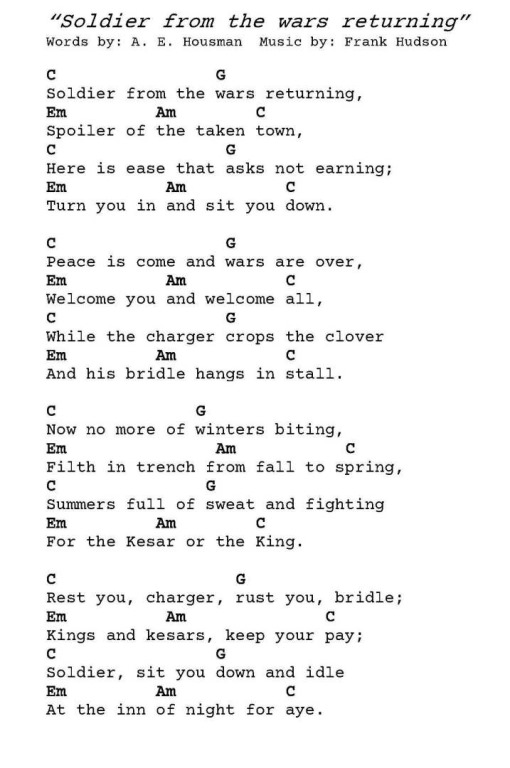
The post just before this one, Housman’s “Soldier from the wars returning”  was the first poem I wanted to do, and it’s a straightforward poem of simple gratitude for a veteran’s service. The second one is a little stranger, and I made it stranger yet. Can we be sure Robert Louis Stevenson wished his poem “The Dumb Soldier”  to be read as a whimsical piece about a child’s toy? He published it in A Child’s Garden of Verses  after all.

There were no sensitivity readers for children’s books then,* but the nature of the poem’s story is not benign. It starts right out with the poem’s speaker burying a soldier, which from the text alone we don’t know yet is a toy. When we read “leaden eyes” we might get the hint that it’s a cast metal toy soldier — but if we were to hear this poem as I performed it, without context, sung by an adult, even that detail might not tell us clearly what is going on.

I leaned into that strangeness. I trimmed a couple of stanzas for better performance length and chose to truncate the final one, leaving off the reveal that this is a toy soldier that will return to the child’s shelf. This left this a more ambiguous buried soldier then unable to tell us anything about what they’ve seen.

The Dumb Soldier

Here’s the chord sheet for my version of Stevenson’s poem. To read his original text, here’s a link.

.

Although written decades before the first Armistice Day in 1918, this mode of the silent war dead is clearly apt for that holiday as celebrated outside the U.S.**

It was late Friday night before I was ready to perform these two poems as songs. I had music written, and for practicalities sake, I was able to quickly use my studio space to record the pair of songs with just acoustic guitar for accompaniment. Neither of these are perfected or sophisticated performances, they are more or less what you’d hear if I was to present them off the cuff. You can hear my version of “The Dumb Soldier”  with an audio player below, unless you don’t see any such player. Some ways of reading this blog won’t display that, so I give you this highlighted link that will open a new tab with an audio player in those cases.

.

*”Dumb” used as a term for someone who cannot speak is now a highly impolite term. Given the sacrifice and suffering of war, that term’s objectionableness might be a lesser concern.

**Since the U.S. had an existing holiday, Memorial Day, for remembering those who died in military service, the U. S. Armistice Day became Veteran’s Day to celebrate all who served, particularly the living. Housman’s poem, couched though it may be in the particulars of WWI, speaks to that element of the holiday. As a mid-century child, I can recall Armistice Day was still used occasionally in my youth for November 11th since veterans and others who had experienced that war were numerous.

Soldier from the wars returning

I’m going to present a pair of poems which are more related to Armistice Day, the former name for the holiday now called Veteran’s Day in the U. S. Here’s the first one.

Earlier this month I was confessing to Lesley Wheeler that I haven’t read much of English poet A. E. Housman, a poet who I believe retains more readership in the UK than here in the States. Well, no matter how little I know of him, his poetry has qualities that attracts musical composers like myself.

Soldier from the wars

Here’s a chord sheet for today’s song. I recorded this with a capo on the 2nd fret, sounding in the key of D

.

This poem, which may not have had a title as I saw it with just the first line in quotes, is clearly a poem for Armistice Day and its veterans, first published a few years after the end of WWI. I don’t find it a complicated poem, but that doesn’t hurt it when one seeks to be comprehensible in an immediate performance such as I gave it. It’s hope, contemporary with Housman and his listeners when he wrote his words, that “wars are over,” now has sort of cruel quaintness, but it was an earnest statement then. Here’s a link to Housman’s words, and then below this is an audio player gadget to hear my performance of the song I made from them.

No audio player? Clicking on this highlighted link will open a new tab with its own audio player in that case.

.

All Souls’ Night, the conclusion of our Halloween Series

You may wonder if our Halloween Series has continued past Halloween — but in pedantic fact,* the calendar date referred to in this poem’s title is November 2nd. Halloween has no particular religious element for most these days in the US, but originally it was All-Saints’ Day Eve (saints=hallowed people), the day before that observation.

That Halloween was for spooky, eerie, and likely non-Christian things was kind of a “get that all out of your system before the day for all saints comes around” proposition. So, if All-Saints’ day is on November 1st, what is this next-up All Souls’ Day? It’s a day for all the dead souls who aren’t  saints — that is to say, for most of us. The ubiquitousness of the total of all those who’ve ever lived, minus those few that were saints, is a likely cause for this holiday to fall into obscurity. It’s the Participation Medal of the holy calendar.

Similarly, the author of today’s text, Hortense Flexner, is not a famous poet, though she spent her entire life working in the field of literature and education. For some reason, probably the effectiveness of the poem and its continued relevance, this single poem out of her life has survived her to be passed around the Internet and in publications as a Halloween poem.**  She subtitled it “1917” on publication, no doubt in reference to the suffering and casualties of WWI — but it’s since needed no dated subtitle. I’m risking little to suggest few read it now as a historical document of situations more than a century old.

All Souls Night

Once more I present a chord sheet so that other singers can spread the singing of this.

.

Today, to anyone her words reach in times of fresh suffering and a glass separation between those comfortable and those afflicted with new death, “All Souls’ Night”  requires no further instructions from me. I’ll just say there’s an audio player gadget to hear it below, and if you don’t see that, I supply this highlighted link that will open a new window with an audio player in it.

.

*I have family members who were Protestant ministers. I’ve had friends who had at least passing familiarity with the Catholic religious calendar — but I’m evidence in that I knew Halloween in its devout practices of costumes and candy, and vaguely its religious connection to All-Saint’s Day, but nothing at all about All Souls Day.

**Although this poem is the last in my Halloween Series this year to get a blog post, a previous post here presenting “All Souls’ Night”  has gotten steady visits throughout the past few weeks.

A Winter’s Tale: A cold mystery for Halloween

Having done over 700 audio pieces in the more than 7 years of the Parlando Project, I take pride in the variety of the original musical settings I’ve supplied for them. Oh, there are more than a few of the performances over the years that embarrass me: stuff were my problematic vocals don’t deserve parole, or arrangements where I can’t now tell how I ever thought they worked, or those where it would have been better if I’d had access to better musicians than my overdubbing, but many of them still sound good to me.

None sounds better than this one as we near the end of my Halloween Series presenting some of the listener favorites from those 700-plus pieces. “A Winter’s Tale”  sets a should-be-better known poem by D. H. Lawrence. For some of you that poem’s climate is going to seem premature — and you may even wonder why it fits a Halloween theme. I assure you in Minnesota, in the northern parts of North America, this poem is not out of season. We’ve had no snow yet, but my morning bike ride was –5 Celsius. And tomorrow? Those thin polyester costumes sold at stores for trick or treating are not right for many a Minnesota Halloween. And any creativity in making one’s own costume is suppressed by the eventual need for an overcoat which will cover it. And what of Lawrence’s poem — here’s a link to the text of the poem — what’s Halloween about it?

Winters Tale 1080

A long way between houses just for some candy.

.

Well, it’s quite mysterious. This is the third time I’ve presented it, and I’m still not sure what the specifics of the described wintery mystery are. At times it seems like a breakup or strained love poem. Other times it seems like a hunting poem, metaphorical or not. It may have some connection I’ve not fathomed to Shakespeare’s play concerned with virulent mistrust. If it’s a hunt, I can’t even say who the speaker/singer and the hunted are. One or the other may even be Winter itself. That mystery and the air of danger are enough to make it a Halloween poem, and after my musical work, a Halloween song.

You can hear it with the audio player gadget you should see below. No player to be seen? This highlighted link is a backup that will open a new window with its own audio player.

.

William Blake’s The Poison Tree

There’s much commerce between fantasy and fable — and William Blake, as literal as he may have drawn the angels of his visions, was one such trafficker. In this poem a metamorphical form of pomology creates out of anger a beautiful, attractive, and cursed fruit, so I thought this poem suitable for our Halloween Series.

One question asks for an answer in Blake’s poem: what makes the poison apple grown from wrath, fear, and tears “bright” and “shining,” and eventually so irresistible to the poem’s enemy?

Many readings concentrate on the poem’s singer, the one who instead of forgiving as he had done with a friend, grows their anger, sorrow, and fright into the Poison Tree. But let’s consider the other party, their enemy. Let’s look at the song from their view.

The emotions that grow the Poison Tree are often stronger than the more positive emotions like trust, love, and mere happiness — and the alloys of these negative emotions can be made into purer metals. Thus the human reaction, however unacknowledged, to envy the tactics of our enemies. Oh, what great evil they use, how powerful that is, how greatly we’ve been hurt by it — so, shouldn’t we be allowed at least some of the fruits of that tree? No, not all the root and trunk of that evil —for we are not like our enemies, — we are just owed a little of that power, maybe one apple?

The poison apple “shines” because it seethes with the power of hatred. It’s “bright” because the dark fruit becomes reflective the moment we reach to pick it. A convex apple is a strange mirror. We see ourselves magnified, we see our enemies too, we see wrath distorting us.

Blake’s fable in that reading says then: do not plant that poison tree from the injustice done to you, as the poem’s singer does, for the fruit will be impossible for your enemy to resist. “Oh, that’s not so bad,” you may first think, “the foe ‘is outstretched beneath the tree” as the poem ends. But beyond the poem’s ending there’s another refrain: the foes survivors have wrath, fears, and tears — and a seed poison apple for another tree.

One thing I admired about Blake was his multiple skills, out of which he created the poetry, the book design, and the artwork for his Songs of Innocence and Experience. Indie!

.

My performance of Blake’s “A Poison Tree”  is full of the sound of an American invention most often used by British bands of the late Sixties and early Seventies, the Mellotron. The Mellotron was supposed to be a home or light theater/salon entrainment device. It had tape recordings of instruments, including recorded sections of orchestral strings and woodwinds, one recording for each note to be triggered by a keyboard. When it was discovered by rock bands they found they could saturate their recordings in these orchestral textures. Because the articulations of the taped instruments were “canned” not freshly played, the result was a little ersatz — but eventually this was embraced and the output of the polite Mellotron was sometimes patched through overdriven amplifiers like an electric guitar might be. That’s part of the sound in the LYL Band performance of “The Poison Tree”  that you can hear with the audio player gadget below. No player?  This highlighted link is an alternate way to hear it, as it will open a tab with its own audio player.

.

The Listeners: a classic of mystery

Judging from the numbers of its inclusions in Internet lists of spooky poems, Walter de la Mare’s “The Listeners”  comes to mind to more than just me when people are asked to think of Halloween poems. Yet it has no monsters, no sudden scares, no wicked battles, no fully-described supernatural events.

It creates its strange effect in this strange way: it gives us lots of details which may seem inessential, and next to nothing of its central situation. The plot is simple: a man travels to a building on horseback. He knocks at the building’s door. No one answers. He leaves. As an elevator pitch summary, it has little to call us in or disturb us. Why does it leave us with a wondering chill? It’s those details. Here’s a link to the poem.

First off, there’s a supporting character in the poem which seems to have only one for sure, the Traveller. That character: his horse. We meet the horse right at the start, noticing that it is unconcerned and grazing as the Traveller opens with his door-knocking announcement of arrival.

We’re also told it’s night. Only slightly unusual, in that one generally doesn’t schedule appointments at night. The Traveller knocks again. We’re told the building has a turret. Castle or fortress, or just a decorated Victorian era house? We know by this it’s not a small hut or cabin. The listeners that are spoken of soon are something of some means.

The Listeners Illustration 1080

Our two characters: the Traveller, and the horse he rode in on. One thinks it’s very important to be there, the other couldn’t care less.

.

We’re told the Traveller has grey eyes. What an odd detail! We’re not filling out his driver’s license after all. Grey is a quite rare eye color in de la Mare’s Great Britain or Western Europe. Does the poem mean to suggest the Traveller is coming from a far distance?

Is there anyone inside the house? The poem mentions “phantom listeners” and these listeners are in the title. “Phantom” says they aren’t in the house at present in the way the Traveller and the horse are outside the door. We learn that the house has a hall, reinforcing by detail that the building isn’t small. The Traveller senses these whatevers, their “strangeness.” How are they strange? Nothing is said — but our second character, the horse, remains only interested in grazing.

The Traveller is insistent, pounding louder, shouting the intriguing line “Tell them I came…that I kept my word.” This is the plot’s climax, we don’t know what duty brought the Traveller there, perhaps from a long way off. Of course, we wonder what the bargain is, what the promise was. Is our wonder stirred by not knowing? Mine always is.

Another detail: we’re told the Traveller is “the one man left awake.” How are we to take that statement? That the “phantom listeners” are asleep and can’t be awakened? Or should we take it more catastrophically: that the “phantom listeners” aren’t human, never were, and that the Traveller is the last man at all, anywhere, awake? I never considered this latter reading until typing this tonight —perhaps I’m over-reading — but if so, is the Traveller coming to ask them to lift that spell, the only man still with agency to plead?

I love the final quatrain of this poem. Our horse returns, and the listeners, we’re told, can hear the creak of the leather from its saddle stirrup — a lovely detail, and a quieter sound compared to the pounding and shouting that has preceded it. Finally this sound: the evocation of the horseshoes ringing on hard stone inside a world of otherwise silence. The horse may be unconcerned by the silence, perhaps even the lack of any other awake people is not of any matter to it.

My music for this features the electric 12-string guitar, an instrument that I love. You can hear me perform Walter de la Mare’s “The Listeners”  with the audio player below. If you can’t see that player, no need to knock louder, use this highlighted link which will open a new tab with its own audio player. Thank you for being The Listeners for this Project!

.

Does your garden have ghosts, part 2: Hardy’s “The Shadow on the Stone”

Yesterday in our Halloween Series I mused on the appearance of ghosts in a garden with Millay’s blithe apparition. As I present today’s musical piece adapted from literary poetry, Thomas Hardy’s “The Shadow on the Stone,”  let me start by asking questions. Many others will follow.

Do you want to see a ghost? Is that wanting part of what makes it appear?

Hardy’s poem is poised in that first question. As I have performed it as a song with music that I wrote for it, I should wonder if the words are clear enough in themselves to tell us what the situation is. Looking at the text of Hardy’s poem, I think it’s mostly self-sufficient in that regard, though some mystery (possibly useful mystery) remains if nothing else is explained.

When I first presented this in 2021, I went into the biographical specifics that engendered this poem, but for today let me just say that the “she” that the ghost is supposed to be is Hardy’s dead wife who was completely estranged from him before her death.  Nothing in the poem spells that out, nothing tells us that when living she had grown to find Hardy completely unsuitable. Well nothing, save for a line that we can hear as modern idiom that Hardy may have intended only as a brief metaphor: “Her behind me throwing her shade.”

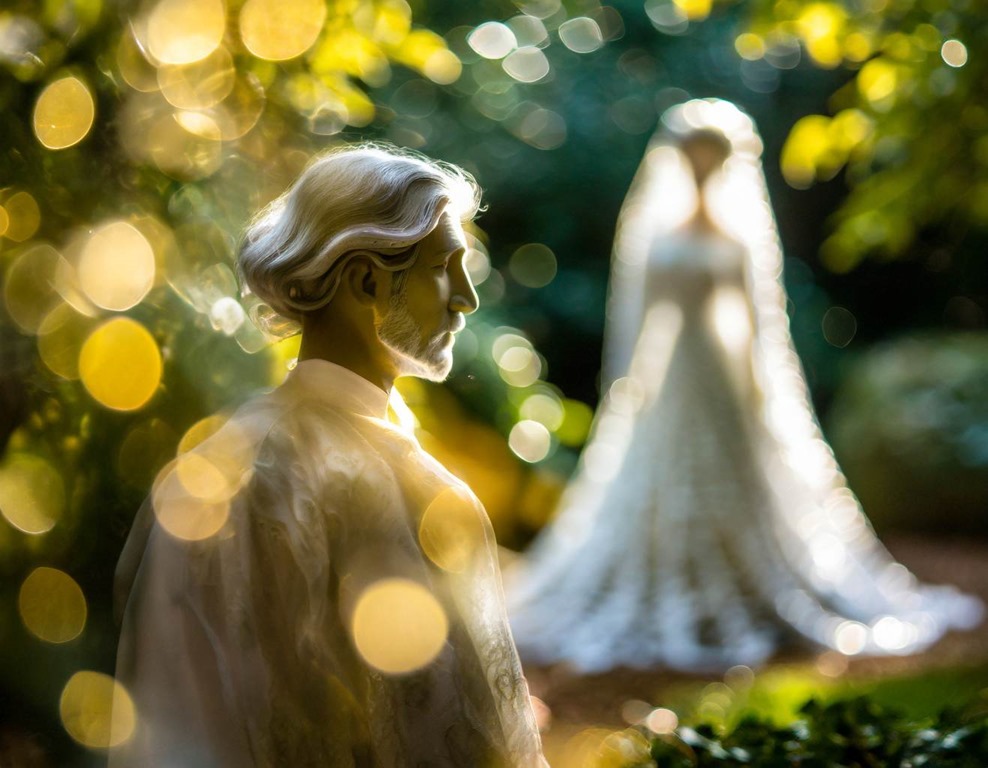
The Shadow on the Stone illustration 1024

Ghost from a machine: illustration from Adobe Firefly, the AI engine that proclaims it doesn’t use uncompensated artists work.

.

Such a complex ghost, or a wish for a ghost, this is!

Does Hardy want to see the ghost? Does Hardy fear to see the ghost? Can either of them speak? Are either of them changed from what they once were? Is he haunted by her, or haunted from her? All the answers are all the answers here. The curly shape of the question mark the shifting curve of an ghost manifesting.

Spontaneously when doing the vocals for this piece I decided to throw in some more answers at the end of my song in the form of “inline epigraphs” that Hardy didn’t include with his poem, but this performer did.

You can hear my performance of Thomas Hardy’s “The Shadow on the Stone”  with the audio player gadget below. You don’t see a player?  This highlighted link will make one appear in a new tab.

.