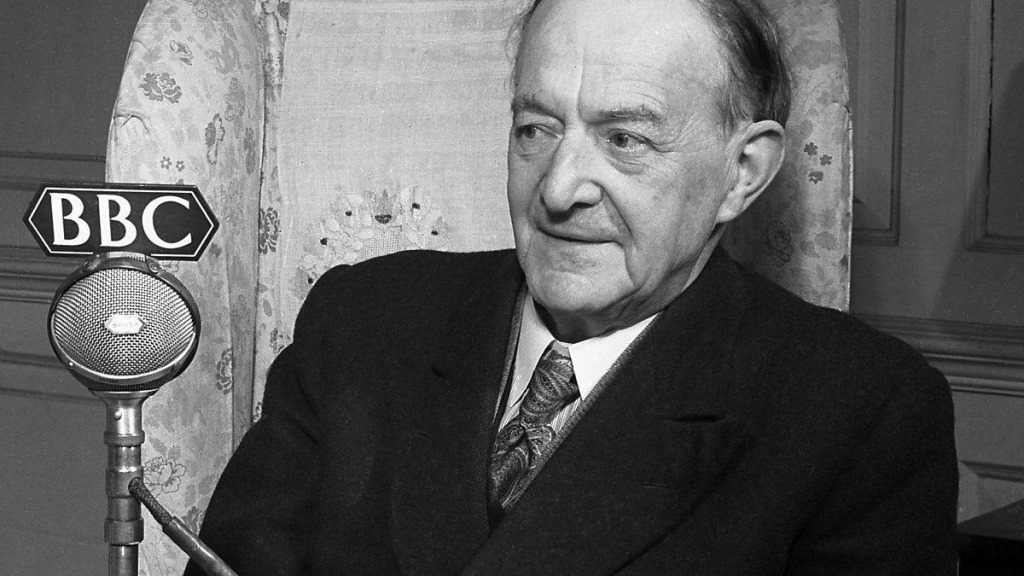
Last time in our Halloween series I reported that Edgar Allan Poe had movies made from some of his poems — well, sort of. Today’s poet Walter de la Mare’s poetry, in title and under his name, wouldn’t have served for such, because so much of what de la Mare does is understated and inferred. He’s one of those poets that when read casually seems to not be doing as much as he’s actually doing. There may be no fireworks going off when you read a de la Mare poem of the supernatural— until after reading it once and remembering the poem later, you may sense the flash-bang-backs of what’s there and evoked.
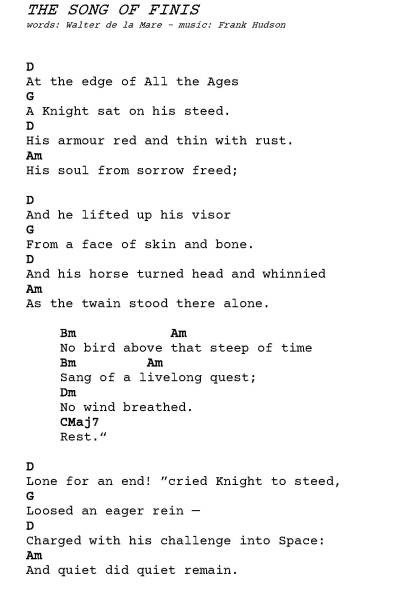
Today’s Walter de la Mare piece “The Song of Finis” is an example. It seems simple enough to be children’s poetry, and indeed his publisher bound selections of de la Mare’s more whimsical short poems to market them as children’s books. “The Song of Finis” presents an eerie short scene and situation, supplying only the barest of details still rich in specificity, and wraps it all in some fine word-music that urged me to make a song of this proclaimed song.
I present these chord sheets so that you can sing these songs yourself.
.
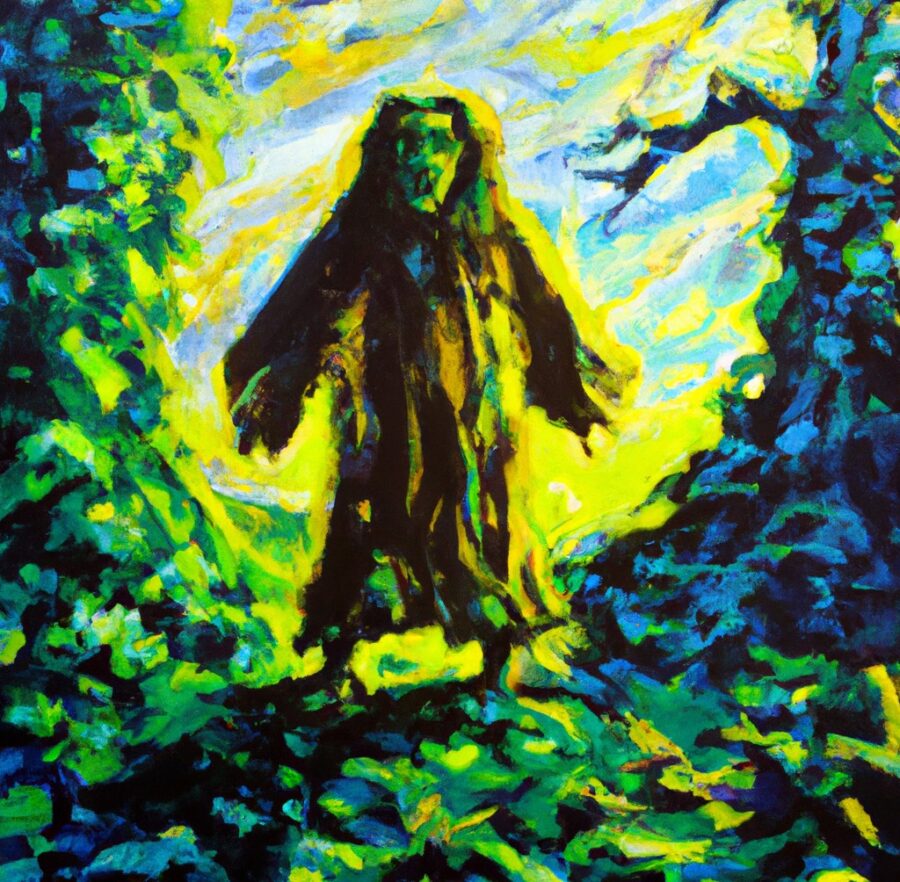
We have a knight, but one out of his time, yet still errant. The once shining armor is rusted.* When he lifts his helmet visor, we see yet “skin and bone,” a choice that lets us imagine a gaunt face suggesting the skull beneath. He’s alone somewhere warm and windless (warm enough to summon the tea-time image of steeping).
There are but two lonely sounds of dialog recorded. His horse whinnies knowing something’s up, and the knight calls out “Lone for an end!” The latter is a bit poetic-dictiony, but I’ll allow it to depict the out-of-time knight, and I suspect de la Mare wants us to hear “lone” as double-sounding for “long.”
What happens in the poem’s conclusion? Does the knight and horse charge off some cliff to end his anachronism? Or is he challenging that empty place he finds himself in with that single cry that has no answer? My thought, it’s sort of both, the song of “Finis” is about endless endings, and the desire for one last adventure.
In de la Mare’s poem there are no angels
.
You can hear my song setting of Walter de la Mare’s “The Song of Finis” with the audio player gadget below. It’s not finis is you can’t see that audio player, as I supply this highlighted link that will open a new tab with its own audio player. Not finis for me either this year, for my plans are to return soon with at least one more de la Mare fantasy piece before this Halloween charges into memory.
*As a fan of the 20th century Rock group Procul Harum, I wondered if the band’s lyricist Keith Reid read de la Mare’s poem once and remembered it in his song “Conquistador.”
Let’s continue our series of fantasy and supernatural poems with a musical performance of a poem by Edgar Allan Poe — a poet that might be expected to appear in any such series. Before we go to that poem and my performance, let me take a quick jaunt back to my mid-century youth.
Poe sat in a unusual place in literature back then (and probably still does now). His writing, including his poetry, remained in circulation. Unlike Longfellow, it wasn’t likely because it was deemed worthy lessons for young people — Poe’s writing kept its place for its gothic sensation into the 20th century. Without Poe or his sensibility, would there have been then a Vampira, EC horror comics, pedantic pulp detectives, Lovecraftian horror, a great deal of Heavy Metal lyrical content, or a post mid-life movie career for Vincent Price? And that’s not even broaching the topic of Poe’s influence on the French Symbolists, who took elements of his strange and abnormal on an emigration journey from the asylum to the academy.
For a year or so around middle school age, I went on a Poe jag, reading a great many of his stories in collections that also included his poetry. It was a short-lived enthusiasm, and I’m not sure what remains of it. Did I start there with my love for an unreliable narrator? Was the on-the-spectrum “Aha” moment attractive to me neurologically anyway before this reading? Since I can’t say, let’s get on with an example of Poe being the inevitable poet that a Halloween series calls forth when the boundary-line between the dead and the living becomes permeable.
The scenery about the ghosts in “The Haunted Palace” is something of a poetic trope. Poetry loves a ruin, and poets being the unacknowledged back-benchers in the world of political power, there’s a draw to poems about the death of kings — and so we have poets writing “Ozymandias” or “Jade Flower Palace.”
Poe though is drawn almost entirely to the sensuousness of the decay here. There’s no lesson about unwise or tyrannical rulers in the poem. There’s no tragedy — if we can even guess the kingdom’s tragic flaw it might be that it was all too beautiful.* On one hand I find the poem a hallow poem of hollowness — but intended by the author or not, that hollowness is a statement about great kingdoms and their lovely riches. And the ending’s invocation of always escaping — and therefore not escaping — unsmiling ghosts of hideous laughter completes the poem with a powerful rhetorical burst.
Take a sideways jump to the genius of SCTV
.
Perhaps because of the simple harmonic structure of my musical setting, I worked some hours unproductively this week on additional musical decoration. I made two attempts at twin bowed-string lead lines for this, and abandoned both those ruins to our mutual benefit. After that wrong turn, I decided that the piece’s feature is more its swaying, understated groove which I left to stand for its value. Mid-century ghosts visiting this music are welcome to do The Frug or The Jerk while listening, but those on any side of the Samhain borders can visit “The Haunted Palace” with the audio player gadget below. Has such a gadget disappeared within a fetid mist? Oh, no matter, you can hear it with this highlighted link then, as that will open a pale-doored new tab with its own audio player.
.
*Poe wrote that the death of beauty was the ultimate poetic theme — the gothic manifesto in short. I’d note in that an undercurrent there that many (most) artists feel: that they create all their beauties, only for them to become abandoned ruins with rare and uncommon audiences. As Frank O’Hara’s fraternal twin brother Count Floyd said: Pretty scary, huh, boys and girls!
As our Halloween series continues, let me advocate today for an element of the fantastical: the goblin. Some fantasy creatures are, by definition, not fully alive: your vampires, zombies, golem, all animated undead meat; your ghosts “spirited” in some way, but incorporeal. The goblin, like all the variations in the fairy realm, seems akin to the human, but not in the beautified, glammed-up way that many fairies are depicted; and also, like the human, goblins seem subject to motivations and whims, not driven by some designed in need.
Puca is a goblin name of uncertain etymology, and specifics of their appearance and nature are like the word’s origin, broad-ranging. That non-specific appearance is baked into many accounts: they are shapeshifters. Some accounts link them to taking on animal forms: rabbits, red-eyed horses, and so on.* Today’s puca is related in a poem by Irish poet Joseph Campbell.** While Campbell is attuned to shapeshifters, his puca doesn’t change species or form in his poem: he starts and remains a hairy creature of the forest, human-enough to mirror human behavior, which becomes the signal incident in the poem.
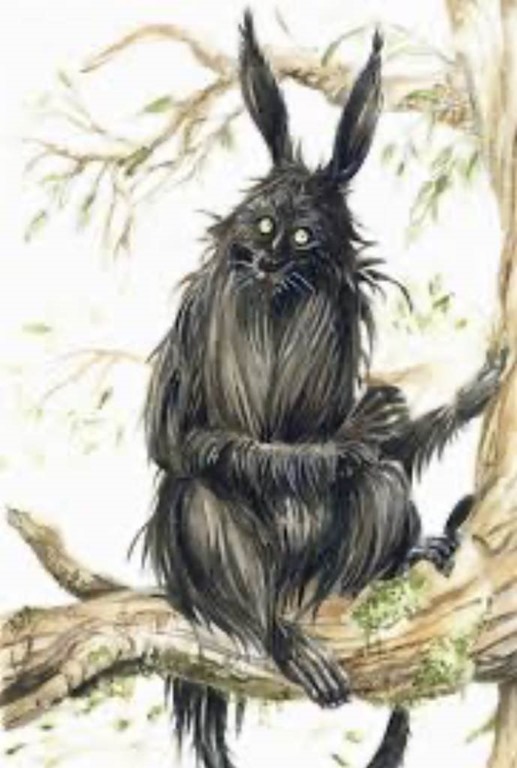
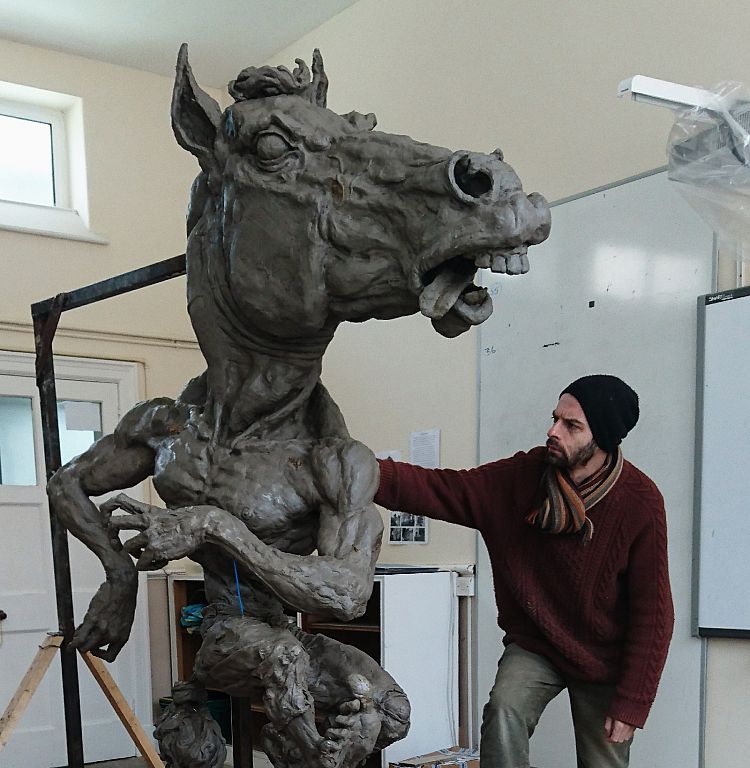
Shapes of pucas. I don’t know the artists for the two on the sides, but the sculptor in the middle is Aidian Harte and his mid-transformation depiction caused a commotion in the Irish town it was to be displayed in.
.
If goblins are unpredictable, portrayed as helpful and troublesome, this puca does in a way transform. In my reading of the poem, I sensed it describes something of a turn-about: rather than a human encountering a magical creature and then by elfin spell or trickery the human is changed, Campbell describes the opposite: a shy creature emerges, is observed laughing, dancing, poetry on his lips. And then a stanza later, his mood is sad, distressed, bitter. What causes this change?
The poem doesn’t say, but another creature, the poem’s voice is observing the puca. Let us assume he’s human, even that he may be the poet himself. The unhappy puca is said to have become “the double of distress.” Does “double” just mean equal to the happiness of the second stanza? Or does it mean the puca has taken on, mirrored, the human who has revealed that he envies the puca’s “sunny mood” in the happy verse before?
The poem ends by telling us this human/goblin encounter has caused the puca to retreat back into its cave, hiding itself. The puca may have been enchanted by the human’s sadness, and thus fled from the human’s thrall.
Unsaid in the poem, but I’ll ask: is the human changed by this encounter? While the puca instinctively flees the dissatisfied human, it’s the poet that’s telling us this story, and I think they’ve concisely explained that their bitterness has an effect, causing the happy fantastic to leave. Did the poet learn something from this?
I’ll add this biographic note on the author: Campbell’s involvement with the Irish Civil War that followed independence broke him. He was imprisoned, faced at least some danger of execution — and once released, he fled the Ireland whose culture had fed his art. His literary efforts tailed off sharply and the “gall and bitterness” that the puca demonstrates was Campbell’s lot in the last part of his life.
But this is a poem of Campbell’s early career, first published in 1913. Mute on the page, it set out a spell for me to set it to music. I think “The Puca” shows one of Campbell’s strengths: concision. A great many literary balladeers want to write epics. While I admire those that can vivify a 10-minute ballad in performance, I also observe that that endurance is beyond me — and Campbell, fresh from rubbing shoulders with the concise Imagists, has packed a charged moment in time into four stanzas — and if my reading is valid, more is evoked in the incident described than might be explicated in extra verses.
I tried for the eerie in the music I composed and recorded here: a certain wildness in the keyboard line’s contour and oddness in their timbre. You can hear my performance with the graphical audio player below. What? Such player has crept away into a cave or twilight glen? This highlighted link is an alternative, as it will open a new tab with its own audio player.
.
*Articles on the puca I read this month relate this creature to the Easter Bunny and the invisible friend in Harvey, generally benign creatures — but then, the red-eyed horse is said to offer rides home to the inebriated, the acceptance of which will lead to a wild, bucking, bramble-scratched ride, ending with the rider being bucked off in a field far from home. Unmentioned in the pieces I read would be the animated cartoon character of Bugs Bunny, the gender-fluid trickster that I’d see as in this tradition too.
**Obligatory footnote every time I bring Joseph Campbell up — no, not the Power of Myth guy. This Campbell is a deserving-of-more-interest writer of the turn of the century Irish cultural revival. Like many others of his generation, he was caught up in the Irish independence struggle, used Celtic folklore material, and dabbled in writing for performance (plays and song-lyrics) — but he was also connected with the Imagists and early English language poetic Modernism that emerged in London before WWI.
Is today’s piece the Parlando Project’s surrender to the Internet’s pervasive cat fancies? No, this is a very serious piece of cultural distribution — and it’s Halloween fans, that grave and gothic lot, that we’re serving with content this month.
I do fresh translations into English as part of this Project semi-regularly. Translations bring benefits, important ones that would fulfill that serious…cultural claim. Since poetry exists in nearly every society* no matter the language spoken, translation allows us to casually absorb more outlooks as readers. And as proud as English speakers can be about the home-team’s innings in verse, a great many poets have taken tactics, forms, and inspiration from writers that wrote in other languages. Adding to the corpus of translations then, is a service to readers and poets.
A couple of the poets I’ve translated here have almost nothing available online in English, a few more, little. Rilke, who wrote today’s piece in German is not such a case. He’s a favorite poet of many English-speaking readers, and has had many well-known translations. But even so, adding another Rilke translation is like adding another human perception of a piece of his writing. All translation comes with a viewpoint and a path taken by the translator to the point of translation. My viewpoint is not particularly learned. I’m not an expert in German literature, and I don’t speak German beyond a few phrases. While I happen to like my approach to writing or performing poetry (most poets get little love for their verse other than self-love, so we’d better have that regard to do the work) that’s about all I bring in qualifications to translating.
My translation approach is primarily image-centered. I want to try to absorb what the poet is seeing, and feeling and transfer that portrayal of sensation into contemporary English. I usually don’t try to convey the parallel sensation of the poems word-music in its original language, but I will give some weight to a sequence of the images as they convey the poem’s argument, the thing I call “the music of thought.” I do like there to be some English word-music in the end result, but as with my original poetry in English the images shouldn’t suffer much just to make some formal lock-step.
Which brings me to the other benefit of translating, the reason I recommend translation to every poet, to every creative-writing class: translating forces you to consider choices made by the original poet intimately, and to make subsequent English-language choices that are not dictated at origin by your desire to tell your life-story or outlook. This separation allows you to practice, in separation, the craft of poetry.**
I took on Rilke’s “Black Cat” because it seems like an apt Halloween poem — after all, it does start out with the cat being described as an apparition of mysterious supernatural powers.*** As I dug into the poem there was one mystery I didn’t solve: how much is Rilke joking with us? Is this cat a dark vision, a domestic cosmic black hole with a gravity that absorbs light? A real Rilke scholar might have a learned opinion on this, but I am not that person. The Rilke poems I know, and famous Letters to a Young Poet essays seem utterly serious — I’d say almost to a fault as weighed by my own tastes. There’s a certain kind of Rilke fan, like a certain kind of Robert Bly fan, that makes me wary of the seriousness with which they take their precepts and scriptures.
The Internet was designed so that scientists, the military, and government could exchange ideas. And cat pictures like this one I found there. Well, the cat pictures came later, but I’m sure it was in the design. Now, who’s my dark little existential vision of non-being that meets my gaze…
.
But as I translate Rilke I occasionally find images that seem to fall into slapstick. Did Rilke intend this, or is that my own path, my outlook, reflecting off the surfaces of poems? Seriousness is indispensable to slapstick after all. My favorite part of this poem is when the frustrated viewer of the black cat resorts to enraged stomping about. Last time we had a poem about the pathos of black & grey ghosts seeming to manifest in a dark house. Is this dark cat a solemn symbol of ever-so-serious human-condition dread — or an excuse to burlesque the frustration of life we cannot fully control, things we cannot perceive clearly, yet are stuck trying to figure out anyway?
This is what I came up with for today’s performance
.
It may not be what we’d wish, but as Rilke gets to his last line, I smile. We try to see in the darkness, we might try to command capricious cats, but in the end we’ll all be extinct as prehistoric insects captured in amber crystals — but at least by translating Rilke (or other poets) we can see our gaze in their gaze.
To hear my spoken word performance of my fresh translation of Rilke’s “Black Cat” you can use the audio player below. What, has a black cat crossed your screen and obscured any such audio player gadget? This highlighted link will open a new tab with its own audio player.
.
*Do historians and anthropologists know of any documented society that didn’t have a form of poetry? I’m neither — but I don’t know of one. If so, this seems a strange fact in the face of poetry’s peripheral place in modern American culture. Is poetry just an archaic skill, like how to make a stone knife or knowing which fungi are safe or sacred to eat?
**Current online language translators (Google’s seems particularly good) are generally adequate at giving you an English-language gloss to start with. For key words conveying images in a poem, online foreign language dictionaries can drill down into further insight. The translator’s job isn’t just turning some decoder ring though: the job is to find effective English language poetry to hold the poem you’re translating.
***Admitting my lack of portfolio to do so, there’s a third reason to do my own translations: I want to avoid — even for my “absolutely-no-profit” Project — taking other writer’s work that isn’t free for reuse. Rilke’s work is in the public domain in the U.S. — but this isn’t true of most English translations of it.
It’s been a busy week at the Parlando Project studio as I record more Halloween-themed songs freshly made by combining other people’s words (usually literary poetry in the public domain) with original music in differing styles. Let us go to the lab and see what’s on the slab.
Last dark-and-stormy-night-time we had a poem that started with someone at a household’s door asking to be let in. Waif or wraith? Therein lies that tale. Today we again have a piece that starts at a doorway — but the tale-teller here lets themselves in. What do they find there? Well, that’s the song.
The words I used today originated with a poem by early 20th century American writer Margaret Widdemer. While Widdemer is little remembered now, she was a successful presence in the literature of her day. And while the Parlando Project does the everlasting Greatest Hits of Poetry sometimes, I also like digging through old poetry collections and anthologies looking for overlooked poems and poets. Such “many a quaint and curious volume of forgotten lore” reading let me find Widdemer, and one thing that drew me to her was that she seemed to have absorbed some stuff from the folk-music collectors of her time — for example, this eerie poem of hers that builds on the “Lyke Wake Dirge”presented here six years ago.
One thing that folk-music tradition teaches us: the singer is free to change and adapt the song that was handed down to them. Entirely new words or new music may be applied. Verse order, much less exact wording is not sacrosanct. Instead, a good fit for the singer and the audience (these being the folk in folk-music) is the guiding force. Most composers who work in the Art-Song form are compelled to keep the text unaltered, and while I’m not of that tradition, I most often present the poet’s words as they published them for the silent page. But, for today’s piece I substantially altered Widdemer’s poem to make what I hope is a more effective song.
I started with a simple change: I created a refrain based on the initial verse of Widdemer’s original text when I found it ineffective for audience grabbing. In other revisions and additions, I sought to sharpen the “build” of the story’s details, and I excised antique words and diction that added no charm.
Musically I recorded a late-night laid-back Rock combo of two electric guitars, electric piano, bass, and drums for my resulting song. Here’s the chord sheet in case you’d like to play your own rendition. That’s also the in the folk-music tradition: the song shouldn’t belong to only one voice.
To hear the way I played and sang it you can use the audio player below. What? Has no audio player gadget materialized on your screen? This highlighted link will open a new tab with its own audio player then.
I plan to be back soon with an entirely different, more orchestral ensemble for the next piece in our 2024 Halloween series. Should I act like a YouTubber or Substack author and urge you to subscribe for this upcoming content?*
No, I’ll leave you as a free agent on that decision. This Project goes beyond non-profit — it is by design no-profit. I just love diverse music and poetry and get a kick out of exploring what’s possible. I have nothing to sell and would avoid anything that is paid by the click, because I have no makeup to be a small-businessman.** But my self-regard (or desire to promote a range of poetry) likes seeing viewers and listeners. Sharing this stuff on social media, or just telling a friend, will help keep this going.
.
*The Parlando Project started as a short-form podcast, one sans the usual blather, paid-for-promotions, and between-host jocularity — presenting instead our typically 2-5 minute musical pieces unadorned. It turns out that podcast audiences prefer one-to-two hours of gab — but if you want a break between the talkers in your podcast app, you can still subscribe to the Parlando Project on Apple Podcasts or most other popular ways to get podcasts.
I don’t believe I misunderstand those who appreciate the typical podcast format. I sometimes listen to podcasts while cleaning or fixing something with my hands. Alas, as a person who spends much of their time reading, composing, playing, recording, and mixing music, my own ears are usually occupied, and so I lack time to partake.
**I admire small-business people in general — and yes, I appreciate how hard it is for musicians, composers, and writers to make even a meagre living these days. While I work at this Project like someone with a small-business enterprise, I’m just not suited to bookkeeping, form-filling, and tax-law lane-keeping.
I’m starting a Halloween series again this year, so musical pieces using public domain poems that have fantasy or supernatural elements are something I’ve been gathering, and this one popped up in a couple of lists. It’s by Mary Elizabeth Coleridge, an English early 20th century poet I did not know.
Yes, she’s distantly related to Samuel Taylor Coleridge, the “Kubla Khan” and “Ancient Mariner” guy, but this poem reminds me (in a good way) of Christina Rossetti. Here’s a link to the text of her poem “The Witch.”
My search for Halloween material and reading those early 20th century children’s poetry anthologies for this year’s National Poetry Month shows that supernatural creatures were a cultural thing in this era, and were presented in a range of contexts from folk-tale weirdness, to gothic, to pleasant guises. I’m hesitant to say without enough scholarship, but unlike ghosts or fairy folk and the like, witches were almost always depicted as evil.*
Here’s an excuse for me to trot out my favorite construct, the how-old was-X-thing-when-this-was-written calculation. Witch trials and witch executions were around 200 years past when “The Witch” was written, perhaps long enough to be considered expired history to be toyed with for literary uses, but the general roots and results of that deadly hysteria lingered. Fear of the outsider, the strange one, their unknown and supposed beliefs and motivations never left the world. I can see it in current disgusting news stories recycling old libels.
If Halloween is a holiday that has broadened its scope from an origin of remembering the dead and their spirits into a celebration of the things we fear as much as death — and to the spice of experiencing those fears in a transitory way — then this poem is an example we might want to interrogate.
The plot of “The Witch” is simple enough,** but Coleridge does a great job of structuring the tale. The first two of the poem’s three stanzas are a vivid present-tense monolog from what sounds like a refugee or wanderer who’s outside someone’s homesite door begging to come in from the cold. The outside voice describes herself as “a maiden still.” An interesting claim — what with the “still” — and my imagination as I read this says that she is claiming this because she doesn’t necessarily look like a young woman.
The poem’s final stanza is swift and concisely indirect in a way that pleases me. The viewpoint changes to someone else, the home’s resident on the inside of the door recounting (now in past-tense) what happens. The outsider is invited, indeed carried, in past the threshold, there’s a movement intensified by a repeating “she came,” and the poem’s standout enjambment ends a line with “the quivering flame” continuing on the next line’s “sunk and died in the fire.” It doesn’t say this, but my imagination filled this line break with the outsider changing shape into something less solid and smothering the home’s hearth-fire. The poem ends with the inside-the-home’s voice telling us the fire can now not be relit. This conclusion is ambiguous. It might be that the outsider has killed the home’s resident who would have tended the fire, just as it has killed the fire. Or it might be (and I prefer this option) that the insider is doomed to be as cold and lost as the outsider was in the poem’s opening, and now is cast in the same curse. This is a well-told tale, so easily set to music — I couldn’t resist letting it over my threshold.
But as I worked on it, it wasn’t the supernatural element that was giving me chills. Is this the wrong poem to make into song in my time and place when fear of the outsider is being whipped up for purposes? Is this poem a parable supporting that?
Yes and no — but I’m going with the no. To me, it’s also a story about deceit, those lies that we invite inside ourselves, which is why I fell to and promote the reading that in the end the insider becomes the same creature as the outsider: cold, in despair, now likely self-serving and lying to be invited in though the door.
Documentary oil-painting evidence that all witches are not dogmatically against fire.
.
I don’t know if I’ll find any good witches to sing about this month, but I do plan, in whatever Halloween series I can complete, to examine our fears and the why and where they take us.
You can hear my song performance of Mary Coleridge’s “The Witch” with the audio player below. Is your way of reading this ghosting that audio player gadget? This highlighted link is a spell to open a new tab with its own audio player.
.
*Well, L. Frank Baum’s Oz has a good witch, but even there Margaret Hamilton and her flying monkeys are what’s tattooed on our dreams. Modern NeoPagans and so forth wish to rehabilitate the idea of witchcraft as empowerment with a sideboard of herbal remedies.
**The premise of a supernatural pretense to gain invited entrance to a warm homestead reminds me of a fantasy verse play and excerpted poem by Yeats. Yeats wasn’t necessarily anti-magical beings — after all, he had his own sideline as an esoteric mage. Robert Frost directed Yeats trickster-fairy play for student actors, and later wrote this gently satiric “answer poem” to Yeats’ work. In Frost’s poem the wizard powers of New England skepticism is cast to defeat supernatural treachery.
Someone on social media this week suggested this conversational opener: “Remember when talking about the weather was just small talk?”
I was thinking about this as I worked to finish today’s musical piece that I’d started a week ago. Since then, American news has been filled with accounts of one major hurricane’s aftermath and the approach of another one. The kind of fun I have meshing poetry with a variety of music I compose and realize is hard to set beside disasters of this scope. I think: here I am privileged to explore unusual connections when other citizens are dealing with hardship and immense losses. In the end I saw the Dickinson poem speaking to those differing situations, and I’ll finish by talking about making this musical piece and the style of its playing which also lets two strong differences coexist.
“The Wind Began to Rock” presents as a narrative, with well observed descriptions of the storm’s arrival and then deluge, but Dickinson chooses the odd conclusion. You can read the text of her poem here. We don’t get a tale of devastation. We don’t get the following suffering. We’ve had the fury — and then what? The incongruity of that ending — if it isn’t a mistake, what is it? I think we should be convinced of Dickinson’s genius enough to make our default assumption it’s written with intent. I’m already risking insensitivity, could I add humor to this and say that with the anti-climactic ending of the narrative arc here, I could have appended a subtitle “Started early, took my shaggy dog.”
I’ll just briefly note that Dickinson could be writing from experience. During the 1861 hurricane season, her hometown of Amherst got the inland tail-end of two storms. But I’ll note another metaphoric storm too at the same time: America’s Civil War. That this huge storm occurs, and the Dickinson household damage reported at the end is only “quartering a tree” may be her point. Some are losing more, up to their lives. The question of enslavement’s onerous human property and the continued existence of the nation that her father served in the Congress of are at risk.
Even the seemingly inconsequential summary of “quartering a tree” is an odd choice that bears consideration. Is this a reference to the particularly cruel execution practice of “drawing and quartering?”
The storm has not made her house divided and not standing, but the tree may say her privileged situation has a crucifix of more complete suffering in view. Questions may arise to us, if we are privileged to not be in the direct path of hurricanes or oppression, looking out on our own storm season and the drifting path to an election this Autumn. All those thoughts arose after I’d completed the recording of today’s musical piece. My earlier performance was innocent of them, but let me present the music anyway.
As I mentioned last time, Emily Dickinson’s wide-ranging poetic spirit had possessed me with this charge: “I wanna rock!” I have no idea how rocking Dickinson’s own parlor-piano music-making was, but her poetry often indicates to me a mood of loud slyness that could front a rock band.
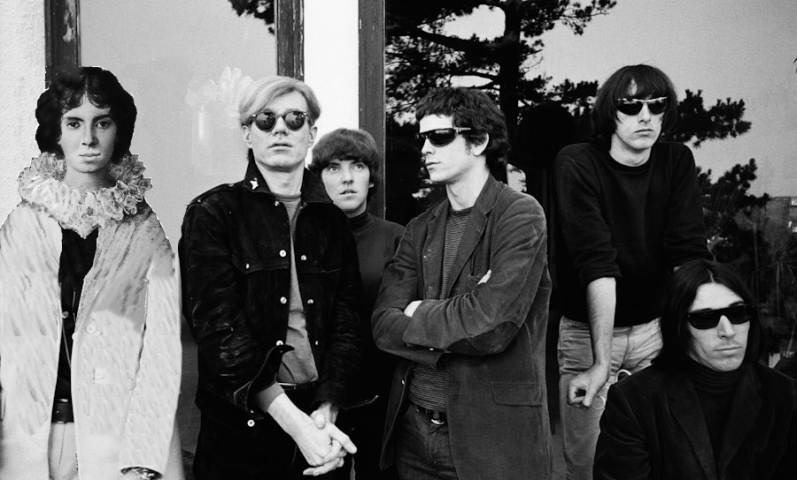
Rock music famously doesn’t require a lot of compositional undergirding, and the harmonic framework of the music here was minimal: two chords (B and A), their roots a full-step apart. Yet, it really doesn’t correspond with typical chordal cadences in Blues or Rock — it’s a tactic I associate with the Velvet Underground, a smart people in a rock band collective whose formative association once traded under the name “The Primitives.”
Today’s musical piece doesn’t sound much like this band, but “All Tomorrow’s Hurricanes” was a cut on the first Velvet Underground and Emily Dickinson album. Andy Warhol’s cover had a picture of a peelable ghost flower.
.
As much as I was working with piano, bowed strings, and acoustic guitar lately, I was itching to get back to loud electric guitar — but my situation in this era of my life makes two poles of music making more difficult to schedule. My quiet stuff has to be recorded when outside noise won’t scrape and bark into sensitive microphones, and the loud Rock that asks for interaction between the electric guitars and amplifiers pushing rude airwaves into a room risks disturbing others. Sometimes the situation, that I can’t whisper in an otherwise silent room, only makes me want to turn up the electric guitars all the more.
As you’ll hear if you venture to the audio player below, I was able to turn the guitar amps up for this, though I had a limited window to shatter.
The kind of guitar playing that steps out to the lead in the ensemble today is a style I worked with quite a bit back at the turn of the century. Like the chord progression, it’s not Rock-band-conventional. The framework is two lead guitars each free to explore melodic lines without strictly alternating (e.g. obligatory “call and response,” “trading fours,” or the like) or playing pre-composed harmonic intervals between their melody notes. It’s still Rock-music-like in that the two lead instruments reference the Rock beat, but this kind of simultaneous, spontaneous lead playing happens only rarely in the Rock genre. You can hear something like it in some folk musics, in early Jazz, and much later in Free Jazz — but for all its “let’s make a racket” ethos, Rock music generally avoids this.
Anyway, if you want to listen to this as it’s intended to be heard, don’t use ear buds or quiet levels. Use a set of stereo speakers and turn up the volume level. You can dance if you want to.
Audio player washed out on your way to reading this? This highlighted link is an alternative that will open a new tab with its own audio player.
I thought I was done with my Emily Dickinson series. I had started to think of what poets would be next, and….
Emily came back. Not the mystical psychedelic Dickinson. Not the weird indie-folk Dickinson. Oh, still mysterious, still a trickster — but she asked not for unusual harmonies or strange timbres this time. She wanted to Rock!
Well, if you’ve been in a mode lately of working with acoustic guitar, and you want to transition to Rock, then there’s no better way to start than Blues. I grabbed my bottleneck slide and my resonator guitar* and it was time to get down with some rough ‘n’ ready Delta Blues — at least the way I play them.
I didn’t learn how to play slide from some Papa Legba at the crossroads, nor by grizzled tutelage from an in-the-tradition player. I was an Iowa teenager when a white college kid from Minnesota pulled out a severed wine bottle top from his jean-jacket pocket and proceeded to show the results of the guitar lessons he’d had in Minneapolis.** I recall his technique was not pristine, but the sound including the incidental noises of the slide grinding into the strings and occasionally slapping onto the fretboard entranced me.*** Five years later I finally decided to try to figure out how to play guitar, by myself, living in a little rented travel trailer, and unable to afford any lessons.
We know Emily Dickinson played piano. Did she have lessons her family could have afforded her? Did a family member teach her? I don’t know if we know what kind of music she played, but it may have been hymns and popular parlor pieces that were sold as sheet music. Did the Celtic immigrants in Amherst leak any of their music to her? Was Black American music in her ken, and if so what variety? All mysteries, but it’s unlikely she had any idea of Blues music, because as best as can be determined, it didn’t exist yet. Sometime around the time her poetic writing was tailing off, it seems that Black Americans began mixing the musics they heard around them in North America with the music that survived the slave ships, and lullabies, and work-a-day chants of work-gangs or field laborers. Most were newly freed from enslavement. Commercial entertainment was a newly opened field for them as musicians and as audiences. In this new situation they had a new story to tell.
Extracted as musicological theory, Blues can be expressed in a lot of ways, but my appreciation says it’s an attitude as much or more than a scale, timbre, or harmonic framework. What attitude? The Blues isn’t “the Blues” as Western European derived Americans knew it. It’s not melancholia or simply depression. It’s not elevated Romantic despair. Sad, bad, and difficult things happen in a Blues song, but that’s not the main point: the main points are that the singer is still here, can tell you about it, and has maybe figured out something about what has led to this situation that they’ll share with you.
So, here’s what Emily Dickinson did that was Blues-like. Like the Blues, Dickinson is going to use humor and incongruity to describe her experience. If death is a fact of human existence, she’s going to write its Yelp review telling you about it. She’s going to tell her tales using coded language at times, so as to not rile up those who think she shouldn’t have the thoughts she has — and besides, coded language gives one the paradoxical freedom to choose the strongest, sharpest words.
Now the poem I took today is from late in Dickinson’s life, and it’s more puzzling than many of her often puzzling poems. “Nature can do no more” strikes me as an Autumn poem. Here’s all it is, as she wrote it down:
Nature can do no more
She has fulfilled her Dyes
Whatever Flower fail to come
Of other Summer days
Her crescent reimburse
If other Summers be
Nature’s imposing negative
Nulls opportunity —
Dickinson’s “Nature can do no more” in manuscript. Above the poem she wrote: No dreaming can compare with reality, for reality itself is a dream from which but a portion of mankind have yet worked and part of us in a not familiar Peninsula.“
This poem expresses itself strangely. “Fulfilled her Dyes?” Floral blooming colors? Autumn leaves? Punning “dies?” The transcribers think she scribed “crescent” but it might be “descent” — but what’s accounts receivable here? “Negative Nulls opportunity?” As the Pythagorean math-lyricist Billy Preston put it “Nothing from nothing leaves nothing.” Or it just clearing the field for new growth? I saw a short presentation on Dickinson poetry this week where the presenter compared Dickinson to Joyce’s tangled Modernist word-play mode. This poem would be an exhibit for that.
But this struck me as Blues-like too. You see, following up on my mid-century, Upper Mississippi white-blues-kid introduction to this old acoustic Blues style, I wanted to hear more of this music performed by its originators, and you did that listening to LPs re-recorded off of worn, made-cheap, second-hand-store shellac 78s, cut fast in any handy room with a single approximated microphone. It’s a powerful sound, but it’s not a pristine and clear sound. And the singers, even if I was in the room — maybe because I was in the room, a white guy like almost all the recordists — aren’t always going to speak out. They’re asking to be heard by other Afro-American listeners perhaps, so their patois and accents aren’t lightened or toned down.
To this day, after years of listening, after much more study of Afro-American history and language, after generations of audio restoration advancements, there aren’t 100% agreed upon transcriptions of lyrics sung and said on all those early 20th century records (and their meaningful context) — “crescent” or “descent” isn’t the half of it.
I might have performed Dickinson’s exact words for this piece, but I wanted them to fit into a common Blues music form, and so I was already prepared to modify them. I decided to make words that were more my extrapolation of what I feel she might be saying as she views the null of winter coming on with the knowledge of the cyclical phase of the seasons meaning another summer follows. I tried to mumble the words a bit as I sang them to give it the air of those old slide-guitar Blues records. Here’s what I sang:
Nature can do no more, she has fulfilled her Dyes
Flowers that failed to bloom left for other summer days
The crescent moon decrees, other Summers yet to be
Colors’ slow cremation — nulls for opportunity
Yes, there’s a spoken aside in the middle of the song. I’m not printing that, because the spirit of the old 78s says you have to try to figure it out. You can hear my performance of this “after a poem by Emily Dickinson” song with the audio player you should see below. No player seen? You don’t have to jump the Katy looking for it, you can use this highlighted link that will open a new tab with its own audio player.
.
*The, neck and the body’s outline shape is like a regular acoustic guitar, but the top and interior are replaced with a 10-inch metal speaker cone. This cone is driven to vibrate by the bridge holding the guitar’s strings producing a louder piercing tone that has a directness and can’t-ignore-it volume that Blues players liked.
**The kid’s name was Don Williams, an all-to-common name. If he’s still alive he’d be in his 70s. I’d love to meet him again if only to tell him that for all his pretentions and mine he imprinted my approach to the guitar.
***This is not how everyone plays slide guitar, even Blues slide. Precise touch and technique can produce music with tight intonation that avoids all these artifacts. I just like hearing those artifacts. I love recording piano with key or pedal noise or even a bit of a squeaking bench too.
****I often fear I’m too long-winded when a feeling starts me up. But I’m nothing like what recordings like Geeshie Wiley’s can do to folks whom the muse has touched. Here’s two of them (warning: long form writing) Daphne A. Brooks. John Jeremiah Sullivan.
This Emily Dickinson poem tracks like many others of hers: a vivid set of images, so unexpected in its choices and details finished with a gnomic conclusion that puzzles as well as tantalizes. Last time we had her famous “My Life had stood — a Loaded Gun.” Today’s lesser-known poem is just as weaponized. I find it as strong as “Loaded Gun” — Dickinson, powerful enough as a writer to bring the proverbial knife to a gun fight. Here’s a link to the poem “She dealt her pretty words like Blades” in case you’d like to follow along.
I maintained last time that in “Loaded Gun” Dickinson created a tragic character out of an inanimate object. Today she’s describing some other personage who uses “words like blades.” I didn’t think she was the gun in the last poem, only its playwright. Is the blade-wielder here Dickinson? I can’t say for sure. Is she “othering” herself to examine something she does with her verse? Poets will do this, but at first I was unconvinced. Dickinson has elements of satire and calling out foolishness in her poetry, sure, but I’ve never seen her as the kind of devastating wit that boldly impales the subjects and pins them to the bloody page. Did she think she could do that, or that some thin-skinned reader thought she did that? Possible, but we must consider the theory is that she may be writing of another writer.
Who? I don’t know. Our knife-wielder is gendered female, and in Dickinson’s 19th century circle that doesn’t leave us with many candidates. The woman-poets we know she read: Elizabeth Barrett Browning, Emily Brontë, or her classmate Helen Hunt Jackson don’t immediately jump out, saber in hand. Of the three, Brontë with her Gondal fantasy world poems is the strongest “could be” here. If we stretch it, I could add to the suspect line-up the “terrible swift sword” Julia Ward Howe of “Battle Hymn of the Republic” fame. These are all wild guesses, so let’s leave that off, posit it doesn’t really matter to the poem, and return to read it again.
Rereading the poem, I began to sense less of a swashbuckler and more of a butcher’s tale here. Aha! Now we see something that I can associate with Dickinson’s life. In the household domestic tasks the two Dickinson daughters had to carry out, Emily took to the cooking and the gardening from all accounts. Did she butcher meat, or prepare cooking cuts from carcasses? The wantoned, without concern for the former life of the meat, carving to the bone is in that work. She does say the blade is being used on “Creatures” in her images too. If we want to return and take this poem’s “she” as Emily Dickinson, then here we may have the dissecting poet* we read in her work metaphorically describing something of her process!
This striking image shows an installation by artist Kim Simonsson at the American Swedish Institute some years ago.
.
I can’t give you a clear reading of the poems final four lines either, I only see the images, not where they are to lead us. Pain, human pain, is indeed not polite. The film upon the eye is the dead eye on the carcass. What though is the locking up in the last line? That we abstract (lock out) ourselves from the former living creature now the meat? Did she butcher for cold storage in a meat locker? These biographic details — again, perhaps beside the point. In experiencing the poem, those things are dispensable. Is this a household butcher or a fearless ninja-writer? She wants the effect of both for the listener, and perhaps Dickinson is happy that the final part’s summary is just as mysterious as a blade-wielder leaping out from her packet of poems.
I’m always amenable to mystery in the music I present here. Here I used my 12-string acoustic guitar and a viola with the undercurrent of the South Asian tanpura beneath them. What’s the tanpura doing there with these occidental instruments? Oh, it just mysteriously appeared, drawn to the drone of the lowest strings on the guitar You can hear my performance of “She dealt her pretty words like Blades” with the audio player gadget below. No player to be seen? Maybe one will appear like that tanpura within a new tab called up by this highlighted link.
.
*It quite possible that she dissected animals as part of her schooling. Another biographic theory.
Is there a name for a poetic form made of two quatrains? Emily Dickinson wrote a good number of these 8-liners — brief, but a bit longer than one-stanza forms such as the haiku or the cinquain. One advantage of short forms is that they are easy to hold in memory, allowing them to be shaped and revised while one’s hands are busy with other daily tasks. We know Dickinson sometimes jotted down short pieces on household paper scraps, but maybe even those had earlier drafts before she could grab a pencil.
What can she put in such a container?
This one implies a short narrative. Someone (we’ll just say Dickinson for simplicity’s sake) is waiting at her house for something to arrive. She’s ready to tie on her bonnet (her outdoor hat) and on the waited arrival she’ll be going outside her home. In the second quatrain she says she’s awaiting “his…step.” The something is revealed as a male someone. Where are they going? Dickinson writes of a “journey to the Day.” Is this an odd way to say she expects a day-long journey? Perhaps, but she did capitalize “Day” as if it’s a particular concept rather than a 24-hour interval, and the poem ends with mention of a similarly capitalized “Dark.” Dickinson was fond of circular intervals standing for a lifetime, with a day’s sunset or nightfall standing for death. I suspect that’s what she’s getting at here.
I was captured by this poem, given my musical interests, by its citing of singing in each stanza. Examined carefully, the first line says something distinctive. “I sing to use the Waiting.” What a striking statement to a musician — or to music’s sister art poetry and poets. Life is time, that’s its waiting. What counts its meter and shapes the air in-between? I think of composer Frank Zappa’s quote “Without music to decorate it, time is just a bunch of boring production deadlines or dates by which bills must be paid.” Poets and musicians sing to use that waiting.
In the ending sentence Dickinson says both she and the awaited are singing to “Keep the Dark away.” Does music — does poetry — hold off, or prevent, death? Well, it may not be that death=dark exactly. Dark may be the unknowable aspect of death, the frightening nature of the threshold we cannot see beyond.
A thought occurred to me as I was living with this poem over the past couple of days: it would seem to pair well with — as a prequel of sorts — to one of Emily Dickinson’s most famous poems: “Because I could not stop for Death.” In “I sing to use the Waiting” she’s awaiting that other poem’s he, Death, to bring around a carriage for her. If that’s so, we might expect that on the ensuing carriage ride the two, Death and Emily, are singing as they ride past the playground and the cemetery toward eternity.
I’m OK with all the night-time transparent carriage traffic, but I wish they’d stop singing so loud. Still from The Phantom Carriage (1921)
.
I had immediate ideas for the musical sounds for today’s Dickinson poem setting, which helped me get a rapid start of the process of composing and tracking it. I was aiming for mysterious, but when I went to mix the various tracks it began to sound odder than I had thought it would be. I explored different options at that point, but in the end I decided there was no going back from strange. I should more often remind listeners here that I go exploring a lot of different musical ideas, so don’t take any one piece you hear here as representative of what you might hear in the next piece, or the one after that.
You can hear my musical performance of Dickinson’s “I sing to use the Waiting” with the audio player gadget below. Awaiting a gadget that never shows up? This highlighted link is an alternative.