Frost Warnings: an appreciation of the poetry of Phillip Dacey

I mentioned earlier this month that my late wife took creative writing classes with poet Phillip Dacey in the mid-1970s. Later, through her, I met Phil and was able to talk to him a bit about poetry. Phil was generous about this, and I’ve never forgotten that.

It’s always hard to accurately, objectively, analyze where one is in in their writing craft. I knew I was only partway in craft, but I self-judged myself as better than average in the imagination aspect. Looking back at that young man I was then, I’d re-set my judgement now to say I was even less far along in craft than I thought, but I still think my imagination was as good or better than many. Those models that I looked to back then: Blake, Keats, Sandburg, Stevens, and the Surrealists were good enough for starters.

Of course, old men can be wrong when looking at themselves too – presently or retrospectively. I’ve come to consider self-judgment as so unreliable that I treat it as a traveler’s tale: something to listen to, but with a duty of skepticism. If I get time, I might extend this informal series engendered by finding old 1970’s manuscripts packed away in boxes with a few of my youthful poems. If I do, I’ll try to make it worthwhile for you rather than self-indulgence.

This Project takes author’s rights into strong consideration, and you may notice that we almost always perform works in the Public Domain.* As the Parlando Project was starting I learned that Phil Dacey had died. I hadn’t seen him in over a decade at that point, but I contacted his website on hearing the news, and got permission from one of his sons to perform a couple of his poems here. This autumn, while in a dusty boxes clean-out, I came upon a letter from Phil to my late wife dated November 1977, and within the handwritten letter was a typed copy of a poem of his about this time of year.**  I felt I had to perform it for you. Phil’s personal site is no more, and I retain no contact info for the family, but this not just a non-profit – non-revenue – Project would propose that the promotional/educational aspect far outweighs any abrogation of the rights holders. If one wants to seek out and read any of Phillip Dacey’s poetry collections, you’d be following my recommendation. I don’t know if today’s poem made it into a collection (I only have some of Dacey’s many books), but you will find poems like this in them.

This picture of Dacey is from the poetryfoundation.org site. There are some other poems of his linked to a short bio there.

.

The subject matter of Dacey’s poetry when I met him was spread out between memories of his childhood in St. Louis (a city that punches above its weight in modern American poetry), a Roman Catholic upbringing, erotic desire and its complications, and family and marriage. He came into a long-term teaching gig at a rural Minnesota college, and stayed in the state during his retirement; and as a result, the setting for many of his poems is distinctly Midwestern. In my early posts here where I wrote about Phil’s poetry, I stressed the humor in it and the unusually engaging way he presented his work to audiences. Both of those things might endear him to listeners and readers, but I fear they might blind the completely earnest (or the envious) to other strengths in his poetry.***  I don’t know how he taught the craft professorially, but he models for young writers a subtle kind of poetry, and the piece I perform today is an example of that strength.

“Frost Warnings”  begins – and with only casual attention might remain – an occasional poem about the present point in an Upper Midwest autumn. Afternoons remain warm, yet the hours before dawn drop lower and lower until they eventually sink below 0 degrees Centigrade – frost and freezing time for plants. Food gardeners must make their household harvests, flower gardeners, preserve their late bloomers. The poem’s bed sheets with rips and out-worn baby blankets start as reportorial items in a task to stave off frost-burn, but are, if we think again, stealthy deep images of desire and parenthood, the kisses from which we make mankind as Éluard had it our last post.

Then a third of the way in we meet the bedding again, cast as shabby Halloween ghosts. Dacey’s unshowy poetic compression of the worn-life of young parents “too much revelry and worry” is masterful, but might you overlook it on first reading? The modesty of how Dacey uses his craft pleases me – and then he playfully indulges himself by breaking into Wallace-Stevens-voice for the word-a-day-calendar delight of writing down the ridiculous sounding “tatterdemalion.”

On the page it’s also easy to miss the use of rhyme and near-rhyme in this poem: that “revelry” with “worry,” “find” and “vine,” and the comic “jalopy” and “credulity.” Finally, the poem sticks the ending with a rhyme: “Fall” and “mortal.” For at least a while, I think Dacey was associated with “New Formalism” in poetry. “Frost Warnings”  is Formalism unfettered.

I wish I’d spent more time on the music I made for this one. It’s been a busy week or so for me, getting vaccinations, some banking business, attending a large gathering against cruel and capricious authoritarianism, getting my own “garden” of bicycles and composing/recording equipment ready for the upcoming winter. As a result, the music I performed with Phil Dacey’s poem is quite short, and is just a trio. I wanted to add a melody instrument, and strip back or deemphasize the piano part for a guitar, or even a horn or wind instrument part, but that would delay things, and I have a half-a-dozen other pieces in WIP state that also want completion.

Phil was a great performer of his own work. He’d have done a great job presenting this, so I tried to use my memories of him to guide me. I attempted to memorize the poem for the performance (Phil often did poetry readings without “reading”) and I hope I brought out some of the elements in my recording that a quick reader of the page poem might miss. So, it’s done, and you can hear Phillip Dacey’s “Frost Warnings”  with the audio player below. Worried that someone’s taken the audio player away and spread it over last roses in the garden? Don’t wilt, I’ll provide this alternative: a highlighted link that will open a new tab with its own audio player.

.

*Yes, I have bent the rules a few times – and as the Project was beginning, I thought I’d get permission to use more recent poems by sending simple requests, only to find that would too often require prodigious effort and persistence.

**Here my late wife and Dacey were operating like 19th century Emily Dickinson and Thomas Wentworth Higginson well into the 1970s. By the end of the 20th century it’d be emails, and by now, social media or chat software. My dusty boxes and my late wife’s metal box held things for near 50 years, but who knows at what interval current inter-author correspondence-in-effect goes all Library of Alexandria.

***Often humor has a shorter shelf-life and lower canonical trajectory in literature. Using humor, or other approaches which seem to attract a wider audience, can attract a distrust of “mere entertainment.” The argument here, to be fair to detractors, is that such an audience is shallower even if broader, and that “fan-service” audience-pleasers keep an artist from growing and dealing with difficult subjects. My personal belief? Those most difficult subjects are absurd, incongruous, impossible mysteries and dichotomies to solve, and that humor can portray them as well as any other mode.

Phil read a few times with musical backing, as I present him today. One performance I attended was with his sons’ alt-rock band. His “readings,” even if acapella, could have performance elements. He’d weave well-told stories into the poems in such a way that you didn’t always know when the poem had started and explanatory introductory material had ended. He sometimes sang lines when he quoted a song inside a poem. Again, let me concede this sort of thing can be cloying. I’ve heard poetry readers down-rated for an “AmDram (amateur drama) style of presentation, and the “You are hereby sentenced to attend my one-man-show” jokes are easy to make – and that’s sometimes justified. My summary? This can be done badly. Just about all ways of presenting poetry can be done badly.  I thought Phil did it well. Other than talent and attention to his craft (including presentation) one reason it may have worked for Phil was the modest and subtle nature of his poetry that awaited and welcomed being presented more expressively than on the silent page. Still, and unlike some performance-oriented poets, Dacey’s poetry does stand up on the silent page – I just have had the pleasure of seeing it in that other framing.

Shadwell Stair

Halloween is a chance for us to note our fears.

I first wrote “celebrate” in that sentence, but revised it to ”note,” with musical pun intended.* I don’t think we actually celebrate fear on Halloween, but rather we play with it: pretend we don’t have it, pretend we can sport with it — though perhaps some connoisseurs roll the sense of it around on their tongue to absorb fear’s full body and taste. But in any of those ways, however obliquely, we are acknowledging it.

How close are we to our fears the rest of the year? I suppose that varies. Can we name them? Do we bother? Do our friends, our intimates, know them? Do we even speak of them to ourselves?

Today’s piece is based on a hard to explain poem by one of the most loved British “War Poets” who wrote of their experience of WWI, Wilfred Owen. Certainly that war’s trench warfare, mixing squalid contemplation and carnage, would offer enough horror to write about, and Owen’s WWI poetry is loved while not flinching from that horror or buffering it in patriotic bunting.

But then there’s this poem. It is not set on the front lines. If it mentions the war at all, it must be implied from knowing his biography.

Shadwell Stair is on the banks of the Thames River in urban London. In Owen’s early 20th century it was apparently a noisy, smelly industrial area. This blog post has numerous pictures, some history of the Stair, and the delicious trivia that it’s next to “Labour in Vain Street.”

As treasured as Owen’s bleak poetry is, Shadwell Stair  isn’t one of his best-known “Greatest Hits.” Its effective condensed portrait of the locale isn’t the most-read poem of that time and place in metaphor, being eclipsed by “The Waste Land’s”  bankside sections written by an American, T. S. Eliot. Those portions of Eliot’s poem are alienated, partly by the recent Great War, and partly by his own sense of an educated visitor weighing England’s and Europe’s history and culture against the grimy realities of the London he had settled in. Eliot’s “The Waste Land”  doesn’t actually name the fears in the center of it, but it conveys them in vivid and varied silhouettes. Arguably, Owen’s poem is more coy — if only by being brief — but let me make a case for it. Here’s a link to the text of Owen’s poem.

The first stanza introduces lovely word-music that the poem carries on throughout. It claims to be in the voice of a ghost. We may (I did) anticipate a classic Halloween poem. If we know Owen’s biography, we might think the slaughter-house there is a reference to the war. It may be, but I think the second stanza gives us a different context.

It’s a fleshy context. I can almost feel the goosebumps on the skin, and the speaker’s eyes are lit up in what? Fear? Anticipation? Heightened vigilance? If this be a ghost, it’s an embodied one.

The third stanza is almost all scene-setting, lit by snapping arc lamps evoked between interrupting night noises — those streetlights had a sensual, buzzing, almost reptilian sound that younger readers now may not have had the experience to hear. Of our mysterious speaker, it only says of themselves here that they are watching. OK, watching for what?

Later readers have given an understanding to the mystery here: Owen’s sexuality had a homoerotic element. In this reading, the speaker (presumably Owen) is cruising for a hookup, and it’s said that the disreputable docks and titular Stair were known sites to London’s homosexual demimonde. As with the harsh arc-lights, this context illuminates the poem. I see vividness in this reading, and no reason not to give it credence. Let’s consider then the situation evoked: here is a man, likely on leave from the immense horror of a war that was grinding men up with ineffective tactics in the face of modern lethality. Many Halloween readers here with holiday ease to play with fears would likely have no gauge to measure that — but what has his flesh firming, his skin puckered with cold plucked-chicken skin, his pupils dilated out round as the gems of Rilke’s absorbing cat from last time? Answer: the anticipation of sensual, carnal, sexual contact — intensified by a fear of police trolling for arrests, complicated in the doubts of attraction or rejection with disgust that strangers meeting in the night would encounter.

If so, the enigma of this poem has a specific — if unspoken — core, and the last stanza is an aubade of something even more transitory than the average parting of lovers at dawn. We started being told this is a ghost poem, and the ghost here meets another ghost. The ghosts here are metaphor for spirits that could barely speak of the eros of their lives. A silencing louder than bombs.

shadwell stair MS1

Here’s Owen’s poem in work-in-progress form, He seems struggling most with the 3rd stanza yet at this point.

.

Today’s music had two challenges for me. The setting I devised might benefit from a “real singer,” someone who could carry a melody with confidence and a beautiful timbre. I’m not that. I decided I could do no better than I can do. And then too, while I was pleased at what I could come up with feeding parts into my orchestra instrument arranger, and particularly with the high trumpet part that comes in near the end, I was never satisfied that I could get the best trumpet Virtual Instrument I own to have the correct envelope I wanted. There I just surrendered. No one with a “no-revenue” independent musical enterprise could expect to be able to present the full richness of the actual instrument. Those who can, will know I fell short — but the rest will, I hope, accept my approximation. You can hear my musical setting of Wilfred Owen’s “Shadwell Stair” with the audio player gadget below. Not even a ghost of such a player visible?  This highlighted link is an alternate way which will open a new tab with its own audio player.

.

*”Note…fears?” See that final paragraph today.

Stars: Robert Frost and The Book Of Nature

Robert Frost. Long-time readers/listeners here will know I love to sing Frost’s early poems as part of this Project. We’ll get back to Frost, but another thing long-timers here know: for me, roundabout is the best mental journey — and there will be a piece of music at the end as we rest from our walk.

Ok, let’s stroll.

It’s a famous midcentury half-hour black & white TV episode. So famous that you don’t have to have seen it to know the recognition scene near the end of its story that has become a modern myth that SF and Fantasy fans like to point out their stories aspire to. Given that, I’m going to assume no one will need a spoiler alert for this 1962 Twilight Zone episode called “To Serve Man.”

The format’s so brief, the story must be told rapidly. We’re told that a race of other-planetary beings have landed on Earth. With retrospectable irony, their leader is described as “Christopher Columbus from another galaxy.” They go about setting things here in benign order with advanced technology. They leave behind a book in their language that seems to be a guide to the extraterrestrials’ efforts. Partway in, Earth’s code-breakers have deciphered the book’s title: To Serve Man.  And they seem to be doing just that: ending hunger, gently enforcing world peace, taking selected humans on spaceship rides to their home planet.

Many of you are now speaking — telepathically or aloud — to a device’s screen what is urgently delivered to the story’s human hero once the humans can decrypt more of the book than just the title: “It’s a cookbook!”

I’ve written here often about something I call The Book of Nature. Though not an exclusive American idea, I connect it with the 19th century American “New Thought” movement called Transcendentalism. The Transcendentalists believed that a true scripture of the universe’s higher power was transcribed in nature. By contemplating nature big to small one could discern the highest truths. Our contemporaries who are “spiritual but not (sectarian) religious” may hold to this as a core belief, but it’s likely that every denomination of religious belief can incorporate this too — after all, if The Creator made this, their authorship means there is plausibly something there to be read.

Now we can get back to Robert Frost. Frost no doubt knew Transcendentalist thought, but unlike his fellow great American poet, Emily Dickinson, Frost didn’t hold with its doctrines.*  Yes, Frost wrote seemingly “En plein air” about nature often. His early poems, some of the ones I like best, are suffused with the landscape and particulars of New England nature. Did he see a supreme being’s handwriting there?

If so, Frost would be critical of The SB’s penmanship.

stars

Chord sheet so that you can sing this one yourself.

.

If we look at this example, “Stars”  from Frost’s first book of poems, A Boy’s Will,  what do we “read” from nature’s book? The stars come out at night. What is their nature?** “Countless(ly),” we can’t even get the basic stats correct. Oh wait, Frost can see a primary Roman goddess in there: Minerva, the goddess of wisdom and strategy. No, he reconsiders: it’s a statue of Minerva he sees in the stars, a human-made simulacrum — and her marble eyes are the form of sight organs without any such function. So should we look lower down at our earthly landscape?***  Snow covers it profoundly, drifting “as tall as trees” and so obscuring even the ground-level facts. Wind is blowing — the choreographer of this landscape — yet, this dance doesn’t tell a story, it obscures it, though here at last Frost reads a message. That wind, that obscuring snow, is “our fate.” In the most mysterious part of the poem, the second stanza, we cannot see where we’ve walked or where to guide our steps. The gothic part of my nature reads Frost’s “place of rest invisible at dawn” as death. I read the image in this stanza that in such deep and overblown snow, one cannot even see the walk fate will not reveal to a farmhouse graveyard.

Nature acts “with neither love nor hate.” Robert Frost has decrypted The Book of Nature — and all the pages are blank.

Here’s that song at the end of our mental walk where I set Frost’s poem to music with acoustic guitar. You can hear it with the audio player gadget below, or with this backup highlighted link if that gadget is not shown.

.

*Frost’s friend and fellow poet Edward Thomas was an exquisite nature poet of his British Isles countryside. In regards The Book of Nature, he’s between Frost and Dickinson for he has a horticulturalist’s specific eye like Dickinson — and his consistent naming of natural details and seeing them as readable symbols indicates he finds them plausibly capable of guidance.

** Astrologers, Biblical Magi, and classical constellation dots-connectors of course are reading that sky in clear text.

***In a changeup meant to fool this writer and singer, my specific winter this year has been oddly empty of any expected Northland winter symbolism. We’ve had next to no snow, only a week or so of bitter sub-zero cold, and I look out today on a sunny brown yard over which squirrels are carelessly playing tag and tree as we rise to our predicted afternoon high of (in Minnesota! In January!) of 55 degrees F.

I’ve been riding my summer bicycle with its summer tires most every day this “winter,” where that bike normally stays hung up high in the back of my shed. Spring in Minnesota is famously snowy, my winter bike with studded knobby tires cannot be put out of the way. Perhaps as long as I leave it by the door we may continue to have a mild winter.

Free to Fall

Allow me to be more internal than I usually am when presenting these pieces. Today’s piece uses my own words (we do that rarely here) and it’s here today for a peculiar reason — and peculiar is something I enjoy indulging in.

Early this autumn I was looking for a musical piece that represented the season, and I recalled this poem of mine that I had written music for. When? I probably wrote the poem early this century, and from a file I found, I was able to determine I wrote the music in 2007. Sometime after writing the music, I recorded what I recall was a pretty good version of it, likely with Dave Moore playing keys.

“Maybe I made this one of the early Parlando Project pieces” I thought. At the beginning of this Project as I was figuring out how to compose and record our combinations of original music with literary poetry, I had used several recordings of that vintage. Having some already completed pieces gave me time to get a handle on other tasks while getting this thing going.

But, what, I didn’t know? Well, I’ve put up over 700 publicly accessible pieces in this Project’s lifetime since 2016 — and that doesn’t count the ones that just didn’t work or didn’t fit the concept. One might like to think I keep my eye on every sparrow — but with that amount of catalog, it’s not fully accessible in my head. So, I looked. Here. For my own work.

Nope. I hadn’t presented it. It might not have made the cut because I wrote the words, and the Parlando Project is about other people’s words. Where else might it be? I looked in my somewhat disorganized collection of sessions and finished non-public pieces. Nope, not found there either.

My solution then was to re-record it. Recording time has been hard to come by lately, but I remembered this poem-which-became-song as being effective, so I tried to have it ready when I could open my microphone and record.

The piece is called “Free To Fall.”  As I wrote at the start of this inward story, I said I remembered it as being an interesting variation on the poetic perennial of autumn. In the first verse I already hit the falling leaves motif (can that one be escaped?) and I think the “every tree grows tall” was me referencing the British folk song “The Trees They Do Grow High.”   I continued to try to bring some longstanding tropes into this brief song: my own restatement of François Villon’s “Mais où sont les neiges d’antan*” starts off the second verse. I think the lines “Old men carry winters/in which the children play” are my own, but like my memory of where I put this song’s older recording, who knows if I just don’t recall some inspiration or reference.

The third verse’s reversion to summer memories and grief may be influenced by what I consider to be one of the great autumn songs, one found in every fakebook: Joseph Kosma/Jacques Prévert/Johnny Mercer’s “Autumn Leaves.**”  That song too begins with falling leaves, but references a summer lover now gone. Having lost my late wife in August might have made sure I made that step back in memory in the song.

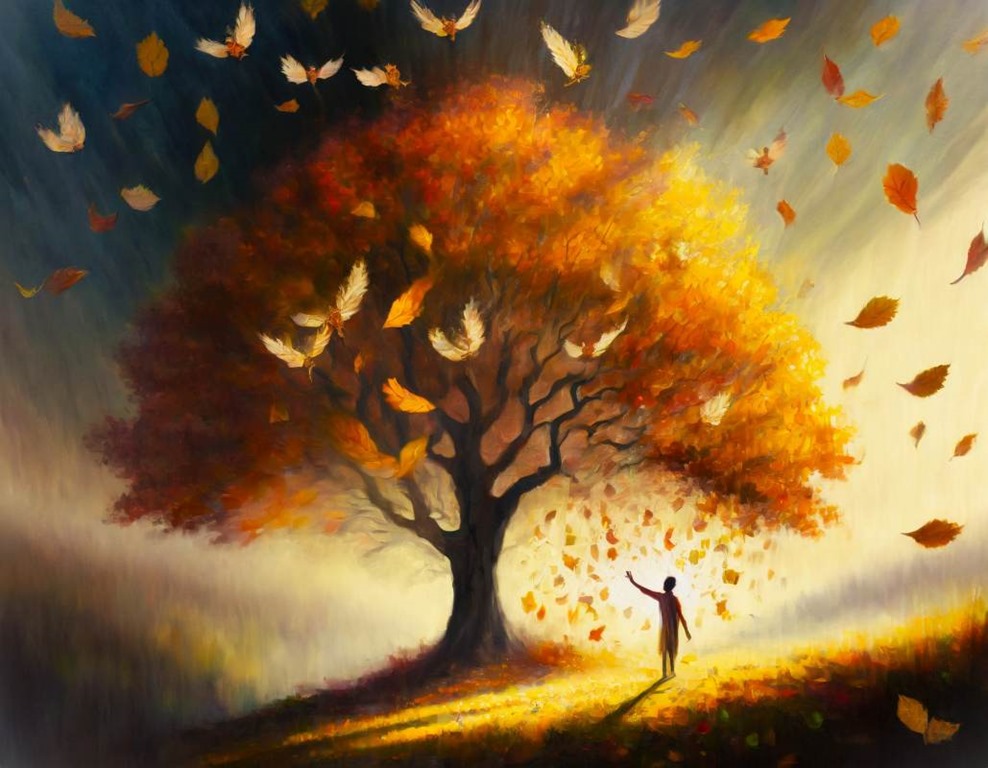
Free to Fall Illustration 800

“Everything is free to fall”

.

The originality of this compressed catalog of autumn thought comes in the refrained pair of lines “I grew up believing/everything was free to fall.” What was my intent there? I’m not sure if I’m articulate enough to do as brief a job as the poet me did in writing the poem. Yes, I knew many readers/listeners would think of things like free will and predestination, shibboleths of theology — but in the lines’ first statement I wanted the connotation that autumn’s falling leaves are freed from their work in photosynthesis and now can flutter and drift. The fourth verse refrain may (or may not) put this in a different context. Is this a compressed statement of “free will,” the doctrine that humankind has the choice of choosing good or evil, which also carries a connected thought that this is what makes good, good, not just an inherent trait? I was likely aware of that when I wrote it, but in performing it this fall I took another plausible memory: that there are those who believe in an afterlife, or a rising or rebirth of the souls of the dead, but that the song’s singer believes that however temporary or final autumn’s dying off is, that there’s a freeing element in it, like that leaf that has been loosed at the start. That’s a bittersweet freedom I wanted to convey.

Free to Fall

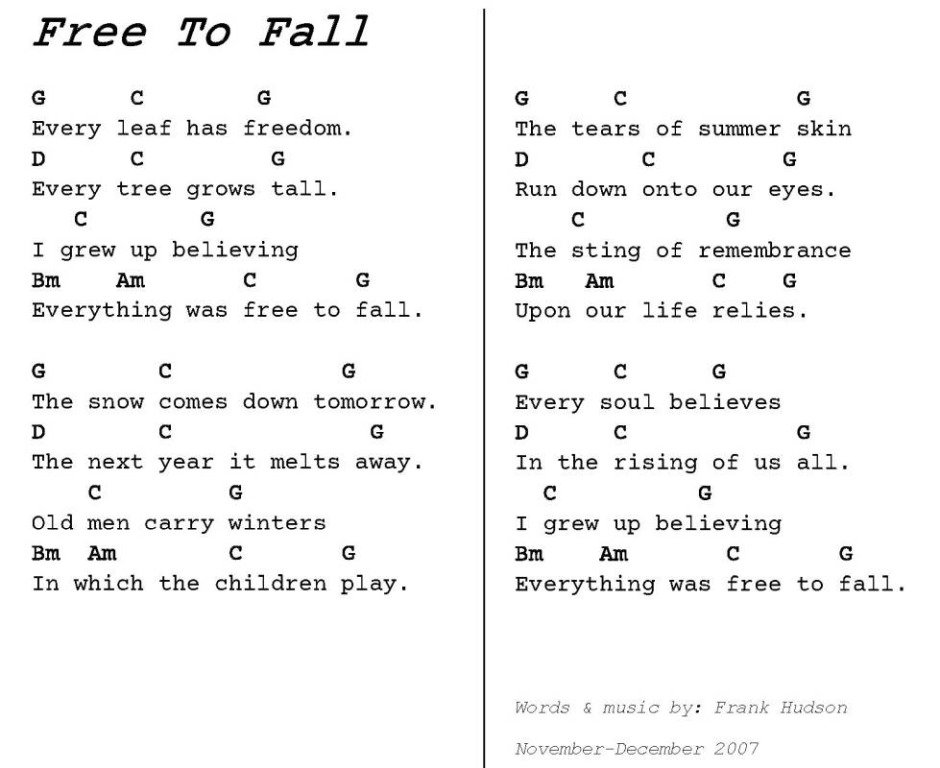
Here’s a chord sheet so that other singers can extend or improve my performance

.

This poem/song works for me. Maybe it has some worth to you. In summary, the way I think it works is from the ability of compressed verse and song to collect things in a small memorable chunk of words, a portable experience. I’m glad I remembered this 16-year-old song and that I was able to record a new version to share with you. You can hear it with the audio player gadget below if you see that. No gadget? Some ways of viewing this blog won’t show them, but this highlighted link will open a new tab with its own audio player.

.

*“Where are the snows of yesteryear” is the concluding line of his “Ballade des dames du temps jadis”  published in 1533. Yup, those snows are definitely gone.

**One of the abandoned Parlando Project songs you won’t hear came from my idea to do a fresh translation of Surrealist-associated poet/lyricist Prévert’s French “Autumn Leaves” lyrics. I got a hold of those lyrics in French, and found that Johnny Mercer’s English lyrics are a freer, looser sort of translation. Prévert’s lyric is longer and more miserable, while Mercer’s cuts right to the nub of the situation without wasted elaboration. I found there was nothing I could do with Prévert’s French that would even approach the recasting that Mercer had already done.

Southern Exposure, more Waring Cuney

Last time here, as we examined the young “Harlem Renaissance” writers who created the 1926 issue of Fire!!, we met one of its lesser-known contributors, Waring Cuney. Today I present an example of something that Cuney did later in his career. But let’s start by going backwards. Cuney was contributing to Fire!!  around the time he had won a poetry contest prize as a 19-year-old, but he was originally intending to become a musician. His Wikipedia entry says he changed his mind because he thought he had a poor singing voice.

Already you can see why I, with my inconstant voice and a project that uses the subtitle “The Place Where Music and Words Meet,” might take a liking to him. His family’s music and civil-rights connection may be deep and as strange as America could offer. While I can’t confirm this as I write today, he appears to have been the grandson or other descendant of Norris Wright Cuney (Waring’s father was named Norris Wright Cuney II) who was an important figure in Reconstruction era Texas politics and therefore also related to Norris’ daughter Maude Cuney Hare. Even a glance at the Wikipedia summaries for Norris Wright Cuney and Maude Cuney Hare might tell you how rich and fascinating American Black History can be.*

So, what strangeness made Cuney consider poetry? Here’s the story I found: one day Cuney was riding on a bus reading a newspaper when he saw in it a picture of another young black man his age who had just published a book of poetry. He looked up, and there was that same guy, riding on the same bus, Langston Hughes. The two became friends.

If Hughes’ poetry was early in concerning itself with Black musical expression, Cuney was alongside him with that same inclination. Later on, Hughes would occasionally read his poetry with jazz accompaniment. Cuney went Hughes one better, collaborating with Josh White on a remarkable dawn-of-WWII record of Blues songs about racial injustice called, like the lyric I perform today, “Southern Exposure.”

Southern Exposure album cover

The 1941 record where Cuney’s lyric was first performed

.

This song lyric is nothing fancy, but it’s a compressed portrait of the forces that led large numbers of southern Afro-Americans to move North. What moved them? In short: industrial or domestic/pink color work seemed preferable to the feudal system of southern agriculture enforced with outright de jure racial segregation and restrictions. I could step back a bit and say that like Joseph Campbell’s highly compressed portrait of Irish rural poverty and emigration, “Southern Exposure’s”  small cabinet of modest imagery is in the service of describing big things.

I didn’t use Josh White’s music or arrangement for my musical performance of Cuney’s “Southern Exposure,”  preferring to rig up my own. I’m singing with acoustic guitar, the adopted Blues instrument White used, but about halfway in the rustic guitar is joined by a cello, a concert-hall instrument. You can hear my rendering of “Southern Exposure”  with a graphic player if you see that, or with this backup highlighted link that will open a new tab with a music player.

.

*When I read the current controversies being utilized for political leverage regarding American Black History, may I introduce one point that I think gets missed as folks try to maximize white fears about this subject. Yes, horrible things occurred — and they weren’t accidents or fate, they were inflicted with intention. But strange and brave things occurred too. I’d argue that studying evils inflicted with intention is a vital subject for humanity — but also that the second, however bittersweet at times, is marvelous and intensely interesting.

“Sweet Thames” from Eliot’s “The Waste Land” for National Poetry Month

Today we’re going to commemorate something we did to celebrate National Poetry Month during the earlier years of this Project. In a series of posts and performances each April over five years we serially presented the entire “The Waste Land”  here.

Eliot’s Modernist masterpiece famously begins “April is the cruelest month…” — a line that is endlessly quoted during NPM and otherwise to make it as famous a line of poetry as any. Yet the extraordinary collage of words that follows may have frustrated or just turned-off as many poetry readers as it has attracted. To counter that, as I presented this poem over the years, I tried to make these points about it:

  • It’s abundantly musical. It’s possible to enjoy it while understanding little about what it’s trying to mean, as if it were a cousin of “Jabberwocky.”
  • For such a complex and multi-layered poem, it makes more sense more quickly spoken than on the page. “He do the police in different voices” was the working title for it. Vocalizing the various characters was assumed in its vision.
  • It’s a poem written by a depressive about their experience of depression. That might sound like a recipe for needless wallowing. Yet “Depressing English Majors is Like Shooting Fish in a Barrel” is not  a suitable blurb for “The Waste Land.”   It ends in uplift and a rage against self-pity.
  • Generalizing wildly: English poets sing melancholy songs, American ones sing the Blues. The Blues is analytical about sadness, tells sorrow it knows its game. Eliot, the America-to-England emigree, is somewhere in the middle, and then he draws on Buddha the bluesman.
  • The poem has a thread that examines sexual roles (summary: it excoriates them) and even indulges in some gender dimorphism. The theory that there’s a gay subtext hangs together pretty well — but objective correlative and all, the ghastly, haunting, lost, and unclaimed corpse of Jean Verdenal, and all the WWI dead, suffuses the poem. Alas, we’re now in another cruel spring of warfare this year.

But still and all, what’s the deal with a poem that has footnotes,* and seems to require them? Even my high school English teacher who did so much to introduce poetry to me thought that a little embarrassing back in the Sixties. Can we understand the wide range of quotes, parodies, references, allusions, and just plain collage better as Modernism has permeated our culture even more by our 21st century? Can we now see “The Waste Land”  as a big mix tape, full of samples being dropped? Can one dig the groove and general effect without needing to know where the sample was taken from, or what in-joke M. C. Eliot was putting down?

With a T and an S and L I @ / here to rock this mic with my river rats. / Think you’re a sick rhymer with a mad dose? / I’ve been to a Swiss asylum and been diagnosed,./ Dis my soft Thames flow while I’m singing my song,. / you might end up drowned like that Phoenician! /Peace (that passeth all understanding) out!

.

The section I decided to use to represent the entire serialized performance was this one, the start of the poem’s “The Fire Sermon”  section. In this part that I titled “Sweet Thames,”  we begin with a decidedly not-so-sweet urban river, a polluted river being actively polluted, an adjoining gashouse is visited (a hideously smelly polluter), and finally we get the corpse of Jean Verdenal, lost in the sea/sand verge of the disastrous WWI Gallipoli landing being sung to and fro to a bawdy hymn about a madam and her girls who euphemistically are washing their “feet” in water.

Two ways to hear it, one way to see and hear it. There’s player gadget below for some ways this blog is read. This highlighted link is here for those that don’t see the player.  And as we’ve been doing so far this April, there’s a lyric video too, linked here.

.

*Eliot later apologized for the footnotes.

Bond and Free

Looking for texts to feature here this month, I came upon this odd Robert Frost poem “Bond and Free”  and I could easily see how I could perform it Parlando style. Performance unavoidably involves choices, even if it can precede fuller understanding. Let me talk some about those choices I made and what understanding I’ve come to have about this poem. If you want to have the full text available while I discuss it, it can be found here.

What seemed odd about this poem? Well, I associate Frost with specific and palpable imagery. If one has any sense of the rural landscape of the 20th century, as I do, I can often place myself directly on the stage with the speaker in a Frost poem and examine the set decoration. Critical overviews of Frost’s era will sometimes want to clearly distinguish his work from the Modernists, mistaking the devices of rhyme and meter as the essentials of his work. This ignores that he’s so often working in his early short poems with the same direct observation, avoidance of worn-out tropes, and fresh, lyrically present moments as the Imagists.

This poem with it’s capitalized “Thought” and “Love” is not like that. In some ways it’s like Emily Dickinson in her more philosophical or legalistic abstract mode. To the degree that this poem has a landscape, a stage set, the one on which this poem plays is cosmic.

Frost’s poem begins “Love has earth to which she clings.” Any accustomed Frost reader would expect that garden or farming matters will follow. We first read Love here as implying a plant’s roots, but what follows has a topography viewed from aerial heights. From there the valleys of a hilly country are, as they can practically be in Frost’s time, wall after wall that separates people and their towns from each other. That third word “earth” as the poem progressed could well be capitalized too, for it’ll turn out to be more at the planet Earth, not mere soil. The first stanza ends by introducing Love’s contrasting principle in this poem — Thought, as in Free Thought. Right away we see Thought is flying above it all, in the mode of Icarus or Daedalus.

The poem’s speaker (I’ll call them Frost, for as there’s no sense that Frost is setting up some special other voice from his own) follows Thought as the second stanza views Earth’s earth from above as a landscape with marks of human effort on the ground visible as a printed page. “Nice enough” it seems to have Free Thought thinking, but “Thought has shaken his ankles free.”

It’s now a good time to take note of the poem’s title: “Bond and Free.”   Frost is writing this about 50 years after African-American emancipation. Like Emily Dickinson (who wrote most of her poetry during the Civil War) Frost almost never mentions slavery, the issues of racism, or the widespread theories of racial differences or superiorities in his poetry.*  Leg shackles could be applied to prisoners of course, but like the broken shackles that are hard to view at the feet of the Statue of Liberty, in the American context I think slavery is an intended connotation here. Essays on cultural appropriation could be written from this. Not here, but it’s possible. I could suppose someone could see a BSDM reading. While I know a blog post titled “Robert Frost and Sexual Kink” would be surefire clickbait, I’ll resist. It’s also plausible that he was connecting “bond” in the sense of “marriage bond.” More on this below.

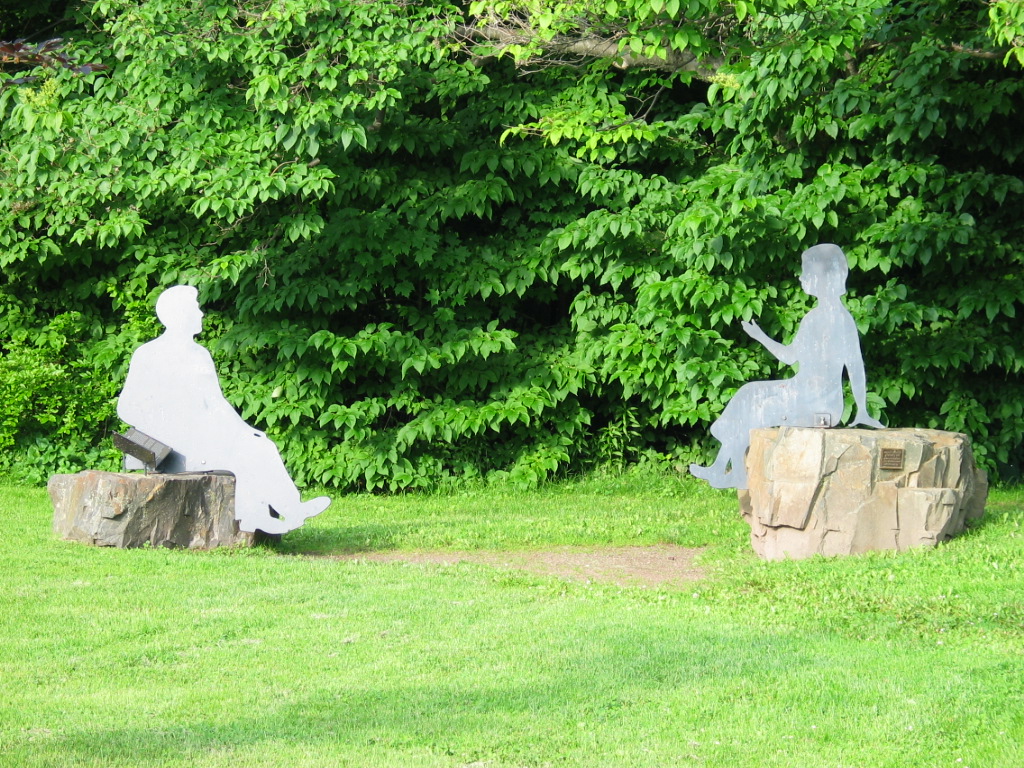
“You read your Emily Dickinson. And I my Robert Frost…” The two great American poets lived in Amherst in different centuries, and this set of statues there commemorates that.

.

In the third stanza we outdo Bezos, Musk, and Branson as Frost notes with inexpensive poetic efficiency that Free Thought is not bound-in by earthly hills but is capable of interstellar flight. This stanza’s final lines, an Icarian or Luciferian plummet, find that at the end of the limits of the dreams of a night Thought invariably returns to an “earthly room.” As my footnote below notes, Frost is fairly sure of the fallen nature of humanity.

The final stanza is, to my reading, an ambiguous judgement. If humanity is fallen, Frost too is unable to judge the competition and contrast of Love and Free Thought. Thought’s freedom and range, even if temporary, even if illusionary, has a pull and value. And “some” (Frost externalized this opinion and doesn’t say they are right or wrong) say Love (even if it’s bondage and constrains one) can have a fuller possession by nature of its grounded stasis.

The poem’s final couplet retains this duality, Free Thought has partial experiences of multitudinous beauties in a wonderous universe, but these beauties are “fused” to other stars. To choose other than temporary dreams, just replaces New Hampshire with Sirius.

I said at the start performance means choices. I made an audacious choice. In Frost’s poem he consistently gendered Love as female and Thought as male. Furthermore, I’ve read second-hand references that in an earlier draft he chose to make both Love and Thought female, an unusual choice that he abandoned. I made my choice for my own reasons, to help the performer, myself. I think that choice makes it a stronger piece for myself and for my audience.

The reports of Frost’s abandoned choice would make for a different poem. English writing in Frost’s time usually used male pronouns for universals and abstracts, so that original choice of female pronouns must have been intentional. His choice for skyward Free Thought as male, and earthy and fecund Love as female is archetypal, and I in turn made a conscious decision to reject that. I did this because I feared that too many listeners might grasp this poem as a conflict of male sexual freedom vs. the clingy women. Intentionally or subconsciously, this may have been in Frost’s mind, and even so then this is Frost’s version of the complicated love poem that the female “songbird poets” were developing in his time, even if it’s more abstract in describing the bond and free of desire.**  I just preferred the duality of the poem ungendered, and I think modern audiences are ready to receive that version.

The player to hear my performance will appear below for many of you. However, some ways of reading this blog won’t show it, and so here’s a highlighted hyperlink to play it. You will notice that besides the pronouns there are a few other textural differences, some accidental, some chosen to make the language more colloquial***  and easier for a modern listener to grasp on hearing. I don’t know if these changes are for the better, but they were this performer’s choice.  As promised earlier in this month of noisier musics, acoustic 12-string guitar and piano featured this time, but just enough sarod and tambura in the background to add a non-New England air.

.

*Frost did write one searing poem on racial hatred and violence: “The Vanishing Red,”  which I presented here. A brief search today didn’t return much. I would expect that he held stereotypical views and used ugly racial epithets casually. Like Dickinson, Frost’s silence on this central American issue should be more often considered as a loud silence. In her defense, Dickinson’s stance on human freedom, often expressed in her poetry, can easily be viewed as inspirational by all. Frost is surer of a fallen humanity, but that too can be appreciated by those weighed down by life or oppression.

**That reading would say that Frost was more guarded and indirect in dealing with desire than Millay, Teasdale, and the “songbird poets.”  Thus, the uncharacteristic abstraction of this poem

***One of Frost’s Modernist strengths was to largely remove from his metered and rhyming verse the sense of stilted and too formal poetic diction. My judgement was that this skill deserted Frost several times in this poem. Perhaps abandoning his usual distinct and grounded settings for this more abstract poem also blunted his naturalness of speech.

What the Thunder Said Part 4 and completing our performance of “The Waste Land”

During this project’s first April #NationalPoetryMonth back in 2017 I started what has become a 5-year serialized performance of the entirety of T. S. Eliot’s “The Waste Land.”  And here we are today, finally completing that portion of our Parlando Project.

Why “The Waste Land?”  for this lengthy each-April presentation? Several reasons.

Like a number of literary cultural artifacts, the single thing widely known and carried forth from it is only a single line. A certain significant ratio of us knows “The best of times, the worst of times,” or “Do not go gentle into that good night,” or “To be or not to be” — and so you may know “The Waste Land”  from its opening line: “April is the cruelest month.” That small keepsake of a long poem is much brought forward for anything that occurs in any April, and as much or more than Chaucer’s April preface to his Canterbury Tales, it’s likely the reason April is National Poetry Month. As an opening line it’s not misleading. Much cruelty happens in Eliot’s poem. Is it cruel to be kind as Shakespeare and Nick Lowe might put it? Is it just cruelty for shock effect — or can it cure, however partially? Our long serialization explores that, covering all those parts that you may have forgotten even as you remember and repeat the first line only.

“The Waste Land”  is also a landmark, a milepost, a line in the sand for a certain kind of Modernist English language poetry. While this project is not entirely about the rise of Modernism, the current rules of public domain make work from the first quarter of the 20th century the latest I can surely use for my project’s purposes without complications. If time permits me, I may follow up today’s post with a later one about what I’ve learned about Modernist poetry before and after “The Waste Land”  while working on this project; but when I first encountered the unescapable “The Waste Land”  in a schoolbook and classroom as a teenager one thing that I understood about it (perhaps the only thing I understood about it) was that it’s quite musical in most all of it’s movements.

“The Waste Land”  is not, at least in America, a beloved poem from what I can tell. Even among college-education-exposed Americans it’s not commonly memorized, kept in a commonplace way, used for occasions, or re-read for pleasure or new insights. Consistent with that, for the most part, these every-April “Waste Land”  segments have not been among the most popular here.*  Even among poetry lovers there are some that actively dislike it, find it a pretentious mishmash overrated by those afraid to speak plainly. Eliot himself seemed to avoid speaking about it or reading sections of it at later public readings. He may have thought his later poetry more accomplished, but I also wonder if he didn’t care to revisit the more unbounded elements of his life reflected in The Waste Land.

Which brings me to the main reason you’re about to get a chance to hear this performance today: The Waste Land  is not just one thing by design or execution, but it is significantly about someone in the throes of depression. Indeed, much of this year’s final section, “What the Thunder Said,”  was first drafted while Eliot was hospitalized for this. This section is not “The Waste Land”  of scholarly footnotes, bank officer work, gender blurring and questioning, or the knowledge of a night-class schoolteacher for working class women, or the lament of a man who has a personal sense of the intimate losses of a great war. This is the howl of personal despair of a consciousness who can portray those things — and it’s the howl of someone seeking to explode and break out of that state.

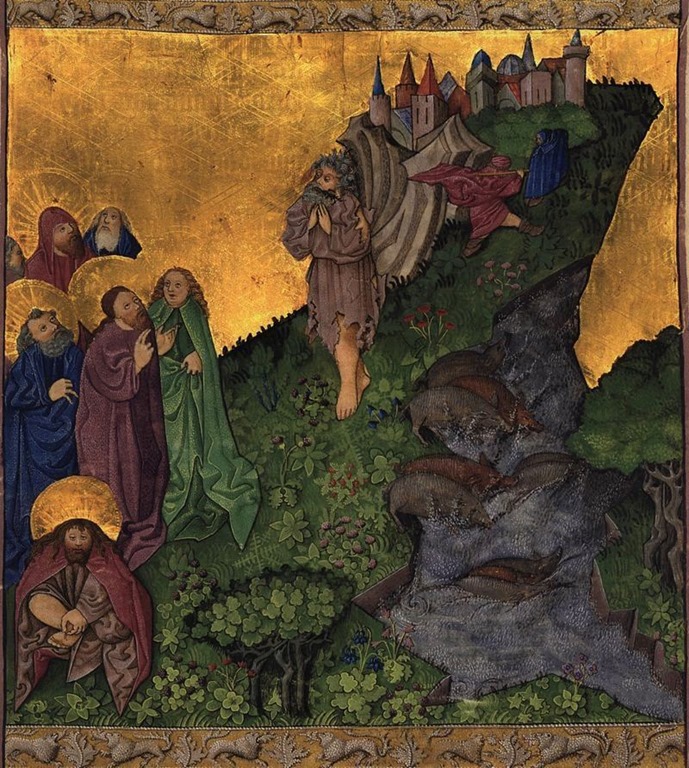
The LYL Band performance you’ll hear if you click on the player at the bottom of this post is a live performance from more than a decade ago, long predating the other sections I’ve presented here of “The Waste Land”  over the past 5 years. At the time of that performance I myself was emerging then from an episode of depression, one of two I believe I have gone through in my life. Depression has a variety of feelings and absence of feelings, and if one reads good writers describing their own depression experience you may well get a sense of the blind men’s elephant of fable, but my own feelings on the day and hour this was recorded were largely feeling sick and tired of those depression feelings. At some level I felt this section of Eliot’s poem was similar to what I was seeking, feeling, finding: an expression of an expiation of that, of demons transferred into mad pigs being cast into the sea. This coincidence of my life, a performance, and the poem would make it dear to me.

Ottheinrich Folio casting demons into swine

Jesus casting demons into swine. Guitar feedback not shown.

.

As I said, this is a recording of a live performance. Besides my voice and electric guitar playing, you’ll also hear Dave Moore’s voice spontaneously following along as I unfurled mine. I was cold-reading Eliot’s text here, I had not rehearsed or prepared for this performance, other than printing out the text. Embarrassingly, as I reached many of the foreign words in the text and fully in high transport of the moment, I mangled their pronunciation or dropped them from the reading. I used a handful of short samples you’ll hear mixed in the background to restore some of the dropped text.

In later, calmer reflection I continue to think this element of expiation is part of Eliot’s design here. A line I recall feeling strongly and intimately as I came upon it in my reading and performance that day is:

We think of the key, each in his prison
Thinking of the key, each confirms a prison.”

Whatever part of the elephant of despair or depression you might jiggle, touch, or be crushed by, we think of the key. Can we also think, hope to think, expect to think, of the prison as invalidated, destroyed, or obsolete?

What you’ll hear if you click on the player or hyperlink is rough, it has some mistakes, and being recorded live there is little I can do to fix them — and by intent it’s not a very genteel and formal presentation of Eliot’s poem. If that was my intent on that day over a decade ago, I today renew that intent by concluding our long, serialized The Waste Land  with this performance that predates all the other segments. In one of Eliot’s later poems (“The Little Gidding”) that he may have uprated over his 1922 landmark, he wrote:

We shall not cease from exploration
And the end of all our exploring
Will be to arrive where we started
And know the place for the first time.”

And so it is here too: every episode for this serialized presentation of “The Waste Land”  has been informed by that beginning, performed and recorded long before, that is now being used at it’s conclusion.

The player is below in most full-fledged web browsers, but this is an alternative hyperlink for those reading in apps or views that won’t show the player gadget. Yes, a longer audio piece than we customarily present —nearly 14 minutes — but it may still be worth your time and attention.

.

*For whatever reason, the Hyacinth Girl segment is one part that does get viewed over the years.