Arcadian Ewes (Ca’ the Yowes to the Knowes)

Today is Robert Burns’ birthday, which I hear is much celebrated in Scotland. While this Project has done over 800 audio pieces over the years, none of them (before today) have used Burns words. Why not? It’s a personal limitation of mine: his poetry uses a lot of Scottish words and dialect, and I have a hard time doing that.*

But, at last, I’ve finally snuck in a bit of Burns. And while it’s not as novel, I’m also using a set of words I wrote for the bulk of today’s performance, though the Parlando Project remains overwhelmingly about experiencing other people’s words. The second part of “Arcadian Ewes”  is a draft version from a work in progress: The Memory Care Sonnets.  Drafts of other poems in the series have appeared here before, but for those new to this, they tell the story of a daughter visiting and caring for a mother with increasing dementia.

While hearing the original account of a daughter and the daughter’s friend going for a weekly singing session at the memory care facility last fall, I was somehow struck at the time with the story’s Arcadian sensibility. That’s a place I know from this Project. Poetry and folk-song is rich in Arcadia: there are shepherds, flocks, meadows, love, peril, loneliness, peace, gifts, songs, a sense of time ever-present without fences, taking place over the hills and away from our actual daily lives. Here, in the sonnet, the shepherdesses go to the place, gather their flock of singers. What songs will they sing?

Even as I was writing the poem the refrain of Burns’ song that now begins the recorded performance was in my mind. I can’t quite account for why, other than the song for some reason often brings me to tears — and I can’t fully explain that either.
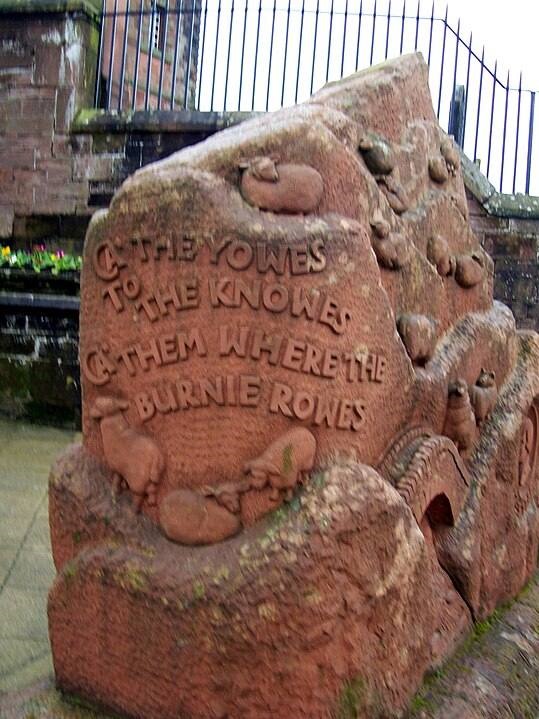
Ca the Yowes status Dunfries Scotland

Today’s musical piece begins with part of a Robert Burns’ song  displayed on this monument in Dumfries Scotland
(photo by: summonedbyfells via Wikipedia)

.

“Ca’ the Yowes to the Knowes”  was collected and reshaped by Robert Burns in the late 18th century.  He published at least two versions, and the folk process has given us other variations, including differences in how much of the Scottish accent and wordage is retained. As a text though, it generally isn’t a sad song. The song’s shepherdess, taking her ewes among the hills seems happy enough in her labor, but happier yet to find a swain in her Arcadia who promises her unending devotion and care. That story isn’t sad now, is it — unless one dotes on how love’s promises aren’t always faithful, that human lives are not unending. But as I said above, poetic Arcadian time doesn’t end, and maybe that contrast with human time is the essential sadness. Perhaps it is those elemental parts of Burns’ story, of the care for the carer, is what linked it to my resulting poem of the daughter taking care of the mother.

However inexplicably, I believe it’s the music that makes me cry when I hear that song’s tune. Music, that same powerful class of thing that is the balm that restores a connection to the mother on one of her “bad days” of deeper withdrawal in the sonnet. The music for the performance you can hear below doesn’t hew exactly to the old song’s tune, for I don’t know if I could have stayed with the reading if it did. You can hear my performance with the audio player gadget below. Has your audio player strayed away over the hills? No, just some ways of reading this blog suppress displaying it, so I also offer this highlighted link which will open a new tab with its own audio player.

.

*That lack of the ability to hear and then repeat back sounds bedevils me several ways: it’s often relied on in musical endeavors, and it’s long frustrated me in my desire to speak other languages, or even pronounce some names correctly. I suspect it’s a neurological quirk of my brain.


The Nymph’s Reply to the Shepherd

There’s a long tradition of “the answer record” in pop music, where another artist responds to a hit record with an opposing viewpoint. Christopher Marlowe’s 1593 “The Passionate Shepherd to His Love”  (our last post) received a similar diss from Sir Walter Raleigh with his “The Nymph’s Reply to the Shepherd,”  which is today’s. Who will folk-rock the mic harder? Feel free to re-listen to Marlowe’s inning before considering Raleigh’s reply, Marlowe’s player is just below:

As I mentioned last time, these poems with their shepherds and lovers, called Pastorals, were proudly artificial, and set in a completely stylized and relaxed world of affection and sufficiency. You may find any desire to dwell in this unreal world strange and old-fashioned, but perhaps we imagine now another kind of locus amoenus/“pleasant place” to dream of going to, to escape the world.

Christian_Wilhelm_Ernst_Dietrich_-_A_pastoral_landscape_with_Diana_and_her_Nymphs,_1754

“Then he was all about rural handicrafts all of sudden. Was he even interested in me?”
“Well, it’s not like taking care of sheep is that hard. A child with a tambourine can do it!”

 
Raleigh’s “The Lie”  has already demonstrated here that Raleigh had no patience with romanticism. So, he’s primed to take on “The Passionate Shepherd,”  but he also notices another weakness in Marlowe’s argument: the Shepherd promises pleasures, presumably mutual pleasures to his lover, but he isn’t stopping there. He’s going to demonstrate his commitment by throwing an entire Etsy shop at her: beds of roses, caps, vests and belts made from woven wildflowers, wool dresses and wool lined slippers. And bling! Gold buckles, coral and amber buttons.

So, Raleigh composing the nymph’s reply has three arguments to make. All those hand-made crafts on offer? Doesn’t move me Shep. Outdoor animal husbandry? Not as romantic as you make it out to be in May, and those wool slippers better be warm if I’m going to be traipsing after some sheep come January. Lastly Shep, you’re all hot and bothered about me now, but just how lasting is all that? I appreciate the offer, but let’s just say I’m keeping the wool lined slippers and you can go try your line on some other nymph?

Wool Lined Slipper

I’m not even sure what a kirtle is, but I understand cold feet at night

Musically, this is another piece inspired by a 1960s folk-rock sound. I was thinking specifically about the musical style of Fred Neil’s Capitol records as I arranged this. I used a minor key chord progression somewhat related to the major key one I used for “The Passionate Shepherd,” and once again I sung this one. Raleigh, if downbeat, is just as lyrical as Marlowe in his answer. Marlowe has pretty lines like “By shallow rivers to whose falls/Melodious birds sing madrigals,” but Raleigh has “The flowers do fade, and wanton fields/To wayward winter reckoning yields.” So, use the player just below to hear Sir Walter Raleigh’s response in song.

The Passionate Shepherd to His Love

Let us leave the Modernists for a moment, for a trip to an imaginary land, a locus amoenus, a pleasant place, within whose bounds certain things hold true: love brings simple riches and complex pleasures ignorant of inconstant affection, and where the cares and complexities of cosmopolitan life, brutal prejudice, and other social constructions fade away.

Such a place can have many names. To the Surrealists it was the unfettered confusion of certain dreams. To the west coast optimists of the Sixties and their cross-Atlantic vibrationalists, it was a new Eden of decorated affection and open-mindedness. To a resident of fetid Elizabethan London, it was the pastoral, a demi-countryside where love was free and the rent non-existent. Shepherds, Pan and Panopticon, willed willing partners to their bowers. It seems like a nice place to visit—and in the mind, even more so.

Christopher Marlowe must have written this pastoral love poem sometime before he died in 1593 (baring any occult forces of the Twilight variety, or the posthumous inspirations that allow Oxfordians to confound Shakespeare’s later plays) but it wasn’t published until a few years after his death. It’s a full-throated exhortation in the pastoral style—with a slippery set of gold-buckled feet at the bottom of its argument as we’ll soon see, though that may not matter. Not only is it lovely sounding, even read flat on the page, the whole point of the imaginary pastoral world and the locus amoenus is that it isn’t real, that it’s the place we want to lie in and be lied to sweetly, within.

Marlowe and Peel

“And we will all the pleasures prove.”  The 19 year old Marlowe and the 29 year old Peel.


In the spirit of all this, today’s audio piece is one of the few Parlando Project selections where I sing, as you can’t really declaim “The Passionate Shepherd to His Love.”   Musically, I chose to use some of the production techniques popular among dreaming optimists in the Sixties, where John Peel’s Perfumed Garden  would be another locus amoenus, another imaginary place, where, in fetid times, we might want to go. This week, 50 years ago, John Peel performed his final  broadcast of that accidental and influential radio show.

To hear Marlowe’s“The Passionate Shepherd to His Love”  performed as if it was a cut being played on the Perfumed Garden, use the player that should appear below.