Today is International Women’s Day, and I was fortunate to be able to complete this recording of a new musical piece setting a poem by Alice Dunbar-Nelson before the day ended.
“I Sit and Sew” is likely Dunbar-Nelson’s best-known poem — it’s certainly the first one I knew of. I’d encountered it as a poem written amid WWI during the years this Project was noting that conflict’s centenary. “I Sit and Sew” still comes up fairly often in regards to war and destruction, or because it mentions domestic, woman-associated work in the context of the greater world.
I noticed one other element in re-reading it this week: it seemed to me to relate to another line of woman-associated work: medical nursing. Having spent a couple of decades doing nursing work myself, the poem’s focusing-in on the trauma and injuries of warfare really made me think Dunbar-Nelson wasn’t just thinking generally, writing something that could be paraphrased as “War is terrible, and yet here I am peacefully making or mending something with needle and thread, as women have for millennia.” There’s nothing wrong with experiencing the poem that way, as a companion-piece perhaps to Hardy’s “In the Time of the Breaking of Nations” — but I’m a person who often asks questions while reading.
While the poem can stand on its own, I wondered if Dunbar-Nelson herself wanted to serve as a nurse.* Short answer: this issue has additional complications. Currently in the United States we’re suffering from numerous outlandish statements and acts snuffing out complexities of diversity, but historically women’s wartime work, including nursing, is tightly connected with increasing respect and civic equality for women.
Alice Dunbar-Nelson was an Afro-American woman. The U.S. armed forces were segregated during WWI, and the roles available to the non-White military were limited along with that, based proximally on rules about race-mixing no-doubt supported by a pervasive background of racial superiority. A few years back, while learning about another poem, I came upon the case of Col. Charles Young, a Black West Point educated officer with experience in two foreign deployments who couldn’t get himself utilized as America mobilized for WWI. The situation for Black Americans who wanted to work overseas as nurses was also exclusionary. I’ve found out Dunbar-Nelson was working as a national organizer, a member of something called the Women’s Committee of the Council of Defense, and her focus was on Afro-American support of the war effort. She published today’s poem in 1918, and after the war she wrote up a summary of Black women’s WWI efforts.
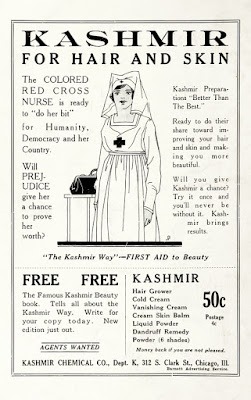
We Wear the Mask Dept. I found this ad here in another post mentioning this poem. In her article linked above, Dunbar-Nelson mentions, in passing, (pun intended) that some lighter-complexion Afro-Americans snuck through the overseas nursing service ban.
.
No long post today, that’s a start for anyone who wants to dig deeper.
The song I made out of her poem came together more efficiently than many, partly because it began before I knew I was making a song. This week I remodeled a nearly 30-year-old Squier Telecaster that I had put a Bigsby vibrato bridge on a decade or so ago. This guitar and that bridge just never worked out. I couldn’t get the neck angle and string height right, the saddles rattled, and the strings slipped sideways when I bent strings. After some looking, I unearthed the guitar’s original non-vibrato bridge and put it back on.** The guitar was transformed. Back when I put on the Bigsby I’d also installed a set of upgraded replacement pickups, and with the string-path mechanics sorted out, the guitar played and sounded great! While I was resetting the action/intonation etc., I quickly made a short musical piece on my recording computer that would let me play strummed chords, arpeggiated chords, and single-note lead lines over three separate sections — just so I could have fun while seeing if I’d eliminated all issues.
Funny how fast you can compose, if you’re not composing. I saved the drum pattern, the bass track, and the keyboard noodling after testing the guitar, thinking “Hey, I like that groove, might be useful.” This morning, I had about an hour when I could open a mic and record. I loaded the saved rhythm tracks, worked them into a longer song-form, recorded the guitar parts using the transformed guitar, and found that I could sing Dunbar-Nelson’s poem to this.
You can hear it with the audio player below. No player? It’s not hiding under a box, it’s just some ways of reading this blog suppress the player gadget. This highlighted link will open a tab with its own audio player.
.
*”Nursing” is a very broad word covering a wide range of caring work and levels of technical knowledge. Dunbar-Nelson’s write-up seems to indicate the women’s war work she was promoting covered a range of things, not just licensed medical nursing as we know it this century.
**One difficulty was that the original — like the Vibramate-brand vibrato bridge I took off — was a non-standard bridge. When I finally found the original bridge, it was sitting underneath a storage box in my studio space. Luckily, like most Telecaster parts, it’s not a fragile thing. By the way, I’m not knocking Vibramate’s hardware. I’ve used Vibramate products to add Bigsby vibrato bridges to other guitars with good results, and their “Spoiler” accessory for Bigsby bridges makes restringing or replacing a broken string a much calmer experience.
I have a new audio piece today, combined with a continuation of my Parlando Project influences-as-episodic-memoir series. The audio piece uses text from Gertrude Stein’s Tender Buttons — worthy in itself — but what suggested it was a question that reading about Stein brought to my mind during The Seventies when I started to look into her life and work a bit.
Despite being nothing like an expert on Stein, I could fill this post with stuff about what she did and how she went about doing it. I’m going to make a summary of that a footnote, though that’s worth reading if you know even less about her than I do.* There’s one detail from Stein’s life that hooks into my story as I entered The Seventies. I’ll come back to that. Watch for it.
In the last post I’d left college in 1970, disconnected in the aftermath of the political activism post Kent State and my failure as a young editor of my college’s student newspaper. I wrote of some musical and poetry experiences in the early Seventies there. Another thing was both continuous and changed at this point: I needed to find a job. This was continuous because I’d most always worked from my middle teens. I’d had paper routes, did odd jobs for the local bank, and besides my work in my second year with the school paper, I’d been what was called a “work-study” student working most days in the college cafeteria. Although it didn’t occur to me then, I suspect the more well-off students may have noticed that I was doing kitchen work while they were only concerned with regular college life, but this continuousness of work was ever more complete from the time I was 20 until I was past the age of 65. Another way to say that was that I worked full-time hours all those year with no more of a break than a worker’s vacation. After leaving college I worked frying hamburgers at a fast-food restaurant and on a factory floor making vertical blinds, but in 1971 I was back in my small Iowa college town looking for work. I went to a nursing home in the town, thinking they might have kitchen work. Instead, they asked if I wanted to work as an orderly/nurses aide.** I took that job.
So, if work was continuous for me, what was changed? In some expectations one is supposed to find one’s career in their 20s. I had decided earlier that I wanted to write. In some other lifetimes perhaps I would have found an entry-level writing job, in another I might have wandered into something with politics. I’m not sure however if those alternative livelihoods would have suited me, for reasons I may discuss later in this series.
My job in the nursing home was in the Extended Care Facility, the wing for those patients who needed more-or-less complete bodily care for the rest of their lives. Many were completely bedridden, and many of that portion also unable to communicate. I worked the overnight 11-7 shift with one RN. I’m guessing we had around 20 patients in the unit. Our night work was turning the incapacitated every four hours to prevent bed sores, to clean up the incontinent and their bed linen, and to occasionally minister to those who awakened, often with some level of anxiety and agitation. It was hard physical work, and I will confess that I let the physical work deaden me somewhat at first to the Sisyphean nature of their lives and my tasks with them.
If one has a lot of triangles to move from Iowa to New York…
.
I moved to New York state to stay after a few months of that, carrying everything my wife and I owned in the bed of a rusty 1960 Chevy pickup truck that I’d purchased for $200 from my wages. The truck was so rusty that I could see the tires through holes in its floorboard, but other than a hydraulic clutch that would reengage itself if depressed too long, it ran OK in its rattly way. Back in New York I was living in a poor, mostly Black section of Westchester, renting a room from an elderly Mrs. Whitted who had a framed life-time membership certificate to the NAACP on her living room wall. I worked there first in another nursing home, a much fancier one in upscale Westchester, on the day shift this time. There were more staff there, but some elements of the care bothered me.*** Being low on the care system org chart I chose not to try to remedy that, and left for a job working on a med-surg floor at a Catholic hospital on the overnight shift again. The regular charge nurse on my floor was Miss Watson, a young highly competent Black Anglo-Jamaican with an impeccable English accent that would match a Sidney Poitier. We worked along with an LPN and at least one female aid (usually one of several Afro-Americans with a Great Migration southern-American accent) to complement my coverage of the male side of the patient census. I fully enjoyed working with Miss Watson. The most peculiar absurdity of her life that I got to observe was when patient relatives came in around the change to the morning shift after talking on the phone with Miss Watson. They’d assumed a starched-white Englishwoman, and so the recognition scenes when they arrived and saw her dark black skin always had me stifling a laugh. How much humor Miss Watson could consistently find in this might be another matter.
These orderly/nurse’s aide jobs paid a dime or so over minimum wage. The work was physically hard and even at its most basic levels it involved deep responsibilities all out of proportion to what it paid. Around this time, I came to embrace this necessary and underpaid work. It provided an inescapable, palpable, meaning to my life, something that struggling over a poem or prose draft could not demonstrate objectively. It allowed me access to all kinds of people in a wide range of economic classes and backgrounds. Occasionally, I thought of the members of my generation who served in the military, some drafted, and I told myself this was my service.
Eventually I moved up to Newburgh, New York, which will need to be another post. I worked my last overnight shift at the hospital and then I hitchhiked up to Newburgh at the end of my shift. I’d already gotten a job at St. Luke’s Hospital there in the Emergency Room. I’d work the 3-11 shift there the next day.
Are you waiting for Gertrude Stein to return? Here’s the connection. I can remember reading about the little Paris apartment she and her partner, edibles pioneer Alice B. Toklas, shared with Stein’s brother and a wall-smothering collection of Modernist art bought directly from artists that she knew, and the world would know later. It was there Stein lived from 1903 after leaving Johns Hopkins Medical School short of a medical degree.
As a time-travel destination that place is five-star. Artists, writers, critics, composers who once needed only to travel geographically to go there, wrote of it in their memoirs. A famous place.
Gertrude Stein in front of some of the Modernist paintings collected in her Paris apartment.
.
You know what I thought reading of that apartment? Yes, there was wonder. How did they figure which artists to collect? He, she, they, all of them were there, people before the pronouns. So and so met so and so there? Hemmingway finding part of his prose style in this small apartment — and from a woman? But my most nagging thought? Something else, another question: “Who paid the rent?”****
Many (most?) writers have the ability to be motivated by that experience, though in reading I can tell some are, and others are not. I myself am inconsistent. I have written and performed poems here that the richest and most comfortable person in my time might have written or could easily relate to. And then again, I may overselect poems whose speakers are in extremis.
Some take a commercial-first approach to their art, making sure it earns the rent money. My nursing work from age 20 to nearly 40 illustrated a variety of life to me, but it also allowed me (with worries) to pay the rent.***** Others take a cause-first approach, advocating with their art resolutely for remedies to what they see. Could my nursing work have reduced that aspect of my writing? That has just occurred to me. I’m not sure, though looking back I’m more at glad I didn’t have to point to my writing, and later my music, as what justified my life. And “Other People’s Stories?” Each day in the Emergency Room you’d meet up with other people’s stories. If your own were limited, or intractable, you could move their stories forward.
I had found a job that in those days allowed one to pay the rent. Inside that conceptual room, paid for by working with the sick and injured, I worked on the writing. And those years of unbroken work, of clock-in every working day, and rotating shifts? I suspect a habit retained as this Project approaches 700 pieces this year.
Today’s audio piece is from Gertrude Stein’s still controversial, still avant-garde, collection of “Cubist poems” Tender Buttons. That book is divided up into three sections: People, Objects, and Rooms. I performed the opening to the final section, Rooms today. Tender Buttons remains gnomic. Though the words themselves are plainspoken, a straightforward meaning is most often hard to make out. My performer’s working theory during the recording was that she’s making a statement about Modern Art and Cubism. Rather than a center and conventional panorama, Stein holds for more perspectives at once. She seems to be advocating for something not just decorative or the easy dessert of sentiment (“silver and sweet”). She sounds a “Life is real, Life is earnest” almost Longfellowean note when she says “A preparation is given to the ones preparing.” She perhaps compares a conventional painting with a center and a border to an empty dress, flat on a hanger. The final paragraph/stanza moves, synesthesia-wise, to music where the flowing facets of a Cubist painting may show a sequence of time.
.
Though printed as prose, the musical rhythm and rhyme of this poem arises with any earnest effort to read it aloud. If one was to modify it to conventional lineation, parts might almost pass as Emily Dickinson, albeit the more obscure and compressed Dickinson.
You can hear my performance with a drums, bass, piano, and electric guitar quartet with the player gadget below. No graphical gadget? This highlighted link is an alternative way to hear it.
.
*These footnotes are going to be long, and are for the more curious. They’re not necessary to enjoy the audio piece. Stein is easily classifiable as equal to Apollinaire and Ezra Pound (both of which she knew and interacted with) for influence on the emerging Modernist movement in the first quarter of the 20th century. Her influence on English language Modernist writing is not consistently admitted or admired, but her influence also extends to Modernist music — and along with her brother Leo, she’s absolutely central to the development and appreciation of Modern art.
The most amazing thing about her pre-Paris youth is that in a 19th century when women’s education and careers were constrained, she attended Radcliff (meeting, being mentored by, and admired by, William James) and then sought to become a medical doctor through graduate work at Johns Hopkins Medical School. Her center of interest was how the mind and its perceptions work, something she was studying at a time when Sigmund Freud had just started publishing. She dropped out of Johns Hopkins before graduating however.
**Job titles and even jobs listings were routinely gendered in 1970. Orderly was a male job, nurses’ aide the woman’s. Training for either was generally informal and on the job. Later in the Seventies I barely started an academic RN program, but affording the classes and especially the time and automotive costs of traveling to the nursing school put the brakes on that. Since I worked in teaching hospitals for over a decade after this as an aide hand-in-hand with nurses, interns, residents, and staff doctors, I learned a great deal of practical knowledge along the way. Administering medicine was not legally allowed, but I eventually did much of everything else the LPNs and RNs did. Afterwards, I always called what I did nursing, as it was a better description of my role for most of that decade-plus. In the middle 70s I helped in a small way to train early EMTs and given how much I liked the pace and variety of work in Emergency Rooms, I might have gotten into that line of work if I had come along a few years later.
The gendered job titles may have faded out as the Seventies progressed, but some of the work remained gendered. Despite having a poet’s level of athleticism and large muscle development, I was often called on to move or lift heavier patients, or to help restrain out-of-control people. Given how many stories there have been in recent years of people killed while being restrained (one in the news this month) I have wondered retrospectively if a different fate could have involved me in such a case. As things worked out, I never injured anyone while restraining them, though besides wear and tear I got a couple of minor injuries.
***I suspected a co-worker of patient abuse. I was new — they’d been there for some time. I had nothing concrete, and other longer-tenured coworkers thought they’d seen more, and that was part of my unease. A better person would have tried to organize a complaint and urge an investigation.
****Did you go to this footnote to find the answer? I’m not enough of a scholar to know all the details. Paris was dirt cheap then, there was some Stein family wealth, and the idea of artistically curious Americans of some means being gifted with broadening time abroad was common. Another Stein sibling, Michael, who also lived in Paris, has been cited as the man who handled the family finances there. The Stein bought-cheap-then paintings eventually became capital gains. At one later point someone noted a missing painting from the crowded apartment walls and Stein explained “We are eating the Cézanne.”
*****I’m no economist, but it’s my understanding that rent and housing costs have risen compared to the wages that of job earns now. It’s not my intent to engage in a walk-uphill-both-ways misery Olympics, just to explain some things that led to making this Project. Has any economist explained how jobs like the ones I held then, which are physically hard, unpleasant in some elements, demanding of all-shifts work, are at least mildly dangerous, have a chronic shortage of workers (much less good ones), and can have a life-and-death level of need and responsibility, yet pay less than much easier jobs for which there is a surplus of applicants? In my last few years of hospital work I moved to being a ward-clerk: typing, paperwork, general workflow organization and support (all of which I did as a nurses aide, as well as patient care) —and I then got a small raise.
As I mentioned as January ended, this February has been challenging for me to keep up with this Project and it’s associated tasks. I still hope to have new pieces soon. In place of a new encounter and performance with a poem or other text, let me do one of those posts where I pretend this is a normal blog
I know nothing other than what I read in the news about the situation in Ukraine — and that news with Ukraine now is, in short, mostly about what is feared to be an imminent invasion. I’m sure this Internet is full of folks with takes and information and policy positions if you feel the need for that, but instead I’m going to tell you a little story from my youth.
Back in the 1970s I was working the overnight shift in an urban hospital’s Emergency Department. Overnight, those 11 PM to 7 AM shifts, are probably not good for one’s health or social life, but I rather liked them. Staffing is much lower, and there was in my day almost no administrative or support presence. No crowd of attending MDs looking for proper deference to their priorities, no administrators to set or enforce policy in between meetings. Therefore, hierarchies were radically flattened at night, and I got to see and participate in a lot of different medical things.
My ED then was staffed with myself, a registered nurse (RN), a clerk who typed in information to print up a chart and the handy labels that would be pasted on lab requests/samples, and a family practice resident* Just down the hall from our suite of four treatment rooms was a door with a buzzer where anyone from the ambulance patients we’d expect after incoming radio calls, to those who’d called their doctor and clinic and were told to drive to the hospital for further evaluation that couldn’t wait until morning would appear. And then too, the walk in.**
I worked nearly 20 years in hospitals, most often in Emergency Rooms. This stock photo looks about the right vintage.
.
On the night I remember, the buzzer rang and there was an older man at the door. He had apparently walked up alone, and I usually was the one who went to the door to see what was the matter. And that was the issue from the start: he was speaking some foreign language, and he seemed to have only a scattered understanding of English and almost no English words to reply with. He looked to be in his seventies, had no obvious injuries, no severe distress. He moved slowly, but was walking.
Our door had a big lit-up Emergency Room sign, we could only assume he’d come in for treatment, but for what? You might assume that any 1970s urban hospital would have multiple language interpreters on hand, but that was not the case in ours then. And frankly, we wouldn’t even know what interpreter to call because we couldn’t figure out what language the man was speaking. Some words sounded a bit like German to me, so we called up a nurse working that night who spoke some German to come down. The RN and I hooked our mystery man up to the cardiac monitor, and the resident MD did a quick exam to see if we could figure out why this man had come to us. I think I may have even done an EKG on him, with no obvious issues found.
We looked for an ID in his clothes once we’d put him in a hospital gown and on a stretcher. There was none.
The nurse who spoke some German arrived. She got to her first preliminary question, which might have been “What is your name?” “Or why are you here?” and the mystery man exploded. At least some of the reply was in German. And our volunteer nurse interpreter said his angry words were that Germans had killed his family. How much German did he know? Made no difference, he wasn’t going to answer questions when asked in German.
I next got a bright idea. One of that class of residents was a young doctor who had a great facility in European languages, speaking at least a half-a-dozen of them. He wasn’t on call, and it was 4 AM, but I thought we should call him in. Given the infamous hours that residents worked in those days (maybe still do) that was asking a substantial favor, but he agreed to come in early. I was busy with something when our multilingual resident MD arrived. At one point he thought maybe Russian, and tried that. Later, I heard that once again the mystery patient became angry. Our resident didn’t know the man’s native language, but he got back something that was similar to our German speaking nurse — Russian was not a welcome language to our mystery patient.
Our multilingual resident was a smart guy though. One of the old-guard attending doctors on the hospital’s staff was Ukrainian American and had written a book dealing with Ukrainian culture in Ukrainian, a copy of which was on the shelf in the hospital’s medical library. Our resident showed that book to our mystery patient he later told us, and there was a quick realization that that was his language. After the regular day got underway, the older Ukrainian American doctor found that the man was one of his patients who was somewhat confused and had wandered to the hospital thinking that his doctor might just be there in the middle of the night.
So, as I said at the start, I know nothing about Ukraine — but I do think of that man who appeared in the night at the door of my Emergency Department and demonstrated how little I knew of him and what his country had been through.
Long guns, a poetic example.
.
What to bring forward for a musical piece today? How about this one about war and violence that combines a line or two of language expression from Afro-American singer Howlin’ Wolf with second generation Swedish immigrant Carl Sandburg’s poem about countries that pack those long guns. Player gadget below for some of you to play it, or you can use this highlighted link otherwise.
.
*Family Practice was the improved modern evolution of the old school “General Practitioner,” and the program that our hospital had treated that generalism like any other specialist residency to give the doctors who went through it a great deal of practical experience in things they would encounter. Almost every one of the residents I worked with there and then were fine people, who would come in some degree of unsure in the Emergency Room and leave after three years as the kind of doctor that I would want for myself or my family. Doctors and regular medical educators ran that program, but experienced nurses were so important in that too. Each June brought in new residents who really needed the steady hand of nurses at night to guide them in practical medical logistics and solutions.
**There was an indoor hockey rink across the street that had a fairly full set of bookings that ran until midnight. Yes, we needed to keep a lot of suture kits in stock.
I’ve been planning on presenting this eerie ghost story by English poet Frances Cornford for awhile now, but I wanted to take care with the musical setting while working on our recently completed countdown of the most popular pieces here from this past winter.
Heidi Randen was interested in doing this as a guest reader, and it’s her voice you’ll get to hear today. She’s also the guest blogger for this piece, so before I say our customary few words about the music let me turn it over to Heidi.
From Our Breasts, Frances Cornford’s The Old Nurse
By Heidi Randen, guest writer for Parlando (and Frank’s wife)
Like the subject of this poem, I am an old nurse. When my husband shared these sad, sweet, ghostly, gothic verses, they resonated with my experience of nursing in the biological and professional sense. I breastfed our kid and have worked as a Registered Nurse in hospital and clinical settings with very old and very young people.
Frances Cornford wrote this poem in the 1920s when professional nursing was still a new concept. Florence Nightingale pioneering nursing in the field during the Crimean War would have been about as far back in the collective memory as the Korean War is to us now. Nightingale started the world’s first professional nursing school in London in 1860. This occupation would have been as relatively novel as computer programming or palliative care are today. In an English village in the 1920s, an old nurse would most likely mean an old wet nurse or an old nursemaid.
Wet nursing is a humble and humbling profession:
Against my breast I felt a small and blunt-nosed head.
To breastfeed is to be reduced to a mammal, a one-person dairy operation. To share your milk with an infant in need who is not your own is an extravagant act of human kindness, yet it carries great stigma. In my family’s American immigration story, relatives on my mother’s side repeat the line: Our family was so poor that your great-great grandmother had to work as a wet nurse in the Netherlands.
Breastfeeding is like still being a little pregnant. Your body is not wholly your own, still providing shelter and sustenance for another. This is also the case in professional nursing. When I worked in the hospital, I would often forego sleep, meals and bathroom breaks if it was a particularly busy shift. This self-sacrifice is why nursing is still considered a calling and is listed as the most trusted profession in the United States and the United Kingdom.
The circle of life: the woman who breastfed me and who suffers from Alzheimer’s, being helped long by the person I breastfed, my kid who talks about going into nursing when they grow up.
In my experience talking with fellow nurses, neonatology, pediatrics, oncology and hospice are considered extra special callings. It takes greater emotional mettle to get close to babies and children in pain, to help people with serious or life-limiting illness and their families. Put any of those specialties together: neonatal hospice or pediatric oncology and you are exponentially special, perhaps super-human.
But nurses are very human. We see things that are unbearably sad. And there is nothing sadder than a dead baby. It seems like the worst violation of the order of things. But it is not. To me, the worst thing in the world is when people are left alone in sadness and fear. Like the woman in the poem, the nurses of the world—in all senses of the word—hear crying over the sound of storms, seek out those in distress and provide comfort. The satisfaction of this experience is expressed tangibly by the poet:
And a sob-quivering body slowly growing calm
And toes like round cold buds that warmed inside my palm.
Like the subject of this poem, I too see dead people and they don’t frighten me. The longer you watch human beings move through all their stages, you see that the end of life has much in common with the beginning of life. This became most apparent to me in the space of one day when I visited a friend in the hospital with a newborn and a friend dying in hospice. The mystery of where that baby came from was the same as the mystery of where my friend was going. To nurse is to help for a little while on another’s journey, then—like the old nurse at the end of the poem—to be alone again with this mystery after they leave.
The page from Cornford’s “Autumn Midnight” collection where the poem was published in 1923. Woodcut by Gwen Raverat
Heidi didn’t mention this when she wrote this earlier this year, but of course now we are asking nurses and others to put their bodies on the line with our current Covid-19 crisis.
Here’s those few words on the music. My original starting idea was to use singing bowls as part of the arrangement, but I have only one available, and while I could manipulate the single pitch after recording, I wanted them to play intervals and triads and decided to go another route. I used some gongs and bell for the piece’s intro, but much of what sounds like the singing bowls is an electric guitar being sustained to feedback levels and then being fed through a modulated reverb. I also made use of one of my favorites, the Mellotron cello sound, because that instrument’s uncanny aural valley always sounds spookier than the real thing to me.
The player gadget to hear Heidi’s performance of Frances Cornford’s “The Old Nurse” is below. If Cornford intrigues you, I’ve presented two of her poems with original music earlier this month.


 Frank Hudson