Color — Caste — Denomination: The Seventies and Me Part 3

I’m going to share a musical performance of an Emily Dickinson poem, but before I get to that, I’m going to continue my memoir-of-influences series on things that formed the idea of the Parlando Project earlier in my life. I’m going to try to keep it short, which will force some amputations, but I feel embarrassed spending much time on the small events of my single life. Those in a hurry, or only interested in the new audio piece and what I have to say about that, can skip down to the second section of this post.

At the end of the last post I had moved to Newburgh, a town on the Hudson river about 60 miles north of New York City. I don’t know if the town knew what to do with The Seventies, it seemed between eras; and in some larger sense I might not have known what to do either, but like the town I had a daily job to do, and kept doing it. Can we say that had some value?

I liked many of the people I worked and lived with during my five years there. I still think of some of them from time to time, and they were often kind to me. The folks who worked with me at St. Luke’s Hospital, particularly those in the Emergency Department, worked hard under significant limitations trying to do things that we could only address partway. I could say much of that under-addressed were systematic issues — and I’d be right — and the levers of those systems were outside our direct grasp. Another part of those limitations were closer to us, internal. I said I’d try to be brief. I said there would be amputations. Newburgh had a racism problem. The town, the region, was populated by stratums of immigrants, with the original European WASP colonials to Irish, Italian, and Puerto Rican waves following on. Mixed in there were Afro-Americans who were there, as they were everywhere in the United States. I don’t know the exact demographic details, and I said I’d try to keep this concise, but I’d guess the Black Americans were first in the region from servant and slavery times, and then there was some low-paid and otherwise undesirable work that still may have seemed better than some parts of America for Black folks. Few poor people ever emigrate for marginal gains from acceptable situations.

That work had shriveled over the years, and what jobs there were, those other immigrant waves got some of the employment from the white folks who did the hiring. Again, I’m no expert, I may have some of this wrong, but when I think of the Irish and Italian Americans who can recount the derogatory tropes employed against their ancestors,* I still suspect that even within the cruel othering they received, they sometimes got, in practice, hiring preferences over Afro-Americans.

This led to the town, in the time I was there, with an underclass of underemployed Black folks viewed by too many of the white population as shiftless, ungrateful and unenterprising wards of the state. Think I’m amputating too much to say this was a prominent white attitude? Ten years before I arrived there was a controversy that was called “The Battle of Newburgh.” I didn’t know much of this specific history in 1971, but the attitudes were still easy to hear and feel while I lived there. Here’s a link to a 30 minute podcast on the 1971 controversy. Wonder what happened later? Here’s an article that updates things to 2015.

Back in my Emergency Room, The Seventies, we were the place anyone came when things broke down. Folks needing medical care that couldn’t pay. Victims of violence. Stressed out or addicted people. Worn-out old workers and beneath the working-class people. I worked the 3-11 shift, the busiest one in the ER. We’d typically get 50-70 such situations every shift. What could we do for them, right now, in our imminent place? Patch’em up. Give them a preliminary diagnosis and maybe a shot or some pills. Hand off a referral card to a medical system already fragmenting and requiring insurance levels of payment from various payers. Witness their deaths.

So those folks I worked with, who did this, were they racists? I’m not saying that. I can’t see into the hearts of them — not then, and not with any level of magnification now. I know we were frustrated with the people in and around the treatment beds at times, thinking that what’s close and in front of us was the most significant thing in what was going on. No, no, we’d no doubt say, that thought wasn’t from the color of their skin, that was what they did, or were doing, or weren’t doing. From what some of my coworkers said talking among our tired selves, I could hear racism, hear pat rationalizations. I’d be hearing this from folks on a modest paycheck given the responsibility of a past that isn’t even the past as Faulkner put it. Our actions were mostly care — yes I saw kindness too, even when our philosophies and capacities could not fully appreciate the lives of our patients and their families. Perhaps it was good that we were too busy to think about that incongruity. Would our care have been better if we — speaking now of the whole group of us, including myself — were less ignorant and more broadly empathetic? That’s certain. But such wiser folks weren’t there then, we were. Imperfection trying to heal what could be treated directly.

A couple of years before this, a songwriter was 40 miles to the north of me, goofing off with his Canadian R&B band buddies in a big pink house. Sing heavenly muse, he sang these lines:

Remember when you’re out there
Tryin’ to heal the sick
That you must always
First forgive them.”

To this day, when someone, almost always a white person, concludes some confession to me with a variety of the phrase “You might think I’m a racist because I said that.” I reply “You said it, and you might well be to some degree. So, what are you going to do about that, and about the situation that is before us?” Ignorance and prejudice may not guide us well in trying to solve things, to remedy faulty systems — so what efforts can reduce that so we can see more clearly? But beyond that, even though our thoughts and prejudices can make us work blindly or in the wrong direction, the injured and endangered may be more in need of helpful actions than faultless inner wisdom.

Is writing and performing poetry a helpful action? Well, it’s not clearly so as is binding wounds or performing CPR. Poetry is in the calling-attention business, including part I normally celebrate here as “Other People’s Stories.” With that focus, I feel conflicted in writing so much within this series which touches on individual and sometimes trivial things in my life. What good will calling those things to attention do? Perhaps it helps make you aware of the “unimportant” things in your life, or the dependencies we have in others who have broadened or deadened what we’ve seen and felt. It can be someone else’s story that helps you see the contours of your own story.

And then too, poetry is full of little, trivial things that poets write down to stand for the ineffable larger things. Can our lives stand for the larger things? They do I believe, or they can, in ways we never fully know.

color-caste-denomination

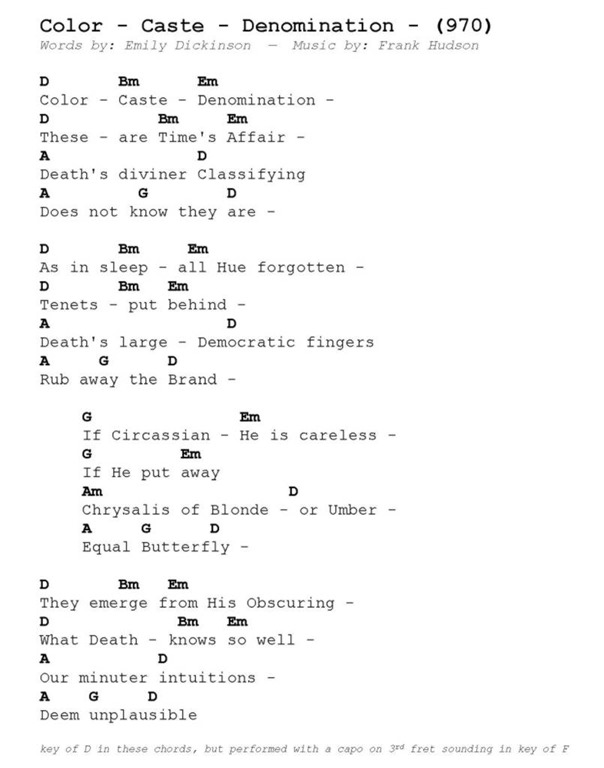
Once more a chord sheet if you’d like to sing this too.

.

The Emily Dickinson Poem

Emily Dickinson has many poems where the small things stand for larger, and then she has others using more philosophical language — yet I was still struck by the first line of today’s Emily Dickinson poem. Poems sometime seek to grab your attention right at the beginning, and this one does that with a trinity: “Color — Caste — Denomination.” These things rule so much of our lives. We may think we don’t let them rule us, but then we see the next person is using them to guide them — or perhaps guide them in how they view us. How can that not affect us. How many next persons can there be without us sometimes being one of those next persons, or yielding to the next person in our lives?

A couple of short notes on things to mention in the poem since we’re running too long. Who’s a “Circassian?” It’s a Middle-Eastern Muslim-believing ethnic group largely exiled from their homeland by the old Russian Empire. “Caste” is a word given by Portuguese colonialists to a hereditary hierarchy they found in South Asia, but it has taken on new usage in modern America to describe the intertwined prejudices and discriminations based on skin color, ethnic background, religion, and economic class. Both terms show a breath in Dickinson’s reading and education. Even though Dickinson’s America was approaching or undergoing a war around race-based chattel slavery when this poem was written, Dickinson seems to give religious prejudice equal or greater weight in the “minuter intuitions” her poem holds that we use to obscure our common humanity. Some scholars have pointed to this poem as a comment on Irish-Catholic immigration in Dickinson’s region at this time which led to a substantial reaction from the existing Protestant settlers.**

My musical setting for it is simple, just guitar and voice, as I’m somewhat rushed for time — and then wanting to use what gifted time I find available when I can record acoustic guitar with open microphones that would otherwise pickup other noise. Though that may have been a practical reason, I think the simplicity works for this hymn from Dickinson’s alternative hymnal. You can hear my performance with the audio player below, or with this alternative, a highlighted link that will open a new tab with an audio player.

.

*Not doubting those stories — see the next note as we see that connect to Emily Dickinson. And I haven’t mentioned anti-Semitism in its Jewish and Muslim varieties. Or the ugly anti-Chinese laws and hate. Oh, and First Nations? I could go on. And that’s just America. I know I have an international readership. Other countries have their own varieties of this, as we’ll see too in Dickinson’s poem. We had all kinds of supposed levels of intelligence and moral fitness that bedeviled us then and now.

**As I mentioned in one of my favorite posts on the roots of Emily Dickinson, her mid-19th century Amherst Massachusetts region had Afro-Americans, mostly in her time in servant class jobs. As she grew into adulthood, the Irish immigrant wave started to displace them, and anti-Irish sentiment ran high. Emily’s brother Austin, who she was close to, at least dabbled with the notorious anti-immigrant Know-Nothings. When young Austin was assigned to teach Irish immigrant kids in Boston, he found the job stressful. There’s a letter from his sister Emily where she jokes that it sounds so bad for him that he ought just as well to go and kill some of them, referencing in the same letter a notorious Boston murder case with anti-Catholic connections. Generously, I sense Emily the satirist there, but this kind of edge-lord humor, then as now, can just be “just joking” license as well. I think: Dickinson, for all her independence of mind, was part of systems, just as you and I are. Even Transcendentalism, the time’s new thought movement that sought to open up cultural enquiry, was not without racism and prejudice. Emerson’s “American Civilization”  which I presented part of earlier here, and which is contemporary with this poem, contained portions with racist ethnography.

The most remarkable thing I can think of regarding Emily Dickinson and Irish-Catholic prejudice is that she ended up working elbow to elbow with Irish maids on her rural homestead that retained elements of its former farmhouse work-load carried with other poor first generation Irish immigrants as the hired help. The longest serving maid, Margaret “Maggie” Maher — did she recall Irish poetic bards and song? When Emily’s precious packets of her remarkable poems, overran a portion of a bureau drawer, Maggie offered up her immigrant’s trunk, in which she’d carried her all to America. When the Dickinsons decided they didn’t like the likeness in the oft-seen daguerreotype of Emily we rely on now, they tossed it out, and Maggie rescued it and kept it. Maggie worked beside Emily as she cared for her invalid mother during her prolonged illness, and she then cared for Emily as she lay dying. She was a loyal worker, but it’s said Emily told her to burn the poems. Then, she didn’t obey. When Mabel Loomis Todd was given the task of arranging the poems for posthumous publication, I read that Maggie did housework for Todd to free up her time for the editorial efforts.

And here’s the final thing, as final as death’s equivalence that today’s poem recounts. When Emily Dickinson died, she, this descendant of one of the town old-guard WASP leaders, asked that her coffin be carried by the Irish workers of her homestead. Aren’t you glad you read footnotes, patient reader? You can read a summary account I relied on for much of this in this academic paper available via JSTOR. It’s author Aife Murray expanded her research into this book, which I read a few years back.

The Seventies and Me

There’s a saying, oft shared with a wink among my post-WWII generation, “If you remember The Sixties, you weren’t there.” In many cases I think this misses its mark. The forgotten decade should be The Seventies. And this is not true just of that generation’s personal stories — while objectively the Seventies has just as many years and minutes as the preceding decade, there’s much less romance to it.

Earlier this spring I indulged in writing in a condensed yet round-about way about some influences that led me into creating the Parlando Project. To remind readers, I’d decided as a teenager that there was something attractive, even exalted, about poetry and this was entwined with an eclectic appreciation for music as a listener. Let me also be clear in summary about this: this was instinctive on my part, mysterious in that no one encouraged these interests.

Now more than 50 years later, these things are still somewhat beyond my understanding. I believe I have some ability to create phrases that seem a good shape and use for language, but I did not understand poetry all that well. Nor was I particularly well read. Even now, if one goes beyond poetry to novels, nearly everyone interested in literature has read more than I have. And poetry? My reading of contemporary poets was not extensive. My observation was that this was not so unusual in my generation of young aspirational poets then. Sure, we knew the greatest hits in the anthologies. A City Lights Ferlinghetti or Ginsberg might be on our shelf of books, maybe an e. e. cummings or a selected or collected here and there.*  But at least among the non-upper echelon college creative writing students I crossed paths with, there was less reading of our contemporaries than I believe one would find currently.

Yet, on these small bits of evidence, I had decided that I was a poet.

Music? Note that I said “listening” above. Despite that single song I wrote on a borrowed guitar late in The Sixties, as I entered The Seventies I neither owned nor played an instrument. I was a howlingly bad singer, even more problematic than I am now. Therefore, my connection to music was as a listener.

As my story now enters The Seventies, what had changed there? Rock music in the Sixties and The Seventies shared many overlapping musical stars, and for those of my age, a likely compiled survey of greatest records would roughly balance in numbers between the two decades. But, somewhere around 1973 something had changed in the music scene —and it wasn’t merely the “27 Club” deaths. My own summary analysis, informed by reading a great many first-hand accounts written by others, was there was a change in drug usage. Heroin addiction wasn’t even the worst of it. Cocaine seems to have inflated egos and tasked musicians with a need to accumulate working capital to keep being famous and high. **

So much framing to start my Seventies condensed memoir —and yet incidents of my life to extract to explain the eventual Parlando Project from the early Seventies are slim! After the post-Kent State flame-out of my short college career and the associated failed college paper editorship, I ended up moving to New York. I hung out at colleges with my peers sometimes, though college for credit was an Eden I was exiled from. I got married, another story too complex, and too peripheral to the eventual idea of the Parlando Project. Still, I can think of three things in the first half of The Seventies that connect somehow to the Project.

I hung out for a season with a college radio station at Westchester Community College. Though the “radio” part was limited to wired connections to audio speakers on the grounds, the students worked to do their best to portray the newly expanded playlists on FM radio. New promotional records came in constantly, expanding what music I would have been able to afford to hear. One young host I hung out with had an informed interest in and programmed contemporary Jazz records. Other students taught the student DJs how to slip cue vinyl LPs on the turntables, which I found fascinating. The hosts worked their own basic but serviceable board to mix in the records or their mics. I gained appreciation for the perfect segue or flow in a set of cuts. Once in a while since, I’ve thought of an alternative, hip-hop or club DJ infused life I might have developed. Didn’t happen, though I later got to watch radio on another level.

Here’s the second story: when I had enough money free, I enrolled in an American literature class at SUNY New Paltz and lucked into the classroom of H. R. Stoneback.  I recall one class were Stoneback asked us what relationship music, and folk poetry and music, might have with literary poetry, the very question I deal with in this Project now. He continued examining some points while playing an acoustic guitar. He was also the person who first informed me that many Emily Dickinson poems could be sung to the tune of “The Yellow Rose of Texas.”

This last one is a more peripheral story, but it connects. At another non-enrolled college situation I was ghostwriting a column and stories in the school newspaper ostensibly under the name of the woman I would marry, who was an enrolled student there. Now I’m not sure if the student newspaper editor was enthralled by the writing or his more carnal desires to sleep with the young woman, which he eventually did. He also edited the school’s student literary annual. I got the wild idea to see how many poems I could publish in it. I grabbed my portfolio of poems I had written at this point, retyped up some of those poems on a variety of typewriters attributing them to various assumed names, and submitted them. As I still do, I wrote in several styles, further establishing the numerous poets as plausibly different people. When the annual came out, I was around a third of the issues’ selected poems, and one was singled out for an award by an English department professor. He couldn’t find the student. “Did anyone know him?” he asked around.

That last story in itself, like many a good poem, has several facets to gleam or blind you. I could explore those — but perhaps I, the author of the scheme and the telling, has a distorted or glare-obscured view. What is it I draw from that tale, that might apply to this Project? I enjoy variety. I enjoy not being myself, and I often am most accepted when I am not myself.

Branched Song

I recall writing this sitting in a old college classroom building, not sure what it was to be about, but knowing the  poor condition of the brick tuck pointing. 7 years later in the  ‘70s,, I made it into the song the title says it could be.

.

I’ll continue later here with another post on how The Seventies developed for me — but let’s honor this Project with a musical piece. Today is the anniversary of Emily Dickinson’s death, so maybe I should honor her and Professor Stoneback? Shame, not enough time after so much writing about myself. How about an example of one of the kinds of poems I was writing then? I looked through old recordings digitized from cassette tapes, and found this one from the 1990s which is an example of one type of  poem I wrote near the end of The Sixties and set to music in the later Seventies. It’s a different gothic sensibility from Dickinson, and I may have been starting to show an interest in French Symbolists, though I don’t recall reading them until later in The Seventies. It’s called “Branched Song.”   Graphical player for many below. No player? This is an alternative link to open a tab with a player in it.

.

*Note these poets, while alive during The Sixties, were obviously much older than my cohort, but they were also for the most part post the textbox canon inclusion line. Frost, Eliot, Sandburg, Wallace Stevens made it under the wire for the tail-end of the canon in the Sixties, though all but Stevens were still living in The Sixties. Marianne Moore and William Carlos Williams, were special cases, maybe there or not, though I recall seeing them first in textbooks in that decade. I did read, as did some others of my generation, Richard Brautigan and Leonard Cohen, who like the Beats were not considered canonical then. But both of those “young” poets were born in The Thirties. I also read poets in the New York School, particularly Frank O’Hara (born in The Twenties!). Black Arts and Afro-American poets came into my ken later in The Seventies. Note also, how scarce-to-none were the women. Not even Millay, who my father knew and read.

**”Rock” was a tag that started to be used in later Sixties to separate “serious” popular music from what was felt then to be the merely commercial and only incidentally and accidently artistic “Rock’n’Roll.” This transition is a complex subject, and it can’t be reduced to a footnote. Rock was open to a variety of influences then, but it was also far whiter and therefore less American than Rock’n’Roll.

And here’s a question that could be debated at length. Would the music changes have happened without then-illegal drugs? And even if something like the Rock transition happened, would it have been as wide-ranging and open to altering expectations? But beyond the Sixties’ evidence on those questions, the Seventies says there’s a rat-train of pipers to be paid. Another imaginary question: if everyone magically went into rehab in 1972, how much better would later Seventies music and what followed on have been?

The Subway

I think I’ve established that I like examining lesser-known Modernists, or even writers who weren’t always considered part of the Modernist movement. Now today I may cause a few literarily knowledgeable readers to throw up their hands and do a spit take. Why? Yes, today’s piece is a sonnet, but we should note that not all Modernists rejected rhyme, and after all this is also a piece of down-beat gritty urban experience. Just look at the opening two lines:

Tired clerks, pale girls, street cleaners, business men
Boys, priests and harlots, drunkards, students, thieves…

A litany that wouldn’t be out of place in the Unreal City a few years later. It could sound like the opening of a piece by Whitman or even Lou Reed as it starts out. As it continues, it doesn’t stint on the darkness literal and figurative. Those subway riders are riders, without agency. With fixed tracks underground they go their “sunless way” with “reluctant feet” as our Modernist Dante tells us. When I first read this* having seen the author’s name before reading, my thought was “Could the writer of this piece be misattributed?”

Go ahead, go to the bottom of the post and listen to the performance I put together using this early 20th century New York City poem about ordinary and agentless people lost in underground darkness. It’s less than 3 minutes long. Hear it first without knowing who wrote it.

Joyce Kilmer in uniform

Is this something of a belated Memorial Day post? Today’s author would die serving overseas in the U.S. Army during WWI.  But stop reading and skip down to the bold-faced section at the end for a chance to hear the audio piece first.

.

OK, now let’s take off the Masked Singer costume: the author of the sonnet that I used as the text for today’s audio piece is Joyce Kilmer. I expect two responses to that information: “Huh?” and“What!”   The former “Huh?” might be from my younger readers, as this is less likely a poet they’ve run into in our present century. That was not always so. Those my age or older will likely associate Kilmer with a single poem which was once so well-known and liked that it became a point of contention with many educated folks. That poem was “Trees,” the one that begins “I think that I shall never see/A poem as lovely as a tree.” My first High School English teacher Terry Brennan explained that he had had a High School teacher who had recited it while bodily enacting the “lifts her leafy arms to pray” part of Kilmer’s “Trees”  poem. I believe he told us this to establish that he was not going to inflict a similar pedology on us (thanks Terry for that, and much more!) A columnist I liked to read in the Des Moines Register as a teenager, Donald Kaul, loved to pillory Kilmer’s “Trees”  as a crime against better culture.**  They had a point. “Trees”  was ripe enough with pleasant sentiments that it likely did its part to help kill off the pathetic fallacy in modern poetry, but let’s start with its first publication: in Poetry  magazine in 1913, in an issue of that important publication for new verse that also included certified Modernists Ford Madox Ford, Ezra Pound, and Skipwith Cannell, the later a favorite of the Others  circle.

And speaking of Others  magazine, Kilmer was in New York as a young poet in the years before WWI, rubbing elbows with those who would be associated with that city’s fearless avant-garde. Orrick Johns mentions him as someone he knew in those days. When Poetry’s editor Harriet Monroe published her anthology The New Poetry  in 1917, Kilmer and his poem “Trees”  is included alphabetically between poems by Orrick Johns and Others’  founder/editor Alfred Kreymborg. Kreymborg in his interesting memoir Troubadour  recounts that Kilmer was one of the few “actual writers” he was acquainted with in his earliest days as a poet. Kilmer read some of Kreymborg’s short free-verse poems and suggested “You ought to divide those lines and make them rhyme—there’s poetry in them” which Kreymborg considered encouragement. Kilmer was working then for Funk and Wagnall’s, the dictionary people, and even gave Kreymborg some assignments for the dictionary which paid the young man $10, his first check for writing anything.

But all that is circumstantial Modernism. Besides “Trees”  the Kilmer verse I’ve found online is almost entirely religious in nature, and it doesn’t come close to threatening Gerard Manley Hopkins’ gravity and vitality in that regard. If there are other poems that Kilmer wrote that are like “The Subway”  I haven’t seen them.

Why did that “Trees”  poem stick? Trees may not be the Internet Cat Pictures of nature poetry, but readers do seem attracted to those stately greenhouse-gas-absorbing plants. And there’s more: unlike Great Britain, Kilmer was just about the only U. S. poet killed in WWI.***  In England a young poet like Rupert Brooke could gain public attention that persisted after the war even if he was only one poet-casualty out of several of his countrymen. In America, the “Trees”  man received the whole pension, and a large East Coast military base was named Camp Kilmer and served as the place where many of the Greatest Generation embarked and returned to America for WWII.

Did you jump down to here in order to listen to the song I made out of this early 20th century American poem about the New York City subway? If so, there’s a player gadget for some of you, and for the rest, this highlighted hyperlink that will open a new tab/window to play the piece. After you listen to the song you can return to the rest of the post to find out what “Modernist” wrote the lyrics.


.


*I first read this poem over at the Fourteen Lines blog, which, as you might guess, likes to present shorter poems in the sonnet range. This link is their post about this poem, and it also includes the much more widely-known “Trees.”

**Even later in his career, satirist Kaul couldn’t help but get one more lick in against Kilmer and his poem “Trees.”   Kaul also didn’t like girl’s basketball, which I and Iowa were in agreement was a mistake on Kaul’s part.

***The other name that comes to mind was Alan Seeger, the “I Have a Rendezvous with Death”  poet who died ahead of the U.S. participation in the war fighting with French forces. His nephew was Pete Seeger, as Pete liked to point out at times.

Songs of a Girl II

I’ve mentioned I’m reading a couple of memoirs that cover the early 20th Century Modernist era in America this month. At some point there may come a post here directly about them — which this isn’t — but in one of these memoirs, Troubadour,  its author Alfred Kreymborg is discussing the launch of his crucial American Modernist poetry magazine Others.*   He writes that his initial goal in starting Others  was to publish Mina Loy** and William Carlos Williams, but as he and his main backer discuss their first issue, the initial work of selection is described as including Loy, but then another poet: Mary Carolyn Davies. Indeed, when the first issue of Others  arrives in the summer of 1915, the first poet presented is Mary Carolyn Davies and a version of her collection of short pieces called “Songs of a Girl.”***   Davies work directly precedes in Others’  first number the debut of Mina Loy’s set of longer “Love Songs,”  the series of caustic love poems which introduced Loy’s indelible image of “Pig Cupid.”

Mary Carolyn Davies

One of the few pictures of Davies

.

In memoirs when I come upon a writer I’ve never heard of, a “I should at least check briefly on who they were, what they did” research reflex is triggered in me. “What? Not even a Wikipedia stub entry!” was one return on that. Just how obscure is this author? I’d say we know more about Davies than we know about Sappho, and less than we know about any other author that was published in Others  just a hundred years ago. Dates of her birth and death are not clearly known. The former somewhere in the 1880’s or early 1890s, and the later as wide as 1940 and 1974.  She grew up in the American Northwest, and this short Oregon Historical Society entry has the longest biographic note I’ve found. Her work was presented not just in Others,  but by the Provincetown Players too, giving some evidence that she was connected somehow with the bohemian New York City area avant guard in the early 20th century, but she’s also said to have published in a variety of mainstream publications, perhaps to keep the pot boiling.

Mary Carolyn Davies Play

This is Davies’ play which was performed with music by Kreymborg at the Provincetown Playhouse in NYC. Read this link for this  intriguing description of it. Now, to give some contrasting sense of what her potboiler work may have entailed, this hit recording with a Parlando recitation may have been from a published poem of Davies. Per the Oregon Historical Society bio, about this time Davies would have been destitute in NYC when this 1942 record was on the hit parade. The bestial creature with the whip in Davies’ playbill? The character’s name is Life!

.

Some have compared Davies to Edna St. Vincent Millay, who of course is vastly better known. Encountered in a vacuum, Davies’ “Songs of a Girl II”  could be taken for Millay, and particularly with today’s piece, as a more explosive take on Millay’s famous “First Fig”  short poem published several years later.

In our time, I could casually compare “Songs of a Girl”  to modern “Instagram Poets” what with “Songs of a Girl’s”  short pieces and public intimacy.

Those who’ve read this blog over the years know I’m often fascinated by such mysteries, with those “Flowers [that] fail in wood — Or perish from the Hill” that Emily Dickinson wrote of. How widely or narrowly interesting is Davies’ work? I don’t know yet, but for about a minute and a half you can consider one tiny bit of it as I perform “Songs of a Girl II”  using the player below. If you don’t see the player gadget, you can also use this highlighted hyperlink to hear the performance.

*Here’s the Wikipedia entry for Others.  The contributors that wrote that want to make a strong case for the social and sexual radicalism of Others  in 1915. I don’t know enough to say if they overstate that case, but with Kreymborg’s determination to publish American Modernist work he was  pushing boundaries out every which way. Other important and sometimes longer-lived publications that included Modernists, like the Chicago based Poetry,  mixed in more conventional verse, while Others  stayed true to its credo: “The old expressions are with us always, and there are always others.”

**Mina Loy was once nearly as forgotten as Davies, but in this century her work has been re-examined and found by many who do that to be extraordinarily vital.

***I am unsure at this point what the entire contents of Davies’ “Songs of a Girl”  was intended to contain. There appear to be at least three differing collections that can be found under this title and author — all of them sets of short pieces without individual titles, each set off by Roman numerals. In one, today’s piece is “II,” and in another it’s “III” in a series titled “Later Songs,”  while in the 1915 publication in Others,  today’s short bit doesn’t appear at all. The version I saw first and used when preparing my piece today was in the 1917 The New Poetry  anthology edited by Harriet Monroe.

Perhaps Davies intended Songs of a Girl  to be like Whitman’s Leaves of Grass, an all-encompassing and evolving statement?

Long Island Sound

Some poets, like some musicians, suffer from the “one hit wonder” syndrome, and Emma Lazarus is surely one of them. Lazarus is forever tied to a sonnet The New Colossus,”  the one that includes the line “Give me your tired, your poor…” which has not only been made part of The Statue of Liberty, but has become an unofficial idealized civic document of America’s relationship to immigrants and refugees.

Which might make you think that Lazarus’ family was part of that great American immigration wave of the 19th and early 20th century. Not so. Her family were 17th century immigrants to New York State, via a bank shot from Portugal to Brazil, as Jewish heritage peoples fleeing the aftermath of the Inquisition.

That someone had to have written this well-known poem is self-evident, but it hasn’t really made Lazarus’s work beyond “The New Colossus”  subject to much study or readership.*  Today’s piece “Long Island Sound,”  another sonnet by Lazarus, has been passed around on blogs and poetry sites a bit though, so let’s see what we have. Here’s a link to the full text of “Long Island Sound”  if you’d like to read along.

It’s a nature poem, a somewhat ecstatic one without resort to explicit words labeling emotion. I note one or two darker notes in the catalog of images of an August day that add shade to this summer ease: a “grave sky” appears here, and unless that’s a foreshortened “engraved” for meter’s sake, a summer storm may be forthcoming. The imagery raises to a superior level at times for me. The far-off sail “white as a crescent moon” is good, the tide’s sound on sand rendered as a “lisp” and the children linked with crickets is even better, and the “clouds fantastical as sleep” sticks with me even after several readings. Did Lazarus intend the pun on the word “sound?” I hope so.

I also like the ending. As I’ve learned, Lazarus’ family was well-off, but the persona in the poem is not specifically of any class or wealth. I can recall a summer working at a small factory in Mamaroneck, and a weekend afternoon watching a friend of a friend’s father sail his one-man boat out in the lower part of the Long Island Sound while we on the shore had the free talk and association of those without money for much of anything else. This poem’s Winslow Homer-ish landscape requires only the poet’s ownership of attention to claim it.

Winslow_Homer_-_Moonlight

Since this is a painting by Winslow Homer, you won’t be able to hear the water lisping on the sand or crickets chirping amid the sound of distant children.

The player gadget to hear my performance of Emma Lazarus’ “Long Island Sound”  is below for most, but if you don’t see it, this highlighted hyperlink is an alternative way to play it.  A short and jaunty one today.

.

*No worse than any other 19th century American woman poet who isn’t Emily Dickinson I guess. Lazarus is not the poetic innovator that Dickinson was, but she shares a few traits with Dickinson: her family was well-off, allowing her some privileged resources, she never married, she was something of a follower and admirer of Emerson (for at least awhile), and like Dickinson she knew Thomas Wentworth Higginson.

Adelaide Crapsey, A Ghost Story

We’re a couple of weeks past Halloween, but let’s finish out our series on American poet Adelaide Crapsey with a ghost story about two families. Perhaps you don’t believe in ghosts? That’s OK. In this story one family believes in ghosts and the other one doesn’t.

As we learned yesterday, a young scholar and writer of poetry, Adelaide Crapsey was struck down just days after she turned 36 in 1914 by tuberculosis. Though greatly weakened by her illness, she had worked on organizing a book-length collection of her poems in her final year, including a section introducing examples of a new poetic form she had created.

Alas, she didn’t seem to have a publisher when she died. It’s uncertain who knew about the poems she’d selected. Adelaide had a strong belief in self-reliance and not burdening her friends and family, and so for as long as possible she’d kept the news of her grave diagnosis from them, and some of the poems in her manuscript (such as the ones used in our last post) spoke frankly about her illness, pain, and thoughts on mortality.

adelaide crapsey grave

A grave marker that doesn’t burden you either. She ended her collection of poems: “Wouldst thou find my ashes? Look/In the pages of my book”

There were some external reasons for this desire not to burden her family. Her father, Algernon Crapsey* had been a prominent Episcopal priest in Rochester New York, one who had practiced a ministry to the poor and other disadvantaged portions of the Gilded Age. Adelaide’s father came to believe that certain spiritual beliefs of his church were not only of doubtful accuracy, but that taken on faith they would hinder service to the poor. Once he decided he was right about this, he wouldn’t shut up about it either. He preached it, he wrote articles and books about this: if you believe in miracles and heavenly rewards you are all too likely to not feel the need to make your own miracles by action here and now, in this life, on this Earth.

This put his church in a bind. Here was a churchman who was known for manifest good works around the state of New York, a Christian hero of a sort—but who was also vocally opposed to church doctrine.

So it was that a few years before Adelaide Crapsey died that a committee of investigators from the Episcopal diocese came to the parsonage where Adelaide had grown up to question her father on these matters. Her father was out, doing those good works. Her mother was worn-out from dealing with this all. Adelaide, like any good PK,** stepped in as hostess. The story is told that she served them tea and kept them graciously talking as the tea went down.

Oh, and she had spiked the tea with rum. It was said the investigators inquisitorial rigor suffered a decline during their wait.

But Adelaide’s father would not keep quiet. He eventually met with a church trial for heresy.***  He claimed the heresy of the church not serving the poor as Jesus commanded was far greater than any they could charge him with over supernatural events, but the church’s hierarchy convicted him. Maybe he wasn’t a heretic who believed in different gods or another heavenly host, but it just wouldn’t do to be a priest of their church who didn’t profess the right beliefs.

No burning at the stake though, he was just written out of his job and the church. The family had to leave the parsonage where they had lived for decades for a house some supporters found for them elsewhere in town.

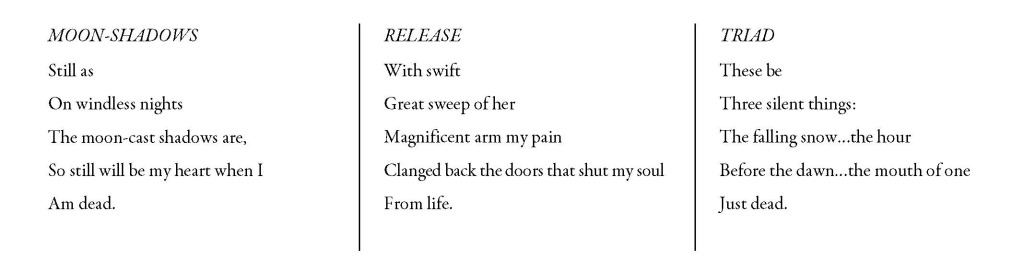
Adelaide, like her family, didn’t believe in heaven and hell. And now she was dead, and as her poem had put it, her mouth was now part of the quiet as with falling snow and the hour before dawn.

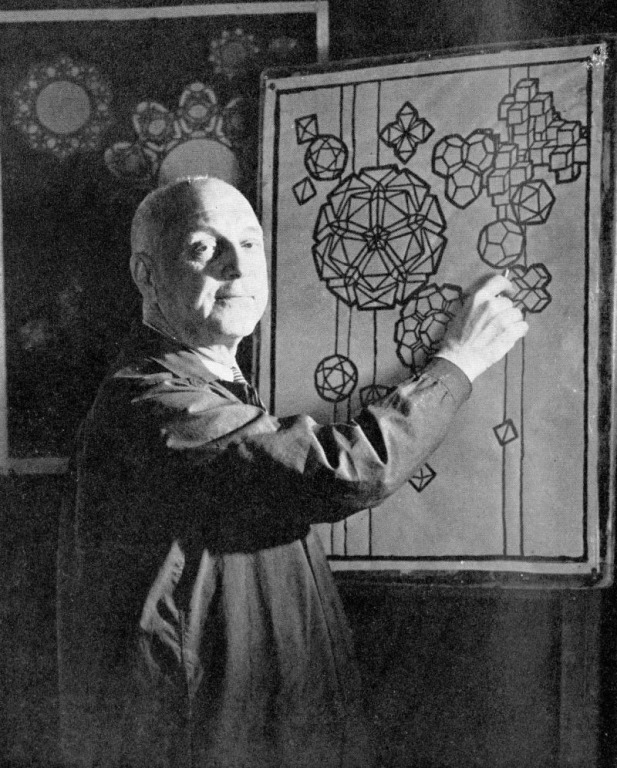
In another part of the same town, there was a successful architect, Claude Bragdon. What kind of architect? Do you know the names of Frank Lloyd Wright, Louis Sullivan, or Buckminster Fuller? Claude Bragdon was that type, committed to artistic principles, in his case to a religious and mystical level. Indeed, he had a strong side-interest in Theosophy, a 19th century unified field theory of spiritualism and hermetic knowledge. He had known the Crapsey family and Adelaide at least somewhat. Adelaide had taken his mystical bent in stride, calling him “cube man” due to his fascination with the hypercube (which I think may be related to Buckminster Fuller’s theories about the geometric nature of the universe).

Claude_Bragdon

“The geometry of innocence flesh on the bone/Causes Galileo’s math book to be thrown” Claude Bragdon sings the Tombstone Blues.

Claude Bragdon had not been married long when Adelaide Crapsey died. His new wife, Eugénie had never met Adelaide. One day, in that silent time of the hour before the dawn, something happened. Here’s how he described it in his autobiography:

One morning in the summer of 1915 I was awakened by my wife Eugénie, who asked me if I knew anyone by the name of Adelaide. I told her that Mrs. Algernon Crapsey’s name was Adelaide, and it had also been that of her daughter, who had died a short time before. “Take me to see Mrs. Crapsey,’ said Eugénie, ‘because I was awakened by the sound of her name, repeated over and over: Adelaide! Adelaide!’ “

Now if a chill runs up and down your spine to hear this, the architect and his wife may have taken it more calmly. Not only were spirit voices and mediumship part and parcel of Theosophy, Eugénie was a “Delphic Woman” in her husband’s estimation, one who used automatic writing to take down sayings and messages from the ether.****  And so now Eugénie’s automatic writing sessions became peppered with messages from the late Adelaide Crapsey. With a little interpretation, the messages seemed to be referring to the poems, the book-length collection Adelaide had been working on.

Book negotiations have been known to get complicated, and I haven’t read all the source materials for this story*****  but somehow the husband and wife mystic family convinced the social-gospel materialist family to go through the late Adelaide Crapsey’s effects, and retrieve the manuscript. I can see this scene written in Mulder and Scully dialog.

Claude came out of the Arts and Crafts movement, so buildings weren’t his only art. He also ran a small press for books on his theories and other Theosophical works. He became the book designer and publisher that introduced the world to Adelaide Crapsey the poet and determined ghost.

What became of Adelaide’s ghostly voice? It didn’t do a book tour or poetry readings—pity that, it would have pipped Tupac’s hologram by nearly a century and spiced up the valves of many a bookstore. The final automatic writing messages thanked the Bragdons for their efforts and assured everyone that the other side was a fine and happy place where she didn’t miss living at all. Just so much “Bread and butter notes” from the beyond.

At this point the man with the skinny tie and narrow lapel suit should step forward from the shadows and wrap things up, but where’s today’s audio piece?

Well, I did say that Claude Bragdon had many artistic interests. One of his friends was Alfred Stieglitz, the pioneering art photographer who was connected to another famous photographer Edward Steichen, a friend and brother-in-law of Carl Sandburg. Either through that connection, or Sandburg’s strong early interest in short poems created with concrete images rather than abstract words, or some Great Lakes leftist linkage between Adelaide’s social gospel preaching progressive father and the Milwaukee and Chicago based socialist Sandburg (maybe more than one of the above?) made Carl Sandburg aware of Adelaide Crapsey’s poetry and story, and he wrote a passionate elegy for her.

Here’s my performance of that poem of Sandburg’s, available with the player below. No player visible? Then use this highlighted hyperlink to play the piece. The full text of Sandburg’s poem is here if you’d like to read along.

.

*I should have warned you: as elsewhere in this story, the 19th century names are full-flavored.  If Lemony Snicket reads this, let it be known that I will defend my intellectual property to the upmost here!

**PK, “Preacher’s Kid.” As a class, they have an opportunity to grow up with an interest in philosophy, ethics and words, but also with a childhood were the expectation to be good and the desire to rebel have to be balanced from a too-early age. Alternative reader here Dave Moore and my wife are both PKs.

***The story of Adelaide’s father Algernon Crapsey sounds eerily similar to a tale from The Sixties and another Episcopal clergyman (a bishop no less!) James Pike.  Pike was also committed to social change and questioning of religious dogma and was threatened with an ecclesiastical trial for heresy. Coincidentally, Pike eventually worked with a medium to try to contact his dead son.

****We now use Twitter. Much better. But are those odd messages we read from bots or….the other side!

*****Two women have worked to discover and catalog much of what is now known about Adelaide Crapsey’s life and work and are the prime source for much of what I know: Karen Alkalay-Gut who has written a biography of Crapsey Alone in the Dawn and Susan Sutton Smith who has written about the Crapsey and Bragdon families’ associated papers and published the Complete Poems and Collected Letters of Adelaide Crapsey.

Three More Cinquains

Once more, let’s travel back to 1914.

For several months, as summer 1913 turns to ’14 through autumn and winter, a 35-year-old woman is creating the manuscript for her first book-length collection of poetry. Creating a book-length manuscript is always a challenging task, and regardless of whatever realistic expectations the author might have for its reception, hope is normally the fuel for this. First collections are like that, as a poet figures out how to introduce themselves to strangers.

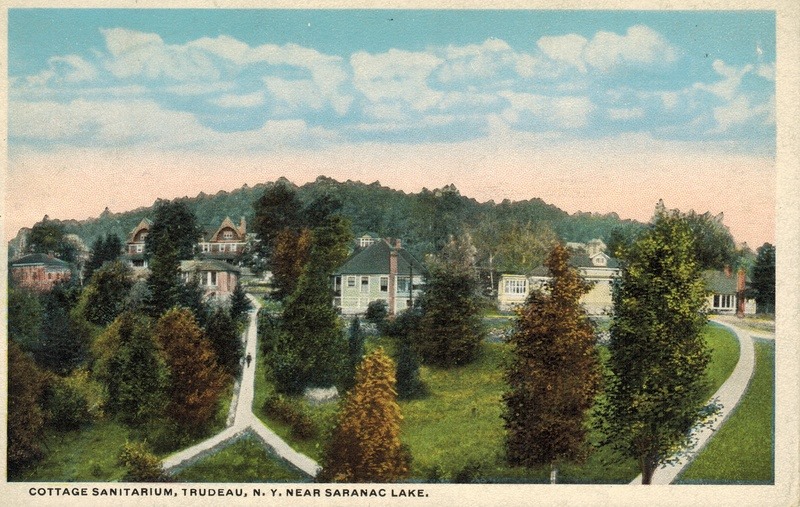
But this woman, Adelaide Crapsey, is also producing her final collection of poetry, and she likely knows that. She’s not working in her study or at some granted writer’s retreat, but at a sanitarium* where she’s suffering through the last stages of tuberculosis which has spread to her brain. If 1914 is The Year that Imagism Broke, it’s also the year that she will die.

Saranac Lake Cottage Sanitarium circa 1918

There are many paths away from here. How long are any of them?” Du Fu


The book that she is working on will be published in 1915, and it will be the place where she’ll introduce her own poetic form, the cinquain. The cinquain is a short five-line verse form, primarily iambic, that uses an increasing series of syllables: two in the first line, four in the second, six in the third, eight in the fourth, and then back to two in the final line. Some have noted that the increase creates an expectation of growth or expanding sense, only to have the ending come up short and terse. I’m not the first to see this as a symbol of Crapsey’s life and art itself.

Still it’s remarkable that Crapsey chose such a small, tight form into which to pour her thoughts on illness and approaching death. Some might choose a short but loose form to conserve energy; others might turn rangey trying to get all their last expressions in. Crapsey seems to find in the form’s limits the borders within to hold her place.

Three More Cinquains from Crapsey

Here are the three cinquains I used today. Illness and the eventual passage of dying is something we all share. Crapsey used tiny poems to bear vivid witness.


In the early 20th century world of Modernist American poetry, her tragic story lent a degree of publicity to the posthumously published book, but it was a small fire which soon burnt out. As I mentioned last time, extremely short poems and the direct lyric impulse is not where Modernism headed after the 1920s—but in the long run, we can still access these poems the only way that poetry can be reached: by directly taking them inside us. These cinquains don’t ask for a large place.

For my performance of three more of Crapsey’s cinquains of 1913-1914 I composed music for strings which sounds acoustic even though there is some spare, bell-like Rhodes electric piano and a cello line that is treated with a strong resonant echo that I think adds some poignance. I don’t know where this melody and counterpoint came from, but as I tried and played some string lines on my MIDI guitar it came to me quickly, as if out of the air. You can hear it with the player below.


*Looking to see what I could find about a Saranac Lake sanitarium I found a fascinating story about a small upstate N. Y. town that welcomed tuberculosis patients for palliative therapy in the early 20th century. Other literary residents after Crapsey included novelists Allan Seager and Walter Percy. On first reading “sanitarium” I had visualized a large dreary hospital building, but the setting appears to be surprisingly humane. Coincidentally, the remaining buildings were sold a few weeks ago.

Union Square

Last month when I dropped Sara Teasdale’s “I Shall Not Care”  hurriedly, I promised I’d return to Teasdale and say a bit more about her.

I’m not sure where Teasdale is in “The Canon” of modern verse now, but back when I was in college, she was even more left-out than Edna St. Vincent Millay, and for similar reasons. Teasdale and Millay were both contemporaries of the pioneering early 20th Century Modernists, both were published in their little magazines, received prestigious literary awards, and achieved a considerable readership in an era when page poetry had a more general readership.

But such status didn’t hold. As the 20th Century wore on, and High Modernism and academic-informed writing became the predominant style, Teasdale, like Millay didn’t seem to have the gravitas High Modernism required—after all, both wrote often about love and desire, a subject that if treated directly wasn’t thought serious enough. You know, “women’s stuff.”

If you’re getting the idea that by mid-century, Modernism was a bit of a boy’s club—well, yes, it was.

Teasdale had all of Millay’s problems with the curators of Modernism, and then some. Millay could write in the more modern style as well as engaging in somewhat old-fashioned-sounding sonnets. Teasdale was more adamantly a writer of metrical, rhymed lyrics that increasingly didn’t sound modern enough. Millay herself was a fiercely modern woman whose persona contrasted against any Victorian trappings in her poetic music, while Teasdale seemed less sure of herself. A typical no-win-situation for female poets by mid-century: assertiveness or originality couldn’t overcome the patriarchal attitudes—while submissiveness and reticence guaranteed its victory.

We’re decades past all that now, and we have a new century well underway. Today, it may seem like less of a crime for Teasdale to use the poetic music of 1875 instead of 1925 in this poem written around 1911. Publishing a poem like “Union Square”  would have not caused Millay any second thoughts, but Teasdale went back and forth on that. In a fascinating run-down of Teasdale’s own doubts about the poem, Melissa Girard recounts early readers giving feedback like “Perhaps it is better, after all, to pursue the lovelier side of existence, and only give expression to what is unmarred in the realm of beauty.” And bizarrely, even after publishing it, Teasdale suggested “If the idea at the end of ‘Union Square’  had not been an accident suggested by rhyme, I should never have said what I said.” Say what? One of the beneficial side-effects of rhyme is that the search for it can work like Surrealist and automatic-writing techniques to jolt the mind’s search for language in directions it might not otherwise go—but none of the lines in “Union Square”  where the poem’s speaker compares herself to the streetwalking prostitutes are rhyming lines.

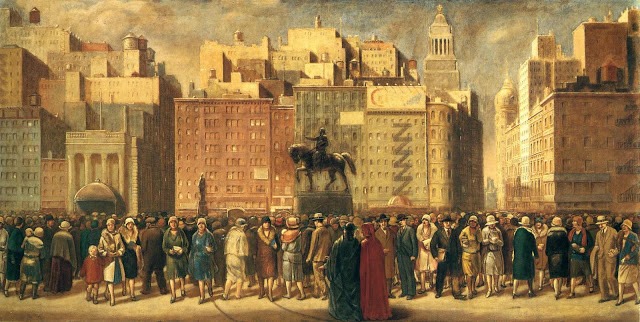
isabel-bishop-virgil-and-dante-in-union-square-1932

Looking for early 20th Century pictures of Union Square I discovered a remarkable painter Isabel Bishop

I found it impossible not to sing this poem when presenting it, the poetry just demands it, even if the poem’s persona is expressing constraint. I think that contrast is what makes this poem, and Teasdale, worth considering. To hear my performance of Sara Teasdale’s “Union Square,”  use the player gadget below.

Up-Hill

Last post I compared late 19th Century cultural hipsters with early 21st Century urban cultural revivalists.  Did modern natural-fiber clad, skin-inked and perforated young people study up on William Morris’ Arts & Crafts movement and visit museums to absorb the Pre-Raphaelites? Some perhaps, not all. And the same can be said for what is carried onward from punks, hip-hop kids, hippies, beatniks, and so on. I’m too old, and too little a sociologist to answer this definitively.

I can say that when I tried to discover what kind of music I wanted to make in the 1970s I copied imperfectly many musicians from the previous decades as well as my contemporaries working down the river in New York City. And those NYC contemporaries? They too were looking backward to move forward. What had been overlooked? What had gone out of fashion for no good reason? What had been uncompleted? So, in listening to them, I was listening to their understanding and misunderstandings of the past too.
 
One of our principles with the Parlando Project is “Other People’s Stories.” Part of the above is “my story”—but my musical story is really made up of other people’s stories.
 
Tracing the path of influence is often hard to do. Today’s piece Up-Hill  is an example. The words were written by Christina Rossetti, that sister of the Pre-Raphaelite Brotherhood. Obviously, she’s familiar with the Pre-Raphaelites and their circle—but she’s also deeply interested in a Christian religious revival, and that too gets reflected in “Up-Hill.”  Would she have known Anna Coghill’s poem that was set as the hymn Work for the Night is Coming?”  That’s unknown to me, but “Up-Hill”  and “Work for the Night is Coming”  are both poems understood in context as being Christian devotional, while containing not a single specific utterance about a deity, salvation, or an afterlife. With revivals, context changes things.

Christina Rossetti

Christina Rossetti thinking about an up-hill journey?


And here’s another way that influence is hard to trace: it becomes unconscious. As I was writing the music for “Up-Hill”  I was mostly interested in varying my customary harmonic cadences while keeping it to just two or three chords, a short number that often works best for performance with the LYL Band. And “Up-Hill”  is, after all, a work of beautiful simplicity, saying something profound without pretentious elaboration.  I settled on a simple I V IV I progression, and tried it with the band last month, but my vocal wasn’t working. Trying again this month, the unconscious struck.

VU - Shall I Meet Other Wayfarers At Night

“Shall I meet other Wayfarers at night?” The Velvet Underground  certainly think so.


I didn’t realize until I was working out the rhythm track that I was falling into a Velvet Underground groove, like the one they used in I’m Waiting for my Man,”  a tune that is also understood as devotional in context—though to drugs, not a deity. Both songs feature a journey to a destination (up-hill or up-town), both engage in conversation along the way. Was this subconscious choice a sly comment on Christina’s brother Dante Rossetti’s addictions? A comparison of recovery to salvation, or of addiction to salvation?  No, the groove was just working, and it helped me get a better vocal down. If I understood anything about what I was choosing while doing, it was that I was linking sub-cultures and following the near invisible web connecting Other People’s Stories.

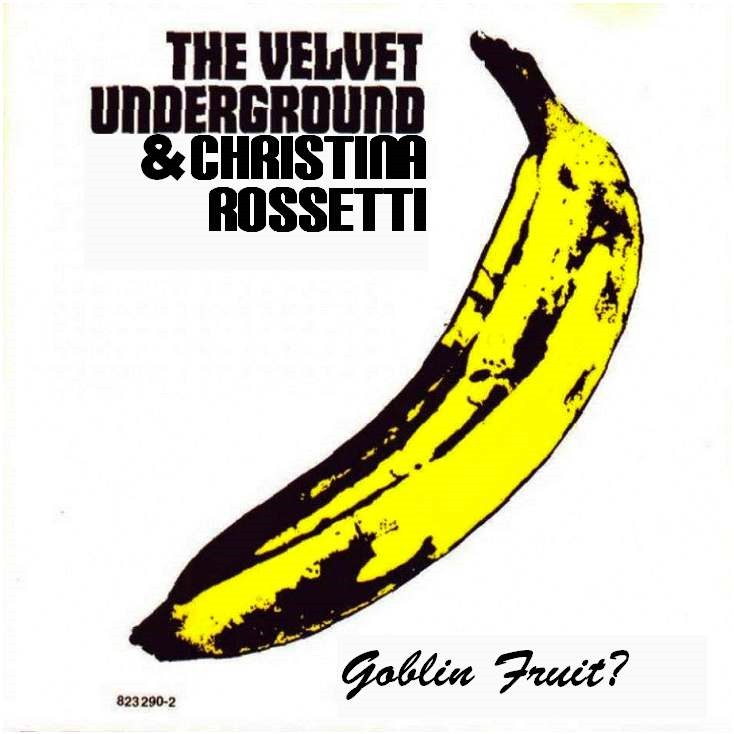
Velvet Underground and Christina Rossetti Cover

So what would that sound like? Use the player below to find out.


Same as always, the player should appear below.to hear the performance of “Up-Hill.”  And keep sharing the links, subscribing, and telling folks about the Parlando Project.

Bar Tryst Late Winter

I’ve been on the serious side for the last few episodes, but this time it’s going to just be a late night, late winter jam called “Bar Tryst, Late Winter.” I wrote the words to this one—at least I think I did.
 
Do you know the story of how the song “Me and My Uncle” came to be? It’s a great cowboy song, recorded and sung by many people, including The Grateful Dead. Sometime in 1964 or so a songwriter named John Phillips who had toured to no great acclaim during the American Hootenanny pop-folk era in the early Sixties got a royalty check for writing this song. Seems Judy Collins has recorded it on a live album, and his first thought was to set the record straight. He got in touch with Judy Collins and told her that the writing credit must have been a mistake, that he didn’t know anything about any such song.

Collins then proceeded to tell the surprised Phillips that both of them had both been at an after-concert party in 1963 where a heady mix of intoxicants were present. During this night she had heard him compose this song on the spot. Luckily someone had run a tape recorder during the party, and from that tape she had learned the song.

Judy Collins

Such a good song-finder, she could find songs the songwriter didn’t know about!

 
Well, Judy Collins was not involved in my story, but it’s more or less the same. Sometime early this century I was looking through some old notebooks from the 1970s where I had written some things, and there on a page in my handwriting was this piece. Not only had I had no recollection of writing it, I had no recollection of any night quite like it describes. It’s possible I imagined the scene, using elements of things I had experienced,  It’s even possible that I didn’t write it, but why would I transcribe something of that length in the midst of other things I was writing?

Shortly after rediscovering it, I recorded this live take with the LYL Band and a drum machine. The guitarist I was playing with at that time was Andy Schultz who pulled out a lot of improvement in my playing as we wove lines between the two of us. Like the composition of the words used here, I can’t always tell when I listen to recordings from this time which of us played which guitar line back then.

To hear the LYL Band perform “Bar Tryst, Late Winter,” use the player gadget below.