Susan Partain Hudson’s Anniversary Poem

It’s New Year’s Day. Most everyone’s looking forward, but I’m going to double-jump into the past, first to exactly 99 years ago, and then to more than 160 years ago.

I do a lot of stuff from the Modernist era of the first part of the 20th century here at the Parlando Project, but of course not every poet was going all Imagist or Surrealist or whatever new ist was their jam. And one can well note that written poetry in this era still retained a bit of the mass-media or populist strains that are harder to find in our 21st century.*  Non-literary-circle people then still might read poetry or write it without taking a stand between Amy Lowell or Ezra Pound.

An example: on New Year’s Day in 1927 an 80-year-old woman wrote an anniversary poem to her husband of 61 years. Susan Emeline (Partain) Hudson was my great-great-grandmother, the mother of my great-grandfather for whom I am named. Her New Year’s poem isn’t looking forward much, but then her husband would die later that year, and she would die within two more years. Instead, her poem recounts how the couple met and gives some hints about how they came to settle in Iowa.

Susan Emeline Partain was born in 1847, the daughter of a carpenter who lived in Chattanooga, Tennessee. Tennessee’s stance during the American Civil War over slavery was somewhat unique. It was a slave state, but it joined the Confederacy only after the war broke out – though eventually supplying the second highest number of troops to the retain slavery side.**  Yet the state government also officially withdrew from the Confederacy shortly before the end of the war, and this move meant that Tennessee didn’t come under the short-lived era of Reconstruction when the federal government sought to remediate the former slave-holding and secessionist leadership. Tennessee was also the place where the very first WASP-supremacy KKK terrorist group was founded, right at the end of the Civil War.

That’s a hell of a paragraph to put in a love story isn’t it! In calmer national times than ours of New Year’s 2026, throwing this in would be as inappropriate as my choosing a poem-made-into-song of religious persecution for this past Christmas.

But I go forth, and here’s the background of the tale Susan Partain Hudson put down. That husband was David Hope Hudson, a young corporal from Ohio who enlisted in the Union Army. His unit was fighting in Tennessee, and involved in some of the bloodiest battles of the war. On and around New Year’s Day 1863 they are engaged in the Battle of Stone’s River. Union forces suffered 32% casualties over 4 days of fighting. For those that aren’t military history nerds, that approaches Charge of the Light Brigade levels of carnage. That summer these Union forces take control of a critical railroad/riverboat center, the town of Chattanooga. Later that year, in the autumn, they are in the battle of Chickamauga as the Northern forces seek to expand their control in that region. Once again, casualties on both sides are terrifying, 28%, and given that 150,000 troops were engaged (counting both sides) it was the second bloodiest battle of the American Civil War to Gettysburg.

Chickamauga was a Union defeat. The forces that included David Hudson had to fall back to Chattanooga. The Confederates, bloodied by the equivalent casualties to the Union at Chickamauga, didn’t press on against the retreating Union army, choosing instead to surround and cutoff the town of Chattanooga. For about a month, the Union army is besieged with no supplies able to get through. Hardtack and salt pork run low, are rationed. And here I need to leave off details, as I haven’t found a detailed account of that month for the Union army troops, or for remaining civilians.***

Susan Partain was a teenager living with her family there, and it’s possible they remained in the town, or at least in the area. Without details, one can only speculate on what things were like for Susan and David during this siege. I’d hold that it’s possible that the cup of water that her poem speaks of was symbolic of more than that, though the poems says the exchange happened in summer and the siege-stage of these battles was in the fall – but clearly this matter is much more risky than a simple flirtation between two young people. Susan’s poem doesn’t give us those details, but her audience – chiefly her husband now near the end of their long-life together – wouldn’t need for that to be said.

We also don’t know everything Susan’s family felt. Hudson family lore says they might have had Union sympathies, but also that they weren’t supportive of Susan’s romance with the soldier. In the summer of 1865, Susan’s mother died, and that may have broken some constraints for her. David, still stationed in the south, was mustered out in October 1865, and he and Susan eloped off back to Ohio for that New Year’s wedding.
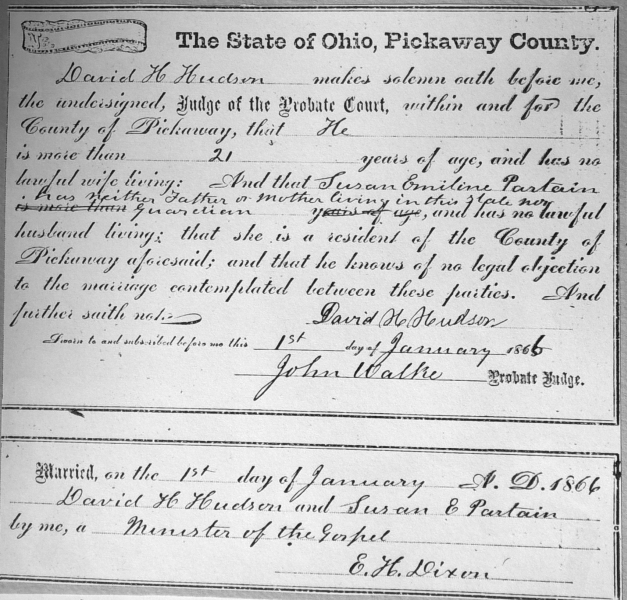
David Hudson and Susan Partain Mariage cert 600

Two things I notice in this marriage certificate: that it may have been necessary to be in another state for Susan to marry without her father’s permission, and that David, or whoever filled out the Jan. 1st date, may have suffered from the still common error of writing 5 first before revising the year with the current 6.

.

Susan never saw nor stayed in contact with any of her family back in Tennessee until 1905, by when many of her elders were likely dead and she wanted to find out what had happened to her siblings. The newly-married Hudsons also didn’t stay in Ohio – Susan was viewed with suspicion there too. The place they chose to raise a family (eventually, 11 kids!) was Iowa, where David got work in a coal mine.
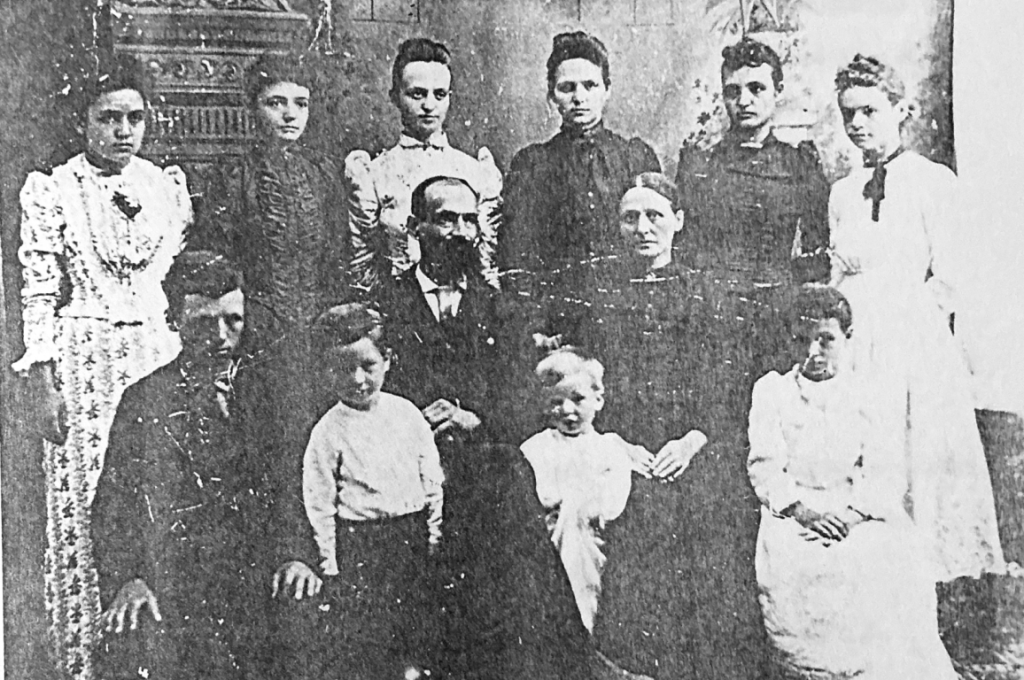
David and Susan Hudson's Family with 11 kids 768

“From Kisses we make mankind:” Dave and Susan Hudson with 10 of their (take that Nigel Tufnel) 11 kids. The tallest boy on the front left is Frank Hudson, my great-grandfather (who looks a lot in this picture like my dad in his younger years).

.

But it’s still a love song – these are my kin, and as Paul Éluard would have it, their kisses helped make me. They married, looking forward on New Years Day 1866. And Susan made this poem that says they celebrated a long life together in 1927 when looking backwards on another New Year’s. Some other little things before I hand you over to the song made with Susan Partain Hudson’s words. Susan mentions being struck by David’s dark moustache and goatee. A few decades ago, I took to that facial landscaping, proximally because I don’t like the irritation of shaving those areas – but who knows, maybe something whispered the idea from some DNA, and my wife only knows me, from the day we met, with that face. And writing poetry? At least one of Susan’s grandsons did too, as I have seen a poem written by my grandfather to my father on his birthday. And the other half of this Project, music? Susan’s family name, Partain, is common in Tennessee. In days when literacy was far from universal, the exact written spelling of a name was not strictly enforced, and a leading spelling variant of Partain is Parton, also commonly found in Tennessee – in particular, with one Dolly Parton. Family genealogies have found no link whatsoever, but that hasn’t stopped me from stretching beyond fact to joke about “Cousin Dolly.” I should also mention that much of what I know about this story comes from work of a later David Hudson, my uncle, who put together information remembered or gathered by other older relatives.
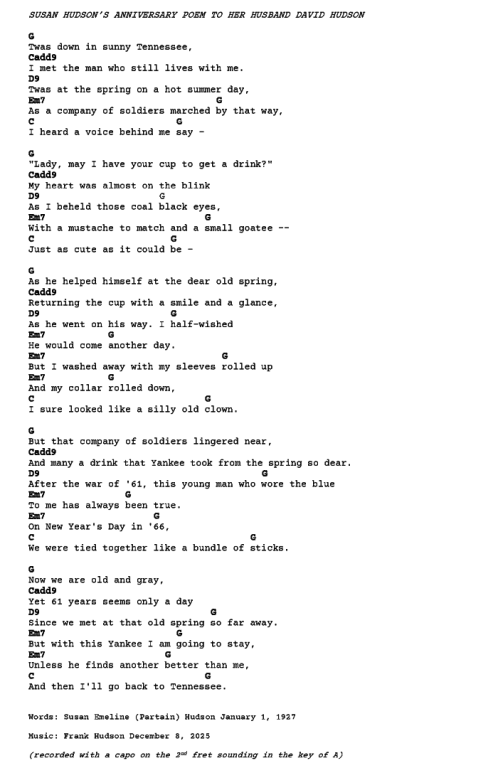
Susan Hudson's Annivesary poem-song chords

Susan’s poem in chords-sheet form for those who’d like to sing it themselves.

.

I’ll leave it to you how much Tennessee heritage can be found in the song I made from my great-great-grandmother’s poem, but like Dolly I compose a lot on guitar, and I also plucked a little mandolin to frame today’s musical piece. You can hear it with the audio player gadget below. Has any such player eloped from your view? Well then, I offer this highlighted link that will open a new tab with its own audio player.

.

*Today is also Public Domain Day in the US, works first published in 1930 are now freely available for reuse. Each year a couple of places celebrate with a list of the works now freed-up. In previous years I’d gratefully see a handful of poetry collections or poems in those lists. This year? Nothing highlighted in the summaries. I think this is a double reflection. By 1930 both poetry as a mainstream publishing genre and the Modernist revolution have entered a downward slope, and landmark collections of verse are rarer; and for putative readers in 2026, it’s likely understood that only a handful of readers will be looking for poems to gather.

Populist poetry, everything then from newspaper and radio poets, to greeting cards with short verse, to scrapbook keepers, to folks who simply wrote their own verse for themselves/friends/family without any aim of publication – all these are hard to locate in our current year. “Instagram poets” and others who use social media are perhaps something like this past group. Early in this project I suggested that this kind of poetry, even “bad poetry,” wasn’t harmful to literary poetry, that it wasn’t any different than other “high arts” that tolerated examples that were simply vin ordinaire.

**Wikipedia says Tennessee also supplied a relative high number of Union soldiers for a Confederate state.

***The siege was lifted when a couple of Union Generals named Grant and Sherman sent troops to break the Confederate encirclement, but of course there was more fierce fighting around Chattanooga related to that effort.
At the New Year

I’ve long been fond of the poetry of Kenneth Patchen — but even though an old edition of his Collected Poems has followed me about over the years, it was only today that I appreciated this poem of his. He wrote it sometime in the 1930s, but reading it this morning I felt he was speaking my thoughts as I look back from the ending of our year 2024.

Patchen’s poetic sensibility was essentially an exercise in Keats’ Negative Capability. Patchen admired human love and wrote reverently about nature and joy, but he was also disappointed and in opposition to a world manipulated by selfish and thoughtless power. He wrote some poems so sweet you might select them for a child’s bedroom wall, and others bitter in the taste of his analysis — but his life wasn’t a trajectory between those poles. Some of Patchen’s most politically radical and downbeat poems were written in his youth and some of the most hopeful pieces of bonhomie came from late in his life. And this was so despite never achieving crowning literary success, and after suffering chronic and painful health setbacks. He seems to have liked today’s poem, as it stuck with him. Looking briefly at its history tonight I see he had sent it out to be set for a choral musical performance in the 1940s,* and he printed a broadside of a slightly revised version in 1967, shortly before his death. So whatever specifics he was thinking of when he first set it down, the man himself thought it more universal. Here’s a link to the version of “At the New Year”   I found on my bookshelf.

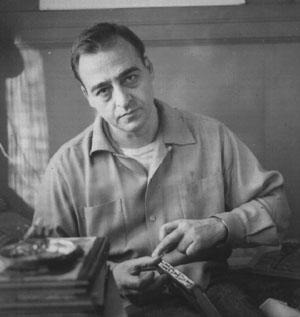
Patchen photo

Kenneth Patchen. He wrote of his times and is timeless.

.

Today I read it as if it was expressing my own thoughts this year, about this  year — not some year in the 30s, 40s, or 60s. Most any decade has wars, but the cruelty of current wars and new refugees cuts freshly. And then, my country’s last national election was heartbreaking for me. I have long held faith with Lincoln’s democratic analysis of how long how many can be fooled, but at my old age I don’t know if I will be there awaiting the arc of the universe when it bends toward justice. As Patchen moves into the second half of his poem he writes of the brave talk and the mean talk, he takes in this world as full of the good and the lovely, but also a measure of the sham and hatred. When he says as the New Year’s bells are to be rung that there are other bells that he, that I, that you and I too perhaps, would ring — well I got a little misty singing those words this afternoon.**

I had to proceed rapidly to create a realized singable version of Patchen’s poem before New Year’s Eve, and so I quickly set up a broadly repeating musical cycle for the accompaniment: VI, V, i changes in musician’s shorthand, but the VI and V sometimes go minor in the quick and dirty rush to make the cycle. Since the passage of years is cyclical and won’t wait, perhaps this accidentally makes for a fitting setting. I was lucky to get accommodation this afternoon so I could open a microphone, and I ripped through the vocal you can hear below while that musical cycle did its thing.

The audio player is below for my performance of Kenneth Patchen’s “At the New Year.”   What, has the ball dropped, the bells have rung, and there’s no player gadget on your screen? No need to stop time, just use this highlighted link.  That’ll open a new tab with its own audio player.

.

*I make a quick search to see if I could find this once-planned 1940s choral setting, but came up empty,

**The bells motif at the end of Patchen’s poem recalls Henry Wadsworth Longfellow’s holiday poem “I Heard the Bells on Christmas Day”  that I wrote about and performed a few years back. Long after Longfellow, and some years after the death of Patchen, Leonard Cohen did his own New Year’s “Anthem”  with bells that contains one of that poet’s more remembered passages: “Ring the bells that still can ring,/forget your perfect offering,/there is a crack in everything/that’s how the light gets in.” Cohen’s poem echoes Patchen’s sentiments, and Cohen’s poem and song may have been in conversation with those earlier poets’ work.

To not be scared of death that doesn’t understand us

I’m going to start off the new year 2024 with something I do less often, presenting a new piece that uses my own words. I give myself permission in part because it was engendered by thoughts of another poet, Robert Okaji, who I’ve considered as something of a kindred spirit to my efforts here since this Project began 8 years ago. Like most every blogger I can’t help but talk about myself, but when I do that I fear I become a spendthrift of boredom, so one of this Project’s mottos has been “Other Peoples’ Stories.” Yet, for all that, this isn’t Robert Okaji’s story in any summary — he’s his own poet, his own writer. I’m presumptuous, but I won’t go there. I don’t know him, though I’ve read his blog, his poetry, seen him read online once. Is that like knowing him in some way?

Many of us poets could admit that we see ourselves in a timeless guild. Homer, Sappho, Shakespeare, Emily Dickinson, Du Fu, Yeats — they’re our co-workers. We flatter ourselves at times that we now occupy their offices. By the same conceit, I could think of Okaji as a compatriot. We live in the same country at the same time, we’ve exchanged the customary short notes over the Internet. At least once before today, something he wrote caused me to write something myself. I think I started writing translations/adaptations of classic Chinese poetry before reading his, but his approach (we both need to start from literal English glosses) ratified mine in effect.

So we poets, at the moments our heads swell up so that poetry can burst forth,* may think it’s as if we know each other, because we think we know each other in poetry. To say then that it’s like companionship, that it’s as if, is to do that thing that’s called in poetry a simile.

Every simile when examined harshly knows it’s pathetic. Every poem is not the thing it represents — even the great poems that change how we look at the thing they represent. Let all in the poetry guild admit this to each other within the walls of the guild hall.

I started writing today’s words on one of my more-or-less daily bicycle rides. In spring there may be many kinds of birdsong in my well-forested city, but in winter it may be only crows — which, as the poem describes, are quite vocal about a solitary early morning bicyclist in their midst.

Crows, ravens, big dark birds, are a death symbol of long repute. And it struck me that while we might chide ourselves for not having sufficient knowledge or understanding about death, we could just as well say that death doesn’t understand us. Living in our consciousness as if the present continues indefinitely, we don’t understand death, but death doesn’t understand that moment either. And then, we poets think we can capture the flow of consciousness and preserve it in poems. Today’s poem carries on in a series of similes and then makes a final summation of the series.

Okaji has written a group of poems over the years featuring the character of a scarecrow. Perhaps he too is riffing on crows as the death symbol, but his scarecrow is at times a comic figure too. A scarecrow is just another simile, a sort of, an as if symbol for us — and so I speak of Okaji’s scarecrow in my poem.

Scarecrow takes a winter bike ride

Scarecrow rides a bicycle in early winter mornings, and the crows object. (a note: I begat these AI illustrations with Adobe Firefly, which claims it doesn’t use uncompensated artists’ work to train itself)

.

I said my poem isn’t Okaji’s story — it’s more mine partway — but if you’re like me in some ways, particularly if you want to consider those of us aged to where a compatriot’s death seems next door, then it might be as if it’s partway yours too. The admonition in the poem’s title is therefore not addressed impertinently to Robert, but to myself and perhaps others who might read or listen to this.

Woody Allen wrote a great line: “I don’t want to be immortal from my work. I want to be immortal by not dying.” We write poems, we make those “like a” statements by writing poetry. As if: in our minds we walk into those poetic offices, write our metaphors, our similes. And some day, we must clean out our offices, leaving on our desks a few sheets of paper, maybe enough to stuff a scarecrow.

Today’s performance started with two electric guitar lines I recorded early on New Year’s Day, following the tradition of trying to do things on that day that one would like to continue to do regularly the rest of the year. The two somewhat irregular riffs were spontaneous,** thinking that promise to myself required doing  as much as planning. The bass line was laid down almost a day later to try to hold things together, and the decoration of the keyboard parts arpeggiating the spontaneous chord changes which had started things off, were the final tracks. Those things done, I had my rock band to declaim my sonnet “To not be scared of death that doesn’t understand us” over.

You can hear that with the audio player you should see below. No player?  This highlighted link is a back-up method, as it will open a new tab with its own audio player.

.

*A metaphor that sounds more like a sneeze than Athena’s birth when I re-read this.

**I fancy the right channel line played on my Telecaster has some crow-call-like moments.

The Orphans’ New Year’s Gifts

Last time I said I looked through Arthur Rimbaud’s collected works in the middle of the nighttime looking for something to translate, combine with music, and perform. I guess I could have saved myself some time, because I eventually chose the first poem in the collection, The Orphans’ New Years’ Gifts,  placed first because it was the first poem he ever published. When it appeared in print on January 2nd, 1870 Rimbaud was all of 15 years old.

On first reading, it’s not representative of the poems Rimbaud would be writing in little more than a year or so. While the entire poem is a gothic story, it’s also quite sentimental and largely conventional. For reasons of time and preferring shorter works, I decided to only perform the first part, but spoiler alert: it’s soon revealed that the children are recently orphaned and they are dreaming of their family still being intact and how they will give their now dead mother they expect to find in their dreams a pair of “for mother” plaques from each of them as a New Year’s gift.

But for us, the performer and listeners today of this first section only, this is no matter, because it’s the last day of 2021 and tomorrow is a new year. We know nothing of 2022 save for dreams pleasant or frightening. The coming year is a more mysterious ghost to us than our past years.

It might seem odd to say, but I’m an orphan — that’s not unusual, at my age most everyone is. It’s a different matter to write this as a 15-year-old, as an adolescent, as Rimbaud was. Those are the years that children learn how to gradually break away from their parents in whatever manner they fall into. Rimbaud instead would do this early and abruptly, leaving his mother — and for Paris, and unrest, and rebellion of all sorts  in that “about a year” timeframe. Poetically and emotionally, this poem hardly seems to be a rehearsal for the Rimbaud of 1871 and after.

As I worked on translating this poem, I saw a little window into that other Rimbaud in this short first section. Those intimations were unlikely put there by conscious choice. Maybe they were slipped in by Rimbaud’s future ghost?

A few notes on how I translate. I generally don’t try to bring over the word-music (too tough, too damaging to other elements of the translated poem). I start attempting to be as faithful as I can, but then while in process I am often tempted to sharpen or expand on the images I’m trying to bring forward into contemporary English; because those images expand in my mind as I consider them, and because I want them to remain vivid. I’m of two minds about doing that, and I try to make clear here when I’ve really inserted something altogether invented. If you’d like to read the whole poem in it’s original French, here’s a link.

The Orphans New Years Gifts

My local forecast says –11 F (-24 C) for New Year’s dawn. I think of a blues song Leo Kottke used to sing with the line “So cold in China, the birds don’t even sing.” Maybe that’s why I choose the guzheng today?

.

Here are a few examples in this one, in ascending order of significance. I suspect the curtain Rimbaud has blowing in the winter drafts is a bed canopy, a largely unfamiliar antique item, and instead I’m leading you to see a window curtain. Leading you to the window lets me transition to an image I sharpened. Rimbaud doesn’t explicitly say the cold winter birds are walking, but I think he did intend to tell us they aren’t able to fly in this moment, and I thought I’d underline that. And the final image, the one of New Year arriving as a woman in a dress of snow, I wanted us to see a tipsy celebrant whose party gown is no longer arranged neatly. Did the 15-year-old Rimbaud intend that image? I don’t know, but his future ghost might well have chosen it!

Yesterday I revealed that I wanted to do this piece to honor ardent Rimbaud admirer Patti Smith. Obligation completed, though you may notice this is nothing like how Patti Smith or her band would characteristically perform this. The first instrument you hear is a Chinese guzheng,* a sophisticated zither family instrument, then eventually a variety of drums and percussive sounds arrive along with electric bass, and finally a low synth moan. But did I make clear in talking about Smith yesterday: one of the things she demonstrated was that untapped possibilities of presentation styles are the point, not just duplication of one’s heroes.

The player gadget to hear my new translation of Rimbaud’s New Year’s Day poem is below for some of you. Don’t see it? This highlighted hyperlink is an alternative way to hear it.

.

*With expensive and exotic instruments like this I usually use what are called “virtual instruments” that sample the notes and sounds of the entire range of the instrument; and as in today’s piece allow you to articulate some of the instrument’s particular attacks and variations, like the guzheng’s vibrato. I select and play the notes with a little plastic keyboard or my guitar with a MIDI interface.

The Darkling Thrush

My teenaged son is proud of his mastery of modern youth slang and enjoys the idea that his parents and their generations will have no idea what such terms mean. This is of course part of the utility of language: it not only binds people together, it keeps them apart.*

No matter, new times and new experiences enjoy making fresh and untarnished words to describe them. Words must have their pleasures, even when we don’t quite understand everything someone is saying. Take Thomas Hardy, a man who wrote what may be one of the last poems written in the 19th Century, after he had spent 61 years in it. Published on or around New Year’s Eve in 1900, today’s piece is “The Darkling Thrush.”  In Hardy’s poem, as an old man looks at the changing of a year and century, we have the reverse of my son’s joy: old words from an old man.

Thomas Hardy Moustache wax abuser
Careful with the moustache wax Tom, you’ll put someone’s eye out!


“Darkling”, “coppice”, “spectre”, “bine-stems”, “lyres”, “outleant”, “illimited”—we meet the first one in the title, the second five words in, the third at ten words. Even if I was to quiz educated Americans, I doubt most could define the majority of these words, and I’m unsure how much better modern British residents would do.**

Coppicing is a European method of managing tree growth, in which mature trees are cut off to allow fresh shoots to continually propagate. Spectre is more known now as a trademark applied to laptops and James Bond bad-guys, but is an English word for a spirit or ghost. Bines are not vines to the knowledgeable horticulturist (bines twist their main stem around things to tangle and climb, vines use special parts of branches to hitch themselves up). Lyres are not supporters of disreputable political movements, but a stringed harp. Illimited is just another, rarer, form of the word unlimited, and I think Hardy may have chosen it because it starts with a sick word, ill, but also puns on illuminated. The titled adjective, darkling is a handy way to say it’s occurring in the dark. Although it’s a little-used word, like illimited, the sound of it brings to mind something else, the smallness of the title bird, as in duckling,  and darkling’s sound also lets us see dusk rather than deep night, when we can still see the winter thicket Hardy sets his poem in.

But outleant is the real mystery word. A short web search finds no online dictionary definitions, no examples of its use other than in Hardy’s poem. A simple deconstruction of the word’s parts would make it, inverted, saying “leaning out.” And that’s what it probably means. There’s textural evidence as it ties back to the poem’s second word, “leant upon the gate” to the coppice. Yet, did Hardy intend to infer two other close words in this word’s sound? Out-lent, a sense that the haunted and dreary winter scene of the poem is owned by the old, dying century and is lent out only to the present? Depending on pronunciation of the printed word’s “ea,” it could conceivably be pronounced out-lent (and Hardy does rhyme it with “lament.”) Does he also want us to hear a closeness to outlearnt, and that the old century’s corpus of belief has been superseded (by newer scientific discoveries?) That would be consistent with Hardy’s beliefs.

Perhaps this is my weakness as a reader, translator, performer and poet myself. If I sense an image is possible, I want to see it, hear it, perform it. Bare winter bines twisted around a copse of brush wood as a corpse leaning out of a coffin may be grisly, but it’s not to me a strong image.*** Even if it’s abstract, the second sense, that of this bare and haunted landscape being the cemetery plot owned by the old century of which we are only visiting seems stronger. For others, the sense that new knowledge has killed off the old beliefs (outlearnt) could be a choice. I can’t know that Hardy intended this ambiguity by choosing this unusual word outleant, but I, the reader, put it there.

The title calls attention to the central image, yet another messenger bird in British poetry, to go with the nightingales and skylarks of Keats and Shelley, poets of Hardy’s now dying century. I like that Hardy lets us see the bird, and it’s frail, gaunt, and -ling tiny, and that we can see feathers fluffed to best insulate its frame, which the wind is disputing.

So, there was Hardy, around New Year’s Eve, using his old and odd words at the end of an old century. For us, Hardy’s oncoming one (the 20th century) has now closed itself. Will things get better or worse in our new year? Something in us wants to foretell at every ending—yet even looking backwards, we have trouble making a simple better or worse judgement. Here, the battered bird, the darkling thrush, says better. Hardy says he knows he doesn’t know.

He knows he doesn’t know is the realist’s version of hope.

Anyway, one of the joys of combining poetry with music is that you don’t have to take a test on the words to enjoy the piece. My pompatus of a performance of Thomas Hardy’s “The Darkling Thrush”  is available with the player below.


*Right now he’s very generous in this however. He wants me to know these words so I won’t be left out.

**Before looking them up, I knew spectre and lyres for sure and I was fairly sure about darkling as an adverb, then taken to adjective. I had ideas (some from context) on the others—and in the case of coppice, my ideas were wrong. My son knew spectre and lyres and defined darkling as “a creature of the night” for which I’ll give half-credit. In the case of bines, I told him I learned how bines were different from vines, and he told me “Sure they are! Vines are 7 second videos.” (That last was a joke on his part.) My wife, a fine word-smith, also got 2.5 (“Bines, it that like a wood-bine?” got half-credit as understanding was there, even if a good dictionary definition it wasn’t.)

***Saplings and bines and “sharp landscape” would indicate a skeletal image is intended, but bare bones are not particularly scary or intense compared to rot and decomposition, much less animated brains-hungry undead. Hardy doesn’t mean scary so much as long-dead I guess. Interestingly, Hardy had a direct graveyard experience to draw on here.

Ring Out Wild Bells

This guy was once famous. Not just writer-famous, but Beyoncé or Beatles famous. In England, and to a large degree in America, he was the face of, and the center of, Victorian poetry. And poetry in Victorian times, the written-down and printed in books kind, was still a force in mass culture.

tennyson

Once an empire’s most famous poet, now reduced to modeling a Slanket.

The town I grew up in was platted and settled around 1880, its success achieved by the industrious Swedish-American farmers around it and the railroad that went through it. The town was named Stratford, after Shakespeare’s birthplace, and so it was that the town’s main street, with it’s block of stores, was named Shakespeare Avenue. Shakespeare Avenue was met just north of the shops by the town’s central cross street, Tennyson Avenue.

That’s a remarkable piece of trivia isn’t it? Think of how many suburbs and housing developments were similarly planned and platted in the centuries since in the United States. How many of them had main streets named for contemporary poets? Milton and Byron had their streets along with Shakespeare in Strafford, but even Byron was 50 years dead; but here was Tennyson, a man still in his career across half a continent and one ocean away, and here this proud avenue in a farming town was written down to bear his name.

The problem with being a big-thing Victorian, as Tennyson was, is that our Modernists came after them. Came after them in time and eventually, opposition. Even though you can see the influences of the Victorians on the early work of some Modernists, you can also see the things they came to reject in search of an art for their own time. In those scattered small settlements where page poetry is still read or studied, we are now more likely to be reading Hopkins or Hardy for the English, or Dickinson or Whitman for Americans, or hinge figures like Yeats who spanned the eras, than Alfred Lord Tennyson, the once leading poet of his age.

Besides the street in my tiny town, Tennyson lives on in a handful of phrases from his poems that have become commonplace mottos such as “It’s better to have loved and lost, than never to have loved at all”words well-enough known even as their author’s fame and esteem has faded, that many people think they must be Shakespeare’s.

Today’s words come from another section in the same long poem or collection that premiered the “loved and lost” phrase, Tennyson’s broad meditation on loss and perseverance “In Memoriam A.H.H.”  If we’ve forgotten Tennyson, this makes it possible for him to be new again, and this is a piece, as I recast it, that seems very appropriate for our age—even for this year. The New Year’s bells ring in a new year, but they also chase away the devils of the old one.

So, enjoy the music I wrote and recorded for “Ring Out Wild Bells”,  but you may be surprised at how well Tennyson’s sentiments fit as you sing along with them while 2017 ends. The player for the audio piece is right below this for many of you. Don’t see a player? This highlighted hyper link will also play my performance of a new setting for Tennyson’s words.

.