Paying the Piper chapter 6: bonus library time & the widow Piper has some formidable opinions

After my rewarding visit to the Carl Sandburg birthplace, our plan was to return to Iowa City and leave early the next morning to return home. I felt I knew more about the lesser-known early 20th century poet I’d come to find out about, Edwin Ford Piper, and I had had the experience of seeing something of Sandburg’s roots. My wife had gotten to explore several habitats. And I was pleased to find out my old body could still get around walking while carrying a 10 pound bag — even as a shade of the young student I once was.

Every trip is like this for me: enjoyment at the new place, appreciation of the new things experienced — but once the final day arrives, I’m ready and looking forward to returning home. But that evening as we were getting ready for bed, I was making a quick check of Internet things and saw that I’d received a response from S. L. Huang, a writer who had initiated my interest in the idea that Piper had been foundational in the University of Iowa Writer’s Workshop method of teaching creative writing students.

Why would I (and plausibly you) care about that? The Iowa Writers’ Workshop was the origin-point of some things that have become pervasive in creative writing: the MFA degree, the workshop method of developing writers and critiquing work in progress, and the practice of literary writers being brought in and paid to be instructors in such programs.

Little I’d read in the Edwin Ford Piper papers before the Sandburg finale had addressed that element of his life directly, but Huang’s reply said there was more info on this in his widow Janet Piper’s papers which the University special collections also had. I mentioned this to my wife — she was agreeable to leaving at noon instead of dawn for the long drive home, and she would find one more landscape to explore while I made the walk back to the library for a half-day looking at Piper’s wife’s papers.*

By now I already knew the routine in the special collections reading room. The tough part would be that Janet Piper’s collection was larger than her husband’s, and only generally cataloged. I had gone into the husband’s papers knowing at least a few things about him, but all I knew about Janet Piper were references that she thought “politics” had led to her husband’s early and sudden death in 1939 just as the Workshop was getting underway.
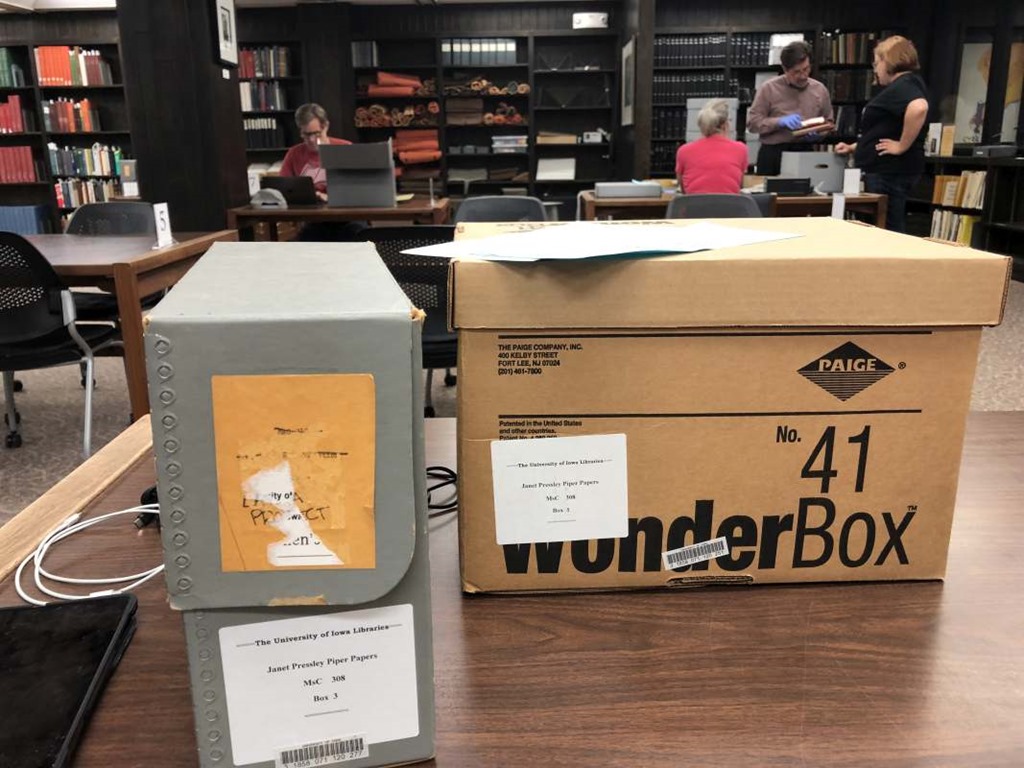
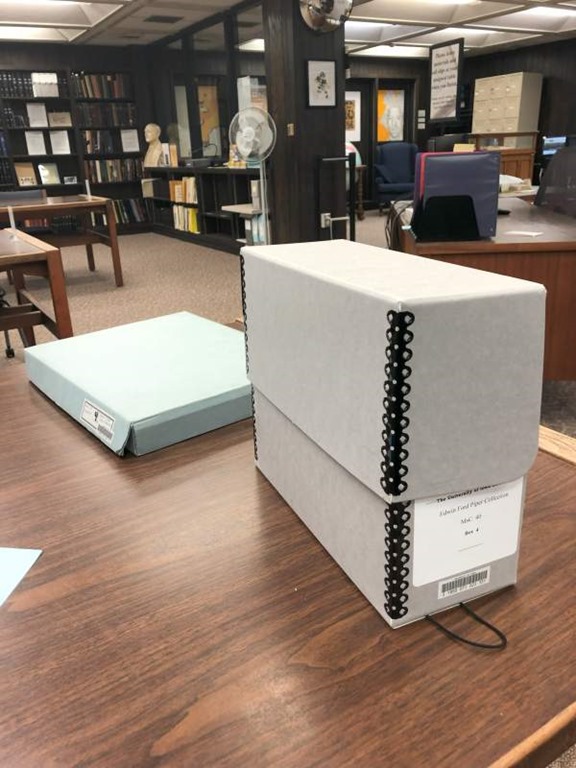
Janet Piper files 800

A small portion of Janet Piper’s papers in the University of Iowa collection, but my best guess at what might answer my questions about the beginnings of the Iowa Writers’ Workshop.

.

It’s taken me until the first day of July to read and comprehend what I captured for later perusal in those few last hours at the reading room. Later in June I also read Stephen Wilbers’ 1980 book The Iowa Writers’ Workshop  which aimed to show how that noted program came to be. Wilbers corresponded with Janet Piper while researching his book, duplicating a slightly earlier attempt by Janet W. Wylder to get information from Edwin Ford Piper’s widow. Wylder was attempting a similar book on the Writers’ Workshop that was never completed.**

Janet Piper’s papers include correspondence from these two with her, and a more than 100-page, response that seems to have gone through several revisions and titles, eventually being called “Edwin Ford Piper and the Iowa Workshop: a prehistory.”   It’s likely the best we have on the later adult life of Edwin Piper, who taught at Iowa for more than a generation and encouraged student creative writing throughout that time — right up until his sudden death just as the official Writers’ Workshop was launched. But spoiler alert: his wife’s account doesn’t live up to that promising title.

Since Janet Piper is even lesser-known than her husband, here’s a capsule bio extracted mostly from what I read in her papers and some web research:

Born (family last name: Pressley) in 1902 in Des Moines Iowa. May have moved to eastern Nebraska sometime in her childhood, and eventually attended college there and completed a Masters. She knew other young literary people in Nebraska and was already a poet who had won a couple of awards for her poetry while in that state. Began advanced degree work at the University of Iowa in Iowa City in the 1920s. Her academic work was interrupted by her 1927 marriage to Edwin Ford Piper, one of her professors, and by the following birth of their only child Edwin Ford Piper II in 1928.***  She writes little about the day to day of her marriage other than asides to the considerable duties of motherhood and being a faculty wife. She seems to admire and support her husband in his work and notes increasing change, stress, and conflict at the University then. She had resumed her academic work toward a PhD by the later 1930s — and then in 1939, her husband dies suddenly. She describes completing her final thesis defense in the midst of new widowhood in a disassociated state, flying on under auto-pilot. Various statements, some as corroboration, say this is likely the first PhD granted for a thesis consisting of creative writing.

She leaves Iowa in 1940 and within a couple of years takes up a teaching position at Sam Houston State in Texas, where she taught until retirement. In 1949 she made a suicide attempt by pills and was committed by her 21-year-old son to a facility in Texas, where she later writes she received the kind of coerced treatment, including electro-shock, that was common then. There’s some heartbreaking but formally-stated correspondence in her papers with her son from the early 1950s when they are estranged. She blames him for that mental facility commitment, and she says that he blames her for expecting too much of him as a child and not giving him appropriate attention.**** At her retirement in 1972 it’s written that she has continued to write poetry. She lives until 1997.

The Iowa Writers’ Workshop in their official histories started in 1936 — or it started in 1939 in other accountings. Edwin Piper had been encouraging students creative writing for decades, but the administration was now committed to allowing these efforts to be given academic credit and to become substantive toward degrees, a new concept for American academia. From Wilbers’ book and Janet Piper’s account, Edwin had some level of prominence in the mid-1930s in this now officially academic writers’ program — Wilbers writes it was more over the poetry sub-section while Janet Piper portrays her husband as being increasingly marginalized by the department’s administration, making the department head Norman Foerster a particular villain in the matter.

Yet, in a 1976 letter Wilbers includes in a footnote, a fascinating (but secondary to our story) figure Wilber Schramm recounts that he took over as director in 1939, being drafted into the job because of a pressing need occasioned by Piper’s death. In the Workshop’s official history, Schramm was the first director of the Iowa Writers’ Workshop, but Schramm doesn’t tell it that way.

Alas, from what I’ve been able to find out so far, there’s no solid information about how central Edwin Ford Piper was to instigating those Iowa Writers’ Workshop changes to how literary writing and writers live and work in our century. His career shows he’d long favored working with young writers, but Janet Piper portrays that she and her husband didn’t like some of the leaders making Iowa a pioneer in granting degrees, or their matter of going about it. There’s a cryptic report from the 1930s that Edwin didn’t like how the Workshop was turning into a promotional effort which I cannot completely evaluate. I was at first skeptical at Janet Piper’s constant reference to the malign forces of something she calls “New Humanism” ruining her life, her husband’s life, and literature in general. I knew nothing of that term, but a little research confirms that that was overtly the flag that her chief villain Norman Foerster and some of his allies were flying.*****

For a person like me who likes to know how directional changes happened, to see what turned us from one path to another, it was engrossing to try to chase this down, even if the crossroads turned out to be shrouded in fog. I’ll close by saying I’d like to thank Edwin and Janet Piper. Though they are dead, and they likely never concerned themselves exactly with my questions being formed in the 21st century, their papers gave me a window into their times and challenges. I’d like to thank the folks at the University of Iowa Special Collection section who were always helpful to this old and informal scholar. And thanks to you, rare and curious readers, who granted attention to this 1930s couple caught up in the changes in American literature and this 2020s couple celebrating their anniversary with their particular interests.

Watching my time carefully, just a few minutes before noon I packed up in the library, went down to the street, and swung into the car as my wife pulled up at the entrance curb. We were leaving for home.

.

*Coincidence: as I went looking into the beginnings of the Iowa Workshop, she visited the Devonian Fossil Gorge which I later read famed Workshop Director Paul Engle also liked to examine while still a student.

**This double pump seemed to frustrate Janet Piper. She at first thanked Wylder for rekindling her memories of her dead husband and her time with young writers at Iowa. Piper’s response appears to be a version of the around 100-page memoir which includes a long side-discussion of New Humanism. In her following correspondence with Wilbers she’s upset that Wylder had in effect ghosted her, and she wonders why Wilbers doesn’t have the material she sent Wylder. Moderns, remember: this is the era when producing 100 pages meant typing that singular ms. entirely and inhaling correction fluid, not just cutting/pasting and pressing send, or dumping pictures off your phone’s camera roll.

***More notes for Moderns: I can hear the ick factor bursting in your minds. This sort of thing was quite common, even into the years of my youth. Their contemporaries wouldn’t necessarily think this scandalous — or even unusual — though the age difference (56 to 25) here is broader than many of these male prof/female student marriages. That said, everything you object to was still possible despite different mores. Janet Piper’s papers give no indication it wasn’t a happy marriage.

****Whatever led Janet Piper to her suicide attempt isn’t spelled out in what I’ve read. The number of stressors and level of endurance it would take to be a single mom, a widow, a rare woman/academic in an era when that was even tougher than today, and while society is in the transition from the Great Depression to a World War — all that might batter anyone’s defenses. Similarly, I can only imagine a 21-year-old son having their only parent, their mother, trying to kill herself and being put in a position to try to decide what to do about that. I don’t know the particulars of Texas law at that time, but authorities themselves might be pressing for civil commitment. I’m not suited to be a novelist, but reading in Janet Piper’s papers on this matter I thought “There’s a novel.”

*****Let me resist trying to give an outline of New Humanism. Like a number of Fugitives, New Criticism proponents, and neo-Thomists that followed this movement and somewhat evolved from it, they tended toward political conservatism, and in the 1930s many were, at the least, permissive of fascist authoritarians, which some (including JP) might lay to them being already authoritarian in aesthetics. Janet Piper speaks distressingly of fascist Iowa professors in that era, even names some. Janet Piper’s papers that I’ve read don’t tell me exactly what Edwin Piper thought of this. Though a Chaucer specialist carrying that interest into a project completed at the end of his life, Edwin’s papers don’t demonstrate a pervasive appeal to timeless classical truths, and his folksong fascination would likely oppose a tight highbrow/middlebrow/lowbrow outlook. I can’t say for sure what Edwin Piper’s politics were, but his widow seems left/liberal in the 1970s and makes no mention that they disagreed on politics back in the 30s. Janet Piper’s summary that “politics” led to her husband’s early death leads to the question: what level of politics? In her mind it appears university politics and civic politics were indivisible.

When asked about this era in the 1970s. Janet Piper continually wants to talk about what she views as more than a cultural tendency or scheme, and more at an active, effective, powerful conspiracy originated by New Humanism. At times she’s detailed and footnoted with her charges, at other times vague and implying great harms in a broader and fuzzier way. More than once in her papers she refers to Ezra Pound, T. S. Eliot, and Conrad Aiken as the heads of a secret cabal advancing evil work — and I can’t quite “read” if I should take those expressions as satiric exaggerations. In a letter from Robert Hillyer, he agrees with her that she’s not a crank, using that word as if it had been applied to Janet. In what I read she spends less time than my curiosity would like expounding what she prefers in literary or cultural theory rather than what she damns.

It would take more study and knowledge to fully understand or evaluate that element in Janet Piper’s later writing. This element, often present in what I read, shows a life of great reading and learning exceeding my own, evidence of great energy for a person roughly my age — and likely at times I can’t quite measure, effective moments of literary criticism and insight.
Paying the Piper chapter 4: “I heard my mother sing this ca. 1876”

Today is Juneteenth, a holiday coming into greater recognition as a celebration of the ending of America’s race-based chattel slavery. Why this date? I repeatedly warned you that I can’t tell a story simply and briefly, but for this holiday I have an excuse.

Slavery began in the American British colonies somewhat haphazardly, but by the time we became an independent country we had lots of laws, customs, and beliefs to entrench it. As it often is with the mechanics of oppression, the structures to hold it up took work to maintain, and by the 1850s there was great worry between slaveholders that it would collapse. In the 1860 election, Lincoln won, and even though he’d stated a politician’s compromise middle ground on the slavery issue, his party included enough abolitionists that most powerful slave-holders were ready to press their states to rebel and set up their own government. Civil war ensued.

Which didn’t free the slaves — at least not yet.

Of course the enslaved had been freeing themselves, when they could, all along. Armed rebellions hadn’t worked for more than moments, but the brave, lucky, and skilled might successfully flee at least from the slave-holding states if not to Canada where US law couldn’t touch them.*  But it wasn’t easy traveling all that far.

Once the war started in 1861, some enslaved people recognized they could try a shorter route: just make it to the Union troop’s camps, and a good many did just that, which created an awkward situation. You see: nothing had ended slavery’s legal framework, Lincoln still maintained he wasn’t doing that (if only because a few slave-holding states and slaveholders remained on the Union side). He just wanted to put down the rebellion.**  Law still said the slaves were property.

Someone on the Union side came up with a peculiar idea. If the enslaved were legally property, they could be confiscated during wartime like a cannon, horse, ship or other enemy property could be. Dehumanizing language? Sure, but escaping past the Union lines meant an increasing chance that they wouldn’t be taken back.

Eventually, Lincoln supersized that freedom, by declaring that all the enslaved in the states in rebellion were free. This, the Emancipation Proclamation was issued at the beginning of 1863. American slaves elsewhere? Nope, not in the Proclamation. Slave owners in places under Confederate rebel control? Not gonna listen to Lincoln’s order. In April of 1865 Robert E. Lee surrendered the bulk of Confederate troops, but that still didn’t mean all enslaved were free, and the legal matter wasn’t consolidated until December of that year with the adaptation of the 13th Amendment.

A couple chapters back I talked about how slow by modern standards communication could be in the mid-19th and early 20th century. Well, it was slower yet when not everyone was on-board with the news. Juneteenth, with an absurdity that is so often a part of America’s racial history, celebrates when Union troops got over to Texas in June of 1865 to announce that the war had been over for over a month and the enslaved in Confederate Texas were no longer legally slaves.

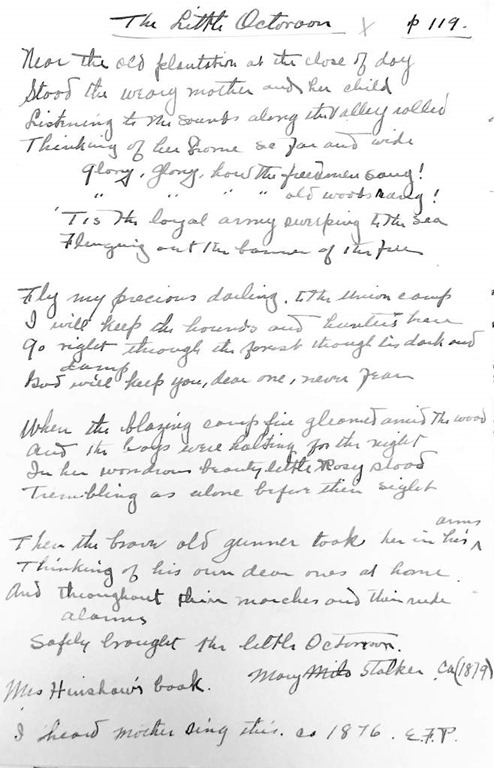
When I left off I was (more or less) talking about folk songs and the songs collected in the American Midwest before WWI by poet Edwin Ford Piper. I’ve also already mentioned that folk songs aren’t unchanging, and aren’t pure. While going through the yellowing paper in Piper’s archives, I came upon this song, handwritten in his own handwriting. He has the title as “The Little Octoroon.”   Things aren’t going to get simple here readers. I can’t be simple.

The Little Octoroon 1024

The song as Edwin Ford Piper heard it from his mother

.

Octoroon is a largely obsolete word, derived from a lot of rigmarole regarding how Black someone was. It means 1/8th (octo=8) Afro-American. In general, the mumbo-jumbo legal biochemistry in American history regularly said it didn’t make much difference. Half, quarter, sixteenth — hell, for those who had trouble with fractions it was sometimes written down as: 1% Black, you’re legally Black.

An octoroon may not look  Black. I can still recall when I was 14 or so, and having grown up in a tiny rural Iowa town. An Afro-American man who was a civil-rights activist was to visit my church camp. He arrives. Wait — that man’s Black? I remember in my naivete looking at his summer hands and forearms. The man had freckles people!

So why does this song, which is clearly a song from the Union and Abolitionist side make some point about the child being an octoroon? This will get weird: it was possible to be an abolitionist and  a white supremacist thinking Afro-American’s inferior. Yes, you could be smart and ignorant at the same time! If you’re trying to end chattel slavery, and you’re counting votes or troops, you might not care to make a sticking point about this, ugly as it is. Those with pseudo-scientific beliefs such as an octoroon is “nearly a white person” might have stirrings of respect. (Ugh!) And then at the unconscious, illogical level, there’s the factor of that person looking much like me, so maybe they  should have rights like me. Even if it’s a song (something with no visual element) those factors may have entered into its composition.***

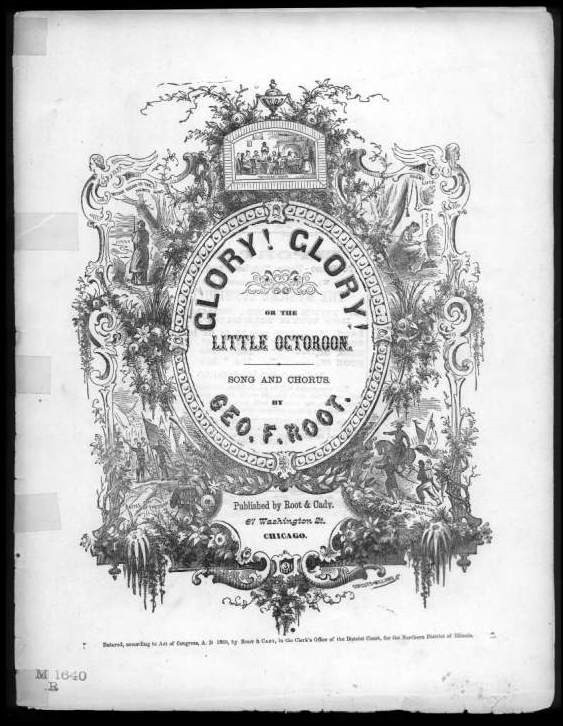
While there are no notes I saw in the archive that Piper knew this, this song does have a composer: George F. Root.  Root didn’t quite reach Stephen Foster or Dan Emmett level of 19th century American songwriter fame, but he had his “hits” such as they were in the pre-recording era. During the Civil War period and based out of Chicago, he specialized in songs for the Union side.

The Little Octoroon song sheet cover 800

The sheet music from George F. Root’s music publishing firm. When Piper remembers his mother singing this tune, it would have been only 10-years-old.

.

Did Piper’s mother learn this from someone else? Was there sheet music in a piano bench for this, unknown to the 5-year-old Piper? In the quiet library archive, I visualized two white people, a mother and child, in rural frontier Nebraska sharing this song. The differences in the printed song from the one Piper wrote down from his mother’s singing say this isn’t likely a handwritten copy from sheet music.****

Here’s my conclusion, which I hope I’ve demonstrated even though I’ve trimmed parts of this piece back: Juneteenth is the most complicated American legal holiday.  The only simple thing about the holiday is that it stands for freedom and the lifting of oppression. Taken at its whole, though messy and with calculated delay, that makes it a favorite of a person like me, who still cries and wonders at how simple truths and rights take so long to be established. The song I’m performing today, its path and turning into a folk song, isn’t that complicated — but yes, the path of American freedom is.

You can hear my performance of Root’s “The Little Octoroon”  with the audio player below. No player? This highlighted link is an alternate.

.

*In 1850 a Fugitive Slave Act was passed that required northern state governments, not just the federal government to return enslaved people who reached northern states. Some cities and states wouldn’t comply (there’s this Minnesota case for one example).

Piper’s mother was in Canada near the US border in this era. It’s possible that fugitive slaves might have crossed over into her region. I also note that Piper says she was singing it in 1876, perhaps because that’s the border of Edwin Ford Piper’s memory, but I read the date and think about it being the year Reconstruction largely ended and new de-jure laws and customs greatly restricted Afro-American citizenship.

**No, Nicki Haley, slavery was the cause of the Civil War, even though many liked to parse Lincoln’s compromise and coalition statements of this time to make it sound like it wasn’t. The flaw in that framing? Lincoln didn’t start the war, the South did, and they were explicit in proclaiming why they did it.

***There’s another song using this terminology that this Project has already presented: Longfellow’s scathing pre-Civil War poem “The Quadroon Girl.”   In Longfellow’s poem the situation leading to that poem’s mixed-race child is laid out: feudal concubinage and/or rape by slaveholders. For making a speech implying the same, Longfellow’s friend, US Senator Charles Sumner was beaten to within an inch of his life on the floor of congress.

****The biggest difference: the printed song’s title calls out the chorus — it’s officially “Glory, Glory, The Little Octoroon.”   I only sang the martial chorus twice in my performance because I was more drawn to the bravery and sacrifice told in the verses. We have two holidays that say soldiers made us free, but it’s not only soldiers.

I followed Piper’s transcription for the words, not the printed lyrics, honoring the chain of transmission to me rather than accuracy. I also modified Root’s tune and chords to suit my tastes and tendencies. I could not help but think of these things as I sang this: first, the mother, her family heritage caught in that sexual exploitation making the choice to stay and face the slave hunters and their dogs to assure her child’s escape. We never find out if she and the daughter will be reunited, or even if she survives. Then next I think of those pursuers who to the degree they are portrayed in the song would be gaslight villains — but in history they would be real people doing great evil, who could be thinking they were serving justice. And then lastly, the final-verse gunner who cares for the child, though he’s more the Horatio of the story, with the mother being the tragic hero. I ask you not to skip over the villain characters. It’s fine if you empathize with the gunner, but some great dangers in one’s life (and often to other lives) are those middle souls, like the slavecatcher pursuers, who have a system that tells them they are arduously, justly, doing right.

Paying the Piper chapter two: time travel, wagon trains in space, & folk song

The walk across town to the University of Iowa main library turned out to be no problem, even in the heat. I walked into the modern lobby of the facility decked out with LCD screen-signage, a set of computer carrels, and airy windows. I used handy lockers with touch-screen set-your-own-combination lock panels there to store my bag and hat.*  The library is one of those amended buildings, representing different eras in décor as it was added to over time or remodeled — so it was almost a theme-park-ride effect as I walked further into the main entryway to reach an old elevator with a flickering florescent fixture that took me up to the third floor with dark wood trim that reminded me of the libraries of my mid-century youth.

The special collections staff set me up on a placard-numbered plain table in the reading room. It took only a few minutes for my selected boxes from the Edwin Ford Piper collection to be delivered by cart. Looking around the reading room as I waited, there were filled bookshelves, a globe, a couple of busts,** and a few framed posters. Curiously, there were life-sized carboard standups of 20th Century Star Trek actors in their character costumes in a couple of corners. Why? Generalized nerd culture? LaVar Burton’s following enlistment in Reading Rainbow? I momentarily thought, at the commencement of my time-travel by library collections, that the original Roddenberry Star Trek concept was travel to “seek out new life and new civilizations.” They called it Star Trek,  not the second-word choice of the later movie franchise Star Wars,  nor something referencing a technology-based science fiction premise. Pitching to SF resistant TV programmers, Roddenberry famously described his show it “Wagon Train in space.”

The U of Iowa Special Collectons Reading Room 800

Transporter or time machine: archive boxes in the University of Iowa Special Collections Reading Room.

.

I don’t know how Piper’s parents came to rural Nebraska. His mother’s family (Ford) emigrated from Ireland first to Canada around 1810. The Ford brothers who emigrated were stone masons. His father’s line had settled in Massachusetts from 17th century, near-Pilgrim times. Piper’s mother was born in rural south-west Ontario and his parents were married there in Zorra township in 1848. The parents moved to Auburn Nebraska in 1869 where Piper was born in 1871. The 1869 date means it was likely by wagon, as that date predates railroads there.

I know no particulars about why the Ford brothers emigrated to Canada. 1810 preceded the infamous Irish famine years a generation later. My guess (by inference) is that the Fords were Anglo-Irish protestants. I don’t know why Piper’s father was in a non-descript rural area of Canada either.***

It’s hard for me to judge his parent’s economic status. Piper speaks briefly in papers in the archive about his father being a rancher who raised livestock and that the barb wire that titled Edwin’s poetry collection came to Nebraska with homesteading post-Civil War farmers who tended crop-fields cordoned off with that fencing, causing his father to move his livestock grazing farther west to Alma Nebraska (southwest of Kearney) and then Box Elder, which is more than halfway to Colorado. In a short biographic note Piper prepared and found in the archives he says he “rode in the movers wagon.” In the same note he says he had “broken sod and raised corn to sell at ten cents a bushel; I have paid three percent a month interest.” Since he went to Omaha and university there when he came of age and was an academic the rest of his life, this would indicate that his family wasn’t exclusively a cattleman or other livestock operation.

In talking about places and names I found in the archives, I get ahead of myself, it’s just clear that the young Piper was a traveling man coming from a traveling heritage. When we speak nowadays about the Midwest as “the heartland” or casually assign it as a homogenous place in stasis we miss that it was (even its rural areas) just as much an immigration site as the tenements of New York City — there was just more space between farms or towns.

In effect I was another immigrant in the library archives. I was eagerly opening the contents brought to the table from first box and on, lifting out folders from inside them and examining the mix of handwritten letters and notes, typewritten pages, fragile yellow newsprint clippings, and occasional whole publications. The libraries abstract of the contents, and the Piper collection’s mixed filing, meant that I never knew what I’d find “over the next hill.” I had been concerned if I could keep my focus on this task for a full workday. I could. Easily. I was back in the era which The Parlando Project so often refers to, the first quarter of the 20th century when Modernism emerged. I’ll look at Modernism later in this series, but the folk songs are things the travelers carried with them from the past. Same quarter-century, Janus like, looking forward and backward.

As the collection abstract promised, the folk music collection materials were considerable. Many of them have marginal notes or material showing either they came from other collectors or that they had appeared in versions in other contemporary published collections. Some of these notes are from a 1934 run through of Piper’s folk song materials by a graduate student who cataloged and categorized the material while Piper was still alive, though his organization is not reflected in the current filing in the archive boxes. That student, Harold Daniel Peterson, no doubt using Piper as an informant, says that Piper first collected the songs to sing himself, that WWI interrupted Piper’s personal collecting, and that post-WWI, his students at Iowa contributed songs their families and locals knew. Correspondence and marginal notes with associated names show that Piper seems to have assembled or participated in an informal network of other folk song collectors. Piper also mentions the Journal of American Folklore multiple times, and that publication and society started in 1888.

There’s a number of files dealing with hobo songs (some with notes presumably by Piper about the particular hobo who shared the song) and articles about hobo culture, Hobos were migratory workers who often hopped trains to move from place to place.

Coincidences can move me, even if I realize I’m the one making chance meaningful. The very last folder in the last box I went through in my days examining the Piper archive folk song collection contained a version of “Jack of Diamonds”  a traditional song with a variant that also goes by the name of a commonly included verse: “Rye Whiskey.”  Long-time readers here may recall that I was told by uncles that “Rye Whiskey”  was a favorite song of my great-grandfather, after whom I am named. In my time travel during this June trip I wasn’t just traveling to the time of Modernism’s emergence, I remembered at that moment opening that folder that I was traveling back to that man’s, a common laborer’s, time too. When investigating something else years back, I was taught that folk culture isn’t uncomplicatedly pure, always the result of children learning songs from the old folks on the porch of an isolated cabin. I recorded a performance with music of a plausible theory of how my great-grandfather might have come to fancy and appreciate that song. You can hear that performance with the audio player below, or with this highlighted link if that player isn’t visible to you.

To be continued…

.

*As is now common in special collections, there are rules about what you can bring into the reading rooms. Alas, theft has been a problem in such places, so bags (much less spill-risk food or drink) are not allowed. I noted the University’s rules also restricted paper notebooks and outside writing instruments.

**Of who? I never left my focus to find out, but the human form amputated to a head and shoulders is already concentrating on the life of the mind. The Piper Archive papers mesmerized me, time passed rapidly as I tried to take in as much as I could. The first day I had packed a bagel in my shoulder bag, necessarily left in the downstairs library locker in case I needed to take a lunch break outside of the Special Collections Reading Room. I ate that bagel in the evening back at my room.

***This basic genealogical detail is from a typewritten sheet titled “Notes on Family History” with some pencil annotations in Piper’s handwriting in the archives. It also says that he was “the tenth child in a family of eleven children” and gives the date of Edwin Ford Piper’s own later marriage to Janet Pressley in Iowa City as 1927.

The Last Antelope

Nothing excites me more while doing this project than coming across a little-known poet that I had never heard of. Some of these poets have perhaps a single poem worthy of interest; others, whole bodies of work which have slipped off the page, fallen to the floor, and have then been lost in the cracks.

Just how interesting is Edwin Ford Piper? I don’t know yet — and that’s fascinating! I’ve picked up a few things about him. He grew up during the closing act of the American frontier in the vicinity of the small town of Auburn Nebraska near where Nebraska’s southeastern border meets up with Missouri and Iowa. Despite a typical rural childhood of his era, with schooltime being “Sometimes two months a year, sometimes none,” he largely educated himself as a child by reading, graduated from the University of Nebraska, and he then became a long-time college professor of English Literature at the University of Iowa until he died in 1939.*

But here’s what’s intriguing me so far: unlike a great many of his contemporaries, it appears he takes as his subject the local culture of the Midwest in his time, including the ordinary working-class and underclass. At least at first glance he’s a Modernist of a sort. Some of the first poems I’ve read look like a melding of Sandburg** and a Midwestern, not New England, Frost — but with his own vision and sound.

I’ve been long-winded lately trying to share as much as I’ve been able to find out about another lesser-known Midwestern poet of this time, Fenton Johnson. So, let me rest your eyes from the historical matters of Piper so far, and share a performance of the first poem of his I came across: “The Last Antelope.”

In its deep cross-species empathy the poem reminds me of Kenneth Rexroth, who’s a generation later. Piper tells its story using some Modernist tactics, including abrupt time-shifts and changes in point of view, always chasing the most vivid perspective. It’s in an unfussy iambic pentameter, but like Frost, the language and word-music seem so natural you don’t hear the pentameter, just feel the rhythm without noting it. If  you’d like to read the poem along with my performance of it available below, you can find the text of it here.

Edwin Ford Piper

Like Fenton Johnson, there’s not a lot of pictures of Piper to be found online. How little-known is Piper? Not even a stub Wikipedia page!

.

A few pieces of detail about the pronghorn antelope that might serve as background for this poem: it’s the fastest land animal in North America (55 mph top speed!), and unlike some other speedsters world-wide, it can keep up significant speed over a long time and distance. The method of hunting implied in Piper’s poem is similar to what Indigenous tribes used, but with guns improving on bow and arrow: large groups of hunters driving the antelope into a natural or constructed dead-end pen where it can’t use its speed to escape.

Why did it become extinct in the Iowa/Nebraska area in Piper’s childhood era? He concisely notes the reasons in the midst of the chase the poem takes us on: they are skittish prairie creatures who want the lookouts of high ground and long free spaces to run. Early attempts to conserve them in fenced ranges failed, they refused to thrive where they couldn’t run. Barb-wire, a famous marker of the closing of the American frontier, was particularly dangerous: the pronghorn generally don’t leap over fences, they prefer to kneel and crawl under them. The barb-wire then tore at them, their crown of thorns.

Simple music for this closing of the frontier story — just acoustic guitar — but I hope I can tell well the story Edwin Ford Piper wrote. You can hear it with the audio player below this. No player? This highlighted link is an alternative way to get an audio player for it.

.

*Coincidences: for a few years late in the 20th century the University of Iowa’s Iowa Poetry Prize was named the Edwin Ford Piper Poetry Award, but for whatever reason, this name was abandoned. While it had this name, Missouri-to-Minnesota poet Phil Dacey, who I treasure for his early kind words and influence to me, won that prize.

**Like Sandburg (actually “with,” as he submitted collected songs to Sandburg’s landmark American Songbag  that helped kick off the American Folksong Revival) Piper was known to break into song when reciting poetry. He got called “The Singing Professor” for this, and that makes him a natural Parlando Project interest.

Carl Sandburg’s Band Concert

A break in the influences as memoir series here, that theme that I’ve fallen into doing for National Poetry Month? Maybe. I’m going to present a new performance of a Carl Sandburg poem — but before that I’m going to talk about another writer, Rod Serling. Serling wrote a variety of things, but he’s best known for creating and hosting, often presenting his own scripts, the mid-century TV show The Twilight Zone.

I’m doubtful young people watch the old gray half-hour Twilight Zone  episodes anymore, though they are still available in various ways — but people younger than me certainly did, and to some degree still do. That generation between today’s youth and my old age has sought to revive it under its original title or in spirit, and they still talk between themselves about the original episodes and their hard to reproduce sensibility. I remember being in a creative writing class back in The Seventies, with folks maybe five years younger than me, and I was surprised at how often they might refer to some TZ episode instead of a Greek myth or some piece of literary poetry. SF/Fantasy fandom has grown a hundredfold since, it’s the backbone of popular narrative culture now. The SF/Fantasy memory-hole village that was Twilight Zone’s  once, has become a crowded inner-ring suburb, neither new-hot nor charmingly old-fashioned.

One episode of that series, one that came early in the show’s 156 episode run from 1959 to 1964, appears on some of the middle-generation’s “best of” lists, though I think there’s a strangeness that it does. Titled “Walking Distance”  it’s tied very clearly to Serling’s own Greatest Generation memories, not as much to my generation who might have watched it on its first run, and I’d expect not-at-all to those younger than me. To summarize the plot without spoilers I’ll say the story is that an overworked and worried 1960 advertising man ends up walking in the countryside and enters his old hometown, the allegorically named “Homewood,” where he grew up before he left for New York City. He finds it not the present town in 1960, but the town of the 1920s.Given the number of time-fantasy stories written since then, not that unique a setup.*

Well, is a poem about a poet hearing a bird sing, or mourning a dead intimate, or finding themselves awash in desire all that unique? “Walking Distance”  works, if it works, on performance and from the strength of the slightly wordy** but emotionally resonant script. A feeling of nostalgia — more than that, the feeling of wanting to be able to walk one’s childhood places in dimensions more palpable than memory is something easy to evoke in us. Serling’s script wants to draw a bit more than just all the feels in this situation — but let’s face it, all the feels, the range of edges soft and sharp of them, is the powerful engine here. That engine is strong and universal enough that I can feel the lost 1920s that Serling evokes, even if I never lived them.

Which brings me to Carl Sandburg and today’s poem for performance, “Band Concert.”   Published in 1918, it presents itself in a poetic collection of contemporary portraits of American places and people that Sandburg has observed in his travels. The night of the band concert in this poem — while in Nebraska instead of upstate New York — is closely contemporary to Serling’s Homewood. Poet Sandburg is roughly 40, so while the scene in his poem is set in the now, the poem views the kids half his age re-enacting things that are already past for our storyteller.

If one knows the history of American music, Sandburg can be decoded as knowing that the Nebraska city is a few decades behind Chicago or New York. The band seems to be playing rags, the craze of the turn of the century, not of 1918. A small-town kid who had long left for the biggest cities in America, Sandburg can compare the giggles of the kids to the “Livery Stable Blues,”  a landmark early Jazz recording where white musicians produced outrageous instrumental sounds imitating farm animals. “Livery Stable Blues”  was released in 1917, and Sandburg was an early Jazz-bug — but he’s not knocking the Nebraskans for their music. He’s celebrating it, and them. And after all, cowboy rags and Negro*** rags, would be in the repertoire of Carl Sandburg the folk musician who would be including a set of guitar-accompanied songs in his poetry readings.

Walking Distance x4

Homewood’s park and our 1960 visitor, dressed much as script writer & host Serling would be. Town square park and bandstand from my grandmother’s town. Bandstands in towns were common enough in my Midwest, so I forgot this elegant one, but I did remember the alligator.

.

In time-space, I’ve never visited Serling’s Homewood, nor the Nebraska place Sandburg is reporting from. Those are my grandparents’ times. In my own midcentury I’ve been to their outskirts close enough to see the band pavilion in the park or square, the full summer dresses, farm boys when that was a common occupation rather than employees of feed lots, and I’ve walked the sidewalks past the lattice shadows decorating porches. I can translate some from their writing. Serling, Sandburg, my grandparents, they know “more of the story.” Which is us — time, space, placental barriers away.

You can hear me perform Carl Sandburg’s “Band Concert”  with a rock quintet which has no tubas nor cornets in this concert. Audio player gadget below, alternative link here for those who don’t see a graphical gadget.

.

*Twilight Zone  itself did another well-loved episode later with a very similar setup: “Next Stop Willoughby.”

**As if poets have standing to complain about the use of words to portray things, rather than filming a chase, fight scenes, or calling in a CGI render farm.

***Those who go to the original text linked here will note that Sandburg uses the n-word in this poem as he does elsewhere in his early poetry. I’ve “translated” it. Sandburg also uses the general range of derogatory ethnic names of an era where “white” by the conventions of today wasn’t then a monolithic block, but instead was segmented into many othered creatures to be devalued with rude names and determinatory stereotypes. I’m not a Sandburg expert, nor am I the one to rule on what’s racist and what’s documentary, but what I’ve read of Sandburg says to me that he was intentionally anti-racist.

Sunset from Omaha Hotel Window

Have you ever noticed how little poetry deals with the world of everyday work, with the employments that occupy such a large portion of our lives? Some of this is due to the positioning of art as an escape from all that humdrum and haplessness. We go to poetry, or to music, partly to divert ourselves from it. It promises us the respite of beauty, or at the least a music to shake ourselves down from the defeats and stress of it.

On the poets’ part, some of that may be because poetry is almost never their “day gig”—and that other regular bills-paying job is, at some level, an embarrassment. After all, Lord Byron didn’t have that waitress job, Edna St. Vincent Millay didn’t have to sweat getting the reports done by EOD, and Homer didn’t have to stay awake wondering if he should raise a stink about how his co-workers are dumping too much of their work-load on him. Poets, if they are to make it to the level possible in our modern culture, can at best aspire to the level of college teaching with sabbaticals and a modicum of grants. That necessary rent-paying day gig is an admission that they are marginalized as artists.

Carl Sandburg seems unaffected by that embarrassment, one of the reasons to treasure him in his years as a pioneering Modernist. Since he was politically aligned as a socialist, some kind of workers-solidarity stance might be obligatory. Luckily, the early-20th Century Sandburg rarely reads that way, and his life demonstrates reasons why this is so. He was born of working-class immigrants, and all through his Imagist years, while he was focused on becoming a poet, he remained working class through and through.

You may not share Sandburg’s politics (any more than I share Ezra Pound’s), but even through the superficial changes in the decades since he wrote them, you can find in Sandburg poems a real, felt, understanding of day to day work for pay. His first three poetry volumes are filled with this understanding. Today’s piece, “Sunset from Omaha Hotel Window,”  from his Pulitzer Prize winning collection “Cornhuskers”  is suffused with this.

Much of Sandburg’s 1918 “Cornhuskers”  seems to be reflections published some 20 years later of his experiences while still a teenager in the 1890s when he hoboed out west from his native Illinois, working day labor and various farm jobs. Some of its idiom is unclear to me. I am not sure what is simply obsolete vernacular and what is figurative language invented by the poet.

hotel-by-a-railroad by Edward Hopper

He: You know my boss says I’m in line to be a supervisor if I just keep at it.
She: It says here “An image is that which presents an intellectual and emotional complex in an instant of time.”


“Sunset from Omaha Hotel Window”  tells you right off it’s allegiance to Imagism. It’s titled like a painting or an art photograph, and while Imagism wasn’t dogmatic about visual images, the visual arts were undergoing their own revolution influencing Modernist poetry; and as a practical matter, visual images have a directness that lend themselves to Imagism’s rejection of abstract and tired poetic tropes. And the poem’s first lines start, like many an Imagist poem, with colors and objects: a sunset over the Missouri river valley separating Omaha from Iowa. But then a line that’s a bit allusive: “The long sand changes.” My first thought was “like sands through the hourglass, so are the days of our lives.” That maybe what Sandburg was intending, but I don’t know if it’s some obsolete saying or something Sandburg invented. Sandbanks formed on a river channel are sometimes given this name, and that may be part of the meaning, and the wandering Missouri river has formed and erased many of them.

Later we meet up with two more lines like that: “Time knocks in another brass nail. Another yellow plunger shoots in the dark.” The first is partially clear, as the driving of a nail is a job of work with a sharply defined end. But why brass? It’s something akin to the still extant idiom “getting down to brass tacks” which is clearly understood to mean “getting down to the real, basic, concrete issues,” but the brass-tacks image that idiom presents, and its origin, is a mystery. The second part, the yellow plunger, I understand even less. I thought: meteor? Some meteors have discernable colors. The sun? He says in the dark, and his sunset is red from the first lines. As I sang it I just thought: shooting star, but I would welcome any ideas.

Still, the meaning of the poem is not hard to discern for any working person. As an Imagist, Sandburg doesn’t have to say what he’s feeling—weary, sad, cheated, worried, broke, lonely, unappreciated, angry—he just presents the scene. In my arrangement of this piece, I added repeats of Sandburg’s refrain “Today is a goner and today is not worth haggling over.” Time passes, work is done, and the issues of work, however numerous, enduring, undimmed, and uncontrolled by us are as stars—they are distant and present for a moment in Sandburg’s poem.

To hear the LYL Band’s performance of Sandburg’s “Sunset from Omaha Hotel Window” use the player below.


The Parlando Project Winter 2017 Top 10 Part 2

Picking up from where we left off yesterday, here are the next three most popular audio pieces based on readers here hitting the like button along with the number of streams and downloads counted during this past fall.

Number 7 is Edna St. Vincent Millay’s “”Sonnet 43”.  I seem to be coming to a greater appreciation for Millay as I do this project. Like my long time favorite Carl Sandburg, Millay “suffered” from too much popularity in her heyday, and like Sandburg I believe that her popularity in non-academic circles at the least caused critics to feel that they need not bother to examine her work more closely.

I’ll admit, I was one of those that thought she sounded like someone trying to be a 19th Century poet when the 20th Century was well and truly underway. Now in the 21st Century, I find this less of a crime, and when I let go of that, I find I like this sonnet’s complex appreciation of love’s limits.

Musically I love that I was able to play a convincing arco bass using a MIDI-controlled virtual instrument for this one. Bowed string bass is like the snoring of the bear mother in a winter den to me, immense, and yet sweet and comforting.


Speaking of Carl Sandburg, his “Autumn Movement”  made it all the way to number 6, and that’s remarkable because it was only released on October 20th and thus had less than half of the Fall interval to pickup likes and listeners. I love the central autumn image in this one from Sandburg’s “Cornhuskers”  collection, and it reminds us that Sandburg, known also for his acutely observed Chicago poems and journalism, was from the very start of his career interested in conveying rural life as well.

Musically, this piece demonstrates how recently I had seen Bill Frisell in concert—and seeing him, and the musicians he plays with, is something I try to keep always recent in my experience. Of course, Bill Frisell has an immense amount of musical vocabulary under his fingers, and I don’t; but I tried to make the best of mine, which is all any musician can do.


Bill Frissell with books

Besides his music, I admire Bill Frisell’s interior decorating sense and, alas, his sartorial style.


Our number 5 piece in popularity this fall was T. E. Hulme’s report from “Trenches St. Eloi.”   Many of the Modernist soldier/poets who served in WWI grew not only to  hate war, but to distrust their country’s cause and justifications for their particular war. Hulme is something of a exception. As far as I can tell, he remained supportive of the British war effort in which he eventually lost his life. That doesn’t make “Trenches St. Eloi”  propaganda, for it’s far from blind to the horrors and difficulties of extended conflict. Hulme’s death shortened his career and helped mask his seminal contribution to modernizing British poetry.

Since starting this blog, I’ve been following the centenary of World War I off and on in the background, which meshes well with much of the material I can present here without running into rights issues, since modern public domain status cuts off at 1924. The material from the poets who served in the war or were otherwise touched by it, is, not unexpectedly, downbeat. Just as the Modernist revolution changed poetry, WWI changed how war was written about, breaking millenniums-long Homeric traditions of war heroes, that however flawed, were able to shape battles by their character, into stories of endurance like this one.

This is another one where the bass guitar gets to carry a lot of weight.


Thanks again for reading and listening. It’s been a huge amount of work this past year to bring you the Parlando Project pieces, hundreds of hours of reading, studying, translating, composing, playing, and recording these unique combinations of various words (mostly poetry) with various original music (as varied as Dave and I can make it). That wasn’t drudgery—far from it—it’s brought joy and amazement to me to see what’s out there that I haven’t heard or imagined before, and I hope some of that wonder and discovery comes through to the readers and listeners here, because it’s our goal to surprise and delight you, to show you new facets of poems or poets you thought you knew and to introduce you to some writers that didn’t get included in your textbooks.

Here’s what I ask you to do if we’ve succeeded in that, even if only for a piece or two out of the more than 160 pieces we’ve presented so far: let others know about it. Tap them on the shoulder, show them the URL, link us on your blog or on social media, stick an earbud in their ear. Every like, listen, link and comment helps me keep doing this. I know I should be a better promoter of this work, but frankly, I’m too engaged in the work itself to do as much as is needed.

And standby, the next three most popular pieces from the past fall will be posted soon.