Before the Snow

Long time readers know that the Parlando Project is largely about our encounters with other people’s words – usually their literary poetry. Poetry, even impersonal or hermetic poetry, is a rich way to transfer experience between consciousnesses. Poetry’s strengths in this transference over memoir, blog post, or informal conversation are largely the strengths of focused beauty – that thing that attracts us even before knowledge, expressed as sound or by novel connections.

Still, these beautiful elements of poetry come with costs, which is why many, most of the time, prefer other modes. Yet, I think the shortness and the compressed incidents of lyric poetry offer a possible compromise. We’re asked to share a little burden, a few minutes of reading or listening, subconsciously absorbing the word-music and linkages, which may in leisure or with mood be extended by re-reading and re-thinking such a small number of lines.

One of the things that caused me to begin this Parlando Project was thinking that a short musical accompaniment might add pleasures to possible serial re-encounters with the words. Is this so? I’m not sure, though I persist in doing this.*

That preamble out of the way, I’m going to look like I’m violating the “Other People’s Stories” maxim that is a principle of this Project, because I’m presenting today words I wrote to go with the music I compose and record – but hold on, I’m going to tell you this is still about a poetic transference across a gap.

Here’s why: once again I’ve been running into things from decades ago as I do my “death cleaning” reduction in things stored away or unlikely to be of foreseeable use. Just last week I moved aside a drum set that had been played by Dean Seal when he was in the LYL Band,** and found under the bass drum a plastic carryall tub with things hurriedly packed up after some gig: a Radio Shack battery-powered mixer, cables, a guitar strap, a cassette recorder, and a few tambourines we’d hand out for audience participation. And more spiral, college-ruled notebooks have come to light. Glancing through one I found a page with 9, untitled, lines – the start of a poem. From the style of the poetry in the fragment I think it’s from the 1990s, but it might be earlier or later. It caught my attention because it seemed to be talking about November in Minnesota in that interval right before the first snows come.

I remember nothing about writing this poem, or what prompted it, but it had some nice word-music and was roughly pentameter. That pentameter made me think I was writing a sonnet, and for some reason left off at this incomplete draft. That night, before bed, with my aching muscles and joints from twisting, bending, and hauling I decided to complete a full 14-line draft.
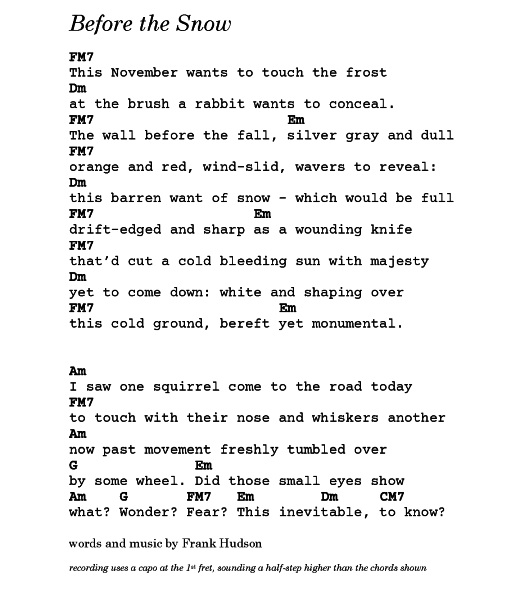
Before the Snow

More musical perversity: the difficulty in finding times to record acoustic guitar with sensitive mics in the past year or so has increased the number pieces I’ve done with that instrument.

.

For the final 5 lines I used an incident from a recent bike ride. Rolling down to a favorite breakfast destination at the borders of my wooded city I’m usually met with a rewarding bit of wildlife (outside of deep winter): constant squirrels, rabbits, small rodents, birds, including waterfowl by a pond and creek I pass, insistent crows, and so forth. If Keats wrote his “Ode to Autumn”  on Hampstead Heath in the Highgate section of the city of London, these near-daily rides of mine with this contrasting nature in the midst of modest single-family houses and parkland is my equivalent. What I saw this day was a little epiphany – a squirrel had been quite recently struck down crossing the road. Not smack dab run over, for it was not squashed, and there was only a little blood – yet it was clearly not moving or breathing, and even from the height of my bicycle its eyes could be seen fixed and dead. And then, as I was approaching, carelessly another squirrel scampered out onto the road and up to the corpse. Though I was riding onward, and only slowed a bit moving to the side, this squirrel bent down right to the head of the dead one, close enough to touch it barely with whiskers, clearly looking closely at it, for a moment regardless of my vehicular approach.

And then, just as I was beside them, it scattered off, missing by accident or close design, my slowed, but rolling, bike wheels. What was that squirrel after, what was it thinking in those few seconds with the dead one? This  was the matter to finish the poem that had started years ago with a rabbit finding scarcely-leaved autumn bush and brush to hide in. And I too had had my customary Parlando encounter without firm context, working with the part of the poem written by someone I hadn’t seen for decades: though in this case, it was my younger self. Not really that different from the usual encounters here with Frost, Dickinson, Sandburg, Millay, Stevens, Hardy, et al.

I originally gave the resulting sonnet the title “Before the Rapture of Snow,”  because I thought that tied-in the rabbit’s anxious waiting and the dead squirrel. I drew back from that thinking it too grand a reach, and because the theological implications of “rapture” would repel, puzzle, or draw in too-determinant reactions.

I was lucky enough to have a Monday to record this, finishing what felt like a good take of the vocals and acoustic guitar just before I had to leave my studio space. I added piano yesterday and mixed the tracks. As a non-pianist I’ve fallen into using that instrument simplistically as I do here, and I’ve grown fond of how these pounded single notes mesh with the timbre of acoustic guitar. You can hear “Before the Snow”  with the audio player below. Has the player been raptured up to heaven? No, it’s just that some ways of reading this blog suppress displaying such a thing, so I provide this highlighted link that will open a new tab with its own audio player.

.

*Besides my lack of talents for promotion, I sometimes feel what I do with this Project presents a number of detriments to gathering an Internet-scale audience. Poetry, as I write above, is not something sought out by modern Americans in great numbers. And then the music I make suffers from these things that reduce audience interest: I’m not a singer with a beautiful voice, nor do I think of myself as a performer with charisma or erotic appeal, and the music I make despite that is both too varied and too limited.

Many potential listeners or readers, presented with an infinite library of options in our modern age, will avoid things that have but one of those strikes against it – and to add another one or two against the Parlando work wouldn’t be rare either.

All this isn’t breast-beating or humble-brag, and I’m even hesitant to waste your time writing this. I am proud of much of the work I’ve done over the last decade here. While my audience is Internet-small, I believe it’s not all that small by poetry standards, and increasingly, not completely outsized by the audience for much non-Pop Indie music. Thanks to my hardy listeners!

**Dean was working elsewhere in comedy, and with at least one other partner in music, when he played in the LYL Band in the 1980s. He was talented and creative, we were looking for a drummer or bass player, and we perversely came upon him as both – unconcerned with the challenges of one person filling both roles! He may have grown to think of us as less professional or ambitious than he was, I don’t know, or events of his life may have intervened, but for reasons unknown to me we just stopped playing together – but this happened without him picking up the small drum set he played with us, and stored at my place. While working on my cleanout this fall I briefly tried to find contact info for Dean to see about the drums, but the trail ran cold after finding articles about him being part of the pastoral lineup at a church that no longer listed him on staff.

Dread Robin

The attention I’ve been calling forth this National Poetry Month has been divided up between “civic poetry” about the state of nations, and poet’s examination of Springtime. Today’s piece continues with the wildflowers and wildlife side of April, but because it’s by Emily Dickinson, it’s a complex statement.

Dread Robin

Dickinson here uses the ballad meter as she often did, a form also used for many Protestant hymns. This form as common as the robin. Simple music, startling images, another disconnect.

.

This poem, approximately dated at 1862, can still startle the modern reader. Over a century and a half of poems have been written since then, yet the language, images, and play of thought within it still seem fresh and surprising. And there’s no wait for the surprise in this one, beginning with the idea that I used for a title for the resulting song I made of it. Dread of Robins? This common North American bird is anything but frightening. It’s not large, or fierce, no raptor or raven. In the context of the poem, the outstanding thing about the American Robin is that it’s a migratory bird whose arrival is a sign of Spring. Yet it causes pain somehow.

The next stanza seems to amplify sound. The song of the robin is not that loud, but the sound of wild birds in Spring taken together does have a choral aspect. In their territoriality and mate-seeking, there is a shout to their throats. Dickinson hears some music in it, but it’s not altogether pleasant. The Piano in the Woods image delights in sideways incongruity. The piano is Dickinson’s instrument, the one she played, but as an acoustic guitarist one thing I know about the piano is that it can be overpoweringly loud. And placing the piano with its wooden case in a woodland implies a metamorphosis. Perhaps ED hears a piano whose notes are bird calls? “Mangle” here is another characteristic unusual word choice by Dickinson. In her day she’d know the machine named with the verb: the wringer for squeezing water out of laundry. Spring is putting the speaker in the poem through the wringer.

Many of this April’s pieces have featured wildflowers, and specifically daffodils, but the colorful brightness of the flower here does not delight even after the dreary monochrome of a Massachusetts Winter.

Bees are everywhere in Dickinson’s poems, more than angels in Blake or Rilke. She often speaks fondly of their seeking sweetness, their industry, their pollinating agency in horticulture. Dickinson had by interest and education knowledge of these details, yet here the Spring bee too is unwelcome and she feels alienated from them.

In the penultimate stanza the creatures and flowers of Spring are present. She grandiloquently calls herself, “The Queen of Calvary,” suffering as if the crucified Jesus of Lenten Spring.

In the final stanza there’s a parade of sorts, with drums and salutes. “Plumes” here strikes me as an odd choice. It may be a bereaved funeral procession. Black ostrich plumes were apparently used for funeral decorations in the 19th century, so oddly we start with a modest small bird and end with the plumage of one of the largest.  The poem’s speaker dreads the robin, yet seems accepting of the plucked raiment of the giant.

Is this a poem of disappointment and depression? Yes, that is there — but it’s majestic too. The poem is a catalog of Spring’s changes, all of which the poem’s speaker is unable to find pleasure in: dreaded little robins, pianos in forests, piercing yellow wildflowers, the energy of bees. There’s wit here, and like a Blues singer, there is a power of being able to sing knowing the score of a bad outcome!

I think this is a poem of a divided mind. I can relate. Spring remains wonderful, much as this Spring I’m experiencing this year, but my civic world has presented us with discordant changes, public cruelty, careless acts, all cloaked in self-serving bluster. Dickinson’s poem is dated to 1862 — the American Civil War, which for now still has a singular name, had started.*

I originally tracked my musical setting here with just my voice and acoustic guitar. I thought that spareness might contrast with the last two musical pieces here with full-on Rock ensembles. I had second thoughts though: this may be a poem about internal sensations, but it’s also about change in a fuller natural and national world. Eventually this arrangement, one that evolves throughout with high wind instruments and emerging synth seemed better suited. You can hear it with the audio player gadget below. No dreadful robin, I mean player, to be seen? You may be reading this blog in a way that suppresses the player, so here’s a highlighted link that will open a new tab with its own audio player.

.

*One reader of a Dickinson blog has a detailed theory of the personal particulars that might have faced ED when the poem was written. Deadly Civil War or mentors splitting for the coast would be matters of mismatched scale. Is the Spring of closely watched bees, and little birds and yellow wildflowers smaller or bigger than those things?

William Carlos Williams “The Birds” and what nature sounds

Something about the Spring I noticed this year — oddly, this year as an old man who has had a full lifetime of Springs — is the intensity of natural sounds in my city. There’s a tendency, demonstrated in many poetic tropes, to make nature a portrait or a silent movie, putting nature in contrast to the noise of our civilization’s hum and bark.

I ride my bicycle nearly every day off to a café to have a breakfast, sometimes early enough to feel like the single soul on the street, but by the return trip certainly part of the city waking and doing: kids on their school bus stops, sometimes with a parent, sometimes waiting with their own cohort only, folks holding coffee flasks unlocking their car doors to go to work, a few other bicyclists, including those on big front basket bakfiets or long-tail rear-seat-shelf bikes holding small kids, this observant cargo watching whatever in the morning beneath their pastel helmets. The human noise is slight and clicking. In such mornings we are more like crickets rubbing their wings.

But the birds! When most of those humans are making only accidental noise this early, and the kids waiting for the yellow bus aren’t always talking, perhaps practicing quiet for the ordered schoolroom, the birds are singing at the tops of their voices in the morning. Like miniature feathered fiddles, their song cuts through larger sounds, it insists on being heard. “Ladies, I got your genetic material here!” “This is my and my kind’s tree!” “Whatever this is, this Spring, I am here, and I’ll use my breath to say it!”

Like us bipeds lacking much fur, other mammals aren’t sounding much. Yard bunnies are suspicious and quiet. The squirrels don’t chirp, and their little feet make quiet footfalls. The dogs on leashes: all nose-leading in an alternate sensory dimension. But the frogs and toads are singing out too — whole amazing choirs of them, all wanting to contest Emily Dickinson’s Nobody with a harrumph and high whistle of who they are.

So, it is this Project’s nature to add sound to page poetry. Today’s audio piece is just me alone with a Telecaster electric guitar during a hurried session early this Spring to put down some musical ideas. In the poem that I’m combining with my music, “The Birds,”  William Carlos Williams follows Imagist principles, melding a moment into concrete images. Given that we’ve just had a set of rainy days throughout the long holiday weekend in my city, I resonate as Williams poetically paints the bird-morning wet as undried paint.

Is the world not “wholly insufflated” as he says at the start? The bird song is breathing into our world — nature is not silence, but poetry aloud.

Strange Powers Magnetic Fields photo by Heidi Randen 600

My wife found these* stapled to poles around our neighborhood on Sunday.

.

You can hear my performance of Williams’ “The Birds”  with the player gadget below. No gadget to be seen? This highlighted link is an alternative that will open a new tab with its own audio player. Want to follow along with the text of the poem? Here’s a link to that.

.

*This bird couple’s heads are superimposed over a human pair of heads from the cover of The Magnetic Fields Holiday  album. The quatrain quoted below is from a song found there “Strange Powers.”   Despite being a substantial Magnetic Fields admirer myself, I had never seen this album cover.

Pea Brush

There are more things than well-made that a poem can be — but as someone who’s worked to make their own poems work, I can use that experience to admire what Robert Frost does in today’s piece.

“Pea Brush”  is a rhymed iambic poem, based on four-foot lines, but it throws in enough variation that it never seems like it’s limping along in its gait. The rhymes aren’t fancy, and at least for me, they quietly chime along in the background without calling attention to themselves. This is prosody that isn’t bragging or showing off. It was easy to sing in my rough-hewn manner for the most part,*  but if I was to reformat it into blocks as if it was prose, it wouldn’t seem all that strange either. Indeed, as I performed it, I wanted to stress its conversational quality.

If you’d like to follow along, here’s a link to the text of Frost’s poem used for my performance.

I myself haven’t had a garden in decades, but one friend of the blog Paul Deaton covers their kitchen garden regularly at his blog, and alternative Parlando voice and keyboardist Dave Moore has a garden that we talk about sometimes. I could imagine reading the first-layer plot of this poem as a post Paul might make. “I’ve arranged with a neighbor to use the small limbs from some birch trees he’s clearing as poles for some of my climbing garden plants. When I went to pick them up on Sunday, I noticed bent-over wildflowers** blooming under the brush pile. My reuse of the felled branches will help my pea vines and give the wildflowers room to grow.”

Besides this clear plot line, there are fine clear images in the poem’s story: the smell of sap still in the air from the just-cut trees, the pause in the frog’s song, the near-like to a baby’s grip of an adult’s finger to the tendrils of a climbing plant on garden stakes.

Pea Vine Tendril!

 Wishing good luck to all the gardeners reading this.

.

Below this surface, what is the poem trying to convey? The poem’s speaker (as a character perhaps a more prosaic farmer than the poet and indifferent farmer that Frost was) just notes the practicality of the arrangement — free garden stakes — while letting us in on the blooming of May flowers and the promise of harvest aided by this arrangement. Frost the poet has written this well-made play, painted this scenery, blocked and directed its performance. The play portrays the give and take of humankind in nature. We’ll grow (and consume) the peas with their infant tendrils. Neighbor John has amputated the treescape for his own agricultural designs. These are planned acts of life and death. The episode of the frogs has them portraying those things outside our plans, their Sunday-service silence to hide from a two-footed demigod that might come to capture them to a final silence.

I’ll note too the poem’s ending “had to come” interjection breaking the meter to make a final statement of the budding wildflowers that couldn’t wait for humans to make their plans.

I had to make do with a single hour to get this musical performance down today, and I chose to grab an acoustic guitar to get this accomplished. The results felt right enough to produce this new piece that you can hear with the graphical audio player below. No player?  This highlighted link is an alternative that will open a new tab with its own audio player.

.

*The line “The same as you seize cat’s-cradle strings” is a bit of a tongue-twister. And while I get Frost’s image clearly in that line’s stanza, the syntax is a little disordered I think.

**Frost names his wildflowers as trillium. I don’t know if Frost was the exact botanist that his friend Edward Thomas or his great New England predecessor Emily Dickinson were. Neither am I, but I’m often open to researching specifics like this in poems. I find that one of the species of trillium that grows in Frost’s New England is the Nodding Trillium, a variation that grows crooked stems naturally, not because a brush pile has altered its growth.

The World Is Too Much With Us

This sonnet is one of William Wordsworth’s most well-known short poems. As can be the case with commonly known poems, I can’t remember when I first read or heard it, and so it might seem like it’s always existed, that it’s just there, ordinary in its presence. I’ve been thinking today that the poem’s familiarity hides some strangeness. Let’s look at some of that.

For National Poetry Month this year I’ve been examining poems included in a pair of 1920’s anthologies for children: The Girls and The Boys Book of Verse.  Let’s start by examining context for this poem appearing there. This is not a poem of childhood experience.*  “The World Is Too Much With Us” starts off speaking in an adult’s voice of the weariness of “getting and spending.”  I’d say that inside the pair of anthologies I’ve been looking at this month, this is more intended as a poem a parent would read to their child. Other poems in these books live and report from the world of imagination, a splendid world, which though it may also not be physically “with us” as children, exists in the same way as the thoughts and emotions of the actual world do.

The World Is Too Much With Us

Chords in case you’d like to sing this poem yourself. Another form of participation: As the two 1920s poetry anthologies were gendered, I’m asking my audience to guess if each poem I present this month was in the boys or girls volume. Answer below.

.

Do we ever think of Wordsworth’s opening phrase as odd: “The world is too much with us?” Volumes and volumes of poetry are filled with nature poetry telling, seeing, hearing, approaching tasting or smelling, the world. We expect poetry to give us that world-muchness. We’ll get to nature eventually in the second quatrain — though it may not be the nature we’d expect — but this is an example of a leading phrase that should shock or intrigue us: “What do you mean WW? I’m so busy with my adulthood I hardly see the world beyond nearsighted bills and paycheck!” Perhaps familiarity keeps us from feeling any shock at the opening.

There’s an odd idiom to finish off that first line: “late and soon.” Was this a common phrase in Wordsworth’s time, or is it just a make-rhyme? While its variation “sooner or later” is something that everyone still says, in this exact saying it seems to be making the present moment a wider aperture: saying that recently and in my next future this is the way things are — though it’s also expressing the deadlines that press our getting and spending, all that ASAP and overdue.

In reading poetry I’m immediately attracted by the musical impetus prosody brings to the words, but another part of my mind should (eventually, after the word-music has struck me first) trace the actuality of the images. The poem’s second quatrain brings the nature images, one almost conventional, the following one, extraordinary. This poem is so commonplace with us that we think little of this quatrain. “This sea that bares her bosom to the moon” may be an all-to-conventional readymade now, but Wordsworth wants us to see there an offer of vulnerability; and with the other well-worn trope of the moon’s tides, a sense that we will, even if we are “out of tune,” resonate with the pulls of nature. And then the unusual image: this nature is not a slow, predictable rising of a consonant chord. If we think we remember this poem, do we forget the “winds that will be howling at all hours” that are now enclosed inside the petals of “sleeping flowers.” This is Wordsworth’s Blakean heaven in a wildflower. I cannot say what the poem’s composer’s conscious intent was — but as a deep image, the flowers containing the plant’s reproductive features could illuminate that desire and sexuality are a riveting but unreined nature.**

And within the later specific context of this poem appearing in an anthology that might be bought by parents to read to young children, this remarkable — yet little remarked on — image may speak to the howling winds of parenthood.

So, the world of human commerce is too much with us — but nature too may be too much with us — it may rack us beyond our control. Do we overlook that Wordsworth says for everything  we are out of tune, something he writes after a quatrain on the commercial world of work and a quatrain on nature.

The sestet that concludes Wordsworth’s sonnet to my reading is not a grand summation or synthesis, some glorious wish. I read it as saying some rickety, obsolete, altogether false mythology might seem a preferable refuge from this world — its nature and  its business. Proteus and Triton there are not the speaker exalting in neo-paganism. They are “outworn,” and a thing that the poem can only see as plausibly not as bad as the elongated moment the poem has presented. In such a fancy — if bound between covers, the imagination of a childhood book of Greek myths that our anthologists might also offer — we could have powers and a way to shape the world that elude the poem. Over on a bookshelf near me is such a book from my wife’s childhood. In childhood, our imaginations, our fancies, are our superpowers. Us obsolete children, outworn, cannot call on those powers and inveigh them with this world.

I hope I brought out some of those inferences with my musical performance in a poem that is perhaps too well-known to be known today. It was rewarding to take out my nylon-string guitar to record it, the kind of guitar I started on in my 20s. You can hear my performance of “The World Is Too Much With Us”  with the audio player below. No audio player? Is it inside a sleeping flower? No, some ways of reading this blog hide it.  This highlighted link will open a new tab with its own audio player.

.

* One of Wordsworth’s best long poems, Intimations of Immortality from Recollections of Early Childhood,  is the author’s own brief supporting this division.

**Wordsworth’s romantic life and parenthood has complexities that early biographers excised, including a second family in France, a country England was at war with. One can also summarize that women helped make the poetry his name alone is on, including another famous short Wordsworth poem “I Wandered Lonely as a Cloud.”  Here’s one condensed account of Wordsworth and those matters. If you’d like to hear this Project perform his famous April daffodils poem, and read what I wrote about it, that’s linked here.

The answers to your gender quiz game today. “The World Is Too Much With Us”  appears in both the girls and the boys 1920s anthologies. Relax busy adults, no one loses points today. “I Wandered Lonely as a Cloud”  is also in both books.

Each in His Own Tongue and the “middlebrow” problem

Social media likes controversy, so it’s no surprise that two things have recently mingled there in provocative assertion: poet Mary Oliver and the dread “middlebrow” epithet.*  It’s not a long bridge between the two: Oliver’s poems are put forward as all too middlebrow in this charge, and middlebrow is a sign of significant lack of ambition or achievement. I’m not a fan of the term “middlebrow,” for a hierarchy is implied and I don’t care for hierarchies much — but to speak of this I should define middlebrow poetry. A definition that works for me is: poems that remind us of something we already sorta-kinda know, but maybe couldn’t quite put into words. These poems are usually immediately understandable on first reading by a significantly literate reader.

Why’s this bad or lacking? If this is a singular mode it rules out poems that tell us multivalent things, or mysterious things that require more thought to comprehend, thought perhaps taken in stages. It rules out shocking, utterly surprising poems. And such poetry doesn’t feed our playful desire to puzzle-solve with clues we are proud to have acquired.**

My view? I think various modes of poetry (even differing modes of reading the same poem) have diverse values, and I’m more than OK with that. Poetry’s eye should be the insect’s compound eye, containing a hundred, a thousand, ommatidia. And so, if it was up to me, the best cultures wouldn’t be restricted to, or rewarding of, one poetic mode. This may be a visceral thing with me: I get bored with all one type of thing quickly. Building towers of hierarchies might be fun, and illustrative of what one can stably hold long enough to build such a tower, but in the end, the domain one will look out on will have a lot of scenery that isn’t in your tower. In the right mood, I can get pleasure out of looking at the commonplace apprehension poem and a “difficult” avant-garde one — and in the wrong mood on my part, or insufficient achievement in the poet, not a touch of pleasure in either mode. And beyond all this meaning and metaphor, there’s the oldest part of poetry, the part even young children understand, that poetry also has abstract pleasures like music has — poetry is the instrument on which the meaning plays.

A great many of the poems in our pair of 1920s children’s poetry anthologies are as middlebrow as any Mary Oliver poem brought up on charges in this controversy. This shouldn’t surprise us. A modern children’s anthologist looking to duplicate the task of those in the previous decade called The Twenties would, I think, do likewise. Some of those pressures would be commercial: what will sell to parents, libraries, teachers. Some would be practical: these children aren’t yet bored with the lessons of the world — those lessons are new and useful building-blocks for their youthful towers — and maybe a lesson of my old age (and a lesson of Mary Oliver) is that I shouldn’t have been bored with the lessons of the world either.

I think too of what happened as the first childhood readers of these poems in the 1920s progressed into the economic distress of the Great Depression, the rise of nationalist dictators, the Second World War, and the Damoclean Cold War. All through the middle of their lives how much time would they have for poetry that offered them the highbrow pleasure of gnostic meaning, of shocking new combinations and collisions?

The answer is: some would find the time, some went on and made their own verses in those modes — and many others would not. Some kept food on the table, kept bolts tightened on airplanes, tended the sick, kept fuel in NATO tanks facing east. Some had their yet young lives ended sans poetic envoi. Others desired, birthed, and raised my generation.

Highbrow, middlebrow, it is neither sophistication nor no-nonsense populism to forget either part of that cohort.

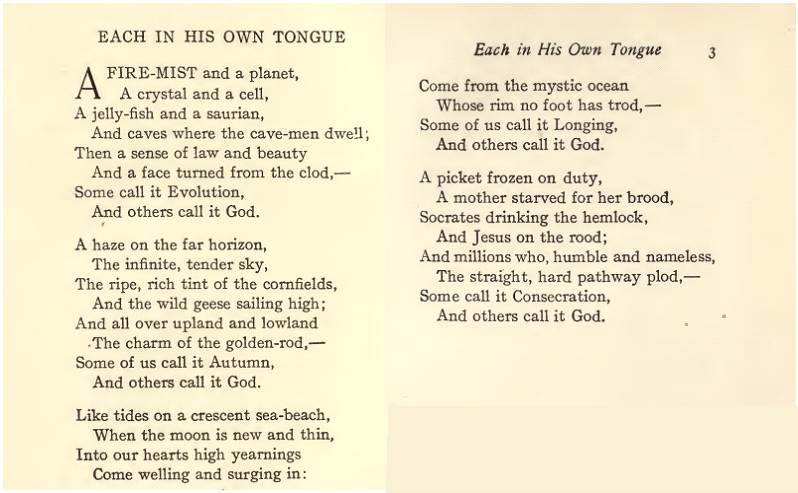
On to today’s poem, an example of a poem that earnestly intends to be a lesson: “Each in His Own Tongue”  by William Herbert Carruth. Look! Mary-Oliver-approved wild geese make their appearance in it, decades too early! I also offer this month’s puzzle challenge: the pair of 1920’s anthologies I’m drawing from were gendered: one for boys, one for girls. So as with each post this month, you’re asked to guess in which volume did the poem appear. Answer lower down.

Each in His Own Tongue

dedication to Ina Coolbrith

Here’s today’s poem as it appeared as the title poem in a book-length poetry collection by Carruth.. Marginalia picked up in the scan of  a copy of that poetry collection. Wonder who Ina Coolbrith is? Here’s a link.

.

The brief Wikipedia stub for Carruth tells me he was “president of the Pacific Coast Conference of the Unitarian Church.” One of my preacher relatives once said of an Unitarian school he’d attended “The only time anyone would speak of ‘God’ is when someone stubbed their toe.” I read this morning a brief poetic knot of a summary of Oliver’s earnest lessons delivered by A. M. Juster who wrote that he’s “Not a big fan or a big detractor of Mary Oliver” but then sums up his impressions of her work by saying “I also think her spirit wanted to write religious poetry, but her mind wouldn’t let her.” Each in their own tongue I’d say, ungendering Carruth. Carruth wrote “His,” and his poem appeared in the Boys Book of Verse. You can hear my musical performance with the audio player gadget below. No gadget to be seen? This highlighted link is a backup which will open a new tab with an audio player.

.

*Here’s a link to a well-done post on the controversy, and a refresher on Oliver’s poetry if you are not familiar with it.

*This last factor is less-often laid out as I just did, perhaps because it doesn’t seem serious when complex poetry is discussed. But let’s admit it: great portions of humanity loves puzzles and challenges in which they feel rewarded if they can progress farther than some other human.

All These Wild Geese Poems – and how one of my music pieces migrates

The route today’s musical composition took to existence was almost comically round-about. I added a new virtual instrument (VI)* drum set this week, one with a drier, more retro sound. I decided I should try it out. I grabbed an acoustic guitar track I’d recorded weeks ago, but not used for anything, and went to creating a simple drum track using the new kit’s sounds to see how they meshed.

It sounded pretty good, but that track-of-convenience guitar part had bleed from other stuff into the acoustic guitar mic, and so I used a tool I have that extracts a chord progression from an audio file, and then had that extracted progression played with a VI piano.

That cleaned things up enough that I figured I should make a little instrumental piece with this. Why not complete a trio and play some bass? Just over my shoulder in my little bedroom-now-home-office sits a Squier fretless Jazz bass.** I love its sound, but my old fingers need to be in good shape to get a clean sound out of it. Yesterday, my fingers were feeling strong, so that’s what I grabbed. I found a bass motif and played it in my best attempt to fit into the “pocket” of the drum groove.

A great musician or a more meticulous recordist might have perfected this, but something in me accepts a certain looseness and imperfection. Even if I’m recording one track at a time in one-man-band mode I’m often looking to get that spontaneous live-take feel, and my resulting trio had that I thought.

At this point my little house was filled with a half-dozen late-stage teenagers, all looking to have an autonomous time playing video games and watching YouTube. I holed up in my little office to let them be young. Might as well look to add another VI to my trio — if nothing else, to pass the time. The computer I work with virtual instruments on doesn’t have speakers, only headphones. Returning to the world between the cups of the headphones, I wouldn’t be bothering them.

What could be that another instrument? I decided to try cello. What articulation should I choose? My cello VI has a dozen or so articulations to choose from: different bowing techniques, styles for flowing legato or choppy stabs. I auditioned a few, and found two finalists I liked with the existing trio. Two roads diverged within a wood. Which one to take? I decided I’d use both  of the finalists.

I set the cello part to echo the keyboard part, a simple choice. I often enjoy simplicity in music, and my use of orchestra instruments often reflects that. I’ve taken to calling some of my pieces “Punk Orchestral” for this reason. Hey, ho, let’s go!

It was 11 PM by the time I finished the instrumental. The teenagers decided to decamp for a Perkins restaurant*** in a late-night post-modern way. Listening to the rough mix of the trio with the cello section I now thought this is good enough for a Parlando Project piece — I just need to find a poem for the words. I didn’t have much collected for possible imminent use. I had some Emily Dickinsons, but I fear I’m doing too much of Dickinson lately, as much as I like the results. I tried a Robinson Jeffers, but the mood of the poem didn’t match the jauntiness of the music’s groove. Then I tried a short poem I’d drafted in June, inspired by watching waterfowl in my city’s urban parks, lakes, and ponds. That fit!

All These WIld Geese Poems text

The poem that became today’s lyric

.

I revised the music slightly to use with these words. Guided by the instrumental’s chords and using my imperfect voice, I devised an expeditious melody. I tried a couple of takes singing the words, and found that my poem sung better with some mild editing of its text. It was around midnight when I tracked the final vocal take you can hear today before going to bed. It was just after that final tracking that a comic turn happened. The drum track, the new VI sound I started with, that, which had inspired the course of this composition, stopped playing, muted itself. A bug perhaps? But in the early AM hours I decided it sounds better without the drums, as the other instruments now have absorbed the groove conception I started with within themselves.

Today I mixed the resulting piece “All These Wild Geese Poems.”   Mixing involves placing the instruments within the soundfield in stereo width and volume depth, and using other audio processing on their dynamic envelopes and frequency ranges. I then created the final mix using some computer tools to adhere to current streaming services loudness levels, and uploaded it to the service that shares my audio to play here and on the podcast platforms of Google, Apple, etc.

A Goose as Ratso Rizzo 600

You, poet, you’re not much of a goose, or much of a Yeats either, so get out of my way!

.

“All These Wild Geese Poems”  takes off from the many romantic poems about geese, cranes, swans and such large waterfowl. The urban geese I meet in my city nature are instead cantankerous beasts, and I thought our contemporary poems often take a similar stance, no pristine “Wild Swans at Coole”  musings for these birds — more at the famous Dustin Hoffman Midnight Cowboy  “I’m walkin’ here!” self-involved swagger with a limp. You can hear the performance with an audio player below if you see that, or with this alternative link that will open a new tab with an audio player.

.

*Virtual Instruments are precisely recorded sounds of the various notes and timbres of a physical instrument. Either by using compositional scoring, or the computer equivalents of that; or by playing the notes with a MIDI controller equipped keyboard or guitar, one can make reasonably convincing performances of instruments that one cannot play or afford in real life.

**I play interesting but relatively inexpensive guitars. Squier is an entry-level brand devised by Fender to sell low-cost versions of their famous instruments. Back in the 20th century any aspiring player found with a Squier was considered non-serious. “Real musicians” used “pro instruments” — but in the past decade or so the quality of the better Squier instruments has increased substantially.

***Perkins restaurants are like a Denny’s. Big menus with lots of senior-citizen specials and tastes —but open early and late for the time-expanding young person.

Emily Dickinson’s Mushroom

It’s been said of poets that they go out into a perfectly good morning only to think of glum existential thoughts. When I read something like that and look at the pieces this Project does, reflection is called forth. That certainly calls out a lot of subject matter I deal with here.

There’s a rebuttal, songwriter Townes Van Zandt said “There’s only two kinds of music: the blues and zippety doo-dah.” Poetry of course is music’s sister muse, but despite Steve Earle’s cowboy boots,* Van Zandt isn’t likely to be recognized as the world’s best songwriter. A dialectic of “blues and zippety doo-dah” risks falsely reducing Blues to a synonym for “sad songs.” One reason that Van Zandt, who was an excellent songwriter, won’t get the World’s Best award is that his songs vary between sad, sadder, and saddest. Doesn’t make them less perfect for what they are, just makes them suitable for certain moods while other songwriters might portray a range of outlooks and characters. I like Townes Van Zandt, I think “Flyin’ Shoes”  is as near a perfect song as ever written, but a playlist of 20 to 30 Van Zandt songs would not carry my attention as well as a similar-length selection of Bob Dylan, B. B. King, Joni Mitchell, or Mose Allison.

An Emily Dickinson playlist would be equally as varied as anyone in that latter quartet. There’s the goth-girl Dickinson, the satirist of religion Dickinson, the legalistic philosopher, the altered-states psychedelic Dickinson, the secret bisexual passion Dickinson, and then there’s the Dickinson I’ll perform today: the botany nerd Dickinson. Part of what makes Dickinson such a fascinating writer is that all those personas talk to each other, seem to know each other.

I’ll not go into thousand-words territory on today’s Dickinson piece — I’ve been too long-winded lately for that. I’m going to treat her poem as a simple delight in the oddities of fungi. I have every reason to estimate that that was Dickinson’s intent, and we can enjoy that intent’s achievement. Here’s a link to the full text of the poem if you’d like to read it. To briefly brag about my restraint, there’s a possible deeper, subconscious, reading of the sporocarp fruiting body — but let’s be done with that. All the other Dickinsons may have been there when this poem was written, but we can simply enjoy one of them today.

Mushroom photo by Heidi Randen (2)

Apostate mushroom, pleased grass, surreptitious summer. Emily Dickinson not pictured.

.

Player gadget below for many of you to hear my performance of Dickinson’s “The Mushroom is the Elf of Plants”  with acoustic guitar, piano, and cello. Backup link for those that can’t see the audio player below.

.

*A famous quote by fellow Texas songwriter Steve Earle was plastered on a Van Zandt album cover: “Townes Van Zandt is the best songwriter in the whole world, and I’ll stand on Bob Dylan’s coffee table in my cowboy boots and say that.” Wikipedia reports Van Zandt had a comeback when asked about that blurb too.

But These Things Too (Are Spring’s)

British poet Edward Thomas, who deserves to be better-known in the U. S., is one of the best nature poets I’m aware of. And today’s ode to the beginnings of spring shows one reason why. Like many a good nature poet, Thomas’ landscape, animals, and plants are infused not only with his region’s specifics, but with his own understanding of the order and significance of life. What takes his poetic observation to a next level? In this poem, it’s, well — bird poop.

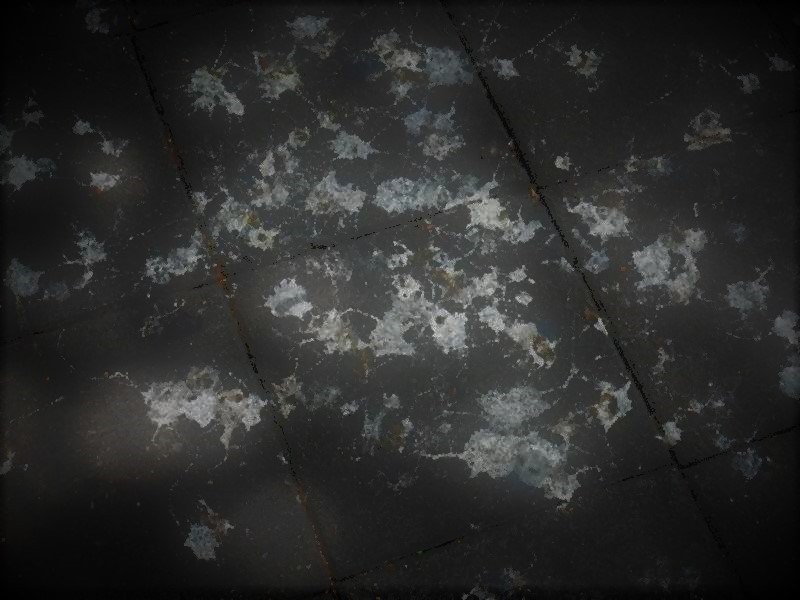
Here’s a link to the text of “But These Things Also.”   This is a grey poem about and often grey time, despite all the odes to the greenness and new-found warmth cataloged in other spring poems. In the reduced contrast of this poem’s palette, white splashes against grey make up its color field. Thomas (who didn’t make it past middle age,* but who could have been myopic) sees plausible flowers emerging. It’s not. It’s bird droppings. Here, nature instructs, changes his poem from an otherwise competent one to a better one. The later appearance of starlings, the British bird of indifferent song and nuisance potential, are foreshadowed (foreshite?) — and we might know (as Thomas certainly would have) that the starlings flocks are startling in their amazing patterned flights.  Life and spring may well get on with amazement after first meagre overtures.

The White Things A Man Mistakes

“In splashes of the purest white” vs. “Continuous as the stars that shine and twinkle on the milky way” Thomas vs. Wordsworth in a springtime faeces & flowers battle

.

You can hear my rock-band setting of Edward Thomas’ “But These Things Also”  below, but before I leave off writing about his poem, let me speak a bit about what I note about the poem’s use of rhyme. Like another great nature poet, Emily Dickinson, Thomas here is not over-determined by his need to make perfect rhymes, and the ABCB scheme starts right off with a sight rhyme of “grass” with “was.” Let’s not mark him down a grade, because the poem has a great deal of near rhyme, an effect that I find often more effective than ding-dong perfect rhymes. The pair of adjacent words “earliest” and “violets” are as strong to me as violet’s eventual end-rhyme with “debts.” And “debts” still hears the echo of the preceding “dung” and following “mist.” You may hear other consonance, assonance, and pararhymes in Thomas’ word choices.

It’s these sorts of things that make me resistant to some poetic formalists. While perfect regularity can reinforce a sense of fate (or to be honest about my own response, boredom) — irregular rhyme appearances, and variations to and from perfect rhyme, can evoke surprise and discovery.

OK, enough dancing about architecture. Let’s get onto the audio piece, the performance. Graphical player below for some of you, and if not, this highlighted link that’ll open an audio player. This is one of those pieces where I wish there was a better singer than myself handy, but it was still fun to move from chair to chair to create this one-man-band recording. I recorded this close enough together with our last piece, Anna Akhmatova’s “Like a White Stone,”  that I’m thinking if this was a polished prog-rock album that I’d fade the two pieces into a 7-minute medley.

.

*I decided to insert into Thomas’ ode my own aged vision issues, by making “man” in his text, “old man” in my performance.

Synchronicity: Spring 2022 Parlando Top Ten numbers 4-2

Sometime before The Police made it an album title, this project’s alternate voice and keyboard player Dave Moore took to using the term synchronicity to explain some things that going forward cause significant effects where there was no pre-existing reason or even connection. Maybe me seeing Dave read a poem in a church while we were both teenagers would be an example. Or here’s another one: an American poet who had generated no interest in America travels to England and creates not one but two poetry careers. And then that runs together with the next three pieces in our countdown to the most popular piece with listeners over this past spring.

Robert Frost went to England largely unpublished and un-heralded in 1912. He was 37. If you were thinking of starting a fantasy draft league for poets in 1912, Frost could not be your pick. I’m not enough of a scholar to know all the reasons for this move, but it might well have been because some of what Frost was writing chimed with poetry that had been published and reached an audience in the UK, poetry that used a rhymed/metrical lyrical voice to portray unpretentious countryside settings. While living in England Frost met another writer, the 35-year-old Edward Thomas. Thomas, also not your fantasy poet draft pick — he wasn’t even writing poetry. The two took a liking to each other.

Frost rather quickly found an English publisher while in England, and published two book-length collections containing many of the poems he’s still best known for. American Ezra Pound took to praising Frost to Americans, and Frost’s career was launched!

4. The Aim was Song by Robert Frost.  Coming in at number four in our spring countdown this year we find the now successful Frost with a poem published first in America. It’s a natural text for this Project because it uses music as a metaphor in a very musical poem. It’s been popular here over the years since I first presented it, and it was one of the most popular pieces among the 30 I re-released for National Poetry Month this April.

You can hear my performance of “The Aim Was Song”  with a player many will see just below this paragraph, or with this alternative highlighted link, which is here for those that won’t see the player.

.

So, what happened to our Edward Thomas? Thomas’ writing was focused on work-for-hire, the scriveners gig-economy of the time set to fill column inches in magazines and newspapers. Thomas’ personal interests were present in some of those works: he was an avid walker, bicyclist, and amateur naturalist. Like Emily Dickinson, no plant is encountered in Thomas’ writing and is not given a specific name or description. And likewise birdsong. Thomas kept journals, and they too have passages filled with the countryside carefully observed.

Frost saw Thomas’ writing, declared to his friend that he already had the stuff of poetry, and analyzed Thomas’ situation as a “suffering from a life in subordination to his inferiors.” Thomas subsequently took up writing poems with the now published and becoming-known Frost’s encouragement. However, time was marching up on the pair with a large surprise — a world war was about to break out.

Thomas’ non-militarist outlook, his middle-age, and his family for which he was the sole support non-withstanding, Thomas seemed drawn to military service for his country. Frost moved back to America to further build on his growing reputation there. He put forth a standing offer for Thomas and his family to join him in the United States.

3. Gone Gone Again by Edward Thomas.  Here’s a poem Thomas wrote during this time, and it’s a wistful evocation of war’s absences. In England Thomas is often thought of as a war poet, and there are reasons for that. But one of the uniqueness’s in his poems set during the time of WWI is that they avoid tableaus of the battlefields and the action set thereupon. “Gone Gone Again”  is a poem of what’s not there: people, workers who are now soldiers.

Thomas enlisted, trained as a lieutenant, a most dangerous job in the warfare of the time. After duty in England (he helped make maps, an apt job for a man who so well knew the countryside) he shipped overseas to the battlefront, where he was shortly killed.

Like for some young poets and musicians, death was a good career move for Thomas. Friends posthumously published a collection of the freshly-written poems that Thomas had crafted in only a couple of years writing verse. Attention was paid in the UK to the “war poets” and everything Thomas wrote was read in the context of that cataclysmic event for Great Britain.

One poem Thomas wrote, based on a journal entry from a train ride he took on this very day, June 24th in the summer of 1914, became his best-known and loved poem in his home country: “Adlestrop.”   You can hear my performance of “Adlestrop”  here.

Or you can celebrate “Adlestrop day” with this “lyric video” from earlier this year.

.Most Americans don’t know this poem or Thomas. I didn’t, until 2016 when one summer day of unwonted heat the train I was to make was subject to what became an hours-long delay in arriving at Kingham. The heat was such that trains had been stopped for fear of track failure. I can recall the trees and foliage swaying in the summer breeze at the little station, some small bird activity, a station caretaker who arrived to drip a watering can into some hanging plants on the platform. It was only afterwards that I learned of this poem, set in the very next town on that trainline, the even littler town whose trainstop had been removed some years back. Rod Serling should have come out the station door with a skinny tie and a summer-cut suit to quip on that synchronicity. Did I miss him because I wasn’t looking for him, because I didn’t know any of that until after I had been in Kingham that afternoon? Thomas’ poem was, and to some significant degree still is, loved because a few days after Thomas was stuck in Adlestrop, an Archduke got assassinated and the slow-motion trainwreck of WWI broke out over the ensuing summer. Thomas wrote his most famous poem afterward, referring to his memory and journal entries, and so he likely intended this poem to be read, like “Gone Gone Again,”  as a study in absences, a summer day with a peaceful nothing-urgent before “the guns of August.”

To hear “Gone Gone Again,”  there’s a graphical player for some — and you others? This link.

.

2. Cock Crow by Edward Thomas.  So, is Thomas only  a war poet? Could he have been something else? I think it’s highly likely. He was a troubled man, some other calamity less nation-shared than a World War could have taken him early, but the more I read, even his slightest poems, the more I see why Frost was taken with him, and why even Americans who may not share the cathedral-plaque reverence given UK war poets might still discover him. When I read “Cock Crow”  in a 1920’s anthology of Thomas’ contemporaries this past spring I was struck by how much fresher and less puffed up with ineffective references Thomas’ writing was set against the field. And Americans, whose culture received a 19th century dosage of Transcendentalism, love our closely observed nature poetry perhaps more than Brits. Maybe I feel a connection from that afternoon in Kingham, and that prejudices my reading?

Bird song occurs in “Cock Crow’s”   title and text, and in reply I was pleased I was able to end my performance of it with a choral part. You can hear it with the player, or its backup, this link.

.

“Cock Crow”  got a lot of listens. I thought it might be the most liked and listened to one, but when I totaled them all up this June, another piece beat it out. I’ll be back soon with the most popular piece this past spring. It’s a surprising one.