For National Poetry Month this year we’ve been looking a poems that were selected in 1922 and 1923 for a pair of gendered poetry anthologies: The Girls Book of Verse and The Boys Book of Verse. Today’s poem is another reasonably well-known selection, John Masefield’s “Sea Fever.”
I’ll not have much to write about the poem itself, it speaks so straightforwardly. I will say that I always thought of it as a poem by an older poet, and an archaic one at that in that it speaks of ocean-going sailing ships. Turns out, I read this poem with misapprehensions. Reading briefly about the poem, I found it was published by a poet only in their mid-twenties, and though the long-lived Masefield’s life overlapped mine — he was still England’s Poet Laureate during my schooldays in the United States — he indeed worked on windjammers.
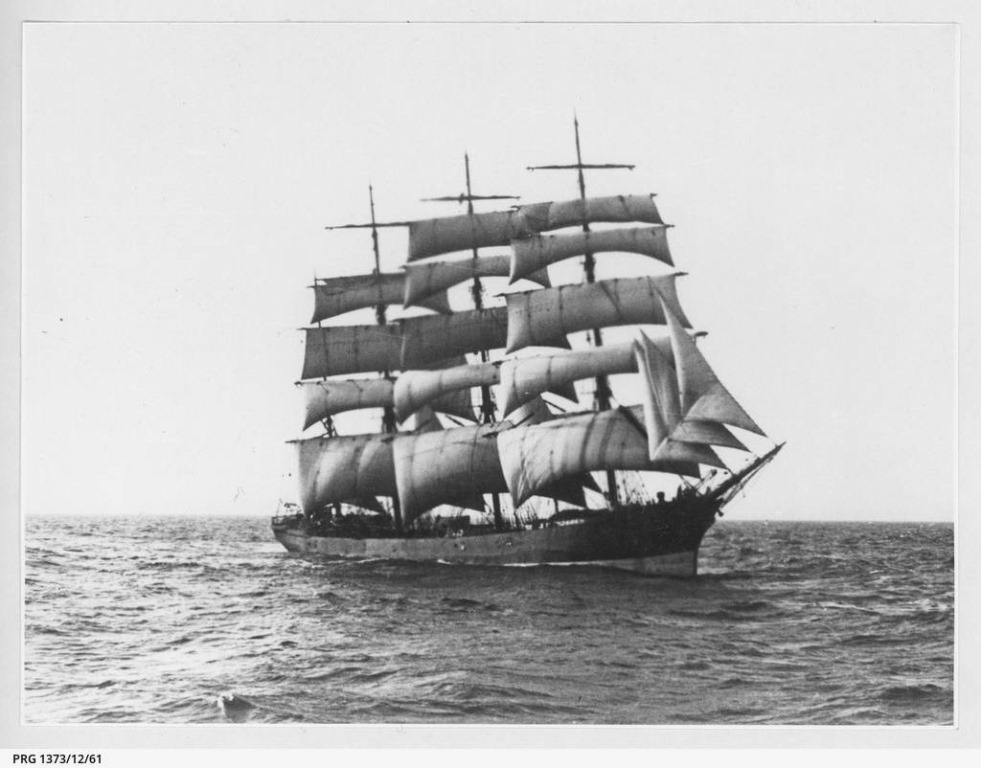
The young Masefield sailed on the cargo ship Gilcruix at the end the 1800s, and yet the ship looks like it could have been from the beginning the 1800s.
.
These two 1920’s poetry anthologies clearly wanted to encourage reading for the children that would grow to become the fabled Greatest Generation of the Great Depression, WWII, and the Cold War. Ironically, Wikipedia says Masefield was unhappy in school and shipped out to a life at sea “to break his addiction to reading, of which his aunt thought little.”
Masefield worked at sea and in America* for the next decade. The seagoing did not cure his reading addiction,** he continued to read on shipboard and eventually began to write himself.
While “Sea Fever” is more in the mode of poetic memoir than our poem last time by Emily Dickinson — it’s a nice bit of parallelism that Dickinson imagined books as a replacement for sailing far away, and Masefield imagined he could sail far away as a replacement for books!
As with our other poems from this pair of gendered anthologies this month, I’m going to ask you to guess if this was in the boys or the girls poetry anthology — answer below.
Here at the Parlando Project we take words, usually literary poetry written by various poets, and set them to original music in different styles. Not for the first time, this is a poem that already has a fairly well-known “art song” setting: one by John Ireland. Ireland made a lovely song, and not an overly elaborate one melodically for that sort of thing — but it’s beyond the limits of my vocal talent. So, the setting I created and performed with just my cruder voice and acoustic guitar is what you can hear below. I don’t know if you will be able to hear the canvas slap or the wind through the rigging in this version, but I was trying for that and a hearty song feeling in this one. There’s a graphical audio player to hear it below, but if that player is not visible, this highlighted link is your backup. It will open a new tab with its own audio player. Was this song of manly company on the high seas in the girls or boys book? It was in the girl’s volume.
.
*In between voyages, Masefield worked in a factory in Yonkers New York, something I did in my early 20s too. I may not have shared his nautical adventures, nor will I ever become the poet laureate of anyplace, but that tiny little happenstance made me feel kinship with Masefield 70 years apart.
**More of what is likely only coincidence: when Lou Reed’s protagonist in his song “Heroin” escapes into his drug addiction he likens it to a wish that he’d “Sailed the darkened seas on a great big clipper ship sailing from this land here to that.” If Reed had started his other song of that era “I must go down to Lexington 125, to the call of the running tide” we’d have an actual connection to go on.
For National Poetry Month I’ve set out on a feature where I’m examining the poems in a pair of poetry anthologies directed at children which were published roughly a century ago: The Girls Book of Verse and The Boys Book of Verse. Each collected around a hundred poems in a variety of styles, sub-categorized in broad subject areas the anthologists thought reflected childhood moods and interests.
That child audience became our ancestors. The early readers of the first edition would have been the oft-praised Greatest Generation which grew up in the Great Depression and served in the titanic national struggles of WWII and the Cold War. It’s likely that childhood has changed since then, but did these books in any way equip the young minds for the panorama of their future?
One of the pair of anthologies used this well-known poem by Emily Dickinson as a lead-off poem placed even before the table of contents. How many libraries had, maybe still have, this poem on the wall of their children’s section? I can’t say, but I recall seeing it in more than one in my post-WWII childhood.
Some of the words, if laid plain on the page, might risk being obscure to a 1920 or 2020’s child. Dickinson and the anthologists seemingly had little fear of that. A frigate is a class of fast war ship. Do children still have youthful romance with sea-ships? Born in a landlocked Midwestern state, I did — reading of and knowing all the classifications of ships, famous naval battles, famous captains, that sort of thing. Modern youthful D&D fantasists of the earth-like realms seem kind of land-bound to me, perhaps because Tolkien seems to have left his sea-faring tales to the long unpublished Silmarillion. Current SciFi readers might still have all the trappings of sea-battles recast in airless space, but that is less the exact particulars of historic ships.
Coursers too is not a word in most modern children’s vocabularies, and I have my doubts for a 1920s child. It’s a term for a fast-pursuing horse, and by extension those that ride them. With frigates just preceding it, I always heard and misremembered the word here as corsairs, a term for pirates or privateers, and it’s possible Dickinson thought she was punning there.
Dickinson’s second stanza makes reference to funds, and by extension class, in its metaphor. Rather than the appeal to straightaway imagination in the more remembered first stanza, here she makes the case that it doesn’t take much money to read. Dickinson’s family seems to have been roughly middle class, despite some challenges in her family’s finances during her childhood. Extensive world travel might have been outside their means or attitudes, but books wouldn’t have been. Oddly though, she says the “poorest” can have this book-led adventure. Does she simply not know of that level of poverty, or is this just “poetic license?”
I’m grateful to my parents and librarians for extending limited means to afford books as a child. My mother, an avid reader, knew how to use library extension services to order nearly any book, and I can still recall my joy when she’d open a substantial cardboard box from a letter-placed order which would include several books picked by some far-off librarian to be about sailing and historic sea battles for me to read. My father would let me ride in the empty well of his bread truck to be let off at the county seat which had a beautiful and bountiful library for me to wander in.
Here’s a standing question for this month’s pieces from the two gendered anthologies: do you think it was the for boys or for girls book that lead off with this Dickinson poem? Answer below.
A note about how today’s musical setting of Dickinson’s poem came about. At around 10 PM, which ought to be bed-thinking time, I was still thinking about more recording opportunity to bank musical pieces for this Project. Like last-time’s Blake piper, today’s poem’s book-with-far-flung-words seems to invoke not only poetry, but this Project itself — so I thought I should do this one sooner rather than later. My wife, who’s sometimes bothered trying to sleep if I strum an unplugged electric guitar in the next room was out house-sitting for a friend. I need a tune! I grabbed an old plastic acoustic guitar with a large crack in its top that I bought in a second-hand shop decades ago and now keep out in the dry, wood-cracking-weather of my home office. The chord progression I settled on was simple. My melody, like many of mine, is doomed to be served by my voice, and so is utilitarian. After finding that music in the nighttime, I decided to record a short demo then and there. It was after midnight. I rigged up some way to record the cracked plastic guitar — a brittle and unappealing pickup as there’s no room for a mic on its body like I would use in my studio space — and set one down.
Simple guitar chord sheet in case you’d like to sing this song yourself.
.
The next morning I listened to the demo and thought it aspired to be presentable. To disguise the crinkly sound of the guitar I did my best to sweeten it with EQ and reverb — but more elaborately, I composed one of my simple string trio parts to further cover the guitar sound up. You can hear that night sound Tolless-Traverse with the audio player below. No player? This highlighted link is a backup way, as it opens a new tab with its own audio player. Was our poem, written by a woman hunting on fast, pursuing ships in her imagination, in the girls or the boys verse anthology? It was the boy’s book.
From my Parlando outlook, this is a fine choice to start off a look at our twin girls and boys 1920’s poetry anthologies for National Poetry Month. Today it’s a poem by William Blake, a poet still known and rated today, and a poem that includes a child and praise for music inside of it. It’ll make a natural beginning I figured.
After I made that decision, I started to notice a couple of things. The poem began to seem stranger than it somewhat straightforward first reading might suggest. The odd thing I noticed first was the amount of insistent repetition in it. Lyric poetry, and even more so poetry meant to be sung. will often refrain lines, repeat entire verses or sections — look at many a modern charting pop song and you’ll see hooks as repetitious as today’s poem — but it still struck me as odd. The child continues to ask for song. The piper plays it. Immediately, the child asks for the song again. Parents experienced with young children may relate here — insert your own bête noire kids-song ear worm and insatiable toddler — those requests can be cute and dulling at the same time. Blake’s child is laughing at the time of the first request, weeping at the second, Why? Best guess: because the song is over, and they must hear it again. But then the child asks for a third song — perhaps the same one, perhaps not — and they are asking for it without the piper playing the pipe. Since most pipes are wind instruments it’s likely the piper in the poem hasn’t been singing the first two times.*
Combining the child’s responses after the first two requests which the piper has immediately fulfilled (laughing, weeping) the child “wept with joy” after the third go-round.
The picture I get here is joy in repetition, and woe at ending. The child makes one more request: the piper should cease the singing and write this music down. The piper MacGyvers up a pen and ink and gets to scoring.
Simple guitar chords on the chord sheet this time.
.
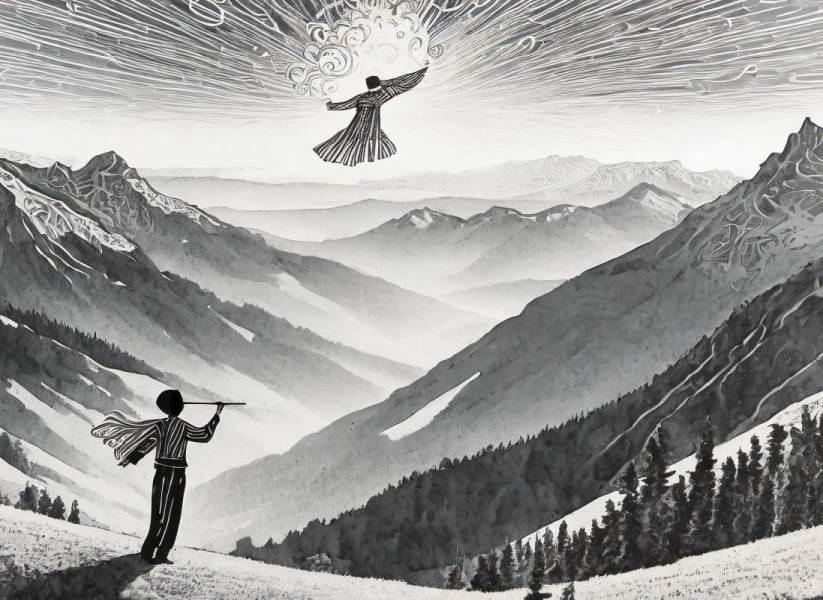
Then we’re told the child vanishes. This shouldn’t surprise us. If we were paying attention, this child appeared to the piper “on a cloud.” This child wasn’t a flesh and blood child — wasn’t one of the potential readers or listeners to the anthology’s contents — it’s a spiritual emanation of childhood.
OK, that’s a little weird, but Blake was a self-confessed visionary, and literary inspiration stories can be peculiar. Just another day at the poetic office for Blake. And as the piper makes his own pen and ink, I thought of one of the things that I found most inspirational in Blake’s life: that despite literary poverty he mastered the means of creating his own poetry, art, and engraved books.
Just after completing my musical version of this, another area of concern came to me. Just how strange did this seem to the children in the 1920s or to their parents who might read this to them if they were younger children?
I was a young child in post-WWII America, and in my time and place, I would have been puzzled. About the only piper I’d have any reference to was The Pied Piper, a page-bound storybook character. Yes, various kinds of musical pipes were extant then, as there would have been in the 1920s, but nothing I would expect in my time to see being played in wild valleys. Blake’s poem was over a century old when the 1920s anthology was made— maybe late 18th century England had itinerant rural pipers?
As they grew up, the child reader, then or now, would likely understand this is fantasy, even if exactly what Blake was getting at with his fable might be missed. Its value would remain as a set of word-music that speaks to the joy found in music and the arts.
Is anyone trying to guess if this was in the girls’ or boys’ anthology? Male author. The cloud/child is male, the piper is not gendered. Is joy in music a gender role thing? Not really.
Wilderness cumulous-carried spirit children are not a reliable compositional prompt.
.
It’s from the introductory section of the “for girls” book. My music is a simple folk music setting: acoustic guitar and bass, and eventually an Irish tin-whistle for piping. The tin-whistle is a played VI.** Two other instruments make a subtle entry in this recording. There’s a quiet electric piano in the piece, played and mixed so low it almost sounds like an overtone of the guitar, and another VI of a small obscure 1940s keyboard instrument, the Solovox that comes in for the next-to-last verse.
The Solovox was an FDR-era monophonic analog keyboard synthesizer, with glowing tubes and a wood-veneer case like a large table radio of the time. I used it for two reasons. If this song floats in fairy-tale time with children appearing and disappearing out of clouds, I thought the piper’s sound could change from the tin whistle to something more mid-20th century as a marker of how the children the anthologies were written for grew and changed. But also, I’ve seen, even briefly played, a particular real Solovox. The mother of alternative voice and keyboard player in this Project Dave Moore had one, and when he was young his mother would play piano and deftly slip one hand over to play melody lines on a Solovox. Dave now has his mother’s example of this old instrument, and has had it fixed so it plays, though with some glitches.
To hear “Piping Down the Valley’s Wild” you can use the graphical audio player you should see below. Player vanished? This highlighted link will open a new tab with an audio player. I plan more poems, adapted musical pieces, and observations from The Girls/The Boys Book of Verse coming up soon.
.
*There are methods to do that, where a singer alternates using their breath to sound the instrument and to sing lines of song. And there are bagpipes and the like where the wind comes from a bellows. But the child has asked the piper to drop their pipe and sing, so it stands to reason this is a request for the piper to sing a song with words after playing instrumentally for two renditions. The song then progresses from melody, to sung words, to finally written words — a plausible metaphor for the writing of a poem.
**I explained VI/Virtual Instrument technology last time, but in short it’s playable software that tries to contain all the sounds an actual instrument makes, often by capturing all conceivable notes and many articulations of those notes with a microphone it makers placed on the real instrument.
Earlier this Spring I had an idea for a Parlando Project feature for this year’s National Poetry Month. It was based on something I read in the blog “My Life 100 Years Ago,*” as blogger Mary Grace McGeehan turned some of her attention to children’s literature. As those interests crossed over for her, I learned there were a paired set of poetry anthologies from a century ago, one first published in 1922, The Girl’s Book of Verse, and the other the following year, The Boy’s Book of Verse.
A reason I’m drawn to poetry is that poets often examine and see things many others would miss. I read of those two titles and was intrigued. Lots of things to examine. One, the books are gendered — unsurprisingly, they only saw to market two volumes then — and being published in the early 1920s they might say a lot about how the anthologists viewed childhood and gender roles at the time that Modernism was starting to become a substantial part of literature in America. And for those targeted boys and girls (and their parents) the world was changing in areas well beyond poetry, music, and the arts. Adult women had just been given the right to vote, and there was increasing belief in expanding women’s roles. Fathers had in some cases returned from America’s first extra-continental wars.**
And there was another reason, I had recently come to see appealing elements in some of Robert Louis Stevenson’s poetry aimed at children as I revisited it. It’s long been a cultural commonplace that Mark Twain and Lewis Carroll are children’s books with layers of understanding, not just fantastical adventures. And in our present culture a great deal of our marketplace is taken up by young-adult books and genres that often have roots in youthful reading: Fantasy and Speculative Fiction for example.
So, what if we step back a century and see what’s there? I found a number of interesting poems in the two books, and my plan was to step up the posting tempo of this blog to at least double time. There’d be writing on what I observed in the books, and the Parlando Project’s combining of literary poetry with original music in various ways and styles would top that off. I started stockpiling some compositions, even recorded initial tracks for a couple. I was realistically readying myself for more activity here than usual to celebrate NPM 2024.
I didn’t know this would be the poster for this year when I started out. Seems appropriate for my plan.
.
Great plan.
Great plan, meet life.
I’d already figured what would be the first two pieces of this series. Monday I was going to complete recording the music I had set for the first one. My old-man energy didn’t hold out, and mid-morning recording expectations turned more into an early afternoon plan. Monday afternoon, I grabbed my music to go record, and..
The music stayed on the table. More family distress came home. I haven’t found a way to write about this that feels appropriate to me — and I’ve felt so blessed the past eight years of this Project to have so much time to do the extensive work it entails that I don’t want to be disproportionate in measuring my little change of plans this week against the reasons for distress. Today’s concluding summary: this is an introduction of my original intent, and a public statement that I still have hope for some variation of the plan still coming off for this April Poetry Month here.
My appreciated long-time readers will know to wait — and new visitors: there’s a lot here for those interested in poetry and the various ways it can be combined with music. You might want to search for a poem or poet and see if we’ve already presented it. Over 700 pieces, there’s a lot here — but it’s all over but the footnotes today — and those footnotes are something else this blog picked up from Mary Grace.
.
*Her blog started out with a pledge to only read material from 1918, but it has transitioned to an occasional look through stuff that was contemporary a century ago. Lots of considerations of what women in this dynamic time were presented with, often through magazines of the day. This stuff fascinates me. It’s the mundane and commercial mirror to the era when a lot of the poetry I’ve presented was created.
**How about other historically significant issues in this last decade that called itself The Twenties? Social inequality was certainly on some adults’ minds then, but that generally goes unreflected in these middle-class oriented poetry anthologies. I may take a second scan, but the issues of America’s racial caste system are largely ignored, though there is a bizarre Longfellow poem I hope to at least mention in the series (even if I might never figure out how I could perform it). Another thing to think about as we consider these century-old books: the children’s audience here would be inside that Greatest Generation who experienced the Great Depression, the global rise of nationalistic fascism, and eventually an even greater world war and its aftermath. Is there anything here in these poetry books which the authors suggested their mothers should be handing them that helped them through that?
The end of U. S. National Poetry Month is approaching and there are things I meant to get done (and didn’t) this year, but the last day of April is also International Jazz Day, and I can’t let that go by without a piece to celebrate. Poetry Month and Jazz Day — shouldn’t that be a piece of Jazz Poetry read in front of a Jazz combo?
I looked around the house and didn’t find one. Not the Jazz poem, it was easy for me to think of Langston Hughes, one of the originators of the form, and find a poem of his, “Jazzonia” that I didn’t perform when I celebrated his book The Weary Blues a couple of years ago.
No, it’s the Jazz combo that’s missing. Not in the garage, not in my studio space, not under the table in my office amidst that messy pile of stuff. Not in my phone’s contacts list. None marching down the street in my city too northern and cold for Mardi Gras.* Oh sure, there are a couple of Jazz clubs in town, and local musicians who can play Jazz, but I don’t know them. I’ve handed out Parlando demos to a couple over the past few years, and heard nothing, which may indicate politeness around my audacious use of my limited skill-set — and that would be right. I can sort-of hang with a Jazz feel on a good day with guitar as long as I’m under control of the context,** but Jazz isn’t about tightly controlling the context. It’s about surprise, about flexible chops that fit with a multitude of things.
So, I went about doing my best with what I had at home. I have a little device I use to practice instead of a metronome. It lets one play-in a set of chords in rhythm, and then generating from the form you play a drum and bass track following the harmonic material in tempo you’ve given it. It’s a fine quick practice tool, but I’ve only used it a couple of times here for public Parlando Project pieces.
I prefer to put in work on the digital drum tracks, adding hand percussion, even playing a real ride cymbal I collected from a neighbor a few years ago, editing the hits and beats on drum patterns — but I let that go this time. The machine had supplied a serviceable walking bass part, I let that stand as well. I played the guitar part in a single pass after warming up. I had to duck out a couple of egregious clams, but it represents one of my good guitar days.
In the whirling cabaret, guided robots and human jazzers play for Poetry Month and Jazz’s Day.
.
Looking at Hughes’ poem (full text here) I see that he specifies there’s six Jazz players in his poem’s combo. If I count my reading at the mic as a player, that got me up to four, including the two robots on bass and drums. So, I next checked out my naïve piano skills. I was pleased with a couple of little motifs I came up with. My repetition with under-elaboration of those motifs marks this piece as more of the simplified “Soul Jazz” emanation*** than a hardcore blowing session. That’s OK with me, I liked those records. For the sixth and final musician, I played some vibraphone over MIDI from my little plastic keyboard.
The above account may have convinced too many readers to not listen to the result, but for a one-day-wonder I think it came out pretty well. It’s a little longer than most pieces I present, but that lets its relaxed celebration grow on you if you’re receptive. The audio player gadget to hear it is below for many, and this backup highlighted link is for those that don’t see that.
.
*One thing my town once had, and I now miss, was the May Day parade that happened each year in my neighborhood. Elaborate giant puppets, kids on decorated bicycles, dancing troops, folks on stilts or riding on fantastic creations, and usually more than one amateur shambling marching band with a touch of second -line New Orleans flavor. Alas, lack of funds and what seems to be a case of sectarian infighting has stopped this annual event. I did some videos of this while it was still a going thing. You can see some here,here, and here.
**Jazz guitar is much about chord chops, something I’m embarrassingly bad at. Similarly, advanced Jazz harmony will confuse me quickly if I try to understand it in real time. Luckily, with this Project I usually get to be the composer and bandleader, so I work with myself the player to do what I can accomplish.
***You’re still here reading the footnotes? Good, this probably should have been the main thing in this post. Langston Hughes’ long life and immediate and lasting appreciation for Jazz meant that he could write about and be influenced by early Jazz when Dixieland was fresh, and then he continued to dig it, incorporate it, and perform his poetry with Jazz musicians in the post-WWII years. So even though Hughes wrote “Jazzonia” about 1920’s Jazz, he lived long enough that he could have performed it more in the mid-century bag I experienced then and sought to manifest today.
What’s extra cool about how Hughes presented the still emerging Jazz of the 1920s in “Jazzonia” is that he sees it already as part of a continuum from the African Garden of Eden, and then via Cleopatra, and through Harlem Renaissance — so it’s no surprise his Jazz, and Jazz itself, can keep on reformatting itself into new ways of expression. The honesty I shared regarding this audio piece above? It’s part of living the Musician’s and Composer’s Prayer: “May music find a way.”
We mentioned Emily Dickinson in our last post, and it’s time to return to this essential American poet during this National Poetry Month. I saw this charming poem of hers earlier this week and thought I might be able to do something with it.
Over the years here I’ve delved into some of the more cryptic Dickinson poems, but her poem beginning “The things we thought that we should do” is reasonably clear on first reading, at least until you get to the end. Here’s a link to the poem’s text if you’d like to read along. This three-stanza poem uses exactly one rhyme, which helps its flow stick together, appropriate for a poem about how our lives sometimes seem to take us down one track that we never get around to changing. Our inability to shape our lives to what we think we should do is the first stanza’s statement. The second puts the untaken should-path and compares it to travel, or rather not traveling. Dickinson was often portrayed as homebound — though an examination of her life says she traveled more than many women of her time — but I think this is more metaphor than memoir. This stanza ends with the idea that one may then pass on the untaken task of some travel to a “son.” This may be legal language sneaking into Dickinson again,* but I also wonder if she’s punning on “sun,” since she has elsewhere used the day as a miniature measure of a lifetime. If so, she’s saying we think we’ll do these should-things tomorrow, or in the sense of generations following us, in another lifetime.
Poetry? Law? Poetry? Law? Screw it! I’m going to go outside and putter in my garden.
.
The last stanza is the response, the turn, the summing up. It starts out: If we haven’t been disciplined enough to do our shoulds, we likely won’t get our restful reward in heaven. And then the last line “But possibly the one —” Ah, the Dickinson dash, that little transition — but wait, there’s no more text. It ends on the dash!
This is ambiguous, and her syntax is jumbled. Did she not complete the poem, is this an unfinished draft? Or did she want the thoughtful reader to come up with the resolution that’s not stated, but derivable from the situation: that there’s a heaven even for those not doing all the shoulds, all the time? When she writes “possibly the one” is she saying that there’s only possibly one heaven, but she’s not certain — or even, that the heaven one finds outside the shoulds is plausibly the one?
I was able to bring together the music and performance for this one quickly, which was necessary since I’ve spent the past two days taking care of a computer failure over on my spouse’s desk. But I should — no, it’s not a should, it’s a desire — get another piece posted this April. So, acoustic guitar, piano, standup bass, and just a taste of celesta were called into play to realize the music that unusually is made up of mostly major 7th chords. You can hear it with the graphical player gadget below, or if that’s not there, with this backup, a highlighted link that will open a new tab with an audio player.
.
*I’m increasingly noticing that Emily Dickinson, growing up in a multigenerational family of lawyers, seems to have picked up a fair amount of legalese. As a woman in her time, she couldn’t take up the family trade, but her mind enjoys playing around with the concepts such as ceding a should obligation to another as if in a treaty or a property transfer.
When reading this poem, I also think of psychiatrist Karen Horney’s “Tyranny of the Shoulds” — and in this manuscript version linked here, it looks like Dickinson had considered “tyranny” in place of the version we have with “discipline.”
The early 20th century American Modernist poets I often feature in this project were born in the 19th century. What American poets could they look to as their influences while they developed the poetry that rapidly re-shaped English language poetry? The answer/list for American American-Modernist influences is surprisingly short, and as a result these poets looked to writers from outside the United States. A summary list would include the early 19th century British Romantic poets and those still emulating that style in the UK. French writers got attention (even those French writers who had been influenced by American writers). Classical poets were still part of the British-influenced education system, so like Shakespeare the turn of the century Americans might have gotten “some Latin and little Greek” in school.
What are we left with for home-team poets? Poe, that formative poète maudit? Not much — even though his influence on some of the French writers was there second-hand. Dickinson? Less than some now may imagine in our age where she is considered a giant of American poetry. Dickinson was not significantly published in the mid-19th century, and so she was, on the printed page (beginning in the 1890s) a near contemporary of the Modernists. So, for our early Modernists at the beginning of the 20th century, Dickinson was considered more often as a new, interesting oddity than as the canonical mainstream. Longfellow, the massively successful American poet whose own roots lay in recasting European language poetic forms to American English? It is to laugh. Did even Vachel Lindsay or Carl Sandburg, the most populist and public minded of early Modernist era American poets ever dare to tip their hats to him? I haven’t seen it if they did, as Longfellow was already beneath contempt. Sandburg and the Black American Modernists like Fenton Johnson, Langston Hughes, and Gwendolyn Bennett did look to Afro-American Spirituals, Blues, Jazz lyrics and forms, but like Dickinson this influence would become greater later in the 20th century than it was in the first part. That leaves us with Whitman, who “broke the new wood,” as Ezra Pound put it, with his free verse, his hardly subtext eroticism, his ostensibly personal I-am-the-one-who-wrote-these-lines voice, and his poetry of mystical optimism.
Today I’m going to perform a poem by the only poet whose pioneering interests and corresponding influence are plausibly greater than Whitman — and not just because he was a direct influence on Whitman and Dickinson: Ralph Waldo Emerson. You can trace Emerson’s spirit in 20th century (and 21st century) American poetry not by his poetic tactics (he was often a mediocre-to-awkward poet) but by his underlying world-view, one that helped form a widely influential New Thought movement in the United States called Transcendentalism.
What did Transcendentalism give American poetry?*
Individualism and equality of office. Every person’s soul has an equal potential to receive important revelations and insights. From the start this included women and eventually it included all ethnic backgrounds and races.
The Book of Nature is the scripture. Nature isn’t just a decorative metaphor — it’s the revelation of all that is.
The job of poetry is not just to be beautiful, it’s to instruct. Transcendentalists didn’t do irony** that much and they almost never took to the poète maudit stance. That is not to say that it didn’t have stoic threads*** in its weave, or that its optimism was unbounded.
America is not only, maybe not even primarily, an Atlantic continent. It’s also a Pacific one. We should be open to China, India, Japan, et al as artistic and philosophic influences.
That last one is shown distinctly in today’s piece, a poem of Emerson’s from 1856 that shows he’s been deep into the Hindu Mahābhārata**** — something I haven’t been. Reading Emerson’s poem to prepare for composing my music and performing it, I’m as lost as an ordinary someone listening to a Tolkien adept, or as a father listening to my daughter talk anime or Homestuck. My research says that many of the stories in this Hindu sacred epic deal with wars and wars between gods — and that behind it all, though not usually as an active part, is Brahma, the maker of the universe, who, as Emerson’s poem tells us, is above and beyond such struggles. The poem final line, “Find me, and turn thy back on heaven” then says that all else, even some heavenly reward or alliance, is illusion — that nature, the all that is, Brahma’s abode, is the highest revelation.
Influencer. “Hey, @Fuller, @Thoreau, @Alcott — this easel thing is a great lifehack for reading Indian sacred literature.
.
My musical performance is available below with a graphical audio player. The acoustic guitar composition here is within another Asian and Afro-American influenced musical style, one that its founder called “American Primitive.” I’m not fond of that label, but John Fahey meant it in the sense that it looks to show a direct experience in the music, not that it was unsophisticated or ham-handed. In my case the pork-fingers are a risk, but it fits Emerson’s text (linked here) well. No player visible? This highlighted link is your alternative way to hear my performance.
.
*Note to readers: I am not a scholar of American literary history, just a curious visitor who writes about my exploration. I’m not an expert on Transcendentalism either. I could be wrong in details or significance in today’s post, or with many others here. All this is offered as “It seems to me (sometimes).”
**Dickinson, who may have been a Transcendentalist, and certainly was familiar with its precepts, does have access to a side-eyed, darkly humorous at times, irony.
***Robert Frost, the stoic, seems to have a deep and dark reading of the Book of Nature which he shared with his British friend Edward Thomas.
****By later in the century, we began to take for granted that South Asian and Japanese religion, philosophy, and art are available for American poetry, while Emerson was there at the beginning. I’d expect the non-Asians, however well-meaning, to misunderstand some of it, even as they appropriate it — but then I’d assume some Asians misunderstand, or differ in their understandings, too. Yankee Emerson was one of the first here, and I have no standing to discuss what he got egregiously wrong or surprisingly right. Let me also note since this is cruel April, that T. S. Eliot, a half-century after this Emerson poem was published, took to studying Indian religion in college, dropping his own samples from Hindu and Buddhist scripture into the Modernist landmark “The Waste Land” while still an expatriate American.
I’m taking a break today from telling some stories of discovering my own influences, and through them the possibility of this project combining words (mostly poetry) with original music. Instead, let’s return to one of this Project’s themes “Other People’s Stories.” Today’s piece is by William Carlos Williams, and it tells a story of a morning for a 30-something young father. The mood this poem is coming from is ambiguous on the page: it could be read as joyful, even if gently self-mocking, or it could be seen as an earnest Whitmanesque celebration. Since the poems here are performed — and more so, performed in the emotional environment of music — I had to make a choice of mood. I think it’s wistful, and I took that choice largely from the short song the poem tells us the poem’s speaker sings in the midst of it.
Parenthood, particularly first parenthood, is often a very significant life event. The urge to have a child, to reproduce in the emotionless language of biology, can be partly an expression of the parents seeking to extend and duplicate themselves. The reality of the child and child-rearing, conversely, is to reign in one’s autonomous self. Depending on one’s personality and role in the household, it may mean to act as a caretaker to the helpless and needy infant, or to find much of the home’s attention is now on the newcomer. The romance of the ideal baby can be immanently real some moments, and the endless labor and new roles just as real other times.
If the mood is ambiguous, the story Williams’ “Danse Russe” tells is told directly. It’s morning, the rest of the household is still asleep. Three others are mentioned as the sleepers: “my” wife, “the” baby, and someone named Kathleen, who has been identified biographically as a nanny the Williams’ family employed. Let’s be honest about the slight tells of the “my” and “the.” My is possessive, the isn’t. Kathleen’s named presence means there’s one other caretaker here. However privileged* we may view what was, in biographic fact, the presence of child-care, I’ll note that the speaker, the father, is plausibly then even more separated from the child. He is obligated and estranged in mixed degrees.
As the poem opens, he’s inside, physically in the household, but not with the others, and the house in his image has a sense of the outside world in morning mists and a cosmic sun. What does he do in this quiet early-morning time?
“To dance beneath the diamond sky, with one hand waving free.” Yes Bob ‘n’ Bill, but then the baby wakes up.**
.
He dances and sings, though one hopes it is a large house and he’s sotto voice and light on his feet. We’re told he’s naked and before a mirror. He indulges in a short Whitman’s sampler catalog of his unencumbered body,*** fully himself, able to bask in himself. Is he having a full-on Robert Bly drum circle moment here? Maybe. Let’s give Bly the poet his due here, he was often able to see a layer below the simple image — and Williams has chosen to show us this, even if we don’t know for sure why he makes this choice, and he doesn’t direct us to all his feelings, save for one, the one the dancer sings: loneliness. He concludes from the song that it’s best to be lonely, it’s his fate from birth (for being male?) From Williams’ own life I can assay he was certainly willing to be lonely, proudly stubborn in his self, but his story here, his image, is not without wistfulness mixed with self-justification. He, the poet, can help us see this. Who knows how much he, or we, can do with that knowledge? I tried to emphasize in performance that there’s a small refrained phrase in this short poem. Do you notice it when you read the text, linked here, or listen to the performance below? Three times the poem begins “If I….” What do we know of the I? What shall the I be?
Williams ends with his own “who knows?” Is he self-evidently, or by his own claim, “The happy genius of my household?” “Genius” here I think is meant in the mode of creator and progenitor, not in the IQ test sense.
I choose to think this is not a rhetorical question, that it’s truly at issue. He’s asking to cheer himself on: I’ve made the purchase of this house, I am the father of this child, I’m half the choice of its life — even if I’m also separated from this household and baby, and I feel that separation as loneliness. So many first-time parents feel in thought, bound and estranged, in all their variety of roles, partners, resources, and situations: “Am I happy?” And their best answers are “Halfway.” And then, “Shouldn’t it be all the way?” Who shall say? Well, William Carlos Williams dances and sings, and he says the distance from halfway is loneliness.
Today’s musical portion to go with Williams’ words I jokingly told my wife this morning is “shoegaze,” the genre named not just for the lack of audience eye-contact but for the number of floor-stationed effects pedals to be employed. You can hear that performance of “Danse Russe” while waving your shirt in the air with the graphical audio player below. What, there’s no player to be seen? Now you’ve got to rebutton that shirt? No, you can use this highlighted alternative link that will open a new tab with an audio player.
.
*Live-in childcare was more common at unexceptional levels of income in the early 20th century. A substantial number of young immigrant women worked in this role.
**I slightly modified this image generated from a text prompt using the test version of a new Adobe product, Firefly. Adobe promises that it uses only licensed art from it’s stock library to “train” the algorithm. Much controversy these days about AI, but of course poets have been using words to invoke images for some time.
***The contrast here between childbirth and breastfeeding roles and their intimate demonstration of bodily connectiveness strikes me. Did Williams intend this? I don’t know, but it’s there for me to sense. As a family physician, Williams would have certainly known intellectually of those differences.
OK, it’s time for my Frank Zappa story. I’ve told this story a few times, but it’s appropriate that I tell it here as part of this series where I discuss the ways the Parlando Project’s meshing of poetry and music became an idea, and an idea I could implement. This post will be exactly as short as I can make it in order to move the story from Francis Poulenc to Frank Zappa.
Last time in this series you met Dave Moore and Jim Scanlon. During the year the three of us were all at this small college south of Des Moines in Iowa, we worked on an “underground newspaper” called The Gadfly that Dave and his partner ran. The content consisted of a mix of things, often with a strong satirical streak, commenting on politics, culture, and music. The capsule overview younger people of later generations get of The Sixties* is that every white young American was a hippie, everyone had long hair, and we all lived in bohemian haze coincidentally stoned and angry at political situations and injustices. The reality, as I saw it in Iowa then, was that 1968 was not that different from 1961. One common complaint reflected in The Gadfly was that the problem wasn’t just The Establishment, it was also our own cohort (at least the ones we were living among) who seemed mired in apathy. We thought new ideas and some ridicule of the old order might change that. Were we, and others like us elsewhere, slowly changing things? Observations differ.
Then came the spring of 1970, when for a brief moment the political activism spirit seemed to change in the matter of a couple of days.
My friends Dave Moore and Jim Scanlon had left for another college in the fall of 1969, Beloit in Wisconsin, where they hoped they would get a better education and find a more responsive group of students. I remained at the small college in Iowa where I had become the editor of the official school newspaper at a premature age. Over the school year, that responsibility slowly spiraled out of my control. I had no idea how to lead a group of people (still don’t). My working theory was to let them exercise their talents and see what happens.
Here’s what often happens under that scheme: many people will valorize what they think is their talent, then not actually exercise it. What will some conclude from that? That they must be restricted yet, somehow — that the actuality that they can’t deliver must be due to outside forces. For those, any extra degree of freedom doesn’t free them, it exposes them.
If you’re considering that carefully, you may wonder, is that what I was suffering from as well? I’d been given this opportunity/responsibility after all. Was I ducking it? Was I not taking advantage of it? I will say this: I wasn’t blaming outside forces, I was blaming myself. The romantic me wanted to see others blossom. The romantic me thought that blossoming was a natural process. Like an inconstant gardener, I was looking at a lot of failed plantings.
Then the spring of 1970 arrived, and with it the shootings at Kent State University, shortly followed by further deaths at Jackson State in the context of the now official expansion** of the Vietnam war into neighboring countries. This led to an extraordinary expansion of activism on college campuses around the country. I was frankly surprised at the speed and the rapid spread of the college student response, even after the shootings. There had been for at least a couple of years an eminent fear among the young men regarding the draft risk, which while it had helped fuel the anti-Vietnam War efforts, it hadn’t engendered this level of response. Tens of thousands of Americans, our generational contemporaries, had died in the combat, and that’s just considering “our side.” Activists being shot or killed wasn’t new either. Activists knew all this. I knew this. What had I discounted was that the Kent State shootings were at a very ordinary midwestern university, that dead included non-activists who just happened to be between classes, and that the dead included women.*** Across the country hundreds of colleges were shut down by a fast-rising wave of student activism, including my little Iowa college.
As quickly as the tide of activism rose up, the wave subsided. Our college-based headquarters and its plans for increasing political pressure to end the war depopulated as students returned to home or summer jobs. Eventually it was a few people in an apartment on the town square, lieutenants without any troops.**** I left for New York in an adventure I don’t have time to recount today.
Returning that fall, I was living in a sort-of-commune in the college town, without any funds to attend college, trying to figure out what I should do. Not only didn’t I know that, I didn’t have any idea how I would know that. That’s when I heard that Frank Zappa was going to play at Beloit, at the college my friends had left for over a year before.
I probably heard this news by reading it in a letter. Yes, younger readers today, there was no other way. There was no Internet. There wasn’t even timely press coverage of national tour dates, everything being done through local promoters and short-lived rock concert halls. Phone calls beyond your city were “long distance,” charged by the minute and too costly to use for entertainment gossip. I found out in 1970 the same way as someone would have exchanged this information in 1870.
My interest in Zappa had grown over the two years since I’d first heard Zappa’s Mothers of Invention on recordings. I didn’t realize it fully, but wider music listening and observing Don Williams’ ability to construct music on the fly was mixed with another rare thing my small college supplied me. This little college 20 miles south of Des Moines, with enrollment of barely a thousand students, had a burgeoning opera program. Opera of course is — what does it say up at the top of this blog? — a place where music and words meet. The opera curriculum would grow over the years, but at this time the program was still emerging. The theater used for performances (also the site of some of my classes) was a small old building, with seating for a few hundred. I’ll summarize one part of my experience in this: to see opera sung in a grand opera hall, with elaborate sets and pricey tickets, with a complete orchestra, is a very, well, operatic way to view the realization of that art. All art is artifice, sure, but the human connection to me in those situations is stilted. Not so, opera sitting a few yards away from another person singing it, perhaps even a person your own young age who you might see in your classes or on campus. That’s another experience, far rarer.
You have not likely seen that impact reflected on my adult life, or on the Parlando Project that you know here. For one thing, my voice is not operatic, it’s barely a singing voice. Yet I can write this today, that I remember seeing for one exact example, a performance of Poulenc’s Dialogues of the Carmelites, and being carried away about what performed music, voice, and words could do in that small space. It may have helped that this opera makes an extensive use of recitative.
Listening to Rock music in my daily life then in The Sixties, it occurred to me, who in Rock could bring something to opera? Besides the differences in the use of the voice, or the nature of projecting character as opposed to ones seemingly authentic personal voice, there was the problem of extending the instrumental colors. My thought-answers then? Jim Morrison, who had performed a bit of Brecht/Weill on the first Doors album, and Frank Zappa, who claimed the ability to be “a composer,” and was even allowed to demonstrate that he could compose for larger ensembles including orchestral instruments.*****
That I could consider that was consistent with Zappa’s brand then. In those early, heady days of Rock Criticism, it was a given that Zappa was a genius. He wasn’t the sort of musical act that many people listened to with addictive, ear-worm pleasure, sure, but still a genius. Well, there were those smutty lyrics, and an assumed swimming pool of contributory drugs, but still a genius. It was The Sixties, we assumed impossible things could happen, but we still felt genius was rare and worthy of note.
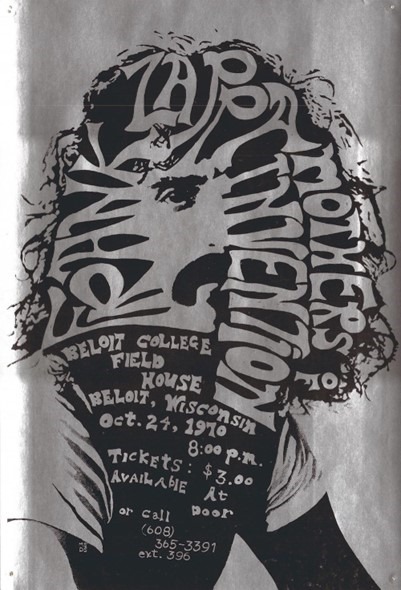
So, a chance to see this genius in a live concert, this artist whose recordings had opened up other considerations for me, couldn’t be missed. I drove there, 300 miles, with other share-the-gas people in a Fiat 1100D.
Cost of the concert? $3. An amount similar to my portion of the share-the-gas cost too.
.
The concert? Not life-changing. The acoustics in the fieldhouse hall were atrocious, and our seats were in the galleries far from the stage. The music was good, but with the sound bouncing around and the typical poor vocal PA of the time, the result was a mixed pleasure.
We got back in the little car to head back to Iowa. Finding our way through the unfamiliar streets we saw another car occupied with hair as long as ours inside. That car contained some young women. For some reason they wanted to share with the fellow freaky-looking folks that they knew the hotel where Frank Zappa was staying and that they’d been invited to visit him.
Of course we believed them. Of course we followed them. What did we assume was to happen there? Some sex, drugs, and rock’n’roll orgy? I’d just turned 20. I didn’t know what I was going to do with my life, or how I’d figure that out. So, why would I worry about might happen for the rest of some single night in October?
When we arrived, the bunch of us from the two cars, maybe 8 or 9 people, spread out around the non-descript motel room. A couple members of the band were checking in with Zappa. There was a short discussion at the doorway between Zappa and George Duke about what Duke had played at the concert, which got approval from Zappa. The band that night, though billed as the Mothers, was new, containing vocalists who had once been part of the pop band The Turtles, now billed as “Flo and Eddie.” One of the young women from the other car bounced on one of the beds. Most of us seemed like me, passive, waiting for something to happen. Zappa turned his attention to us, asked us what we’d thought about the concert. There was some short discussion. I think I may have mentioned that a lot of the material seemed new. Best as I can remember, that was accurate. Zappa replied that they were doing some of the old stuff too. Memories fail, but I believe “Concentration Moon” was replied as one of the veteran numbers. The male part of the room had some hard-core Zappa fans, who started to geekout on questions about the band’s history. I recall one asking about Doug Moon who had played with early versions of Captain Beefheart’s Magic Band. Were they trying to impress the genius with their knowledge, even in the midwest, of the places Zappa had come from? Zappa replied Doug was some guy who’d worked at a gas station. Zappa was patient about the questions, however trivial. At one point he took out a movie camera and filmed us in the room. I remember he moved in close to my face as I was missing one bow on my eyeglasses after that part had broken, and I had no funds to fix or replace the frames yet.
Here’s a few things Zappa conveyed to us in the roughly hour that I, and maybe others in the room, didn’t know before meeting him.
When asked about his doo-wop music parodies, including the Cruising with Rueben and the Jets LP, he corrected us that he liked that music. He spoke about Fifties R&B records he was inspired by. Since the lyrics in those songs were satiric, I’d assumed the music was also something he held in contempt. Far from it, he lit up talking about this. In The Sixties there was a widespread critical assumption that good music was “progressive,” meaning that we were to drive our plows over the bones of the dead, so this was news to us.
He nonchalantly corrected any impression that he was inspired by drugs. How he did this without sounding like a “Listen kids…” PSA I can’t exactly recall.
He seemed genuinely interested in us, and what we thought about the music — though at times, such as when he wielded the camera, the idea that we were natives and Zappa was an anthropologist occurred.
For me, the important thing happened near the end of our time in the room with this “…But, a genius” guy. I asked him how much of the show was improvised and how much was composed. He went over to the side of the room and picked up an oversized portfolio. Opening it, he showed it to me. Multiple staves of music, a rather full score as I recall. Dialogue written out, seemingly informal and back and forth, as if the band members were speaking off the cuff. In retrospect, I believe I was looking at scores for 200 Motels which would be filmed a few months later with a full orchestra. As he showed me this, he talked briefly about the effort he put into it, which the score showed. I was immediately impressed with the formality of the effort to achieve what seemed like chance informality. There must have been some serious seat-time in getting that done. The intent of it!
Imagine instead if I had somehow visited the hotel room of Jim Morrison in 1970. Perhaps my romantic notions of the creation of art would have gathered more poète maudit forces. Did something in my subconscious connect what Frank Zappa conveyed that night with William Blake, who when not out talking with the visions of angels, was innovating printmaking techniques and making books with his own skills?
After that significant side-trip, we left the room and returned to Iowa. If you’d asked me that day, I still didn’t know what I wanted to do with my life — not a whit more — but what I did have was a piece of information, and an outlook. From that night I could remember that doing was a large part of doing something with your life.
This is already a double-length post, so enough for today. To tip my hat to Mr. Zappa, here’s the LYL Band roughly approximating one of his later tunes in a we’ll-give-it-a-go live performance.
We flattened Zappa’s music and arrangement here, but as the video points out, if Zappa were performing this song today he’d be sure to include more screens than just TV.
.
*This oversimplification is more accurate about youth in The Seventies than the Sixties, even the final three years of The Sixties. In terms of clothes and hair, look at a range of contemporary photographs and film from the actual Sixties. Beards and long hair will be sparse on the young men, not movie wardrobe department common. Yes, use of marijuana and other drugs increased during the last half of The Sixties from a very in-group secrecy thing to a sizable minority, but in doing so it lost a bit of its bohemian rhapsodic connotations and became just another illegal high like drinking alcohol before the age of 21 had previously been. Real “counter-culture” bohemianism in an artistic sense had grown from the beatnik Fifties — maybe even doubled or tripled — but was still something a single digit percentage of people engaged in with any seriousness.
**In reality, this regional expansion of the conflict had been going on by proxy and by secrecy for a long time — but in the run up to the Kent State shootings it had become stated policy, driving hard-to-escape fears that there were now going to be additional para-Vietnam Wars.
***This is a complex point, one I need to leave off too briefly. Women of course were involved in anti-war activity before Kent State, but it occurs to me that this small factor may have been more important than recognized in adding to the explosion of activism in the spring of 1970. In case you’re wondering: yes, the anti-Vietnam war organizations, like the counter-culture, weren’t significantly less patriarchal than the rest of Sixties society — and though it may rankle some, I’ll add this as well: the victims at Kent State were also white.
****Any reading this who participated in Occupy Wall Street or the Black Lives Matter activism of this century may have a moment of recognition here. The emotional high of sensing that something is finally being said loud enough, that mass pressure is finally being brought by an unprecedented number of people is shared from this time. The emotions following, when such movements crest and seem to dissipate, need to be considered too. Here’s one piece of wisdom from someone else from this time worth listening to.
*****Will some Classic Rock oldster reading this think “Well, Rock Opera, what about the Who’s Tommy?” Tommy had yet to be released.
As National Poetry Month continues, let me take a brief break from the personal history of Parlando inspirations to again do in the present what this Project does: explore a poem as I combine it with new music. A few weeks ago I found an early poetry collection by the Peruvian poet César Vallejo. Before looking into this collection Vallejo was just a name to me, a poet who is best known as being a favorite of other poets whose work I had read.
If I had time to write more tonight I could go into his troubled life, but I do not. Suffice to say he grew up poor in rural Peru, and by paths he traveled to Lima and studied some in Peruvian universities, but poverty and trouble with the authorities seems to have always followed him. He fled to Europe and had down-and-out adventures there, but eventually died there 85 years ago this April. In a brief interchange with another poet on Twitter this spring we agreed that from what we know Vallejo seemed to always be an expatriate, an exile — and unhappy from that. If so, unhappiness for a man, but poetry deals with diaspora often and well — perhaps because even when we are dealing with our native language, the dialect we spoke from childhood, we are seeking in poetry to find its real home. So often poets stand in the midst of other native speakers of their language and find this so.
My adventure with a poem in a foreign language forces by nature a greater travel. Even if I have another English translation, I try to find it in the original and start again with the awkward literalness of a machine translation of that. Other translators likely have smoothed over the troubles of a literal with their chosen solutions, and out of some pride and a desire to not appropriate the work of other living writers, I then try to make a vivid poem in English out of it. Besides recreating the poem’s images and music of thought* in English, I often drill down into individual words by looking at foreign language dictionaries and examples of usage to see what plausible other English words might convey the author’s intentions. Though I feel conflicted about this, the process of collaborating with a dead author engages me as if I am writing my own poem, and from that arises a danger that I may be tempted to extend the poem or add variations on the original’s theme. In this Vallejo poem, my translation has a couple of gray areas, which I’ll note for accuracy’s sake.
Here’s my translation of “Bajo Los Alamos” into “Beneath the Poplars:”
Jose Garrido was another young Peruvian writer that Vallejo knew before exile.
.
A few notes on my translation. In the first line “bardos” might well be translated into poets or bards. I made an eccentric choice, “scriptores,” trying to make the image more clear and mysterious at the same time. I thought of the poplars branches swayed over in the pasture wind would be like monks hunched and copying manuscripts, and that would be consistent with a poem that I feel is about labor and respite. I believe poets labor, but as a word poet doesn’t suggest it directly enough.
The 11th line was difficult for me, and I can’t right now recall all the struggles I went through to arrive at the line in my version. Given that the poem is about an old shepherd falling asleep in autumn, a clear image of the falling leaves being like sheared wool may have attracted me more strongly than a literal line translation.
I think the 12th line describes a sunset — and while Vallejo didn’t say sky, I decided to clarify the sense of “azul” here as the blue sky, as we mean it when we say “out of the blue.”
Lastly, did you notice that this poem mentions Easter, but is set in autumn? Peru is south of the equator and April is autumn there. All those easy connections we northerners feel about Easter and spring as a resurrection metaphor fall apart in the global south.
A gorgeous poem of work and rest, and I hope my rustic music helps set the mood for it. Given Vallejo’s life it seems he’s writing here of his locus solus, his essential place that he’s exiled from. Here’s how you can hear my performance of it: there’s an audio player displayed below for many of you. No player? This highlighted link will open a new tab with an alternate audio player.
.
*I give priority to transmitting what I think are the poet’s images to our eyes through our words. The word-music, such as rhymes and meter where present, I generally take as what is unfortunately lost in translation, though I like the resulting poem to have an attractive sound in English. The “music of thought” is my own term for the order and manner of repetitions in the presentation of the poem’s substance by its images and statements. This has its own musical structure and can more easily be transferred into a different language.





 Frank Hudson