A Game of Chess, presenting T. S. Eliot’s “The Waste Land” for National Poetry Month

Each April, as part of our celebration of National Poetry Month, the Parlando Project has been presenting in serial form T. S. Eliot’s High Modernist masterpiece “The Waste Land.”  This year, we’re up to the third section of the poem “The Fire Sermon,”  but before we present new material, I want to give our newer listeners/readers a chance to catch up.

It’s possible to read the entire “Waste Land”  aloud as a dramatic monolog in less than 40 minutes total time. Fiona Shaw has done this, and her performances of it cannot be praised or recommended enough. But for me personally (and this goes back to my first readings of the poem) I’ve always been struck by “The Waste Land’s”  intense musicality. The collage process of various voices is musical, and “The Waste Land’s”  constant changes in tone and insertion of quotes from other poetry eerily predict hip hop mix tapes in a 78 rpm world. Themes emerge and fall back and are then repeated later on, just as they do in long-form musical composition. Eliot even quotes song lyrics multiple times in the poem.

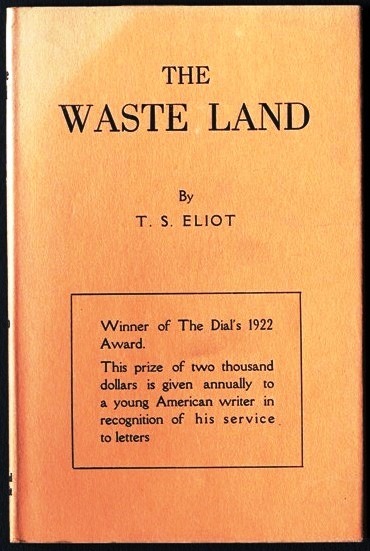
The Waste Land cover

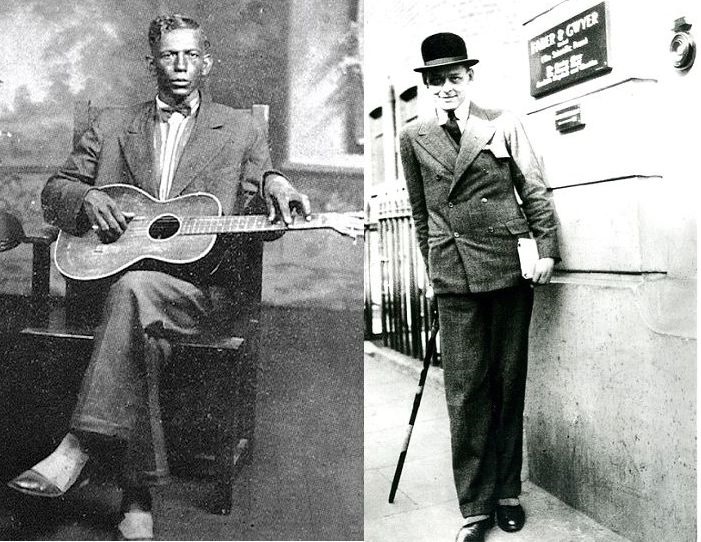
He got $2,000 for service to letters, but our aim is to demonstrate the music in it


So, I’ve long dreamed of performing “The Waste Land”  with music—and now, as part of this project I’m realizing that dream on the installment plan. While I think the music can help bring some solace and additional shadings to Eliot’s unstinting look at human failure and limitations, the resulting performance is lengthy. It’s not the kind of thing I can take on creating and performing lightly—and to listen to it, even casually, is not light entertainment either. The Parlando Project normally focuses on shorter poetry, the lyric impulse. Almost all of our pieces are under 5 minutes, and we have hundreds of them available here. So, don’t feel obligated to listen to these longer “Waste Land”  pieces. They are not for everybody, and I believe they are consistent with Eliot’s design to write only for those willing to look at dark impulses and feelings, to weigh and consider them within your mind and heart.

Here’s “I. The Burial of the Dead,”  the first section that famously opens with “April is the cruellest month, breeding/Lilacs out of the dead land…” which is likely a reason that April is U. S. National Poetry month (and may already be referring to another poem, Walt Whitman’s Lincoln elegy, When Lilacs Last in the Dooryard Bloom’d.”)


And here’s last year’s contributions, the section “II. A Game of Chess”  rolled up into one piece for the first time here. I start out this one by making an ex-post-facto connection of Eliot’s lavish and dissipated opening of “A Game of Chess”  with the late-night, dragged out, “Ain’t it just like the night” style of Blonde on Blonde era Bob Dylan, and it ends with an appearance of a guest reader Heidi Randen for the monolog about Lil and Albert and their just-discharged-from-the war marriage.


This month we’ll continue our serial presentation of “The Waste Land”  with one of its longest sections, “III. The Fire Sermon.”  If you’d like to read along with the text of the poem while listening, the full poem is here. With these musical presentations I maintain that you can listen to them and not feel that you need to understand what the poem means in the essay-question sense, and instead only require the poem’s words to strike you with scattered connotations and impacts. There are a great many resources for those who would like to delve into deeper meanings of “The Waste Land,”  all the things that Eliot intended to put there—and also the things he only inherently and accidentally included. For those that enjoy that, there’s much there at that level, but I remind you of the concept I laid down a couple of posts back regarding Emily Dickinson’s much shorter poem: a poem isn’t so much about ideas, it’s about the experience of ideas.

10 Definitions of Poetry from Carl Sandburg

Let’s continue our celebration of U. S. National Poetry Month!

If Emily Dickinson and Walt Whitman are the parents of modern American poetry, then one poet is most nearly the descendant with an equal inheritance from both: Carl Sandburg.

Sandburg’s poetry has two modes: the tightly compressed Imagist poem and the expansive, iterative, catalogic Whitman-like ode. I find him effective in both styles—and sometimes he mixes both, as in today’s selection. Each line in his “10 Definitions of Poetry”  is its own compressed poem, but taken together in a list they express different aspects of poetry.

Carl Sandburg in black cowl-neck

The forgotten American Modernist. Sandburg! thou shouldst be living at this hour!

.

I’m something of an advocate for Sandburg here, as I feel he’s fallen out of favor during my lifetime and now is more than due to be re-evaluated. The major knocks against him in the later part of the 20th century were that he wasn’t complex and subtle enough, that his poetry didn’t dig deep enough in to the hard-to-grasp philosophic questions at the core of meaning and human existence, and to a secondary degree that his poetry wasn’t, well, poetic, that it was neither lyrically beautiful nor painstakingly constructed.

I won’t lay out a complicated case for Sandburg on those two issues here today, but on the first issue I’ll say that Sandburg’s Socialist and working-class outlook leads him to address universal issues of the human condition, from top to bottom of our current social organization; while other poets, ones with an avowed aesthetic focus or a calling for self-contained spiritual insight look at only part of the situation. Even those that don’t share Sandburg’s politics can benefit from his insights. On the charge of Sandburg not being a poetic craftsman, I’ll say that while I don’t know much yet about his working methods, I can look closely at some of Sandburg’s shorter works and find well-chosen small things—and whether they were intuitively there in his vision or created by exhaustive study and revision, I find that less important than their existence.

I’m also sorry to say that Sandburg’s poetry can sometimes be—as reflected in some of his definitions in this list—fun, funny, entertaining. You’ll just have to overlook that.

And if he’s charged with those things, weren’t Whitman and Dickinson also charged with these faults throughout the 20th century? Our current century looks at Whitman and Dickinson and sees their still startling differences—but has begun to realize that where the past saw in those differences infelicities of expression or simple directness, that they are instead part of their genius, part of why our need for those poets has not been replaced. And if we need Whitman and Dickinson, then perhaps we also need their hybrid descendant Sandburg too—he of his synthesis of hyacinths and biscuits.

I took my musical inspiration today from Sandburg’s first definition: “Poetry is a projection across silence of cadences arranged to break that silence with definite intentions of echoes, syllables, wave lengths.” My guitar part runs through some modulation effects and an echo/delay; and underneath, working with my electric bass-line, a wobbly Mellotron* waves along. Hear this with the player gadget below, (of if you don’t see the player, you can use this highlighted link)  Check back soon for more combinations of various words with original music—and, oh yes, please let others know what we’re doing here at the Parlando Project.

.

*No, I don’t have an actual funky tape strip Mellotron. Thankfully the tapes have been converted into digital samples and can be played with an inexpensive MIDI keyboard or controller.

The Aim Was Song

Let’s give the lyrical reins over to Robert Frost one more time for another electric guitar driven piece. “The Aim Was Song”  is a poem from Frost’s 1923 Mountain Interval  collection, and not only is it a reasonably straightforward poetic credo from Frost, it speaks a little to Parlando’s goals too.

I put forward a definition of poetry as I was starting the Parlando Project as “Words that want to break into song.” I don’t recall where I read that definition, but when I searched this afternoon, all I can find is myself, so the source of that phrase may remain a mystery.

Careful with that axe Eugene. Robert Frost prepares to kick out the jams.

Unlike Sandburg and Yeats, Frost himself had no desire to sing or perform to music that I’m aware of, but his desire to use metrical/rhyming verse goads me to use him often here. And Frost had his own theory about how meter and language worked in poetry. He called it “The sound of sense,” and he once described it in a letter as akin to what comes through if you listen to talk in another room from the other side of a door. I don’t think he’s writing there about meter as commonly scanned in metrical poetry, I think instead he’s talking about human vitality that arrives through the panels of a door, the rise and fall, the breath and repetition. Frost’s theory was that you then laid that over the structure of metrical/syllabic prosody, so that each side pushes and pulls on each other. Too much evenness and it’s a motorik machine. Too little and you have only thoughts scattered on the page where only a silent and uncycling eye can gather them. You find that balance with one’s ear and heart.

Perhaps what Frost is aiming for here is the thing musicians call phrasing, but one thing that’s sure is that Frost believes poetry, even poetry of complex meaning or subtle rhetoric, is received through the ear and not the eye. So, even if Frost was not thinking directly of his poetry in association with music as we present things here, he is thinking of poetry as suffused with orality.

In “The Aim Was Song”  Frost develops one image throughout: how the human being captures breath, moving air in waves, the essence of that natural force of the fierce spring wind, and shapes it into a smaller but more intimate thing. That is the work of musicians and poets. I could almost hear Lord Buckley read this one, as Frost repeats some words in his short poem that seem to pun on musical terms, to “blow,” “how it ought to go,” and “measures.” I didn’t go that route (if I could) but consider that an undercurrent in this.

To hear my performance of Frost’s “The Aim Was Song,”  use the player below if you see it. Don’t see a player? This highlighted hyperlink will also play it.  U. S. National Poetry Month is coming up in a few days, and I’m hoping to have a good number of encounters between music and words here in April. Please check back or subscribe, and spread the word.

.

Poets to Come

A month ago I began our celebration of the U. S. National Poetry Month with an audio piece using the words of Walt Whitman. Today I bring our month of music meeting poetry to a close with another piece by Whitman: “Poets to Come.”

Which is appropriate, as modern American poetry begins with Whitman.

From time to time in his work, Whitman reminds us that he knows he hasn’t fully realized his poetic project. This isn’t just false modesty. He revised and added to Leaves of Grass  throughout his lifetime, but it wasn’t because he thought perfection was one more edit away. Whitman seems to accept that it’s better to try to do what his ideals say to aim for, to make the effort to become the artist his art asks to exist. It’s better to be 80%, or even half or less, of that ideal Whitman he writes of, sounding his barbaric yawp over the roofs of the world, than for no Whitman to dare exist.

Note though that Whitman isn’t asking himself to do this for self -expression. His expression, even with the particularities of his own person being unavoidable, is cultural expression. He sought to sing into existence the culture he wanted America and the world to have.

Which is what makes this poem a great basis for the last post of this Poetry Month. He had faith for the poets who would follow his innovations and audacity. Many did come forth after him, many of which we’ve presented here. Whitman had, I might suppose, faith in the intentions of the Parlando Project—and I, if I pay attention to the spirit he wrote of, I should have faith too.

Walt Whitman in Philadelpia 1889 by Frederick Gutekunst

Good Gray Poet, Thin White Duke.. David Bowie sang “Ain’t there a pen that will write before they die?” Whitman’s caption says he was about 4 blocks from Sigma Sound studios were Bowie recorded that. TSOP!


During April I’ve created and presented 16 combinations of various words with my music, more than any other month in the year and a half of this project. I took a crack at preforming all of that “April is the cruelest month” modernist epic of T. S. Eliot’s “The Waste Land” —and only got near half-way done. I worked on the finding and understanding the words I’ve used, or composing, playing, and recording music for several hours every day this month.

And you’ve listened to these pieces, and if you’re here, you’ve even read my words about the process, for which I’m grateful. I’ll be back tomorrow with a piece by Dave Moore and the LYL Band for May Day and there may yet be more LYL Band recording before this Spring is over. I do expect to take a bit of a rest after the efforts of this April though. I have a pile of books I want and need to read, a whole lot of interesting blogs I’ve gotten behind reading too, and I’m looking forward to listening to music I didn’t have to think up first.

If you want more, I remind everyone that we have over 200 pieces here in the archives on the right. There’s lots of stuff that you may find better, worse, or at least additionally different there. If you, or someone you know would just like to hear the musical combinations we do, the Parlando Project music is available on all the major podcast services like Spotify, Google Play Music, or Apple podcasts.

Here’s Whitman’s “Poets to Come”  performed with my music. Use the player below to hear it, and if you like it, please tell other folks about the Parlando Project.


My Poor Bagpipes

In search of words to combine with music here, I sometimes find it necessary to translate from other languages. Poetry translation involves following strange paths.

Here’s the path I followed to present today’s piece, Jules Laforgue’s “My Poor Bagpipes.”  Throughout this month I’ve been presenting parts of T. S. Eliot’s “The Waste Land”  as part of my celebration of April as National Poetry Month. This causes me to look more at Eliot and where he derived his sense of modern poetry from. Eliot’s own testimony says that a late 19th Century French poet, Jules Laforgue was very important to his own poetics. That’s about all I knew about Laforgue: important to Eliot.

I search and find some Laforgue poems, though only a couple in English translation. Luckily, there’s a site, laforgue.org that has put a great deal of his work online in its original French. I pick out a handful that have interesting titles or first lines and see what rough machine translations will show me.

As I looked at the rough translations I was struck by déjà vu—only in English of course. “Hey, that sounds familiar! I’ve read something like this poem.” In French it was Poètes a Venir,” and of course it was Walt Whitman’s “Poets to Come.”  It appears that Laforgue may have been among the first to translate America’s Whitman to French in 1886, while Whitman was still alive. And from his work translating Whitman, Laforgue began to write “vers libre”—free verse, himself, helping to pioneer that idea in French poetry.

Chat Noir Poster2

“The very illustrious company of the black cat with his famous shadow plays, his poets his composers.” Remembered by its posters long after it closed, the Chat Noir cabaret was a place where music and poetry mixed in 19th Century Paris. A very Parlando Project thing, no?


I will not be translating Laforgue’s translations of Whitman back to English here. I picked his “Air de Biniou”  to try, primarily because I was intrigued by the first line “No, No, my poor bagpipes.” I’m attracted to incongruity and black humor, and I kept double-checking to make sure that line’s “cornemuse” in French must mean “bagpipes.” The poem’s first verse seemed to refer to the bagpipes’ famously raw timbre and pitch issues: “everything is a mistake, everything turns out bad” claims Laforgue’s first stanza.

Inserting gratuitous bagpipe joke:

Why do bagpipers walk while they play?

To get away from the sound.

As I worked on it, I had trouble with several words, two or three of which I’m still unsure I’ve translated correctly. This may be a general issue for anyone translating Laforgue, as he liked to play with language and meanings, sometimes using unusual words. But I soon had a more serious issue, after dealing with “occit” in the second stanza. A poet’s images are not his literal manifesto, and irony was part of Laforgue’s stance. In this second stanza he says Nature is a wife the artist will kill. I get his point: the artist thinks they can better the mundaness of nature and create something new and above it. And it’s nature—an inanimate concept, not a person. Yet and all, it’s still a too-casual image of a too-serious and widespread problem, domestic violence, for me to be happy with it. Looks like this is a general issue with Laforgue too. He consistently used images of women, sex and relations with women as a repository for his issues with our biologic nature. In a word: misogyny.

Clearly he’s not alone in this. It could be one of the things Eliot picked up from him too. Like Eliot, he’s not stinting on masculine failures, but this can reveal an attitude that men  fail because of their souls  while women  fail because of their gender.  I tried to mitigate that stanza by dealing with another problematic word in it: “carambole.” It’s a word usually used for a particular fruit, but it’s also a bumper pool game, and something like that later meaning I think was what Laforgue intended. I was going to use something like rebound or carom in my translation, but at the time I performed it, I went with a more archaic meaning of the word where it may refer to cannons. At least that put the poet and Nature in a running battle. I may have made a wrong choice there, but that’s one of the things you run into in translation, needing to convey the author’s outlook which may not be your own.

We have little space left to wander more in the twisted paths you find when translating. I think it can be tremendously helpful for poetry composition, because it puts you, hand in hand with another poet, trying to find the right word with the right sound and connotations.

Bretons' with Bagpipes

“Je suis bagpiper!” says the man in the center. “Daddy, can we talk about the patriarchy and your intonation issues.” says the girl on the right.

But one last thing, those surreal bagpipes in this French poem. Laforgue’s family was from Breton France. Bretons are a Celtic culture, and yes, they have bagpipes. As to my music here, while I enjoy composing string parts and breaking out the classical guitar, sometimes I don’t want to be careful, I just want to grab electric guitars and bash something out. “Everything is a mistake” says Laforgue. Nonetheless. Use the player below to hear it.


I Shall Not Care

Here’s a poem by Sara Teasdale, an American poet of the first part of the 20th Century. I was actually planning to drop another piece using words by Teasdale today as part of my April National Poetry Month celebration, but I changed my plans and quickly worked up this one when I found out belatedly that Tom Rapp, songwriter and founder of the “transcendent folk” band Pearls Before Swine had died.

Sara Teasdale. Photograph by Gerhard Sisters,  ca. 1910 Missouri History Museum Photograph and Print Collection. Portraits  n21492

I’ll need to say more about Sara Teasdale later this spring


Rapp loved this poem, and set it to his own music in the 1960s. It was performed on Pearls Before Swine’s first album on ESP-Disk when he was still a teenager, and he later performed it along with his setting of Shakespeare’s “Full Fathom Five”  on another LP in the Seventies. I’ve always loved his version, and Rapp’s work in general, so this is a tribute to him. I didn’t use his music for my version today, nor did I sing Teasdale’s words, as Rapp did beautifully. His version is of course better, but I wanted to do this today anyway.

Musically, classical guitar, two simple cello parts, and a number of South Asian instruments in the background mixed low. They’re there to resonate with the main tones of the guitar and the cellos the way a sitar or Hardanger fiddle does.  The player to hear my version of “I Shall Not Care”  is below. One of Rapp’s versions is linked in in the post before this one.


Good Night Ladies

While performing and posting about T. S. Eliot’s “The Waste Land”  bit by bit this month, have I mentioned enough how artistically revolutionary it was? For today’s section let me talk first about form and then about subject, and I’ll share a little-known episode in Eliot’s life that may have contributed.

I call today’s part of “The Waste Land” “Goodnight Ladies.”  Formally, even today, nearly a century later, a section of a major poem written like this would be provocative. First off, it’s not “poetic” in its language. While there’s a minimal irregular structure from the interjected closing-time refrain of the bartender’s call, there’s no striking images, meter, rhyme, melodic flow, and certainly no “poetic diction” in it. It’s part in the musical structure of this very musical poem is to present a section with no music in its words. While politically and culturally apart from the Dadaists working at the same time outside of England, Eliot’s structure for “The Waste Land”  is to throw in jarring and unannounced cuts in voice and setting. Even sophisticated, educated readers cannot agree how many voices and scenes are present in the “A Game of Chess,”  which this passage concludes. I made it three pieces, three scenes, others think differently. Eliot has already used plenty of high culture references in the “A Game of Chess”  section of “The Waste Land”  before today’s scene: Shakespeare, Ovid, and obscure Jacobean playwright Middleton—but he’s also thrown-in a pop song parody. Now he concludes “A Game of Chess”  with a bit of working-class pub dialog absent of any literary allusions (until the very end).

The speaker, an unreliable narrator, as well as her subject are working-class women. There is no sentimentality. This isn’t a “salt of the earth” bit of condescending or ennobling praise. The speaker is unkind and perhaps duplicitous (the implication is that she will, or has, put a move on the subject’s husband), and her subject, Lil, is a woman described uncharitably as looking “antique” at age 31, after multiple difficult pregnancies and an induced abortion.

The monolog, if not poetry, feels authentic. The depiction of class and sexual politics, is sharp and unstinting. A poet like Carl Sandburg, the radical and newspaperman, could have heard such dialog—but where the hell did T. S. Eliot, upper middle class raised, prep-schooled, Sorbonne and Harvard (legacy) educated, international banking officer, and furthermore, a man with a reputation as stand-offish and diffident toward women—even those of his class and cultural background—get informed enough to write this passage?

I couldn’t let that question go without some research, and I think I found an answer. It’s one of those “this would make a great movie” moments in literary biography. I knew Eliot had taken a crack at teaching school at a boys-only school in Highgate. That’s the start of the story, he taught French, Latin, math, history, drawing, beside duties coaching baseball (!) and swimming. One of his students: a 9-year-old John Betjeman.

Schoolteachers will know what kind of workload that entails. The bank officer job that followed was a relief to Eliot.

Here’s where it gets interesting. Through some connections, he was introduced to the Workers Educational Association. They were organizing college-level night school classes in Southall. Eliot applied to teach Modern English Literature there, and he continued to do this from 1916 through 1919. Since WWI was on, with many men overseas, the classes were ¾ women.

The weekly classes were a lecture followed by an hour of discussion. Regular papers and reading were required of the students.

What was the experience like for Eliot and his working-class students? Surprisingly rewarding for Eliot, and (as far as we know) for the students. In letters home to America, Eliot praised the minds of his best students, singling out several women. In an account he provided for the Association’s 50th Anniversary in 1959, he could still recall one in particular:

“There was one poor young woman who was one of my best students, but was an elementary schoolmistress with a very large class of little children in the daytime and (she)…died, I am sorry to say, of overwork.”

Was Eliot being polite in both his contemporary letters and his remembrance letter to the Association? Perhaps he did gloss over, or was unaware of, the difficulties one could imagine between himself and his students—but he did this for three years, as a second job that was presumably not his main source of income, and each year, he asked to do one more. Each year, he developed a new syllabus covering additional authors for his literature night-students, some of whom stayed with him for his entire run.

Students-inscription-to-T S Eliot 1919

Inscription on a gift copy of The Oxford Book of English Verse signed by his students on the day of Eliot’s last lecture. The longer article about this is a must read for those interested in this little-known period of Eliot’s life.


Was that worn-out school-teacher, or some other night-school student, a model for Lil in today’s portion of “The Waste Land?”  It seems possible. After reading this, my thoughts went to those students, hungry to learn and experience more about literature in the London night speculating of Zeppelin raids. How I wish we had accounts from the students as well! In “The Waste Land,”  Eliot wasn’t going to give us anything he learned about their joys, or any compensations they found for the travails of their lives, anymore than he gives anyone that. We’re left, in today’s piece, with this mean girl’s account of Lil, unsparing in scorn, revealing Lil’s burdens as more of the weight of the timeless waste land on post-WWI Europe. Eliot doesn’t even give her story, told so meagerly, any ennobling literary references, nor any poetry, does he? Just a story in a bar.

Wait. Her name’s Lil. Lillith? Possible, but I think not. How did this poem begin? “April…breeding lilacs  out of the dead land.” And the last line, the one I use for the title of this performance? It’s no longer the recounter of Lil’s life speaking (she who says it “goonight” not “good night”). The voice has shifted again, without warning in this unpredictable poem. It’s the voice of Ophelia exiting to her death by water in Hamlet.

Ophelia by John Millais

Ophelia by John Millais. Almost nothing to do with Eliot and “The Waste Land,” but it’s been too long since I’ve been able to put a Pre-Raphaelite painting in a post.


The reader in this performance is Heidi Randen, who does a great job with the words and keeps me from having to inflict my voice in too many pieces here. To hear it use the player below.

I Wandered Lonely as a Cloud (Daffodils)

It may be U. S. National Poetry Month, but one can’t deny the impact that English poets have had on poetry, particularly before the Modernists launched with significant American participation.

Modernism, as practiced by those early 20th Century Imagists sought to cleanse poetry of the rust and rot of “poetic language” and rote abstract metaphors. Strong, exact words, no more complex or numerous than necessary were to describe things that were actual things, not merely decorative analogies to describe something else. By the 1920s, that American import, T. S. Eliot, became the standard of one large stream of Modernism. Although inspired by this fresh use of language, the Eliot wing of Modernism sought to rid poetry of “romanticism,” defined as a relentlessly subjective expression of personal experience unshaped by a greater historical and cultural understanding. Poetic language might be refreshed, but the cult of the great poem returned, and said that poetry is best to be in service of great themes and elaborate—rather than elegant—structures of thought.

Early Imagist/Modernist poems were about moments. The High Modernism of Eliot allowed it to be about eras. Imagists prized images of things formerly ignored or costumed only in the rhetorical finery in 19th Century poetry. High Modernism still allowed the mundane to stand for sublime thoughts, but it often sought to display a level of knowledge and literary scholarship along with the everyday in its choice of images.

This is why it’s important to look at the early part of artistic movements. Often their best ideas become mutated as the movements develop. Their revolutions become the new orthodoxy.

Today’s piece, “I Wandered Lonely as a Cloud (Daffodils)”  is by English poet William Wordsworth, one of the founders of Romanticism. It’s a poem that can be attached to an exact (April, Poetry Month) date: April 15th, 1802, and to a walk that Wordsworth and his sister took in rural England. But that’s not how the poem was written. Wordsworth wrote it a couple of years later. He referred to his sister’s detailed journal entry about the April walk to refresh his particulars. His wife supplied two critical lines for the final stanza. This was not a spontaneous outburst of subjective personal feeling at all.

Daffodils at Kew Gardens

I couldn’t make it to the Lake District, but even a month ago, daffodils were blooming during an English Spring in Kew Gardens
In a few weeks my lawn will look like this in Minnesota—only dandelions, not daffodils.


When I performed the version you’ll hear below, I made one significant change and one minor one. The minor change? I dropped the adjective golden from his line “A host, of golden daffodils.” I suspect I did this by accident as I performed it. Not to dis Wordsworth (and by the way, Billy, what’s with that obvious pen name “Words-worth” for your poetry gig?) but I think I improved the line when I sung it as “A host, a host of daffodils.” First off, daffodils are a common flower, and they are in the wild always yellow. Strict Imagists would say the golden adjective is therefore unnecessary—and it is, well, a gilding of the lily. I can’t recall my reason for the major change, dropping the next to last stanza—I may have desired to shorten the piece for performance—but it is the weakest stanza in the poem.

The resulting “Daffodils”  I perform wouldn’t have been far from what F. S. Flint or Richard Aldington would have written a century or more later as pioneering Modernists. After all, Wordsworth said that he was trying to cleanse English poetry from special, high-flown, poetic diction too, to return it to “as far as is possible, a selection of the language really spoken by men.”

I do retain something else Wordsworth does here, something I don’t recall the Imagists doing much. “Daffodils”  is presented in a framing device, while the Imagists were all about the presentation of immediacy. Wordsworth doesn’t say merely that looking at all these wildflowers, the temporary exultation of spring, was transfixing—and he says that less with that next-to-last stanza removed. This is not a poem only about letting us see them in their wild, external multitude through his eye on an April walk in nature.

No, the poem starts, deliberately, in past tense. “I wandered lonely as a cloud.” And the poem closes even more removed. The speaker of the poem is not the energetic nature-walker strolling in Spring. In the actual, unknown, later time of the poem, he’s lying on a daybed, vacant or pensive. These daffodils are now only obtainable by the “inward eye” of recollection.

Setting something in the past can be seen as a tactic of sentimentality, something the Modernists distained, but what we have here is worth that risk. How so?

I thought it a delightful little nature poem when I read it as a teenager. Then I read it decades later, as my Eagle Scout father, the angler long accustomed to waiting perpendicular on the flat surface of lakes, the man who had bicycled across his rural state many times—while then, as I re-read, he was further and further confined to lying flat in rooms with the erasing of days. In that later time, noting the wild daffodils bliss is told to us in memory, I reversed Wordsworth’s famous dictum on the origin of poetry. In my reading, in that time, it became a poem, a song, of tranquility recollected in emotion.

Here’s my performance of “Daffodils”  as I sang and accompanied it on acoustic guitar.

Rats Alley

Continuing in our April Poetry Month serialization of “The Waste Land”  by T. S. Eliot, it’s come time to perform the next section of the poem, which I call “Rats Alley.”

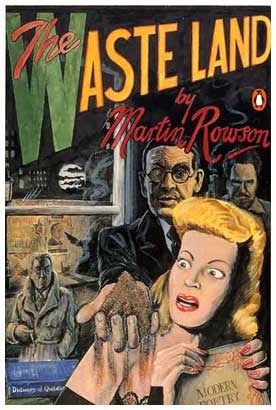
It just happens that this week I got a copy of Martin Rowson’s “The Wasteland,”  a 1990 comic-book riff on Eliot’s poem as if written by hardboiled-detective fiction writer Raymond Chandler and filmed like “The Big Sleep”  or “The Maltese Falcon.”  Rowson notes that in “The Long Goodbye”  Chandler had referenced Eliot’s “Prufrock”  with a character quoting “In the rooms the women come and go, talking of Michelangelo” and having the character ask his detective Marlowe “Does that suggest anything to you sir?”

Marlowe replies, “Yeah—it suggests that the guy didn’t know very much about women.”

Though that’s clever repartee, charges that Eliot was naïve about women or even misogynistic can be difficult to disentangle from his general misanthropy. A female Chandler character may be given more apparent agency than the women in Eliot’s “The Waste Land,”  but both the male and female voices of “The Waste Land”  are frankly damaged and the minor male characters, wraiths and zombies.

Rowson Wasteland1

Sometimes with a dame you gotta show’em some quotations in Greek or Latin.


In any case, Rowson’s comic-book/graphic novel is a lot of fun for fans of Film Noir and Chandler, or Eliot and Modernist lit. His drawings have more in-jokes than a season of “The Simpsons”  watched with a finger on the pause button. And from his notes Rowson supplies in my edition on dealing with Faber and Faber and the Eliot estate, it could have been even funnier if any of them had allowed the comedic-take to use any of the lines from the poem. I laughed often reading the Rowson, but never so much as when he recounts being refused the rights to use the ancient Greek and Latin quotes Eliot dropped into his poem, because Eliot’s rights now include them as part of a unique compilation. That may well be legally sound, but it’s also howlingly funny. Eliot as he wrote his “Waste Land”  was clearly borrowing widely from other authors’ work, because he thought it would show us something new when he put them in another context—the same thing that Rowson’s book sought to do.

Which is also what we try to do here as part of the Parlando Project, show you familiar and unfamiliar words in the context of different music and performance styles.

“We are in Rats Alley, where the dead men lost their bones”

“Rats Alley”  is a dialog, and the two speakers are clearly broken vessels. The woman dissatisfied, depressed, afraid, maybe even unstable. The man, numbed, haunted, unable to express even the short expressions of discontent the woman speaks. When he (once in the poem, three-times in my performance) breaks into the cryptic “We are in Rats Alley, where the dead men lost their bones” I decided to alter the voice, to make it a third voice. She’s asking him to speak, to tell her what’s going on, but she doesn’t seem to have heard him say anything, other than a litany, literally, of “nothing.” And so, I’m portraying the Rats Alley line as his inner torment, his monster, that is heard loudly, but only in his head.

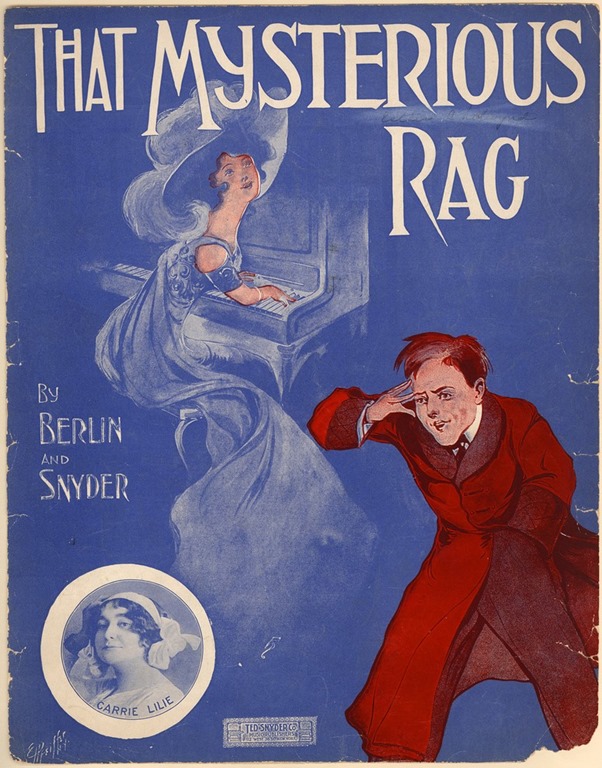
That_Mysterious_Rag_1

“In the rooms the women come and go, digging riffs from Ahmad Jamal”


Rats Alley sounds like yet another reference to some dark Jacobean revenge play, samples from which Eliot has already peppered his poem with. If it is, no one has found that work. Some speculate it sounds like the darkly humored street-signs WWI trench-soldiers hung on their subsurface battle lines. If so, then the last voice, the fourth voice of the piece, an imaginary, comic ear-worm song Eliot has made up, “That Shakespearean Rag,”  could also be an internal voice. It’s sometimes been considered to reference Irving Berlin and Ted Snyder’s “That Mysterious Rag,”  a giant pre-WWI hit with lyrics that say “Did you hear it? Were you near it? If you weren’t then you’ve yet to fear it.” In the hit parade context, the lyrics turn out to be just bragging that this rag is a killer hook “because you never will forget it.” Eliot substitutes Shakespeare in his parody, but is this male voice a soldier, haunted by the trenches and dead comrades to whom old tunes now take on a new context, a sinister edge? It’s a bit of a stretch, but could Eliot have planned to use “That Mysterious Rag’s”  mock-dangerous lyrics as a counterpoint to his scene—wouldn’t that have been a powerful sample!—but was enjoined by copyright issues?

To hear my performance of “Rats Alley,”  today’s segment of Eliot’s “The Waste Land,”  use the player below. You can hear the first section, “The Burial of the Dead”  or the first part of the “A Game of Chess”  section which I performed as “Visions of Cleopatra”  by looking in our previous posts this April as we celebrate #NPM2018.

Dear March

We had a real Minnesota whip-saw this week, the aftermath of a 15-inch snowstorm as the week began and a day in the 50s as it ends.

Much digging out of cars, and wheels doing the whistle-spin on the ice beneath for three days. It’s been a long winter, but Sometimes It Snows in April  as Prince once sang.

Today, when it reached the lower 50s, people were out in shorts and T-shirts, with snow still covering yards, with the low rubble of white ruined walls still on the streets where cars had once been imprisoned. This is how Minnesotan’s celebrate unbelievable spring.

Now this Saturday brings the anniversary of Prince’s death, which was as unbelievable as Spring. I was looking for another poem to combine with music, and I reminded myself I hadn’t done an Emily Dickinson poem yet this April, and there can be no full celebration of U. S. National Poetry Month without Dickinson. As I looked, I came upon this poem, and it seemed right.

“Dear March”  has one of Dickinson’s bold apostrophes, but instead of death or some other imponderable, it’s Spring that gets to be portrayed as the caller, one who gets welcomed at the door with old-school manners. There’s delightful wit in this: the March winds portrayed as being out of breath, it must have walked the long way to get here! “I got your letter, and the birds.” But being Dickinson, she will add her slant. Just past halfway she bemoans the colorless landscape of winter that she’s been left with, as if it would be her job to color it in: “There was no purple suitable/you took it all with you.”

“There was no purple suitable, you took it all with you.”

I think again of Prince, and I think this is the poem to do.

The poem continues, and we can now understand that the wit has an undercurrent. Someone else is knocking. It’s April, more visitors—or are they both suitors? “I will not be pursued!” Dickinson is now ambivalent to more Spring, to more young man’s fancies. She’s not answering the door “He stayed away a year”—well so did March. The poem ends in ambivalence. She should doubt the constancy of these Spring suitors even with the flirting, the flattery and the gifts they bring, but then there’s joy in blaming them for their absence now that they have returned.

Prince in the studio

Prince: performer, songwriter, impresario, but I’ll think of him as the patron saint of studio rats

,

I don’t want to stretch things too far here, but there are a couple of similarities in Dickinson and Prince. Both known for wearing one color (white and purple). Both enigmatic to the public (“The Myth” and “The Glyph”) and increasingly reclusive. And both were capable of being prolific and artistically self-sufficient, though this is not as rare for poets as it is for musicians and songwriters who could (as Prince did) write and record all the parts. In the end, they are both American originals, not copies of anyone before or since.

To hear my performance of Emily Dickinson’s “Dear March”  use the player below. And let folks know about what we’re doing here, combining various words (mostly poetry) with original music in different ways. It’s #NPM2018, and you can dance to it.