Meeting Music and Words, a personal history. Chapter 3

Here’s more of my condensed history of what showed me ways the Parlando Project could be done. I’m continuing, though I’m needing to disregard some fear or wisdom (can we ever tell which is which?) that I’m talking too much about myself, a person of little consequence. What keeps me going? While I write this expecting that what I’m trying to talk about is of interest to only a few, I continue in the hope that for those few it’ll be of value. While I love some music loved by millions, that’s not all of musics to me. And poetry, the supplier of the words used here, is a strange art: omnipresent yet under-considered. Combining literary poetry with non-commercial music is not the way to millions of Internet clicks. I’m hoping for individual interest — yours, valued readers and listeners, and I appreciate that attention.

There are democratic and utilitarian reasons to care about majorities, but most majorities upon a closer look are made up of smaller groups. And too, few majorities are born that way, they start and accumulate smaller groups. “I contain multitudes” said Whitman — multitudes of smaller groups, inconsequential taken to themselves. He called his book Leaves of Grass,  not The Biggest Damn Lawn You’ve Ever Seen.   If we’re lucky in life we will have found small places, families, affinities, constrained spaces we can contain and explore. In some of those places people will make art, that encapsulated way we exchange our inward handful-grasps of the outward world.

So, I was talking about the end of my teenage years, as I was off to what would be a shortened not quite 2-year experience of college in The Sixties. I’m going to next write about three artists of that time that I was introduced to while still in Iowa, each of which left seeds of what years later would make up the Parlando Project.

In my very first day at college, I was walking in the center of the little campus when I happened to strike up a conversation with a stocky man in a cape. I’m not talking a Superman or Batman cape. No, this cape had a full collar and could be buttoned at the top. It was more of a 19th century woolen military cape, or like the green cape that musician David Crosby liked to sport around the same time, though Crosby and his scene wasn’t anywhere near the two of us in Iowa. This caped crusader had an interesting conversation starter: “Do you know who the Fugs are?” he asked.

Here’s what I knew: I seen a mention of them as an outrageous act in the New York City area, with unprintable lyrics that could only be cited by their suggestive titles. “They’re a dirty rock’n’roll group” I replied. I was better or worse then for capsule descriptions.

“Do you know who the Mothers of Invention are?”

“They’re another one.” This was nervous inarticulateness on my part. Though I had not heard a note of their music, I had read their leader’s insightful essay in a Life magazine round-up of what was starting to be called “Rock,” the “’n’Roll” having just been significantly dropped by doughy critical burghers due to a new appreciation of the all-protein counter culture. Zappa’s essay perceptively pointed out that culture is always present, always countered of fitness and absurdity in some mix.

This minimal performance on my part must have encouraged the caped one. We immediately conspired to get our dorm room assignments switched around to share a room. I think he may have had a preliminary dorm assignment secondary to being a football player. Later I would see that both his legs had simitar scars from knee operations secondary to his high school football career.

The caped guy’s name was Jimmy Scanlon, he was from Chicago. He’d seen those groups perform, had their records. His plastic record player was a little fancier than mine, and had two small speakers that swung out from each side, a stereo. I soon got to hear all those two group’s records.

Let me write first about The Fugs because they are by far the least known and admired of the three artists I’m going to write about, and that’s odd since they were pioneers who I believe directly influenced other artists we now remember as the pioneers. Richie Unterberger, a man from a later generation who looks back at this time calls them “Arguably the first underground rock group.” That’s something I’d say too, even though the core of the Fugs were not musicians in any functional way. They were instead anarchist/beatnik/poets from New York City who just on guts decided that they could get together and sing in 1964. In this instinct they were directly influenced by the short-lived jug band fad that emerged in the folk music revival. The idea of the folkie jug band was this: rather than relying on the individual stage presence of a single performer at the mic (underrecognized: that’s difficult!) you could get up with a bunch of vaguely related instruments and make a somewhat coordinated noise. But the Fugs were distinct from that fad in these ways: their material was politically and socially outrageous, clearly making no play for commercial markets, they soon added musicians who played electric instruments, and they couldn’t sing. Am I being too blunt about that last part? Call me experienced here: this is a pot calling that kettle. They were pitch challenged, they didn’t have, nor did they attempt, pleasing vocal timbres, and they recorded anyway.*

Does this sound indie AF? Does this sound akin to what earliest rappers did with what they had a few years later in NYC? Does this sound like punk rock to you? It should. A decade before CBGBs that is what this was. And they performed a lot in the city. The Velvet Underground had to be aware of them as they were both forming within blocks of each other simultaneously. Did Bob Dylan think of them when creating the most ribald and playful Basement Tapes songs? No matter how fully formed Frank Zappa’s ideas were, did he at least see his Mothers as competing in the same atmosphere when they both had extended runs in rented theaters in NYC?

Does this sound indie AF? Does this sound akin to what earliest rappers did with what they had a few years later in NYC? Does this sound like punk rock to you? It should.

Those things happened from going on guts. From believing the things you are apprehending have value. It’s too limiting to call this competition, or rivalry, it’s the mutual demonstration of possibility.

Before I leave The Fugs, here’s a very Parlando Project thing about the Fugs. They were poets themselves, and yet they formed a band. They performed other poets work regularly.** When Dave Moore and I started performing ten years later I (we?) described what we were aiming for as the Fugs performing with the Yardbirds.

The Fugs repertoire was political, satiric, scabrous and — well, very sex-positive. But they could carpe that diem with the poets too. Here’s my rendition of a Tuli Kupferberg song “The Garden is Open” that I performed a few years back.

.

Since I wasn’t in New York or connected directly with any of this, here are a couple of accounts of the Fugs from those who where there. One by Fugs founder Ed SandersOne about Tuli Kupferberg’s life.  And this account of how the musical scene including the Fugs interacted with the general poetry and art scene in NYC.

What about the Mothers of Invention and Frank Zappa? Wait. Though Jimmy Scanlan and that same year Dave Moore too, introduced me to these two groups almost as a pair, you’ll need to wait for my Frank Zappa story. And there’s a third artist that I was discovering in my late teens that helped me formulate this Project. We’ll get to him too.

.

*I’ve had long suffering partners in my life, what with the kinds of music I am too well drawn too. Most of them couldn’t stand more than a few minutes of the caterwauling of The Fugs. I wouldn’t blame you either — but I’m reminded of Bob Dylan’s parable about what a beautiful singer, Sam Cooke, said about this: “Voices ought not to be measured by how pretty they are. Instead they matter only if they convince you that they are telling the truth.” I love music. I love the beauty it can manifest, even without words. If I had to choose a world with only beautiful singers or only truthful singers, I’d take the latter.

**Ted Berrigan, William Blake, Allen Ginsberg, Algernon Charles Swinburne, William Burroughs, Charles Olson, and of course band founders Ed Sanders and Tuli Kupferberg were poets themselves.

Meeting Music and Words, a personal history. Chapter 2

As we celebrate National Poetry Month this spring, let’s continue with my condensed memoir with footnotes of how and why the Parlando Project came to be. Last time I was leaving home for college in The Sixties.

I was an undistinguished student, able to connect with some teachers and subjects and unable to connect with others. I think I went on to college because I still had curiosity and desire to learn about some things and because I had no other firm idea of what I wanted to do other than write poetry. Even the naïve teenager in me knew that poetry was an exalted vocation but a dreadful-paying job. The fool in me thought that if I was good enough with poetry, things would take care of themselves. Is there a word for a fool that stumbles upon wisdom for other reasons than their own? There should be. That was me.

Is there a word for a fool that stumbles upon wisdom for other reasons than their own? There should be. That was me.

There was another reason to attend college in The Sixties if you were male. There was a military draft. Depending on where you lived (draft bards were local, county-sized, units and their quotas and pool of 18-26 year olds to fill them varied) most of the most eligible would be drafted to serve 2 years in the armed forces. The “most eligible” part was the trick of the inequality of this system.*  Those married with kids or students were put in a “deferred” level. With the rising deployments in the Vietnam war in The Sixties, concerns about the common inconvenience of military service were escalated into a fear that “I’ll be drafted, sent to Vietnam, and I’ll be killed.” **

Because my experience with school was in a small town, small school, I went to a small college of just about 1000 students, one still in Iowa, Simpson College. Road not taken thoughts could wonder: what if I had been more adventuresome? The English Literature department was largely younger professors who taught the smallish classes directly. One of those younger teachers was a quiet but scholarly type who loved St. Thomas Aquinas and Gerard Manley Hopkins. I’m no Thomist but he did introduce me to Hopkins. Another had a full John Berryman beard and curl-dangle cigarette ash while he talked on. He loved Norman Mailer and encouraged unconventional thought. I picked up the idea that French poets were important in the emergence of modern English poetry, so I tried to take French for my language requirement. As remains the case to this day, I found myself entirely unable to form the correct sounds to pronounce the words. My young French teaching professor had a great story though. She’d taken the position at Simpson, located in Indianola Iowa. That summer she went to Indianapolis Indiana ready to start her professorship, and upon arriving asked for directions to Simpson.

Here are two people near my own age who I met at Simpson who changed me and eventually the Parlando Project.

One was Dave Moore, who readers and listeners here already know. How’d we meet? I met Dave in my first year at Simpson when he led an unconventional service at the school’s chapel. He read the words to Dylan’s “With God on Our Side”  and made them vivid even as unaccompanied spoken word and then he read a poem of his own. I had to get to know him — and did — because here was another poet. Dave’s influence on the Parlando Project is impossible to understate, but in this era, Dave left Simpson for another school to further his education at the end of my first year. He’ll necessarily return often as this memoir continues.

In my second year at Simpson I took an inexpensive catalog-store acoustic guitar with me to college for just a few weeks at the beginning of the school term. It was an instrument that belonged in common with my siblings. In an act of cargo-cult magic one day, I remember walking around the little campus with it hanging by a strap across my back, like I was on some cover of a folk music magazine. I ran into this skinny guy wearing a Levis jean-jacket who said he played guitar too, and he invited me to his dorm room.

When we got there did I notice then that his guitar was likely better than my family’s shared plywood egg-slicer string-action guitar? No, I didn’t know anything about that then, but it was no-doubt a quality instrument. When he took it out of its case (his guitar had a case!) he tuned it up quickly and started to play a bit of this or that, and then launched into a piece he informed me was called “Vaseline Machine Gun.”

One or two of you may startle as I say the name of that guitar piece. It appeared later at the very end of The Sixties on a record by its composer Leo Kottke with the it-can-afford-its-understatement title of “6 and 12-String Guitar.”   Within the smallish world of steel-string acoustic guitar instrumental music that record is a landmark. The album’s energetic playing in an original style, the polyphonic lines going on all at once from a single instrument was impressive — still are, though players have had decades since to try to work at that level. The record’s showpiece, the cut that was meant to make your jaw drop the farthest is “Vaseline Machine Gun.”   So, you one-or-two know what I felt sitting a couple of feet away from someone playing it live in a small Iowa college dorm room in The Sixties. Here’s a 2-minute live version of the young Kottke playing it for the rest of you.

.

OK, you’re back. That skinny kid, a year younger than me, nodded at me with my plywood catalog-store guitar, one that I’d figured out three or four reliable chords on to be rung up with vigorous strums. His manner was hip, cool. “What do you play?”

One could  write a whole chapter on that moment, that interchange. I write poems and attempt-to-be-short blog posts. I said, “I don’t really play.”

The skinny guitar player kid’s name was Don Williams. Like Dave Moore, there are other Don Williams, some of them better known than others. With that common a name, I’ve never been able to find him later in life. He was from the Minneapolis area, where Kottke was based and where he could have heard him in local coffee houses. His family had money enough to afford him the better instrument. He had the funds and inclination for lessons in that city, and the wherewithal to absorb them. He dropped the names of Twin Cities guitarists Dean Granros and Dean Magraw, who I suspect he may have taken those lessons from. I hung out with him some, heard him play more. He had an amp and a Howard Roberts model Gibson electric guitar too. If I was to meet him again, all these years later, I’d thank him for initially imprinting me with the broad possibilities of the guitar, acoustic and electric, and in particularly with bottleneck slide.

I went back to my dorm room. Sometime that fall before I had to return the guitar to the family home, I took a short poem by another Simpson student I knew, Keith Hill, and using that and those few chords played with some make’em pay up strums, I wrote what I will later call the first Parlando Project song, decades before there would be a Parlando Project. The poem was called “Eat At Joes”  and Keith Hill was aiming for a gently satiric mood. I adapted or misconstrued it as an indictment of go-along acceptance. More than 40 years later I still remembered it well enough to attempt it with Dave Moore and the LYL Band. You can hear that remembered version with this highlighted link, or with the graphical music player below.

What happened next? Why did I stick with the idea of literary poetry combined with music?

.

*There were other deferments. Some professions were still deferred as I recall. Homosexuality along with mental illness was considered a no-go, though as throughout history, gay people served. Medical deferments were issued, and for those in the know during the era there was a saying “No one is too healthy to not have a reason for medical deferment.” If the proponents of conscription debate that it promotes an equality of service and sacrifice, the reality of the system manifestly reflected racial and class-based castes. I wasn’t analyzing this at 17, but it wasn’t subtle people!

**Like a lot of historical remembrances, this is accurate in terms of the believed myth and inaccurate in terms of the reality. In generational talk of “Boomers had it easy compared to…,” this level of existential risk for teenagers seems somewhat forgotten. Still, not only did most Boomers not get drafted — due to that range of deferments and the size of the pool — most draftees never went to combat even during the height of the war. None-the-less, this perception of a real risk is an under-acknowledged motivation for the growth in the antiwar movement then. I don’t know if anyone has written of this, but it seems to me that this was also one substantial reason that college enrollments increased even above the demographic bulge, which then helped set the expectation that college was a pre-requisite for many more jobs. Racial and class-based caste systems again.

Meeting Music and Words, a personal history

While continuing my observance of National Poetry Month, I must apologize for resorting to regular blogging form and writing about myself today. That sort of thing works for many, but I tend to run on a bit when I do it. It must take a long time to bore myself.

Why, when, did I decide to do the Parlando Project, this odd little idea to combine words, mostly literary poetry, with not-exactly commercial music? It wasn’t something I toddled off to grade school knowing I wanted to do. I had no great early childhood connection to poetry. I was exposed to the children’s poetry in my mid-west, mid-century tastes: Longfellow appeared, illustrated. The D. Seuss of my time then was Dr. Seuss, not Diane. My interest in music was greater, despite having no discernible musical talent or outlet. The wife of my little town’s school superintendent taught a music class, which was mostly music appreciation, little samplings from records of the orchestral repertoire. My peers found this impenetrable and boring. Since I was something of an outcast I decided to listen to what was so outré in their just-teenage world. Around the time I myself entered teenagerhood I got a gift of the mid-century handheld device, the transistor radio. I would bike around my town and outskirts with its faux leather case strap wrapped around my bicycle handle-grips, twisting the little plastic radio’s orientation with my fingers so that the stations from far-off towns aligned with its antenna. Was I listening to rock’n’roll, that mid-century strain? No. At first I was listening to an AM station that was one of the pioneers of what later became public radio, and this station programmed classical music.

Rock’n’roll was the music of those that distained that music appreciation teacher and distained me. If many then and now read the sneer or assertion in rock’n’roll as the music of when-in-the-course-of-human-events independence and freedom, I heard it as the music of those that didn’t care much for me. But I eventually relented. I wanted to look at the music the rest of the teenage world was hearing, thinking it might be a window into their interiors. Maybe it was a bit of survivor’s reconnaissance.

I found some of what the Top 40 station played interesting. This was in the era which the American pop music histories sum up as post-Elvis, pre-Beatles, describing it as dire and worthless. Were the teenagers of that Ike to Kennedy time, even if subconsciously, wanting more, wanting better? I dunno. For myself, I didn’t know any better. It was a mix of Brill Building girl groups, Black R&B, folk music/country and western* crossovers, late period crooners, and novelty records that would shame a modern TikTok sensation in their silly sensationalism.**  Unlike my peers who were closed-off to me, there were voices there speaking secrets, their moods and moments.

Want to know why the Parlando Project musical pieces are all over the map in terms of musical flavor? This is the child-is-the-father-of-the-man reason.

Poetry? I admire the knowledge and deep interests of academics, while somehow worrying that poetry is seen as having an academic requirement for reading or writing it. You didn’t need to go to school to listen to the radio. There was no MFA for the Brill Building, Motown, or Slim Harpo, at least not then. Still, I have to be honest, like many who continue to read poetry that they won’t be graded on, it was a teacher again, Terry Brennan, a recent St. John’s of Collegeville grad, who taught an English literature class in my little 100-person high school who introduced me to poetry as possibility. Did I understand poetry? Does one need to understand what one is drawn too? I don’t think so — a little mystery may even help. Much of it was beautifully inarticulate to me, phrases that said with inevitability, descriptions that were exotic, situations that I hadn’t lived, or lived in any understanding whatsoever. I loved Keats and Blake. I found out Blake was the original DIY Indie, who wrote, illustrated, engraved, and published his work, mastering what technical, logistical, and creative work was needed to realize his art. I loved a capsule description of Blake I found in the back of one of my parents’ old textbooks that they had saved. It went something like this: “He wrote early charming lyrics showing real talent, but later descended into incomprehensible writing suggestive of madness.” Writing without limits! I was ready to sign up.

On the day after Christmas, riding in a Dodge station wagon filled with my sisters and parents, rolling between Minnesota and Iowa, I wrote my first poem. I was 16. I thought it rather marvelous that I could write such a magical thing. A year later, the last Christmas I was to spend in my childhood home, I got enough money to buy a cheap record player and three LPs. These inscribed, foot-square, vinyl circles were the adult music, the things that could contain the igneous something that was starting to get called “rock.” Rock as a name seemed solid, monumental, permanent. I suppose in much of my cohort it still is — childhood transition music sticks with you. These are the three LPs I bought with the leftover money: The Doors “The Doors,”  Bob Dylan “John Wesley Harding,”  and The Rolling Stones “Their Satanic Majesties Request.”   In reverse order they imprinted me with love for Mellotron and ramshackle pretension, spare acoustic guitar arrangements and one-room songs without bridges or choruses, and poets who wanted to front a rock band that had listened to some Jazz and Blues records.

Parlando Inspiratins 1

Of those 3 LPs, maybe only the Dylan retains current esteem, yet all were considered significant in their time.  Blake & Keats? Well, it’s poetry, so the answer is complicated, particularly in the United States.

.

Music, various, and words, mostly poetry, exploring other people’s stories — yes, I can still see the damage there. While we’re not to the Parlando Project yet, this is enough for one post. Let me leave you with a Parlando Project audio piece, words from another poet recalling that era, Ethna McKeirnan’s poem of “Stones”  that seemed permanent as she moved through her life.  Player below for most, backup link for the others. McKiernan’s final new & selected collection including this poem is available here.

.

*Little known fact: C&W and folk music were often thought of as the same or aligned genres then. The 21st century Americana thing was how things were considered circa 1960 as well.

**Look up “Ahab the Arab”   for one such example. Can I call it transgressive? Can you call it cultural appropriation? Fatima has less agency in this tale than Clyde (the girl-group Brill Building songwriters might have made her the main character.)  If you’re on the borderline of acceptance, I’ll tell you that Jimmy Saville had the UK cover-version hit with this.

National Poetry Month 2023 and I introduce this Project to newcomers

In the nearing 7 years since the Parlando Project launched we’ve normally celebrated the US National Poetry Month with increased activity. This year that celebration is conflicting with some other factors which are keeping me from a focused plan for NPM. That said, one goal of the #NationalPoetryMonth activity here has been to draw new readers and listeners to what we do. So, it’s probably a good idea to let new eyeballs and ears onto what to expect if they visit our archives of over 650 audio pieces released, pieces featured and expanded on with the nearly 900 posts since we kicked things off in 2016.

You see one motto up in the header of this blog and elsewhere: “The Place Where Music and Words Meet.”   I take words — usually not my words, but words their authors likely intended as literary poetry — and combine them with various original music — music that I generally compose, and increasingly often play myself in one-man-band ways.

2023 NPM poster_800

Sometimes what we mean takes time to discover. How do we relate to something else, the differences, the things similar? That’s a metaphor. Make the metaphor musical, however you do it, and that’s poetry.

.

A few readers may figure — perhaps even a listener of a stray Parlando piece they see linked somewhere — that there’s a convention, a style I follow when I do this. I hope they’re mistaken. I’ve always intended to not do that. The people that have influenced, or unintentionally given me permission to do what I do, made music and word combinations in different ways.*  I try to use all those ways, and hope to stumble on some others. I will sing the words, but just as often chant them, talk-sing them, or resort to a freer, spoken word cadence — thus the origin of my Project’s name.

I try to keep the audio pieces short, almost always less than 5 minutes. I try to keep these blog posts shortish too, less than 1,000 words — and though I sometime fail in keeping those goals, I try to keep my failures in check. And not all the realizations of the words with my music and performance work for everyone, or most, or perhaps anyone. Some of them are even embarrassing to me, but I leave them up in our archives you can see separated into months to the right of this post.

Why do I do this? Manyfold reasons. Some of them? I like the challenge, the variety of verse, the variety of music. I think poetry is musical speech, and making even more of the musical component offers a different way to enter the words for the listener. Consider how you might enter into a song you grow close to, over listens, over time. At first it might be a phrase, riff, or refrain that catches you, or a general tone you feel, but then some new nuance may come to the fore. Or how a song you thought an abstract construction of words can from new experiences, experiences inside or outside of the song, somehow become more realized and concrete.**

This is how poetry lives, it’s the only poetry. Poetry does not live on reputations or silent copies printed, it lives inside you, a single reader or listener, as sound that may eventually saunter up closer in sense. This is what I celebrate all year, and some more so during National Poetry Month.

.

*Perhaps I’ll write more about, and thank more, those possibility creators this month? To name some of the models for Parlando: Beat poets and their immediate predecessors Rexroth and Patchen reading to music, Patti Smith, Bob Dylan, Joni Mitchell, Leonard Cohen, The Fugs, those English lute composers like Campion and Dowland, Tom Rapp, whatever William Butler Yeats planned to do with his bespoke psaltery, Rabindranath Tagore, what alternative hymnal Emily Dickinson was internalizing when she played her Homestead piano, Frank Zappa, Carl Sandburg, Langston Hughes, the American blues poets from Charlie Patton to Gil Scott Heron, Anne Sexton and her rock band, Laurie Anderson and her expansion of Ken Nordine and his “word jazz.” I’m also aware of “art song” — and appreciate both the achievements and the limitations for my purposes of that long established form of combining literary poetry with complex musical settings and melodies using orchestral instruments.

**One of the reasons I trust that you may find these experiences when the poem is carried to you inside a musical environment, and buffered there, is that I very often have had that experience composing and recording the Parlando musical pieces. I start out not sure what a lyric means or thinking I know something of what it means, only to find that there’s an entire other something or somethings there the 5th, 10th, or 20th time through it. The very act of putting the poems words into my mouth illuminates things, the exact question of how to utter them throws light from out of my dark throat.

An Immigrant American Dream Girl

I’ll admit I rushed to complete today’s audio piece because I wanted to make note of a birthday anniversary of an important contributor to the American wing of the Modernist movement of the early 20th century. I’m going to get to it in a roundabout way. Have patience, valued reader, I think this abbreviated story is worth your time if you care about the everyday accidents and personal connections that you might find scattered about behind what become large changes.

This story starts with two 19th century American immigrant families. I know a few details, and though I probably don’t know a lot more, but I think I know enough for a story. One family’s breadwinner was a laborer from Sweden. I read today he signed his name with an X, and he worked at various jobs including blacksmith’s assistant in Illinois after arriving. His wife was resourceful and was able to keep the underfunded household going. The other was described as a “peasant family” from the tiny country of Luxembourg. “Peasant” sounds so Bruegel, I don’t know if things were that feudal in Luxembourg in the middle of the 19th century, but that second family emigrated to the midwestern United States like the first one. The husband started out working in a mine until ill health forced him out. Luckily his wife found some income working as a milliner.

What’s important about these two families? Well, so far, nothing — though they raised families, that’s something. The second family already had kids when they arrived, the first one soon had seven kids. We’re going to concentrate on some of the kids. Our first family was the Sandburgs, the second the Steichens. One of the Sandburg children in Illinois called himself Charlie, and over at the Steichens in Wisconsin we had Edward and Lillian who were born in Luxembourg but were now growing up in the US. Charlie, the son of the man who signed his name with an X was passionate about writing. Edward, the son of the miner, was interested in art.

Charlie, our writer, had to leave school to help earn money for the struggling family at age 13. Eventually he volunteered for the army and served in the Spanish American War. Edward worked at the commercial end of art while having ambitions to move into the fine art world. Given those ambitions he took a wild chance by moving over to photography, which in the late 19th century wasn’t yet considered a fine art. How could that acceptance happen?

Edward started taking pictures and working on various ways the composition, lighting and film developing process could alter the images in artistic ways. One of his models for the photographs as he worked on his craft was his younger sister Lillian (see below).

Charlie got a break after the short-run war he was in. A local college gave him a scholarship* as a returning war veteran, and one of his sisters, Mary, was big on education and helped support him. Charlie rushed into doing everything writing he could do there — and while he didn’t graduate, when he left it was to pursue writing and to give talks on the midwestern Chautauqua circuit. Looking to network, he found himself in Wisconsin attending a Socialist party meeting.**  It’s there that he met Lillian Steichen. Bam! Charlie fell hard and fast for Lillian. Lillian was perhaps a bit more careful. Charlie told her he was a poet, an artist, and he asked for her address (she was visiting her family, but was teaching in another state). She obliged. That was it, one accidental meeting.

For the next six months Charlie Sandburg wooed Lillian Steichen with letters. Lots of letters. Letters with poetry. Lillian’s letters easily showed her intelligence and wide interests, and she may have felt freer to discuss those things with native-born Charlie in writing because English was her second language and she may not have been as fluent in it speaking casually. And despite Charlie not being a good provider catch, the two fell deeply in sealed-with-a-kiss love. How much did Lillian rev Charlie Sandburg’s poetry engine? We’ll see at the end of this story today.

What about Lillian’s big brother Edward? His art photographs were getting some interest, and he had crossed paths with Alfred Stieglitz, another man who was interested in the Modernist movement to make photography into art. In 1905 the two go in to showing not just their fine art photographs but all kinds of Modernist art in New York City. Edward’s photographs filled Stieglitz’s journal Camera Work. A gallery they set up, the 291 Gallery, shows much new modern art work — not just photographs— and this work is often shown there publicly for the first time in America. How important and primary were Stieglitz and Edward Steichen in Modern art? Even a person who’s not primarily interested in visual arts like me has heard of the famous 1913 Armory Show in NYC, often considered the pioneering event in America’s exposure to Modernism. Well, Stieglitz and Steichen were showing that kind of work and laying the groundwork for that show for a decade before.

Back to Lillian Steichen and Charlie Sandburg. They married in 1908, job prospects for free-verse poets not overly concerning them. Charlie started to go by his birth name Carl, which he’d previously ditched because it seemed too ethnic. He worked for awhile as the PR/Press Secretary for the Socialist mayor of Milwaukee.***  And then he moves on to daily journalism as his day gig in Chicago. Carl, Lillian, and the brother-in-law exchange Modernisms. Carl’s poetry becomes more tightly visual, more show not tell. Later, if by extension photography can be an art, how about movies? Carl Sandburg’s daily journalism includes becoming an early movie critic.

Edward Lillian Steichen and Carl Sandburg

Edward & Lillian Steichen. “My Younger Sister with a Rose Covered Hat.” Carl and Lillian Sandburg. “My Little Sister.” All photos by Edward Steichen. Check out the hats. Was it another happy accident that Steichen’s mom was a milliner?

.

In 1918, ten years after he married Lillian, Sandburg issued his first collection, Chicago Poems. It wins the Pulitzer prize, helping to bring Modernist poetry to the attention of the public in America. He dedicates the book to “My wife and pal, Lillian Steichen Sandburg.” If you want to read more on Lillian, the couple’s courtship and their life-long marriage, here’s a link to start with. If you want to know more about how Edward Steichen and Alfred Stieglitz’s the 291 Gallery was a beachhead for Modernism in America, you can start here.****

On the anniversary of Edward Steichen’s birth, here’s one of Carl Sandburg’s poems wooing Lillian Steichen, “A Dream Girl,”  performed as a song. You can think of it as Sandburg’s “Love Minus Zero/No Limit.”  But knowing the art-photography Steichen side, consider the poems final line when you listen below, or read it here.  I recorded the song quickly, with just my voice and an acoustic guitar, something that Carl Sandburg would have had handy to him, because Carl Sandburg was also a pioneering folksong revivalist, often dropping a set of acoustic guitar songs into his readings at a time when Pete Seeger wasn’t out of diapers. Oh, and Bob Dylan? Did you know that when Dylan’s poetic songwriting was just taking off that he took it upon himself to seek out Carl Sandburg?  Oh, so many stories, let’s get onto the song. Graphical player below, and an alternative highlighted link for those that can’t see that player.

.

*Charlie, Mary, or someone must have talked Charlie up a bit. Colleges, even then, didn’t usually admit folks who hadn’t attended high school.

**By the turn of the century, democratic socialism was an emergent movement in the US. Despite its suppression in the WWI years there was some chance that it could have developed into a European style mass political party. Even with the Palmer raids and fears of a Soviet style revolution after WWI, US Socialists were able to win governorships, congressional seats, and mayoral races in places in the American Midwest in the first half of the 20th century.

***The history of Milwaukee’s Socialist mayors is fascinating and too-little-known. They were the good-government party in that city, noted for reliably delivering civic improvement and services. How did poet Carl find working in the municipal front lines of progressive politics? See this post from earlier in this Project.

****My own dedication: I found out about the 291 Gallery in a book Strange Bedfellows  about the intertangled networks of American Modernism that was given to me by Dave Moore and Linnea Hadaway. Thanks!

Love and a Question

While looking for material to combine with music and perform for the Project this week I came upon a specific but little-known connection between two great early 20th century poets. I’ll go into the details of that in a bit, but before I write about that, let me set the scene by mentioning something about one of those poets, Robert Frost.

In the past mid-century, when I was growing up, Robert Frost was a poetic institution. He’d won four Pulitzer prizes, his work was as well known as any living American poet, ordinary readers might have familiarity with some of his best-known poems, and a few phrases from those poems had entered general usage. It was not uncommon for the schoolbook poetry anthologies that I’d encounter back then to end with Robert Frost. If he wasn’t the end of poetry, he was as good a symbol as any of the end of poetry as it was consumed up until that mid-century time, where literary poets wrote verse that was assumed to have a chance at general readership and could have evident value to them. He wasn’t Tennyson or Longfellow exactly (Frost’s sound was more like common American speech) but you could see him as a proprietor in the same trade as the 19th century giants.

He was enough of an institution that schoolboy-me was having as little to do with him as I could. Sure, he was living, but that was no help, because he was old.  Many dead poets left young corpses, paintings, engravings, or photographs of dashing writers, heads cocked with their thumbs and index fingers up against their visionary brains. Keats or William Blake, now there  were my comrades, not Frost. I plead youthful ignorance and concerns, and Frost’s poetry stuck around to eventually inform me in my foolishness.

So, it surprised me to eventually learn that for nearly half his life Robert Frost couldn’t get arrested as a poet in America, and he wasn’t doing all that well in finishing college or finding a steady day gig. Frost may have been trying, but he wasn’t trying very long in any one place — inevitably either they or he wasn’t for having him stick around. Nearing 40 years old, Robert Frost did something next in his unstable life: he went to England. What was this guy, that by my time was the quintessential American-scene poet, thinking?

I’m not enough of a scholar to know for sure, though reading a few Frost bios would probably inform me. One good theory: nature poetry and poetry about rural subjects was having something of a bloomlet in England. If England had led the way in industrialization and empire building, an in-reaction interest for literature about the countryside and country living was arising.

Within a couple of years of arrival Frost connected in England as he’d never been able to do in New  England. He published his first two collections of poetry. He formed a close friendship with British critic Edward Thomas (and in return convinced Thomas to write poetry). He ran into another American ex-pat, Ezra Pound, and the younger Pound trumpeted the now 40-year-old Frost’s poetry back to America as part of the coming new thing.

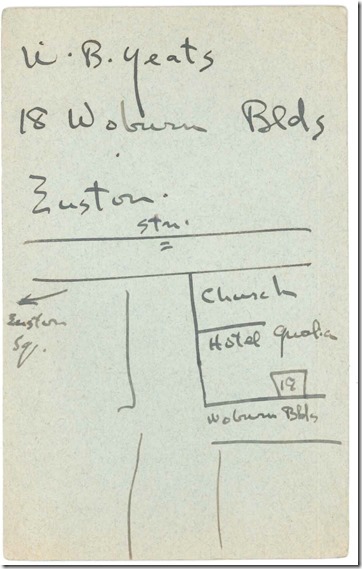
Imagism in action Ezra Pound, acting as a Georgian-era GPS, drew this map to show Frost how to get to Yeats place in London.

.

And there may have been another factor, a hoped-for connection with another poet: William Butler Yeats. Yeats wrote of the rural Irish  countryside of course, and I had never associated Frost with the Celtic revival at all. Just in preparing for this post today, I took note for the first time that Frost’s mother was a Scottish immigrant. Why did I start to look into that kind of connection?

I started re-reading Frosts first English-published collection, A Boy’s Will,  where I came upon this poem with a generalized title: “Love and a Question.”   That poem stood out at first glance because I could easily see how it could be fit to a folk-ballad style musical accompaniment. It even included a close variation of a floating verse line used in several folk songs “Her heart in a case of gold/and pinned with a silver pin.” But then there’s a second line too: the woman by a country hearth with thoughts of “the heart’s desire.” Here’s a link to the full text of Frost’s poem.

That second line would have been unremarkable except for the accident of performing a Yeats poem from an early verse play of his The Land of Heart’s Desire  this past winter. I link to my post on this if you are new or have forgotten, but this play sets up a nearly identical situation to Frost’s “Love and a Question.” A newly married couple are in a remote cottage on a stormy night. A knock at the door, and we are introduced to a stranger who asks for some comfort — but who is, it’s inferred, a fairy who wishes to enchant the new bride.

How well did Frost know this piece by Yeats? In research this week I found out that while in one of his short-lived teaching jobs before leaving for England he’d directed Yeats play with a company of his students. Cites I can find online mention him putting on this play,*  but nothing I found mentions that he also wrote this poem rather directly dealing with the play’s same story.

What does Frost bring to Yeats’ material? While his poem is understandably more condensed than even a one-act play, Frost obscured the situation considerably over Yeats well-told fantasy tale. The few attempts to write about Frost’s poem I found online catch nothing of the fantasy element because Frost makes that so unclear. Yeats’ stranger at the door is portrayed as odd and troubling soon after the character’s arrival, yet other than the continued borrowings from Yeats plot, the only thing in Frost’s text that suggests that the stranger is not a mortal is the peculiar detail of the stranger carrying a ”green-white stick” which if read in the context of Yeats’ tale may be interpreted as a wand or wizard’s staff. The stranger in Yeats is an active character, throwing themselves into the newlyweds’ relationship rapidly. Frost’s stranger is but spoken to and doesn’t act or speak other than the knocking entrance. The bride in Yeats has some action and agency in her own thoughts. The bride in Frost is a single tableau by the fire. The fears of the bridegroom are expressed in both the verse play and the poem, but in Frost’s poem he seems to be talking almost to himself. Endings? Spoiler alert: in Yeats’ play the bride dies, and it may be guessed that her soul-spirit has been taken by the fairy-stranger. Frost’s ending is vaguer. The bridegroom seems to say he understands the protocols of regular alms-seeking, but he can’t understand why someone would be so rude as to interrupt a new wedded couple on their honeymoon. Yeats’ bridegroom is anxious, but wary as he tries to win the occult battle, even though he fails. Frost’s bridegroom seems, well, puzzled.**  Is Frost satirizing Yeats tragic Irish tale, suggesting that a real rural bridegroom wouldn’t figure out what was going on? I might be missing something, but does the poem feel like a satire? For the bridegroom to be a fool wouldn’t surprise a Frost reader. Many kinds of human foolishness, misunderstandings and limitations are portrayed in Frost poems.

This brings up another factor. This early Frost poem isn’t very Frostian. The story, such as it is, isn’t clearly laid out, and the language and prosody — this seems impolite to say about this master — is awkward. I thought this poem would be easy to sing. It wasn’t, and I think that goes beyond my limitations and the brief time I could obtain to work on recording this. The poem strains natural, clear syntax and order at times to make the rhyme, and it doesn’t show well Frost’s famed use of metered verse that sounds like natural 20th century American speech. I don’t know if being so confusing adds to the weird tale, though as an aficionado of handed-down folk music there are times when the stuff that falls out through worm-holes or is forgotten in the folk process does add power by mystery. No one really knows for sure what “Smokestack lightning” is, or what it has to do with the rest of what Howlin’ Wolf sang about, and most don’t know what the hell a cambric shirt is either. We know only that something strange is going on. The listener here may be like Frost’s bridegroom: with some passion though puzzled.

So now you know that Robert Frost wrote a poem after a verse-play by Yeats, and you can hear me work to bring that Frost poem to music with the graphic player below. If that player doesn’t show up at your door, wave your magic pointer and strike this highlighted link to open an alternative audio player.

.

*Introduction to a Frost anthology The Road Not Taken by L. U. (I’m thinking, Louis Untermeyer), Yeats and American Poetry  by Terence Diggory, and Robert Frost: A Life  by Jay Parini. The latter quotes Frost writing that Yeats was able to “make the sense of beauty ache.”

**The ballad tradition includes tales of ordinary folks who by luck, pluck, or guile beat the occult challenger. I don’t know how well Frost knew his Child ballads, but he did know the golden heart box with a silver pin. Still, I can’t think of one offhand where the mortal wins just by being a bit dense about what is going on.

But These Things Too (Are Spring’s)

British poet Edward Thomas, who deserves to be better-known in the U. S., is one of the best nature poets I’m aware of. And today’s ode to the beginnings of spring shows one reason why. Like many a good nature poet, Thomas’ landscape, animals, and plants are infused not only with his region’s specifics, but with his own understanding of the order and significance of life. What takes his poetic observation to a next level? In this poem, it’s, well — bird poop.

Here’s a link to the text of “But These Things Also.”   This is a grey poem about and often grey time, despite all the odes to the greenness and new-found warmth cataloged in other spring poems. In the reduced contrast of this poem’s palette, white splashes against grey make up its color field. Thomas (who didn’t make it past middle age,* but who could have been myopic) sees plausible flowers emerging. It’s not. It’s bird droppings. Here, nature instructs, changes his poem from an otherwise competent one to a better one. The later appearance of starlings, the British bird of indifferent song and nuisance potential, are foreshadowed (foreshite?) — and we might know (as Thomas certainly would have) that the starlings flocks are startling in their amazing patterned flights.  Life and spring may well get on with amazement after first meagre overtures.

The White Things A Man Mistakes

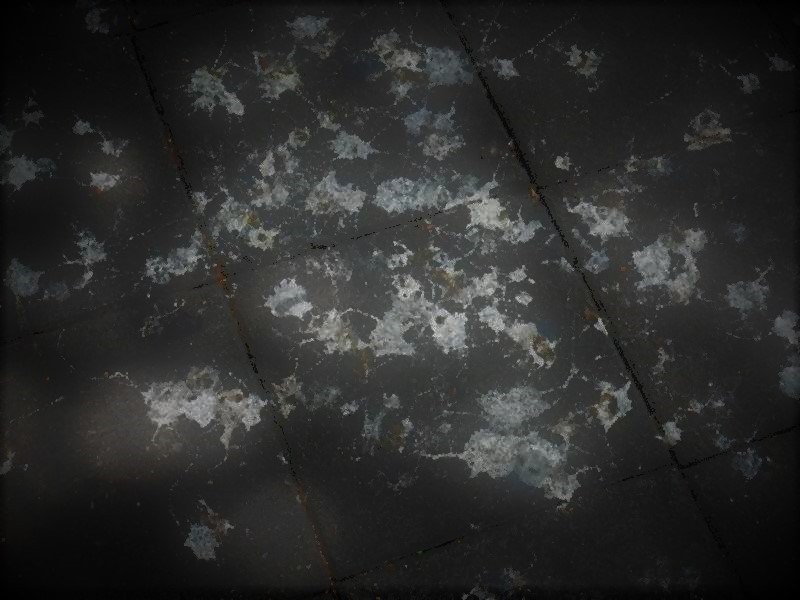
“In splashes of the purest white” vs. “Continuous as the stars that shine and twinkle on the milky way” Thomas vs. Wordsworth in a springtime faeces & flowers battle

.

You can hear my rock-band setting of Edward Thomas’ “But These Things Also”  below, but before I leave off writing about his poem, let me speak a bit about what I note about the poem’s use of rhyme. Like another great nature poet, Emily Dickinson, Thomas here is not over-determined by his need to make perfect rhymes, and the ABCB scheme starts right off with a sight rhyme of “grass” with “was.” Let’s not mark him down a grade, because the poem has a great deal of near rhyme, an effect that I find often more effective than ding-dong perfect rhymes. The pair of adjacent words “earliest” and “violets” are as strong to me as violet’s eventual end-rhyme with “debts.” And “debts” still hears the echo of the preceding “dung” and following “mist.” You may hear other consonance, assonance, and pararhymes in Thomas’ word choices.

It’s these sorts of things that make me resistant to some poetic formalists. While perfect regularity can reinforce a sense of fate (or to be honest about my own response, boredom) — irregular rhyme appearances, and variations to and from perfect rhyme, can evoke surprise and discovery.

OK, enough dancing about architecture. Let’s get onto the audio piece, the performance. Graphical player below for some of you, and if not, this highlighted link that’ll open an audio player. This is one of those pieces where I wish there was a better singer than myself handy, but it was still fun to move from chair to chair to create this one-man-band recording. I recorded this close enough together with our last piece, Anna Akhmatova’s “Like a White Stone,”  that I’m thinking if this was a polished prog-rock album that I’d fade the two pieces into a 7-minute medley.

.

*I decided to insert into Thomas’ ode my own aged vision issues, by making “man” in his text, “old man” in my performance.

Like a White Stone

Poetry, musical speech, is so associated with symbols that it may be impossible to imagine it without metaphor as a rhetorical device. This both bugs and pleases readers and listeners. Symbols can add richness, a sense of novel connections, or they may vex the reader, taunting them with needs for esoteric knowledge or psychic investigations of the author’s mind.

For me at least, poems can work when they are clear as any condensed speech would be on first reading — and  when they are nearly incomprehensible as anything other than collections of energetic words. So, along that continuum, a poem may succeed (or fail) — but it must compel. After all, we have so many other words that waft over us written, spoken, recorded, some enriched with music, video, some from those already near and dear to us. As a young person I was drawn more to the richness of images and cared less for the clarity of expression. Other poets tried to convince me that clarity showed respect for the readers busy lives, that incomprehensibility wasn’t a requirement for good poetry. I eventually listened to them and somewhat changed what I wrote and admired. In my newer but still ambiguous stance toward poetic obscurity, I believed that a poem needs to be no more complex that it has to be, and no fancier in its conceits than it needs to be to draw a reader’s or listener’s attention. I may have a bit more to say on these issues in another post, but let’s move on to a new musical piece today.

I’m largely unfamiliar with the poet whose words I’ll use for today’s audio piece, Anna Akhmatova.*  She became known to me several years back when the unique American roots singer-songwriter Iris DeMent recorded an album of heartfelt intuitive settings of Akhmatova’s poems, “The Trackless Woods.”   This record was released in 2015, around the time that I was formulating some ideas of how to do what became this Parlando Project. Many of my ideas were already set down, even some of the pieces you’ve heard here had already been recorded, but I felt then that DeMent’s record reinforced my intents to do this Project at a time of decision.

Now this month I saw Akhmatova’s poem “Like a White Stone”  featured in poets.org’s Poem A Day — and it did that “compel” thing with me as I read it in the middle of an otherwise occupied day. I eventually set upon creating a musical setting for it, one which you’ll be able to hear below.

Revisiting some interviews DeMent did around the release of her Akhmatova album I found out it was the same Akhmatova poem that compelled her. In a 2015 interview with the Poetry Foundation, she said:

This whole project is so mysterious to me…. It’s just this weird thing that happened instantaneously upon the first reading of the very first poem of hers I ever read which was “Like a White Stone”.  In that period of time, within an hour or so I’d set three or four of them to music.”

I also found out, after composing and recording my performance of “Like a White Stone,”  that Akhmatova was associated with a movement called Acmeism which reacted against the French Symbolists, a group of French poets that attracted me in my youth. The Symbolists were all about the effusive, exotic and elusive image. The Acmeists, in reaction, all about precision and clarity. The Symbolists were admired by Dada, Surrealism, and the hermetic strains of modern poetry in English. Acmeism could easily be related to other modern poets who want clarity and the power of easily discerned emotional messages.

Anna Akhmatova

“Someone looking closely into my eyes would see it” Anna Akhmatova

..

Knowing that, how does “Like a White Stone”  stack up on the continuum from clear and direct to wild and elusive? Here’s a link to the poem’s text. I’m working from this translation (by Babette Deutsch and Avaham Yarmolinsky) and I know, as one who’s translated poems myself, that there are risks that I may be grabbing onto details that are the translator’s solution not the author’s own design in the original language. My judgement overall is that this poem is in the middle somewhere, even if closer to the clear and direct pole. The opening image, the one that first grabs the reader, is both clear and elusive for me, a combination that often works to compel. A “white stone**” deep in a well, yet it’s also “hard and clear.” It somehow doesn’t put us off that this is contradictory. How much might we be able to see anything clearly, even a light-colored stone, deep in a well? Yet the poem says we know it’s there, we know its hardness sensuously — it’s not only some indistinct imagination. Is it likely we know the stone, its color, its feel in the hand, because we’ve tossed it there? And the poem then launches into an extended consideration of memory, its dichotomy, how it’s both present and by definition, absent. It’s easy to explicate this poem as something addressed to a false, absent, exiled, or discarded lover, yet it refuses to choose details or say that directly. In the poem’s conclusion, the white stone deep in the well is an image like unto a human turned into a rock or statue, unable to move from or toward exile, as permanent as ended — a memory.

Would this poem be more powerful if it just straightforwardly told us the details? Would it be more artful if it was more elaborate and fanciful in its images? Well, some poem otherwise might be — but this poem compelled both Iris DeMent and me, and maybe it’ll compel you to listen too.

My performance isn’t like DeMent’s at all. I hadn’t even recalled that this poem was one that she had performed when I worked on it this month. Although DeMent uses the same translation as I used, she phrases it differently, and while I’m no stranger to some American roots style musical flavors my choice today was more toward electronic synth sounds. Hers has a Protestant hymn flavor, mine aims at the surging dance of the floating memory mind. You can hear my performance of Anna Akhmatova’s “Like a White Stone”  with the player gadget below, or if you don’t see that player, with this alternative highlighted link.

.

*My ignorance isn’t Akhmatova’s fault. Although her work was suppressed by the Soviet Union’s cultural czars, and some of her associates killed, exiled, or imprisoned, she’s now generally recognized as an important 20th century Russian language poet.

**The white stone image, the specificity of which depends on translators’ choice, might possibly connect with another translator’s choice, in the Bible’s Revelations verse about a white stone. But remember, these are two translators, one going from Russian and the other from Greek to our English, each deciding exact words that we put in with our own connotations. Did this white stone have some connotation of translucency, perhaps even a diamond? Intuitively to me it’s a lover’s token, but I could be wrong.

Winter 2022-2023 Parlando Top Ten

It occurs to me that it may have been a while since I’ve reminded new readers what the Parlando Project is, has done, and tries to do. It started as an idea around 2015 to focus on something I’d done off and on for decades: to combine other people’s words, usually literary poetry designed to be seen on silent pages, with a variety of original music.

I did this not only because I think it’s fun, but because the process allows me to more deeply absorb some sense of what the poets are trying to convey. At least for me, I can read a poem with my eyes and sense that there’s something wonderful there — but then to read it aloud, perhaps even to sing it, allows me to inhabit it, to visit the environment inside it, as if one is deep inside some forest, awash at a water-brink, or walking down its street or inside some meaningful building.

Reading a poem silently is like looking at a picture. Performing it aloud is painting the picture with the words still wet.

Early in the Project many of these performances were with others, most often my long-time musical partner Dave Moore. For a number of reasons those opportunities have decreased. These days the typical musical setting here is composed, and all the parts played or scored, by myself. I’ve done a handful of pieces in the Project without instruments, but that’s unusual. I think that even though they are played by a one-man-band I want the words to have companions. Even the loneliest poems can have these here.

I do these pieces myself, not because I have great confidence or a high appraisal of my musicianship. Far from it. I compose and play the parts because I’m available. I’m an amiable contractor to myself, I enjoy playing different instruments, and I’m unafraid to dive into a variety of musical environments. My estimate is that most musicians who hear what I produce for the Parlando Project are unimpressed by this work, in that I almost never get responses from them when they are exposed to it.*  My guess is that is because I use simple ideas, and my realization of even these basic conceptions via my own playing has imperfections. My musical “thing” is more at participatory folk music or the punk/indie ethos — and though I try to produce good work here, and I’ve put effort into that, I don’t consider many of the Parlando Project pieces the best realization they could have. When I’ve taken to putting up chord sheets of some of the simpler acoustic guitar pieces here in the past year, I’m thinking that a better singer or player might take them to a better musical place.

Hepcats of Venus

Imaginary band gets down in beatnik cellar. Illustration shows my younger self & spouse in the center. W. H. Auden taps his cig on the ashtray in the foreground. Behind the drummer, Gertrude Stein considers Virgil Thomson.

.

Now let’s get on to a brief rundown of the Parlando pieces that were most liked and listened to this past winter. I do this countdown style, from 10 to the most popular. The highlighted titles are links in case you’d like to see what I wrote about the pieces when I first presented it.

10. All Souls Night by Hortense Flexner.  Long-time readers here will know I like to go beyond “Poetry’s Greatest Hits” here, and this spooky piece by a little-remembered author from the time of WWI continued to be listened to long after Halloween.

.

9. “Uncle Sam Says” by Waring Cuney.  This one, jumping forward to the WWII era, is almost cheating, as Cuney, a friend of Langston Hughes, engaged here in straight-out songwriting with bluesman Josh White. I’ve been playing a bit more bottleneck slide guitar this winter, and that’s what I used to accompany this message song about a segregated military.

.

8. “Now Winter Nights Enlarge” by Thomas Campion.  Speaking of songwriters: poet, musician, and Elizabethan-age physician Campion also intended this to be sung — although, as with “Uncle Sam Says,”  I didn’t use the original music for my performance.

.

7. “The House of Hospitalities” by Thomas Hardy.  A poet who spanned significant chunks of the 19th and 20th centuries, Hardy was well-versed in poems of rich remembrances, as in this Christmas season memory of holiday celebrations past and gone.

.

6. “I’m Sorry for the Dead Today” by Emily Dickinson.  One of three appearances by this crucial American genius, this one a jolly remembrance of a cooperative harvest time in Amherst.

.

5. “I’m Afraid to Own a Body” by Emily Dickinson.  An opening line or two in a poem can grab even the most inattentive reader sometimes, and this poem’s opening pair of lines certainly did so for me this winter.

.

4. “Fairy Song” by William Butler Yeats.  Like many a Yeats poem, this one beguiles you and me with its lovely word music. Then I read the play whereupon the poem appears and discovered that its context is exactly that for the song’s singing fairy: a beguiling away of a distressed person from their heart, hearth, and home. That wind that opens this poem is chilling once you know.

.

3. “I felt my life with both my hands” by Emily Dickinson.  I cannot say authoritatively what Dickinson intended the context of this poem to be, but I read it as an examination of body dysphoria, though I’m unsure if anyone else has “read” her poem that way. As I have sometimes done, I’ve performed this with what I call an “Inline Epigraph,” quoting a line from a Lou Reed’s song “Candy Says”  before the concluding section of Dickinson’s text in my performance. I often think of poems as being in conversation with each other.

.

2. Railroad Avenue by Langston Hughes.  I spent an enjoyable but inconclusive time searching for the “real” Railroad Avenue, thinking it could be like Van Morrison’s Cyprus Avenue or a NYC address in a Frank O’Hara poem. Couldn’t find it. May be it’s only mapped in Hughes’ imagination, a construction for the purposes of the poem. Long-time reader rmichaelroman reminded us in comments that America’s separations often are lined by being right in one’s memories from the “wrong side of the tracks.”

.

1. “I’m Gonna Make Love to my Widow ‘fore I’m Gone” by Frank Hudson.  Another bottleneck guitar piece that readers and listeners liked a lot this winter. Well — a self-penned piece about good old-fashioned winter randiness made it to the top of the Top Ten. Go figure. They’re talking single digit wind-chills and a March snowstorm as this week ends up here in Minnesota. Codger cuddling is carbon-free heating people!

.

.

*I ascribe this to politeness on their part. I tell myself that I overvalue the audacity and aims of what I do, when simple competence with simple ideas might be preferable.

Now that I’m in Madrid and I can think

Something in me says there should be more new pieces here since the last post, as I have several partially completed things, but the distress of folks around me pulls me several ways away from that. The distress hints that this music and poetry stuff should yield to more pressing problems, and then the unpredictability of the distress primes a sense of anxious alertness mixed with weariness. Though I’m at home, I feel like I’m in a medical waiting room, perhaps outside an Emergency Department, waiting for what it is that will be, in some not predictable soon, be said. As waiting people do, I read and do random things, anything having nothing to do with the matters at hand. Nothing too absorbing, for I don’t know when I will need to put it down.

But I’ll also say this, poetry has managed to stick itself into this state nonetheless. Poems can be as small as house mice, there’s always some place they can sift or scrunch their way in. And so it was early this morning when I saw this poem by Frank O’Hara “Now that I am in Madrid and I can think.”   I found it could be fit to an already composed musical piece I had done late last month, and so I put them together this afternoon. If you’d like to read the text of this poem, here’s a link to that.

This is a love poem, and more specifically a poem about separation from the beloved, and O’Hara’s language is as beautifully askew and full of charming scatteration as any of his more well-known poems. If I had time and an inclined mood, I could write at length about his musical language here and his turns of phrase: “The slender heart you are sharing my share of, “See (sea) a vast bridge stretching,” and “The lungs I have felt sonorously, subside, slowly.” There’s this intimacy interrupted, the separation of bodies and their encased lives. The title says the speaker in the poem can now think. Well, they have constructed a fine thing, something that takes some smarts, some wit, but what they have constructed is a set of feelings outweighing any thoughtful aesthetic pleasures of travel.

Madrid Iowa

The exciting places in Madrid Frank O’Hara is ignoring to think of his beloved. Oh— this is Madrid, Iowa! Iowans can tell out-of-staters by how they can’t get the French pronunciation of Des Moines right, and then they’ll see if they’ll correctly say this town’s name as “Mad-Rid.”

.

Perhaps this is why this poem snuck in between the trivia and my nervous time-passers. Here the illustrious culture of Spain is obscured by the distress and longing of separation. The poem finishes with one of O’Hara’s fine last lines. Do I want the empty world, the world without art? Yes, sometimes, but only by the choices of joined desire.

From the times I’ve listened to recordings of Frank O’Hara reading, I suspect he’d be more off-hand and playful in reading his poem than I was, but my reading reflects my current mood. The music for today’s performance is dense and urgent, I will not dance much about its architecture right now, but you can hear it with the player gadget below — or if that’s not visible as you read this, with this alternative highlighted link.

.