Segregated Neighborhoods in Time, Part Three

We left off last time in my Black History Month series this year, with a crumbling scrapbook filled with mid-20th century things someone had gathered. The scrapbook compiler was concerned with entertainment, particularly Afro-American’s in that role, and the largest number of items they’d pasted in focused on a somewhat obscure musical act: The Cats and the Fiddle. Was the compiler a fan or a musician themselves? Woah, we get ahead of ourselves. Let’s stay with the musical evidence we have for a little while longer.

Once I get out of bed in the morning, I grab a newspaper from somewhere in the vicinity of my front door and read it. This is antiquated behavior. I often linger in bed before or after sleeping reading near-instant news on a large tablet connected to the Internet before I later get to the morning paper’s headlines that were written yesterday, yet still I take comfort or distress from reading them printed on paper. This is memory/habit working. I’ve read a newspaper in the morning since shortly after I learned to read. I even delivered them door to door as a youth in my little Iowa town, a place where and when the newspaper might be the only way you’d find out about some things in any detail.

Though I compose music and operate various musical instruments constantly as part of this Project, I’m somewhat removed from the general life of a musician today though I read accounts, I observe. But all of us listen to music, experience it some way. I know of no culture anywhere that for any appreciable span of time has been without music.

In the 1940s and ‘50s world the scrapbook photos, magazine clippings, and ephemera collected would have overlapped my childhood, would have been my parent’s adulthood. I experienced music some from records, some from television or movies, and largely from radio.*  Music face to face? Church music once a week, and the school’s student marching brass band a few times a year. I enjoyed rock’n’roll cover bands just twice, at the Junior and Senior proms in my high school. Concerts? I once got to travel to the large auditorium at the state capitol to hear Handel’s Messiah  oratorio. But that’s a rural, small-town story within a family that had no special connection to music, played no instruments.

For other white folks in cities, and in other areas, music could have been more central, more direct. Step back a generation to my grandparents’ youth? Recordings, perhaps some, radio not yet broadcasting, movies silent. Non-commercially, there was the parlor and folk music of those whose neighbors or families played. Music at events meant musicians playing, making the entirety of the noise right there and then. Let me repeat: that era’s connection to music was almost entirely performer in the room or performance space — and so where you lived or traveled to impacted your music heavily, and overwhelmingly your connection to your music was as fully dimensional, occupying the same space at the same time with you.

Some who read this may be two full generations younger than me. Your connection to music will likely be more removed: streaming playlists, the soundtrack to video games, concerts that could be large TV screens over a distant stage of dancers and miming singers with microphones in their hands. Or it could be a sweaty basement or a club with a small stage at one side, or something you try to record on the ubiquitous computers surrounding us, to hopefully exist elsewhere momentarily on phones, like a brief, wrong-number phone call that each connected party, embarrassed, occupies briefly, and leaves. You may think: I decide how I experience music, or how I make music! Yes, you do have choice, even if you may, out the other side of your mouth, decry that most all others are dictated by culture and capital. The in-between truth is that you, musician or listener, and the musical audience and musicians in general, are still living inside a present culture that changes things. The older ones living now still remember past cultural contexts, a diversity of time.

Because Afro-American representation lagged in mainstream American culture, representation of their music in mass media was filtered out, shown behind a screen for much of America. A Black American circa 1930-1960 is going to make and experience music because of their contemporary cultural particulars, their landscape in time. How long this post would be for me to try to even outline or list those things I think I have a smidgen of understanding of: the divide of parochial cultural ignorance from non-Black folks can fill volumes, Black History Month a pitcher of a lakeful. Demeaning white superiority, colonial European cultural hierarchies, and minstrel show comic-fool stereotypes are the proscenium for Afro-American performers. Sometimes violence lurks at the meeting edges. A well-meaning paragraph in a blog post staggers to carry that weight.

So then, if a Black American was going to use music to relax, or as a balm against the absurdities of your life and times, how much easier is it going to be to find that in Black entertainers, in Black saturated places among fellow Black audience members. But also consider: your experience of music is going to be that fully-dimensional one most often. In the room. In the same time. You can smell the music, which you can’t on Spotify.

Think back to that short movie clip from the previous post in this series,“The Harlem Yodel.”   The Cats and the Fiddle and the Dandridge Sisters are dressed up for the Alps in the roomful of mirrors that we’re to know to be an indoor ski meet. It’s 1938. I notice as the Cats enter our frame at one minute into the video clip, they drop a short series of sour, single string plucks. Is that a musical Dada expression saying: we know this is ridiculous, but we’re getting to be in the MGM movies, even if it’s a B minus, undercard short-subject? One of the producers of the short, Jack Chertok, would work on more than 30 shorts in 1938. By the early 60s he’d be the producer of My Favorite Martian,  a half-hour TV sitcom about an undocumented extraterrestrial alien living incognito on a grey-scale Earth — not exactly Ralph Ellison, but some of the strangeness is intentional. In the movie, the audience is white.

Snow Gets In Your Eyes cast picture

White folks on the right: “What, we can’t even have segregation at an indoor ski jump competition?”

.

In the second music clip, “Killin’ Jive,”  the audience is black in the film and in the producer’s movie-house intent. It’s from one of a series of Westerns made for Black audiences, and the picture’s star (unseen in the clip) is the “Sensational Singing Cowboy” who was variously billed as Herb or Herbert Jeffries or Jeffrey. Wikipedia decided on Herb Jeffries, but I don’t know if the last name varied for carelessness or branding tweaks. His Wikipedia article goes on to write about the unsettled ethnic background of the man born Umberto Valentino, but he was clearly marketed at the time as an Afro-American. The band’s performance there is intense and uninhibited — can’t-top-this showmanship. This clip, and publicity photos, would mean that the Cats would need to do this live on club stages at some point in their sets. This song (like many in the Cat’s recorded repertoire) is by a member of the band, and “Killin’ Jive”  is, full of insider Jazz/Black slang. Here’s a link to the lyrics.

Clearly, it’s a song about marijuana intoxication, and it’s performed in a let’s-get-high-and-party manner. The lyrics, which as I said are written by one of the group’s founders, Austin Powell, can be read as adding an undercurrent to that performance. A line is refrained in the song “He’s a sad man, not a bad man,” and I expect “bad man” in Thirties Jazz argot could carry the same “formidable and unrestrained” (in this case, when high) Afro-American slang meaning as well as the mainstream cultural meaning of he’s not evil, he’s just depressed. There are lines too about “darkest days” and “got no rent” (not transcribed correctly in the link) If this were a Brecht and Wiell song from say The Rise and Fall of the City of Mahagonny,  we’d read these lines and expect Modernist irony. What do I expect? That Powell had a brain and a viewpoint and meant what he wrote.

CORRECTION: The “Killin Jive” song was actually performed in another Black-audience-targeting picture called The Duke is Tops.  They did appear in Two Gun Man from Harlem  too, I just trusted my memory more than double-checking my notes,

Two-Gun_Man_from_Harlem_FilmPoster

“All Star Negro Cast” in the film from which “Killin’ Jive” appears

.

In real life and not in front of Hollywood backlot cameras? I can’t say for sure what kind of places the Cats and the Fiddle played in, but as working musicians the places they performed in would surely be physical contexts in a segregated society. Los Angeles had its own Black musical scene and audience around the Central Avenue neighborhood, and they could have played there. In a following post in the series we’ll get into what I can figure out regarding their musical career and travels from supposition, elements in the scrapbook, and some new information I was able to gather this month. More to come here soon in this series.

For a musical note, here’s a Langston Hughes poem remembering time on the other side of the tracks. There should be an audio player gadget below, but if it’s been red-lined out for you, this highlighted link will open a new tab with its own audio player.

.

*Radio was more-or-less the streaming of my era, but it had the extra dimensions that you knew that others were listening to the same music you were listening to at the same time. When “your record,” the one you made, or simply the one you cared about as a listener, was played on the radio, you may have been alone in your room or your car, but you knew also you were one of some many in a simultaneous nexus. Music on television or in the movie house was most often a generation behind. I’m nowhere near a Jazz musician in skills, but I owe it to TV and movies of my youth that when I hear a Jazz take on a “Standard” I usually know the tune.

Oscars, then Oscar, during National Poetry Month

I hope to still have at least one more piece ready here this month, but I’ll admit that I waylaid some time yesterday watching the Academy Award “Oscars” while restringing and doing some deferred maintenance on a couple of guitars.

Awards shows — which are of course promotional events regardless of their area of the arts and the event’s prestige or pedigree — seem to be going through a rough patch of late. The Nobel literature prize even got removed for a year, so I’d judge that less prestigious awards stand in greater peril. The question of their value, or even if they have become counterproductive, has become commonplace. The use of these events for airing political and social issue positions is one sore point for some.

Let me not waste too much of your time, but to summarize my belief on that last issue: the whole purpose of art is to share human experiences in a way that nothing else does. How things are run, how we experience that, it just can’t be separated from art, and once that is allowed, the questions about what should change and what should be maintained can’t be fenced off as off-limits. This risks of course that wrong and half-wrong and outright misrepresentation is going to be propagated in shiny works of art. An even more subtle risk is that what will be presented must be simplified in some way, even within arts’ ability to present strange non-binary states. Resulting work can be painful or dreary even for points of view we already agree with — and outright hurtful or disgusting for things we find false. The criticisms are true, but this can’t be avoided if we are to have figurative/narrative art at all.

Film is extravagantly more expensive to produce than poetry, and by reputation successful people in the movies most visible roles are well-paid for their contribution to that capital-intensive industry. Garden-variety actors, directors, and writers outside of commercial film, who may not share this wealth, rarely get to speak about their beliefs on international live TV shows. Does this make it bad when the wealthier artists speak, or should we have no actors, writers, directors speak at all?

As a change, I enjoyed the trimmed back show, with many fewer in the main room and with little attempt to make it a spectacular variety show. Different compared to the traditional Oscars, but also not revolutionary. It made the show very like most smaller awards shows, the kind us regular poets or writers might attend. I felt there was a substantial emphasis placed on current social discussions, particularly diversity, representation, racism, violence. I’m no expert, but I suspect that may well be, to use the old Hollywood term, “box office poison.” So, if the ratings turn out to be bad, I will not be shocked. Given that I agree with many of the viewpoints expressed or embodied, should I consider that then brave?

Here at my keyboard today, I started to write a further reflection on those elements. Then I decided to drop it. Then I decided to include it again. Then dropped it. I doubt there is any demand for my extended thoughts on these matters.

But it is still #NationalPoetryMonth. Two of the award recipients made poetry a substantial portion of their acceptance speeches. Did anyone else note that?

Chloe Zhao began her speech for Best Director by saying that her father would banter with her when she was a child by reciting parts of the Three Character Classic*  back and forth to each other from memory. She then recited that poetic work’s opening two lines in Chinese and then in English translation. Let me print those two lines here, and also the two that follow, which add additional illumination I think:

“People at birth
Are entirely good
Their natures are similar
But their habits make the difference”

.

The White Hen or was Dick and Jane ghostwritten by W C Williams

William Carlos Williams concision and white chickens meet Confucian respect for elders. Maybe I need to reassess Dick and Jane?

.

The second bit of poetry was both even more subtle and yet striking too in its poetic compression. Although Best Actress winner Frances McDormand opened with a tiny, informal comic aside, I think she intended her entire acceptance speech to be this:

“I have no words, my voice is in my sword!’

The sword is our work.

And I like work.”

I was stunned. First of all, the concision overwhelmed me, but I believe I caught some intense meaning in these 19 syllables making 19 words. The opening line is MacDuff’s from Shakespeare’s Macbeth. That character utters it as he seeks to revenge the killing of his family. In McDormand’s context, I think the Blakean sword here is not a harvester of souls, but the un-resting illumination of our best work.

Your sword is your work. There is joy in that.

No new audio piece today, but since another Oscar appears in it, and it tells of the plague of humanity being seen as nails, and guns the only tool, I’ll give you former movie critic** Carl Sandburg’s “Long Guns”  with a guest appearance by the spirit of Howlin’ Wolf as MacDuff. Player gadget below for some of you, and this highlighted hyperlink will play it if you don’t see that.

.

*Despite developing an attraction for classical Chinese poetry, I didn’t know that work. Zhao’s experience wasn’t unique. I read that it’s long been used as an introductory text for young children. I can only flash back to the Fun with Dick and Jane  readers of my grade school years, which I’m not sure bring as much instructional density.

**No fib. For 8 years he was the film critic for the Chicago Daily News. He wrote hundreds of reviews, interviewed Hollywood figures, and seemed to have a pretty good grasp of a developing art. Someone has collected his film reviews, and here’s Roger Ebert’s review, and another account, and a short discussion on Sandburg and his view of films.

And the most liked/listened to piece this fall was…

What makes for a “hit” in the small province of the Internet that is yours and mine?

We started off the countdown of the most liked and listened to audio pieces here this past fall by talking about the variety of poets and writers that we use for words. Yes, we present well-known poems and poets work, and yes, we like to go further and look at the poets that other poets were influenced by or admired. Sometimes we go yet farther down into the unclaimed storage locker of history, to the obscurities that you likely won’t encounter in school or standard literary surveys.

When looking for words I only ask to find some interest in them and that they are of a length and focus that can work with music, and that they are free for me to use (typically this means pre-1923 work that is in the public domain).

And you, the audience? If you’ve stuck with our efforts here, you’re broadly curious, or at least ready to wait for something to come along that strikes you. I’m so pleased to have you listening and reading, because, like me, you’re ready to have encounters with the unknown or new aspects of the known.

And look at what most captured your attention this fall. Four poems by well-known authors (Sandburg, Cummings, Blake, and Dickinson). Two by influencers/”poet’s poets” (Edward Thomas and Paul Blackburn). Two that are from classical Chinese poets (Du Fu and the unknown author from the Book of Odes).   And one observation I wrote myself (though I also arranged the short quotation from Blackburn and did my own translation of Du Fu).

This past fall’s most popular piece is yet another English translation from the Chinese Confucian Book of Odes.  Even though the words appear to be an inaccurate translation, they’ve gathered their own place in English-speaking culture in the same way that the King James version of the Bible, or FitzGerald’s Rubaiyat,  or Ezra Pound’s own take on classical Chinese poetry have, despite disputed translation accuracy.

Wild Plums scroll

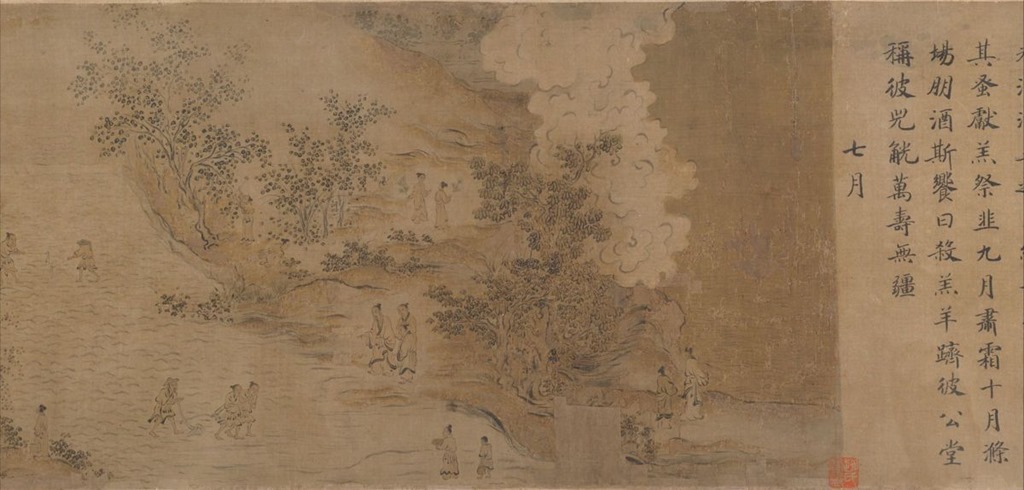
A mid 12th century Chinese scroll illustrating another plum poem in the Book of Odes


Someone first wrote, and likely sung, this poem nearly 3000 years ago in some southern province of China. Given that it’s another of the Odes  written in the voice of a woman, we may assume it was a woman. English translations I have read generally portray the speaker as a well-born eligible woman who is more or less saying “Hey suitors. I’m a catch. If you want to marry me, get your proposal in quickly.” A minority contrastingly represent the woman as being too picky, rejecting too many suitors, and in that view, she needs to stop fiddling around and choose. Either reading is interesting. At least on the face of it, it’s reflecting some (though likely upper-class) female empowerment in bronze-age China. But these are not the translations I used.

Here’s the text of the translation I used for my performance. It can be found all over the Internet, but more importantly and intimately, it was known by my wife who sent it to me.

ripe plums are falling

now there are only five

may a fine lover come for me

while there is still time


ripe plums are falling

now there are only three

may a fine lover come for me

while there is still time


ripe plums are falling

i gather them in a shallow basket

may a fine lover come for me

tell me his name

When I first posted my performance as “Wild Plums”  I didn’t know who did this translation, and despite several hours of reading and searching, I still don’t. Translators generally are attracted to and retain the poem’s litany of plums* decreasing in number, regardless of how they render the situation, but the outlook presented by this version is different. The woman has less agency, or at least in this matter of desire and longing over the course of the poem, she is willing to cede for the moment her power (other than hope). And that is one of the things lyric poetry allows: no one need expect that the moment of emotion or perception in a short lyric is a person’s whole thoughts and feelings on a matter, or themselves. We only ask that it shows us something vital that we wish to have shared between ourselves. As such, this version strikes a chord in our time and our culture.

I still don’t know who this translator is. I have a theory. If that writer didn’t write the translation herself, she popularized it, as I can find no references to this version of the ancient poem before Susan Sandler’s 1985 stage play and then screen play for the 1988 movie Crossing Delancey. Here’s how the poem was used in the movie:

I saw the movie when it came out, and I remember liking it. A different take on the RomCom formula.


The woman in this scene (played by Amy Irving) is the movie’s unmarried heroine, and the somewhat smarmy dreamboat across the table (Jeroen Krabbé) captures the heroine’s attention immediately with the personal resonance she feels with this version of the poem.

The person who posted the movie’s poetry scene on YouTube says the translation was by Arthur Waley, but I’ve already found other references to a completely different translation that begins “”Plop fall the plums; but there are still seven” by Waley. So, what’s my mystery translator theory? Could it be by Susan Sandler herself? If anyone knows, please give me info in the comments.

Well after all that, here’s my performance of this piece. If you haven’t heard it yet, the player is below.


*Poets and writers seem attracted to the plum when choosing their imagery. The wild plum is referenced elsewhere in the Book of Odes, and Horace, Laura Ingalls Wilder, James Joyce, Mary Oliver, and William Carlos Williams (meme-worthy, if non-wild, plums). I even decided to use wild plum blossoms in my own ode about my son.

Hollywood TV

Once more we visit a song from the Dave Moore-written song-cycle looking at the innovative goth/horror persona created by Maila Nurmi in 1953-54. Today’s piece “Hollywood TV”  continues Nurmi’s story as commerce finds a place for her Vampira character as it seeks to fill out the expanding television time slots.

In the 50s, the moving picture industry faced an existential crisis of its own: television was going to deliver its kind of entertainment right to people’s homes, no need to go to the theater, no need to pay admission, make your own popcorn, Philco Playhouse and chill.

One way the old entertainment empire sought to use the new TV medium was to sell rights to rebroadcast movies that had completed—sometimes, long-ago completed–their theatrical runs. One studio, Universal Pictures, wanted to monetize their classic horror pictures it had released back in the ‘20s, ‘30s, and ‘40s and so put together a package of these films for TV stations to buy and rebroadcast in 1956.

It’s hard to believe now, in an era when SciFi, Horror, and Fantasy are the dominant commercial film genres, that in the mid-50s these films were considered shoddy goods. They reflected back to 19th Century characters and tropes, even when they were made before WWII, and so they were not thought to be the stuff that a forward-looking post-war world was looking for.

But wait, we’re in 1953-54. Even this is still in the future.

Nurmi had created the Vampira costume for a Hollywood Halloween costume party in 1953, and the story goes this novel combination of sex and death was noticed there by an entertainment figure, through which she was eventually connected with a TV station looking to broadcast old movies. The TV execs thought such old-fashioned low-value fare needed something else to make it viable, a host to contextualize the old movies to be shown at night when such niche material could fill otherwise uncommercial air time.

So, in 1954, two years before the Universal “Shock Theater” package was offered, Vampira began hosting a show made up of old movies whose rights could be obtained on the cheap, with her character leavening the proceedings with quips and intentional perversity. This is an old show-business tactic, as even in vaudeville theater, a master of ceremonies might be called on to hype or explain the acts, or to fill time when a performer had dragged down the audience’s interest. And intentional perversity was decades old too, what with the Dada cabaret of the WWI years.

Even if this is recent history, in the lifetime of people still living, it’s hard to know how big the Vampira character’s impact was in her time. Her late-night show lasted about a year ending in 1955. A follow-up show with the character on another local station didn’t stick. During the years 1954-56, there was a substantial publicity push, a local Emmy nomination, a Life magazine profile, guest appearances in the Vampira persona on other TV shows; but there was the short run of the show, and a general tailing off of Nurmi’s celebrity and performance career afterward. How big were the waves in that ripple?

If we can’t see how big the first ripples are, we can see the waves that built off it, as they are substantial, and still rolling.

In 1956 came that Universal Pictures “Shock Theater”  package, eventually followed by “Creature Features” and others. Over the next decade, most major local TV markets gained a horror/SciFi host. The pattern was unmistakable. Costume. Macabre humor. Campy name. Maybe a little dry-ice fog, screeches and screams, and a haunted house décor. All parts of the Vampira scheme. What wasn’t copied? The Thanatos remained, however distanced by humor, but the Eros was toned way, way down, and the follow-on horror hosts were invariably male.

Shock Theater around the USA

It’s a boys club. Some of the horror hosts for “Shock Theater”  around the USA


In pop music, the erotic and self-possessed element of Vampira saw a revival by the late ‘70s with Poison Ivy and the Cramps, and in the UK, bands like Siouxsie and the Banshees. Eventually a goth subculture and “look” developed often borrowing from first or second level influences of the Vampira character with various continental European influences.

The Cramps

Poison Ivy of the Cramps substituted midriff & pychobilly riffs for Vampira’s décolletage and goth ennui


It took a generation from the ‘50s before the female TV horror host was revived in 1981, back again in Los Angeles, with a character, Elvira, largely based on an updated Vampira. Nurmi had helped with the creation of the show, but had a falling out with the producers.

By the end of the 20th Century, the Vampira character was still being kept alive by a wordless cameo in a widely viewed “Worst Movie of All Time” “Plan 9 from Outer Space.”  Irony wasn’t just a pose for the character, it was the way the character survived.

More irony: the mostly male ‘50s children who watched Vampira, Shock Theater, Creature Feature, and the other black and white movies rerun on TV at night past their bedtimes, had grown up and became the new Hollywood elite, making tens, and then hundreds of millions for a revived Hollywood, revising the tropes of the shoddy goods whose TV rights had been sold on the cheap.

If you take pre-Comics Code EC Comics attitude, the TV horror hosts, their old movies and modern descendants, add some bite-sized marketing from the candy merchants, and there you have modern American Halloween. If you walk by the rack of tacky vinyl and polyester costumes at the store, past the Star Wars characters in kid’s sizes, over to the adult-sized costumes, and there you see a “Sexy Vampire” hanging, black and low-cut, long, dark-haired wig included. A colored sheet suggests it worn by a thin young woman with red lipstick, white makeup and weaponized eyebrows. Think, then, of Maila Nurmi for Dave and me, won’t you.

Oh, there’s a song. Dave Moore wrote the words, I wrote the music and performed it. You can hear “Hollywood TV” using the player below. Click it. If You Dare!