Pig Cupid

Today we return to the early 20th Century Modernists with a piece using words by Mina Loy. Last post we had a poet taking a political stand: Longfellow aligning himself with the movement to abolish slavery. Decades later, the Modernists joined political movements too.

One might suppose that since Modernism sought to overthrow the old cultural order and revolutionize artistic expression that many Modernists would be attracted to political radicalism—and to a large degree that’s so.

You might also assume that these artistic radicals would be leftists, aligned with the growing Socialist movements in England and the United States, or attracted after 1917 to the as then untested promise of the new Communist government in Russia. Or perhaps they’d make common cause with anarchism. Or maybe they’d create their own playlist mixing all of the above.

And yes, you can find that. Carl Sandburg in the U. S. Midwest, most of the Surrealists, bohemians in New York’s Greenwich Village, Herbert Read and some other British Modernists.

However, one can also find Modernists who aligned with the right wing in this era—and not only garden-variety Tories, or even those who allied themselves with the “respectable” racist strains of U. S. politics. Even in the years before WWI, the social theories that would coalesce into Fascism found adherents in the new literary avant garde. As to Americans, the most famous case is the indispensable Modernist poet, editor and promotor, Ezra Pound, eventually charged with treason at the end of WWII.

Modernists seemed something like stem cells as their artistic revolution kicked off—they could develop into followers of any kind of political radicalism. At a time when political engagement for artists was common, there must have been a feeling in the air that a side must be chosen if one was to be a thorough-going cultural Modernist.

So, much as the French Surrealists once sought to make Communism a dictate for membership in the Surrealist movement, the slightly earlier Italian Futurists eventually made Fascism a core value of their artistic circle.

mina-loy

I love my baby, cause she does good sculptures, yeah!” The young Mina Loy

.

It’s now we get to Mina Loy. No, not the delightful Hollywood actress—that’s Myrna Loy (Myrna Loy was the stage name for the woman born Myrna Williams, and it’s just possible that Loy could have been chosen to refer to Mina).

It’s 1905. Modernism is kicking off first in the visual art world, followed just behind by the poets. Loy, in her 20s, has already done the visual art thing in London and Paris, but her marriage is failing, and she’s just had an infant child die. To change her life, she moves to Italy. She befriends Futurist artist Carlo Carra, and if you follow along on your Futurist score-card she had love-affairs there with two principals of Italian Futurism: F. T. Marinetti and Giovanni Papini.

Let’s re-set our scene. Here’s a young woman in a foreign country going through life stress events. The art-world is shifting under everyone’s feet. As a movement that will eventually fancy itself outright as the cultural well-spring of Italian Fascism, the circle she’s fallen in with isn’t just about making it new, it’s militaristic, paternalistic, nationalistic, and it worships violence. That isn’t what jealous opponents say about Futurism, it’s what its own manifestos brag about.
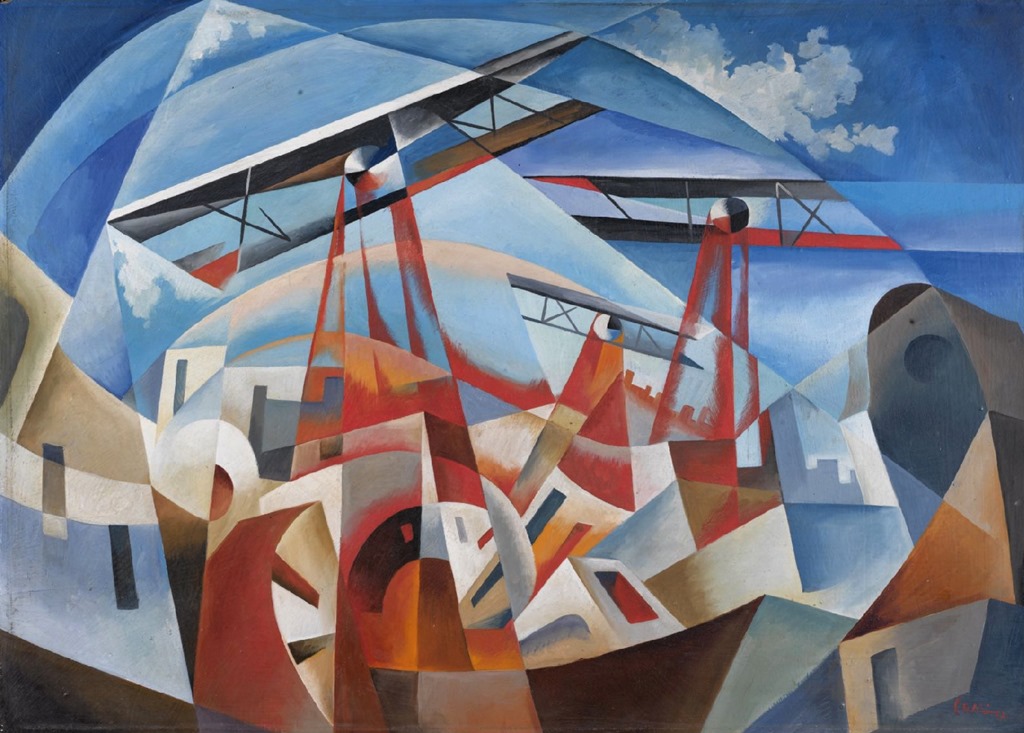
Tullio Crali - Bombardamento-aereo (1932)

Futurist war painting. Compare its outlook to Guernica or Flint’s poem “Zeppelins.
Marinetti’s Futurist Manifesto declared “We will glorify war—the world’s only hygiene”

.

As preparing actors say, all that would be part of the work to figure out what Mina Loy is experiencing. Here’s another bit of business you might grab onto: young, ambitious, male artists. I doubt some not-uncommon tropes have changed in that field.

What happens?

Mina becomes a poet. A fierce poet. Artistically she uses some of the new ideas that the Futurists are thinking about. Her poetry moves between time and tenses, voices and outlooks, in machine gun bursts. Conventional expression and sentiment? Blow them up, run them over with a locomotive. Sixty years later Harlan Ellison would write “Love is just sex misspelled” and be thought provocative. Mina had already been there in the horse-and-buggy era. How can a woman keep her selfhood (or for that matter, how can any human being do so) in the minefield of desire and relationships? What is deep and inherent in motherhood that society will not express openly?

Though she used some of the artistic ideas of Futurism as effectively as any writer, Loy seemed to resist most of its political ideas and she satirized the pretentions of the “Flabergasts” while writing about her Italian time as being in the “Lion’s Jaws.”  Leaving Italy, she next moved to New York, where she joined the Greenwich Village circle.

Today’s piece uses selections I took from a 34-poem sequence called “Songs to Johannes,”  inspired by the relationship with Giovanni Papini (Johannes and Giovanni are variations of the same root name). Loy published these in 1914, near the end of her Italian time. Within the little-magazine world of Modernism she made an immediate impact. Eliot, Pound, William Carlos Williams, and Gertrude Stein said good things about her work. Legendary founder of Poetry magazine Harriet Monroe seems to have been scared by Loy’s frankness. Amy Lowell, poet and influential anthologist, was so put off she is supposed to have said that she would not publish in any magazine that printed Loy.

If the patriarchy may have lost the battle with Mina Loy, for a long time they seem to have won the peace. It was only in the last few years of the 20th Century that Loy’s poems of the first part of that century began to be looked at again. Now, Loy has become a key poetic Modernist for literary scholars tired of the usual sausage-fest, but that opens up the danger that work like “Songs to Johannes”  may be introduced, academically, like this: “Loy in effect diagnoses an end to love poetry in the light of historical circumstance, anticipating that poststructuralist line of inquiry which urges a rereading of ‘lyric’ as a culturally responsive construct. Instead, her poetry constitutes a critique of the very demand that lyric expression be viewed apart from the social world.”

There’s nothing wrong with that view, but I find Loy’s pre-WWI writing here a lot more immediate assuming one has some applicable life experience to bring to it. Her diction sometimes reminds me of Emily Dickinson, and like Dickinson figuring out what is ironic, and what is earnest, and what is both, can sometimes be a challenge. In performance, any of those three choices seem to work for most phrases here. The greatest error would be to make them all of the same tenor. Also, like Dickinson, Loy will move from speaking concise abstraction to vivid metaphor using very few words. Thus, the high minded and the sensual nitty-gritty are juxtaposed.

My appreciation for this sequence grew tremendously as I constructed this performance. There are strong images, richly ambiguous expressions, and yes, lines that one could deconstruct at thesis length. I didn’t even have room to include the phrase from “Songs to Johannes”  that I’ve chosen to title today’s selection, but I can never look at a plump rococo cherub again without recalling it. But the real gift I got, the unique gift of art, is that I could experience some of Loy’s moments in the hot-house nexus of Fascism and Modernism.  “Pig Cupid”  would probably be more authentic if this was performed in a woman’s voice, but alas my voice is what I have available today. To hear my performance, you use the player below if your reader displays it, or this highlighted hyperlink will also play it.

The Witnesses

A couple of posts ago as I presented a piece using words by American poet Henry Wadsworth Longfellow, I mentioned that his prestige has fallen greatly.

How far? His Wikipedia article shares some snark:

Longfellow was minor and derivative in every way throughout his career…nothing more than a hack imitator of the English Romantics.”

“Who, except wretched schoolchildren, now reads Longfellow.”

And Lewis Mumford sums up his significance with a dagger by declaring that Longfellow could be completely removed from the history of literature without much effect.

Furthermore, while there’s no modern bon mot to extract from the Wiki, Longfellow’s didacticism, a huge defect if detected in modern poets, is noted. Even during his lifetime, that rankled the Transcendentalists, always looking for the more inexplicable sublime.

Akin to one our Parlando Project principles, Longfellow took the idea of “other people’s stories” to what are now considered ridiculous lengths. Instead of writing of intense internal experiences as Emily Dickinson did, or expanding the fleshy personal into a democratic universal as Whitman did, Longfellow wrote about many cultures and translated poetry from many languages. The term “cultural appropriation” didn’t exist as such then, but Longfellow could easily be charged with it. His best-known epic poem, Hiawatha,  which has left its imprint all over my own region’s place names, is an earnest and non-hateful mishmash of the mid-19th century’s limited knowledge of indigenous Americans mixed with some contemporary to the time German romanticism. Longfellow would be a cultural criminal if he hadn’t already been reduced to a laughingstock.

OK, so what. All of these charges are true, but here’s what they leave out. To say Longfellow was “an American poet” is like saying Elvis Presley was a rock’n’roll singer. He proved that could be a thing, that an “American poet,” could connect successfully with a wide audience. He imitated Europeans and English romantics. Yes. Who the hell else was there to imitate? He wasn’t as original as Dickinson or Whitman. Yes, and neither is most any other poet you could name, now or then. And Mumford’s dagger? Alas, that can be said of most writers, because literature is a vast swarm of similar literary genetic ideas, but if there wasn’t a Longfellow, someone else would have to establish the idea of a popular American poet. That alternate-history someone else might have been good or bad, but it likely would have lead to some difference, even if the difference would be some other writer to rebel against.

I too wish Longfellow had tempered his didacticism, even if that is a large part of what made it possible for him to succeed. Most Victorian poets suffered from this as well, and it’s part of what the Modernists sought to break free from. To the degree that we are now Post-Modern, we can reassess this. Can poetry stand for something and still be art? If that is difficult to do, should it still be attempted?

Today’s piece is an example of Longfellow seeking to instruct, and the charge of cultural appropriation could be leveled at it too. In 1842, as opposition to slavery started to gather force in the United States, Longfellow wrote a short collection of poems on the “issue”—yes, human slavery, for and against, it was a debate. Longfellow explicitly released this collection for publication and distribution in support of the anti-slavery cause.

The Zong Atrocity

The obscenity of human jetsam. I learned about the Zong case only this year while traveling in Britain.


“The Witnesses”  is from that collection. In it I think Longfellow transcends propaganda for this noble cause and demonstrates his effectiveness as a poet. He audaciously takes the notorious Middle Passage of over-sea slave shipment as his subject here. Though those travails were not his personal experience, the obscene losses at sea in the shipment of chained-up human beings is portrayed. I chose to further highlight Longfellow’s concluding phrase to all this. “We are the witnesses!” he writes, as the still shackled skeletons speak in his poem—but of course, un-romantically, their remains cannot speak. The poet, the reader, the performer, the listener, are the real witnesses here.

A short note. Wouldn’t you know it, after spending a good part of this year exploring the early 20th Century Modernists, I now have been using 18th and 19th Century sources more this summer. One of my favorite blogs, My Year in 1918 recently noted how I was tackling those WWI-era writers with my musical pieces for her readers who might want to sample that.

Well, I’ll return to those literary Modernists soon. After all, a principle here is to try to mix things up, to not be predictable or to always rely on my established favorites. But even today, I think I’ve been tipping my hat to another key early 20th Century American Modernist. As I was writing and performing the music for “The Witnesses,”  with its variations on folk-style melodies that twisted between strains and finished with a louder cadence that didn’t resolve the multiplicity, I asked myself “Where’d that come from?” Early this morning it occurred to me: the composer Charles Ives, who was working at almost the same time as those literary figures. If he had access to an electric guitar he could have been Frank Zappa.

Once more I’ll break with my usual practice and apologize that I don’t feel I’ve fully realized this audio piece, mostly because it really should be performed with a number of featured voices and a chorus. While my computer and inexpensive collection of “virtual instruments” lets me reasonably realize a large number of instruments, it cannot represent vocal works very well. Go ahead and listen anyway, and if you can listen on speakers instead of earphones, crank the volume a bit.


The Most Popular Parlando Project Piece for Spring 2018

I’ve already mentioned in this count-down that I’m sometimes surprised at what Parlando Project pieces are the most listened to. It’s not just that it isn’t always the best-known poems, a surprise factor that I’ve already mentioned, but that it sometimes isn’t a performance that I think I pulled off well.

Such is the case with the repeat number one in this countdown covering activity this past spring: Fenton Johnson’s “The Banjo Player.”  My personal discovery of Fenton Johnson goes back to reading James Weldon Johnson’s 1922 anthology The Book of American Negro Poetry.  Fenton Johnson’s work included there immediately stood out for me in its range of expression, from the hymn-like “God Is In the All Time”  through the startling confrontation of spirituality with reality in “A Dream,” to the frank and compressed expression of despair in “Tired.” I vowed to do my best to present Johnson’s range here.

Fenton Johnson

Fenton Johnson

Which lead me to perform “The Banjo Player.”  It’s frankly a humorous piece, though if one pauses after the laugh, there is a serious point being made. Explaining jokes always risks creating more comedy, but the serious point embedded in the joke here is that the banjo playing songster in the poem knows something of his value, but he still feels like he’s a failure because an otherwise uncharacterized woman called him a troubadour, and he’s not even sure if that’s a compliment.

That problematic name for the banjo player is the only way we can characterize that woman who spoke it. Is she, like Fenton Johnson himself, a member of the Talented Tenth, Afro-Americans who had gone to college and who had been charged in the early part of the 20th Century to “raise” the race with their achievements? Or is she a white Modernist admirer of para-literary poetry? We can’t say for sure, and since either is meaningful, the poem works either way; but I lean to the later if only for the word she used.

As so often with Modernism, you can trace something back to Ezra Pound. Just as the Pre-Raphaelites before him, or some hipsters today, Pound looked to the past to find models for a changed, modern future. One source he used was classical Chinese and Japanese poetry, but another was medieval European troubadour poetry.

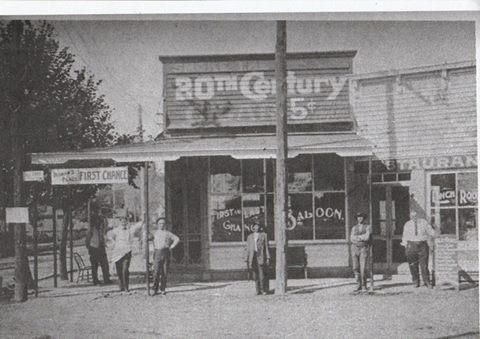
So even at his lightest, Fenton Johnson makes a sophisticated point here, one that he reinforces by using a location, “The Last Chance Saloon,” in both “The Banjo Player” and his now most-anthologized poem, “Tired.”  In the former it’s a place of some solace, in the later it’s the place were the absence of dignity is numbed.

Returning from those more important points to my issues with my performance of “The Banjo Player.”  I tried to cop a little of that Afro-American banjo tradition. It just seemed the inescapable choice for this. I think I failed, if only because I’m not a banjo player. Such things may be inevitable with the production schedule I’ve practiced with the Parlando Project this past couple of years (something I’ll talk about soon), but to be honest, I’m slightly embarrassed that this piece is listened to so much.

But that’s because of me, not Fenton Johnson. Below is the gadget for my performance of “The Banjo Player,”  but consider listening to some of the other pieces I’ve presented using the words of Fenton Johnson too.

Union Square

Last month when I dropped Sara Teasdale’s “I Shall Not Care”  hurriedly, I promised I’d return to Teasdale and say a bit more about her.

I’m not sure where Teasdale is in “The Canon” of modern verse now, but back when I was in college, she was even more left-out than Edna St. Vincent Millay, and for similar reasons. Teasdale and Millay were both contemporaries of the pioneering early 20th Century Modernists, both were published in their little magazines, received prestigious literary awards, and achieved a considerable readership in an era when page poetry had a more general readership.

But such status didn’t hold. As the 20th Century wore on, and High Modernism and academic-informed writing became the predominant style, Teasdale, like Millay didn’t seem to have the gravitas High Modernism required—after all, both wrote often about love and desire, a subject that if treated directly wasn’t thought serious enough. You know, “women’s stuff.”

If you’re getting the idea that by mid-century, Modernism was a bit of a boy’s club—well, yes, it was.

Teasdale had all of Millay’s problems with the curators of Modernism, and then some. Millay could write in the more modern style as well as engaging in somewhat old-fashioned-sounding sonnets. Teasdale was more adamantly a writer of metrical, rhymed lyrics that increasingly didn’t sound modern enough. Millay herself was a fiercely modern woman whose persona contrasted against any Victorian trappings in her poetic music, while Teasdale seemed less sure of herself. A typical no-win-situation for female poets by mid-century: assertiveness or originality couldn’t overcome the patriarchal attitudes—while submissiveness and reticence guaranteed its victory.

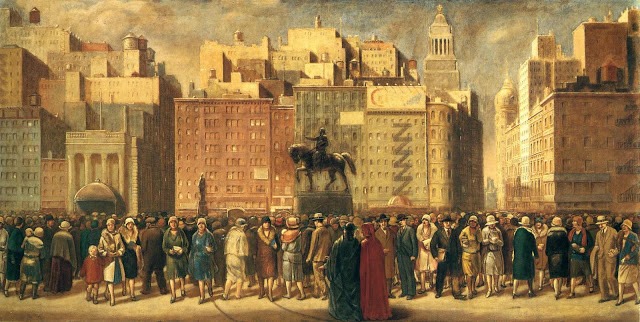
We’re decades past all that now, and we have a new century well underway. Today, it may seem like less of a crime for Teasdale to use the poetic music of 1875 instead of 1925 in this poem written around 1911. Publishing a poem like “Union Square”  would have not caused Millay any second thoughts, but Teasdale went back and forth on that. In a fascinating run-down of Teasdale’s own doubts about the poem, Melissa Girard recounts early readers giving feedback like “Perhaps it is better, after all, to pursue the lovelier side of existence, and only give expression to what is unmarred in the realm of beauty.” And bizarrely, even after publishing it, Teasdale suggested “If the idea at the end of ‘Union Square’  had not been an accident suggested by rhyme, I should never have said what I said.” Say what? One of the beneficial side-effects of rhyme is that the search for it can work like Surrealist and automatic-writing techniques to jolt the mind’s search for language in directions it might not otherwise go—but none of the lines in “Union Square”  where the poem’s speaker compares herself to the streetwalking prostitutes are rhyming lines.

isabel-bishop-virgil-and-dante-in-union-square-1932

Looking for early 20th Century pictures of Union Square I discovered a remarkable painter Isabel Bishop

I found it impossible not to sing this poem when presenting it, the poetry just demands it, even if the poem’s persona is expressing constraint. I think that contrast is what makes this poem, and Teasdale, worth considering. To hear my performance of Sara Teasdale’s “Union Square,”  use the player gadget below.

Millay’s Spring

Yesterday’s Edward Thomas poem “Thaw”  had an irony, he had rooks, a bird used symbolically to represent death, as messengers of Spring’s arrival. Walt Whitman ironically used early spring flowers to start his Lincoln elegy, and T. S. Eliot in “The Waste Land,”  a long poem that we’ve been performing this April for National Poetry Month, followed flowered suit. Here’s a poem by Edna St. Vincent Millay that tackles some of the same tensions that Eliot put in in his longer poem, but in just a few lines.

“Spring”  is Millay at her most Modernist. It’s free-verse, not the metrical verse, often in traditional forms, that she used elsewhere. Is she copying Eliot’s landmark poem, as many would try to later? No, “Spring”  was published in 1921, a year before “The Waste Land.”

One of the good things about doing this project is moving from looking for poems to use, selecting them, and then one-by-one grappling with how to perform and accompany them with music. This poem is so full of complex, multivalent perceptions that I think I could perform it many different ways. Because of the production schedule I’ve set for myself here, I almost never spend more than a week on the production of any one piece. That means I must decide things about the composition and presentation fast. In the absence of limits, this piece could have gone on in search of a more perfect version. I’m comfortable with many of the choices I made here, but one bothers me still.

I decided early on I would sing this one. That decision came from the text itself, it wants to express a variety of things intensely. Good actors (something I’m not, or not yet) can put great shading on a speaking voice, but the singing voice has more tools to bring to the expression of a text. I am under no illusion that my singing voice is strong or skilled, and I think a better singer could improve this. What you hear here is simply my honest attempt to do the best I could with a text that I grew to admire considerably as I worked with it.

Musically I once more found myself using several tracks of Mellotron, the primitive 1960s tape-sample “virtual instrument” before it’s time. The topline melody is carried by violins and the famous Mellotron flute samples that are an audio madeleine for anyone who listened to certain English bands in the age of groovy. Each note played on a Mellotron keyboard sets running a short length of tape playing that pitch recorded from the “real” instrument.


Some random dude shows off the cheesy rhythm machine no one used before playing something you may recognize.


I can’t afford the cost and complexity of an actual Mellotron, but I use a good approximation issued by MOTU a few years back. One thing I perversely appreciate about it is that, just like the real thing, any note just stops after 8 seconds, when the strip of tape in an actual Mellotron would come to its end. Avoiding this can force you into some odd playing techniques when used in a slower tempo piece. If you listen very closely in “Spring”,  I just let that abrupt tape end-stop happen for effect several times. For a sustaining note to end like that gives it a catch-in-the breath gasp effect.


For electro-mechanical nerds: the low down on how the real Mellotron worked, mostly.


One image in Millay’s poem puzzled me over the week I worked on it. “Life in itself is nothing…a flight of uncarpeted stairs.” I can find no one who has made any sense of it. The best I can figure out, knowing houses from Millay’s time first hand, is that while any stairs between floors of a properly furnished home would have likely had carpet runners, utilitarian stairs, such as ones to the basement would not be carpeted. I took that understanding, and had the melody fall down as the word “stairs” is sung.

Anyway, after all this talk about the utilitarian work of making these pieces, please take time to listen to Edna St. Vincent Millay’s “Spring,”  using the player below.


Conlon Nancarrow

A great deal of what you hear me play here is made possible by a 1983 invention, MIDI (Musical Instrument Digital Interface), a standard for communicating musical commands. MIDI lets me create piano parts I can’t play with my non-pianist fingers. I tell MIDI what to play, and MIDI then instantly responds by playing those notes on an instrument so I can see if they fit.

Given MIDI, I as the composer can have the equivalent of a pair or more of pianists willing to play as simply or complexly as I want them to, and not only are my MIDI pianists totally compliant, they can be preternaturally skilled as well, willing to play odd rhythmic displacements or impossible fingerings.

In the years between WWI and WWII, a young musician of no great wealth or social background was studying composition in Boston. He was said to have crossed paths with some of the giants of 20th Century music there, including Walter Piston, whose Harmony  book I once started many decades ago, and Nicolas Slonimsky whose book on scales later became a huge influence on John Coltrane and Frank Zappa.

However, the titanic forces of world events would soon sweep him away from all this. In the 1930s he joined the Abraham Lincoln Brigade, Americans who volunteered to fight the Fascist forces seeking to overthrow a republic in Spain during a war that served as a beta-test for World War II. This was a complex event, but all we need to know for our young man is that the anti-Fascist coalition was defeated, and the survivors who had fought for the Spanish Republic ended up as men without a country.

Earlier this year I was reading some 1939 writing by Herbert Read where he was appealing for support for a plan to transport these Spanish war survivors from French refugee camps to Latin America. Our young man, who’d hobnobbed with key musical theorists before becoming a “premature anti-Fascist,” soon found himself in Mexico City, perhaps as a result of this plan.

It was there our exiled young man took a technological step as a composer. He chose to write his music using “player pianos.” Player pianos, also called “reproducing pianos,” were a home entertainment fad from the era before better quality electronic recordings. An elaborate clockwork rolled a scroll of punched paper across mechanical sensors inside the piano which then drove the hammers to strike the piano strings. Scrolls of piano music, some recorded and played by the famous performers of the early 20th Century could be purchased, and when inserted into the home player piano, and played back with musical fidelity.

Our young man’s name was Conlon Nancarrow. Over the next few decades he exploited the player piano, not for parlor entertainment, but to create striking Modernist music of otherwise unplayable complexity. He was hip to new varieties of rhythm and harmony not only from other 20th Century “serious composers,” but from Jazz too—and the mathematical structures of Bach-like cannons were well suited to the looping scrolls he would punch himself. He wasn’t reproducing music someone played, he was producing music he conceived and punched into the controlling scrolls.

In the first few decades of his work Nancarrow had no funds, no grants, no copyist/assistants, no local orchestral resources to realize his musical ideas; but this one artist, a player piano, and his own score-roll punching could produce work needing only himself and his ideas to sound inside his small Mexican apartment.

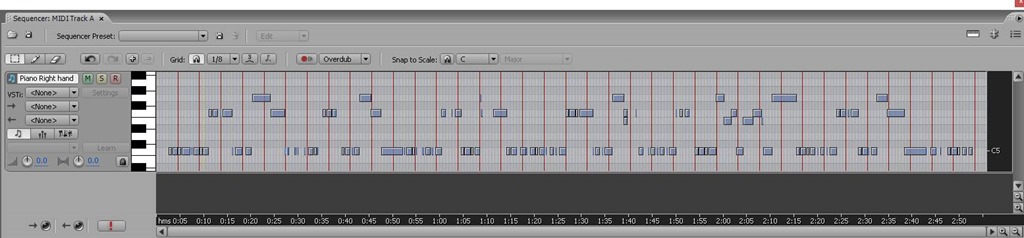
Except for it’s painstaking, mechanical, cuckoo-clock handwork, what Nancarrow did is schematically like how one can use MIDI today. In a tip to this heritage, MIDI scores are still shown on the lit-up computer screen like player piano scrolls.

Nancarrow Piano Part MIDI score

“Stuck in holes which once were dots”
One of the piano parts for today’s piece shown in MIDI “piano roll” notation


In 1969, using the high-fidelity home entertainment media of its age, an LP record of Nancarrow’s works was issued on a major, well-distributed record label (Columbia, the record company of Miles Davis, Bob Dylan, and Gary Puckett and the Union Gap). That’s when I first heard him. Acclaim in avant-garde music circles, and some grants and touring followed until his death in 1997.

In some ways the typical Nancarrow piece sounds like an artist who when finding out the vast capabilities of his new technology decides to use all of them. At once. A lot. Typical tempos sound like someone playing a recording at the wrong speed—and backwards. The number of simultaneous notes can be overwhelming, the intervals jarring, the rhythms insane. It’s challenging you to understand it, and it’s not a matter if you want to, you likely cannot. As with some avant-garde music, repeated listening (if one allows it) can increase comprehension of the ideas, but Nancarrow is never going to be shoving Billy Joel off the piano bench in popularity.


“Punched polyphony in a row” A Nancarrow scroll plays.


No, the reason I wrote this to celebrate Nancarrow isn’t because I think you’ll like his music, or even because he’d figure in any Desert Island Discs episode in my future (though through castaway days one might find the time to try to untie all the knotted ideas in a Nancarrow piece). No, it’s because I admire that kind of audacity and perseverance.

I originally wrote music of an acoustic guitar “folk song” sort, even though the poem sought to make use of eccentric meters and a tricky rhyme scheme to reference some of Nancarrow’s ideas. Today’s version has new music I wrote which fits the words better. Using MIDI-controlled pianos, it’s sort of “Nancarrow-lite” musically. To hear my audio piece for “Conlon Nancarrow,”  use the player below.


The Poplar

We’ve already met most of the small circle of poetic Modernists that assembled itself in London before World War I. From the United States, H. D. (Hilda Doolittle) and her one-time fiancé Ezra Pound; and from England, the combative and influential T. E. Hulme, and the risen from poverty F. S. Flint. Other poets, William Butler Yeats, T. S. Eliot and Robert Frost, touched them tangent in England, but were still bent with the gravity of what Flint called, and Pound promoted, as Imagism. If you’re new here, you can check our archives (now almost 200 audio pieces) and you’ll find all of them represented.

Today we use the words of the man we’ve left out, Richard Aldington. Another Englishman, he married the American H. D. in 1913. He worked with Pound to promote T. S. Eliot. Unlike T. E. Hulme, he survived WWI, but many said his combat experience changed Aldington, and retroactively the diagnosis of PTSD has been associated with him.

His long career had more than a few bridge-burning episodes, all disputes which I know not enough to have an opinion on. Partially because of this, Aldington is not well-remembered as a poet, even though at the start of the Imagist movement he was universally considered a principal.

Richard Aldington in sweater

Aldington, wearing an example of regrettable fashions of the early 20th Century


Like his partner H. D., Aldington looked to, and translated, classical Greek poetry; and like Pound he was fascinated by Chinese and Japanese compressed poetic forms, and produced work connected with these traditions. Today’s piece, “The Poplar”  isn’t one of those poems. In some ways “The Poplar”  reminds me of F. S. Flint (that other too often forgotten early English Modernist), as it’s free verse in Flint’s “unrhymed cadences” mode. It’s blissfully easy to read. It’s homey and unfussy images remind me of T. E. Hulme. It’s odd now that we think of Modernist poetry as requiring obtuse and learned images, when it’s founders like Hulme and Aldington in this poem have no images that wouldn’t be clear to a grade-school student.

Musically, today’s piece has a core guitar part that I played on a small acoustic guitar I’ve owned for 35 years now, but instead of “real strings” (which in my case would be “virtual instruments” where various notes and articulations of actual acoustic string instruments are sampled and then played by a keyboard or a guitar MIDI controller) I used a virtual instrument which sampled a 1970’s vintage keyboard “strings” instrument. I feel the dual falsity of this instrument, a simulation of a simulation, produces something that has its own validity. I also wanted to use a harmonium, but I don’t have that available as a real instrument or a sampled one. The closest I could come was a slightly modified “toy organ” patch which had some of the wheezy reed timbre I wanted.

Enjoy “The Poplar”  by using the player below. Even though it’s from the dawn of modern English poetry, it remains fresh because it’s not that well-known; and it doesn’t ask you to enter some dimly-lit labyrinth of images you cannot decipher. Yes, elusive images can have their pleasures, but so do these.


Tired

I’m going to close out our investigation into the little-known early 20th Century Chicago Modernist poet Fenton Johnson with one of his most emotionally moving poems. James Weldon Johnson first included “Tired”  in his “Book of American Negro Poetry”  in 1922, and it has been anthologized several times since. “Tired”  remains the poem of Fenton Johnson’s that one finds most often shared on the Internet today.

You can see why. Only a few beats in, that powerful line is spoken: “I am tired of building up somebody else’s civilization.” It may take no more than that line alone to have some tag Fenton Johnson as the first radical Afro-American poet.

I cannot categorically disagree there. I know little about Johnson’s political views, and though the two short-lived magazines he founded before 1920 are said to have included political philosophy, I know nothing of the particular stances he took or supported. At least at the time (the first two decades of the 20th Century) “Tired”  along with a few other of Johnson’s poems caused some Black cultural critics to remark that Johnson was too pessimistic, too given over to despair. You might find that strange, but in that moment, there was a feeling that educational and cultural uplift could soon raise the Afro-Americans along with the time’s large and wide immigrant demographics into a new, more accepting America. We know now that didn’t happen, that indeed 20th Century racism and poverty had some mighty blows to land on America and American Blacks with KKK branded racism, Great Depression poverty, and world-wide Fascism—but at the time, that uplift was what many Afro-American elites were pulling for.

However, just by going on what Fenton Johnson poetry I have available to me, I’m not entirely sure Johnson was, at this time, a political radical or a thorough pessimist.

Last Chance Saloon

Somebody give me my gin.” Mike is out back serving warm gin to ladies.

After all, the speaker in “Tired”  is not Johnson himself, no more than the banjo player in our last post’s poem is Johnson, the middle-class raised, college educated man. Even the Last Chance Saloon, where the banjo player played for tips, returns in “Tired”.  Johnson didn’t live in a shanty, he wasn’t married to a laundress.

True, this is a character that Johnson wants us to hear, an important voice that maybe even the Black “Talented Tenth” wasn’t listening to then, much less White America. And though it’s free verse, this is a poem, not an incisive political analysis or program. It’s a dramatic speech with rhythm, repetition, and a rise in despair from gin-houses to the stars.

It’s not hard for me to see in “Tired”  the ancestor of August Wilson’s great play cycle, or the range of characters and voices in Walter Mosely’s detective fiction.

Musically I stepped at least as many decades into the future here, concluding this audio piece with a short burst of the kind of free jazz that allied itself with the Black Arts movement in the later part of the 20th Century. I’ll allow that this music is an acquired taste, but at its core is an ethic of allowing individual voices and modes of expression even in a group context. Free Jazz is not always as raucous as what I played for this, but it does not forbid it either. That’s consistent with what I try to do (within my limits as a musician) with the Parlando Project. When I say we combine words with various music, I mean it.

That does mean that you may not like all the writers’ words I present, or all the kinds of music I write and play to combine with those words, but it means that I’m also not going to stick with one thing and repeat it until we are both tired of it.

I’ve ordered these last four posts here on Fenton Johnson purposely, so to present the man more in full, and because, to be honest, I didn’t feel I could earn any license to speak these words without doing something more than just putting them in my mouth. To listen to Johnson’s “Tired”  as I performed it, you can use the player below where it appears, or this highlighted hyperlink.

A Dream

Here’s a second poem by Afro-American Modernist poet Fenton Johnson. Like the first piece of Johnson’s that I presented earlier this week, there’s a religious element, but it’s handled this time with a remarkable framing device.

As published in 1921, “A Dream”  is the longer of two pieces which are grouped together as “Two Negro Spirituals.”  What strikes me about them is the extraordinary knife-edge irony held in them between spirituality and reality. If the Language Poets descended from the Modernists will not find in “A Dream”  the novel uses of language and syntax they look for, perhaps the Post-Modernists will appreciate Johnson’s conveying a vivid religious vision framed in a way that causes a reassessment of the foreground material.

That’s more critical theory and bin-labeling that I usually engage in, so let’s move away from that to the piece itself.

Elijah and the angel with a firey chariot

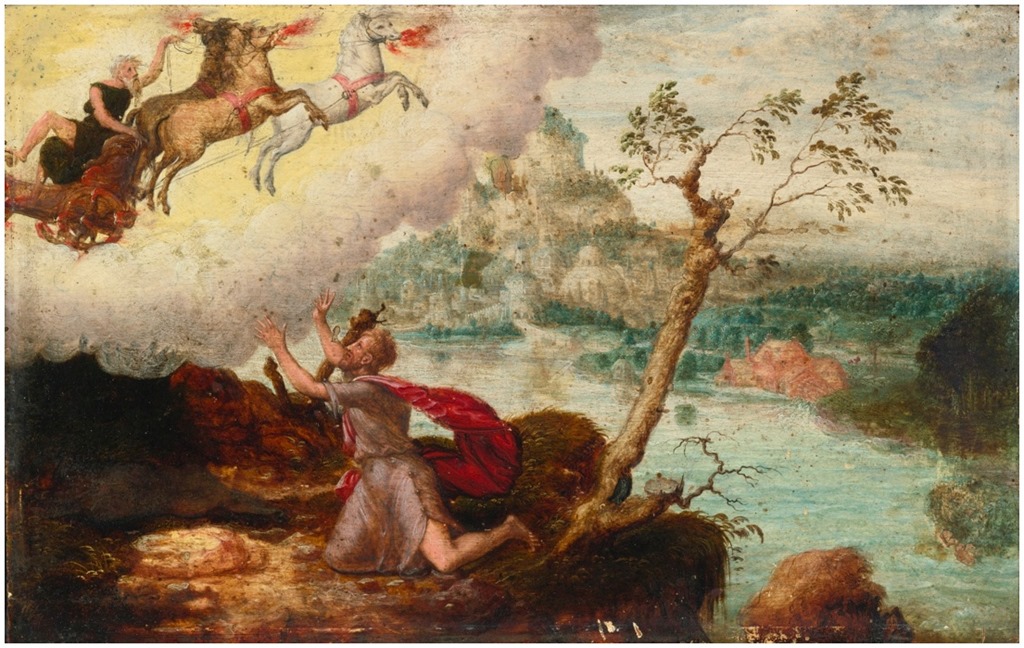
Elijah’s angel-fire chariot. Be sure your seatback is in the upright and locked position.

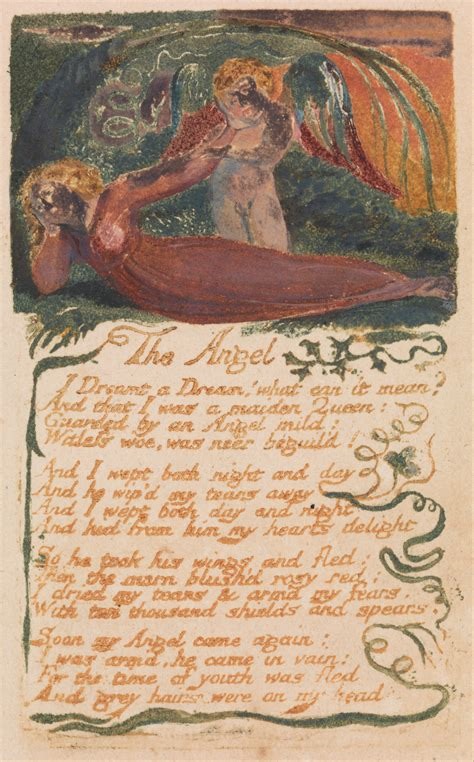
Is this texturally a “Negro spiritual?” Not really, though Johnson significantly chooses to call it that. The vision he presents, after a brief “Oh, my honey” aside, would not seem out of place in William Blake or any of a number of 18th to 20th Century Christian revivalists. The “spirituals” of the title were largely folk hymns, and the language here is more literary. Johnson wants us to know it’s an Afro-American who’s speaking, yes; but also, a man who could read and know these non-folklore sources. Yet, the recounting of the titular dream is not a scholastic catalog of mystical religious elements, it’s a deeply felt vision of a glorious reward. One does not need to be a Christian to feel the ecstasy of this vision, any more than one needs to fully understand all of Blake’s idiosyncratic religious precepts to sense their “thereness.”

William Blake The Angel

Like Fenton Johnson, William Blake frames an angelic vision

Johnson concludes the poem with a single line of a contrasting vision that recasts all that has come before it. Listen to the piece with the player below to hear it as it occurs.

Musically, this piece caused me all kinds of trouble, and, to be frank, I don’t think I got all the way to what I wanted to achieve. The difficulties of being my own composer, arranger, reader, ensemble of musicians and recording engineer should cause this kind of trouble more often than it does. However, I did so want to continue to present the things that this too-little-known poet Fenton Johnson did, that I have “called time” on this piece, and present it here now for you to listen to. Use the player below to hear it if you see that, or if not, this highlighted hyperlink will also play it.
Mirabeau Bridge

Earlier this month I announced that my performance of Tristan Tzara’s The Death of Apollinaire”  was the most popular piece here last fall. Seeing this, it’s past time to present a poem by Guillaume Apollinaire himself.

If one was to draw a graphical map of the French Modernists of the early 20th Century, corresponding to the English-speaking ones we’ve been talking about a lot here, Apollinaire would be at a central place like Ezra Pound. Apollinaire knew everybody, he influenced everybody; as a critic, he wrote about everybody. Although, like Pound, he held strong opinions about what a more modern art needed, what little I know about how he was experienced as a living artist says that he was also loved by most everybody that he met as well.

Like Tristan Tzara he was an example of a European, though his work was centered in Paris and he wrote largely in French. His mother’s family was Polish or Belarussian, depending on where the borders were drawn at any one time. His father’s background was never definitively known. Born likely in Italy, he had traveled and spent time in several countries, and spoke several languages, before settling in Paris before he was 20.

Portrait of Guillaume Apollinarie by Picasso

“Don’t you be L7!” Picasso’s cubist portrait of Apollinaire

In the visual arts, he invented the word Cubism, and he also was the first to call his work Surrealist. He knew modernists in music, like Satie. He knew the young artists, like Picasso, Chagall, Henri Roussseau. Dadaists considered him an influence and a co-conspirator.

In 1913 he published his best-known collection of poetry “Alcools”  (Alcool is the French word for alcohol). In it, Apollinaire set out his direction in modern poetry, using various forms, often imbued with contemporary colloquial speech and connections to modern technology and urban life. One tic he adopted in “Alcools:”  he dropped the punctuation from his poetry, emphasizing the flow of his words, an effect that could be seen as presaging a modern rapper’s unstoppable flow.

Am I guessing at that? It just so happens, I’m not. On Christmas Eve in 1913, Apollinaire was recorded reading one of the poems from “Alcools:” “Le Pont Mirabeau”  (Mirabeau Bridge), and that recording, encrusted though it is with the scratch and noise of time, survives.

So, today’s piece, with my music and my English translation of his words, leads off with Apollinaire’s own reading of his poem in French.

1280px-Apollinaire_Sous_le_pont_Mirabeau

Mirabeau was the longest bridge in Paris when it was built using using new steel-reinforced methods in 1893.

Translating “Mirabeau Bridge”  was a challenge. Having heard and been transfixed by Apollinaire’s intensely rhymed and recited version, I had to bend my usual translation approach, which skips any attempt to keep the original “music” (the rhyme and meter) of the poem. And as I look at the many attempts to translate this poem to English, I see most tried to at least rhyme it. The Pogues used a rhymed English translation for a nice sung version a few years back.

As I approached “Mirabeau Bridge,”  I whined to my wife: “Richard F’ing Wilbur tried to translate this, and his  version is awkward—and Wilbur’s a master of poetics!”

Why do I usually skip trying to rhyme-up translations? It adds a great deal of difficulty to conveying the poem adequately. It almost always leads to awkward English, particularly when you try to follow a rhyme scheme from the French, with many more words that rhyme, using English, whose poetic tradition did not grow out of rhyming. Having been influenced by French poetry at an early age, when trying for similar effects I often use a variety of imperfect and near-rhymes, something an audience may accept or find grating, depending on their tastes, and that’s what I did here, along with a free and not regular rhyming scheme.

Give a listen. Consider it a trip-hop battle between Apollinaire and myself. Respect to Apollinaire. Can’t bust his moves.