Just suppose that back in the 1920s someone wanted to record a Blues song based on Emily Dickinson’s “A Soul selects her own Society,” and so they waxed a 78 rpm platter at Paramount records “New York Recording Laboratories,” located back then in, well, Wisconsin.*
If they did, it might sound a little like this.
We offer this sort of nonsense as part of our celebration of National Poetry Month. Then again, maybe it’s not nonsense. Dickinson’s poem does fit into “Old Weird America” and its music shockingly well. Why’s that?
As best as can be determined, Dickinson wrote “A Soul selects her own Society” during her highly-productive mid-19th century, but for a variety of reasons, this poem, like almost all the other poems that she wrote, wasn’t published until near the end of that century. Somewhat “regularized,” Dickinson’s poetry was bound then into book-length collections that sold well for poetry by an otherwise unknown author, partly due to the myth of her eccentric later-life used as hype for the verse, and because some of her poetry was disarmingly informal and approachable — at least on the surface.
Literary poetry gradually began to take notice of her. I presented Sandburg’s audacious mention of her in 1914 as an “Imagist” earlier this month, and over the course of the 20th century her work has eventually been judged as important as Whitman’s in presaging 20th century Modernism. Now, I daresay that if one was to survey living poets in 21st century America for what 19th century American poet they read, admire, and use as an influence, Dickinson would beat out Whitman — and those two would leave the rest of the field far arrears.
What else happened around the beginning of the 20th century, but took serious critics and culture a while to notice? Afro-American secular music — Blues and Jazz — which would come to significantly define American music internationally and become the dominant strain of our country’s music ever since. Americans were highly important in English language poetic Modernism.** Afro-Americans had their Modernist revolution to offer too, and a great deal was musical in this era.***
So, in another way, this unlikely pairing of Dickinson and Blues isn’t as odd as it seems.
Three ways to hear this performance of speculative fiction: a graphical player is below for a portion of you, but if your way of reading this blog doesn’t show that, this highlighted link will also do the job.And the new lyric videos we’re doing this month is the third way to hear “Soul Selector Blues.” Oh — it’s not your speakers or computer — it’s supposed to sound like a Paramount 78 RPM record!
.
*Port Washington Wisconsin to be exact. I’m not entirely sure why Paramount Records wanted to make it sound like it was in New York, perhaps for prestige, and despite the name they had no connection with the motion picture company Paramount either. What was a record company doing in Wisconsin anyway? Well, they made furniture (the upper Midwest was a timber source) and that led them to make cabinets for the new entertainment device, the phonograph. And if they made phonographs, why not seek another income stream from the “software,” the disks to be played on them?
If you choose to view today’s lyric video you’ll see a sampling of how they marketed to Black Americans variously (I can hear the meeting: “Who really knows what they like and will buy…”). High culture to gut-bucket, spirituals to sexual rebels (Ma Rainey’s “Prove It On Me” is about exactly what the illustration on its Paramount ad might lead you to think it was about). They had a pitch for your money and ears.
**Curiously, almost exactly 50 years before the “English Invasion” brought British rock’n’roll bands to the U.S., a small but influential group of Americans were over in England evangelizing poetic Modernism. Were The Beatles payback for Ezra Pound and T. S. Eliot?
***Even literary minded Afro-American writers, critics, and poets weren’t necessarily ahead of the curve in seeing Jazz music and Blues lyrics as an authentic Modernist revitalization of tired-out existing tropes at first. Langston Hughes and Carl Sandburg were exceptions a century ago in seeing this.
Though an often-puzzling poem, Eliot’s “The Waste Land” is tightly written. I’m not talking about some raw stat like its number of lines, but that the language itself works in its sentences and small phrases directly and without much waste. That’s not a Modernist-only tactic, but early Modernism did make it a goal.
And a large amount of that vividness came not just from the sharpness of the experiences of grief, depression, and failure that Eliot had experienced, but from revision and re-writing, a process famously aided by Ezra Pound suggestions — most often excisions.
Back in this blog’s first year or so I decided to try an exercise based on those Modernist principles. I took this poem, or rather a fragment, written by British poet Rupert Brooke* while he was steaming on his way to the same disastrous Gallipoli landing in World War I that killed Eliot’s friend Verdenal.
My goal wasn’t just to do what Brooke himself might have done if he’d had time to polish up further drafts of his fragment, but to do what Ezra Pound would have done with his blue pencil. Even though I started with a 19-line fragment, I removed over a hundred words, including many that seemed uselessly archaic and flavorlessly formal. This wasn’t just a Readers Digest-style abridgment, I worked to remove the crud and bring forth the images as an Imagist would have.
Here’s the lyric video.
.
I maybe favoring myself, but I thought the result increased the power of the remainders considerably,** and once I composed and performed the eventual musical setting, I titled my adaptation“On the Troop Ship to Gallipoli.” It remains one of my favorite pieces that I’ve presented here for the past six years, and it easily became one of my candidates for this National Poetry Month series where I’m re-releasing some of the earlier pieces from this project along with new lyric videos. You can hear it three ways. The graphical player is below for some, but if you don’t see that, this highlighted link will also play it. And you’ve seen the thumbnail picture above that will play the lyric video.
.
*Brooke was — let’s not put too fine a point on it — a very good-looking young man, with full access to the class-bound academic and social circles of early 20th century Britain. Yeats called him “the handsomest young man in England.” He was considered promising as a poet, or certainly something, even before the war. Frances Cornford, a concise poet who counted Charles Darwin and William Wordsworth as her ancestors, wrote of Brooke “A young Apollo, golden-haired/Stands dreaming on the verge of strife/Magnificently unprepared/For the long littleness of life.”
So, when Byronically larger-than-life Brooke saw WWI’s outbreak, he saw a way to join in something big and heroic. He wrote an instantly famous sonnet about the honor of dying for one’s country in battle. That poem was read by the Dean of St. Paul’s Cathedral on Easter Sunday — and then less than a month later Brooke was dead. Back in 1915, an editor/fate blue-penciled this: Brooke never reached the doomed landing at Gallipoli. He was bitten by an insect which led to a generalized infection, which killed him three days before the battle.
**Perhaps I shouldn’t have left this for a footnote: you might want to try a similar exercise on some other person’s poem or two yourself, and then try what you learn on your own work. Yes, one can add lines and words in a revision, but what this exercise usually does is show how much you can add in power by excision.
The sense I get from today’s example is that by using the generic if exalted name of “Poem” as the title, when what follows is so spare and simply stated, is meant to draw attention to the provocation that this is worth consideration as a complete lyric.
It may be me and my current situation, but when I read “Poem” I immediately thought it was a memorial poem, a five-line-with-one-refrained-line statement of the essence of loss intended to put itself up against something like the book-length “In Memoriam A.H.H.” by Alfred Tennyson. I still find nothing in the text that forbids that reading.
But death isn’t the only loss in life. Some, particularly those looking for obscured clues to Langston Hughes’ erotic orientation see this a coded statement of a romantic or erotic breakup with a “He.” Like Shakespeare’s sonnet sequence and Tennyson’s long poem, the poem has a dedication to a set of initials: “F. S.” in “Poem’s” case. Some articles one can find in a web search identify this dedicatee as Ferdinand Smith, who was in the merchant marine — as was young Hughes before he published The Weary Blues. Hughes did know Smith, but I haven’t seen a full explanation of how this putative identification was made. Oddly, if this poem of complete separation was written about Smith, Hughes and Smith kept in touch until Smith’s death in 1961. In Real Life there was no utter break between the two — but that’s biographical information, nothing in the text forbids the abandoned love reading either.
Frederick Smith, who’s been identified by some as the mysterious F.S.
.
And then too the poet Hughes of The Weary Blues and elsewhere is very broad in his use of the pronoun I. Not only does Hughes not identify F. S. and what exactly was the nature of the love relationship, Hughes is fully capable of using “I” as a collective or representational singular. Think of Hughes most famous early poem “The Negro Speaks of Rivers”— its litany of I’s is not a Quantum Leap confession that this certain 20th century poet worked on the Pyramids or rafted the Mississippi with Abe Lincoln.
But “Poem” does feel like a personal expression, even if Hughes may frustrate us if we prefer poems as memoir filled with explicit self-expression. Yet maybe this is of little importance to the essence the poem wants to express. Grief from loss of a lover who leaves and lives, or loss of a friend who has died — does the heart assay any difference?
Musically today I demonstrated fidelity of a different kind, playing a cheap 40-year-old 12-string guitar that I bought shortly after coming to Minnesota, and a bass that once belonged to Dean Seal, who played in the LYL Band in the early 80s. I have newer better* instruments, but it seemed like a good way to reset and get back to making some new Parlando Project musical pieces after February presented other matters that needed to be done.
You can hear my performance of Langston Hughes’ “Poem” with the player gadget below — or if you don’t see that, with this highlighted link.
.
*My newer guitars are better in that they don’t have parts that won’t exactly work anymore or intonation issues I need to work around, but besides old-times-sake I think there’s some character remaining in these funky instruments sound.
It’s Black History Month, and I’m planning on presenting a series focusing on Langston Hughes’ first poetry collection: The Weary Blues — butbefore we get to today’s new Hughes’ piece, let me briefly set down a few reasons for why Langston Hughes.
This project presents early Modernist poets most often. From the American predecessors of Modernism (Whitman, Dickinson) we often jump to those of the 1905-1926 era who sought in various ways to “make it new.” While I continue to read and have interest in post-1926 work, less of that can be reused freely for this project. This reduces the Afro-American sources free to use, as the beginnings of the Harlem Renaissance have moved into Public Domain slowly, year by year, since this project began in 2016. My earlier Hughes’ pieces, even if they were eventually included in The Weary Blues, were published earlier and so had already moved into PD. It’s only on January 2022 that the whole book’s contents moved to public domain.
Our February focus: Langston Hughes’ first book.
.
A second reason: look at the title of Hughes’ first book, it includes “Blues.” As we celebrate Afro-American contributions and experience this month there’s an important parallel here. Americans, some of whom set up shop in England and France before WWI, are hugely important in establishing the Modernist break with the shopworn 19th century writing styles. At the same time, Afro-Americans were crucial in doing the same job for music. As I tried to briefly explain last Black History Month, a great deal of the American Black intelligentsia was caught flat-footed by this musical revolution happening around and by them.*
Let’s cut them some slack on that: cultural change is hard to understand while it’s happening, and the quick white adaptation of Afro-American musical ideas in The Jazz Age of the previous Twenties reflected back to the Black community some rough or even derogatory approximations of what was really going on.
Hughes was a young man when he wrote today’s poem. He’d crossed paths with Black intellectuals by then, but he wasn’t fully one of them. His father had cut a bargain for him to go to Columbia to become a professional. Langston skipped out, worked as a cook and at other restaurant jobs; and took to sea working on merchant ships. Hughes came quickly to an understanding of this new music, it’s complexities and its reflections.
Lastly, here’s one of the things I’ve come to understand about the beginning of Modernist poetry in English: there were substantial elements there that sought to strip back poetry, to simplify it to its essence, to make it immediate to an open heart and mind without pre-requisites. This mode was eventually superseded by a more academic and allusive poetry to the degree that some of the best of this early poetic Modernism was set aside or down-rated as simplistic and insufficient.
Over the years you’ve heard me sing the praises of Carl Sandburg, who seems to have been eventually excused away as cornball. But Sandburg was still vital to the young Langston Hughes in the 1920s, and Hughes took Sandburg’s Midwestern American Modernism and applied it to his own heritage and experience. The mainstream of Afro-American poetry retained more of the vitality and working-class connection that Sandburg expressed. Thank you, Afro-Americans.
Let’s move onto the poem I used as today’s text for the performance you’ll be able to hear below. “To Midnight Nan at Leroy’s” is not one of Hughes’ best-known works, though it deserves more attention. Here’s a link to the text. You could skim through it on the page and see the Blues connection, even if it’s not a Blues stanza as printed — though it could be refitted as one — but more importantly, it’s got a Blues sensibility. My reading of the poem says there may be a little playing going on, a little con and double consciousness which the whole of the work will show up. This will let the hip listener say on hearing it “Yeah, you and I know what that’s like.” That’s Blues sensibility.
I think the poem is a dialog. Nan of the title is performing at a club, and she’s expressing some eroticism in her performance. I think the poem’s other voice is hitting on Nan. The opening stanza is that other voice, the un-named man, who’s starts out teasingly acknowledging that he’s getting what she’s putting down.
The second stanza could be either voice. I performed it neutral, even as if it might be a narrator, a third voice. Note the loaded word “jungle” in it, one of the “primitive” adjectives used to describe this new Afro-American art. Primitive isn’t totally a derogatory or diminutive to the Modernists, who remember wanted to remove the cruft of a worn-out culture and get back to an essence; but in the context of a white-supremacist-soaked society it could surely slide over to being that. Black artists with intact self-respect did use labels such as “Jungle” in the 1920s, so it’s not simply an external white appellation, but it sure sounds like they’re partially reflecting with the white culture when they do. Pause at the last line: I hear Hughes’ “And the moon was white” with intent.
The third stanza is the man cheering on the singer/performer Nan, and I think also he’s suggesting that if “lovin’” is her object, he’s ready.
Fourth? Yes, the two get together. I perform this as Nan’s voice. Note Nan’s use of the diminutive “boy” for the man in this part of our dialog. He may have been acting the player in his earlier stanzas, but I think this is an intentional reveal that the male character is less than a fully actualized man. The white moon image returns, and their moments of Black joy contrast against it. One could write a moving essay on this poems white moon image, but I’ve already gone long.** You write it.
The poem concludes by refraining the entire first stanza. I perform in the man’s voice, now sour-grapes-ing the couples’ night. Who put one over on the other in this one-night? Maybe some of both, and maybe external social forces are part of the fate-mix too. Hughes chose to dedicate the poem to Nan, so I suspect his sympathies lie more with her. Another question: is Langston Hughes the unnamed male voice? Hughes’ sexuality is mysterious, and while that’s possible, my estimate is that he’s observing, not writing a poem as memoir here.
I performed “To Midnight Nan at Leroy’s” with my own one-man-band providing the trio accompaniment, and I hope your speakers can handle the bass part. Some of you will see a graphical player gadget below, but other ways of reading this blog won’t show it, so here too is a highlighted hyperlink to play it.
.
*Last years Black History Month book was 1925’s The New Negro , which included an essay worrying about the dilution of Black uplift and culture from the diversion of frivolous Jazz. Read my post on that essay here.
**As with Sandburg’s short poems, with Langston Hughes here it may help to imagine that you are translating this from Tang dynasty Chinese. The plain English words here could mislead us to think this a mere rote moon/June thing and that Hughes had nothing complex to say.
Looking for texts to feature here this month, I came upon this odd Robert Frost poem “Bond and Free” and I could easily see how I could perform it Parlando style. Performance unavoidably involves choices, even if it can precede fuller understanding. Let me talk some about those choices I made and what understanding I’ve come to have about this poem. If you want to have the full text available while I discuss it, it can be found here.
What seemed odd about this poem? Well, I associate Frost with specific and palpable imagery. If one has any sense of the rural landscape of the 20th century, as I do, I can often place myself directly on the stage with the speaker in a Frost poem and examine the set decoration. Critical overviews of Frost’s era will sometimes want to clearly distinguish his work from the Modernists, mistaking the devices of rhyme and meter as the essentials of his work. This ignores that he’s so often working in his early short poems with the same direct observation, avoidance of worn-out tropes, and fresh, lyrically present moments as the Imagists.
This poem with it’s capitalized “Thought” and “Love” is not like that. In some ways it’s like Emily Dickinson in her more philosophical or legalistic abstract mode. To the degree that this poem has a landscape, a stage set, the one on which this poem plays is cosmic.
Frost’s poem begins “Love has earth to which she clings.” Any accustomed Frost reader would expect that garden or farming matters will follow. We first read Love here as implying a plant’s roots, but what follows has a topography viewed from aerial heights. From there the valleys of a hilly country are, as they can practically be in Frost’s time, wall after wall that separates people and their towns from each other. That third word “earth” as the poem progressed could well be capitalized too, for it’ll turn out to be more at the planet Earth, not mere soil. The first stanza ends by introducing Love’s contrasting principle in this poem — Thought, as in Free Thought. Right away we see Thought is flying above it all, in the mode of Icarus or Daedalus.
The poem’s speaker (I’ll call them Frost, for as there’s no sense that Frost is setting up some special other voice from his own) follows Thought as the second stanza views Earth’s earth from above as a landscape with marks of human effort on the ground visible as a printed page. “Nice enough” it seems to have Free Thought thinking, but “Thought has shaken his ankles free.”
It’s now a good time to take note of the poem’s title: “Bond and Free.” Frost is writing this about 50 years after African-American emancipation. Like Emily Dickinson (who wrote most of her poetry during the Civil War) Frost almost never mentions slavery, the issues of racism, or the widespread theories of racial differences or superiorities in his poetry.* Leg shackles could be applied to prisoners of course, but like the broken shackles that are hard to view at the feet of the Statue of Liberty, in the American context I think slavery is an intended connotation here. Essays on cultural appropriation could be written from this. Not here, but it’s possible. I could suppose someone could see a BSDM reading. While I know a blog post titled “Robert Frost and Sexual Kink” would be surefire clickbait, I’ll resist. It’s also plausible that he was connecting “bond” in the sense of “marriage bond.” More on this below.
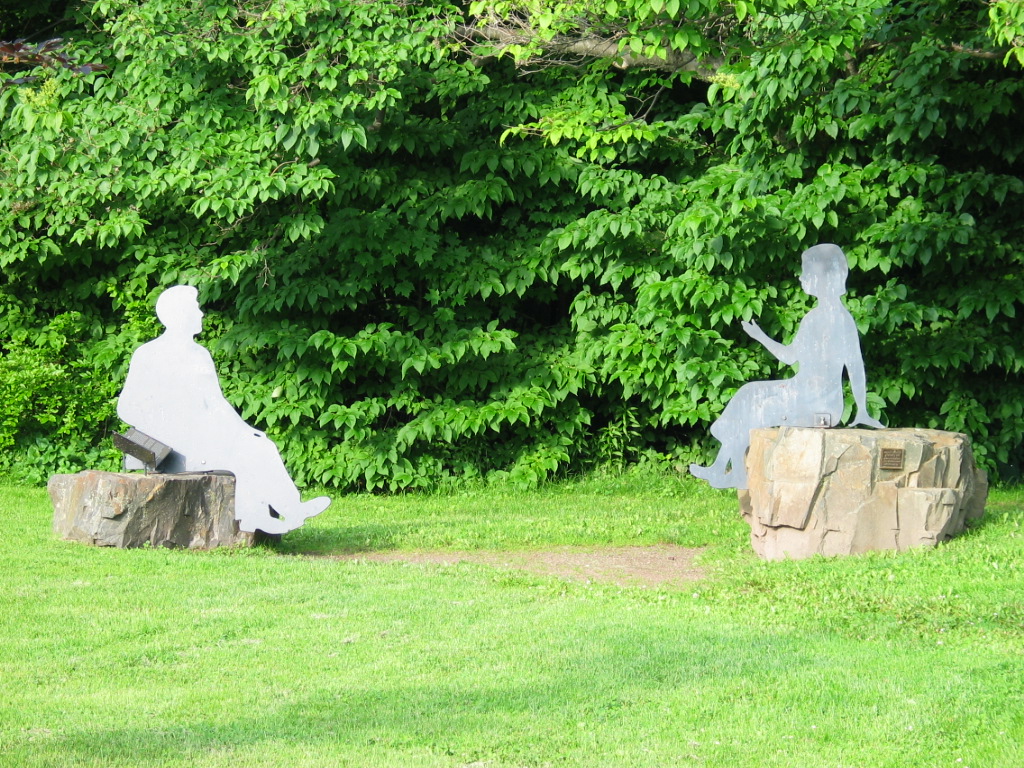
“You read your Emily Dickinson. And I my Robert Frost…” The two great American poets lived in Amherst in different centuries, and this set of statues there commemorates that.
.
In the third stanza we outdo Bezos, Musk, and Branson as Frost notes with inexpensive poetic efficiency that Free Thought is not bound-in by earthly hills but is capable of interstellar flight. This stanza’s final lines, an Icarian or Luciferian plummet, find that at the end of the limits of the dreams of a night Thought invariably returns to an “earthly room.” As my footnote below notes, Frost is fairly sure of the fallen nature of humanity.
The final stanza is, to my reading, an ambiguous judgement. If humanity is fallen, Frost too is unable to judge the competition and contrast of Love and Free Thought. Thought’s freedom and range, even if temporary, even if illusionary, has a pull and value. And “some” (Frost externalized this opinion and doesn’t say they are right or wrong) say Love (even if it’s bondage and constrains one) can have a fuller possession by nature of its grounded stasis.
The poem’s final couplet retains this duality, Free Thought has partial experiences of multitudinous beauties in a wonderous universe, but these beauties are “fused” to other stars. To choose other than temporary dreams, just replaces New Hampshire with Sirius.
I said at the start performance means choices. I made an audacious choice. In Frost’s poem he consistently gendered Love as female and Thought as male. Furthermore, I’ve read second-hand references that in an earlier draft he chose to make both Love and Thought female, an unusual choice that he abandoned. I made my choice for my own reasons, to help the performer, myself. I think that choice makes it a stronger piece for myself and for my audience.
The reports of Frost’s abandoned choice would make for a different poem. English writing in Frost’s time usually used male pronouns for universals and abstracts, so that original choice of female pronouns must have been intentional. His choice for skyward Free Thought as male, and earthy and fecund Love as female is archetypal, and I in turn made a conscious decision to reject that. I did this because I feared that too many listeners might grasp this poem as a conflict of male sexual freedom vs. the clingy women. Intentionally or subconsciously, this may have been in Frost’s mind, and even so then this is Frost’s version of the complicated love poem that the female “songbird poets” were developing in his time, even if it’s more abstract in describing the bond and free of desire.** I just preferred the duality of the poem ungendered, and I think modern audiences are ready to receive that version.
The player to hear my performance will appear below for many of you. However, some ways of reading this blog won’t show it, and so here’s a highlighted hyperlink to play it. You will notice that besides the pronouns there are a few other textural differences, some accidental, some chosen to make the language more colloquial*** and easier for a modern listener to grasp on hearing. I don’t know if these changes are for the better, but they were this performer’s choice. As promised earlier in this month of noisier musics, acoustic 12-string guitar and piano featured this time, but just enough sarod and tambura in the background to add a non-New England air.
.
*Frost did write one searing poem on racial hatred and violence: “The Vanishing Red,”which I presented here. A brief search today didn’t return much. I would expect that he held stereotypical views and used ugly racial epithets casually. Like Dickinson, Frost’s silence on this central American issue should be more often considered as a loud silence. In her defense, Dickinson’s stance on human freedom, often expressed in her poetry, can easily be viewed as inspirational by all. Frost is surer of a fallen humanity, but that too can be appreciated by those weighed down by life or oppression.
**That reading would say that Frost was more guarded and indirect in dealing with desire than Millay, Teasdale, and the “songbird poets.” Thus, the uncharacteristic abstraction of this poem
***One of Frost’s Modernist strengths was to largely remove from his metered and rhyming verse the sense of stilted and too formal poetic diction. My judgement was that this skill deserted Frost several times in this poem. Perhaps abandoning his usual distinct and grounded settings for this more abstract poem also blunted his naturalness of speech.
This is the weekend that ends in American Labor Day, and I’m going to see if I can put up at least a couple of pieces celebrating that.
The relationship between poetry and labor is complicated. On one hand, unlike entertainers, popular prose writers, or some other fields in the arts, almost no poet earns enough solely from poetry to escape a complete lifetime of some other everyday work. This could lead to the world of work and the concerns of those that do it being widely incorporated into poetry, but in my observation that’s not so. Why should that be? Well, as much or more than any other art, poetry, in self-image or in public image, sets itself apart from ordinary work.
Poets are seen as dallying with the muses, observing unsullied nature, being drawn to erotic passion, explaining the godhead and the nearly unreal, or engaging in an endless spree of derangement of the senses. None of this seems related to the world of work. Things like that may be a way to spend the weekend or a holiday, and so poetry may be attractive to those seeking to temporarily escape their workdays — but then not an art used to understand them, or to interrogate them.
American Modernist poet Carl Sandburg conspicuously didn’t avoid work and workers as a subject. Some elements of Modernism liked to write about the products of early 20th Century industry — odes to locomotives and airplanes could stand in for birdsong or daffodils just fine for the make-it-new crowd — but the systems that built them and the human effort involved were largely not viewed as fit subjects. Satires of the management classes could be undertaken, and by damning their mundane concerns, the world of work could be dismissed as a fallen human state.
In variety and extent of opportunities to observe work the poet Sandburg may have had an advantage, and he didn’t squander it. Itinerant laborer, municipal government functionary, labor-union agitator, journalist, small-time farmer — Sandburg certainly had his perch to observe work. He wrote about all of those trades from inside and beside. Today’s piece is taken from the very last section of the long title poem in his 1920 poetry collection “Smoke and Steel.” In the poem Sandburg concentrates on that backbone of American industry in his time, the smelting of iron ore into steel, and he does so by focusing on the laborers in that system. While he’s in a long-winded Whitmanesque mode, he brings to this task the miniatures of Imagism, and in this final section, if separated out as I did here, he presents an Imagist poem. Earlier in his poem we meet a lot of people and their tasks involved in the manual labor of steel making; and now in this Imagist ending we’re left with three or four objects. Once he violates the unity of the charged moment, but otherwise it follows Imagism’s rules. Here’s a link to “Smoke and Steel”, and the section I adapted and used today is at the end of the opening poem.
We first meet cobwebs, called “pearly” to indicate a beauty in them, and they’ve caught and held raindrops. Just a “flicker” of wind tears them away from the scene. Moonshine, golden and so also portrayed as beautiful, perhaps in a pool of rainwater, is likewise shivered and dispersed by the wind. Finally, a bar of steel is presented, and there’s contrast. It’s not so transient. Violating the unity of the moment, the poem says it’ll last a million years, even if nature will coat it with a “coat of rust, a “vest of moths” and “a shirt” of earth, images that seem to me to connotate the grave when we are also told the steel bar will “sleep.”
I’ll admit that while I could visualize the cobwebs with pearly rain drops and the moonshine rippling in short-lived puddles, just exactly what the steel bar was as an image to be visualized was puzzling to me. A railroad track? We don’t usually call rail tracks bars. A fence, or even a jail cell (“steel bars” as shorthand for jail)? Nothing earlier in the poem prepares us for that reading in this section. Some steel ingot stockpiled and stored outside? But destined to be forgotten and left for a million years? Other than that “million years” permanence we’re told only one other thing about the steel bar: that it looks “slant-eyed” on the cobwebs and pools of moonshine. I understood this as “side-eye” and that reading seems pretty solid to me. The steel bar knows it’s going to be there longer than the cobwebs and moonshine, so it can dismiss them as ephemeral.
Then looking to confirm if a slant-eye look would have been understood to Sandburg as side-eye, I could only run into the use of, and disparagement toward “slant-eye” as an ethnic slur. Though that slur wasn’t news to me, it hadn’t occurred to me as I don’t think it’s what Sandburg intends.* Realizing this after I’d completed recording today’s performance, I considered that it might harm the ability of some listeners to receive the poem’s intention, and if I was to perform the poem again, I might take my privilege with a work in the Public Domain and sing it as “side-eye.”
Coming as it does at the conclusion of Sandburg’s longer poem “Smoke and Steel” what do I think the cobwebs, steel and moonshine mean as they are met by the wind of time and change? We may abide by the convention that poetry and work are separate things, but as Sandburg has just written a long poem about work, we know he wants these things to be combined. The things we do everyday for pay, the work we do in arts like poetry — are the later the cobwebs and moonshine, beautiful, transitory, little noticed; and the former the steel, the solid, useful things that will last? Or is the steel the “real” that is buried, and the cobwebs and moonshine it distains the eternal now that returns fresh?
And then, can either be both?
The player gadget to hear my performance of an excerpt from Sandburg’s longer poem that I’ve titled “Cobwebs, Steel, and Moonshine” will appear below for many of you. Don’t see a player? Then this highlighted hyperlink is another way to play it.
.
*Sandburg is too comfortable with ethnic slurs for many modern tastes in his poetry, and “Smoke and Steel” contains a handful of them earlier in the poem. The unabashed way he uses them in his way argues against this ethnic-Asian slur being a 1920’s dog-whistle.
A longish one this time. I’ll try to make it worth your while.
In the places I go it has been hard to escape Joni Mitchell and the 50-year anniversary of her breakthrough record album Blue this month. Mitchell is one of those artists like Emily Dickinson* or Thelonious Monk who people contemporaneously recognized as someone on the scene, someone whose work might appear at hand or gain mention — but then decades afterward the level of originality and importance of what they had done becomes more and more clear.
Mitchell’s Blue wasn’t immediately recognized as a classic, successful statement. Musically it’s a bit odd, even by the eclectic field of 1971 recordings. Though “singer-songwriter”** was a growing genre at the time, most of them would present their songs in a full band context on record. Instead, Mitchell’s record is spare, often just her voice and one instrument — and sometimes the instrument is a mountain dulcimer at that! She often used her voice unusually, with quick almost yodeling leaps in service of the originality in her melodic contours, and this was off-putting to some. One thing I remember about listening to Joni Mitchell LPs back in my youth was that the amount of volume in her upper register would rattle the plastic frame and enclosures of my tiny portable stereo’s speakers, producing a very unpleasant buzzing distortion.
To the degree that she was noticed in 1971, that she could be a figure who’s fame might outreach her record sales or rock critic esteem — it wasn’t just that she was a successful songwriter for others who could round-off her corners just a bit to present “Clouds (Both Sides Now),” “Woodstock,” or “The Circle Game” to a wider audience than their author could — it was because she was known as (this gets complicated, stay with me here) as the “girlfriend” of a lot of male rock stars. This got joked about. The now infamous Rolling Stone “Old Lady*** of the Year Award” in 1971, or a joke picture of a purported Joni Mitchell LP with a song listing of: 1. Crosby, 2. Stills, 3. Nash, 4. And Young.
Do those of my generation remember that? Did you laugh? I did. That’s part of the complication, but then I believe sex is only funny when you’re risking doing it “wrong” — and it is best if it’s funny some of the time. Dead serious and entirely secret? We might as well sign up for Brave New World industrial reproduction or efficient devices shipped in plain brown wrappers.
That said, now-a-days that 1971 behavior toward Mitchell is now viewed as belittling and a case-study in patriarchal attitudes in the “counter-culture.” Which it was. In the era’s defense I’ll say that the times were groping (should I revise that word?) toward an imperfect but different attitude toward sexual relationships. Just exactly what women would have to say about this wasn’t the first or second thing on the official list of speakers, alas.
It just so happens that Mitchell spoke up anyway, and mixed that with a kind of music which might have seemed just a bit odd or imperfect then, but now is seen as effective, important, and original.
And now it’s time to play Frank’s favorite history game. Folks are thinking about Joni Mitchell and 1971’s Blue here in 2021, but what could we see if we rebound off that 1971 time and look back 50 years from then?
Well, they do tilt their berets the opposite way. Edna St. Vincent Millay and Joni Mitchell
.
The poetry fans who are still with this post were wondering when I’d get to Edna St. Vincent Millay. In 1921 Millay had broken out as a young poet to watch, partly by that “being on the scene” presence in New York City in the era around and just after WWI, and by famously losing a poetry contest with a poem that many (including the contest’s winner) thought was the best of the lot. That poem was then featured in her debut book-length collection, and now it was time for the “difficult second album.” She planned that second collection to be what was to eventually become her book: Second April, a title that suggested that plan. But she was having trouble with her publisher, and eventually another collection came out ahead of it, just as the 1920’s began to roar: A Few Figs from Thistles.**** It’s a fair analogy: that book was Millay’s Blue. And like Mitchell’s Blue people noticed the author’s public persona not just the poetry. Millay became the exemplar of “The New Woman” of the 1920s, who were sometimes finding patriarchal marriage a doubtful institution, and flaunting disregard for traditional arguments financial and domestic for that. Speaking openly about erotic feelings. Creating their own art rather than settling for standby muse duties.
I’m not sure if even an incomplete list of Millay’s lovers was known to a general poetry reading public 100 years ago, and one can’t quite imagine Poetry magazine naming Millay “The Old Lady of 1921,” but the persona in A Few Figs from Thistles gave us that adventurer in love character that makes Millay and Mitchell echoing artists. But the original edition was a thin volume, chapbook length, and from things I’ve read this week it seems that Millay worried that it wasn’t substantial enough while Second April’s publication faced continued delays. A second version of A Few Figs from Thistles was hurriedly planned and issued, and some of the additions were standout poems in the collection as we now know it, such as the one I use for today’s audio piece: “Recuerdo.” Here’s a link to the full text of that poem if you’d like to follow along.
In her heyday of the 1920s Millay’s Modernist milieu and outlook wasn’t always reflected in her poetic diction. This may have helped her readership who were not yet used to, or appreciative of, free verse or other experiments in expression. Robert Frost or William Butler Yeats would also retain a poetry audience in this time with lovely metrical verse that expressed the modern condition, but Millay was (to my mind) not consistently as facile with metrical verse and more often fell back to fusty 19th century syntax and language,***** but she could also rise above those limitations. “Recuerdo” is an example of that. It has an effective refrain expressing two contradictory and relatable emotions: “tired” and “merry.” Those emotional words are contained solely within the refrain. The rest of the poem progresses in the Modernist/Imagist style: things and events are described out of order, and in a common Modernist trope in a mixture of tones and importance. How many love poems include a phrase like “smelled like a stable?” Yes, this is largely a love poem — why it even touches on the aubade formula of the pair’s night being interrupted by the dawn — but look again: love (or sexual desire) as a word or even as a direct description is not mentioned once! Yet many readers can sense and feel the limerence of erotic love all through the poem intensely. That is there in this objective and fragmented depiction. Remarkable!
But that absence does allow for some ambiguity. Is there some level of inconsequential going-through-the-motions experience available in a reading of this poem? Or at least some sense of transience in the experience, which after all is framed by the title which means memory in Spanish? I think that’s accessible there too. Suppose I was to present this poem by inventing a frame that imagines it was written by two drug-addled addicts hooking up for one night and to say that that emotion word “merry” in the refrain has some archaic meanings that are congruent with “high.” Same words, different effect in that frame. Or if the same poem was written with a title like “How I Met your Father.”
We do have one clue to Millay’s intent. There is an extant recording of the author reading this poem, and though it’s not very dramatic, it hints at a bit of ironic distance on the events in the poem, a sense of noting the paradoxical koan of memorable inconsequence.
Perhaps I overthink things, but the last stanza with the donation of fruit to the older woman who responds with words of gratitude was rich in ambiguity to me as well. An act of Christian charity, mixed in Modernistically with other random events and sights? Seems likely, but if I’m traipsing around tired and tipsy with my night’s hot flame and somehow, someway we’re carrying two dozen minus two each of apples and pears, their value isn’t exactly gold, frankincense, and myrrh. Is the older woman’s “God bless you” a simple expression of thanks or an implied suggestion that maybe the two younger lovers might want to kick in some spare change, which they consequently provide? Given the push-pull of political radicalism and romance in Millay’s work, can we be sure she doesn’t intend to portray something of the limits of the gesture to the old woman?
How many are thinking then that I’m an unromantic old cynic who has misunderstood and harmed this poem? Is there another group that says I’m not straightforward in my social and political analysis of the situation? Well, my fate is to be doomed to be in both states alternately and sometimes at once. That’s why I like this poem.
One knock against Millay and other New Woman poets of her time once the peak of her fresh fame wore off was that she wrote love poems, not statements about the important, complex issues facing us. Fifty years later, one knock about Joni Mitchell was that she was writing songs about two little people who don’t amount to a hill of beans in this crazy world. Both of those summary beliefs are incorrect — but then, what is it you are saying: love songs are simple?
Maybe for you. Not for all of us.
The player gadget to hear my performance of Edna St Vincent Millay’s “Recuerdo” will appear below for some of you. No player to be seen? Then this highlighted hyperlink will open a new tab window and play it. My music today isn’t very Joni Mitchell-ish (though later Mitchell, much past Blue, was a bit into synths). The vocal turned out to be a “scratch track” I kept because it seemed usefully spontaneous, even though I omit a few words in the poem’s text inadvertently.
.
*Dickinson wrote much of her work in the 1860s, and a small group of people knew of some of it though almost nothing was published in her lifetime. I speak here of the Dickinson that existed at the turn of the century after several volumes of her poetry with regularizing edits had been issued. Today she’s taught as one of the great American poets. Back when I was in school she was a charming slight oddity that seemed to fit in with some of the small, short poems the Imagists/Modernists produced in Millay’s time.
**Years ago I wrote a humor piece where I called this 1970’s trend “Singer Sewing-Machine” artists because so much of their ethos had airs of “back to the land/rent a house in Laurel Canyon/sew hippy blouses and embroidered patches on your jeans.”
*** “Old lady” and “Old man” as in “My old lady” were usages borrowed from what were the old-fashioned/outdated terms for wedded partners. Used in the more fluid arrangements by young people in the mid-20th century counter-culture they were supposed to be ironic statements of: partnership at least for now. Mitchell’s song on Blue“My Old Man” is an encapsulation of that moment.
****Back when I first presented a poem from that collection that so many of you liked this spring,“First Fig,” I was unaware of the origin of that book’s title. I wonder if my father who memorized Millay’s short poem but also studied to become a Christian minister in the Millay era would have known that Millay’s book title is from Jesus’ words in Matthew.
*****Her admirers can parse this as a Modernist use of older “ready-mades” which are being modified in the context of her 20th century verse.
1 A High-Toned Old Christian Woman and First Fig by Wallace Stevens and Edna St. Vincent Millay It seemed like an odd pairing. So much so that I wondered why I thought it might work. Wallace Stevens, who looked like what he was, an insurance executive; and Edna St. Vincent Millay, the beautiful bohemian New Woman of the 1920s. Stevens’ poem “A High-Toned Old Christian Woman” was awash in his characteristic play with esoteric words, luxuriating in its educated Modernism. Millay’s “First Fig” is epigramically brief and simply said. They were only about a dozen years apart in age a hundred years ago when these poems were written, but Stevens seemed older than his years, and Millay was famous as a distinctly young poet and as a poet who spoke for the new youth.
The subconscious forces that had me perform them together is still somewhat inexplicable. The rational connection I can see is that both of them are giving their Modernist defense against an older propriety, each in their own voices. Both are defiant in their ways, but they also somewhat reassure the older generation with an undercurrent in their poems. “A High-Toned Old Christian Woman” is telling the titular old Christian (which may be based on Stevens’ mother) that he too is a devout believer, but his belief is in pagan art. Millay’s “Fig” self-admits the likely unsustainability of her devotion to an artistic life, yet her short poem has enough room to say that she’s aware of that. Both poets accept that their stubborn individual Modernism may make widows wince.
Adding Modernist poets to your electric guitar pedalboard.
The unusual music in this spring’s most popular audio piece may have attracted some. Earlier this year I was able to find a used example of a guitar effects pedal that I’ve looked at for some time: the Electro-Harmonix Attack Decay pedal. Its prime trick is to make an electric guitar’s notes burn at both ends. Most other similar effects work only with single notes, but with proper settings and playing, the Attack Decay can latch on to and do the reverse delay thing on overlapping notes, letting the featured guitar in this piece sound like a hurdy-gurdy.
This is the piece that you, our flexible Parlando audience, listened to and liked the most last season, and you can hear or re-hear it with the player gadget below, or through this highlighted hyperlink which will play it in a new tab window.
I think I’ve established that I like examining lesser-known Modernists, or even writers who weren’t always considered part of the Modernist movement. Now today I may cause a few literarily knowledgeable readers to throw up their hands and do a spit take. Why? Yes, today’s piece is a sonnet, but we should note that not all Modernists rejected rhyme, and after all this is also a piece of down-beat gritty urban experience. Just look at the opening two lines:
Tired clerks, pale girls, street cleaners, business men
Boys, priests and harlots, drunkards, students, thieves…
A litany that wouldn’t be out of place in the Unreal City a few years later. It could sound like the opening of a piece by Whitman or even Lou Reed as it starts out. As it continues, it doesn’t stint on the darkness literal and figurative. Those subway riders are riders, without agency. With fixed tracks underground they go their “sunless way” with “reluctant feet” as our Modernist Dante tells us. When I first read this* having seen the author’s name before reading, my thought was “Could the writer of this piece be misattributed?”
Go ahead, go to the bottom of the post and listen to the performance I put together using this early 20th century New York City poem about ordinary and agentless people lost in underground darkness. It’s less than 3 minutes long. Hear it first without knowing who wrote it.
Is this something of a belated Memorial Day post? Today’s author would die serving overseas in the U.S. Army during WWI. But stop reading and skip down to the bold-faced section at the end for a chance to hear the audio piece first.
.
OK, now let’s take off the Masked Singer costume: the author of the sonnet that I used as the text for today’s audio piece is Joyce Kilmer. I expect two responses to that information: “Huh?” and“What!” The former “Huh?” might be from my younger readers, as this is less likely a poet they’ve run into in our present century. That was not always so. Those my age or older will likely associate Kilmer with a single poem which was once so well-known and liked that it became a point of contention with many educated folks. That poem was “Trees,” the one that begins “I think that I shall never see/A poem as lovely as a tree.” My first High School English teacher Terry Brennan explained that he had had a High School teacher who had recited it while bodily enacting the “lifts her leafy arms to pray” part of Kilmer’s “Trees” poem. I believe he told us this to establish that he was not going to inflict a similar pedology on us (thanks Terry for that, and much more!) A columnist I liked to read in the Des Moines Register as a teenager, Donald Kaul, loved to pillory Kilmer’s “Trees” as a crime against better culture.** They had a point. “Trees” was ripe enough with pleasant sentiments that it likely did its part to help kill off the pathetic fallacy in modern poetry, but let’s start with its first publication: in Poetry magazine in 1913, in an issue of that important publication for new verse that also included certified Modernists Ford Madox Ford, Ezra Pound, and Skipwith Cannell, the later a favorite of the Others circle.
And speaking of Others magazine, Kilmer was in New York as a young poet in the years before WWI, rubbing elbows with those who would be associated with that city’s fearless avant-garde. Orrick Johns mentions him as someone he knew in those days. When Poetry’s editor Harriet Monroe published her anthology The New Poetry in 1917, Kilmer and his poem “Trees” is included alphabetically between poems by Orrick Johns and Others’ founder/editor Alfred Kreymborg. Kreymborg in his interesting memoir Troubadour recounts that Kilmer was one of the few “actual writers” he was acquainted with in his earliest days as a poet. Kilmer read some of Kreymborg’s short free-verse poems and suggested “You ought to divide those lines and make them rhyme—there’s poetry in them” which Kreymborg considered encouragement. Kilmer was working then for Funk and Wagnall’s, the dictionary people, and even gave Kreymborg some assignments for the dictionary which paid the young man $10, his first check for writing anything.
But all that is circumstantial Modernism. Besides “Trees” the Kilmer verse I’ve found online is almost entirely religious in nature, and it doesn’t come close to threatening Gerard Manley Hopkins’ gravity and vitality in that regard. If there are other poems that Kilmer wrote that are like “The Subway” I haven’t seen them.
Why did that “Trees” poem stick? Trees may not be the Internet Cat Pictures of nature poetry, but readers do seem attracted to those stately greenhouse-gas-absorbing plants. And there’s more: unlike Great Britain, Kilmer was just about the only U. S. poet killed in WWI.*** In England a young poet like Rupert Brooke could gain public attention that persisted after the war even if he was only one poet-casualty out of several of his countrymen. In America, the “Trees” man received the whole pension, and a large East Coast military base was named Camp Kilmer and served as the place where many of the Greatest Generation embarked and returned to America for WWII.
Did you jump down to here in order to listen to the song I made out of this early 20th century American poem about the New York City subway? If so, there’s a player gadget for some of you, and for the rest, this highlighted hyperlink that will open a new tab/window to play the piece. After you listen to the song you can return to the rest of the post to find out what “Modernist” wrote the lyrics.
***The other name that comes to mind was Alan Seeger, the “I Have a Rendezvous with Death” poet who died ahead of the U.S. participation in the war fighting with French forces. His nephew was Pete Seeger, as Pete liked to point out at times.
I’ve mentioned I’m reading a couple of memoirs that cover the early 20th Century Modernist era in America this month. At some point there may come a post here directly about them — which this isn’t — but in one of these memoirs, Troubadour, its author Alfred Kreymborg is discussing the launch of his crucial American Modernist poetry magazine Others.* He writes that his initial goal in starting Others was to publish Mina Loy** and William Carlos Williams, but as he and his main backer discuss their first issue, the initial work of selection is described as including Loy, but then another poet: Mary Carolyn Davies. Indeed, when the first issue of Others arrives in the summer of 1915, the first poet presented is Mary Carolyn Davies and a version of her collection of short pieces called “Songs of a Girl.”*** Davies work directly precedes in Others’ first number the debut of Mina Loy’s set of longer “Love Songs,” the series of caustic love poems which introduced Loy’s indelible image of “Pig Cupid.”
One of the few pictures of Davies
.
In memoirs when I come upon a writer I’ve never heard of, a “I should at least check briefly on who they were, what they did” research reflex is triggered in me. “What? Not even a Wikipedia stub entry!” was one return on that. Just how obscure is this author? I’d say we know more about Davies than we know about Sappho, and less than we know about any other author that was published in Others just a hundred years ago. Dates of her birth and death are not clearly known. The former somewhere in the 1880’s or early 1890s, and the later as wide as 1940 and 1974. She grew up in the American Northwest, and this short Oregon Historical Society entry has the longest biographic note I’ve found. Her work was presented not just in Others, but by the Provincetown Players too, giving some evidence that she was connected somehow with the bohemian New York City area avant guard in the early 20th century, but she’s also said to have published in a variety of mainstream publications, perhaps to keep the pot boiling.
This is Davies’ play which was performed with music by Kreymborg at the Provincetown Playhouse in NYC. Read this link for this intriguing description of it. Now, to give some contrasting sense of what her potboiler work may have entailed, this hit recording with a Parlando recitation may have been from a published poem of Davies. Per the Oregon Historical Society bio, about this time Davies would have been destitute in NYC when this 1942 record was on the hit parade. The bestial creature with the whip in Davies’ playbill? The character’s name is Life!
*Here’s the Wikipedia entry for Others. The contributors that wrote that want to make a strong case for the social and sexual radicalism of Others in 1915. I don’t know enough to say if they overstate that case, but with Kreymborg’s determination to publish American Modernist work he was pushing boundaries out every which way. Other important and sometimes longer-lived publications that included Modernists, like the Chicago based Poetry, mixed in more conventional verse, while Others stayed true to its credo: “The old expressions are with us always, and there are always others.”
**Mina Loy was once nearly as forgotten as Davies, but in this century her work has been re-examined and found by many who do that to be extraordinarily vital.
***I am unsure at this point what the entire contents of Davies’ “Songs of a Girl” was intended to contain. There appear to be at least three differing collections that can be found under this title and author — all of them sets of short pieces without individual titles, each set off by Roman numerals. In one, today’s piece is “II,” and in another it’s “III” in a series titled “Later Songs,” while in the 1915 publication in Others, today’s short bit doesn’t appear at all. The version I saw first and used when preparing my piece today was in the 1917 The New Poetry anthology edited by Harriet Monroe.
Perhaps Davies intended Songs of a Girl to be like Whitman’s Leaves of Grass, an all-encompassing and evolving statement?




 Frank Hudson