This month, I’m going to start a series here featuring the words and music of Dave Moore. This is different—and not—because long-time listeners will have heard Dave’s voice and words here from the beginning, but this time I’m going to expose a little more of Dave’s range of work. If you’ve come here expecting our usual eclectic mix of poetry from various eras with music, don’t worry, we’re not abandoning that (and there’s lots here, just look at the archives on the right), I’m just taking some time to present something different, and “something different” has been my aim since the start.
I’m going to try to put Dave’s stuff in context, at least the way I’ve seen it. I’ve known Dave for 50 years. He was writing poetry before I met him, and he’ll write things for the page to this day, but he became a songwriter and he has had a long-running one-panel comic for decades too. I’ll start by talking about the songs.
A little over 40 years ago Dave’s words were used for the lyrics of a third of the songs on one of the pioneering Twin Cities punk/new-wave/indie records: 1978’s Fine Art’s Fine Art. Dave didn’t perform with the band, and as far as I know, he didn’t have any direct input on the music the band created for the songs. Fine Art existed from just before their only LP was recorded until around 1983.
That you haven’t heard of Fine Art is likely derived from several reasons. The biggest one is that they, unlike some later Twin Cities’ Indie bands, never made it nationally, but I remain puzzled as to how they have disappeared from the memories, books, and posts of those who have sought to cover the local Minnesota-based heroes that made and made up the late 1970s scene that produced The Replacements, Husker Du, and Soul Asylum, and even to some degree Prince, a scene that was then the platform under an even later generation of Twin Cities connected indies like Babes in Toyland, The Hold Steady, or the Jayhawks. Like other cities who experienced the eruption of indie bands in the late 70s and early 80s, the Twin Cities has its own selection of “They were so good and original, how come they never made it as national acts?” bands. The Suicide Commandos, The Suburbs*, and The Wallets were unforgettable to most who saw them locally, but their national/international profiles never really existed, and are now, like our weather will be soon, below zero. Fine Art, who have a good case to being seminal to the scene, who staked their own distinctive sound within it, are forgotten even locally, and that pains and puzzles me.
So, if you make it through this post, you’ll know more about the band Fine Art than anything you’ll be able to find in a book or on the web. In talking about why they didn’t make it into history, I’m going to try to sneak in why you should care about what they did.
OK, what were the problems and obstacles that explain why you haven’t heard of Fine Art, even though they helped break the ground for a significant Indie rock scene?
Their name, Fine Art, can be understood unironically. Their leader**, Colin Mansfield was a highly experimental guitarist, and his compositional ideas were not punk pure nor entirely pop accessible. A sizeable portion of the Twin Cities scene followed the early 80’s movement to make hardcore music which was intense not only in its volume and velocity, but in the kind of loose authenticity that later was called grunge.*** “Art rock” was another of the labels hung on “Progressive Rock,” and that was the enemy to this segment. Fine Art, particularly in it’s early days, could be just as much (or even more) a focused frenzy as, for example, Husker Du,**** but that band had a non-sequitur, non-significant name, and Fine Art’s name on a concert handbill may have suggested the wrong thing to some of the market.
They were song-oriented. Despite the continuing connoisseur appreciation for Grant Hart, Paul Westerberg, and Bob Mould as songwriters, the early TC live indie music scene then was not conducive to them. PAs, live board ops, and venues tended to make all the bands vocals unintelligible. On record, the songs come through, but Fine Art issued too few recordings: essentially one self-titled LP of an early version of the band before they were fully formed, and one EP, Scan, that better represents the middle of the band’s life. I’m unaware of any other Minnesota band with the breadth and quality of material from this early ‘80s era which left so little recorded legacy—but then that proves my point I guess, how would I know if such other bands existed?

The Fine Art lineup in 1980 fronted by Terri Paul and Kay Maxwell, Colin Mansfield on the far right. Also visible is Liz, their bass player that year which gave the band a 50/50 male/female split.
Live shows. The power of Fine Art in a live show could be substantial, perhaps most intensely on a small stage in a small room, but despite having exceptional singers/front-women over the band’s lifetime, they didn’t always come over on the First Avenue mainstage, the largest venue to present indie acts by the early ‘80s. Their contemporary local heroes The Suburbs (who like Fine Art never limited themselves to hardcore punk-rock moves) would in this era have one of the most dynamic high-energy live shows I’ve ever seen. Last night I watched Sammy Hagar on TV relating what he thought the wisest words legendary concert promoter Bill Graham had imparted to him: “It isn’t the audience’s job to win you over, you have to win them over.” Sammy Hagar, then as now, wouldn’t be a cool re-teller of an always controversial promotor’s bromide, but Fine Art in all it’s incarnations, had a cool stage demeanor, putting out the best music they could devise without a smarmy sales pitch, but also never explicitly pulling the audience into their vision. This stance works more often after you’ve become famous, or (paradoxically) after you’ve become famous for not catering to audiences in an overt way, but it’s the more difficult shot to make, and Fine Art didn’t make its shot.
I was going to write even more dancing-architecture about Fine Art on stage when I discovered that there is available a good quality film of them just past the midlife of the band, performing at the famous 7th Street Entry small room in Minneapolis. This was a good lineup for the band musically, and the performance is about as open and inviting as any I recall seeing. The short film misses some of my favorite numbers, any 45 minute film would, and in particular it includes none of the songs that best showed singer Kay Maxwell’s more exploratory vocal work. But, apropos of my point above, this is about as open and warm as they got, even in a small club. Guitarist Colin Mansfield even smiles. On stage. While the camera is on him.*****
Fine Art in 1981 perform a set in First Ave’s small 7th Street Entry room. As per usual, I think Dave Moore may have written about a third of the lyrics in the songs here.
They didn’t tour. I can’t say for sure why they didn’t. Any bootstrap band has to commit to a “get in the van” leap even for an Indie tour. This means no income other than chancy part-of-the-door proceeds and increased costs even if only for gas and repairs. Hometown relationships will be sacrificed. And the logistics for a six-person band with two women are a much greater challenge than for say a three person trio male-bonding road trip. Realistically, if they had toured, would out-of-state audiences have reacted differently than Twin Cities ones? In some markets I think it’s possible, but far from assured.
Front women. Throughout almost the entire run of the band’s life it used dual female lead singers. This was unusual in this era, locally and nationally, but more so in Minnesota indie circles before the mid-‘80s. Gender mix at indie shows in this era from my memory showed a higher male attendance, and the tastemakers were almost entirely male. Early versions of the band paired Kay Maxwell with Terri Paul until Terri Paul left to marry Suburbs’ principal Chan Poling. Maxwell then was joined at the front of the stage by violinist/vocalist Jennifer Holt, who in turn left to form Tete Noires, another needs-to-be-remembered-more Twin Cities band that prefigured the Riot Grrl idea of the later ‘80s. In theory, you could expect CIS sex-appeal to be a marketplace-trumps-art plus, but remember Fine Art wasn’t a band that wanted to explicitly ingratiate itself with audiences, and the band’s songs almost never featured conventional or playful boy-girl romance or sexual come-ons. In fact, most Fine Art songs throughout the life of the band took a distinctly cool look at relationships and their frictions with individual autonomy, something that pop and rock music didn’t allow female singers to do much in the 70s.****** In this skeptical and examining regard, they were doing in the small Minnesota scene what some post-punk bands in England and the US coasts were doing, but it’s likely that Fine Art was developing this attitude independently. My guess is, that to the extent the young men of the Brent Kavanaugh generation heard the lyrics at a gig, or absorbed the stance portrayed by the singers on stage in a non-literary way, Fine Art wasn’t going to be their new favorite band. Would it be better if they listened? I certainly think so.
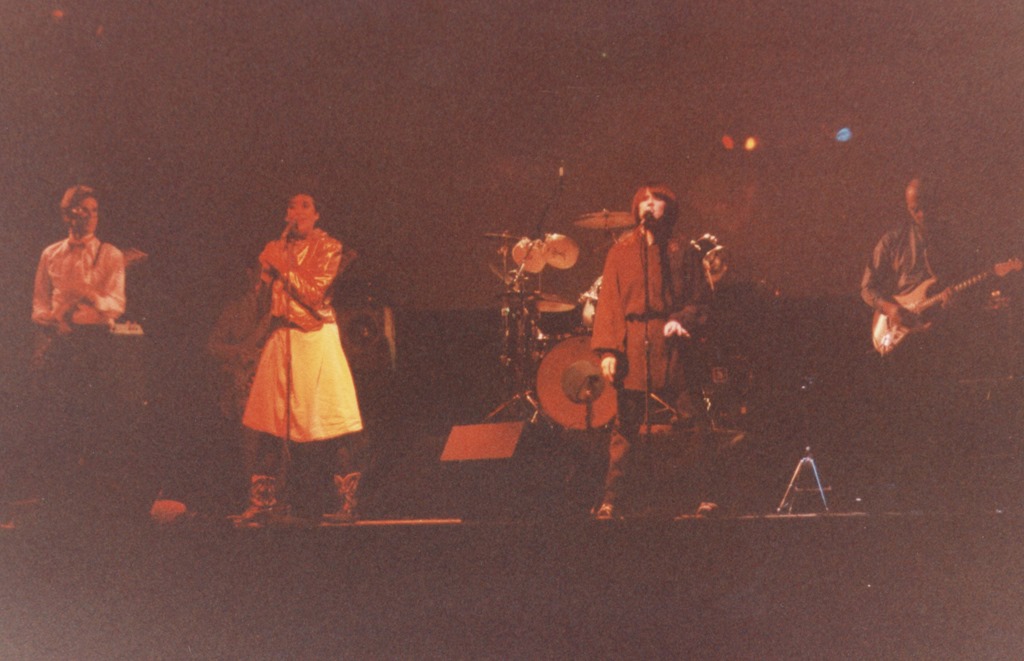
Fine Art circa 1982 on the First Avenue mainstage: Ken Carlson, Jennifer Holt, Kay Maxwell, and Colin Mansfield
Today as I think through these things I wonder what would have happened if I was rich and possessed a time machine, could I use cubic money and hindsight to change things? Could I have tried to break them as a recording act without local scene cred? No assurance in that. Try to move them to New York and ace out Blondie, but end up as The Shirts instead? Move to Athens Georgia and try to be the B52s, but end up as Pylon? I suspect the best fantasy bet would have been to move them to England, an even more imaginary gambit, but it was a scene more capable of breaking unusual bands because the extensive network of critics and music press there competed relentlessly to find unusual bands to champion.
OK, we’ve left Dave Moore for awhile here, so let’s circle back. Fine Art had women frontmen who handled the vocals. That means that Dave’s lyrics first were sung by women. A song like “Nailed,” performed by Fine Art on their LP and regularly in concert afterward, is ostensibly a vampire blues that might have been the text from an issue of Tales From the Crypt, takes on a different cast sung when sung by two women in harmony. Lines like “I gave you my body, and you took it too. Always thought you’d give it back—shows how much I knew” change in that context.
Here’s Dave Moore’s lyric “Nailed” performed not by Fine Art, but by the LYL Band. Colin Mansfield wrote the music here, and we only approximated it. I’m doing the lead vocal, though Dave peeks through on backing vocals. If you watched the Fine Art/7th Street Entry video you may be able to put together a mental construct of what the “real thing” sounded like on a good night. Let me assure you, it was even better than what you are imagining.
——————————————
Because what’s more punk-rock than footnotes
——————————————
*The Suburbs are perhaps the most similar Twin Cities band to Fine Art in style. Their principal Chan Poling brought a broad outside musical background into his band as did Fine Art’s Colin Mansfield. And at their best, each band’s rhythm section was solid, and their approach to songwriting eclectic and unafraid of oddness. The Suburbs had the more dynamic live show though, even on a large stage, and the conventional all-male lineup presented a show that could be enjoyed without further thought by the plastic beverage cup waving male club goer. My impression was that the Suburbs were soon a very consistent live draw for any venue hosting them, and Fine Art never was that. Of course, all that talent and appeal didn’t mean that even The Suburbs made it past local hero standing.
A survivor band version of The Suburbs still exists, and Poling (who performs with them) has gone on to a successful career in music that continues to today.
**I don’t know exactly how the band was organized, but Colin Mansfield, along with his then wife Kay Maxwell and outstanding rhythm guitarist, the late Ken Carlson were the three members who participated in every version of the band, and though music and lyrics were contributed not only by Dave Moore but as well by the rest of the band, I always got the impression that Colin was the organizer and collator of that process. I’ve lost the thread with Colin over the years, but he transitioned to in the box electronic music later on, and unlike the Fine Art material, that later work is available.
***As a marker for this aesthetic, I’ll note that Soul Asylum first performed under the band name Loud Fast Rules. The Replacements, whose IP holders should see about the availability from Blackglama of the phrase “What becomes a legend most,” were able to gain attention as the ultimate in anti-showbiz casualness, where a sloppy show meant that they really meant it.
****Colin Mansfield from Fine Art produced Husker Du’s first demos and their initial single, which sounds less like later Husker Du and more like Fine Art. After Husker Du broke up, Colin and Du bassist Greg Norton formed a short-lived trio Grey Area.
*****In my experience Colin Mansfield was a pleasant, understated and helpful man, as well as quite a musician. I once suggested, from my position on being less than any of those things, that it might help if he looked more animated and moved by the music on stage, and he asked back if there wouldn’t be some visual value in all that sound coming out a still and undemonstrative musician. We both were probably right, but he was right from a position of greater talent and achievement.
******Here for example are some of the other songs from that LP issued at the band’s beginnings in 1978, and remember all vocally performed by women: “Don’t Tell Me That,” “Too Much Pride,” “I’ve Got to Protect Myself,” Rapist,” and “Speak My Language.” Ken Carlson wrote the first three, Andy Schirmer wrote the third, and only the last was written by one of the vocalists, Terri Paul. It’s an odd dynamic isn’t it? Songs of self-assertion, anger, skepticism toward love relationships as a system, sometimes inward turning pain, written largely by men to be sung from the viewpoint and voice of two women. I don’t know if this was planned, my suspicion is that was something of an accidental combination which the band allowed to happen and then grew to embrace. I never asked. I don’t even know if any of the band men thought of themselves as feminist, and it wouldn’t shock me if any of the women in the band would have stories where the men failed to show feminist understanding. Human beings, they’re like that.




 Frank Hudson