Two Minnesota-based Irish-American poets who Dave Moore and I knew and worked with (Kevin FitzPatrick and Ethna McKiernan) used to give an annual St. Patrick’s Day poetry reading in the Twin Cities, a tradition that was ended by their final illnesses and death a few years back. It’s occurred to me that I can carry on that tradition here, so, let’s do that. I’ll start with one of Kevin’s poems.
Kevin’s poems are often parables. He’ll tell a story, most often using simple, off-hand language, though that story may encounter unexpected jumps. A bit of dry humor will often stop by. From working on and talking about poetry with Kevin I learned about the craft and intent in his language. The poems rhythm, sequence, and word-choice were honed – what seemed casual was thought out, and being able to see many of his poems move from earlier drafts to final versions, I’d see Kevin’s poems ending up working like good, even more highly compressed short stories. Like Joyce in Dubliners, the mundane and the particular are a setting in which to find an epiphany.
Here’s a poem, “Two Cities,” from one of his earlier collections, 1987’s On the Corner. It’s set distinctly in Minnesota’s Twin Cities (Minneapolis and St. Paul). These are two, barely fraternal twins. Minneapolis: larger, traditionally more Protestant (its early civic leaders were often New England WASPs) including a strain of tony liberal Republicans that have all but disappeared. St. Paul, more Roman Catholic, smaller, less seated with secular high-culture institutions, a stronger union town. Though not identical twins, they are cojoined, their borders entirely coincident.
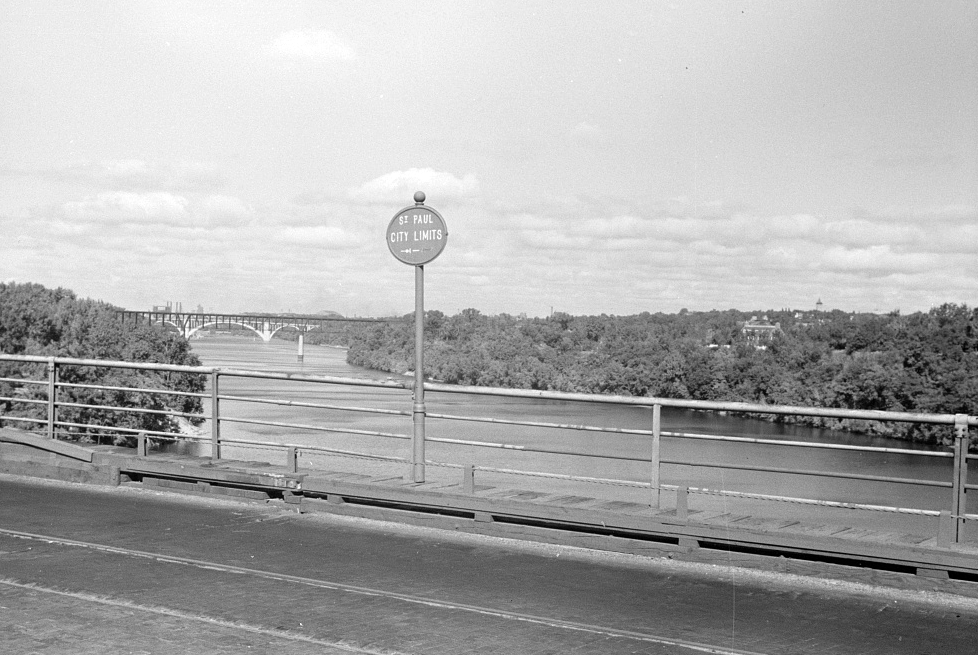
Kevin starts this poem with a tiny, vague head fake about an empty pole, and then drives right into one of the borders. Is it real, even if no one cares to maintain the sign? There are certainly different governments as he shows us in an efficient aside, different even to something as central as time zones. Some residents think the differences in the two town’s citizens are strong, shown in the dive bar anecdote that had me laughing again as I re-read the poem.
The Lake Street Bridge in the mid-20th century at its St. Paul border. I can’t find a picture of the missing bi-directional sign FitzPatrick writes of in the poem
.
He wraps his poem up with another character – and Kevin’s poems are full of characters. Unlike the typically solipsistic modern poem, he casts voices that ask us to consider something/someone else. How quickly Kevin draws him! “Jim” is a military man’s son, not a stay-put native who thinks his birthplace tells who someone is. Perhaps too, from the nature of his family business, he knows the violence that maintains borders more than chipped signs. And “Jim” gets the last word, or rather a last hope: that we can rise above things like borders, see ourselves as ourselves, not as cliches of birth or origin, bound by imaginary map-kept lines.
Is Jim the fool for his hope, when even two neighboring cities in the same state can divide themselves up with rough and ready human pattern matching? The poem sits between those alternatives. By bringing it up, the poem, the poet, asks us to decide.
So, a parable. Yes, its detail is about two cities Kevin and I lived and worked in for several decades. Yes, I’m remembering Kevin for a national culture observance, and remain here, after him – honoring, as it happens, poets with an Irish background. But I write this winter in a time when immigrants are held in a bureaucracy with cruel penalties and moving/sign-less lines. And with wars now too, where the lines of governments are crossed by a mad emperor. Kevin FitzPatrick’s poem reminds us, we all make ourselves (people, towns, nations) what we are, and we might waste our time making someone else what we think they are.
I performed the poem, reading it, to the best of my ability, as I think Kevin might have. I did add one of my “inline epigraphs” to the poem’s text, a line from a song that you’ll hear at the end. Musically I once more unleashed my company of electric guitars, though the Telecaster solo in the middle got caught out by someone’s arrival that meant that would be the last take. While I’m a guitar cosmopolitan, there is something special available from a Telecaster when it and an amp mesh up. You can hear this performance with an audio player you should see below. Has it disappeared like that border sign? No, it just that some ways to view this blog will 86 showing the player, and so this highlighted alternative link is your asylum, able to open a new tab with its own audio player.
I live in a city where 12-string guitars are over-represented. Since I’ve only lived in Minneapolis for 50 years, I can’t say for sure why that’s so. Folk-revival pioneers Leadbelly and Pete Seeger, likely the ur-source for the instruments post WWII use, have no direct connection, but by The Sixties™ this powerful but awkward branch of the guitar family had a nexus of players here. The guitar playing other two sides of the Pythagorean Koerner, Ray, and Glover trio played 12-string. Leo Kottke made the beast a virtuoso instrument while working the small clubs and coffeehouses of the Twin Cities. John Denver had fallen in love with a Minnesota girl and played a lot of 12-string (and who can say what is the cause and effect there). By the time I arrived in the Seventies, Ann Reed, Peter Lang, and Papa John Kolstad also played 12-string in small venues. The year my ten-year-old Pontiac rolled into town, a local college student, Steve Tibbetts, was self-recording his first LP featuring 12-string landscapes pebbled with percussion over which roamed howling electric guitar wolves.
At that point I owned my J C Penny’s nylon string guitar and a weird amorphously shaped Japanese electric guitar I’d bought at a flea market and for which I couldn’t yet afford an amp. Accommodating my new hometown, I soon felt I should get a 12-string guitar. A year or so after arriving I managed to afford a Cortez 12-string acoustic which was sold as a sideline item at the local Musicland record store. My memory was it cost $79. Designed to outwardly look like a “professional” instrument at the lowest cost, it could have been the music equivalent of costume jewelry or a stage prop. As these sorts of things go it wasn’t as bad sounding as modern forum-dwelling guitar aficionados would suspect, and mine had pretty good “action,” reasonable string height to allow easier fretting.
Later in the Seventies I added a DeArmond sound-hole pickup and I played this guitar with the LYL Band, and for the rest of the 20th century. With their double sets of strings, 12-strings sometimes warp and self-destruct under the increased string tension – but cheap and cheerful as the Cortez was, it’s held up, though the top has bellied-up over the years.
I eventually got a better 12-string, but I kept the Cortez around. A few years back I set it up to use Steve Tibbetts stringing variation where most of the octave strings are replaced with unison strings.*
Now let’s jump the month just ending, January 2026. As a writer I can’t paper over the immense mood shift this entails: from oddities about the types of guitars, to lives being mangled by intended government action.
I still feel unable to write fully about my reactions to the many injustices and atrocities that are incurring at the hands of thousands of federal agents that are roaming my city and the rest of Minnesota this winter. The first of the murders this month, the shooting of Renee Good in front of her wife happened on the street just across the alley of my home office and “Studio B.” If I hadn’t been wearing headphones and working on music for this Project I would have heard the gunshots – instead, it was my wife who rushed in to tell me. As of the end of the month, we’ve had a non-fatal shooting and one more murder by the federal agents, and a daily grind of sufferings. I won’t be the one to try to catalog all the careless to cruel things that are happening day after day. It sorrows me, and perhaps you, and at least for now, this information is available elsewhere. Nor will I offer enough praise for the ordinary people in this city who are trying to mitigate that suffering and plead for its ending. I will call out one thing many of them are doing: they’re seeking to be “Observers,” the term that has come to be used for folks who feel called to witness and record with their phones what our own government agents are doing to the people living around us. Think about this for a moment as you read this: these Observers are intending to go to where cruel things are being done by armed bullies who will use their weapons – issued along with pledges from their leadership that they will face no consequences – to rough up, to detain with and without charges, to attack with chemical and “less-lethal” munitions, to in two infamous cases, to kill them. Folks were doing this before Renee Good was killed – and after she was shot, more signed up. After the next murder of Alex Pretti pushed to the ground holding his cell phone camera: more again signed up.
I think of the incredible bravery of the American Civil Rights movement of the mid-20th century, and this is like unto that. But here’s something else I think concerning that role, something I don’t recall being written much about yet. There’s a chance that these observers are going to see armed agents of our government kill someone in front of them, and they’ll be tasked with recording that. The infamous murders of the Sixties’ Civil Rights movement happened in darkness and rural separation, though the corporal brutality of clubs, dogs, and firehoses was done in public and was sometimes filmed.
Along with bravery, that’s an additional heavy burden to take on. And some are now carrying that specific burden. We have memorials to Alex Pretti and Renee Good, but I want to stop and think of those that witnessed their killings, and what they must be carrying in their minds. My mind is once removed, however close to me these things happened, and yet it’s filled with conflicting and intense reactions – but they were there, in that instant as this happened. Dozens of people in my city, some intentional observers, some protesters, some just bystanders, are carrying that as I write this.
So, the name that most often arises in my heart this month after the many insults to justice and mercy isn’t one of the detained or murdered, but is instead, Rebecca Good, Renee Good’s spouse, who was apparently observing ICE action on the broad avenue near her house and mine. When the federal agents came up to their car and began to hassle Renee, Rebecca tries to draw their attention away from her partner. In that moment, I read her actions as saying: detain me, let Renee get away, throw me down onto the ice and snow and get a few punches or sprays of mace into the eyes while you strap cuffs on me. Rebecca can’t get in as Renee puts the car in drive, the doors are locked. On one of the videos you can hear her say “Drive babe,” allowing herself to be left behind with the agents. And then the shots.
You hear her voice in another video, moments later, sitting on the side of that broad road just behind my house, saying that they’ve killed her spouse, and moaning that she was the one that suggested they move to Minneapolis. I should transcribe her exact words, but I can’t bear to watch that video again just for journalist precision tonight.
Another jarring transition I can’t engineer now. In between Renee Good’s murder and Alex Pretti’s, and thinking of Rebecca and other survivors, and of the witnesses, observers, I somehow fell to thinking of a song written by another 12-string guitar player of The Sixties,™ Fred Neil, “The Dolphins.” Neil’s songwriting was a mixture of earnest and off-hand, an unusual combination. “The Dolphins” is a somber wail about the cruelty of the world compared to the swimming pods of the famously playful aquatic mammals, and it’s just a handful of words.** Neil’s career was one of those “better known to other musicians” ones, and his song was covered by others back then, particularly those who played the 12-string guitar. Now if we move onto the Seventies – that off-brand extension of The Sixties™ – I’ve always thought that when another songwriter who played a lot of 12-string guitar in The Sixties, David Bowie, had to have been thinking of Neil’s song when, in the midst of his Cold-War-Berlin masterpiece “Heroes,” he has one of the lovers kissing next to the armed guards around that inland city’s border wall think of dolphins again.
Fred Neil had a rich baritone voice, and David Bowie was a talented singer. I, alas, am mostly singing things here myself, yet I wanted to make a realization of those two songs while thinking of Rebecca Good, and others I didn’t (and still don’t) know how to number and name in this time. That would mean no first-rate vocalist, and I also decided to go primitive on the 12-string guitar, using that old Cortez 12-string. As the song progresses I strummed that 50-year-old box loudly, and I didn’t necessarily want a pretty 12-string with a rich sound.
.
*One of the features of the Cortez is a “zero-fret,” a still unusual feature that brings two benefits: it insures optimum string height in the “cowboy chord” first position area for easy playing and allows greater freedom in using different gauge strings at the player’s whim. Conventional 12-strings use a thinner string tuned an octave above the regular string for the low E, A, D, and G strings. Steve Tibbetts (like Leadbelly) instead uses two regular gauge, unison not octave tuned, strings for some of the courses. My Cortez 12-string has unison D and G strings.
**Neil’s choice of the dolphins, however casual it seems in his song, was a serious one. He drifted out of the music business in the Seventies and spent the rest of his life working on a dolphin support/conservation project.
The recording of this musical version of a short Robert Frost poem somehow was able to slip itself in-between standing watch, comforting, and grieving this month in Minnesota. Increasingly people outside our area are expressing admiration for our fortitude, but inside our local theater of atrocities, I’d say our thoughts and feelings are still a jumble. My aged body has its limits, but I’m trying to support others during this time. Things you might see here? I still find it difficult to integrate these events into the long-ongoing Project.* There’s a great deal of news coverage and analysis being done elsewhere, but during this time you have been spared hundreds of words I’ve written and then not posted, longish things where I sought to add to that. My audience isn’t that large; my remaining skills in prose I’d self-assay as not unique enough to be required. My Parlando Project creative time is constrained both internally by aging and my acute reactions to the present crisis, and externally by limited times when I can use some musical and recording tools.
Yet, somehow, this piece is here today. Does it address the events here this January?** I think it does, at least partially, but first here’s a short account of how it was made.
I’ll skip the details, but the present recording logistics here limits the ways I can record guitars, though guitar is the instrument which I have the most facility with. Electric bass, my “second instrument” is easier. Recording an electric bass by directly plugging into a jack in an audio mixer or interface has long been a best practice for everyone from home recordists to pro studios, and since there are no amp speakers in the chain and a generally inert plank of wood holding the plucked strings, this is near silent in the room and it eliminates microphones capturing unwanted noise. Electric guitar can be recorded the same way, but for some stylistic choices you want the guitar to react to sound coming out of a speaker – and furthermore (for me, anyway) I express things differently when I’m moving air loudly in a room when playing electric guitar. This doesn’t factor into playing bass. So “A Minor Bird” started out with me working out a computer drum pattern and playing a bass line. I created a chord cycle based on the bass line (the reverse of how I often do it) and used a computer piano to create a MIDI piano roll expressing those chords.*** I then edited that MIDI score to get a part that pleased me. I next hacked playing a Hammond B3 organ part myself with my little plastic keyboard, though mercifully, all you will hear are the best bits. The next track was my singing Robert Frost’s words. Each of these steps could be done in the odd hours I could grab, so the song took form in dribs and drabs over a few days. I had intended to overdub an electric guitar solo in the middle, but that time wasn’t there, which leaves the drums/bass/piano trio grooving alone, which might even be addition by subtraction.
This Frost poem is not one of his better-known ones, though published in his 1923 collection New Hampshire, the book that won his initial Pulitzer Prize. The first thing that struck me about it is how modest and unassuming it is: four couplets long, no exotic words, a vignette with two characters: a bird and the poet/speaker. I would almost say that there is no prerequisite reading or coursework needed to understand the poem, but my next thought was that the situation here, poet and a single bird, might be in conversation with other poetry. One could think of other romantic poems of a poet and birdsong – Keats’ “Ode to a Nightingale” for example – but if I was to think of a single poem that Frost is writing his in conversation with, it would be Poe’s “The Raven.” Both poems are set in the context of the faceted emotions of grief/melancholy/depression. Both have the poet wanting the bird to leave, but despite the shortness and plain language of Frost’s poem, there’s room in his short poem for a volta, a turn of thought. Frost never names the species of bird, but by calling it “a minor bird” in his small poem, he’s also explicitly casting the bird’s song as being in a (sad) minor key. The poem’s conclusion is that the calling of grief and sadness should be included in our consciousness.
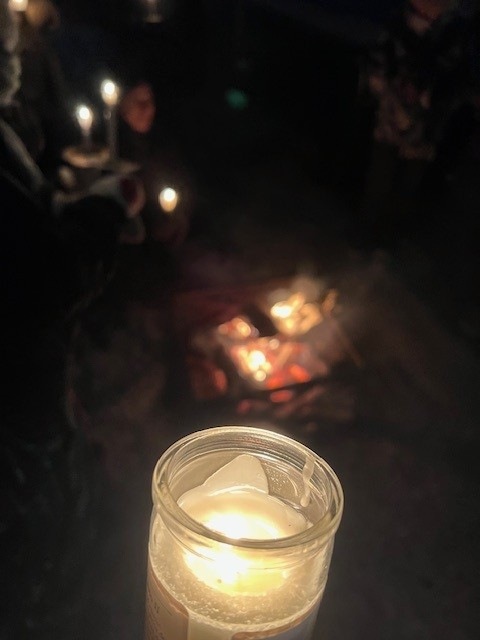
Saturday, after the latest killing of one of the observers who was filming the actions of the Federal troops elsewhere in Minneapolis, other observers in our neighborhood and their families gathered in the below-zero dark on our streetcorner, each of us carrying a candle from our houses.
.
The doorknob where I write this has a lanyard with a whistle. It’s to grab, to take outside in the winter cold and to make our minor sound at anything from the incursion into our city that calls us to flock witnesses too. This state in this country, and this composer and plain singer of Frost’s words, have had their griefs this month. We have chosen not to shoo them away – despite the raptor dread encircling our minor birds, we have not silenced the song.
To hear the performance of Robert Frost’s “A Minor Bird” use the audio player below. No player? Nothing has caused it to withdraw, it’s just that some ways of reading this blog won’t display the player. This highlighted link will open a new tab with its own audio player.
.
*Perhaps I’m an odd duck, but to release art about these events worries part of me that some portion of the artist is seeking to use these largely selfless and unsigned acts of resistance as a platform to promote their work.
I’m not saying you should feel that way! And yes, I am quite aware that conversely some artists and their work have been down-rated, suppressed, and punished due to their art for causes.
My feeling is more akin to the idea that in either case, the thoughts of pros and cons of careerism must be humbled by the everyday bravery and service Minnesotans have shown this month.
**Under what name will this month’s resistance be recorded under? “The Battle of Minneapolis” has already been used for a 20th century labor action. I’m fond of wordplay, but “The Mother Whistlers” is too humorous. “The Minnesota Witnessers?” “The ICE Breakers?” “The iPhone Militia Movement?”
Today’s performance happened a decade later in 1981. This is a series about performances, so I’ll leave out a lot that happened in-between, but in summary, I left school, began working in a nursing home and subsequently spent almost twenty years working in nursing roles, the bulk of that in what were called, in those days, Emergency Rooms.* I rather liked the work, as it was undeniably useful, and the broad ad-lib nature of the responsibilities fostered teamwork between staff. There was something else about it too: if one’s own life was not going smoothly or following some path of professional advancement, a great many of the people you took care of were having a worse day than whatever day you were having.
In the mid-Seventies I decided to try to teach myself how to play guitar, and a couple of years later I moved to Minneapolis Minnesota, where I reconnected with Dave Moore. In the middle of that decade a musical movement was forming which had no name for a year or so until it started being called “Punk.” Once something gets a label, folks will come along and take what the label describes as a goal or set of expectations that should be met — but the musical acts that were already there when that label was created didn’t have those restrictions. They were all over the place in musical intents and tactics.
But there was something that united those that were there to be called “punk” founders ex-post-facto. I’ll use this military metaphor: what happens when a regime has fallen, when the standing armies are no longer functioning, yet a struggle continues? Pressed into the battle are the irregulars, the untrained — and those punk-before-the-name bands prime movers were often: poets, artists, & writers, not musicians. Nor were these figures reactionaries who hated hippies, Rock’s traditions, or exploratory musical moves. For the large part they wanted to take up the fallen banners of what had been exciting about Sixties music and to carry them forward. Where they were in opposition, they were against those credentialed musical acts that weren’t doing that.
Well Dave Moore and I were writers, poets. I’d learned a little about how to play guitar. Dave could play keyboards. This new musical moment was allowing a new “underground” of original music bands to pop up in Minneapolis. What Sixties banner could we take up?
The list of artists we shared as touchstones would be long, and what we thought we could take from them would be a long list too. Let me select but one: The Fugs.
Andrew Hickey, the writer behind the excellent music-head project The History of Rock Music in 500 Songs has a maxim he deploys often in his work: “There’s no first of anything.” When a wise writer gets to questions like “What was the first Rock record” or “Who first played electric guitar” and stuff like that, it’s actually impossible to set objective criteria or establish exact dates, but being aware of that useful maxim, the Fugs can be claimed the first Punk band, and they didn’t start in the middle-Seventies, but in the middle-Sixties.
The Fugs and their implications and cultural inflections are too long a story to tell in this post. If my energy holds out, I’ll make my account of the Fugs a “bonus episode” here, but in short, starting at the beginning of 1965 in NYC’s Greenwich Village, two poets Ed Sanders and Tuli Kupferberg began caterwauling songs with various accomplices in what they advertised as “Total Assault on the Culture.” I suspect they saw themselves as an outgrowth of the “Jug Band Music” branch of the Fifties and early Sixties folk music revival,* but the Fugs material was a substantial expansion from the folk-revival jug bands. The Fugs performed single-entendre odes to sex acts, anarchist satire and political protest, translated excerpts from ancient Egyptian or Greek literature, settings of literary poetry, dispatches from drug takers, and the other daily concerns of Bohemia.
Kuperberg and Sanders did not have professional voices. Their first album is so out of tune that the vocal timbres can drive even those that might entertain their political and cultural points to “turn that damn ‘singing’ off!” You’ve heard me sing here — that sort of “we’ll give it a go anyway” audacity actually comforted me.
Dave and I started playing informally in our living rooms, and between the two of us we quickly developed a dozen or more original songs. Our fresh material addressed the social issues of the on-coming Eighties: the Reagan rightward tilt, the local “big boys who always run things” (as Dave put it in one of his songs), and working class experiences. Unlike the Fugs we largely eschewed the aggressively sex-positive topics and the recreational drug-use reports.*** This rundown makes our early songs sound more like doctrinaire agitprop that I think they were. As songwriters we both were fond of the character study, which is by its nature more complex than a protest sign or bumper sticker.
Dave (the more businesslike and socially competent of the two of us) soon set us out to perform publicly by making arrangements with Ed Felien, a long-time city activist who was at the time running a café called Modern Times in South Minneapolis. We started to use a stage at one end of the dining area there to perform publicly.
One of Dave Moore’s posters for the LYL Band appearing at the Modern Times Cafe in the early Eighties
.
Audiences were small, but it was fun to do. The stage had an upright piano for Dave to play and the place had two vocal microphones connected to a low-volume PA. I played an acoustic guitar which I had to pick with all my might to keep up with the volume of Dave’s two-handed piano chording. I was the weaker of the two of us as a performer, but because of our equality practice of alternating songs, I could feel that Dave’s steadier and more confidently presented songs could keep the audience satisfied, and I enjoyed the accompaniment role during his songs.
So one day, we’re playing on the Modern Times stage to a small crowd. Late in the first set we did a topical song of mine “The Ballad of J.W. Hinckley,” a song set parodically to the form of Steely Dan’s “Do It Again.” The song was voiced as being sung by the titular young man from a well-off family who had just shot President Reagan and his Press Secretary in the hopes of impressing Jody Foster. The point of the song was that due to Hinckley’s privilege and America’s laissez-faire gun regs, he was free to make his attempt even after he’d been caught trying to carry guns onto an airline flight. Yes, I suppose there was a wicked wink in my use of the chorus borrowed from Steely Dan’s song: “You go back, Jack, do it again” — but the subject of the Dan song is a chronic loser, and the Hinckley character in my song was non-heroic too.
We took a little break between sets and we were winding up the first song of our second stint when a thin older man entered the dining area carrying a long-gun. Dave was sitting at the piano, facing sideways, stage right. I was right down in front at the lip of the low stage. The man walked up next to the stage, raised his gun at me, and began his spiel.
So what! Let’s take up a song in honor of Mr. Reagan — in his honor….He’s a wonderful man. He may turn this country around. Let’s have both sides of the story. I think I am well educated (both sides) and I don’t have a pointy head anymore.”
Well, once again someone was missing the subtle point a song was trying to make — but I didn’t try to debate the armed man. In my ER job I’d dealt with many angry people, even agitated, insane folks in the midst of mania or paranoia. My default tactic in such ER cases was to listen to them calmly, perhaps waiting to gently redirect them if they calmed down or had a question. It was actually rare in my ER years to have to struggle to restrain them (those who had been violent outside were brought in already restrained).
I listened to the man talk, trying to present myself as interested in what he had to say. What he said seemed almost composed, as if he was (like myself) trying to perform. He was present for less than a minute, but in gun-time things slowed down. I remember trying to judge just how much height I had from the low stage: could I kick or throw myself down over the leveled barrel of the long gun, forcing it to ground, followed by my younger body pinning the older man? No, my acoustic guitar would impede me. I can’t recall if I thought to look at the position of the man’s trigger finger — perhaps I thought such a clear glance rather than paying attention to his speech might be a tell. I didn’t have time to recalculate much, as the man finished saying his piece, turned and walked out onto Chicago Avenue just as he had come in.
Dave, I suspect elevated in expressiveness from being in his outgoing performer mode, said into his vocal mic “We love it when guns show up!”
Did this incident cause me to have stage fright problems? You might think it odd, but it did not — I still wanted to perform, but my problem as a performer continued to be my lack of sufficient performer’s skills and my issues with being confident in what I was able to convey, leading to a progression within a performance of accumulating failure of “nerve,” and the ability to project confidence.
On top of one of the tables in the Modern Times dining area, I had placed a little tape recorder to record our performance. I’d hit record for the second set minutes before the man walked in with the gun. Later that year when we created our only official record, we melded in part of the incident as an intro to the studio version of “The Ballad of J.W. Hinckley,” and you can hear that with the audio player below. One additional note on the ending part captured in this performance of the song: in my younger years I could improvise poetry over guitar. I think I was modeling that on early Patti Smith, whose first recorded pieces captured at poetry readings were done that way.
Audio player gadget below. What, no gadget to be seen? It’s not stage fright, it’s just that some ways of reading this blog will suppress showing the player. This highlighted link will open a new tab with its own audio player.
.
*In most hospitals these days they’ve been expanded to departments or subsections, with varying services. All the systems that deal with the acutely ill, trauma victims, mental health crises, or those that have no other place to go for healthcare have been expanded — and I lived through a lot of that change in my lower-level position — but the first Emergency Room that I worked in was literally a room or two located by a ground level entrance where an ambulance could pull up likely staffed by folks with a higher degree of licensure to drive a commercial vehicle than medical training.
**This was in effect a largely white effort to revive a largely Afro-American genre of string band music with vocals that often would include double entendre songs performed at lively tempos. One advantage in the commercial folk-revival was that a jug band group could allow more specialization, grouping effective instrumental musicians with appealing singers. In the mid-Sixties US West Coast, the Grateful Dead and Country Joe and the Fish started as jug band revivalists. On the East Coast, Jim Kweskin’s Jug Band and the Loving Spoonful worked out of that style.
***Exceptions? We did cover two Fugs tunes “Slum Goddess of the Lower East Side” and “I Couldn’t Get High;” and though we never played them live, we did play the Velvet Underground’s “White Light/White Heat” and an original song adapted from a local poet’s poem called “Pussy from the Black Lagoon” that was renamed on our sole official recording to “Lucy from the Black Lagoon.”
The Fugs were typical male mid-century bohemians in that women’s equality and perspectives were issues rarely addressed. One of my early original songs from 1980 dealt with the then famous case of Mary Cunningham, a freshly promoted VP at the Bendix Corporation who was rumored to be having an affair with the CEO. Employees gossiped, and the Corporation’s board requested that Cunningham be fired. She resigned. The CEO? He remained. I didn’t know then, and I can’t find a quick answer in a web search today if they were actually having an affair, though the two did marry
Early this morning, I was reading a blog of a modern avant garde poet who has lots of philosophic theories about prosody, and there this quote of Walter Benjamin’s is brought up: “To write history is to give dates their physiognomy.” Well, yes, I thought, that’s what I’ve been doing in this Black History Month series. This scrapbook, its photographs, ephemera, ads, and clippings from newspapers — all a picture of the history of an American Black man: Lawrence Kasuth “Hank” Hazlett, a musician and singer who lived from 1911 to 1990. That scrapbook that had come into my hands portrays his nation-touring time in the 1940s and a residence in South Minneapolis in the 1950s. When it comes to civil rights or diversity, we tend to see change, or the preceding things that needed to change, from a later vantage point. The scrapbook documents such a preceding time, and the sort of things that musician Frank Zappa liked to call “mutations” — the tiny breaking of norms. But, isn’t it just a scrapbook?
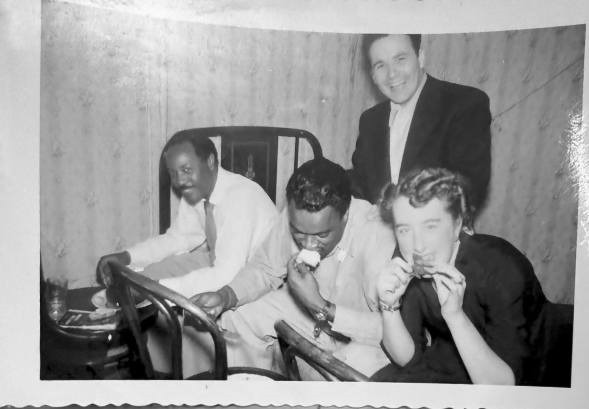
There are pieces in the scrapbook that may give us a glimpse into what its maker noted and selected to save. In the last post, we saw a picture of Hazlett playing on stage with a white bass player with the hippest of truncated neckwear — but overall, the performance photos show black musicians with him, playing (as far as I can see) to black audiences. Yet, here’s a photo from the scrapbook that stood out from that segregated norm:
.
In this photograph two black men (the one on the left appears to be Hazlett) are sitting on a cheap enameled-bedstead bed eating. Sitting on the same bed is a white woman and behind those three, a white man in a dark suit is standing. Black and white, men and the woman are smiling. It looks like an inexpensive hotel room, and maybe they’re all on tour.
On the back of the postcard they wrote: To Edith and Hank. So nice meeting you, it’s a pleasure to be an entertainer along with you. Jeannie Bill and Don
.
The scrapbook also collects this promotional picture postcard for an act called Jennie and her Boyfriends, who issued a single 45 RPM do-wop style record in 1959. Jeannie in the promo picture has a completely different hairstyle and hair-color, but it’s plausible this is her and one of the members of her trio in the bed-sitting photo.
Also in the last post in the series, we showed some clippings in the scrapbook of Black entertainers working to defeat limiting stereotypes, but one thing that struck me was that the scrapbook also contains clippings showing white entertainment figures. Ephemera in the book, like that MGM W2 form from ’44 and Los Angeles addresses for Hazlett make me think that he might have had at least tenuous connections with some of them during the 1940s. Here’s a page from the scrapbook showing a clipping featuring Lana Turner, which may have been included because its caption says Turner likes Duke Ellington records.**
Lana Turner isn’t into vinyl, she’s spinning shellac.
.
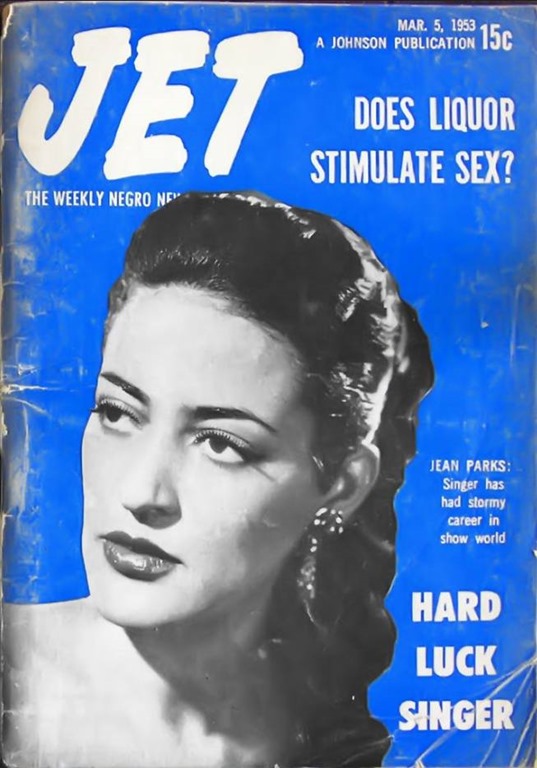
These are old clippings, sometimes from lower-res reproduction, and occasionally I’m misled by the ambiguities of race in the photographs. Take this one of Jean Parks found on this page with both white and Black entertainment figures. I figured she was white.
Find the second Afro-American woman on this page.
.
Those who’ve followed this blog will know that I was immediately saying to myself “Who’s Jean Parks?” The story outlined from asking that is as rich or richer than the story of Bruce Dybvig from earlier in this series. WWII military service put a crimp on the supply of male musicians — so just as with other occupations, there soon arose a number of female bands — Rosie the Riveter, only with saxophones. Popular pre-war bands often enough had female singers, and there were a smattering of woman pianists (and small-group guitarists) — but women playing horns, reeds, drums in big bands— important featured instruments in those ensembles — I can’t think of one. Then came the war and mobilization. All of a sudden there were groups entirely made up of Black or white lady musos sprung full borne from the brow as it were.
One of those was Eddie Durham’s All-Star Girl Orchestra. OK, now we’re studying history, so we have to do dates. It’s Victory over Japan Day, the war is over. In NYC a sailor grabs a nurse in a crowd without her consent, starts kissing her in front of a cameraman, and everything thinks this is splendid because the immense horrors of world war are over — and the, you know, sissy stuff of regular old living is to return. The All-Star Girl Orchestra are in the middle of an engagement on the opposite coast, in Oakland California. The link above says that manager Durham sees that the men are going to return — and just then, dissolves the act. Well, sort of. Some remainder is rebranded around singer Jean Parks. As it turns out, the post-WWII years will be tough for all big bands — and all-around, the all-girl band thing doesn’t survive the peace.
And here’s what happens when Parks meets the world of The Fifties. Just look at the bad-girl triple-double implied and indicted in this paragraph: Black, caught with a 6-foot-tall platinum blond “friend”/roommate, sex-work — and drugs? We got’em all: reefer, opium, cocaine. Other than a Communist Party membership card signed Mr. and Mrs. and documents linking her to a plot to cancel Howdy Doody, this is complete “All-Star” material.***
Seeing that other headline on the Jet cover, and suddenly I’m a teenager in the back row of the classroom muttering to a classmate “I must be drinking the wrong kind of booze.”
.
Two other pictures in the scrapbook seem to tell some kind of story about connections between the races, likely in Minneapolis in the ‘50s. There’s this snapshot, pasted on the same page as the similarly posed picture I speculated last time might be of a child of the Hazletts. I have no idea who Maxine is, or who’s Chuck. But as with the other pictures and accounts in today’s post, I’d reckon that mixed race connections like this had elements of risk beyond just social disapprobation. White school integration riots, Emmett Till, the beating and burning of the Freedom Riders buses, all were contemporary with the scrapbook.
.
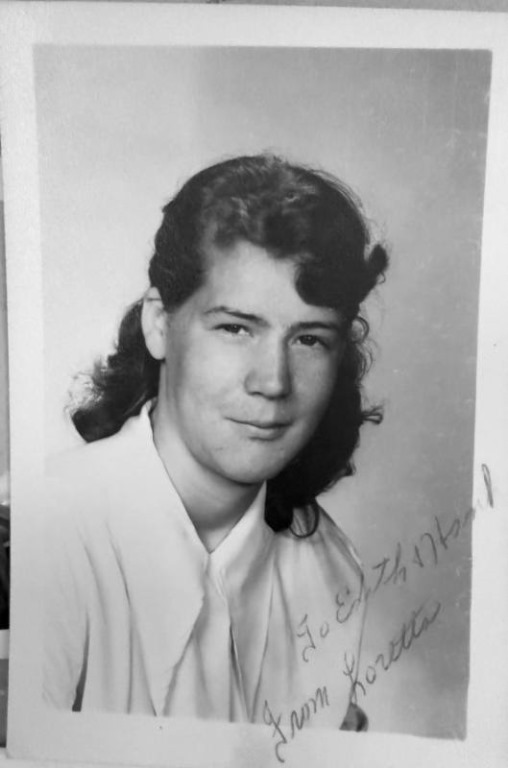
Then there’s this picture, inscribed to Hank’s wife Edith and so presumably from the early 1950s. So many of us have awkward school-picture-day photos, but I found this one more arresting than awkward. This is hard to detail, so I’m going to be more awkward than the picture, where after all Loretta is smiling and seems comfortable with themselves: Loretta looks quite masculine. Unattributed, it could easily be a 20-year-later photo of a mullet-head male guitar player in someone’s high school rock band. Burn-out the long-point blouse collar and retouch the long tresses in the back and it would be a 1950s boy who wants to grow up to play in Elvis’ band.
Loretta.
.
There’s no other context other than the inscription and being in the scrapbook. Looking at Loretta’s photo this month I immediately thought of “Get Back,” the Beatles lyric. Some of you may be singing the applicable verse in your head now that I’ve said that. My second thought: I’d love to know Loretta’s story, but there’s next to no chance I ever will.
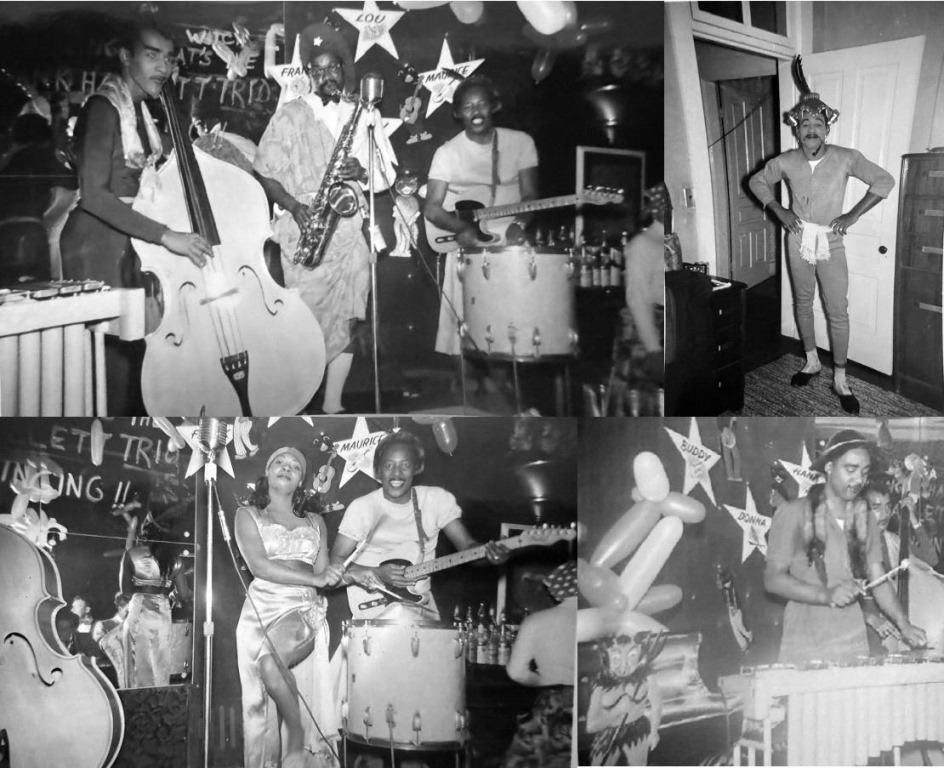
And now a transition that may or may not be apt. There are several pictures of Hank Hazlett, and Hazlett with his Trio, dressed in drag. I can’t place the club stage shown in most of the pictures. The Telecaster he’s playing says this is likely during the Fifties when he’s largely working out of Minneapolis, and it may be a Minneapolis club. Everyone looks like they’re having a good time, and dressing in drag is a multivalent act that can be meant to convey different things.
..
Everyone seems to be having a good time. Of course, right now we know it’s supposed to mean danger to children, and therefore we must let rich folks get richer so they can stop those goings on, because…religion. That’s a very serious opinion, mandate and all — you ought to pay attention to it instead of looking at this approaching 20,000 word series on — what? — a scrapbook about a Black musician who few have even heard of. And the scrapbook is mostly pictures, where’s the meaning in them? Of course, then there are these other Walter Benjamin quotes: “Those who do not learn how to decipher photographs will be the illiterate of the future” and “We collect books in the belief that we are preserving them, when in fact it is the books that preserve their collector.” Benjamin’s life, which we know more about than Hank, or Edith Hazlett’s, or Loretta’s life, could be called in to rebut those quotes. In a corporeal sense, he had little future, books didn’t extend his human, breathing, skin-coated living. But Benjamin did have his quotes, groups of words that might work like poems to let us see something new, and there are even some who will read philosophy at length.
There’s a new musical performance today, taken from a piece of folded and unfolded paper that was pasted into the Hazlett scrapbook. Did Edith carry it? Did Hank? On it, in faded pencil, are written 6 quotes, 6 maxims that someone wanted to carry in order to carry on. They are from a mixed-bag of writers, numbered 1-6 on the page, and in which order I read them in this performance: M. B. Whitman, H.D. Thoreau, Lloyd C. Douglas, Helen Keller, Herbert Kaufman, and Ambrose Bierce.
You can hear that performance with the audio player below. What? No player to be seen? Well, there’s injustice, carelessness, and cruelty we don’t see, and that’s a bigger deal than a couple of minutes of me dressing up in weird Jazz-band drag and reading some inspirational quotes — but you could use this highlighted link which will open a new tab with its own audio player.
.
*Marv Goldberg mentions that the Cats and the Fiddle might have had some involvement with the 1945 MGM Judy Garland film The Clock, which would have been several years and lineups past the original Cat’s quartet burst of Hollywood film appearances in 1938 — those all even before they had made their first appearance on recordings. A 1945-released film would have overlapped the time that Hazlett was in the Cats, could explain the 1944 W2. Mysteriously, I distinctly recall seeing a clipped advertisement for that movie when I first looked into the scrapbook years ago, thinking I should check the film out — but for some reason it isn’t in the scrapbook now.
***Like The Clock ad, I also distinctly remember seeing an article about someone in entertainment arrested for prostitution when I first looked through the scrapbook years ago. It too is missing now. The scrapbook was part of at least one move, and when I look at it now, I have to take care, as it’s falling apart. I now suspect that might have been more on the Parks case. The All-Star Girl Orchestra could have shared bills with the Cats in Hazlett’s time — they played the same theater circuit during WWII.
In the past few years I’ve enjoyed focusing here on Afro-American poets during the month of February. Last year, I dug in and did a bit more research on an understudied but fascinating Chicago poet Fenton Johnson, whose published work sits between the emergence and premature death of Paul Lawrence Dunbar and the Harlem Renaissance. Johnson became easily identifiable as a Modernist before his access to extant publications dried up in the 1920s, and I suggested last year that his poetry allows us to see —albeit silently on a page until I did some musical settings — into the formative years of Afro-American Gospel and Blues music before it made it onto recordings.
Here’s something I formulated for myself early in this Project as I found myself often looking at the rise of Modernism in the 20th century: a part of why Americans became highly significant innovators in Modernism has to do with Afro-Americans. Literary-only scholars might not focus on this inside their silo, but at the same time Pound, Eliot, Frost, Moore, Stevens, Millay, Williams, H.D., Sandburg, et al were reforming poetry, Afro-Americans were spearheading a revamped approach to music. Black poets like Johnson and Langston Hughes were hip to how those two things should be viewed together from the start, and after all, Modernism took root during the last decade called The Twenties under the banner of “The Jazz Age.”
That 2024 series on Fenton Johnson let me further express the musical part of the Parlando Project: “Where Music and Words Meet” — and it should also be obvious by now to regular readers that history is one of my interests. So, this February, like the Fenton Johnson series of last year, I’m going to get into the deep weeds a bit this on some lesser-known stuff.
I’m unable to schedule the Parlando Project work in a fully professional manner, so it’s likely you, if you follow along this month, will be going on a journey with me as I look into elements in real time. I may be revising myself before the finish, and if that gets awkward, let me say at the start that this isn’t some plotted-out documentary, I don’t know what all I’ll find. It’s likely going to be very first-drafty, so put on your reading sweater.
If this was an audio presentation, at this point there’d be one of those audio fades with reverb to suggest a passage of time now. From out of the echo my voice will be saying: “It all started in 1976 when I moved to Minnesota from New York…”
I was looking for a new start. It wasn’t entirely clear if I was going to continue intermittent attendance at college, which was both logistically and financially limited to me at the time. One advantage I had: doing nursing work in an Emergency Department was an easily transferable skill, I could go most anywhere that had a hospital, and maybe it would be good if where I moved also had a college. I settled on Minneapolis because I knew a couple living there from my Iowa college experience in The Sixties. One of that couple, Dave Moore has remained a friend (and contributor to the Parlando Project). Dave and his then wife had plotted out a plan for themselves. They were going to run a small mail-order used book business and needed a place to collect stock, store it, and run that business. They purchased (for an attractive low price) a large old house on Park Avenue in Minneapolis. Park Avenue was, in the last Gilded Age, a place where newly rich Minneapolitans built their mansions along a wide tree-lined street leading into the business center downtown. Now in 1976, this couple I knew were going in big on the sweat equity thing, rehabbing that house. The place, 3132 Park Avenue South, was built as a sort of a Junior-Grade Mansion. The 3rd floor, where the original owners had servant’s quarters would hold their stock of books which Dave was obtaining from aging bookstores that were beginning to close down or dump old stock. The other two floors would be their living space and nursery for the child they were planning to have. I could help a bit with the enterprise and rehab, and stay with them for a while.
It was a grand adventure. I had no builders skills, but mainly helped with the stripping of paint off the old woodwork and general lifting and toting. Work was already more than half done when I arrived. Dave told me that around mid-century the house had been turned into a set of small rentable spaces part-way between a rooming house and a set of apartments. Most of those changes had been removed already, and the book business part of things was more at my interests. For that, I’d go with Dave on trips to the basements of sole-proprietor bookstores, some closed, closing, or soon to close, to clean out old stock in their basements or back rooms. There was so much stuff from the 50s and the early 60s — before, you know, The Sixties. From ruined books I collected a small batch of lurid pulpy covers on these expeditions. The packrat in me wished I’d grabbed more.
This house on Park Avenue is just a location for the drama, a set for one of the acts I want to present haphazardly this month. The whole play is not extant. It exists only in fragments, a bad quattro. How do we raise the curtain?
Dave knew I had an interest in old Blues music, and somewhere in an interval after I was staying at 3132 Park Avenue and maybe as late as when I moved into the rented part of a duplex next door a few years later, he gave me a tattered scrapbook found when they were cleaning out those rooming house remnants. I’ve learned a lot since that scrapbook came into my possession. Let’s take a look inside as this series continues.
Can we accept a little fall-off from Rilke last time to something I wrote?
As long-time readers here know, the Parlando Project is about “Other People’s Stories.” Dave and I both write words as well as music, but I find it interesting to examine how I experience other people’s words, other people’s outlooks and visions. This project’s focus for the past four years has been an exploration—often into writers I didn’t know, or writers that I, and perhaps you as well, think we know because of what we have been told about them.
I was able to run this piece past a fine poet Kevin FitzPatrick,* before it reached the form you’ll read/hear today. He noted that I was working in my Frank O’Hara mode, and he’s right. For me in my 20s, O’Hara helped me integrate the French Surrealists with the American mode of Carl Sandburg,** with a Modernist touch of exoticism I’d retained from love of the English Romantics.
I had to remind Kevin that a big influence on this poem was his own poetry, about which a reviewer once said included so many “poems with other people in them.” Why, oh why, is that so rare? How many poems are about the poet’s own head space or solitary meditation on nature? Of course, that landscape can’t be avoided. And yes, some very good poetry can be written in that less populated country. Readers here will know how much I’ve come to admire what Emily Dickinson did. Though we now know that her life was not entirely that cloistered myth that once was used to define her, does her extraordinary corpus of poetry ever include another human character speaking for themselves?
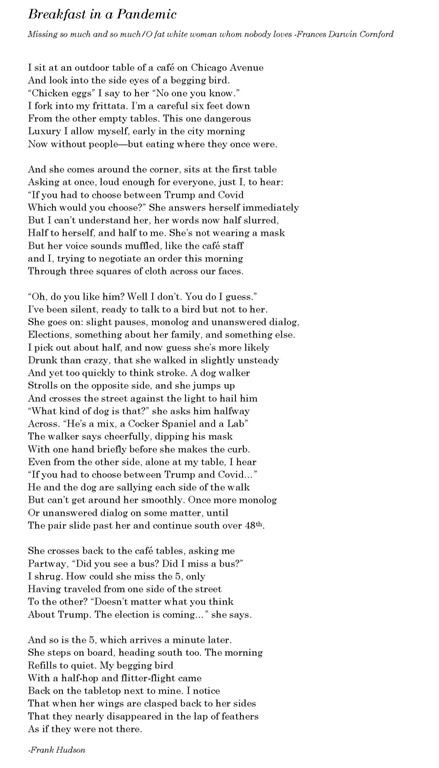
So, my poem starts out like a nature poem, albeit in an urban setting, and then another character breaks in and changes the poem. The music I composed and performed seeks to underline that. And a disease pandemic is, after all, a natural metaphor for our separation.***
A long poem for me these days. Some thought it could be shorter and some thought it could include even more detail . They’re both right, but that’d be another poem I decided.
In the text of the poem I use an epigraph from Frances Darwin Cornford’s“To a Fat Lady Seen from the Train.” Dave wondered if that might put off some readers. His concern has merit. Cornford’s poem (better known in Britain) is an earworm best known for being disliked. I have not seen anything from Cornford about what her intent was with the poem, and perhaps she had little conscious intent, thinking of it only as a catchy triolet. However, I think it’s a kind of pointed failed encounter and is written as such.
As I said above, the music here tries for contrast, with acoustic guitar and then drums and bass with a smattering of woozy strings and distant woodwinds. The composer in me isn’t sure the composition or the performer achieved all of his intent. The middle section may be taken at too fast a tempo. My late father who hated poetry read too fast would certainly think so. But I remind myself that plenty of modern spoken/chanted word is taken at a rapid pace, so maybe not.
The player gadget is below, so you can listen and decide for yourself. Stay well, valued readers and listeners!
*Alternative Parlando voice and keyboardist, Dave Moore had some helpful suggestions on it too.
**I don’t know what O’Hara thought of Sandburg, but I wouldn’t be surprised if it wasn’t favorable. Sandburg might have seemed too straight, and too yokel. But Sandburg was working often in the mode of Whitman and Hart Crane which O’Hara also was (along with O’Hara’s French language influences).
I’m still unable to think of completing new content here, but let me quickly follow up to say that we seem to have passed through the worst nights featuring the burn and bust cadres on Lake Street in Minneapolis. Which leaves only the sorrow and injustice, more than enough to tamp down my muses.
If plagues, oppression, and fires seem Biblical, then we get miracles too. Take the scene of the semi-truck coming down the freeway with thousands sitting on the pavement in focused protest just past a gentle curve. I have surely slighted the murmurations of crowds in a recent post, because they parted in an instant of flight seen in the video that looped over and over in coverage last week. Moses and Aaron never saw the like—not a single significant injury. Knowing America bristles with guns governmental and otherwise is not a comforting thought any night for me, but also the guns barking hardly at all* (so far) seems nearly as miraculous.
Plagues and miracles: additional phone video showed some of the first to the cab stopped retribution being taken on the driver.
I continue to be amazed and gratified at the racial diversity of the protests here. That shouldn’t be a miracle, but it’s noticeably different than the earliest BLM protests. This may be a result of the clear casual atrocity of the George Floyd killing or some “Great Awokening” kind of evolution. Call them the Prince Rogers Nelson brigade. Afro-Americans seem to be leading the protests and observances now and focusing on the issues and pain. When people jumped on the still crawling forward semi-truck and yanked the driver from his controls in the furious moment when several tons had just missed killing and maiming hundreds, it was Afro-Americans in the crowd who stayed the blows.
There’s been much chatter in the neighborhoods/local social media and in some mainstream media articles about who the smash and burn cadres are, and if they are in some organized sense. From watching hour after hour of coverage and trying to use what rusty “radar” I have from old activist days, I suspect at least some small-group organization aided by modern cell-phone tech and automotive mobility is a factor. When I talked to alternate Parlando voice and keyboard mainstay Dave Moore last week I said “Give me 50 agile young people with some hand tools and fire accelerants and I could create all the significant destruction of the past week.” Five teams of ten, even if they aren’t together, would work just as well. Largely unconfirmed reports have these as anything from leftish anarchists, to younger right-wing militia types who hate the police too, to drug seeking gangs.**
Multi-racial neighborhood people seem to be on edge about this. It’s not just some rehash of the old “outside agitators stirring up our good local Negroes” trope. As the protests become more focused and organized, they also seem more effective at recognizing adventurist acting out and curbing it.
When I spoke recently about the Gloomy Gus progressives, the ones who will sagely tell us how nothing ever gets better, and how this or that supposed progressive advance was an illusion or failure, I perhaps should have made clear I was talking to an element in myself too. My nature and life says the human condition is limited, even though it can store immense amounts of hate and love, creativity and indifference.
What are those limits? What elements will be part of the solution or part of the precipitate? What I think about these things, what I can do about them, is less important that what you and you and you think and do.
So, nothing new today, but here’s Dave Moore and I performing a poem written in a set of wet ruins by the supreme classical Chinese poet Du Fu centuries ago, and translated by myself. Was Du Fu a Gloomy Gus? Maybe, though like Robert Frost when he was lost or downhearted, he knew to press on anyway. Here’s the text if you’d like to read along, and the player gadget for the peformance is below unless you’re reading this with the WordPress IOS app (try using a browser instead to hear the audio piece in that case).
Jade Flower Palace – Du Fu trans. by Frank Hudson
The stream winds, the wind sighs.
Rats are running in the rafters.
The prince who owned this palace–
No one knows his name,
But it stands, abandoned beside these cliffs.
In dark rooms green ghost fires are shinning.
The streams now run over the boulevards.
From the trees I hear flutes? Voices?
Autumn leaves are wet with rain and rattle in the wind.
The young palace ladies,
Once painted on scrolls:
Now yellow dust buried in the earth.
What use now their robes,
their makeup and kohl?
And his gold chariots and the men who drove them?
There is only this carved stone horse.
I sit down on the grass and try to write of this,
But my ink is overcome by rain or tears
There are many paths away from here
How long are any of them?
None of them go on forever.
*One man reported shot and killed in what was sketchily reported as a looter/store-owner confrontation is all I know of. He seems forgotten in the surplus of events.
It’s been a rough series of days in the Twin Cities. Other than no great new loss of life (only fear of it) there’s not been much accomplished in my home or in my city.
I have a few new pieces in various stages of completion, and ordinarily I’d be working on additional ones for this project. This spring the pandemic quarantine measures have been bothersome, but so far Dave and my family have been coping and doing the best they can. Given the number of people sickened and killed by Covid-19, bothered and coping might as well count as “the best we can do.”
Then comes a public act of callous manslaughter. Worse for not being unprecedented. Worse for being tied to the sickness of racial oppression. We have a vaccine and a natural immunity for that: It’s empathy and love. Yet, many refuse to be vaccinated, or don’t have the vaccine available to them.
The phrase “the best we can do” has fallen into disrepute. Perhaps you’ve come upon this piece after reading or hearing someone else remarking on why this phrase is dispensed with, or should be dispensable.
For the last two nights the quarantine from the virus has been trumped by the fires and murmuring crowds. Crowds with the wisdom of crowds, which is to say, not much. Crowds work like a jangling overstimulated nervous system, tingling with pleasure and pain receptors, with a prejudice for why not.
My family, my friends, my artistic compatriots, my neighborhood are at the epicenter of this. Long time readers may know that alternate voice here Dave Moore was associated with a 20th century literary magazine that called itself “The Lake Street Review.” Minneapolis’ Lake Street is (insert here the English verb that needs to be invented that stands for the balance of hope/fear/despair in our present moment poised in is/was/will be) a multi-ethnic, multiclass (if mostly working class) strip of enterprises where you can get diapers, groceries, your prescription filled, that part to keep your old car running, foods from fast to global, places where bands used to play before Covid-19, bookstores, libraries, arts labs, paper and toner for your printer, intoxicating beverages, hardware stores, your laundromat-load destination, where you go when your car needs gas and air for the leaky tire. It’s were the Latin Americans and African and Asian immigrants have their shops. Lake Street is an early 20th century construction. Apartments still over the retail ground-floors in older buildings, houses and apartments right next door behind the stores, closer than modern codes allow. Great portions of this are now gutted, looted; still smoldering from last night or cold ashes from the night before that.
I’m sure what we live is a hugely interesting phenomenon for commentators, political philosophers, or folks just looking for a “news hook” to write or say something. Some will be civic sports-bar-tone arguments for who needs to be shot on sight for the sight of their targets, others will be earnest explainers about how rioting is the only effective language of the dispossessed, and that the wreckage of the places that a large percentage of those from the middle on down to the homeless frequent and depend on isn’t the disaster for them that it looks like to those less-evolved in their political consciousness.
As I’ve said already, I myself fear I’d dishonor this with my broken prose and dim eyes. And what old men think about this is less important than what those younger who may read this think, resolve, and do.
Yeats poem written while sequestered in Ireland with his wife during a civil war. “Stare” is a old name for the starling, considered a nuisance bird.
Beneath the beach, more paving stones.
Friends of my family since both our children were born spent the hours around midnight wondering if the unchecked flames from a torched gas station would spread to the homes next door. My neighborhood post office (the same one where Lake Street Review submissions used to come in) went up in big black smoke as it was deliberately broken into and set aflame. I’m not sure if anyone looted stamps.
My wife asked around midnight if we should flee.
“Where would we go?” I asked.
“Away from the flames.” She said.
All this is happening in a mix of memorializing assemblies at the site of the callous killing, protest marches with pointed aims, and then the looting and vandalism. I’ll offer one piece of observation that you may have not seen in the reports and thumb-sucking think-pieces: the memorializing, the protestors, and the vandals are an integrated lot. Skin tone and hair, those markers for ethnicities we use in our great cultural mythology of race, is My Rainbow Race in these events from the pious, to the protest, to the break and burn brigades. Watching cell-cam videos and media long-shots has impressed on me that the palette of the sufferers and perpetuators of these actions are not one shade. Racists are going to need to ignore these visuals as they form their illness’ distortions. The guy smashing the library window, setting fire to the auto parts store, or acting like a drunk frat boy he would never righteously be as he shoves the burning dumpster nearer to the building might well be white in these nights.* And the “Nothing-ever-changes” cadre of gloomy-Gus activists** are likely too tired and weary to notice that the white, Asian, and Latin American participation has increased markedly in this time’s repetition of events sad, demanding, and chaotic.
I used gendered pronouns in moving to the vandal side of things, as that part does tend to become a sausage-fest. My wife is going off to join others this afternoon to sweep up broken glass. Not to get into gender stereotypes here, but how much do you want to bet that the gender mixture there will be distinctive too?
Tonight, I do not know what will happen. The memorializers will continue to do so, for George Floyd is still dead. The protestors will continue to protest, for it’s still wrong. And the vandals, not even interested in the materialist desire of the looter *** for a case of beer, a flat-screen TV, a book of Yeats collected poems or LeRoi Jones’ liner notes will continue to maintain that the best refutation of a failed “the best we can do” is: “the worst we can do.” The tao is too strange for me to know. Blessed be if they are right.
This is all the squishy thinking and writing I’ll be capable for a while. Tonight, I will probably not sleep, or fall asleep in imponderables. Will my wife be able to sleep the night before our anniversary? Will someone’s laddish fire, set with self-congratulating righteousness, find its equivalent of four Birmingham Sunday-school girls? When will America’s Valkyrie gunfire (I say with dread: remarkably rare so far) begin to sing? Will progressive change crest and recede? How happy is Donald Trump, our king of misrule, as his empire expands while progressives proclaim nothing ever changes as proof of their progressive acuity. Tell me, I want to believe, I need comfort: are you sure too it can’t get worse?
I now return you to our usual cultural activities. The most popular piece I’ve posted this year is by a cultural nationalist poet from another nation: Ireland’s William Butler Yeats. When I posted it at the end of January I wondered if I’d done well by it, but I now think I did, and listeners seem to agree. I’m also now sure my reading of this text is shared-heart-true. If you have time, and are interested in the exact background as Yeats wrote this, read the original post linked here.
This is a week where I have been in my own little run-down tower, seeing out my window as Yeats showed me. Brothers and sisters, read the last stanza of Yeats poem in tears—even though they don’t put out fires directly.
Rather than a link to the text you’ll see it above in its entirety because I urge you to do that. If you’d like to hear my performance and music for this, the player gadget is below.
*Having tasted but not absorbed the fibrous materials of current cultural appropriation tropes, do any white anarchist allies as they smash the state at the library window, or get all dewy being a revolutionary fire-starter in a multi-ethnic neighborhood wonder if they are being authentically respectful of non-white culture from their skin privilege?
**I have long wondered at the futility of the salesman (as an agitator is, to a large degree) who paints their product as ineffective in use and their allies and audience as always deficient. I’m an old man. I understand being sick and tired. I’ll buy the “I can’t believe we’re still fighting these same old battles” T-shirt. But don’t tell me it itches, it’s guaranteed to fall apart, and isn’t available in my size.
***A few years back someone, who I cannot remember in order to credit, said that rioting with looting combines the two least attractive tendencies in American culture: shopping and violence.
A couple of weeks back a local music legend Willie Murphy died. I’m going to ask indulgence from this blog’s overseas audience, because unless you were around Minnesota in the last 50 years or so, you’ll likely have no idea who Murphy was—no, it’s even more location specific than that—I believe you need to have memories pinned within a few blocks of the intersection of Cedar and Riverside avenues, in a Minneapolis neighborhood near the Mississippi river known as The West Bank.
Many years ago the West Bank was a Scandinavian immigrant enclave, and it is now the home to Minnesota’s largest Somali community. But my story today is in-between, in the second half of the 20th century, when it was home to a thriving bohemian culture, immigrants of a slightly different sort.
Shortly after I moved to Minnesota, I got work at a hospital there, and when I had enough money saved up, I took classes at the University of Minnesota which spans the two banks of the river. I came late to the West Bank scene, but I absorbed the stories of those nonconformist young immigrants who were homesteading something that was called “the counter-culture.” The counter-culture was Willie Murphy’s job, as much as musician: putting together bands, recording other musicians, inaugurating live music venues, working and networking the scene.*
Willie and the Bees getting down somewhere in the past
But he was a musician too. Sang, played bass, guitar, and piano. Interpreted a lot of great R&B and wrote some good songs himself.
He was never the businessman. He engendered some of the things that entrepreneurs like to claim they do, but he never got the cash rewards. It’s a complicated story and I don’t know all the details—but I do know that he was an artist making art on his own terms right up until his last months of his 75th year. In one trope of musician’s slang, musicians “make the gig” or “make the scene.” Murphy lived that literally: he made a lot of gigs, helped make a scene.
Angel headed hipster. Murphy in his later years, still keepin’ on.
Mine’s a complicated story too. I eventually fell in love at the same time with two people who lived on the West Bank. There was music most nights and every weekend at a couple of coffee houses, a short-lived jazz club, a music school, and several bars, all of them within four or five blocks. And for my literary side, besides the University, there was Savran’s bookstore, which was well stocked with small press publications and poetry in several languages. In one’s Twenties many are imprinted on the culture encountered then, but the West Bank in the ‘70s seems an especially strong tattoo—and nostalgia fades in reverse.
Most change happens slowly enough that you never see it happening. One day you look over your shoulder and you see everything behind you isn’t there anymore.
Or you pick up a paper and see that Willie Murphy has died.
Most change happens slowly enough that you never see it happening. One day you look over your shoulder and you see everything behind you isn’t there anymore.
Or you pick up a paper and see that Willie Murphy has died.
I felt I needed to write about this, regardless of how well I could do it. The song I wrote “Willie Murphy (Is Always Playing on the West Bank)” has in-jokes and puns that only West Bank habitués will understand. In the first verse I twisted a line from Ginsberg’s “Howl” that also supplied the name of Murphy’s last band. Punned-in the name of some West Bank bars in the second verse, gave a shout-out to Koerner Ray and Glover in the bridge, and got in a sideways nod to the West Bank’s Mixed Blood Theater before I finished.
A week ago, I sprung it on the LYL Band and we gave it a go, with Dave Moore supplying his piano part off-the-cuff. You can hear it with the player below.
*Murphy recorded an LP with “Spider” John Koerner back in the 60s, and produced Bonnie Raitt’s first LP in the early 70s. Willie and the Bees was an integrated R&B band that mixed funky jazz and danceable grooves for a decade or so from the mid-70s into the early ‘80s.







 Frank Hudson