Young People Scream

Today’s post will combine a few things: there will be a link to a video of a new odd cover version of a song “Young People Scream,” written by someone who’s not Bob Dylan, and I’ll continue the behind-the-scenes story of how I’m making new musical pieces, but first I’ll explain why posts and interactivity from me has been low since the last part of June.

I’ve been sick for over a week with some kind of respiratory bug, and for a big chunk in the middle of it I was about as sick as I recall being for decades. At the worst, I was feverish and my stamina was very low — walking to the bathroom was a chore. I slept off on through a few days, and when awake I was foggy, unable to deal with any complexity.* Things have been improving over the past couple of days, though I still have a cough and tire easily. My wife preceded me with the same crud, and she’s still got her cough, so I’ll likely be dealing with that for a while yet.

I’ve been exploring some changes in how I record with my long-time friend, poet, songwriter, keyboard player, and alternative Parlando vocalist Dave Moore. A combination of things is suggesting those changes, part of which is that Dave’s playing skill-set has become constrained with age’s infirmities. I wrote last time that MIDI will give us new options to ground the pieces’ chordal cadences within modern computer recording software. Will this work, or do I even know exactly how I’m predicting it will work? Don’t know yet. I’m getting some more cabling next week that I’m thinking will offer some additional audio routing in my studio space for Dave, but today’s cover song recorded in June is an example of a way MIDI was used to shape a recording.

Super-quick intro: MIDI is a way to record things, but it doesn’t record audio. Typically, it records what actions happen when someone plays a controller — in Dave’s case, a piano-style keyboard. If Dave presses the C, E, and G keys on that keyboard, MIDI records when he pressed each of them, how hard he struck them, and how long they were depressed. The sound of that C Major chord we hear when those notes are playing together is created as a separate step. As he plays, a sound is heard, just as if he was playing an organ or conventional electric piano, but this sound is generated by software with only a small fraction of a second delay. An entirely conceptual composer could even play MIDI with no sound, but aside from Conlon Nancarrow humans naturally want to hear sounds when they use the controller keyboard.

As Dave played today’s piece live with me a few weeks ago, he heard a combo organ sound as he played and sang his part. There was a drum loop going to give us a time reference, and I played the electric guitar part you will eventually hear live with Dave and the placeholder drums.

Afterward I listened analytically to what had been played live. His without-a-net, one-pass vocal worked — and as I’ll talk about in the next segment, I discovered that I loved the song he chose to sing. My guitar part was meh, not good enough to feature, but not totally dire. That organ part? It had a few stumbles, but the greater problem was that the vocal had a nice laid-back groove, but the organ’s characteristic timing, attack, and timbre didn’t mesh with that feel. How to fix?

I extracted the MIDI from what Dave played, stripping things back to the chordal structure divorced from the sound. I used that chordal structure laid bare to guide an upright bass part, and using acoustic drum sample patterns I created a Jazzy-sounding drum set track. Having the drums, bass, and guitar grooving together, I used the program that extracted Dave’s chords for me to play that chord information derived from the live performance with a grand piano sound instead of the small combo organ Dave was hearing as he played them live.**

The resulting piece is here in this video.

.

Now what about the song that all this work was done to present? I suspect “Young People Scream” speaks to something some young people are feeling. Hell, I’m not young people, and I’m feeling this! Given that it was first released in 1982 by a still in his Twenties singer-songwriter Robyn Hitchcock, there’s a lot of ambiguity and context shifting when we experience the same song today — probably was so from the beginning too, because Robyn Hitchcock has a long career that I’ve admired of writing songs that are attractively elusive. He may do this using surrealism’s tactic, the remixing normal to seem strange, but in this one I sense asides to irony and satire.

Hitchcock’s own version on his Groovy Decay album was performed with a rock-a-billy arrangement. This would have been then a 30-year-old musical style, but one that had been revived by young musicians spinning off from the Punk and New Wave musical rebellion — and so, “Rock This Town” by the Stray Cats was a 1982 hit. Conscious or not, I suspect a certain slyness on Hitchcock’s observation and choice there: young people in 1982 using their parents’ youthful rebellion’s mode — a mode they’d largely abandoned with embarrassment as those thirty-something Boomers moved on to the modern Rock and pop sounds or the “Greatest Hits of the Sixties, Seventies, and the Eighties.” As the first verse has it, tweaking those younger rock revivalists by telling them “It all been done before” could get a “don’t care” reply.

Despite the upright bass in this current LYL Band version, it’s not hot-tempo rock-a-billy. Instead, I wanted to let the tension-releasing satiric vitriol delivered with a dry “just the facts” attitude by the singer come through. Even if he’s not literally screaming, I think the singer, to a degree of undercurrent, has to appear driven around the bend with their disgust at the older generation — and while I don’t know the author’s intent, I think Hitchcock’s words convey that indignation. The video ends with the on-screen statement it does because I’m “older people” and I’m disgusted, though my throat is still too sore to scream aloud today.

*It was difficult to read when awake, though I had some intense fever dreams while sleeping for entertainment. I did catch up on some episodes of A History of Rock Music in 500 Songs, which are outstandingly detailed and interwoven. If you like the surprising stories and unlikely connections I do here, and would like that sort of thing done at greater length and intelligent confidence within the world of Rock and popular music, you will like this too.

**The program I used for this, Toontrack’s EZKeys, does a pretty good job of automatic transcription. I’ve also used the Capo transcription app for this, but I think Toontrack’s chord detection may use some musical context information that Capo doesn’t in order to get closer to a useful chord sequence right off. Something that EZKeys clearly does: it allows one to apply music grooves or feels to the chord cadence it extracts, which saves considerable time. Those with good harmonic ears could of course do this by hand (with one’s ear? Musicians, we poets will dock you for mixed metaphor!)

All These Wild Geese Poems – and how one of my music pieces migrates

The route today’s musical composition took to existence was almost comically round-about. I added a new virtual instrument (VI)* drum set this week, one with a drier, more retro sound. I decided I should try it out. I grabbed an acoustic guitar track I’d recorded weeks ago, but not used for anything, and went to creating a simple drum track using the new kit’s sounds to see how they meshed.

It sounded pretty good, but that track-of-convenience guitar part had bleed from other stuff into the acoustic guitar mic, and so I used a tool I have that extracts a chord progression from an audio file, and then had that extracted progression played with a VI piano.

That cleaned things up enough that I figured I should make a little instrumental piece with this. Why not complete a trio and play some bass? Just over my shoulder in my little bedroom-now-home-office sits a Squier fretless Jazz bass.** I love its sound, but my old fingers need to be in good shape to get a clean sound out of it. Yesterday, my fingers were feeling strong, so that’s what I grabbed. I found a bass motif and played it in my best attempt to fit into the “pocket” of the drum groove.

A great musician or a more meticulous recordist might have perfected this, but something in me accepts a certain looseness and imperfection. Even if I’m recording one track at a time in one-man-band mode I’m often looking to get that spontaneous live-take feel, and my resulting trio had that I thought.

At this point my little house was filled with a half-dozen late-stage teenagers, all looking to have an autonomous time playing video games and watching YouTube. I holed up in my little office to let them be young. Might as well look to add another VI to my trio — if nothing else, to pass the time. The computer I work with virtual instruments on doesn’t have speakers, only headphones. Returning to the world between the cups of the headphones, I wouldn’t be bothering them.

What could be that another instrument? I decided to try cello. What articulation should I choose? My cello VI has a dozen or so articulations to choose from: different bowing techniques, styles for flowing legato or choppy stabs. I auditioned a few, and found two finalists I liked with the existing trio. Two roads diverged within a wood. Which one to take? I decided I’d use both  of the finalists.

I set the cello part to echo the keyboard part, a simple choice. I often enjoy simplicity in music, and my use of orchestra instruments often reflects that. I’ve taken to calling some of my pieces “Punk Orchestral” for this reason. Hey, ho, let’s go!

It was 11 PM by the time I finished the instrumental. The teenagers decided to decamp for a Perkins restaurant*** in a late-night post-modern way. Listening to the rough mix of the trio with the cello section I now thought this is good enough for a Parlando Project piece — I just need to find a poem for the words. I didn’t have much collected for possible imminent use. I had some Emily Dickinsons, but I fear I’m doing too much of Dickinson lately, as much as I like the results. I tried a Robinson Jeffers, but the mood of the poem didn’t match the jauntiness of the music’s groove. Then I tried a short poem I’d drafted in June, inspired by watching waterfowl in my city’s urban parks, lakes, and ponds. That fit!

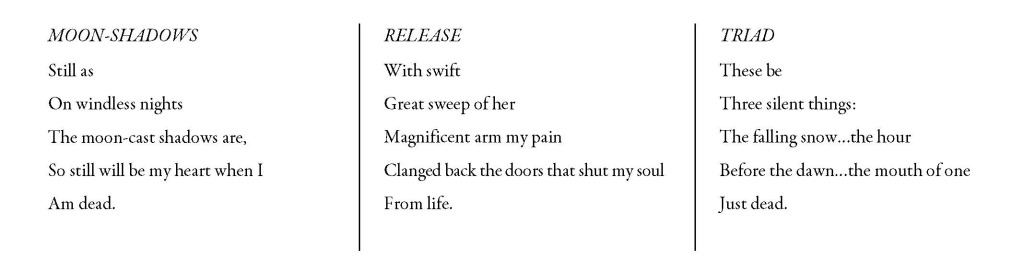
All These WIld Geese Poems text

The poem that became today’s lyric

.

I revised the music slightly to use with these words. Guided by the instrumental’s chords and using my imperfect voice, I devised an expeditious melody. I tried a couple of takes singing the words, and found that my poem sung better with some mild editing of its text. It was around midnight when I tracked the final vocal take you can hear today before going to bed. It was just after that final tracking that a comic turn happened. The drum track, the new VI sound I started with, that, which had inspired the course of this composition, stopped playing, muted itself. A bug perhaps? But in the early AM hours I decided it sounds better without the drums, as the other instruments now have absorbed the groove conception I started with within themselves.

Today I mixed the resulting piece “All These Wild Geese Poems.”   Mixing involves placing the instruments within the soundfield in stereo width and volume depth, and using other audio processing on their dynamic envelopes and frequency ranges. I then created the final mix using some computer tools to adhere to current streaming services loudness levels, and uploaded it to the service that shares my audio to play here and on the podcast platforms of Google, Apple, etc.

A Goose as Ratso Rizzo 600

You, poet, you’re not much of a goose, or much of a Yeats either, so get out of my way!

.

“All These Wild Geese Poems”  takes off from the many romantic poems about geese, cranes, swans and such large waterfowl. The urban geese I meet in my city nature are instead cantankerous beasts, and I thought our contemporary poems often take a similar stance, no pristine “Wild Swans at Coole”  musings for these birds — more at the famous Dustin Hoffman Midnight Cowboy  “I’m walkin’ here!” self-involved swagger with a limp. You can hear the performance with an audio player below if you see that, or with this alternative link that will open a new tab with an audio player.

.

*Virtual Instruments are precisely recorded sounds of the various notes and timbres of a physical instrument. Either by using compositional scoring, or the computer equivalents of that; or by playing the notes with a MIDI controller equipped keyboard or guitar, one can make reasonably convincing performances of instruments that one cannot play or afford in real life.

**I play interesting but relatively inexpensive guitars. Squier is an entry-level brand devised by Fender to sell low-cost versions of their famous instruments. Back in the 20th century any aspiring player found with a Squier was considered non-serious. “Real musicians” used “pro instruments” — but in the past decade or so the quality of the better Squier instruments has increased substantially.

***Perkins restaurants are like a Denny’s. Big menus with lots of senior-citizen specials and tastes —but open early and late for the time-expanding young person.

May Music Find a Way. Spring 2022 Parlando Top Ten numbers 7-5

Tonight is Jazz Night here at the Parlando Project Top 10 countdown. I’m going to ask the folks who come here for the talk about words to murmur down quietly today as I speak about the music.

Funny how these quarterly counts sometimes become nice little “sets.” Both today and tomorrow’s segments as we countdown to the most popular piece this past spring are as good as any planned ones I could have devised. So, let’s get the musicians on stage!

7. Sonny Rollins, the Bridge, 1959 by Frank Hudson.  Remember that the bold-face headings at the start of each entry in this countdown are links to the original post presenting them, where you can read what I had to say about it then. I had a lot to say about this one back in January, and so even though this is a piece where I wrote both the words and music, today I’m going to talk about how this (and many of our Parlando Project musical pieces) was realized.

With significant accuracy I hesitate to call myself a musician. My home instrument is the guitar, but even there my knowledge is not something to brag about, my skillset a bit unusual, but limited, and my consistency not up to a professional (or even many dedicated amateurs’) level. But I have a secret weapon: I can choose to compose or improvise (spontaneous composition) the things I present here. My Jazz guitar chops are not strong, but the chordal part was something I was able to execute. Listening back today to the second guitar part I improvised for this I think it was a good day with the wind at my back for me.

In another world I’d more often use other musicians who could add their skills to this enterprise, but logistically and financially the one-man-band approach is what makes it possible for me to express the variety of different musical ideas that I present.

To hear this or the other musical pieces here, use the player that may appear below, or this highlighted link.

.

6. Lenox Ave Midnight, an Extension by Langston Hughes.  Another little miracle pulled from my limited, if a bit unusual, skill set? On a good day I can do a passible impression of a guitarist, but my keyboard playing is always naïve. The advantage I can find? Modern MIDI lets me use my mind where my fingers don’t know what to do. In a piece like this I figure out some kind of harmonic flavor by trial and error and my sketchy knowledge of music theory. I played that part and then improvised a right-hand part, editing on a MIDI “piano roll” to correct bad dynamics or altering notes I didn’t like. To an actual pianist this could be called “cheating.” To a composer, it’s called “composing.” You see, I use the term composer protectively, because I really do feel ashamed sometimes that I couldn’t play in real time with two hands the keyboard parts that to casual listeners make a sound like I could. And I think: to a real pianist realizing this simple composition would be a trifle. To me: achievement!

Near the end of this piece, to open up its musical world before I speak the two lines I added to Langston Hughes poem (the reason I call this piece “an extension”) I did something I rarely do here, which I personally try to avoid, because it really does feel like cheating to me. I used a couple of small loops of recorded melodic material from Apple Logic’s free-to-use loop library. My composer’s need here was that my simple and not very convincing saxophone part, that I did play on MIDI guitar, needed something to camouflage those issues.

Why does this bother me to do? After all sampled loops have been part of popular music since the hip-hop DJ’s started dropping riffs from vinyl records. Because I use “composer” as my excuse, my get-out-of-pretender-jail free card, I believe I (or at least some human present in the room with me in the creation process) should have played or scored the notes. I think the two short horn section loops used here sound fine, helped make this piece successful for listeners — but that’s why I feel guilty for using that tactic. Whoever played them, devised those short motifs, didn’t know what I was doing, wasn’t working in concert with my aims.

Now look, I don’t generally mind when other artists do this. Returning to words briefly now: I spent many an April here performing the words of Eliot’s “The Waste Land”  which includes — even more than I imagined — squadrons of quotations and paraphrases from pre-existing works. Selection, curation, recombination, and recontextualization are easily defined as creative acts. Maybe my qualms and self-imposed rules in this have a most self-interested reason: I worry that the casual listener here will think I’m just reading poems over pre-recorded music, when I’m proud that I had to write and play and record the majority of the music on this Project, one track at a time.

Player below, or link.

.

Sonny Rollins, inspiring to me, yet my distance from that discipline shames me

.

5. Autumn Movement by Carl Sandburg.  I stopped writing this post here yesterday, because what I had written so far seemed embarrassingly solipsistic, pretentious, and uninteresting to my audience, and yet also because some of the things I’m feeling as I write about my musical work are hard to condense into a reasonable length post — to be better, it would be even more. And so here we are at this, my presentation of a short nature poem by one of my heroes Carl Sandburg, illuminated by lovely music I made for it. How am I to feel about it tonight? Amazed that I, a non-musician, was able to make it? Or something that feels almost like shame or embarrassment that I present it publicly, when there are days I can’t play anything of any value? Knowing enough to know that what I know as a composer (little) and what I can bring to the composer as a player (limited). Knowing that at my age (old) there isn’t much lifetime to remedy those things.

This, though I cannot say I have sufficient understanding or skills, is where Jazz comforts me as no other art does. Jazz is always confronting the empty sky. Always a critique of silence — and able to the fears inside silence, now, not later, and with surprise and failure. There can be no surprise without failure. I’m a small man, it’s a big sky and a big silence. There are better musicians, better composers, but it’s a big sky and a big silence. This the musician’s and composer’s prayer: may music find a way.

Player below, or link.

.

Three More Cinquains

Once more, let’s travel back to 1914.

For several months, as summer 1913 turns to ’14 through autumn and winter, a 35-year-old woman is creating the manuscript for her first book-length collection of poetry. Creating a book-length manuscript is always a challenging task, and regardless of whatever realistic expectations the author might have for its reception, hope is normally the fuel for this. First collections are like that, as a poet figures out how to introduce themselves to strangers.

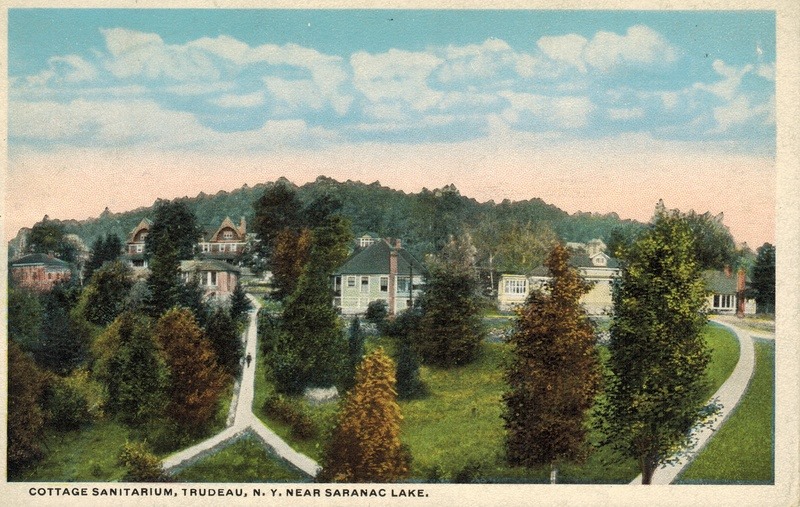
But this woman, Adelaide Crapsey, is also producing her final collection of poetry, and she likely knows that. She’s not working in her study or at some granted writer’s retreat, but at a sanitarium* where she’s suffering through the last stages of tuberculosis which has spread to her brain. If 1914 is The Year that Imagism Broke, it’s also the year that she will die.

Saranac Lake Cottage Sanitarium circa 1918

There are many paths away from here. How long are any of them?” Du Fu


The book that she is working on will be published in 1915, and it will be the place where she’ll introduce her own poetic form, the cinquain. The cinquain is a short five-line verse form, primarily iambic, that uses an increasing series of syllables: two in the first line, four in the second, six in the third, eight in the fourth, and then back to two in the final line. Some have noted that the increase creates an expectation of growth or expanding sense, only to have the ending come up short and terse. I’m not the first to see this as a symbol of Crapsey’s life and art itself.

Still it’s remarkable that Crapsey chose such a small, tight form into which to pour her thoughts on illness and approaching death. Some might choose a short but loose form to conserve energy; others might turn rangey trying to get all their last expressions in. Crapsey seems to find in the form’s limits the borders within to hold her place.

Three More Cinquains from Crapsey

Here are the three cinquains I used today. Illness and the eventual passage of dying is something we all share. Crapsey used tiny poems to bear vivid witness.


In the early 20th century world of Modernist American poetry, her tragic story lent a degree of publicity to the posthumously published book, but it was a small fire which soon burnt out. As I mentioned last time, extremely short poems and the direct lyric impulse is not where Modernism headed after the 1920s—but in the long run, we can still access these poems the only way that poetry can be reached: by directly taking them inside us. These cinquains don’t ask for a large place.

For my performance of three more of Crapsey’s cinquains of 1913-1914 I composed music for strings which sounds acoustic even though there is some spare, bell-like Rhodes electric piano and a cello line that is treated with a strong resonant echo that I think adds some poignance. I don’t know where this melody and counterpoint came from, but as I tried and played some string lines on my MIDI guitar it came to me quickly, as if out of the air. You can hear it with the player below.


*Looking to see what I could find about a Saranac Lake sanitarium I found a fascinating story about a small upstate N. Y. town that welcomed tuberculosis patients for palliative therapy in the early 20th century. Other literary residents after Crapsey included novelists Allan Seager and Walter Percy. On first reading “sanitarium” I had visualized a large dreary hospital building, but the setting appears to be surprisingly humane. Coincidentally, the remaining buildings were sold a few weeks ago.

Conlon Nancarrow

A great deal of what you hear me play here is made possible by a 1983 invention, MIDI (Musical Instrument Digital Interface), a standard for communicating musical commands. MIDI lets me create piano parts I can’t play with my non-pianist fingers. I tell MIDI what to play, and MIDI then instantly responds by playing those notes on an instrument so I can see if they fit.

Given MIDI, I as the composer can have the equivalent of a pair or more of pianists willing to play as simply or complexly as I want them to, and not only are my MIDI pianists totally compliant, they can be preternaturally skilled as well, willing to play odd rhythmic displacements or impossible fingerings.

In the years between WWI and WWII, a young musician of no great wealth or social background was studying composition in Boston. He was said to have crossed paths with some of the giants of 20th Century music there, including Walter Piston, whose Harmony  book I once started many decades ago, and Nicolas Slonimsky whose book on scales later became a huge influence on John Coltrane and Frank Zappa.

However, the titanic forces of world events would soon sweep him away from all this. In the 1930s he joined the Abraham Lincoln Brigade, Americans who volunteered to fight the Fascist forces seeking to overthrow a republic in Spain during a war that served as a beta-test for World War II. This was a complex event, but all we need to know for our young man is that the anti-Fascist coalition was defeated, and the survivors who had fought for the Spanish Republic ended up as men without a country.

Earlier this year I was reading some 1939 writing by Herbert Read where he was appealing for support for a plan to transport these Spanish war survivors from French refugee camps to Latin America. Our young man, who’d hobnobbed with key musical theorists before becoming a “premature anti-Fascist,” soon found himself in Mexico City, perhaps as a result of this plan.

It was there our exiled young man took a technological step as a composer. He chose to write his music using “player pianos.” Player pianos, also called “reproducing pianos,” were a home entertainment fad from the era before better quality electronic recordings. An elaborate clockwork rolled a scroll of punched paper across mechanical sensors inside the piano which then drove the hammers to strike the piano strings. Scrolls of piano music, some recorded and played by the famous performers of the early 20th Century could be purchased, and when inserted into the home player piano, and played back with musical fidelity.

Our young man’s name was Conlon Nancarrow. Over the next few decades he exploited the player piano, not for parlor entertainment, but to create striking Modernist music of otherwise unplayable complexity. He was hip to new varieties of rhythm and harmony not only from other 20th Century “serious composers,” but from Jazz too—and the mathematical structures of Bach-like cannons were well suited to the looping scrolls he would punch himself. He wasn’t reproducing music someone played, he was producing music he conceived and punched into the controlling scrolls.

In the first few decades of his work Nancarrow had no funds, no grants, no copyist/assistants, no local orchestral resources to realize his musical ideas; but this one artist, a player piano, and his own score-roll punching could produce work needing only himself and his ideas to sound inside his small Mexican apartment.

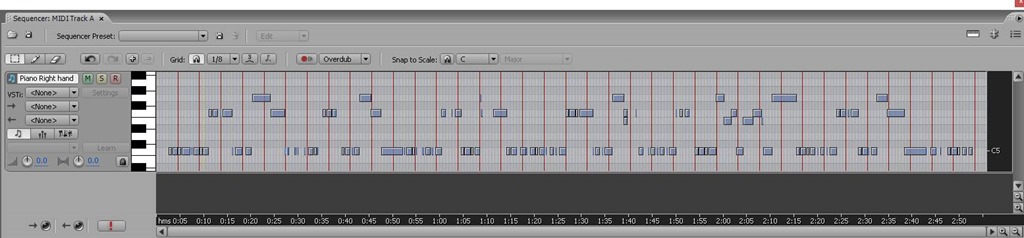
Except for it’s painstaking, mechanical, cuckoo-clock handwork, what Nancarrow did is schematically like how one can use MIDI today. In a tip to this heritage, MIDI scores are still shown on the lit-up computer screen like player piano scrolls.

Nancarrow Piano Part MIDI score

“Stuck in holes which once were dots”
One of the piano parts for today’s piece shown in MIDI “piano roll” notation


In 1969, using the high-fidelity home entertainment media of its age, an LP record of Nancarrow’s works was issued on a major, well-distributed record label (Columbia, the record company of Miles Davis, Bob Dylan, and Gary Puckett and the Union Gap). That’s when I first heard him. Acclaim in avant-garde music circles, and some grants and touring followed until his death in 1997.

In some ways the typical Nancarrow piece sounds like an artist who when finding out the vast capabilities of his new technology decides to use all of them. At once. A lot. Typical tempos sound like someone playing a recording at the wrong speed—and backwards. The number of simultaneous notes can be overwhelming, the intervals jarring, the rhythms insane. It’s challenging you to understand it, and it’s not a matter if you want to, you likely cannot. As with some avant-garde music, repeated listening (if one allows it) can increase comprehension of the ideas, but Nancarrow is never going to be shoving Billy Joel off the piano bench in popularity.


“Punched polyphony in a row” A Nancarrow scroll plays.


No, the reason I wrote this to celebrate Nancarrow isn’t because I think you’ll like his music, or even because he’d figure in any Desert Island Discs episode in my future (though through castaway days one might find the time to try to untie all the knotted ideas in a Nancarrow piece). No, it’s because I admire that kind of audacity and perseverance.

I originally wrote music of an acoustic guitar “folk song” sort, even though the poem sought to make use of eccentric meters and a tricky rhyme scheme to reference some of Nancarrow’s ideas. Today’s version has new music I wrote which fits the words better. Using MIDI-controlled pianos, it’s sort of “Nancarrow-lite” musically. To hear my audio piece for “Conlon Nancarrow,”  use the player below.