In Another Language

I mentioned last time that I’m cleaning out things I can no longer reasonably expect to use, and found a box which included poems by my late wife. Perhaps such things are past the use test, but I asked what use can I make of them?

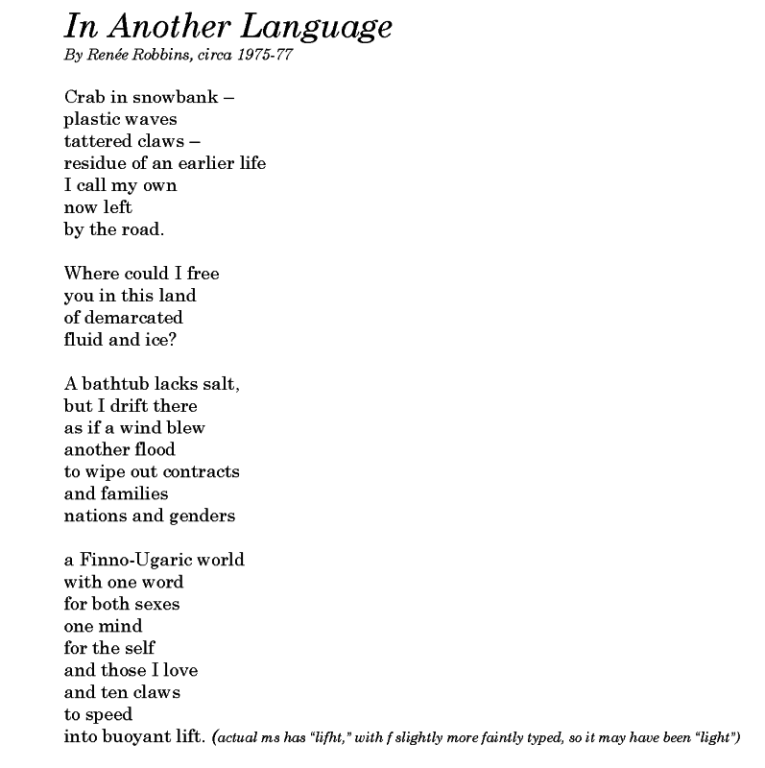
After paging through the papers, I transcribed the handful of poems I found, typing them into documents on my computer, a now ordinary device which would have been a SciFi marvel to her back when she wrote these poems in the 1970s. Could I perform some of them, here, as part of the Parlando Project? Could that seem like special pleading, an enforced overlay of widower husband wants you to shed a tear for his dead wife? Let me try to move you past that. Decades after a death, and when one is old enough to reasonably consider one’s own death to be a nearish interval, shorter than the one from that loss, loss begins to take on a universal and obligatory aura. These aren’t sentimental poems – my late wife, Renée Robbins, was funny and was wearing the full costume of life when she wrote them. Those costumes of life go back into storage, kept for use in later productions. Perhaps her poem “In Another Language”  can be worn by someone still treading the boards?

Yes, these poems are little pieces of someone I loved deeply, written early in her too-short life, and bringing them on to you extends a tiny bit of what she was. Yes, it was particularly nice to feel I was working with and playing this part of her when I performed this poem this month – but yes too, it’s October: everyone’s wearing costumes and pretending they can see ghosts.

I can hear her responding to this situation. How? I’ll explain it with a quote from Woody Allen* that has been reverberating through my mind:

I don’t want to achieve immortality through my work; I want to achieve immortality through not dying. I don’t want to live on in the hearts of my countrymen; I want to live on in my apartment.”

So here you have it, a poem likely written while she was still in college, studying writing under Howard Mohr and Phillip Dacey. I’m fond of the obscure strangeness in the framing image. I can’t be sure what she, the author, was seeing. My best guess is a whole crab or lobster on ice in a seafood display, a mundane piece of unintended Surrealism – and being in a world of frozen water is also an accustomed strangeness to Minnesotans. I like the poem’s leaps, like the dream of the crab escaping to her bathtub, and the totally unexpected leap into the genderless cross-shifting-borders of “Finno-Ugaric.”**
In Another Language

Besides the crab image, I see Noah’s flood in the third stanza. I chose “lift” from the alternatives for that last line because it’s more sensual.

.

I performed Renée’s poem in a style that still hadn’t gone-out-of in the Seventies, as spoken word with an approaching-Jazzy musical backing: drums, bass, and two electric guitars. I believe the music, taken by itself, might shows the subliminal influence of a current band, Khruangbin. It’s subliminal because I don’t use as much reverb.

So, there you go. Looped through with the footnotes, we’ve got Khruangbin, Krasznahorkai, Woody Allen, my late wife Renée Robbins, Phil Dacey, The 1970s, and a fifty-year-old poem by a twenty-something. There’s a lot of intervals and strange harmonies there, but I’ll end with another quote from an artist (actually, from his less famous brother). I read this one in a recent interview answer given by Ken Burns when asked how he makes those famous “Ken Burns Effect” intelligence flights over photos as he edits his work:

It’s all music—my brother, Ric, said that all art forms, when they die and go to heaven, want to be music.”

So, there you go Renée, not immortal from non-dying – but you get music.

As you can see today, we stay narrowly focused on the topic here at the Parlando Project, and we will return with poems by more famous literary poets soon – but to hear Renée’s poem “In Another Language”  as I performed it with music, use the player gadget below. No graphical audio playing gadget? I offer this heavenly highlighted link that will open a new tab with its own music player.

.

*I know a fair number of possible readers of this have strong opinions when they hear his name. I’ve got at least half of those myself. There’s a second, artistic, set of subjects regarding his work that would overwhelm the focus of this piece. To stay on topic, let me just say that my late wife was a comedy fan who could recite from memory the entire 30-minute Firesign Theater Nick Danger radio drama parody, and that Woody Allen movies were a constant date night thread in our relationship. Renée had opinions too, consistently caring ones, but she would have laughed at that quote, and I’m laughing now too, but with a deeper resonance to that laugh.

**My memory of seeing Woody Allen movies with my late wife was intensified by the recent death of Diane Keaton, but there was even more coincidence as I worked on this: the Nobel Prize for Literature went to László Krasznahorkai, who writes in a Finno-Ugaric language. And yes, that language group is non-gendered, even the pronouns – at least from what I find when I checked on Renée’s reference in her poem. And if I may risk one more Woody Allen reference, in my life back then I was (roughly speaking) playing more the Annie Hall role.

I had a guinea golden

It’s known that Emily Dickinson played piano, but my scattershot scholarship doesn’t inform me if she played any other instrument, or exactly what kind of music she played or appreciated. Many of her poems use hymn or ballad meter, and I was still a young person when I first was told that you can sing many a Dickinson poem to the tune of “Amazing Grace,” “The Yellow Rose of Texas,”  or “The Theme to Gilligan’s Island.”

That factoid tells us that her metrical musical inspiration is hard to pin down, for in her 19th century a great deal of music followed that form. By our time, ballad meter is heard as presenting a certain kind of old-timey folk-music vibe — in Dickinson’s 19th century a wide variety of more or less contemporary music used it.*  Did she ever sing her poems, or perhaps noodle a tune on piano while composing poetry? I know of no accounts. Still, when I ran into this early Dickinson poem, written by her as a twenty-something before the bulk of her poems followed during her highly productive thirties, I couldn’t help but think of it as being made to be sung.

“I had a guinea golden”  is a poem about loss of friends or lovers, and it’s not hard to think it a characteristic work of someone in their twenties. Dickinson grew up in a dynamic time, in a small college town. Her school-and-college-age friends would, as they likely would today, be due to scatter to occupational and romantic opportunities during that decade of life, and the biographic data on Emily Dickinson would give us a goodly number of separations from meaningful people in her life during this time. From memory, I can think of only one who was separated by death in this part of Dickinson’s life (Benjamin Franklin Newton) — and I mention that because it may be impossible to be certain about how seriously Dickinson took this poem’s lament at losses.

My suspicion is that “I had a guinea golden”  is layered. That it catalogs more than one loss (the guinea coin, the singing robin, the bright star) and takes time to note that each of these losses are not generally the loss of wealth, bird song, or a starry firmament seems to say to me that these losses are less serious than they feel. In letters to those Dickinson longed to hear from, she often takes a stance that she feels betrayed or onerously deprived of contact from her separated friends. In the informality of friendly correspondence that reads as playful there, and so it could well be here in this poem too. As we reach the poem’s — now song’s — conclusion, I suspect this lawyer’s daughter (unlike our country’s mad king) well knows that unforgiveable treason is not actually indictable just because someone has traveled away from Amherst. But even if playful, the piece does speak to how these losses feel, and in performance I chose not to wink at the pain of the symbolic losses portrayed.

Guinea_1775

Back in 1775 this mad king was taxing and tariffing Americans out of spite, and sending government troops to “protect” American cities that wanted no part of his chaotic misrule. This was the gold guinea coin that might have paid those troops.

.

Well frankly, I was glad to be able to use the limited instrument of my voice once again to record anything. Since late June I have had some kind of flu or respiratory bug that had me greatly fatigued, coughing, and so brain-fogged I could read only superficially. I’m not sure that intentional irony has yet come back fully online, so I performed “I had a guinea golden”  as a serious lament. I’ll let Dickinson’s words and the listener provide the layered context. You can hear my performance with the audio player gadget you should see below. No player visible? “Treason!” “Exile!” “Avicide!” No, it’s just that some ways of viewing this blog suppress the player, and so I offer this highlighted link that will open a new tab with its own audio player.

.

*Poets too, including ones we know Dickinson read, used the format for literary ballads not necessarily meant to be sung.

Dirge Without Music

I’ve worried a bit lately that I’ve been doing too many Parlando pieces presenting sad poems. It’s likely that mood is part of my nature despite living a life I’m grateful for — perhaps even more so because I live a life I’m grateful for, and I’m therefore aware of its temporary nature that I cannot keep. Because of this, I’ve kept a quote, a suggestion, from Kurt Vonnegut close to me:

I urge you to please notice when you are happy, and exclaim or murmur or think at some point, ‘If this isn’t nice, I don’t know what is.’”

Vonnegut wrote this in one of his last books, one that might again speak to my mood in this state of my nation and its ideals, A Man Without a Country.

At my age, it’s no longer morbid to think about death. This past weekend my wife and I went on a goth date, and visited one of the fancier local cemeteries. We mostly went for the 1910 main chapel building full of early 20th century William Morris/Pre-Raphaelite derivations which echo back to the start of the era I mine for a lot of the poetry here.*  The cemetery was taking part in a special open-house event held around the Twin Cities offering more access for the public to “behind the scenes” parts of the facilities.

We walked by famous early citizen’s gravesites, some elaborate with statues and such, and then too the many small vaults with names and dates on their file-cabinet sized faces. One room’s space was maximized with rows floor to ceiling across the room — so much like a library, even up to having a rolling metal staircase that would facilitate viewing the topmost. Instead of spines one views in those tall rows names, and partner’s names, and those bookend years. Every one of them, like every book I suppose, expects that there’s someone left to see and remember them, and I paused to consider that that wasn’t always so.

In another part of our tour, another portion of my nature was stoked. Walking by the cemetery’s crematorium, I noticed this homely implement hanging on the wall. As the old prayer book has it: ashes to ashes, dust to dust — and that passage now had a corollary: and dust to pan.

Dome and Dust Pan

Part of the main chapel: tiled mosaics, stained class, intricate motifs, capitol mottos. Crematorium: clean, professional, and an inexpensive hanging broom and plain white plastic dustpan, the same model as hangs in our home pantry.

.

Oh, it was a beautiful Spring day, full of decoration, full of evidence of grief, inscriptions of loss — and to the puritan, evidence of vanity. Life is so big, or so small, we must laugh at it.

Which brings us to today’s poem I’ve performed with music: Edna St. Vincent Millay’s “Dirge Without Music.”   I had finished this piece earlier this Spring, but at first held it back because I feared it was too much like some other musical pieces I was working on — and then after those coincident issues expired, I started to worry that it was too much-more sadness. Revisiting it this week, I now think no, it’s not just bleak — it’s a bald-faced statement of honest feelings about death and loss. Here’s a link to the full text of the poem.

In writing music and preforming this poem, am I disrespecting the author who titled her poem “…Without Music?”   I think Millay’s intent here was to speak against sentimentally decorating loss. Loss has patterns, resolutions, codas, and rests — and music too, even if it has repeat marks, has an ending measure — but music’s part of the equivalence is so often beautiful. In such ways fine poetic word-music, as well as that with express melodies, may speak over loss, interrupt it. Perhaps my rough-hewn voice with its limits and plainness, its lack of precise or elaborate lyricism, is apt for Millay’s mood here?

You can hear that musical performance of Millay’s poem with the audio player below. What if you see no player? That’s likely because some ways of reading this blog suppress showing it, but this alternative highlighted link will open a new tab with its own audio player.

.

*A few years back here I did a series on “before they were Modernists” with early poems by some Modernist figures. More than a few had roots in those retro-hipster movements of the late 19th century, and many a free-versifier had carried around a Swinburne volume in their youth.

Libertad! Igualdad! Fraternidad!

We’re going to have some William Carlos Williams poetry turned into a song below. If you’ve missed that sort of thing from me, I’ve returned with time to focus on what we do here.*

I think I’ve already mentioned that I’m disappointed in my country and its follies this past year after the national election. I could take your time and patience with some personal punditry on where to apportion blame for this. The electorate? The winning vassal party and it’s red duchies? The oligarchs and emperors ever-richer and more protective of prerogatives? And then too, the losing party, who gets apportioned blame for everything else on the list as well as bearing the sting of defeat?

I’m not going to do that. A complete list opens up the vulnerability of adding one’s own self to the blame. While many personalities have strong defenses against that self-indictment, I’m not sure if that’s a good or bad thing. By now, if you wanted any variety of that, you’ve already had your fill. Rather, if you’re on the side that lost, you might feel left alone. As we approach the new regency in a matter of hours, let me repeat something I said after the election: we can, we should, forgive ourselves for hope. It is a right-sure prediction that we’re going to need more not less hope in the next few years.

As we approach the new regency in a matter of hours, let me also repeat something I said after the election: we can, we should, forgive ourselves for hope. It is a right-sure prediction that we’re going to need more not less hope in the next few years.

Further in that feeling alone — except for the exchange of blame and shame — I’m not thinking this group are presently at risk of being visited by reporters seeking to understand their sorrow, fear, disappointment, despair. They’ve had over 60 days to file those “I must understand them” stories, but there’s a general silence on that front. Perhaps there will be some stories of the manifestations to come of what some of us fear — though if the worst fears come, those could be harder to find, and stories after injury may be less efficacious than the now-impossible to file stories that could have come beforehand.

Libertad!

I urge folks to sing these Parlando songs themselves, so here’s a chord sheet for today’s piece. Some will likely do a better job than I do, and additional voices strengthen a song.

.

So, I was happy to find, write music for, and sing this short William Carlos Williams poem this winter, even though it was written back in the last decade called The Twenties. I too feel forced into the mud, and so much now depends on the stink of the ash-cart rolling toward us. You can hear it with the graphical audio player gadget that should appear below. No player? No editor looking over his shoulder at their owner-baron has spiked it. No algorithm has ruled against it in court. The audio gadget has always been impartially suppressed by some ways to view this blog — but you can use this highlighted link to open a new tab with its own audio player.

.

*This isn’t the first holiday season that has caused a drop in new pieces or posts, but I’ve spent a good deal of time in this cold bilaterally looking January shopping for a replacement for my 20-year-old car. I had previously figured I’d wait until that car had reached its full majority this upcoming fall to shop for a replacement, but like some others I played the odds that new tariff taxes and repercussions would raise prices.

They Flee From Me

Somewhere in the early 16th century, a member of the English royal court Thomas Wyatt wrote a love poem, or rather a poem of lost love. Like Shakespeare’s sonnets, no one knows if it’s autobiographical, but ever since I first read it as a teenager I’ve thought it feels real. Maybe after this many centuries that’s good enough.

If so, then “They Flee From Me”  is an example of the presentness poetry gives us. Begin reading (or listening), as I did decades ago, and one moves through the rich conceit of the poem’s first stanza where the poet fancies he’s feeding some animal, likely a deer kept for private sport hunting in some rich nobleman’s deer park. If one knows that situation, then the tender animal lured inside by the kind-seeming human offering it food may put one in a piteous mood. Poor thing. It doesn’t know what the situation is, what the structure is of a nobleman’s deer park. You’re there to show that nature can be purchased and ruled — and you’re there to be killed at will.

Thomas Wyatt

Although a later engraving, this is thought to be an accurate portrait of Thomas Wyatt. Wyatt also introduced the sonnet to English language poetry.

.

Poetry and its metaphors can do that, it can be clever, show us, if we pay attention, something we otherwise might have overlooked. What if we move on to the next stanza? The poem’s speaker seems to make a shrug at the first stanza’s piteous situation. Then three lines in, something else vivid happens. We may never have visited a royal deer park or lived in the particulars of Tudor royal prerogatives, but something occurs that we, now, here, may have exact sense memories of. It’s no longer a deer now, and the hands are no longer someone feeding the doomed deer kept in half-natural captivity. The hands are a woman’s. She’s embracing a lover, loosening her clothes. Anyone who knows desire knows this scene and may feel the ardor, today as in the 16th century. Like the deer being hand-fed, it feels tender, feels mutual — but that first stanza has warned us.

Last time we had Emily Dickinson bid goodbye to some fairy creature or garden animal under the stars with a line that would one day be used by Bob Dylan: “You’ll go your way, and I’ll go mine.” Wyatt’s final stanza — is that a shrug at the parting or a generous admission of non-ownership of the two lovers to each other? We are left with final lines after we know the lovers have parted ways. The poem’s speaker tells us they feel “kindly served,” and what does she deserve — as fond a set of memories perhaps? If so, we can leave this poem casually and think kindly of long-separated loves in our lives with good wishes for theirs.

But the poet went to the trouble of setting up the captive deer in the first stanza. Do they mean to go beyond a pun of deer and hart and dear and heart? Are we still to liken the poet’s situation (or the woman’s) to that hand-fed deer as they wrap things up. “Nice park, nice grub, and they bring it right to you!” that deer might have thought, but we know why the deer are kept. If we leave the fancies of poetry and move onto the lives that give it blood, I’ll end with one supposition that’s been made about “They Flee From Me”  — that the poem is autobiographical for Wyatt, and that the woman is Anne Boleyn. Boleyn, one of King Henry VIII’s doomed queens, was executed explicitly for, well, slipped gowns and how like you this. Wyatt was also arrested and imprisoned in this matter, but his connections with the King’s fixer Thomas Cromwell trumped the charges.

Accept that, and the final two lines are then not so much a graceful farewell, but a deeply bitter assessment of deadly political power.

My music today could not be made in Wyatt’s time. I used acoustic guitar while the lute was more Tudor style. Then there’s a conventional cello part, but on top of that is an unusually articulated viola part which I meant to sound more like South-Asian bowed strings. To match that viola, there’s a tambura and harmonium underlayment in the music. To hear my performance of “They Flee From Me”  you can use the player below, or if you don’t see that, you can use this highlighted link that will open a player if you don’t see one.

.

Palingenesis — three anniversaries noted

Today’s post is part of observing three anniversaries this week: this blog’s launch six years ago, Atomic Bomb Day (noting the anniversaries of the bombing of Hiroshima and Nagasaki), and my late wife’s death in 2001. An odd combination? Well, yes, but they coincide.

Odd? Personal loss has an odd size. If one holds one’s hand in front of one’s eyes it can block out the entire sun. How close grief is to one, has a similar effect. When the 9/11 plane crash attacks occurred a month after my wife’s death, it was objectively a sad, horrible, thing. To some small and nearby degree it impacted the place I worked. There were employees traveling, in the air as the attacks became known. We had at that time a floor of offices in a tall local building in St. Paul, over a thousand miles away from the attacks, but a tower named at that moment ominously “The World Trade Center.” And the radio network I worked for had a large news component. Everyone and I did what we needed to do in the wake of the attacks. It was not that I did not care or have consideration then — but the sharp pain of that public grief could not be felt to the same degree in my self still encased in loss.

So too the atomic bomb attacks on the two Japanese cities must have been in 1945 to many Americans. Some had lost loved ones in that war, some feared for losses to come. Some were waiting for what, how many, conventional deaths before the war’s end, and wondering if one of them would be their own.

Those nearby close things can blot out an atomic bomb. Ethical philosophers try to make true weights and perspectives, poets on the other hand talk instead of how it feels to think of these things.

Henry Wadsworth Longfellow, an American poet whose importance is now obscured by judgements of excessive conventionality against the bright lights of Dickinson and Whitman’s new approaches, wrote the poem which I’ll perform in part today. Written and published in 1864 during the American Civil War, it’s author certainly knew of the generalized grief and loss of that war and the human slavery it was fought over* — but he also had closer griefs. His wife had not only died in 1861, she died in his arms, her body on fire from a household accident as he himself was burn-scarred trying to extinguish the blaze. And then his teenaged son was serving in the Civil War and was grievously wounded in 1863.

Longfellow-bomb-Renee

Three anniversaries remembered. There’s no way to picture this blog in a single picture, so we’ll show Longfellow.

.

The opening section** of “Palingenesis”  considers memories and grief, considers the imperfection of the rebirth that the obscure word used as the poem’s title offers. If the eternal noises of the sea and ghostly apparitions in the mist may strike us as all-too-tired poetic tropes to our 21st century judgement, the image at the end of the segment I perform, the ashes from which some fabled alchemist might be able to reconstruct a burnt rose still has power for me. This “rebirth” without scent, and without the ability to change and bloom, is not a true rebirth, it does not repair the loss.

My life path after my wife’s death is a complicated story including joy and gratitude. Are those considerable things big enough to obscure the loss — in reverse, a planet bigger than a hand? I cannot honestly weigh that, other than to live in the scent of life and to bloom. Starting this project, even if over a decade after my wife’s death, was one way to return to poetry what my young poet-wife would have given.

I have at least one other planned part to this anniversary post, one other musical performance that doesn’t yet exist. I don’t know if I’ll be able to find time to do that, but this part that I did complete is available below. You can play the performance with the graphical gadget below where you see it — and where you don’t, you can use this highlighted link.

.

*A close friend, a U. S. Senator, was beaten unconscious and seriously injured on the floor of the Capitol over an anti-slavery speech which was deemed insulting for inferring the same crimes of sexual slavery Longfellow wrote about in a poem.

**The rest of Longfellow’s “Palingenesis”  concludes with the realization that a forward-looking new birth, not an attempt at exact repair and reincarnation, is the better answer. Not only would the entire poem produce a piece longer than I prefer to present here, I think the poem’s older poetic language might wear down many current listener’s interest. Here’s a link to the complete version.

Langston Hughes’ Poem

Today’s piece, “Poem”  from Langston Hughes 1926 poetry collection, The Weary Blues, is one of the shortest poems in that book. Here’s a link to the text, all of it, if you’d like to read along. Those who’ve followed this Project as it has looked at early English language Modernist verse may recall that very short poems, even poems that seem bereft of obvious metaphor, were something that many of those early Modernists liked to present. Such tiny poems are pointed darts at the pomposity and long-windedness of the poetry they were seeking to replace.

The sense I get from today’s example is that by using the generic if exalted name of “Poem”  as the title, when what follows is so spare and simply stated, is meant to draw attention to the provocation that this is worth consideration as a complete lyric.

It may be me and my current situation, but when I read “Poem”  I immediately thought it was a memorial poem, a five-line-with-one-refrained-line statement of the essence of loss intended to put itself up against something like the book-length “In Memoriam A.H.H.”  by Alfred Tennyson. I still find nothing in the text that forbids that reading.

But death isn’t the only loss in life. Some, particularly those looking for obscured clues to Langston Hughes’ erotic orientation see this a coded statement of a romantic or erotic breakup with a “He.” Like Shakespeare’s sonnet sequence and Tennyson’s long poem, the poem has a dedication to a set of initials: “F. S.” in “Poem’s”  case. Some articles one can find in a web search identify this dedicatee as Ferdinand Smith, who was in the merchant marine — as was young Hughes before he published The Weary Blues.  Hughes did know Smith, but I haven’t seen a full explanation of how this putative identification was made. Oddly, if this poem of complete separation was written about Smith, Hughes and Smith kept in touch until Smith’s death in 1961. In Real Life there was no utter break between the two — but that’s biographical information, nothing in the text forbids the abandoned love reading either.

Frederick Smith

Frederick Smith, who’s been identified by some as the  mysterious F.S.

.

And then too the poet Hughes of The Weary Blues  and elsewhere is very broad in his use of the pronoun I. Not only does Hughes not identify F. S. and what exactly was the nature of the love relationship, Hughes is fully capable of using “I” as a collective or representational singular. Think of Hughes most famous early poem The Negro Speaks of Rivers”  — its litany of I’s is not a Quantum Leap  confession that this certain 20th century poet worked on the Pyramids or rafted the Mississippi with Abe Lincoln.

But “Poem”  does feel like a personal expression, even if Hughes may frustrate us if we prefer poems as memoir filled with explicit self-expression. Yet maybe this is of little importance to the essence the poem wants to express. Grief from loss of a lover who leaves and lives, or loss of a friend who has died — does the heart assay any difference?

Musically today I demonstrated fidelity of a different kind, playing a cheap 40-year-old 12-string guitar that I bought shortly after coming to Minnesota, and a bass that once belonged to Dean Seal, who played in the LYL Band in the early 80s. I have newer better* instruments, but it seemed like a good way to reset and get back to making some new Parlando Project musical pieces after February presented other matters that needed to be done.

You can hear my performance of Langston Hughes’ “Poem”  with the player gadget below — or if you don’t see that, with this highlighted link.

.

*My newer guitars are better in that they don’t have parts that won’t exactly work anymore or intonation issues I need to work around, but besides old-times-sake I think there’s some character remaining in these funky instruments sound.

I Am Laughing in the Dark Underground

What do you remember of someone who died 20 years ago? Not enough. That is loss. I do remember her kindness, her empathy and help to others, our bodies close together, our youth, our follies, more mine than any of hers.

Today is this blog’s 5th year launch anniversary. It’s also the 20th anniversary of my wife’s death.

Does grief lessen with time? I think it does for most people. It’s not a place most want to make home; and as a vacation spot it’s going to get some no-star reviews. Does loss lessen with time? Not objectively. After all, survivors have over time accumulated additional lost experiences that they have been deprived of. But even that is complicated in honesty. Other things, or one hopes that other things, come in to fill the low and missing places. Those low and missing places are still there, like Pompeii under ash. And like there, there are entwined bodies now made hollow places, suitable for casting.

Pompeii Body Cast

One of the castings that were made from cavities left in Pompeii ash

.

Do not feel sorry for me. Since then, I met someone, we married, we had a child. I get to encounter words, mostly poetry here, compose music, and make some combinations of those real, as best I can, so that you can hear them. Despite infirmities, despite those low places, my store of gratitude is large.

And my loss is far from unique. Unless you are one of my younger readers, you no doubt have lost several you had some level of closeness to. How many, and how close, varies I suppose. In the immediate depth of grief, we probably feel our loss personally, as we still feel every unique part of it. That’s a forgivable illusion, though all grief connects absolutely.

A few weeks ago I wrote the poem that is the text for today’s audio piece. The core image came to me rather forcefully asking to be cast, and the poem followed close at its heels. Last month I got to perform it with Dave. I don’t find this performance as good as I would like it to be, but then that may be my personal opinion and expectations that it be good enough for the occasion. The day to share it with you is today, and it’s the best version of it I have at this time.

I am laughing

The text of the poem used for today’s piece.

.

“I Am Laughing in the Dark Underground”  proceeds by revealing and describing the core image that came over me and caused the poem to be created. Why was I laughing? I knew first only that I was. In dreams or images, one sometimes acts in ways that you would not write consciously, incongruous ways. After creating a first draft of the poem, I began to think that I was laughing out of the incongruity itself. The feeling I was having was neither frightening nor pleasing, but it was mysterious, and I somehow knew the laughter was important.

The mystery of it was largely made up of where was I, and the answer was clearly nowhere I could tell. Nowhere is anywhere. Anywhere is all of us.

My original sentiment in the experience of the image was that the “you” in the poem was maybe my living wife, and then my dead wife, but while the image was still present, I began to see I wasn’t supposed to know for sure, and that it was also others. If grief is universal, if it connects absolutely, then in this place it’s your you too — you grieving, your lost one or ones. I sensed those presences without there being any normal sensory device other than the smallest disturbances in background noise.

I chose to end the poem on the laughter, the necessary laughter, the missing laughter, the laughter that was there in me as I sensed this place. What does that laughter mean? It means what laughter means to you or me, all the time, not some special meaning when in the transport of this image, but ordinary laughter and its multitudinous events and occurrence.

The player gadget to hear “I Am Laughing in the Dark Underground”  will appear for some of you below. No sight of it? Then this highlighted hyperlink is another way — it’ll open up a new tab window to play it.

.

Christina Rossetti’s May

Here’s a piece using a Christina Rossetti poem “May,”  that’s both simple and spare and mysterious and broad. Early in this project I presented several of Rossetti’s poems, most of which were new to me, because her short, lyrical poems delighted me with their avoidance of the cruft her English Victorian contemporaries often fall into. Nothing’s universally wrong with elaborate poems, but to my tastes, sparer poems can offer us guidance to pay attention, real attention,  to what remains.

Here’s the text of her short poem. The stuff in curly brackets are variations I found in a short search through versions online.

I cannot tell you how it was; {,}
But this I know: it came to pass
Upon a bright and sunny {breezy} day
When May was young: ah, pleasant May!
As yet the poppies were not born
Between the blades of tender corn;
The last egg {eggs} had not hatched as yet,
Nor any bird forgone its mate.

I cannot tell you what it was; {,}
But this I know: it did but pass.
It passed away with sunny May,
Like {With} all sweet things it passed away,
And left me old, and cold, and grey.

These variations are from tiny to small. A semicolon or a comma? Can anyone make any difference from that? “Sunny” or “breezy?” I prefer sunny, breezy is more active, since this is a poem that works its magic by giving us a still moment, and then showing us it’s not. And if sunny, then “sunny” is nicely repeated in the 11th line, when this short poem begins to refrain with itself. “Egg” or “Eggs?” Close call there. Egg lets us see a singular egg (it’s usually easier to invoke a single thing vividly rather than a multitude), but “eggs” make the point that this is an entire reproductive process. “Like” or “With?” I like “like.” “With” followed by that “all” has a sense of this being an immediate entirety. “Like” allows us to hear the poet say some thing, part of an indefinite series of loss or leaving, has gone away. Again, the power of the singular. Do we know what that thing is? The poem decides not to tell us.* How does that choice rank against the power of the singular? If it’s not named it could be anything,  the ultimate multitude of possibilities. Here choices for singular things in this short poem become more important, because it then sets off this missing piece of information about what has gone away in contrast to the specific things named around it.

Wait, that’s not a springtime bird guarding its nest in the lilacs!

.

Do you notice one more variation in the poem’s structure? Hint: how many lines? One, two, three, four…Oh, 13 lines. This works like a sonnet, it even has a turn, a volta, after 8 lines, as in one highly common sonnet format; but the final section is 5, not 6 lines.

It’s too certain a variation not to think that Rossetti decided to make a little meta point that other poets or sonnet fanciers alone will catch. “Yeah, something’s gone and left—there’s no damn 14th line!”

I can’t tell you why the variations in the exact text of this poem. I presume that someone, or Rossetti herself, did a light revision before some level of republication. Which is the latest? Which did Rossetti herself prefer? My scholarship is such tonight that I simply don’t know.

But I did worse. Just today, after I had finished recording the performance that you’ll be able to hear below, I noticed I’d made an error, a variation myself. The copy of the text I was working from had dropped the 13th and final line.

I could simply redo the performance, but it’s become difficult to record acoustic instruments over the past year for this project. Though it blunts the meta-point of the 13-line sonnet, I tell myself there’s power in my unintentional change. “Left me old, and cold, and gray,” the 13th line I inadvertently left out, tells us more about that mysterious thing that has “passed away” with May. My slip-up retains some additional mystery.

The player gadget will appear below for some of you to hear my performance of Christina Rossetti’s trimmed-down sonnet, accidentally trimmed again. If you don’t see the player, you can use this highlighted hyperlink, which will open a new tab and play the song.

.

*Here’s another short write up about this poem, which summarizes some of the guesses about what has passed away. Some love gone sour is one guess, and what with the spring birth specifics in the first 8 lines, perhaps some opportunity to have a child would be another. My accidental deletion of the last line, with its emotional damage curtly listed, adds an element of “All things must pass” to the loss, the possibility of a more Buddhist outlook to a change that’s part of the illusion of possession.

In German November, or What? Nietzsche was a poet?

As a person educated in the mid-20th century this is what I knew about Fredrich Nietzsche: he was a philosopher who was all the rage in the late 19th and first half of the 20th century and he had this thing about achieving a more perfected human condition. Oh, I knew one more thing about him, something that discouraged all other curiosity: the Nazis liked him, saw him as an intellectual forerunner of their decidedly non-intellectual movement.

I know only a little more than that now. In the past few years it’s become accepted knowledge that the Nazi connection was to a large degree accidental. Nietzsche’s sister was his literary executor,* and she was a Nazi fan-girl who did a great deal to forge that linkage; and since the Nazis were nationalists, the available idea that there was a notable German cultural figure whose contradictory writings could dab some intellectual cologne onto their bully-boy stink was useful.

I vaguely knew that one of my childhood heroes George Bernard Shaw had admired him, but I had no idea how many leftist and anarchist figures rated Nietzsche. Remember Gustav Landauer, the German Anarchist theorist and grandfather of the famous director and improv comic pioneer Mike Nichols, brutally killed in the post WWI revolutionary activity in Germany? He was said to be influenced by Nietzsche too.

But this fall, while reading a blog I follow,** I learned another thing: that Nietzsche was also a poet. Which shouldn’t be news to me I guess, but it had never occurred to me, even though as a philosopher Nietzsche seemed to be something of a human quote machine who could turn out memorable phrases. And today’s text, “In German November,”  was the example that introduced me to that fact.

November Sadness by  Heidi Randen

Ah sunflower! Weary of cold and $%*@! snow.

.

I know only a little about German literary Romanticism, but what I know makes Nietzsche’s poem part of that tradition: worship of nature, doomed love—Damn! There’s even a prominent talking flower for Odin’s-sake! This can seem very twee in summary, but Nietzsche redeems it with his gift for language and characterization. Unlike other translations I’ve done here, this one’s poetic images and plot moved rather easily into English.

This is autumn: it — it just breaks your heart.”

After the poem establishes its “This is Autumn…” refrain by opening with it, the first full stanza has a graceful post-equinox image of a now lower sun against a mountain that would please Wang Wei. The poem’s second scene, set in a orchard with post-frost fruit starting to rot mixes sex and death tropes effectively. And then there’s that talking flower.

It takes some nerve to carry that scene off both as a writer and as a performer. I felt I had to push myself as a singer to portray the sunflower, and part of the reason I’ve started to put chord sheets up for some of my compositions here is to encourage better singers to improve on my attempts.

German November My Translation for song

Simple chords, but this one has opportunities for a singer.

.

Because Nietzsche’s German moves fairly easily to English my translation doesn’t differ that much from the one in this link, which also provides you with the original German. One choice/change I made: I wanted to emphasize the existential angst of the sunflower and to strengthen an image—and so the original German: “in ihrem Auge glänzet dann/Erinnerung auf” gains a repeated word “memorial” reflected in the dying flower/eye. I also thought the implied pause in Nietzsche’s refrain: “This is autumn: it—just breaks your heart.” could be emphasized further by repeating the “it” for a stutter effect.

As I mentioned above, I went for it in this performance, and given my limits as a singer it may not be to everyone’s taste, but it was the best I could do given the more limited recording opportunities I have these days. The player gadget to hear it is below. Thanks for reading and listening in whatever November wherever you are.

.

*Nietzsche died in 1900, late enough to give his ideas access to the early 20th century’s cultural ferment, but with the benefit that the proponent of those ideas wasn’t around to contradict the uses interpreters put them to.

**Byron’s Muse. I like to think I’ve outgrown youthful goth romanticism, which fits badly with my aged frame and less virginal connections to death, but Byron’s Muse sometimes reminds me that artistically there is still some attraction there.