When the Year Grows Old

Here in Minnesota, the weather is turning, as it does at a time of its choosing in the Fall. Tomorrow morning the Fahrenheit temperature will be in the teens when I get up, and the forecast says single digits will greet me by Friday.

I began work on setting this poem by Edna St. Vincent Millay last week after seeing it at the Byron’s Muse blog. Two things grabbed me when I saw it: sitting there as silent words it begs to be sung, and it’s tantalizingly ambiguous.

This poem was from Millay’s first collection, published (1917) as Modernism was starting to find an audience in America. Americans in the last decade to be called The Twenties saw Millay as a Modern, though her prosody wasn’t like the free-versifiers, and her lyric’s narratives weren’t fragmented word-Cubism. So, a more comfortable Modernist to those whose expectations of poetry still flowed from the 19th century? Somewhat. Still, though not so much in her first book, but soon, Millay began to stand for The New Woman, a character that took up the prerogatives of independent thought, act, and agency in love and desire. A William Carlos Williams might have absorbed radical Modernist visions in Modern Art into prosody. A Carl Sandburg may have taken his Imagist eye and cast it toward workers and immigrants in his poems. But soon after this poem, Millay was using somewhat traditional verse to speak about female independence in life and desire. Cubism and Socialism were controversial, sure, but the kind of change Millay was covering in her poems was large in scope. Man Ray or Monet, Debs or Debussy, Pound or Reverdy — change was in the air — but as far as art such as poetry was concerned, the charge for change from women (and Afro-American artists) in the Last Twenties is a big deal, not something to shelve off as some sideline.

OK, so what does this early poem have to do with that? I’m not entirely certain. Yes, the overall scene of the poem is clear to any Northerner — but even as the poem starts the seemingly simple language has faceted surfaces. The poem is titled “When the Year Grows Old,”  but I’d suspect you might mistakenly remember it as “When the Year Grows Cold.”  It’s not just the rhyme, the poem is clearly about the weather getting colder, all the images intensify that. Intensities of anything old are not there directly at all. And then, I can’t say how idiomatic the opening statement (refrained at the end,) “I cannot but remember,” would be in 1917 — but it’s easy to read it (out loud, or in understanding) more than one way: “I will reflexively remember,” “I have only memory of this,” or even “I can’t do this, but I am forced to remember.”

And who’s the “she” in this poem? I had a thought in early-days with the poem it might be a pet, likely a housecat. Beside a generalized factor of love for warmth, cat owners might recognize the bird watching vocalizations — that, and a reference to “the warmth of fur” led me to that consideration. One reader’s reaction I read online this week thought “she” was a mother. I’m not sure of Millay’s mother’s (if that would be the mother here) characteristic feelings for tending a fire or even the specific kitchen task of making tea. My cursory non-scholarly thoughts are: not likely her happy place.*  Still, I could imagine that a general poetry reader in 1917 (like the Internet contemporary I came upon this week) could think that, or that the “she” is a friend of the poem’s speaker (which we might expect to be Millay), and so find this poem Millay’s predecessor to something like the young old Bob Dylan writing “Bob Dylan’s Dream”  about his remembering lost friends who’d once gather around a wood stove.
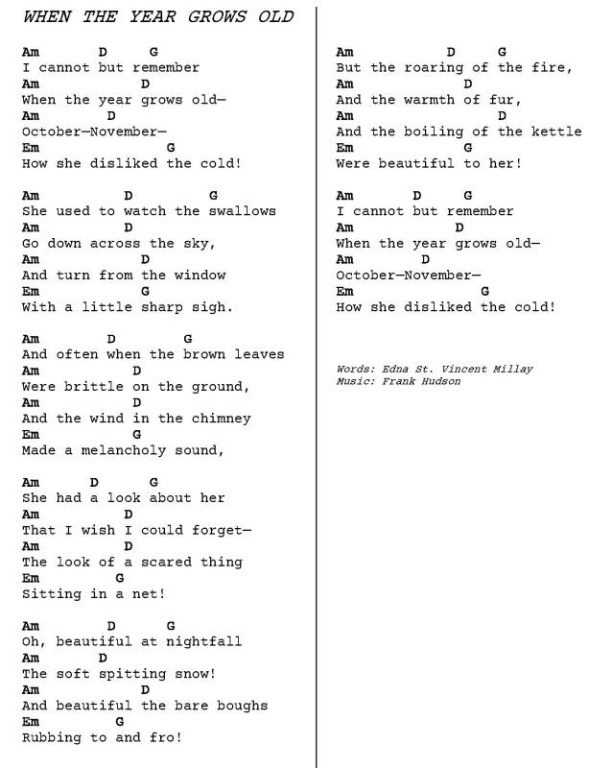
When the Year Grows Old

Simple chords for today’s piece, presented here as chord sheet  in case you’d like to sing it too.

.

Living with this poem as I set it to music and performed it, I came to think of it more at “Girl from the North Country” — a song about a lover who is longingly thought of lovingly, but who is now separated. By the time of the performance that you can hear below, that was how I was singing it. Why did I think that?

Partly from reading later Millay poetry, partly in biographic clues of Millay’s sexuality. There’s a definite undercurrent in the poem of the “she” feeling ambivalent: the sighing look at the flying birds, the melancholy chimney wind, and most directly in the abrupt “look of a scared thing/sitting in a net!” And what follows that line feels lustily sensual to me: those rubbing “bare boughs,” that fur by the fire verse.

That reading also answers the why the year being “old” is the title, not “cold,” other than just seeking variety. A once passionate attachment has been reconsidered by the other party, has grown old/cold.

Millay could have made other meanings (“cat lady,” “dear old mom.” etc,) clear with no commercial readership risks, but following my understanding, this presentation is coded so those who know will see that, and others will see a vaguer poem while recognizing late autumn weather. If I’ve misread it, or if Millay ever explained what she was intending — well, it wouldn’t be the first time — but it worked for me to find an experiential place to inhabit the poem.

You can hear my performance of Edna St. Vincent Millay’s “When the Year Grows Old”  with the audio player gadget below. No gadget? It’s nothing personal, just that some ways of viewing this blog suppress that. This highlighted link will open a new tab with its own audio player.

.

*As poetic testimony: tender as Robert Hayden’s well-loved poem “Those Winter Sundays”  is, it’s not a story of a parent finding happy beauty in loading up a household’s fire box.

O But My Delicate Lover: Canadians translate Sappho

I regularly read and take part in a daily poetry thread on X/Twitter. Its host, Joseph Fasano, posts a theme word and an example poem reflecting a topic most mornings, and other poetry readers respond with poems that relate to that. Early this week the theme was “Longing.”

One of the responding poems was this one:

Sappho-Carson Longing

The X/Twitter poster here happens to be a relative of mine, though I’m not sure which one

.

This is an English translation of a poem by the ancient Greek poet Sappho rendered by famed Canadian poet and translator Anne Carson. If we didn’t know it was a translation, if we thought of it as a poem by a modern poet, here’s one thing we might notice on the photographed page: those short lines, those white spaces, those fenced-off blanks kept apart by square brackets. Looking at the text this way, the poem on the page has a striking effect. Its incompleteness — its, well, longing — is amplified in those spaces.

In Carson’s presentation that’s an inescapable part of Sappho’s work. We have only fragments of Sappho after all, only a handful of her poems are even comprehensively within sight of being complete. Some Sappho fragments are but single words, and many, a phrase or a few lines. And we know so little of the poems’ context. What details recorded about Sappho’s life date at best from centuries after she is thought to have lived, and are inconsistent. That she was a woman in a male dominated world, and lived in an outlying area away from the centers of classical Greek culture that we most know from later surviving works adds to the mystery. That the Greeks of the Athenian Golden Age, or the later Hellenistic Greeks, misread is some way the larger corpus of Sappho still available to them as they supplied us with Sappho quotes, commentary, and biography is plausible.

As readers of modern poetry, we likely assume when reading a Sappho poem that it’s a more-or-less authentic voice of someone describing a moment in her own life. I can’t say that as being a sure thing (any more than it is for, say, Shakespeare’s sonnets). But maybe that makes little difference, especially in the absence of well-attested facts — the words have the effect they have on us, based on our own lives, our own culture, our own time.

Carson’s translations are well-regarded, but she’s not the first to translate Sappho into English — she’s not even the first Canadian to do so. The first attempts there I know of, likely the first in fact as it’s by such an early Canadian poet, were by Bliss Carman.*  In 1904 Carman published Sappho: 100 Lyrics.  Unlike Carson, who is a scholar, I don’t know if Carman was all that knowledgeable in ancient Greek, and from what I can find he’s less open in sharing translator’s notes on his methods. The preface to his book, written by a friend, says only he more-or-less imagined the poems as complete and wrote then from that imagination.

From a scholars’ standpoint this is an outrageous act. On the other hand, there’s a current in poetry of writers finding something in assumed characters, some for anonymity, some for fraudulent reasons, some to burlesque writing styles they wish to make fun of. Carman’s life was not straightforward. There were a lot of bumps and setbacks in his career — all as one might imagine at a time where the idea of a Canadian literary poet was yet to be established. So, to take a vacation from all that to the isle of Lesbos and imagine Sappho strumming her lyre within his earshot? Maybe understandable.

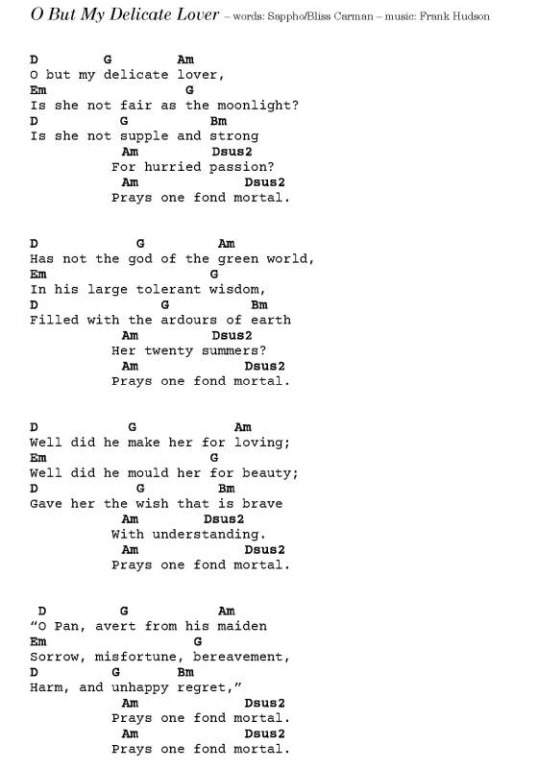
O But My Delicate Lover

Another green world. Here a chord sheet for today’s musical performance.

.

Published in the era just before the outbreak of English-language Modernism, Carman’s version of Sappho found some readers. Ezra Pound apparently read them, and in his loose Chinese translations and elsewhere he seems to have adopted a no-hurt, no foul practice of translation as a personal recasting of the original work. Carman’s Sappho is sensual without overelaborate decoration or any “I’m so  naughty” stance. I can imagine some of those Not-Yet-Modernists who kept a well-thumbed copy of Swinburne in their back pockets circa 1900 appreciating these poems. If the tropes in these love poems are often common ones, he’s portraying Sappho who would have predated those tropes becoming commonplace, and he’s asking us to believe our moments are repetitions with a long heritage.

Many modern readers of Sappho have adapted Sappho as a pioneering Lesbian poet. In the many centuries between Sappho’s 600 B.C. E. and the present there have been a variety of renderings of Sappho’s sexuality. The text, fragmentary as it is, often shows attraction and praise for women and female gods. If we assume Sappho herself is the voice in her poems (and why not, we know so little, and nothing for sure, and Occam’s razor) this would follow. In this poem of Carman’s Sappho, the lover and object of longing is certainly female. Bliss Carman was an apparently hetero male, but his poem’s assigned author is a woman. Parsing….

Those that object to drag-time story hour at the library will have a hard time with all that. If for only that alone, I’m going to give voice to this poem from Carman’s collection of imagined Sappho translations. You can hear my musical performance of “O But My Delicate Lover,”  with the audio player below. Has the important fragment that includes an audio player disappeared for you?  This highlighted link will open a real, not imaginary, tab with its own audio player.

.

*Carman’s 1904 work may also be the first American translation of Sappho, as it predates the top hit in a web search that shows Mary Barnard’s 1958 volume as the first from the U.S.A.  Coincidently, Ezra Pound is attributed as someone who encouraged Barnard to do her book of Sappho translations.

Carman studied in the U.S. and was distantly related to Ralph Waldo Emerson. His ancestors emigrated to Canada as Tories escaping after the U.S. Revolutionary War.

Now that I’m in Madrid and I can think

Something in me says there should be more new pieces here since the last post, as I have several partially completed things, but the distress of folks around me pulls me several ways away from that. The distress hints that this music and poetry stuff should yield to more pressing problems, and then the unpredictability of the distress primes a sense of anxious alertness mixed with weariness. Though I’m at home, I feel like I’m in a medical waiting room, perhaps outside an Emergency Department, waiting for what it is that will be, in some not predictable soon, be said. As waiting people do, I read and do random things, anything having nothing to do with the matters at hand. Nothing too absorbing, for I don’t know when I will need to put it down.

But I’ll also say this, poetry has managed to stick itself into this state nonetheless. Poems can be as small as house mice, there’s always some place they can sift or scrunch their way in. And so it was early this morning when I saw this poem by Frank O’Hara “Now that I am in Madrid and I can think.”   I found it could be fit to an already composed musical piece I had done late last month, and so I put them together this afternoon. If you’d like to read the text of this poem, here’s a link to that.

This is a love poem, and more specifically a poem about separation from the beloved, and O’Hara’s language is as beautifully askew and full of charming scatteration as any of his more well-known poems. If I had time and an inclined mood, I could write at length about his musical language here and his turns of phrase: “The slender heart you are sharing my share of, “See (sea) a vast bridge stretching,” and “The lungs I have felt sonorously, subside, slowly.” There’s this intimacy interrupted, the separation of bodies and their encased lives. The title says the speaker in the poem can now think. Well, they have constructed a fine thing, something that takes some smarts, some wit, but what they have constructed is a set of feelings outweighing any thoughtful aesthetic pleasures of travel.

Madrid Iowa

The exciting places in Madrid Frank O’Hara is ignoring to think of his beloved. Oh— this is Madrid, Iowa! Iowans can tell out-of-staters by how they can’t get the French pronunciation of Des Moines right, and then they’ll see if they’ll correctly say this town’s name as “Mad-Rid.”

.

Perhaps this is why this poem snuck in between the trivia and my nervous time-passers. Here the illustrious culture of Spain is obscured by the distress and longing of separation. The poem finishes with one of O’Hara’s fine last lines. Do I want the empty world, the world without art? Yes, sometimes, but only by the choices of joined desire.

From the times I’ve listened to recordings of Frank O’Hara reading, I suspect he’d be more off-hand and playful in reading his poem than I was, but my reading reflects my current mood. The music for today’s performance is dense and urgent, I will not dance much about its architecture right now, but you can hear it with the player gadget below — or if that’s not visible as you read this, with this alternative highlighted link.

.

Somewhere or Other

Today’s audio piece is another by Christina Rossetti, connected through family with the Victorian art and literary movement that called itself the Pre-Raphaelite Brotherhood. In their painting and artwork, the Pre-Raphaelites often appeal to me. The paintings sometimes have a stunning, oversaturated palette; and they are fond of symbolic and esoteric subjects which fill the paintings with interesting details.

John Melhuish Strudwick  When Apples Were Golden and Songs Were Sweet

Eb Bb , Ab Eb , then Fm Fsus4 Fm, and Ab Eb Ebsus4 Eb—flat keys are murder
on guitar, just so Frank can play simple black key stuff on keyboards

Many associated with the PRB wrote poetry as well, but when I’ve gone looking for pieces I can present as part of the Parlando Project, the brothers in the brotherhood just didn’t do much for me. Surprisingly, the poet who did was Christina Rossetti.  I don’t recall if she was even included in the “New Criticism” curated English literature anthologies of my school-age youth. She isn’t a poet with a lot of flash and filigree. A poem like today’s has not a single arresting image, and its language is simple too.  Using the criteria of the Modernists who came to dominate the assessment of poetry in the 20th Century, this poem should have nothing to recommend it.

So, what does it have or do, why did I bother to write some music for it and perform it for you?   Well, first it has a refreshing modesty of expression. This is a song of longing from first to last, a universal human experience. And the subject of the longing, is it for an earthly partner, the age-old “when will the right one come along” wish? Or is it for an otherworldly, completing partner, a presence beyond the moon and stars? Despite Rossetti’s homey words, it could be either, and the alteration of “near or far” with “far or near” in the 2nd and 3rd verses encourages us to see it both ways.

If one must choose which supposition, I lean to the spiritual object, and if so, the image, such as it is, if off-screen here: earthly love may stand for the longing for religious meaning and connection. The last couplet, the dying leaves falling on “turf grown green” is strangely incoherent, and it reminds me of some of images or rebirth and salvation in British folklore, leading me that way.

But if could also be a song of simple earthly longing for a suitable partner. Adding music to Rossetti’s “Something or Other”  both adds decoration to the simple words and allows the listener to relax in that ambiguity without a need for an immediate conclusion.

John Melhuish Strudwick - Saint Cecilia

See, E flat is so easy on piano, even saints can play it.
Both of today’s paintings are by  Pre-Raphaelite John Melhuish Strudwick


Today’s music for Rossetti’s poem combines acoustic guitar with some cello and strings integrated with a couple of piano parts in the background. It’s another short one, so go ahead and use  the player below to listen to it.