When I last posted I was planning on a trip to an off-the-grid cabin on the north shore of Lake Superior. I’ve now returned, and I’ll have some things I’ll write about here shortly. My goals for this trip: to spend some isolated time with my wife, and then while she would take the opportunity to go off on some nature hikes, to have some quiet time to do some reading or playing guitar amid the sounds of nature.*
The northern place we would stay in was in a birch-rich woods between a river and a tiny creek. It was comfortable, but it had no Wi-Fi, no power, no running water.** The place to park our car was ¾ mile from the cabin. The narrow path from there through the woods had steep rocky and root strewn portions. That concentrates one’s thoughts on what to take. Not a parsimonious hiker, I packed needing two car-to-cabin trips: a backpack with toiletries and a week’s clothes for various temperatures, and then a small acoustic guitar in a Tric guitar case that has attached backpack straps.*** In each trip between car and cabin these two backpacked bags left hands free to carry an additional bag. One trip would add a bag of food we brought with us, the other a bag of books: food for the mind and food for the rest of the body.
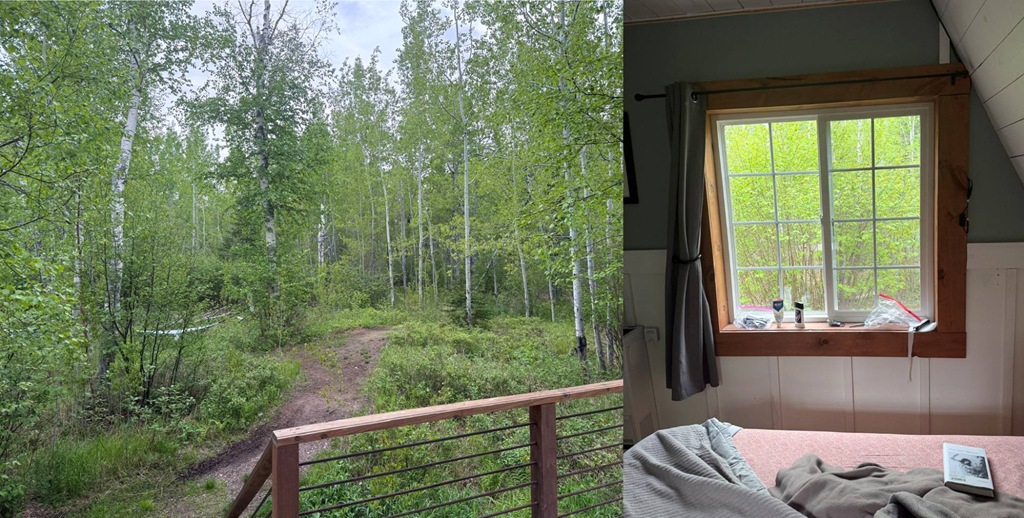
The forest from the front door of the cabin, with one of the flatter parts of the trail leading to it and the view out the back of the cabin from the bedroom. Every morning when dawn would break it was like living inside an Impressionist painting and looking out the frame through the dense pointillist leaved branches.
.
Though I plan to write in a later post or posts about my experiences borne from that bag of books – after all, that’s something regular blogs do – for now I’m finding it hard to get back into the rhythm of producing new musical pieces and more extended thoughts on the texts I combine with them.
So, to tide you over, here’s a little piece, “On the Road,” a lesser-known, but still well-crafted poem by Claude McKay about common days of work enmeshed with people one didn’t choose to be with – rather than my week in the woods as half a pair who had made a determination to be such 22 years ago. Beside the recording below, here’s a link to the text of McKay’s poem. This winter I did a whole month of posts and musical pieces on Jamaican-American immigrant McKay’s poetry, and this one was left-over from then. Audio player gadget below to hear it, and if there’s no such player to be seen, it hasn’t gone off swiving or drinking like McKay’s waitstaff, it’s just being suppressed by some ways of reading this blog which won’t show it. You can use this highlighted link instead – it will open a new browser tab with its own audio player.
.
*In theory (and in practice) I’m reading at home too, but I find there’s something added by the context of reading a book in place remote from one usual location, much in the same way that I would play guitar differently in a forest than on a streetcorner – and my home reading must be slotted in with other things. The pleasure of creating the music for this Project, no matter how tied it is to the poetic texts I use, takes away from reading time. There would be no recording equipment or power for a computer in the cabin. I’ll also confess that my country’s misrule has turned me into a habitual doomscroller – and while there are elements of citizenship and warning alertness in that, it’s rarely productive or satisfying.
**Telling a friend about this over breakfast on this my returning week, he asked if I “Went to the woods because I wished to live deliberately, to front only the essential facts of life….”
And I replied, “You mean like someone else, that other guy? Why yes, I did – but I somehow didn’t get around to writing my manifesto about which academic scientists need to die from letter bombs.”
My friend got the joke. Of “Unibomber” Ted Kaczynski’s nature I am not made nor cultivated. Elevating one’s own thoughts in solitude is a sort of two-headed beast though. Making thought’s resolutions from a majority of one doesn’t necessarily create a Henry David Thoreau. My own Transcendentalist solitude is more at Emily Dickinson’s mode. I enjoy condensing the music of the universe into little poems or six fretted strings, and like Dickinson’s book/frigate, my aged nature hikes are likely stanza to stanza rather than wooded ridge to rocky outcrop.
***The Tric is an excellent but now apparently discontinued guitar case made by Godin, a Canadian guitar maker. It looks (and has those backpack straps) like the “gig bags” sometimes used by musicians, particular those that need to travel by foot or public transit. Like a gig bag it has a tough nylon fabric exterior that is closed by a zipper – but inside a gig bag there is an inch more-or-less of soft foam, enough to protect the instrument inside from little bumps, but not from more serious insults. The Tric case has a couple of inches of rigid Styrofoam inside (like a motorcycle helmet) and that makes it overall as protective as a much heavier conventional standard guitar case made out of vinyl-covered plywood. Just as with a helmet, it’s a better system for absorbing shock from falls, and like a Styrofoam ice chest, it’s better than standard cases for regulating internal temperatures. Despite that added protection a Tric case is as light as non-rigid gig bag, and unlike some highly protective carbon fiber instrument cases it was sold at an affordable price.
(Still reading all the way down here? I think today I’ve finally realized the perfect post for my way of writing: the set of footnotes longer than the body of the post!)


