I must apologize for how rapidly these new pieces for National Poetry Month are being released. That must tax some of my valued reader’s and listener’s time. I planned — and still plan — heightened activity here during Poetry Month, but I expect it won’t be near-daily posts.
In announcing this April’s observance, I said that following #NPM2025’s theme of “The Shared World” that I’d like to include some poetry that wasn’t originally written in English. I’ve done a fair number of translations here, despite not being much of a linguist. I’m also not a creative writing teacher, but I highly recommend for poets to follow my example in this and to do their own poetry translations. When I first started doing French to English translations in my 20s I had only my high school French to guide me, and I relied heavily on French to English dictionaries. This was a laborious process, but approachable with short poems. Nowadays, online dictionaries and even reasonably fluent automatic translation features are available on computers or the Internet. Just plugging in a poem’s text into Google Translate isn’t translation, or a translation that will help your poetic skills. The machine translators are pretty good these days for denotative texts, news accounts, manuals, advertisements, directions — that sort of thing. But poetry asks for at least two other things beyond that: a heightened sense of which exact word brings something to the poem, and those word choices are also part of how the sound and flow of the poem is presented in its new language. As a teaching exercise, sitting for a few hours beside the spirit of another poet and their poem of another language, helps one find skills in making those choices when one writes their own poems.
As a non-native speaker, it’s entirely possible you will make mistakes (even embarrassing ones) or come upon mysteries where even experts will not know what the poet intended in the original language. No matter. That’s scholars’ work — honorable work — but as a poet that’s not necessary for your translations.*
Yesterday I went through some poetry books I have in Chinese, German, French, and Spanish looking for candidates to develop. I found a handful, but still had a couple of books to look through this morning. After early breakfast and grocery shopping, I picked up the next book: Pablo Neruda’s Twenty Love Poems. This passionate early 20th century work is extraordinarily popular among Spanish language readers. I did the first and the last of the set of 20 earlier in this Project and Poem 1 remains one of the most popular pieces of the more than 800 Parlando musical adaptations. I started looking randomly at the rest. It’s there I came upon “Poem 16.”
The imagery and the refraining way it’s presented made me think this a good candidate to sing. Looking at a couple of machine translations, I started work on making a poem in singable modern English out of it. This poem is not entirely straightforward to me, but it seemed to be about separation, though I cannot be sure it’s not about a subjective, obsessive, or jealous sense of separation, a “I want you so much, all the time, and all to myself” kind of feeling. As I started to work on the images — the shared-world-vision that the poet’s voice wants to invoke — and those word choices and sequences necessary for word-music, I was overcome with a connection likely unintended by Neruda.
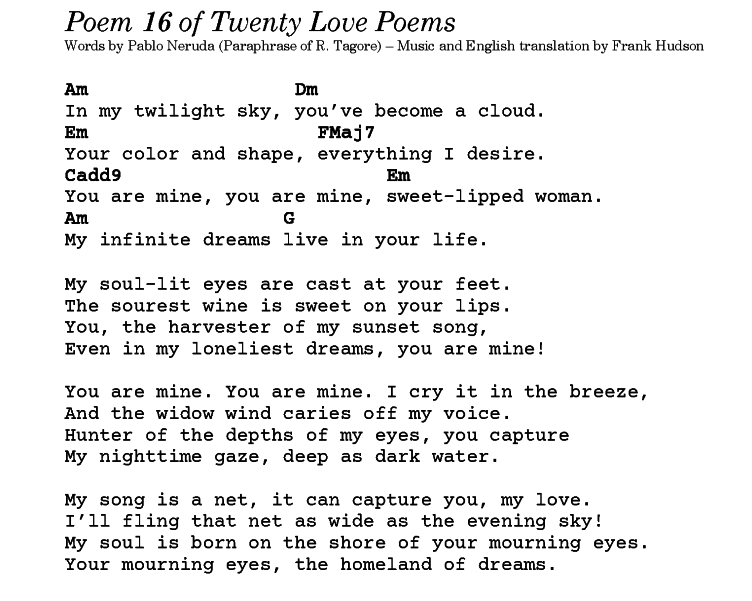
I include a chord sheet because I was inspired by folk revival publications Sing Out! and Broadside back in the day. You might sing it yourself as a prayer and plea for the two Garcias.
.
The poem’s speaker talks about being captured, even imprisoned, constrained as he speaks of his beloved. I thought of a pair of recent news stories of men taken abruptly from their families, one hauled off to a brutal prison in El Salvador, the other pried from the embrace of his wife and children.** The charges, the evidence? They are, what, maybe gang members. How do we know that? “Oh, we just know” says our government. OK, what are their crimes? “No matter, we just have to say so — or maybe we don’t have to say, we can just do.”
It’s possible we have nonsensical laws, though I’d hope our consideration is better than that. But there seems no way this can be just.
I stopped trying to make a better translation. I’d normally want to take more care — after all, this is a work of a young poet who later won the Nobel Prize. I just wanted to put together the sense of this way I could hear the poem’s speaker speaking across our Shared World, because I wanted to sing it to salve my own heart.
The poem, as I now shape it in English, is speaking as a man who loved America, loved his wife, loved his family. All this can be taken away. In one case some executive branch functionary in court, being asked of one of these men, is said to admitted his deportation and subsequent imprisonment there was “an error.” With such slipshod execution, this might be expected. What is to be done? “Nothing can be done. He’s in another country now. Out of our hands.”
This is a project about poetry and music. There’s nothing those two things can do but sing. I did say I would share civic poems this month. Why? To sing a poem, or to listen or read it closely, you must feel it somehow. What you do afterward, I don’t know.
You can hear my performance with the audio player below. No player? This highlighted link is an alternative that will open a new tab with its own audio player.
.
*When sharing such translations publicly, I often take the example of another poet I came to read through this blogging adventure, Robert Okaji. Okaji, like myself, sometimes takes literal, non-poetic, glosses of classic Chinese poems and renders something vital in modern English out of them. He uses the traditional note of “After a poem by…” which indemnifies either of us from lack of fully understanding the Tang dynasty and ancient Chinese.
As it so happens, Neruda in “Poem 16” writes at the top of this poem that he’s paraphrasing another poet and songwriter, Rabindranath Tagore. Tagore’s poetry and song lyrics are sometimes psalms to his country or godhead, written in the language of love poetry.
**The two men are Kilmar Armando Abrego Garcia & Jorge Garcia. Their wives and children are American citizens.




 Frank Hudson