Today is Juneteenth, a holiday coming into greater recognition as a celebration of the ending of America’s race-based chattel slavery. Why this date? I repeatedly warned you that I can’t tell a story simply and briefly, but for this holiday I have an excuse.
Slavery began in the American British colonies somewhat haphazardly, but by the time we became an independent country we had lots of laws, customs, and beliefs to entrench it. As it often is with the mechanics of oppression, the structures to hold it up took work to maintain, and by the 1850s there was great worry between slaveholders that it would collapse. In the 1860 election, Lincoln won, and even though he’d stated a politician’s compromise middle ground on the slavery issue, his party included enough abolitionists that most powerful slave-holders were ready to press their states to rebel and set up their own government. Civil war ensued.
Which didn’t free the slaves — at least not yet.
Of course the enslaved had been freeing themselves, when they could, all along. Armed rebellions hadn’t worked for more than moments, but the brave, lucky, and skilled might successfully flee at least from the slave-holding states if not to Canada where US law couldn’t touch them.* But it wasn’t easy traveling all that far.
Once the war started in 1861, some enslaved people recognized they could try a shorter route: just make it to the Union troop’s camps, and a good many did just that, which created an awkward situation. You see: nothing had ended slavery’s legal framework, Lincoln still maintained he wasn’t doing that (if only because a few slave-holding states and slaveholders remained on the Union side). He just wanted to put down the rebellion.** Law still said the slaves were property.
Someone on the Union side came up with a peculiar idea. If the enslaved were legally property, they could be confiscated during wartime like a cannon, horse, ship or other enemy property could be. Dehumanizing language? Sure, but escaping past the Union lines meant an increasing chance that they wouldn’t be taken back.
Eventually, Lincoln supersized that freedom, by declaring that all the enslaved in the states in rebellion were free. This, the Emancipation Proclamation was issued at the beginning of 1863. American slaves elsewhere? Nope, not in the Proclamation. Slave owners in places under Confederate rebel control? Not gonna listen to Lincoln’s order. In April of 1865 Robert E. Lee surrendered the bulk of Confederate troops, but that still didn’t mean all enslaved were free, and the legal matter wasn’t consolidated until December of that year with the adaptation of the 13th Amendment.
A couple chapters back I talked about how slow by modern standards communication could be in the mid-19th and early 20th century. Well, it was slower yet when not everyone was on-board with the news. Juneteenth, with an absurdity that is so often a part of America’s racial history, celebrates when Union troops got over to Texas in June of 1865 to announce that the war had been over for over a month and the enslaved in Confederate Texas were no longer legally slaves.
When I left off I was (more or less) talking about folk songs and the songs collected in the American Midwest before WWI by poet Edwin Ford Piper. I’ve also already mentioned that folk songs aren’t unchanging, and aren’t pure. While going through the yellowing paper in Piper’s archives, I came upon this song, handwritten in his own handwriting. He has the title as “The Little Octoroon.” Things aren’t going to get simple here readers. I can’t be simple.
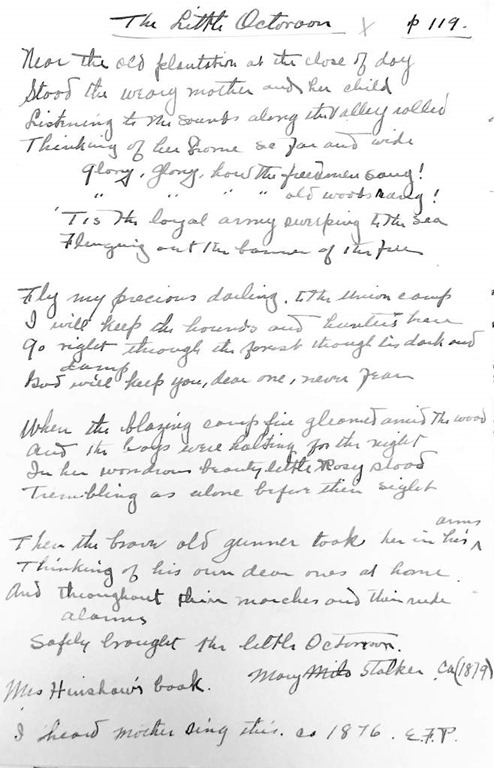
The song as Edwin Ford Piper heard it from his mother
.
Octoroon is a largely obsolete word, derived from a lot of rigmarole regarding how Black someone was. It means 1/8th (octo=8) Afro-American. In general, the mumbo-jumbo legal biochemistry in American history regularly said it didn’t make much difference. Half, quarter, sixteenth — hell, for those who had trouble with fractions it was sometimes written down as: 1% Black, you’re legally Black.
An octoroon may not look Black. I can still recall when I was 14 or so, and having grown up in a tiny rural Iowa town. An Afro-American man who was a civil-rights activist was to visit my church camp. He arrives. Wait — that man’s Black? I remember in my naivete looking at his summer hands and forearms. The man had freckles people!
So why does this song, which is clearly a song from the Union and Abolitionist side make some point about the child being an octoroon? This will get weird: it was possible to be an abolitionist and a white supremacist thinking Afro-American’s inferior. Yes, you could be smart and ignorant at the same time! If you’re trying to end chattel slavery, and you’re counting votes or troops, you might not care to make a sticking point about this, ugly as it is. Those with pseudo-scientific beliefs such as an octoroon is “nearly a white person” might have stirrings of respect. (Ugh!) And then at the unconscious, illogical level, there’s the factor of that person looking much like me, so maybe they should have rights like me. Even if it’s a song (something with no visual element) those factors may have entered into its composition.***
While there are no notes I saw in the archive that Piper knew this, this song does have a composer: George F. Root. Root didn’t quite reach Stephen Foster or Dan Emmett level of 19th century American songwriter fame, but he had his “hits” such as they were in the pre-recording era. During the Civil War period and based out of Chicago, he specialized in songs for the Union side.
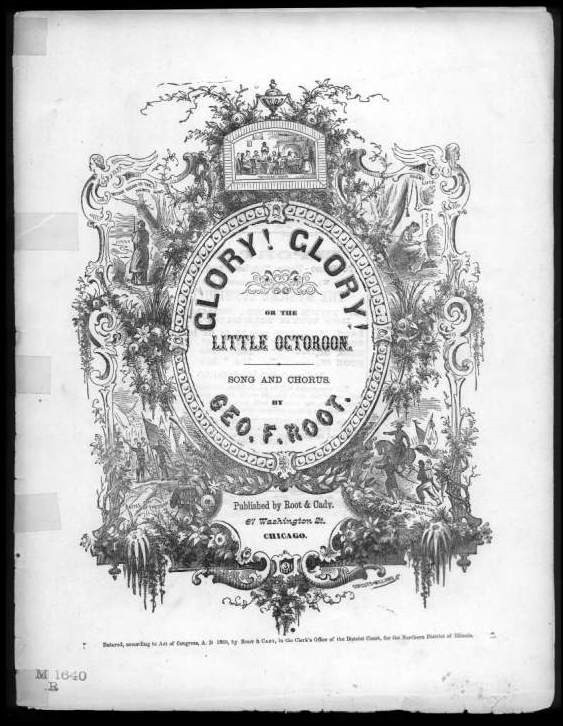
The sheet music from George F. Root’s music publishing firm. When Piper remembers his mother singing this tune, it would have been only 10-years-old.
.
Did Piper’s mother learn this from someone else? Was there sheet music in a piano bench for this, unknown to the 5-year-old Piper? In the quiet library archive, I visualized two white people, a mother and child, in rural frontier Nebraska sharing this song. The differences in the printed song from the one Piper wrote down from his mother’s singing say this isn’t likely a handwritten copy from sheet music.****
Here’s my conclusion, which I hope I’ve demonstrated even though I’ve trimmed parts of this piece back: Juneteenth is the most complicated American legal holiday. The only simple thing about the holiday is that it stands for freedom and the lifting of oppression. Taken at its whole, though messy and with calculated delay, that makes it a favorite of a person like me, who still cries and wonders at how simple truths and rights take so long to be established. The song I’m performing today, its path and turning into a folk song, isn’t that complicated — but yes, the path of American freedom is.
You can hear my performance of Root’s “The Little Octoroon” with the audio player below. No player? This highlighted link is an alternate.
.
*In 1850 a Fugitive Slave Act was passed that required northern state governments, not just the federal government to return enslaved people who reached northern states. Some cities and states wouldn’t comply (there’s this Minnesota case for one example).
Piper’s mother was in Canada near the US border in this era. It’s possible that fugitive slaves might have crossed over into her region. I also note that Piper says she was singing it in 1876, perhaps because that’s the border of Edwin Ford Piper’s memory, but I read the date and think about it being the year Reconstruction largely ended and new de-jure laws and customs greatly restricted Afro-American citizenship.
**No, Nicki Haley, slavery was the cause of the Civil War, even though many liked to parse Lincoln’s compromise and coalition statements of this time to make it sound like it wasn’t. The flaw in that framing? Lincoln didn’t start the war, the South did, and they were explicit in proclaiming why they did it.
***There’s another song using this terminology that this Project has already presented: Longfellow’s scathing pre-Civil War poem “The Quadroon Girl.” In Longfellow’s poem the situation leading to that poem’s mixed-race child is laid out: feudal concubinage and/or rape by slaveholders. For making a speech implying the same, Longfellow’s friend, US Senator Charles Sumner was beaten to within an inch of his life on the floor of congress.
****The biggest difference: the printed song’s title calls out the chorus — it’s officially “Glory, Glory, The Little Octoroon.” I only sang the martial chorus twice in my performance because I was more drawn to the bravery and sacrifice told in the verses. We have two holidays that say soldiers made us free, but it’s not only soldiers.
I followed Piper’s transcription for the words, not the printed lyrics, honoring the chain of transmission to me rather than accuracy. I also modified Root’s tune and chords to suit my tastes and tendencies. I could not help but think of these things as I sang this: first, the mother, her family heritage caught in that sexual exploitation making the choice to stay and face the slave hunters and their dogs to assure her child’s escape. We never find out if she and the daughter will be reunited, or even if she survives. Then next I think of those pursuers who to the degree they are portrayed in the song would be gaslight villains — but in history they would be real people doing great evil, who could be thinking they were serving justice. And then lastly, the final-verse gunner who cares for the child, though he’s more the Horatio of the story, with the mother being the tragic hero. I ask you not to skip over the villain characters. It’s fine if you empathize with the gunner, but some great dangers in one’s life (and often to other lives) are those middle souls, like the slavecatcher pursuers, who have a system that tells them they are arduously, justly, doing right.

 Frank Hudson