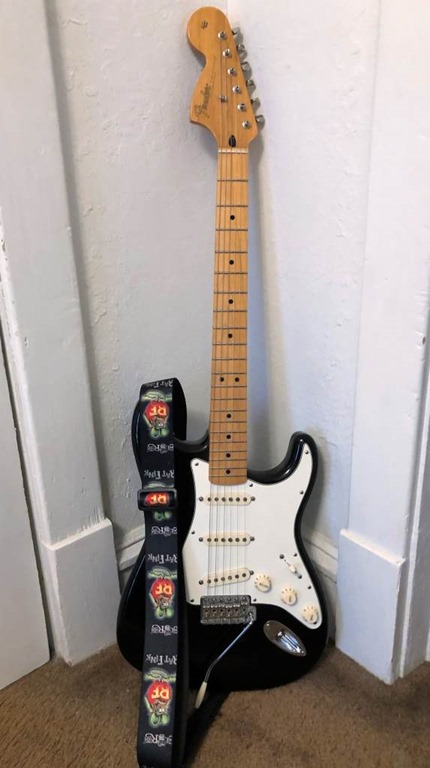
I Should Turn to Be – Jimi Hendrix Tribute 2025

Thinking of the late Nineties, I think of the Sixties, 1970, and then the end of the 19th century. When you’re an old man, that’s the kind of swift mobility you retain.

It’s difficult to comprehend how short the careers of some musical figures from The Sixties™ were. This month I watched a documentary on Jeff Buckley, the charismatic late 20th century singer. One of the challenges of his foreshortened life was to deal with the artistic inheritance and distraction of being the son of another singer, one of those Sixties™ artists, Tim Buckley.*

Here’s something I think remarkable, comparing those two. Jeff Buckley was two years older than Tim when he died at age 30. Jeff left one full-length recording, his extraordinary, eclectic debut album Grace.** Tim, beginning in the onrushing Sixties, and continuing through its continuance in the early Seventies when rock performers were increasingly hobbled by drugs of dependence, released nine LPs! Nine,  moving between three  distinct personal stylistic eras in eight years.

Neither Buckley ever made it to the toppermost of the poppermost, but obscured by their creative and commercial hegemony, posthumous fame, and trailing post-group recordings, consider that even the Beatles band was a living presence for only seven years in America.

Back to the Buckleys – there’s a sharp line ending in their careers: Tim died of an overdose of drugs stronger than he expected, Jeff drowned in river currents during an unwise spontaneous swim. We may expect our artists to be audacious – risks come with that.

Which brings me to today’s annual duty, where I mourn the death on September 18th 1970 of my patron saint of The Sixties™ music martyrs, Jimi Hendrix.***  Time and again in these observances here I’ve tried to make the case that Hendrix – the rightfully proclaimed pioneer in expanding the electric guitar’s vocabulary – is underrated as a songwriter, and particularly as a lyricist. I say this, even if I believe such things shouldn’t be reduced to a rating, because his strengths there are just so under-considered. In the pursuance of this goal, I’ve done things like make the lyrics of “Third Stone from the Sun”  audible, and illustrated in a video the scenario of “Up from the Skies,”  but today I’m going to link the lyrics of one of Hendrix’s greatest compositions to a trope not of the 20th century, but more the 19th.

Are you ready for:

Mermaids.

In his song “1983 A Merman I Should Turn to Be”  Hendrix skillfully unravels a Science-Fantasy story without much wasted exposition: in a troubled world beset by wars and violence, a couple of lovers enter the ocean, find they can breathe underwater, and return to the salty brine from which we all have emerged through birth or evolution. Hendrix’s first-order inspiration for this tale is likely mid-century SF writing which he had been reading from childhood – but his imagination made this material his own and he should be remembered as an early Afro-Futurist – but let’s trace those SF stories he read back: the SF pulp writers were still following on from the Verne/Gernsback/H. G. Wells/William Morris late 19th century genesis of their genre.****

This week I went looking for literary mermaid/merman poems, thinking that a possible route into my Hendrix memorial this year. Surprise, there’s a lot of them!   I don’t have a theory as to why this would be, but a great many British Isles poets had a mermaid poem somewhere in their collected works from around the turn of their centuries. In some of the poems the sea maidens are depicted as sirens, luring men to danger or soggy death in their arms, and this kind of naughty sex/death double feature might be a good fit with Victorian decadence. Then there was the highly successful Little Mermaid  story of Hans Christian Anderson, but that’s an opposite plot from most of the poems: Anderson’s heroine wants to flee from the sea to the land, not from the land to the sea, and the mermaid is the story’s protagonist, not the landlubber male poets hearing sea maidens. Baring the example of Hendrix’s song, mermaids in my lifetime more likely follow Anderson fairy tale path onto dry land.

What turned the tide with this poetic trope? It might be T. S. Eliot’s famous use of sea-girl sirens in “The Love Song of J. Alfred Prufrock,”  his first prominent poem. The satiric uncommitted romanticism of the poem’s Prufrock concludes with human voices awakening us from the sea girl romantic/decadent dream. We’ve largely followed suit ever since.

So, for a text for today’s piece I decided to weave together sections of five mermaid poems from that earlier era,***** but I am putting them in the context of a memorial to Hendrix, on the anniversary of Hendrix’s death, which came to him slept-under from unfamiliar pills, drunk on wine – when and where the man who dreamed a tender escape into the sea died on dry land in the middle of London. He was 27, yes too young, only four years in the general public’s eye, yet he had created his revolution for the guitar, and four albums of songs, songs I maintain that are good enough to be remembered alongside the guitar playing. What mighty things to have done in such a short time.

I Should Turn to Be

Selections from mermaid/siren poems by Tennyson, Beckett, De la Mare, Symonds, Eliot, and Yeats were woven together to make the lyrics to today’s musical piece.

.

My song “I Should Turn to Be”  had to be created in a small amount of studio-space time, but I’m reasonably happy how it turned out. I was aiming for some dynamic range in this tale of doomed fantasies underwater, and I was able to get there. I haven’t been able to play electric guitar much for simple enjoyment this month, but even the focused playing to realize this composition felt good, so forgive the indulgence in two guitar solos – The Sixties™ would forgive me. You can hear the performance with the audio player below? Has any such player slipped beneath the waves? It’s just that some ways of reading this blog suppress showing the player gadget, so I provide this highlighted link that will open a new tab with its own audio player.

.

*I recommend that film, It’s Never Over, Jeff Buckley.  For a music documentary about a male artist, it’s remarkable that it relies largely on testimony from women. Yes, like most music documentaries it avoids talking in detail about music – and the musical examples are short clips, which may not convey enough of the man’s art for the uninitiated – but the emotional narrative is richer for this uncommon choice by the makers.

Tim abandoned Jeff’s mother to focus on making his first record and subsequent touring. Jeff broke up with his partner in the midst of trying to launch his own career, though without a child being involved in his case. Questions about his father bedeviled Jeff, understandably – more so in that both père and fils were taken with a strong ethos of living in the moment. Still, it’s hard not to note the similarities in the two singer’s unbounded singing, and the two even sounded a likeness when describing their dedicated artistic drives.

**In Jeff’s defense, his career as a recording artist was only 4 years, having not made his first recordings until his mid-20s. And the range of musical approaches he assayed over fewer recordings is comparable to his father’s.

***The tight cluster of the Jimi, Jim, Janis deaths in 1970 gave rise to that gothic “27 Club” thing. I’d be risking a lot of “who’s that?” shrugs if I’d say that I myself am probably more like Al Wilson, the singer/guitarist/folklorist who died on September 3, 1970, also at age 27. But Hendrix is my choice because he was as much a poet as Jim Morrison, and doubly an artist when he played his guitar.

****Reviving 19th century Victorian fashions and art was a significant part of the English psychedelic era. This undercurrent too might have led Hendrix to compose his merman/mermaid song.

*****One couplet introduces the piece that isn’t from a late 19th-early 20th century poem. Those two lines are from the most-covered Tim Buckley song, lyrics written by his high school friend and collaborator Larry Becket for “Song for a Siren” – another late contribution to the mermaid genre Tim Buckley released in 1970. It’s a haunted song, and it takes only a little dose of gothic romanticism to wonder if Jeff Buckley heard the sirens beckoning from out across that fatal river in Memphis. See, I wasn’t wasting your time with that Buckley stuff at the beginning, it’s a plan.

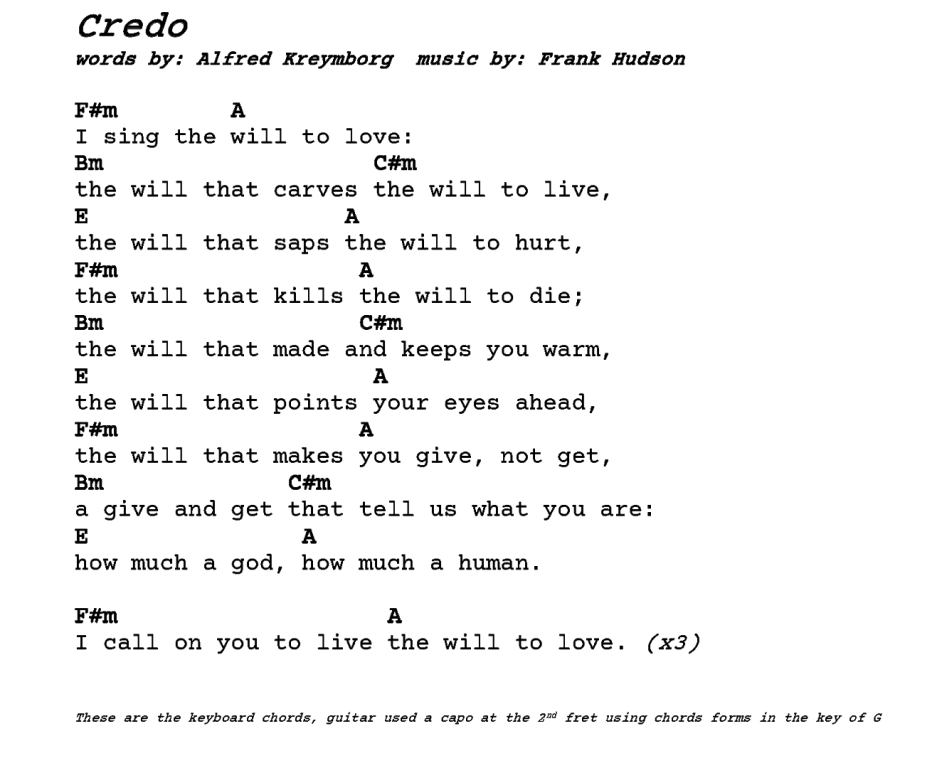
Credo (The Will To Love)

A friend of the blog noticed today I used a particular phrase when I wrote about late-night work on the musical piece you can hear below. I’ll try not to take too much of your time, but I thought I’d expand on my explanation to him, and at the bottom you’ll be able to hear a 2-minute song made from a poem by Alfred Kreymborg.

The early years of the Parlando Project benefited from several things that are not in as great a supply now: I had multiple days in each week when I could work on finding and making these musical pieces. I worked regular workday hours on this, beginning after my morning bicycle ride for breakfast. I was eight years younger then, and those days were filled with rewarding creative work as I learned more about musical composition and recording technology. Shortly after the public launch of the Parlando Project, we had a consequential election in America,*  but that (if anything) increased the energy I found most weeks.

Those who happen upon early posts here might notice a tone that isn’t as common in recent years. Without announcement, I was writing back then with my child in mind as an audience. They were going to be entering the 6th grade, and I vividly recall from my own youth how a great vista of complex, connective, and evaluative thought opens up around that age. I wasn’t going to make it a point to them to read this — adolescents aren’t looking for that sort of thing from parents — but rather more, I thought others in their peer group might come upon this Project and find some interest in my promotion of discovery and enjoyment. Working from that aim, as my child grew, I gradually changed the age group I was aiming the blog writing here at — though I don’t know if I ever achieved an adolescent audience.

Then a few years ago my family went through a series of crises, and it was only after a period of distress that the wise and resourceful members of my little family met those issues and managed them. I tried to be supportive — I probably was, to my imperfect degree — but that work was largely their doing. I’ll say that in that year or so of the greatest distress, my time spent here was a tonic for me from the stress and worry. How much of that was (in the modern terminology) “self-care,” and how much was temporary flight from responsibility? I can’t say, my perspective is too close-in.

But now in the past year or so, the time I can devote to this Parlando Project is constrained by external and internal factors. By choices outside my control, days go by when I’m restricted from recording, and even the blocks of assured time to compose or research are harder to come by. At the same time my energy endurance is lower as I age. As grateful as I remain to have the opportunity to do this Project, I guilt and grumble as an old codger when an opportunity comes — time when I can play or record — and at that moment my body is saying: take a nap instead. If I could schedule creative time, if I was to ask for concessions to schedule it, I’d probably face complex outcomes and reactions when my old body can’t be assured the energy levels and ready fingers like my 70-something self could.

Let me be complexly-clear about that though: that frustration doesn’t outweigh the gratitude. To have the opportunity and resources to do this Project remains a blessing! I just have to work with this, that’s all.

Here’s one “how” of that: after everyone in the house has gone to sleep early, or is at work on an evening shift outside our home — I can do my work, as long as it’s in silence. Knowing this, I often get a “second-wind” after 8 or 9 PM or so. I might spend this time researching or writing early or final drafts of these posts. There’s even limited music-making that can be done without making noise. I can go over the things I have been able to record, evaluate if they are worth using, perhaps adding additional parts silently using my little plastic keyboard, and mix the results into something suitable for releasing to the public. So: the hours between 9 PM and 1 AM have increasingly become working hours for the Parlando Project.

I’ve come to call that time “burning the midnight lamp.” As I told my online friend this morning, that phrase is taken from two particular sources — ones you might not guess could be combined.

“Burning the Midnight Lamp”  is a song, a lesser-known “deep cut,” by Jimi Hendrix. The song had a long gestation, Hendrix struggled to complete it. It was written early in his Jimi Hendrix Experience career, while living in London. Hendrix was a young man who previously had been in the care of a succession of childhood relatives, foster homes, and then a short Army barracks stint followed by couch-surfing until this point. For the first time he had his own place, shared with a woman in what sounds like an equality of love.**  That Hendrix London flat has been restored to appear as it did then, and when I visited it some years back I thought of what a special place it must have seemed to him. I imagine his thoughts: my own place, paid for with my own money, living on my own recognition, work done under my own name. In anyone’s life (not just a “rock star”) the time when one has achieved that — that’s something.

Here’s an odd connection: when you visit the site it’s a joint institution. Hendrix’s apartment is upstairs, but the main floor is laid out to reflect another emigrant musician of another era: this address was also George Frideric Handel’s London home.

When Hendrix was searching for the extra sound needed to complete his “Burning the Midnight Lamp,”   he found the recording studio he was in had an odd instrument present: a harpsichord. Comparing Hendrix’s guitarist skills to my own would be laughable, but things even out in naivete when at the musical keyboard. Today’s song uses piano, but I had to play separate right and left hand tracks to realize the simple part. Likewise, Hendrix hacked out a little harpsichord part for his song. Was Hendrix tipping his hat to his downstairs ghost with that harpsichord?

Why did Hendrix write his tune about working late within the endemic uncertainty of creatives using the image of a lamp? No guess. But another lamp, elsewhere, in another visit: something I recall when visiting Emily Dickinson’s bedroom was the little table that was her writing desk. On the small top of the table was a whale oil lamp. Dickinson, living with her family in a household, with household tasks and human needs that would take the daylight hours, had this little mid-19th Century, middle-class luxury of a warm effective light to work by after the busier-with-others’ hours.

dickinson's desk and lamp

“Ready for the same old explosion/Going through my mind…” A small writing table and lamp in Emily Dickinson’s bedroom (photo from the Emily Dickinson museum)

.

Looking at Dickinson’s lamp, I thought of the whole system that represented: the swimming mammals of the dark, cold sea, the diverse Moby Dick industry which captured, killed and deconstructed those massive bodies — and so, extra hours glowing with North Atlantic juice opened for a woman to scribble and sew little booklets. If I’d try to tell these thoughts and feelings when looking at the lamp to the average person, they’d sense a disproportion. Someone might even harrumph to me “It’s just a lamp — an unexceptional, domestic thing.” Readers here? You’re not that sort of person — and on her part, Dickinson too, she had further thoughts.

And so I continue, to burn the midnight lamp. Alone.

Today’s results came after a week of disappointing myself as I looked for some words to express what I was feeling, words that would ask me to sing them out even with my inexact and unprofessional voice. I was seeking words that would add something hopeful in a time of extraordinarily slipshod callousness carried out with motives of punishment as a virtue. It was this short poem by early American Modernist poet, editor, and publisher Alfred Kreymborg that captured me.

Credo keyboard chords

As I often say here under these chord sheets: someone out there can likely sing this song better than I can.

.

Last post here was a series of inspirational maxims carried by a Jazz musician. Maybe Kreymborg’s “Credo” seems a little too hopeful, too earnest for some of you. It’s probably not the sort of poem you’d first think of as an early text of American Modernist poetry from a colleague of William Carlos Williams, Man Ray, and Mina Loy. Little matter, I felt I needed to sing it. That’s enough for now.

You can hear my performance of “Credo”  with the graphical audio player gadget below. No gadget? It’s not that you didn’t keep your lamplight trimmed and burning, it’s just that some ways of reading this suppress showing the player gadget.  This highlighted link will open a new tab with its own audio player.

.

*Decades before, longtime Parlando contributor Dave Moore and I started the LYL Band just before Ronald Reagan’s election. Then too something that wasn’t very good for the country paradoxically encouraged creativity as contrast.

**This short video shows the flat decorated to look just as it was in the mid-Sixties, and features Hendrix’s then-partner, Kathy Etchingham, speaking briefly about their time together. Hendrix, like other struggling musicians, lived before largely at the behest of his hosts. From accounts, the two lovers seemed to be in a somewhat equitable partnership (within the expectations of the time). Etchingham worked as a DJ in London clubs and had a resident’s knowledge and straight-white-British appearance to bring to the arrangement. Hendrix’s fame was still somewhat localized, and his uprising career had offered him a semblance of a regular income.

All Along the Watchtower — the Tarot Card Version

For more than 50 years, I’ve often thought of this Bob Dylan song.

Today I was learning how to use a feature in my recording software, and I needed a vocal take to use as an example. I’ve been much concerned this winter with events that seem (as Thomas Hardy once wrote) to be “in the breaking of nations.” I guess I thought that busying myself with learning might let me take a break from that dread, and when I opened up a mic to sing, this was the song that came out of my mouth. I think it asked to be here today.

Songs and poems can do that. They aren’t necessarily mystic fortune-telling omens — they’re more at waves in the air or memory that come in to rattle your bones and vibrate your vocal cords or synapses.

The story in “All Along the Watchtower’s”  lyric is a repeating loop, the last verse’s approaching riders are the two foreground characters arriving to speak and open the song.  So, “All Along the Watchtower’s”  story doesn’t unfold — it refolds — and I chose to point that out in my version today. To illustrate this song for the video I dealt out some tarot cards. I don’t believe those cards are omniscient omens either, but the pictures can flip and spread for a receiving eye and mind. Perhaps all symbols, songs, fables, poems, pictures — all foolishness and wisdom — rotate around themselves like that.

Is this short post a break from Black History Month, so soon in this February? Well, maybe, but the song “All Along the Watchtower” is  best known from a monumental version performed by Jimi Hendrix.

Here’s the video of my version:

.

Quiet Night Thoughts under a harvest moon

If we think of poetry as more than a barren art, we might think of things we read in poems as things that occurred to another person, somewhere, sometime. Oh it may be a mistake to automatically read poems as memoir — invention has always been one of those occurrences — but the more universal the poem’s account, the more we may think: this decorated thing I’m reading came from the senses of someone feeling an experience.

If we do that, we can think today that somewhere in China, sometime in the 8th century, an adventurer turned poet in middle-age awoke at night. What kind of bed, what kind of bedroom? The poem tells us nothing posh, despite its brevity: the poet’s expectation in the shining he sees around his bed is that it’s frost. It might be a lean-to, or even a bedroll on some improvised pallet out in the open. At best it might be an unheated room.

But still he’s awakened to something shining. He soon re-adjusts. No, this brightness that has occurred is moonlight not the frost of a more northern climate. Commentaries I read on classic Chinese poetry note that “bright” is something of a favorite poetic ideogram in those poems. A good symbol for immanence and essence? That light from the now open eyes of our poet must be seen. Oh, it’s the moonlight, likely a full moon on a clear night, he figures out. But that realization says something about near and far. The moon is more than 200,000 miles away. Yes, the moonlight is near, he could touch it but feel nothing.

What can  he touch? He can put his head back down on the bed and think, perhaps to think himself into dreams of his home. Feel that now with him as the side of face and scalp touch back down. How far, that home? Moon far?

The 8th century poet who wrote this, Li Bai (also known as Li Po), was an itinerant for much of his life. Choice? Consequences of other choices? Exile? The traditions seem to indicate a mixture of all that.

Quiet Night Thoughs

This is a well-known poem in Chinese, taught as an early lesson in poetry to children like Sandburg’s “Fog.” In my translation I did something I don’t normally do: imposing an English meter & some rhyme.

.

Now another man, in another bed. I can tell you with more exactness where and when: September 18th, 1970 comes in within a night in London, England. The man has been out to nightclubs, “sitting in,” playing music with others, something that consistently energizes him. For much of his life music has possessed him like that. He’s been blessed or cursed with the compulsion to make it. It’s just a couple days past the harvest moon in this room, the moon as far away as Li Bai’s moon.

He’s with a woman whose role is somewhere between girlfriend and convenient stranger, but this is not strange to him. He barely knew his mother, his father’s time was taken with drink, low wages, and a skin color that marked him as an outsider, and so he could rarely care for him. This had often been. As a child, taken in by other women, neighbors, and relations — and as he left home, others in the various valences between girlfriends and strangers.

Do non-performers understand how hard it can be to transition to sleep after the active interaction of live performance? Performers likely have tried it all: sex, boring TV, cannabis, food, and even more alcohol than they drank to take the edge off self-consciousness before performing — enough to move them from the level of self- to un-consciousness. And yes indeed, other drugs.

This man had moved from at least some of the above to the other drugs: his companion’s sleeping pills. A foreign formulary, they were much stronger than he anticipated.

September 18th, 1970, Jimi Hendrix, the man in London, quiet night thoughts. Did he awaken in that night as Li Bai did in his poem? Accounts differ from that London night. Let me think that at least his consciousness tried to return — in his head the sparkling currents like the magnetic waves when electric guitar strings are strummed. Did he think of home as the great Chinese poet did? If so, what would be home? Did he think of America? He was doubly American in a fierce way: some of his ancestors had been kidnapped and sold to enslavement there, and some of his ancestors had had their before-it-was-named-America taken too, a trail of tears. Did he think of his parents, even more so because of their relative absence in his life? Others who had episodically cared for him? He might have. Maybe too his night thoughts were of music, of songs. We can still hear him sing about dreaming on recordings, so he could have dreamt of singing a new and elusive verse. Did he open his mouth to say it, and there was nothing? No air. No breathing. No life.

You can hear my performance of Li Bai’s “Quiet Night Thoughts” (for Jimi Hendrix)  with the audio player below. See just a pool of moonlight at the end here, no audio player? This bright link will open a new tab with its own audio player.

.

Was Fenton Johnson "one of the first Negro revolutionary poets”

Given that there’s no full biography for Fenton Johnson, and that it would be difficult to produce one with reliable levels of detail at this late date, this post is going to resort to a measure of speculation. Reader beware: I’m not a fully engaged scholar, and my knowledge of American and Afro-American history for the early 20th century is only a little better than average. Still, I want to write this post during Black History Month to give a fuller picture of this interesting, if lesser-known, literary figure incorporating some additional information that has become available to me.

From my earliest encounters with Johnson’s work last decade, I’d read that he founded two magazines around 1920 that seemed to be concerned with political issues. What was he writing there? What were his political alliances, his political and social opinions? The possible range of positions here are wide — the early 20th century was a dynamic period, including one of the periodic “backlash” swings in American commitment to racial equality, while it was also an era where the “make it new” artistic movements included many in the arts who explicitly aligned themselves with radical political change. Just as to be a Modernist poet likely led them to make common cause with other Modernists in drama, painting, music, sculpture, etc, — the Modernists were often drawn to new, radical, political movements. A whole spectrum of such alignments were on offer: everything from revolutionary Communism spurred by the recent Soviet Russian Revolution, to Catholic Worker or Democratic Socialism, to anarchism, to various kinds of American Lost (Confederate) Cause racism, to the new violent reactionary nationalist cadres that came to be known as Fascism.

No matter what your personal political convictions are, looking into the alignments of Modernists in the first half of the 20th century is land-mine territory if you believe that the poets you read must have steadfastly maintained recognizably similar political beliefs to your own. Some of them even traced apostate paths making them bipolar pariahs!

For a moment let’s revisit Fenton Johnson’s most famous poem, “Tired.”

A little-appreciated aspect of Johnson’s most famous poem: it’s written in a persona. The speaker is clearly not Johnson himself.

.

Published in an avant-garde poetry magazine in 1919, it could have been written 50 years later, and it would have fit right in. Dashikis, big Afros, raised left fists, and conga drums would sit well in between this poem’s lines — and frankly, lines like “I’m tired of building up somebody else’s civilization” still sound a radical critique today. In Johnson’s biographic summary for the Chicago Literary Hall of Fame it’s said that Others  editor/founder Kreymborg called Johnson “The first radical poet.” James Weldon Johnson* wrote slightly more specifically that Fenton Johnson was “One of the first Negro revolutionary poets” when he expanded his opinion of him in a revised 1931 edition of his landmark The Book of American Negro Poetry.

Oh, I thought, if I could only read Fenton Johnson in his short-lived The Favorite Magazine  which was said to have included essays on his political and social opinions circa 1919 when he’s also publishing his revolutionary poetry in Others!  I’m not sure how many issues there were of this magazine (it may have been a few as two), but as far as online materials there’s only a handful of lo-res scans showing clippings (not even entire pages) of The Favorite Magazine  that I’ve found. What I did find was a good PDF scan of Johnson’s book For the Highest Good,  from 1920 which seems to be his attempt to save and further distribute selections from that magazine.

Whatever my expectations might have been, the result was disappointing. The titular essay is the most informative. It’s a summary of his expressed credo that “Co-Operation Will Solve the Race Problem.” The rest of this very short book reads like hack-journalism in an obsequious mode. Politically it’s closely aligned with the Republican party.**  Three essays in the short book are spent extolling the party, an obscure Republican politician/journalist, and the then current Republican mayor of Chicago, the famously corrupt William Hale Thompson.*** Johnson is adamant at declaiming his firm opposition to “Bolshevism.” His economic and labor platform seems to be (like his platform for racial and civil rights problems) mutual cooperation as well. Labor and Business need to work together he urges. One of the hard-to-read lo-res scanned clippings from the actual magazine praises Madame C. J. Walker for advancing the Afro-American cause through her business success.

If one was looking for an unsparing prose analysis that would seem to match the underlayment of his poetry, this isn’t that. If in his poetry he might aim to be, might be seen as, a Superman — as a Clark Kent he’s not only mild-mannered, he’s not even much of a reporter. I’m somewhat familiar with Republican party positions in this era, and this reads to me to be a restatement of their positions and political platform, with Johnson extending its labor/capital stance to the long-suffering crisis of Black second-class citizenship. The scanned copy that produced the PDF I read captures this piece of marginalia: an author’s dated, handwritten note to the new U. S. Vice President Calvin Coolidge dated Nov. 15, 1920. A stamp a couple of pages in, shows that if this was presented and was to be conveyed in some way to Coolidge, it was passed off to the Harvard University Library on November 27th, only a few days later. I was disappointed at the lack of substance in the book’s contents, but still a little sad to read that once again Johnson’s estimate of his salience was passed off.

Fenton Johnson note to Coolidge

Johnson’s handwritten note on the flyleaf of “For the Highest Good.”

.

My speculation, my judgement so far with gaps known and unknown: in his poetry Johnson remains the revolutionary he was made out to be. And I am not sure that his public political face represented his thoughts and emotions in totality. Was all this (to simply paraphrase) “I’m here to put my Black shoulder to the wheel to move forward mainstream (Republican) politics” persona just a way to get over, to cross-over, to get him a larger platform (or at least pay the rent?) Or where the more radical critiques portrayed in his poems “man on the street” personas — not representative of Johnson’s own sincere beliefs, but rather warnings of why a more moderate approach must actually produce change?

And there’s another possibility to speculate on: by the middle of the 1920s Johnson’s literary work seems to have gone dark. While there was another, 1920s, poetry collection planned by Johnson that likely extended the work that was printed in Others, it apparently found no publisher, and as of yet I know of no other writings that might show Johnson’s political analysis evolving or uncloaking. The 1930s produced another wave of political consciousness for writers. During that decade he apparently was employed with the New Deal WPA Writer’s project, but this could have been just a way to find a survival income during the Great Depression. Johnson lived past WWII and into the dawn of yet another wave of activism for Afro-American full citizenship. Some of the people who associated with him in the Chicago scene from the Thirties onward, and who were aware of his poetry, had less-accommodationist stances. I’ll plan to talk a little bit about them next time.

Instead of another selection from Fenton Johnson’s poetry, I’ll offer this work of another Afro-American 20th century poet today, one James Marshall Hendrix. Jimi Hendrix gets all his proper respect as a revolutionary of guitar, but way less than he deserves as a songwriter. In his “Up from the Skies”  he gives us an Afro-Futurist (or is it Afro-Historicist) monolog about facing a world he’s both a foundational part of and estranged from.****  The LYL Band can’t hope to duplicate Hendrix’s performance, but with this variation we performed last fall on the anniversary of Hendrix’s passing-on, I tried to bring forward the SF story his lyric tells — a story that, as famous as Hendrix genius-electric-guitarist was, was maybe as under-read as Fenton Johnson.


.

*James Weldon Johnson was a polymath who among other things was a leading Black civil rights activist of his time, a literary figure himself, and an anthologist who helped make sure Fenton Johnson’s name was recorded as an Afro-American poet of note. Despite the shared last name, they are not related. As far as I know, neither JWJ nor Kreymborg ever met Fenton Johnson much less discussed politics or his poetic aesthetics with him.

I’ll mention here that there is a contemporary author also named Fenton Johnson. I reached out to him yesterday, and he’s aware of the coincidental name, and has even thought of writing a Fenton Johnson on Fenton Johnson piece.

**The early 20th century Republican party shares little but the name with the current political faction. On the matter of Afro-American civil rights it was, however faintly, still “The Party of Lincoln,” and many of the more ardent Black advocates were at least nominally Republicans. They were also the party more associated with business interests, government reform, moral probity and alcohol regulation. At least in his writing, Johnson seems earnestly on the side of moral probity.

One speculation, Johnson may have hoped for a political patronage job either in Chicago or in Washington. His early model, poet Paul Laurence Dunbar, had received such an appointment.

***Anyone who’s seen the play or movie The Front Page,  the uproarious farce of Chicago newspapering in this era, may remember the inept and corrupt mayor who was worrying about the effect of his stances on the black vote. That’s Thompson in the eyes of Hecht and MacArthur.

****When the wry alien stranger monologist in Hendrix’s song says “I have been here before, in the days of ice,” I wonder if Hendrix, who was aware of his mother’s First Nation’s heritage, was accidently, subconsciously, or intentionally thinking of the ice-age nomads who crossed over into North America. It’s a common trope to wonder what Hendrix the guitar hero would have done if only he’d not suffered the accidental sleeping pill overdose in 1970. May I offer an alternative: what if he’d grown to more fully consider his Afro-American and Indigenous heritage as a writer and Science Fiction aficionado?

Jimi Hendrix’s Tears

Long time readers may recall that I’ve made a personal practice of pausing and noting on each September 18th the anniversary of the day that American guitarist Jimi Hendrix died. This observation has taken various forms over the years, though plugging in and playing electric guitar has usually been one of them. Playing music would seem to be an appropriate way to observe the passing of player that we wish was still able continue playing and composing music.

Strat-Television-Hendrix

The Stratocaster I’ll play later today is heard at the very end of today’s story audio. The original lineup of Television rehearses circa 1974, Lloyd is the guitarist in the center. On either side are the two poet/musicians who founded that band: Richard Hell and Tom Verlaine, Billy Ficca is the drummer. Hendrix in the lower right.

.

However, today I’ve decided to do something different, a bit opposite really. There’s a story I’ve heard in interviews and through various tellings that includes another guitarist whose playing I admire. That guitarist, Richard Lloyd,*  while still an uncelebrated teenager and nascent guitarist, met Jimi Hendrix. I’ve always thought it was one of the great rock’n’roll stories, so I decided to tell it to you in my own words. No music this time, just me telling the story, audio-book style.

You can hear it below with a graphical audio player. No player visible? This highlighted link will play it.

.

*Lloyd was a guitarist in a great New York City based rock group Television, whose debut album Marquee Moon  stands toe-to-toe with Patti Smith’s Horses  as an expression of the remarkable originality that launched what we now call Indie Rock. He went on to record solo records and contribute to other records, notably Matthew Sweet’s Nineties landmark Girlfriend.  Lloyd has a 2017 autobiography Everything Is Combustible   ISBN: 9780997693768 (or ISBN10: 0997693762). One line I remember from a Richard Lloyd guitar tutorial went something like this. “So the student said, I don’t know much, I’ve only been playing for a few months.” Lloyd replied “No, if you’ve played guitar for a few months, that’s over 2,000 hours! You should be able to develop a lot of skills in that much time.”

Squid Speaks of the Electric Guitar

I move back and forth with musical instruments and intent here, but since I started as a guitarist, there’s a lot of guitar playing in the Parlando Project pieces. When someone asks about my musical stuff, such as what I play, I often redirect, and make it a point to call myself “a composer” even though the poet in me knows that word’s connotations are fraught.

“Composer” risks putting the listener either in mind of some long past-tense powdered wig guy or a highly serious and educated modern theoretician. I’m neither. What I mean is that my intents with music are to invoke certain sonic combinations. I use various instruments to do that, and often that’s a struggle as I’m not as skilled as many players. Every note I play here comes after a committee meeting between the composer and the musician where the composer asks for things the musician can’t do and the musician suggests to the composer alternatives it can accomplish. Sometimes these are drawn-out affairs, and sometimes they are small latencies as I am asked to improvise then and there.

My poor guitars sit silently in the middle of this struggle, in days between pieces being finished, or in the moments between notes. These two sides win and lose and compromise. I’d certainly be a better composer if I could experiment in areas which my musicianship cannot empirically enter. I think I become a better musician in the times when the composer pushes me to think thematically or to not make the reflex choice.

If all that above seems dreary, it’s not. Yes, there’s friction, but each side enjoys it most of the time. And making music and hearing it are both sensuous acts. Thinking and scheming are involved, but what happens after that, when the next note is sounded, that just feels.

I mentioned last time that every September 18th I take some time to play an electric guitar and commemorate the date that Jimi Hendrix died after likely mistaking the dosage of some foreign sleeping pills. Think for a moment during this paragraph about the troubled history of musicians and drugs. Drugs to stay up, drugs to mellow out, drugs to excite creativity, drugs to sleep fast and deep. In terms of the life the composer asks so much, and the musician abuses the body’s instrument trying to extract those timbres and notes. It’s unavoidable for the composer and musician to struggle, but sometimes external and internal factors let this get out of control.

I played for a couple hours this Saturday, as much as I could spare. I had no ready words to include until I read on the same day an interview in Premier Guitar magazine with a band called Squid.*  Squid is a British post-rock/math-rock kind of band, and that’s a genre I have some interest in, as bands that get those labels often are seeking new solutions to using conventional rock combo instruments. The band’s two guitarists had some interesting things to say about the electric guitar as it stands in 2021, more than 50 years after Jimi Hendrix helped redefine its parameters. So, I copied out a couple of quotes from the interview** and read them along with what occurred to me on the guitar in that hour and time.***

Today’s piece is what resulted. In the text, Squid guitarist Louis Borlase opens with an abstract theoretical statement, but soon offers a testimony affirming the expressiveness of the instrument, and for all of Squid’s make-it-new Modernism he ends by saying that that expressive voice allows you to aspire to “those people who came before you.”

Borlase implies a lot into what for someone of my age seems objectively a short amount of history for the electric guitar, which was only about 20 years old when I was born, and then whose extraordinary timbral variations were first exploited in my lifetime. But he’s not wrong, electric guitarists have stuffed a lot into that time since Hendrix’s. And electric guitar is also just another instrument, something to make music with, and we know we’ve done that since someone drilled some holes in a hollow bone or reed.

The second part quotes the other guitarist, Anton Pearson, who speaks theoretically again. Pearson says that the electric guitar is the “perfect marriage of technology and a gestural nature” which I believe at this time is true. Just as the invention of the modern drum set allowed for one drummer and their four limbs to command a combination of percussion voices and roles, the modern electric guitarist can use the fingers of both hands and foot-operated devices to create a large amount of playing instructions and sounds.

As beautiful and fundamental as wind instruments are to music, no one has extended them to that level. Keyboards come very close, including their modern use to control synthesizer timbral range and their ability to use all the fingers and limbs at once, but Pearson wisely restates his “gestural nature” of the guitar to include “visceral nature.” I have seen Keith Emerson stab knives into his keyboard and wrestle it to the ground. I have heard the groans and watched the creative agony on Keith Jarrett’s face while he played acoustic piano. Yet, they never touch the strings directly with either hand in various ways, they never move the instrument into the spot where the amp starts to possess the note.

Reverse Strat 1024

“Is this a crime against the state? No! Someone controls electric guitar”

.

Are we past all that, is the electric guitar now a long-tail, trailing instrument tied to a passing era? The very thing I pedantically call myself, a composer, is now often modified to “beat maker” as folks think of new ways to order and modify sound, often without touching a conventional instrument. As listeners the instrumentation is immaterial after all. As I wrestle compositionally with my drum tracks, I know that rewards care, and succeeds or fails just as playing an instrument does.

But does anyone just power up and make beats for the sheer joy of it, not for recording or an audience, but just for the physical feel of the sounds being made, and made in real time, and for the ambiguity of the aches in my old finger joints after a session of fretting and neck wrangling? Does Jimi Hendrix, if and wherever his consciousness resides, miss that feel of that neck and the strings under his fingertips?

The player gadget to hear the result is below for many of you, and if you don’t see it, this highlighted hyperlink will do the job too.

,

*If this sort of music sounds interesting to you, you can hear some of the actual sounds of Squid, touring dates, etc. at their web site at this link.  Not your thing? I understand. It’s just one of the kinds of music that interests me personally.

**The full interview conducted by Tzvi Gluckin is available on Premier Guitar’s website at this hyperlink.

***Toolkit and process? Here’s details for guitar nerds. Everyone else is excused and can go home early. The drums are a software drum machine, which I intended to improve and then didn’t. I laid down the electric bass part with a Squier Jaguar bass. I did two passes and picked the best one. Last year I bought a set of TI flat-wound bass strings for this bass, which cost about a third of what the bass is worth, but I have old fingers and the soft feel of the TI strings are what they like. The guitar I naturally was drawn to on this day is my current Fender Stratocaster, a “reverse Strat” which emulates the pickup array and neck that lefty Hendrix would have on a regular right-handed Strat flipped upside down.

I tuned up and played for a couple of minutes to reacquaint my hands after playing bass, and then hit record and played for a bit over 16 minutes with the bass and drums. The lead guitar in the right channel is going through a reissue EH Triangle Big Muff fuzz pedal and a Cry Baby wah-wah pedal, though for some of what you’ll hear the wah pedal is left partway down for that Tallulah Bankhead “cocked wah” sound. Rather than emulating Hendrix (something I do sometimes on September 18th) I was aiming this time for the guitar to speak in different voices and over the 16 minutes it sort of does, but I decided to trim the piece down to mostly the parts where I read the Squid guys quotes about electric guitar. At over 6 minutes, even the edited piece is longer than I like to present for the Parlando Project.

The last track I laid down was the left channel rhythm guitar part. I used the same Stratocaster guitar, but it’s compressed with a Boss CS-3 compressor pedal and running through a Walrus Audio Lillian phaser, which even bought used is the most expensive guitar pedal I own. That track sounds almost like a modulated electric piano comping away, but it’s just electric guitar being versatile.

Both of the guitar parts are one pass, “live in the studio” parts. I didn’t have much time to do otherwise. The guitar amp for both electric guitar tracks is a Fender Hot Rod Deluxe.

My recording computer in my studio space is still an 11-year-old Mac Mini running an older version of Apple Logic Pro X.

Heartened

We are over half-way through Black History month and I’ve mostly spoken obliquely about it. I think that’s my nature. As poet I’m often doomed to reader response that they just don’t get it, and that bothers me, because in my mind I’m intending to link disparate things because I think that’s powerful. But in intending to do that, I make myself obscure—and painfully, some fine people who’ve heard or read my work think that’s my intent or my error.

So, when I speak about one of my discoveries, a law I think is strangely comforting: “All Artists Fail,” I’m speaking from personal experience. You may think, that’s not true about famous artist X or highly revered artist Y, but it is. Even those that are—for a time or for a long time—popular, many will not hear of them, many will not care for their work when exposed to it, and even those that are treasured and ranked highly, how many will understand what they are trying to do sufficiently? Some? Perhaps. Many? One hopes. All? Never. It’s good to aim for the some and honorable to hope for the many. Be prepared for the never-all however. Sequester or armor yourself against that or be prepared to take comfort in it.

That’s part of why this project has a principle of “Other People’s Stories.” More than 90% of the time the words I’m presenting and talking about here are not mine. Trying to encounter those words a couple times a week with an open heart and whatever limitations or strengths I have is the goal. I’ve done that here over the 420 audio pieces and the over 500 posts in the last few years.

The great majority of those that I present here are now dead, many long so. As my son points out to me, mostly white men too. One needs to interrogate the past to form the future. I have a culture I inherited. One that spoke English, was based in the middle of the U.S., and was as blinkered as any. Everyone inherits a culture. It’s inevitable, as inevitable as “All Artists Fail.” What do you draw from it for strength and inspiration, what do you oppose, what do you seek to add?

What can you find in what is not you? All those things. The future is not made of one heart alone, no matter how perfect, it’s made of many hearts. Good art can tear open our boney-caged chests and let us glimpse the beautiful glistening ooze within all of us: Chinese, African, Irish, English, indigenous, immigrant, and on and on. It’s right and wrong—yes, in some proportion, inside all of us—but it’s always beating as music and poetry does.

Long dead CIS white man Phillip Sidney wrote “Fool, said my Muse to me, ‘Look in thy heart, and write.” That can work. That can fail. My muse said, “Look in another’s heart, and no matter how dim your vision inside that swooshing pump, write there.”

More new audio pieces soon. But I was heartened today by a post over on the Yip Abides blog linking to a post from a couple of years ago here. Bob Roman has some very nice things to say about what’s attempted with the Parlando Project, things that reminded me why I do this. He also recomends that the archives here have a lot for those who’d like to find something different any day. The particular piece he linked to had Jimi Hendrix’s SciFi parable about an alien scout-ship dealing with observing life on the “Third Stone from the Sun.”  The alien gets it wrong, or sees that we get it wrong: the prime Earth species is a bird, not us warm blooded mammals.

Rimbaud’s Eternity

I started out this January trying to translate Rimbaud, and it’s only as the month is ending that I’ve finally got something to present. Why was this such a struggle?

Well, some of it’s me. I’m having a harder time this winter keeping up this project, and by focusing recently on translation I’ve only made it harder on myself. Why do I do these translations on top of composing, recording, and playing most of the instruments in the pieces? That’s more than a rhetorical question, I’ve sincerely asked myself that this month. I’m not a speaker of any of the native languages of the poets I’ve translated, so I work with the highly welcome online dictionaries and computer translators available—but I’m not a literary scholar or expert on any of these poets, and I’ve never lived as part of their culture. I worry about getting it wrong, doubly so in that I present them publicly.

I think I have three reasons. First is that it expands what I can present here. As I’ve mentioned before, it’s difficult to get permission to do what I do for work that’s not in the public domain, and I don’t want to use other people’s translations that are in copyright without permission. Second, I think this is a great practice to improve one’s own poetry. Do any creative writing programs these days require or assign translation of poetry?*  I don’t know, but if not, I’d encourage that. The struggle to find the best English word, to not harm the strength of an image, and to shape the poem so that its word-music works are directly transferable to writing one’s own poems. And here’s the last reason: I think performing a poem illuminates it for the reader/performer, it makes it part of your breath. Translating it imbeds it even more so in one’s mind.

So why was Rimbaud a tougher task?

Unlike other poets, I’ve never been a Rimbaud fan, even though Modernist French poetry was an enthusiasm of my twenties. I think I bought a translation of Rimbaud’s A Season in Hell  at the same Savarns book store on the Minneapolis West Bank where I picked up poetry chap books by Patti Smith and collections of French language Surrealists. And Smith and Surrealists liked Rimbaud a lot.  Smith has spoken reverently about how her copy of Rimbaud helped her through her own early twenties, but Rimbaud didn’t perform that service for me.**

Arthur Rimbaud
Sentinel soul. Teenage poet Arthur Rimbaud

But even just as myth, Rimbaud has an inescapable pull. There’s no story like it: a bright teenager drops out of secondary school, flees to the Paris of the Paris Commune in 1871, takes up with celebrated poet Paul Verlaine. Disasters ensue, including taking the most famous non-fatal intra-author bullet from a disordered Verlaine. In the midst of this, he writes furious poetry, poetry capable of impressing the most avant garde writers of the 20th century to follow.

Bang Bang My Baby Shot Me Down

“Situations have ended sad/Relationships have all been bad…” Plaque marks were Verlaine shot Rimbaud.

All this as a teenager. As his teen years end, he stops writing and moves to Africa to work as a commercial trader, never returning to the writing life and by accounts actively distaining it. He dies of cancer at the age of 37.

As we’ve seen recently here, there are other teenaged poets who’ve produced work we still read today. But very few of them produced their greatest work at that age—and arguably none of their youthful work was as influential as Arthur Rimbaud’s.

I’ve dealt with the trouble that hard-to-grasp, obscure, and Surrealist poets present to translations. Rimbaud was as tough as Mallarmé in that regard. In one Rimbaud poem I finished a complete translation draft, but was left with an “is that all there is” feeling that the result wasn’t all that compelling. I started another and then another, but again the early results didn’t seem like I’d grasped them or that they’d work here.

Then it hit me, at least with his poem “Eternity,”  part of its power is incantatory, it’s in the metrical and rhyming effects in the original French! This shouldn’t have surprised me. While there are other ways to achieve similar effects: parallelism, repetition, old-English alliteration, even a certain kind of intellectual rhyme in imagery itself, rhyme is still used in most songs and hip-hop rap flows, not because there’s some kind of rule about it, but because the expectation of return to the rhyme gives a certain fatalistic drive to the verse. And “Eternity’s”  meter is also unusual, it’s a very short line, just five beats.

Do you remember me saying that I almost never try to bring over the sound of the original verse into my translations, that I’d rather focus on making the images vivid and for the poem to have whatever good word-music in English? That’s still a practical rule, which may go double when translating from a language like French which has the benefit of so many more rhyming words; but in this short poem I decided to move over to respecting the syllable count of the original line and to a ABCB rhyming scheme.

Eternity

For good or ill, this did cause me to play more fast-and-loose with some of the more difficult images and phrases in Rimbaud’s poem, ones where other translators had other readings. If it sounded good, if it kept to the scheme, if it seemed to advance some overall flow to the poem’s meaning from image to image, I judged it “close enough for rock’n’roll.”

In the end, my main diversion from other translations of “Eternity”  I’ve seen is that many other translations make this poem more of a brag that Rimbaud has absorbed the infinity of the titular eternity and is now it’s master. My version has a more elusive eternity and a sense that others are seeking to apprehend it, much like a search for an underground partisan. Because the other translators may be Rimbaud scholars with a greater mastery of French, there’s a good chance they’re more correct—but if there’s a possibility that the “I is another” in Rimbaud’s poem, there may be an element I’m bringing out that was always there. Here’s a link to the poem in the original French for those who’d like to check.

Musically, this is rock in the ragged sense that rock’n’roll is a loose and inclusive form. There’s no tight backbeat, the bass is a bowed contrabass with some filtering, and the guitar won’t really play the blues—but the overall guitar timbres are from the rock palette. For the chord cadence I made a nod to some of those who did help me get through my 20s. The line in Rimbaud’s poem that ended up being translated (loosely in this instance) as “I see no escape” brought to mind “All Along the Watchtower”  sideways to me, and the chord cadence I use is also somewhat similar to Patti Smith/Bruce Springsteen’s “Because the Night.”  The lines in my translation “Murmur our desire/Night that is nothing/A day that’s on fire” could well fit into that sort of expression. Some of you know the drill to hear it: the player gadget’s below, but what if you don’t see a player? Here’s an alternative, this highlighted hyperlink will also play my performance.

*I know in the past students were assigned translations from classical Greek and Latin poets as part of general studies. While this came from the idea that classical grammar and vocabulary were the basis for mastery of English (a suspect notion) I think it must have helped many a budding poet.

**It was poet/musicians did that for me: Leonard Cohen, Bob Dylan, Jimi Hendrix and Smith herself. All of these are controversial figures in purely literary circles. I can tell you that none of them helped my standing in those 1970s years when I should have been establishing the peripatetic poetry career that I didn’t have. It would have been better for me, influences-wise, if I could have said Rimbaud instead.

Brancusi’s Golden Bird

It’s perhaps my favorite scene in D. A. Pennebaker’s Bob Dylan documentary Don’t Look Back.  Pennebaker has setup this narrative as Dylan tours England in 1965, introduced with shots of British music newspapers touting the teen-aged Donovan as Dylan’s rival. My well-remembered scene is shot in Dylan’s Savoy hotel room, where boffins can pick out various UK music figures sitting about and talking. In the background, there’s Donovan himself, tuning an acoustic guitar as Dylan asks if there’s anyone in the British Isles that is a poet like unto Allen Ginsberg. Dominic Behan is offered. Dylan says nah. Donovan has tuned up and launches into his “I’ll Sing a Song for You.”

“That’s a good song” Dylan chimes in as Donovan sings, and though eyes behind Ray-Ban shades he still seems to be paying respectful attention. Someone says “He plays like Jack man,” not a slur, but referring to Ramblin’ Jack Elliot, the legendary folkie and predecessor to Dylan in the Woody-Guthrie-continuation field.

Dylan takes the guitar from Donovan and launches into “It’s All Over Now, Baby Blue.”  The guitar has gathered a capo and Dylan has lost the shades. Donovan lights another filter cigarette and chews on his nails, figures how to be cool.

Now, “rating” Dylan songs is subjective and subject to mood, even for any one person. For this one person, It’s All Over Now, Baby Blue”  gets a lot of respect: a song about love using politics as a metaphor or a song about politics using love as a metaphor? The best metaphors are like that, the thing and the representation can flip places.

So besides the people-watching and the music in a movie about a songwriter that actually has little music in it,* the gist that’s often drawn from this scene is an unhelpful but crucial tip: if you’re ever in a song pull, don’t sing your song just before 1965-vintage Bob Dylan if you can help it.

OK, so I’ve already drifted back to 1965, let’s keep drifting backwards to 1922, and you’re a Modernist poet, not a singer-songwriter. You’re about to be published in The Dial,  the sort-of-successor to the mid-19th century American Transcendentalist house organ, now publishing the cream of Modernism in art and literature. Let’s get specific, the “you” you’re playing as you travel back in time is Mina Loy, a woman who’s au fait with the avant garde and whose poetry remains strikingly original even today. Yes, the Modernist movement is going to have its problems with women as artists, but Loy seems fierce.

Brancusis own photo of The Golden Bird

There are lovely color pictures of Brâncuși’s sculpture, but this is the artist’s own photo, which has a certain monochromatic mystery to it


And the Mina Loy poem that goes into that issue of The Dial is a glorious ode to a visual Modernist: one of Constantin Brâncuși’s series of bird sculptures “The Golden Bird.”  Loy’s poem has something the pre-WWI Modernists often had, a joy at the new way of looking and expression.**

The lesson of the Dylan’s Savoy Hotel room is true but unhelpful here. The November 1922 issue of the Dial leads off with a new publication of a poem called The Waste Land”  by T. S. Eliot. You might have heard of it.

The Dial November 1922
Antiquities dealers ask for more than $1,000 for this back issue


Art of course isn’t a competition. “Rating” art is a silly pastime that gets sillier the thinner you try to slice it. The emotional/intellectual transfer happens between art and audience or it doesn’t. Still the unhelpful rule would hold that if you’re trying to make an impression as a Modernist poet, holding up your “read me” sign next to what gets rated a masterpiece isn’t the way to go.

Now, almost a hundred years later, readers and critics are starting to look again at Loy, whose entire career was overshadowed compared to others she worked beside. How successful was her art? There’s no fixed record, because that assay happens every time it’s read or listened to. I think this tribute to Brâncuși stands up, even though it no longer benefits from the early 20th century shock of the new.***

Musically, today’s performance marks my annual tribute on the anniversary of the unfortunate death of the American musician and composer Jimi Hendrix. Each year for September 18th I plug in a Stratocaster electric guitar and try to channel a little of Hendrix’s bird in flight. Hendrix was enormously interested in the electric guitar’s timbral possibilities, so I tried to make my guitar part reflective, chirping with bird song, and gong-like in turn. You might easily think: this is my Savoy hotel room moment. You could be right, but I persist. My performance of Loy’s piece praising Brâncuși’s sculpture is available with the player below.  The text of her poem is here if you want to follow along.

If you ever find yourself, regardless of the unhelpful rule and your careful plans, as a Donovan next to someone as a Bob Dylan, one choice is: go ahead anyway. I’m glad Loy did.


*Yup, it’s true. The movie is forever showing Dylan about to go on stage and then it cuts to another backstage scene. This may have been necessary for music-rights issues, but the movie Pennebaker got was all the more unique because of this.

**RaulDukeBlog has sagely commented here about the gloomy-gus nature of so much of 20th century High Modernism. T. S. Eliot’s poem helped turn it that way, even if it was a personal expiation to break out of that. Two World Wars and surrounding atrocities certainly didn’t help cheer up the arts, and our present state is damp with sodden things that can only be dried with some fire that joy sparks. Another reason to go back earlier in Modernism, and to look at the kindling of artists like Loy and their pure enthusiasm for breaking out of entrenched tropes.

***A famous anecdote about Brâncuși’s work has it that at one point when the statue was being transported to the U.S. the customs officials refused to believe the abstract form was a sculpture at all, and it was instead classified as a metal ingot.